

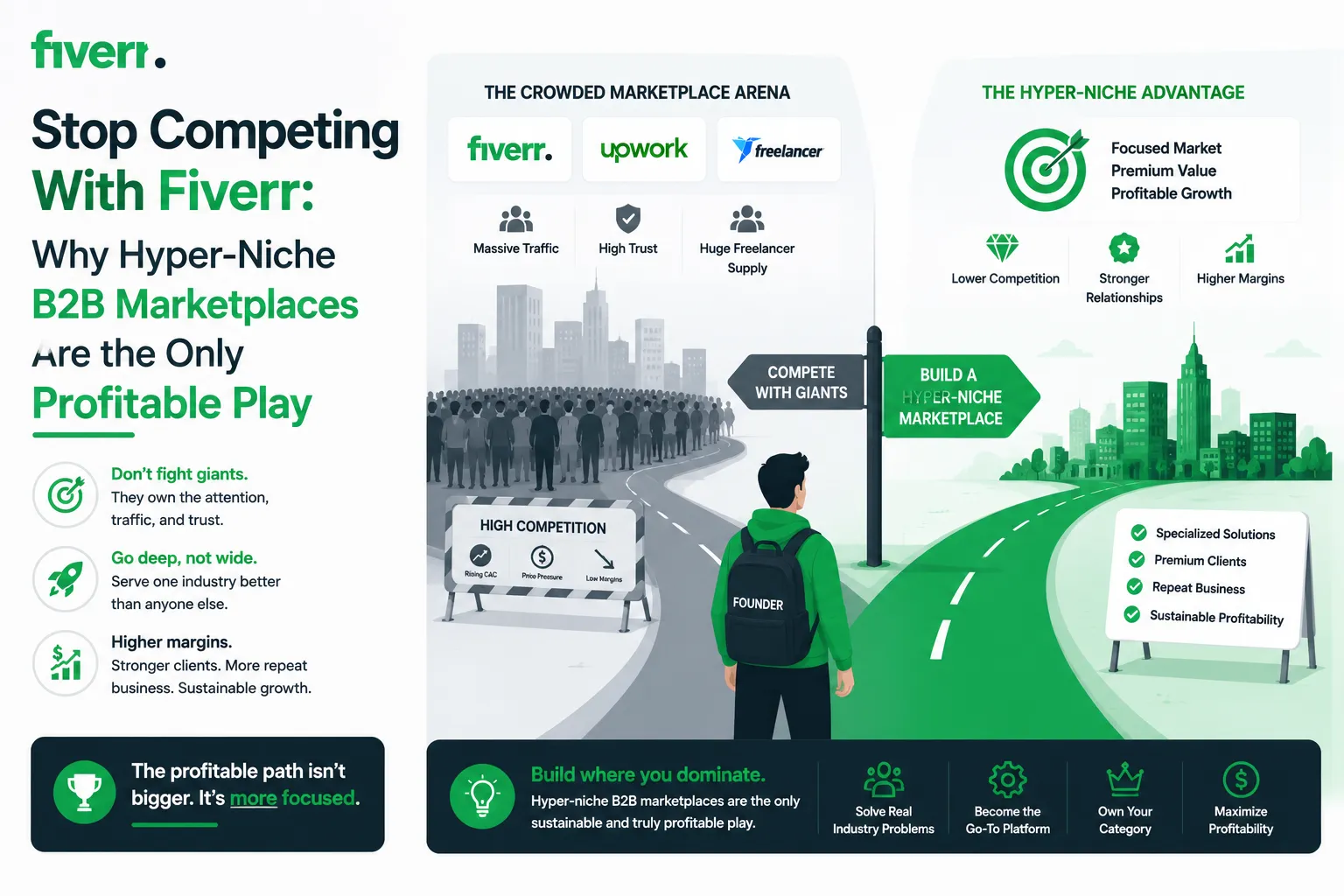
Key Takeaways
- Hyper-niche B2B marketplaces outperform broad marketplace strategies.
- Owning a specific supply niche creates stronger network effects.
- Focused platforms acquire vendors more efficiently.
- Industry specialization improves customer retention.
- Targeted marketplaces scale with lower acquisition costs.
Marketplace Signals
- Focus on one industry before expanding categories.
- Build vendor onboarding for niche business needs.
- Use industry-specific search and filtering tools.
- Support customized pricing and quotation workflows.
- Track supply quality with marketplace analytics.
Real Insights
- Broad marketplaces face intense competition.
- Niche dominance creates stronger competitive advantages.
- Industry expertise builds long-term buyer trust.
- Specialized platforms attract higher-quality vendors.
- Miracuves builds hyper-niche B2B marketplaces with scalable industry-specific workflows.
Most founders who say they want to build “the next Fiverr clone” are already walking into the wrong war. Not because freelance marketplaces are dead. They are not. The mistake is trying to build a generalist marketplace for design, writing, coding, marketing, admin work, and every possible digital service under one brand.
That battle is no longer a startup opportunity. It is a capital trap. Upwork, Fiverr, Freelancer, Total, and dozens of specialist platforms already own search visibility, buyer trust, freelancer supply, payment behavior, review histories, and category memory. A new founder trying to compete with them using another broad freelance platform is not building a differentiated business. They are renting attention in a market where the incumbents already control the demand curve.
The better play is sharper, smaller, and far more profitable. Build a hyper-niche B2B marketplace for expensive professional outcomes. Not “hire a logo designer for $50.” Think “hire a fractional CFO for a Series A SaaS company,” “find certified SAP architects,” “source AI governance consultants,” “book healthcare compliance auditors,” or “hire cybersecurity penetration testing experts for enterprise vendors.”
That is where the economics change. A generalist gig marketplace needs massive volume to survive. A high-ticket B2B marketplace can win with fewer transactions, stronger trust, better qualification, and meaningful commission revenue per deal.
Miracuves helps founders use a ready-made, white-label Upwork clone foundation to move faster in this direction: job posting, bidding, profiles, milestone payments, secure communication, admin control, and source-code ownership can become the operating layer for a gated professional marketplace instead of another generic Fiverr copy.
The Generalist Death Trap: You Cannot Outspend Upwork’s SEO
A general-purpose freelance marketplace sounds attractive because the market feels huge.
Designers, developers, writers, marketers, editors, virtual assistants, translators, consultants — everyone can join. That sounds like opportunity. In reality, it creates a positioning disaster.
When a platform serves everyone, it has to compete for everything.
That means fighting for keywords such as “hire freelancers,” “hire developers,” “hire designers,” “freelance writing jobs,” “logo design,” “WordPress developer,” and thousands of other search terms already dominated by mature platforms. Upwork publicly positions itself as a major freelance marketplace for hiring talent across many categories, and Fiverr’s marketplace also spans wide service categories.
A new marketplace cannot simply “do SEO” and expect to win. The incumbents have years of indexed pages, freelancer profiles, reviews, backlinks, buyer behavior data, brand recall, and conversion history.
The founder’s real problem is not software. It is demand concentration.
A generalist freelance marketplace must solve five expensive problems at once:
| Problem | Why It Hurts New Founders |
|---|---|
| Buyer acquisition | Broad keywords are expensive, competitive, and dominated by incumbents. |
| Freelancer supply | Generalist freelancers already have profiles, reviews, and earnings history elsewhere. |
| Trust creation | Buyers hesitate to transact on a new marketplace without proven talent quality. |
| Category liquidity | Every category needs both demand and supply, or the platform feels empty. |
| Price pressure | Generic gig platforms train buyers to compare providers mainly by price. |
This is the generalist death trap.
The founder thinks they are building a large marketplace. What they are really building is a marketplace that needs enormous capital before it can feel useful.
Read more : Best Fiverr Clone Script in 2026: Features & Pricing Compared
The Smarter Bet: Own a Narrow Market Where Trust Matters More Than Traffic
The contrarian move is to stop asking, “How do we compete with Fiverr?”
The better question is, “Which expensive B2B service is too specialized, too risky, or too trust-heavy for a generic freelance marketplace to handle well?”
That question opens better categories.
Examples include:
- Fractional CFOs for funded startups
- Certified SAP architects
- Salesforce CPQ implementation consultants
- Healthcare compliance advisors
- Cybersecurity auditors
- AI governance consultants
- Legal operations specialists
- ESG reporting consultants
- M&A due diligence analysts
- RevOps consultants for B2B SaaS teams
These are not $50 gigs. They are business-critical decisions.
A founder hiring a fractional CFO is not looking for the cheapest freelancer. They are looking for credibility, domain proof, industry fit, availability, trust, and risk reduction. That kind of buyer does not need 40,000 profiles. They need 40 qualified experts.
This is where niche marketplaces become powerful.
They do not win by having more supply. They win by having better-filtered supply.
The Economics of the $15,000 Contract vs. the $50 Gig
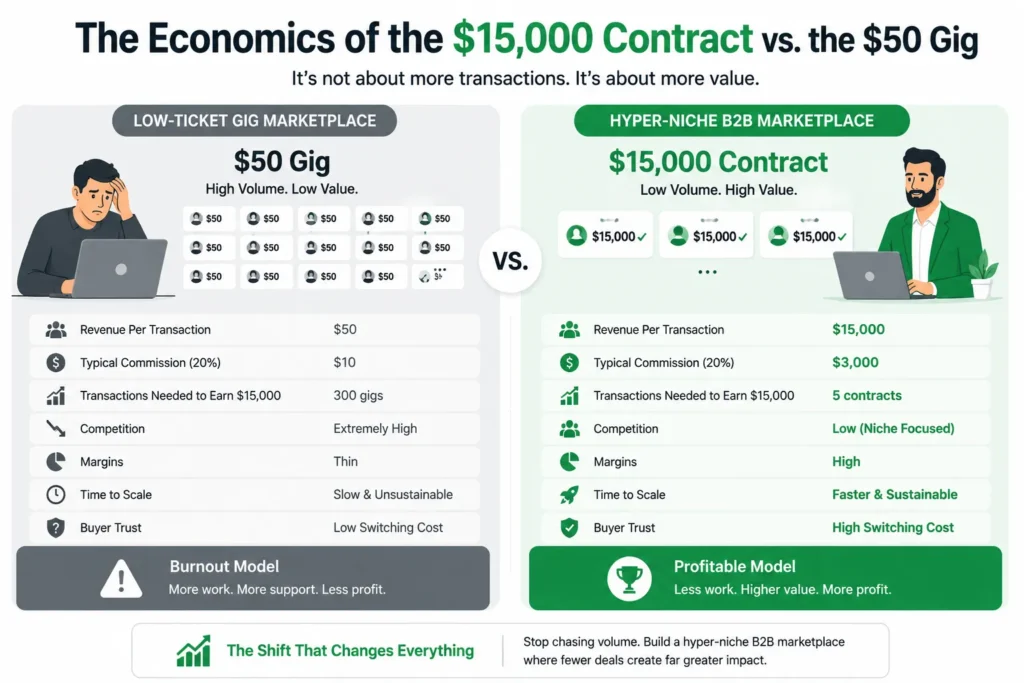
The user-supplied strategy for this blog uses a simple contrast: a $15,000 B2B contract versus a $50 gig. Treat those as strategic examples, not universal market averages.
The math explains why the niche model deserves more attention.
| Marketplace Model | Example Transaction | Commission at 10% | Transactions Needed for $15,000 Platform Revenue |
|---|---|---|---|
| Low-ticket gig marketplace | $50 | $5 | 3,000 transactions |
| Mid-ticket freelance project | $1,000 | $100 | 150 transactions |
| High-ticket B2B expert marketplace | $15,000 | $1,500 | 10 transactions |
A low-ticket gig platform needs huge transaction volume, constant buyer acquisition, heavy moderation, dispute management, review integrity, and payment operations.
A high-ticket B2B marketplace can create meaningful revenue from far fewer successful matches.
That changes the operating model.
The founder no longer needs to onboard every freelancer. They need to curate the right professionals. They no longer need millions of visitors. They need high-intent buyers in a specific industry. They no longer need to win broad SEO. They need to become the trusted hiring layer for one expensive problem.
That is a better use of founder capital.
Read more : Fiverr Clone Revenue Model: How Fiverr-Like Platforms Make Money in 2026
Why Hyper-Niche B2B Marketplaces Can Command Better Margins
A niche marketplace has one unfair advantage: it can look like it understands the buyer better than a generalist platform ever could.
A CFO marketplace can ask for fundraising stage, accounting stack, revenue model, board reporting needs, and investor reporting requirements.
A cybersecurity marketplace can filter experts by certifications, cloud environments, compliance frameworks, testing scope, and incident response experience.
A SAP architect marketplace can structure profiles around modules, implementation history, industry experience, languages, and project complexity.
Those details matter because B2B buyers do not just buy labor. They buy confidence.
A broad freelance marketplace organizes talent by skills. A niche B2B marketplace organizes talent by business risk.
Founder Decision Signals
Speed
If the market already has urgent B2B demand, a white-label marketplace foundation helps you launch faster instead of spending months building common marketplace modules from zero.
Cost
Founder capital should go into expert acquisition, buyer relationships, verification, and niche positioning — not rebuilding profiles, chat, job posting, payments, and admin workflows from scratch.
Scalability
A focused marketplace can scale category by category, starting with one high-value vertical before expanding into adjacent professional services.
Market Fit
If buyers already pay high contract values offline but struggle to find trusted providers, the marketplace has a stronger validation path than a broad gig platform.
Deploying a White-Label Marketplace for High-Ticket Professionals
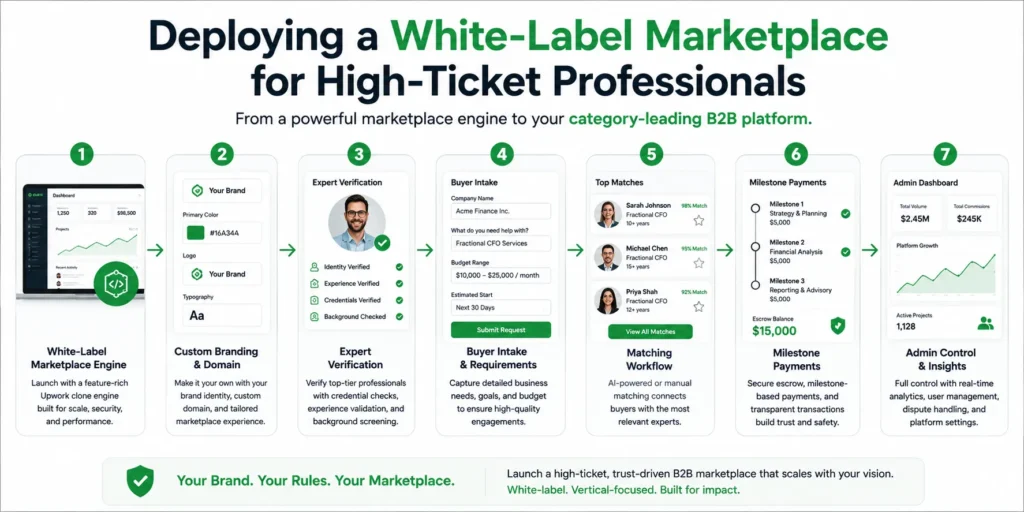
A white-label freelance marketplace is not valuable because it lets you copy Upwork.
It is valuable because it gives you the marketplace operating system: profiles, buyer accounts, expert accounts, job posting, proposals, messaging, payments, reviews, disputes, and admin control.
The founder’s job is to reshape that operating system around a specific vertical.
For example, a general Upwork-style platform may have categories such as writing, design, development, and marketing. A fractional CFO marketplace would need a very different structure:
| Marketplace Layer | General Freelance Platform | Fractional CFO Marketplace |
|---|---|---|
| Profile fields | Skills, hourly rate, portfolio | Funding stage, SaaS metrics, audit experience, board reporting, accounting stack |
| Buyer intake | Project title and budget | Revenue size, funding status, finance pain, reporting deadline |
| Matching logic | Skill and budget fit | Industry fit, company stage, financial complexity, availability |
| Verification | Email/profile review | Credential checks, references, prior finance leadership experience |
| Monetization | Commission on projects | Commission, subscription, retained search fee, premium vetting |
| Admin control | User/job/payment management | Expert approval, buyer qualification, dispute handling, contract monitoring |
Miracuves’ Upwork clone page highlights core marketplace features such as search, chat, reviews, job posting, bidding, milestone tracking, secure payment gateway workflows, user verification, admin management, and multiple monetization options. These are the base systems a founder can adapt for a vertical B2B marketplace.
The advantage is speed. You are not spending early capital asking developers to rebuild standard marketplace plumbing. You are spending it on the niche layer that actually creates differentiation.
What a High-Ticket B2B Marketplace Needs Beyond Basic Freelance Features
A generic Upwork clone is not enough by itself.
If the business is targeting expensive B2B contracts, the marketplace must feel more controlled, more curated, and more trustworthy than a gig platform.
Important modules include:
High-Ticket B2B Marketplace Features and Business Value
| Feature | Business Value | Founder Impact |
|---|---|---|
| Gated expert onboarding | Improves trust by preventing low-quality supply from flooding the marketplace. | Lets the founder position the platform as curated, not open-access. |
| Buyer qualification forms | Captures budget, urgency, company size, and project complexity before matching. | Reduces wasted proposals and improves close quality. |
| Milestone-based payments | Supports structured delivery for larger B2B projects. | Creates confidence for both buyers and professionals. |
| Admin approval workflows | Gives the platform operator control over experts, listings, disputes, and payments. | Prevents the marketplace from becoming a low-trust directory. |
| Premium search filters | Helps buyers find specialists by certification, industry, experience, location, or availability. | Makes the niche platform more useful than a broad marketplace search page. |
| Dispute management | Protects both sides when large contracts involve scope, timeline, or payment disagreements. | Strengthens marketplace trust and repeat usage. |
The Best Niches Are Painful, Expensive, and Poorly Served
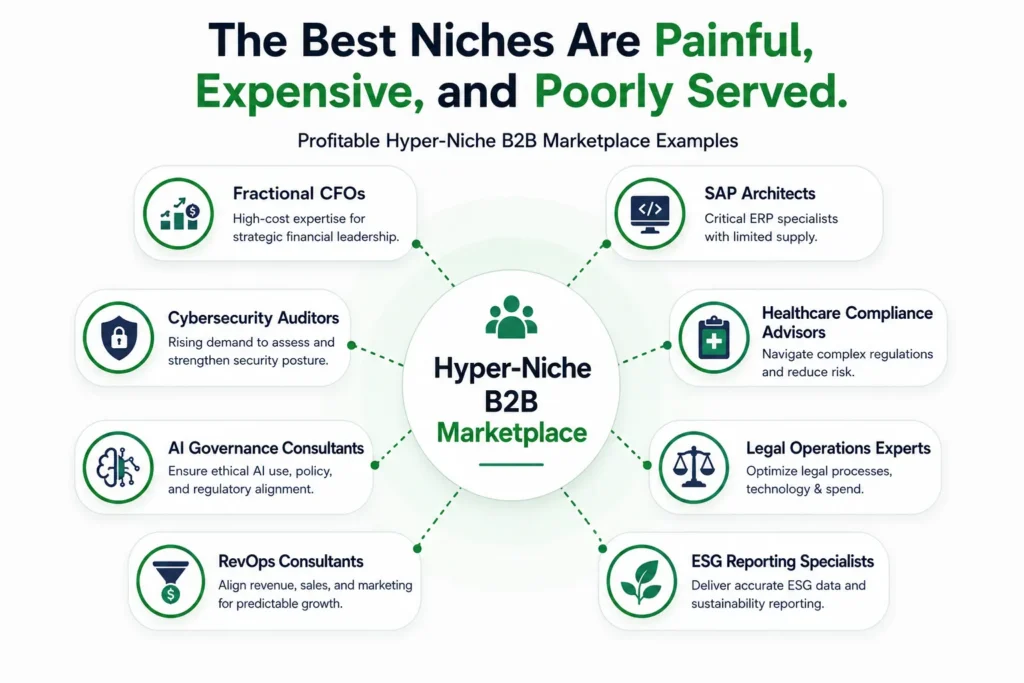
A niche is not attractive just because it is small.
It becomes attractive when the pain is urgent, the buyer has money, the provider quality is hard to judge, and the current discovery process is broken.
Good marketplace niches usually have at least four signals:
- High contract value: Buyers already spend meaningful money on the service.
- Difficult provider discovery: LinkedIn search, referrals, and agencies are inefficient.
- Trust matters: Credentials, reviews, references, and domain experience affect the buying decision.
- Repeat or adjacent demand: Buyers may return for audits, advisory, implementation, maintenance, or related services.
Weak niches are usually the opposite. They have low budgets, low urgency, easy substitution, and heavy competition from existing gig platforms.
A marketplace for “all freelance designers” is weak because buyers can already find thousands of options.
A marketplace for “healthcare UX designers with EHR workflow experience” is stronger because the buyer has a narrower, riskier, more expensive problem.
Revenue Models That Fit High-Ticket B2B Marketplaces
The general freelance marketplace usually depends on transaction commissions. That still works, but high-ticket verticals create more monetization options.
| Revenue Model | How It Works | Best Fit |
|---|---|---|
| Transaction commission | Platform takes a percentage from completed contracts. | Most professional services marketplaces |
| Buyer subscription | Companies pay monthly or annually for access to vetted experts. | Enterprise hiring, consulting, and advisory networks |
| Expert membership | Professionals pay for verified placement or premium visibility. | Curated expert directories with strong buyer demand |
| Success fee | Platform earns when a contract is closed. | High-ticket consulting or fractional leadership |
| Featured expert listings | Experts pay for priority visibility in specific categories. | Competitive niches with many qualified providers |
| Managed matching fee | Platform charges for concierge matching or shortlist creation. | Complex B2B buying decisions |
| Certification or verification fee | Experts pay for credential review, assessment, or badge approval. | Trust-heavy verticals |
The founder does not need all of these on day one.
The best early model is usually simple: commission, subscription, or managed matching. Complexity can come later.
Why Source-Code Ownership Matters in a Vertical Marketplace
A hyper-niche marketplace will evolve differently from a general freelance platform.
The intake forms may change. The expert verification process may become deeper. The admin team may need new approval layers. Payment flows may require milestone structures. The search system may need industry-specific filters. The dashboard may need reporting for enterprise buyers.
That is why source-code ownership matters.
If the founder is locked into a rigid SaaS marketplace builder, vertical differentiation becomes difficult. They can change branding, but not the deeper workflows that make the marketplace valuable.
A source-code-owned marketplace foundation gives the founder more control over:
- Custom onboarding flows
- Industry-specific profile fields
- Buyer qualification forms
- Commission logic
- Verification layers
- Admin permissions
- Reporting dashboards
- Payment and milestone workflows
- Future integrations
- Market-specific compliance workflows
Miracuves positions its ready-made marketplace solutions around white-label branding, source code, admin control, and faster deployment. For niche B2B founders, that control is not a technical luxury. It is the product strategy.
Security, Verification, and Trust Are the Real Product
In a $50 gig marketplace, the buyer may tolerate some risk.
In a $15,000 professional services marketplace, risk becomes the product.
That means the platform must support trust infrastructure from the beginning:
- Expert verification
- Business profile approval
- Secure payment gateway integration
- Milestone-based payment control
- Dispute workflows
- Role-based admin access
- Activity logs
- Review moderation
- Abuse reporting
- Document and credential checks where relevant
- Permission-based dashboards
The goal is not to claim legal or compliance approval. The goal is to give the platform operator a compliance-ready foundation that supports better operational control.
For regulated or sensitive verticals such as healthcare, finance, cybersecurity, or legal services, final compliance depends on jurisdiction, legal review, integrations, and the operating model.
Mistakes Founders Should Avoid
Building a broad freelance marketplace with no wedge
If your platform targets designers, writers, developers, marketers, and consultants all at once, you are competing directly with platforms that already have stronger supply, demand, SEO, reviews, and buyer trust.
Thinking software alone creates liquidity
A marketplace does not become valuable because it has job posting and chat. It becomes valuable when the right buyers and providers repeatedly transact around a painful problem.
Ignoring verification
High-ticket B2B buyers need confidence. If expert quality is not controlled, the marketplace becomes another noisy directory.
Choosing low-ticket niches
Low-ticket categories force the founder into high transaction volume, high support burden, and thin platform revenue.
The Miracuves Perspective: Do Not Clone the Category, Clone the Engine
The phrase “Upwork clone” can mislead founders.
The smart founder is not trying to copy Upwork’s market. They are borrowing the engine: profiles, jobs, proposals, matching, milestones, communication, payments, reviews, and admin control.
The category must be different.
A Miracuves Upwork clone foundation can support founders who want to launch a white-label freelance marketplace with faster deployment, custom branding, source code, and marketplace control. But the highest ROI use case is not another general freelancer site. It is a gated B2B vertical where every successful transaction is worth more.
That is the founder move: stop competing for cheap gigs and start owning expensive trust.
Final Thoughts: The Money Is Not in Another Fiverr
The next profitable freelance marketplace will not look like a broad, chaotic gig bazaar.
It will look smaller. More curated. More expensive. More trusted.
Founders should stop chasing generalist traffic and start designing marketplaces around painful B2B buying decisions. A marketplace for certified enterprise specialists, fractional executives, compliance experts, or high-value consultants does not need millions of low-intent visitors. It needs qualified buyers, verified supply, controlled workflows, and a monetization model that rewards successful outcomes.
The real opportunity is not to compete with Fiverr. It is to build the marketplace Fiverr is too broad to become. contact us .
FAQs
1. Is it still profitable to build a freelance marketplace in 2026?
Yes, but the strongest opportunity is usually not a broad freelance marketplace. Generalist platforms are extremely competitive. A hyper-niche B2B marketplace can be more profitable because it focuses on high-value transactions, verified experts, and a specific buyer problem.
2. Why should founders avoid building another Fiverr competitor?
A direct Fiverr competitor must fight for broad traffic, low-cost gig buyers, freelancer supply, reviews, trust, and category liquidity. That requires significant capital. A niche B2B marketplace can focus on fewer but higher-value transactions.
3. What is a hyper-niche B2B marketplace?
A hyper-niche B2B marketplace connects businesses with specialized professionals in a narrow category. Examples include fractional CFOs, SAP consultants, cybersecurity auditors, healthcare compliance experts, or AI governance advisors.
4. How can an Upwork clone be used for a niche marketplace?
An Upwork clone provides the core marketplace engine: job posting, profiles, proposals, chat, payments, reviews, milestone workflows, and admin controls. Founders can customize that foundation around a specific B2B niche instead of launching a general freelance platform.
5. What revenue model works best for high-ticket B2B marketplaces?
Common revenue models include transaction commission, buyer subscriptions, expert memberships, success fees, managed matching fees, and premium listings. The right model depends on contract size, buyer urgency, and expert supply quality.
6. Does a niche marketplace need thousands of freelancers?
No. A high-ticket B2B marketplace often works better with a smaller, carefully verified expert pool. Buyers in these categories usually care more about credibility and fit than large numbers of providers.
7. Why does source-code ownership matter for a B2B marketplace?
Source-code ownership gives founders more flexibility to customize workflows, verification, search filters, payment logic, dashboards, and integrations. This matters because niche marketplaces often need industry-specific workflows.
8. Can Miracuves help build a white-label freelance marketplace?
Yes. Miracuves offers a white-label Upwork clone solution with marketplace workflows such as profiles, bidding, messaging, payments, milestone tracking, admin control, rebranding, and source code.
Miracuves is an independent software development company. We are not affiliated with, connected to, sponsored by, or endorsed by any company or product named in this article.
Terms such as “X Clone” are used descriptively. It is how the software industry refers to building a platform with functionality comparable to a known service, and how clients search for it.
The entire design and codebase of our products is built by our own team. Our products contain no code, design, graphics, or content originating from any third-party website or applications.
All third-party names and marks referenced in this article are the property of their respective owners, referenced solely to identify the services discussed.