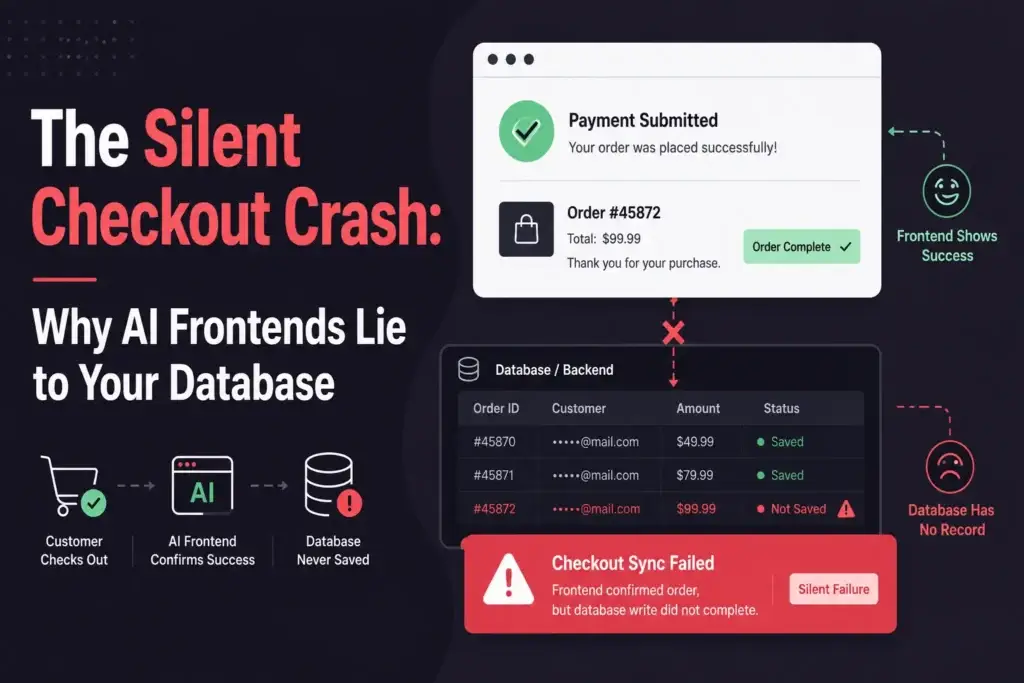



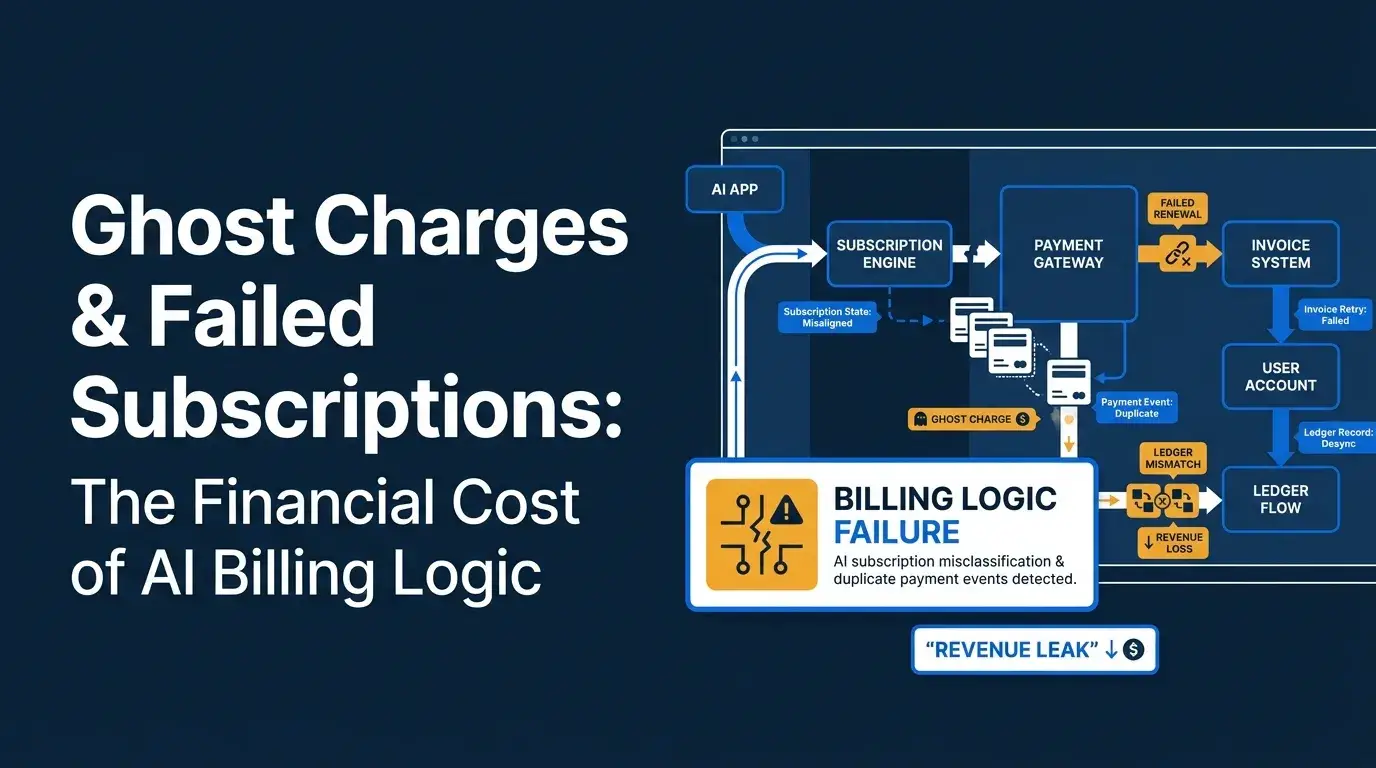
Key Takeaways
- Weak SaaS billing logic can cause failed subscriptions, ghost charges, unpaid access, and revenue leakage.
- Founders, users, admins, payment teams, and backend systems need reliable subscription workflows.
- Subscription states, invoices, renewals, failed payments, webhooks, and entitlement updates are core billing layers.
- Billing risk depends on payment gateway handling, database updates, retry logic, and access-control accuracy.
- A strong SaaS billing engine helps protect recurring revenue, user trust, and product access after launch.
Billing Signals
- Users need clear plan status, renewal dates, payment history, failed-payment alerts, and cancellation control.
- Founders need billing logs, subscription reports, retry handling, revenue visibility, and churn tracking.
- Admins need control over users, plans, invoices, refunds, credits, access status, and billing disputes.
- Backend systems should sync payment events with subscription access, usage limits, credits, and account permissions.
- Real-time alerts help detect failed renewals, duplicate charges, unpaid premium access, webhook errors, and revenue mismatches.
Real Insights
- A payment gateway can charge correctly while the SaaS app still shows the wrong subscription status.
- Poor billing logic can create support tickets, chargebacks, failed renewals, and angry users.
- Webhook verification, idempotency, retry queues, and audit logs help prevent duplicate or missing billing updates.
- Founders should test trial expiry, upgrades, downgrades, renewals, cancellations, refunds, and failed payments before launch.
- Miracuves builds SaaS apps with secure subscription billing, webhook handling, payment reconciliation, entitlement control, and admin workflows.
SaaS founders usually discover broken billing logic at the worst possible time.
A customer gets charged after canceling. Another user loses access even though payment succeeded. A team account downgrades incorrectly. A trial converts twice. A failed invoice never triggers a retry. The founder opens Stripe, checks the app database, reviews the admin panel, and realizes the numbers do not agree.
That is the moment a “small billing bug” becomes a financial control problem.
In an AI-generated MVP, billing logic can look functional during demos because one-time payments are easy to test. The real risk appears later, when subscriptions renew, invoices fail, webhooks arrive out of order, cron jobs miss their schedule, and entitlement rules decide who should or should not access the product.
This blog breaks down the real cost of ghost charges and failed subscriptions, why AI billing logic often breaks around server-side recurring workflows, and why founders should treat subscription management as core infrastructure. With Miracuves SaaS development, that foundation can be planned from the start instead of patched after customers lose trust.
The Subscription Breakdown: When AI Forgets to Bill or Bills Twice
A subscription business depends on a simple promise: the customer is charged correctly, access is updated correctly, and the founder can trust the numbers.
Broken billing logic breaks that promise.
A ghost charge happens when a customer sees a charge they did not expect. It may be a charge after cancellation, a duplicate renewal, a failed downgrade, a trial conversion that was not communicated clearly, or a usage charge that does not match what the product displayed. A failed subscription is the opposite failure: the customer should have been billed, but the backend missed the renewal, did not process the retry, or failed to update the subscription state.
Both problems damage the business.
Stripe’s subscription documentation shows that subscriptions can move through states such as past_due, canceled, and unpaid, with different consequences for invoices, retries, and product access. When the latest finalized invoice fails or is not attempted, the subscription may continue creating invoices, and the business must decide what happens next through its billing settings.
That is why billing is not just a payment gateway integration. It is a state machine.
For SaaS founders, the risk is not only that money moves incorrectly. The risk is that the product, payment provider, database, admin dashboard, and customer experience disagree with each other.
Read More: Stripe Payments Not Reconciling? Fix the Webhook Desync Breaking Your AI App Revenue
Why Recurring Billing Is Harder Than a Checkout Button
A checkout button answers one question: can this customer pay right now?
A subscription engine answers many questions repeatedly:
| Billing Question | Why It Matters |
|---|---|
| Is the user on a free trial, active plan, grace period, paused plan, canceled plan, or unpaid state? | Determines access and messaging. |
| Did the latest payment succeed, fail, or require customer action? | Determines whether to grant access, retry, or request payment method updates. |
| Did the user upgrade, downgrade, add seats, remove seats, or apply a coupon mid-cycle? | Determines proration and invoice accuracy. |
| Did the billing provider send a webhook once, twice, late, or out of order? | Determines whether the app updates the right state safely. |
| Did the scheduled billing job run exactly once? | Determines whether users are billed correctly. |
| Does the admin dashboard show the same truth as Stripe or the payment provider? | Determines whether support and finance teams can act confidently. |
Subscription management platforms exist because recurring revenue involves the full customer lifecycle: signup, billing, renewals, upgrades, downgrades, payment recovery, cancellation, and reporting. Chargebee describes subscription management as the system that handles the customer lifecycle across billing, payment recovery, pricing changes, and metrics such as MRR, churn, and lifetime value.
That lifecycle is where AI-generated MVPs often struggle.
An LLM can generate a Stripe checkout snippet. It can scaffold a subscription table. It can produce a cron expression that appears correct. But recurring billing is not a single snippet. It is a coordination problem across time, state, failures, retries, and customer trust.
Read More: What 70%+ of AI-Built Apps Get Wrong About Security — And Why Users Can See Each Other’s Data
The Cron Job Failure Variable Founders Usually Discover Too Late

The most dangerous billing bug is not always visible on launch day.
It may be hidden inside the cron job.
A cron job is a scheduled backend task. In subscription billing, it may be used to check renewals, sync invoice states, process usage, update expired trials, reconcile failed payments, or suspend unpaid accounts. When it works, founders barely notice it. When it fails, the business can quietly lose money or trigger angry support tickets.
The cron job failure variable usually appears in five ways:
- The job never runs. Trials do not convert, expired subscriptions remain active, or failed invoices are never checked.
- The job runs twice. Customers may receive duplicate invoices, duplicate emails, or duplicate access updates.
- The job runs at the wrong time. Timezones, daylight saving changes, and delayed queues create mismatched billing cycles.
- The job conflicts with webhooks. A webhook updates the subscription, then the cron job overwrites it with stale database state.
- The job has no idempotency. Retrying the same operation creates a new financial action instead of safely recognizing that the action was already processed.
Stripe’s revenue recovery documentation shows how failed subscription payments require webhook handling, retry schedules, attempt counts, and different behavior for hard decline codes. Stripe also recommends using webhooks for subscription events and configuring recovery actions when payments fail.
That matters because billing workflows are event-driven. A stable subscription engine needs to know what already happened, what should happen next, and what should never happen twice.
AI-generated code often fails here because the prompt is usually written as a happy-path request:
“Create recurring billing for my SaaS app.”
The output may create a subscription. It may save a payment status. It may even add a scheduled job. But unless the founder forces the logic to handle retries, idempotency, race conditions, webhook verification, subscription state transitions, cancellation timing, and reconciliation, the product may launch with billing debt hidden inside the backend.
Read More: How an AI-Built MVP Leaked PII and Why the White-Label Rescue Worked
Calculating the Cost of Chargebacks and Lost Trust
A refund is a transaction.
A chargeback is a trust event.
When a customer disputes a charge, the founder is not only dealing with the original payment. They may also face payment processor fees, manual support time, finance review, account reputation issues, and future conversion loss because public complaints create doubt.
Here is the practical cost model founders should use:
| Cost Layer | What Happens | Founder Impact |
| Direct refund cost | The business returns the payment. | Revenue is reversed. |
| Chargeback cost | The customer disputes the transaction through their bank or card provider. | Additional fees and processor scrutiny may apply depending on provider and region. |
| Support time | Agents or founders manually inspect invoices, logs, and user history. | High-value team time shifts from growth to cleanup. |
| Engineering time | Developers patch billing logic, reconcile records, and inspect webhook failures. | Roadmap slows down. |
| Finance confusion | MRR, churn, refunds, and unpaid invoices become unreliable. | Investor reporting and forecasting become weaker. |
| Customer trust loss | Users believe the product is financially unsafe. | Retention and referrals decline. |
| Payment risk | Too many disputes can affect payment processor confidence. | Future payment operations become harder. |
This is why the real cost of broken AI billing logic is not limited to the failed invoice.
It hits revenue, operations, support, product confidence, and brand trust at the same time.
Flexprice’s subscription management guide describes missed renewals, messy prorations, and billing issues as causes of churn, revenue leakage, and frustrated conversations between product, finance, and customer success. That is exactly what founders feel when ghost charges start appearing: every department suddenly becomes part of the billing team.
Read More: The Authentication Loop: Analyzing Session Failures in AI-Generated MVPs
Where AI-Generated MVP Billing Logic Breaks in Production
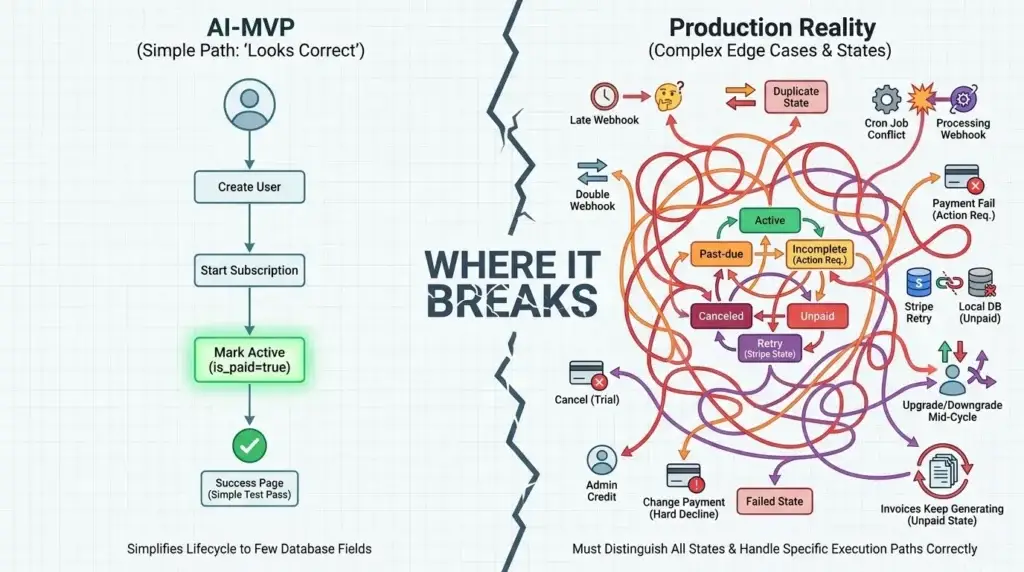
AI-generated MVPs are useful for speed, but billing is a dangerous place to rely on “looks correct” code.
Research on LLM code generation shows that models can struggle with more complex problems and may generate code that is shorter yet more complicated than canonical solutions. The same study also found distinct bug patterns in real-world project benchmarks compared with standard coding benchmarks.
Another survey on code generation hallucinations notes that LLM-generated code can include incorrect or unjustifiable outputs that are difficult to identify, especially when the issue appears only under specific execution paths.
Billing bugs often appear exactly that way.
The code may pass a simple test:
- Create user
- Start subscription
- Mark user active
- Show success page
But production billing requires edge-case tests:
- Payment succeeds but webhook arrives late
- Payment fails and requires customer action
- User cancels during trial
- User upgrades mid-cycle
- User downgrades after renewal
- Admin grants a manual credit
- Stripe retries payment but local database still says unpaid
- Webhook is delivered twice
- Cron job runs while the webhook is still processing
- Customer changes payment method after a hard decline
- Subscription is unpaid but invoices keep generating
Stripe’s subscription states and retry behavior show why a single boolean such as is_paid = true is not enough for real SaaS billing. The product must distinguish active, incomplete, past-due, unpaid, canceled, and retry states correctly.
AI-generated MVP billing logic breaks when it simplifies this lifecycle into a few database fields.
Read More: AI MVP Security Audit: The 14-Point Checklist for Founder Survival
The Manual Reconciliation Trap
Once billing logic breaks, many founders try to solve the problem manually.
They open Stripe. They export invoices. They check user records. They update a few subscription states. They issue refunds. They message customers. They ask the developer to “just fix the cron job.”
That may work for ten customers.
It does not work for a subscription business.
Manual reconciliation creates three problems.
First, it consumes founder and engineering time. Every hour spent matching invoices against database records is an hour not spent on retention, sales, onboarding, product improvement, or fundraising.
Second, it creates inconsistent fixes. One customer gets refunded. Another gets account credit. Another keeps access for free. Another is suspended by mistake. The business starts operating through exceptions instead of rules.
Third, it hides the real architecture problem. If the billing engine has no reliable subscription lifecycle, admin control, audit trail, retry logic, or reconciliation dashboard, manual repair only delays the next failure.
A 2025 paper on SaaS pricing systems describes modern SaaS pricing models as increasingly complex, with features, usage limits, plans, and add-ons growing from tens to thousands of configuration options. It states that manual management can become time-consuming, error-prone, and ultimately unsustainable.
That is the exact reason founders should not treat subscription logic as a spreadsheet problem.
What a Reliable SaaS Subscription Engine Should Include
A reliable SaaS subscription engine is not only about charging a card. It controls the relationship between billing, access, user roles, admin decisions, support workflows, and financial reporting.
Reliable SaaS Billing Features and Business Value
| Feature | Business Value | Founder Impact |
|---|---|---|
| Subscription state management | Tracks active, trialing, past-due, unpaid, canceled, and paused states correctly. | Prevents incorrect access and confusing customer experiences. |
| Webhook handling | Updates the app when payments succeed, fail, require action, or change state. | Reduces mismatch between payment provider and product database. |
| Idempotent billing actions | Prevents duplicate processing when events or jobs run more than once. | Reduces ghost charges and duplicate account updates. |
| Retry and dunning workflows | Handles failed payments through structured retries and customer notifications. | Recovers revenue without immediately losing customers. |
| Entitlement control | Connects plan status to product access, seats, limits, and premium features. | Protects revenue by making sure users get exactly what they paid for. |
| Admin dashboard | Gives operators visibility into users, invoices, payment status, subscriptions, and disputes. | Reduces support chaos and improves operational control. |
| Audit logs | Records subscription changes, admin actions, and payment events. | Helps founders investigate disputes and prevent repeated mistakes. |
| Reconciliation reports | Compares provider data, invoices, local records, and access state. | Improves financial confidence and investor-ready reporting. |
Founder Decision Signals: When Billing Logic Is Too Risky to Patch
Speed
If your team is spending more time fixing invoices than improving the product, billing logic has become a launch blocker.
Cost
If refunds, chargebacks, manual reconciliation, and support tickets are increasing, the cheaper AI-generated route may already be more expensive than a robust foundation.
Scalability
If your subscription logic cannot handle retries, webhooks, upgrades, downgrades, and role-based access safely, growth will multiply the error rate.
Market Fit
If users like the product but complain about billing, the problem may not be demand. It may be infrastructure trust.
Deploying Battle-Tested SaaS Billing via Miracuves Clones
The financially responsible choice is not always to rebuild billing from scratch.
For many SaaS and marketplace founders, the better move is to start from a proven app foundation that already understands subscription billing, user roles, admin control, payment gateway configuration, and source-code ownership.
Miracuves’ SaaS development page positions its SaaS platforms around subscription SaaS clones with user apps, admin dashboards, Stripe billing, role-based access, source-code ownership, and deployment timelines in the 3–9 day range depending on scope. The same page also describes SaaS clones with billing hooks, seat licensing, admin consoles, usage-based billing, enterprise contracts, marketplace take rates, and tenant admin controls for seat management, usage meters, billing self-service, and custom domain configuration.
For a founder dealing with ghost charges, that matters because the real problem is not just “billing code.”
The real problem is missing product infrastructure:
- subscription plans
- account roles
- user and team access
- payment gateway configuration
- admin control
- invoice visibility
- usage limits
- retry logic
- support workflows
- audit logs
- source-code access
- deployment ownership
A ready-made SaaS clone from Miracuves gives founders a stronger starting point than an AI-generated billing patch because the business does not have to rediscover every recurring billing edge case manually. Miracuves’ broader software development page also emphasizes production-grade web and mobile applications, cloud-native architecture, and source-code ownership from day one.
That is the core financial argument.
If the business depends on recurring revenue, billing reliability is not a back-office detail. It is part of the product.
Read More: How to Start App Development When You Are Not Technical
White-Label SaaS Billing vs AI-Generated MVP Billing
| Decision Factor | AI-Generated MVP Billing | Miracuves White-Label SaaS Foundation |
| Setup speed | Fast for demos and simple flows. | Fast for launch-ready SaaS workflows based on pre-built foundations. |
| Subscription depth | Often limited to happy-path checkout and basic database updates. | Built around subscription hooks, admin controls, user roles, and configurable billing workflows. |
| Error handling | Depends heavily on prompt quality and developer review. | Designed around repeatable product flows and tested implementation patterns. |
| Admin visibility | Often missing or shallow. | Admin dashboards are part of the operating layer. |
| Source-code control | Depends on builder, tool, and development setup. | Miracuves positions source-code ownership as a core part of delivery. |
| Reconciliation | Often manual after problems appear. | Can be planned into the admin and reporting layer. |
| Best for | Prototype exploration and early technical experiments. | Founders who need a monetization-ready SaaS or marketplace platform with stronger control. |
Miracuves’ white-label vs custom development guidance notes that white-label solutions can reduce decision drag because the product foundation already includes common workflows, while custom builds require founders to define every backend function, dashboard screen, edge case, and integration from zero.
That distinction is important for billing.
A founder should not spend the first three months of a SaaS launch discovering what a subscription engine should have included from day one.
Read More: White-Label Solutions vs Custom Development: How to Choose the Smarter Path
Mistakes Founders Should Avoid When Fixing Billing Failures
Treating Ghost Charges as Only Refund Issues
A refund may calm one customer, but it does not fix the billing state machine. Founders need to identify whether the root cause is webhook handling, cron scheduling, cancellation timing, entitlement logic, or database reconciliation.
Letting Cron Jobs Control Money Without Safeguards
Any scheduled billing job should be idempotent, logged, monitored, and protected from duplicate execution. A billing cron job should never create a financial action that cannot be safely retried.
Using One Boolean Field for Subscription Access
Real subscriptions include trialing, active, past-due, unpaid, canceled, paused, and failed-payment states. Reducing access to one field creates confusion when payments fail or customers change plans.
Ignoring Admin Dashboard Depth
If support and finance teams cannot see invoice status, payment state, plan history, admin notes, and audit logs, every billing complaint becomes a manual investigation.
Scaling Before Reconciliation Works
Growth multiplies billing errors. Before increasing acquisition, founders should confirm that subscription records, payment provider data, product access, and reporting dashboards match.
The Financially Responsible Path for SaaS Founders
The panic around ghost charges is not irrational.
Customers are trusting the product with money. When the billing experience feels unpredictable, they do not separate the payment bug from the brand. They assume the business is careless.
That is why SaaS founders should treat billing logic with the same seriousness as authentication, data security, and core product reliability.
The financially responsible path is:
- Map every subscription state.
- Confirm how payment provider events update the app.
- Make webhook handlers idempotent.
- Monitor cron jobs and scheduled billing tasks.
- Build admin visibility before scale.
- Test upgrades, downgrades, cancellations, failed payments, and retries.
- Avoid manual reconciliation as the long-term operating model.
- Use a proven SaaS foundation when speed and billing reliability both matter.
Miracuves helps founders move faster with ready-made and white-label SaaS platforms that can include subscription workflows, payment gateway configuration, admin dashboards, role-based access, and source-code ownership. For SaaS founders already dealing with angry customers and chargebacks, that foundation can be more financially responsible than continuing to patch fragile AI-generated billing logic.
Final Thoughts: Billing Logic Is Revenue Infrastructure
The real cost of AI billing logic is not the code.
It is the uncertainty.
Can the founder trust the MRR number? Can customers trust cancellations? Can support explain a failed renewal? Can finance reconcile invoices without a spreadsheet marathon? Can the product scale without multiplying ghost charges?
Recurring billing is not a feature to improvise. It is revenue infrastructure.
For early SaaS founders, AI-generated MVPs can be useful for validating interface ideas, workflows, and early product assumptions. But when the business model depends on subscriptions, renewals, retries, and access control, the safer decision is to use a billing foundation that has already been built for real operating conditions.
Miracuves gives founders a faster way to move from fragile billing experiments to monetization-ready SaaS platforms with admin control, source-code ownership, and subscription logic designed for growth.
FAQs
What are ghost charges in SaaS billing?
Ghost charges are unexpected or incorrect charges that appear on a customer’s account. They may happen after cancellation, during failed downgrades, after duplicate renewals, or when subscription logic does not match the customer’s actual plan status.
Why does AI-generated billing logic fail in SaaS products?
AI-generated billing logic often focuses on happy-path code. Real SaaS billing requires webhooks, retries, subscription states, cron jobs, idempotency, failed payment handling, access control, and reconciliation. These edge cases are easy to miss without strong technical review.
What is a cron job failure in recurring billing?
A cron job failure happens when a scheduled backend billing task does not run, runs at the wrong time, runs more than once, or conflicts with another billing event. In SaaS apps, this can cause missed renewals, duplicate invoices, incorrect suspensions, or ghost charges.
How do failed subscriptions affect SaaS revenue?
Failed subscriptions can create involuntary churn, lost renewals, manual support work, inaccurate MRR, customer complaints, and chargebacks. The financial damage is larger when the founder cannot quickly reconcile payment provider data with product access.
Can Stripe alone prevent billing logic failures?
Stripe provides powerful billing, subscription, webhook, and retry tools, but the SaaS product still needs to handle events correctly, update access safely, maintain accurate database records, and provide admin visibility. The payment provider is only one part of the subscription architecture.
What should a SaaS subscription engine include?
A SaaS subscription engine should include plan management, recurring billing, payment failure handling, webhook processing, retry logic, entitlement control, admin dashboards, audit logs, reconciliation reports, and support workflows.
Is a white-label SaaS clone better than building billing from scratch?
A white-label SaaS clone can be better when the founder needs faster launch, proven subscription workflows, admin control, and reduced early development risk. A fully custom build may be better when the product requires highly unique billing logic or proprietary infrastructure.
How does Miracuves help with SaaS billing and subscription platforms?
Miracuves helps founders launch ready-made and white-label SaaS platforms with subscription billing hooks, admin dashboards, role-based access, payment gateway configuration, source-code ownership, and faster deployment depending on project scope.