


Key Takeaways
- B2B SaaS architecture must satisfy enterprise IT teams before procurement, onboarding, and contract approval.
- Founders, CTOs, admins, enterprise buyers, and security reviewers need proof of access control and data protection.
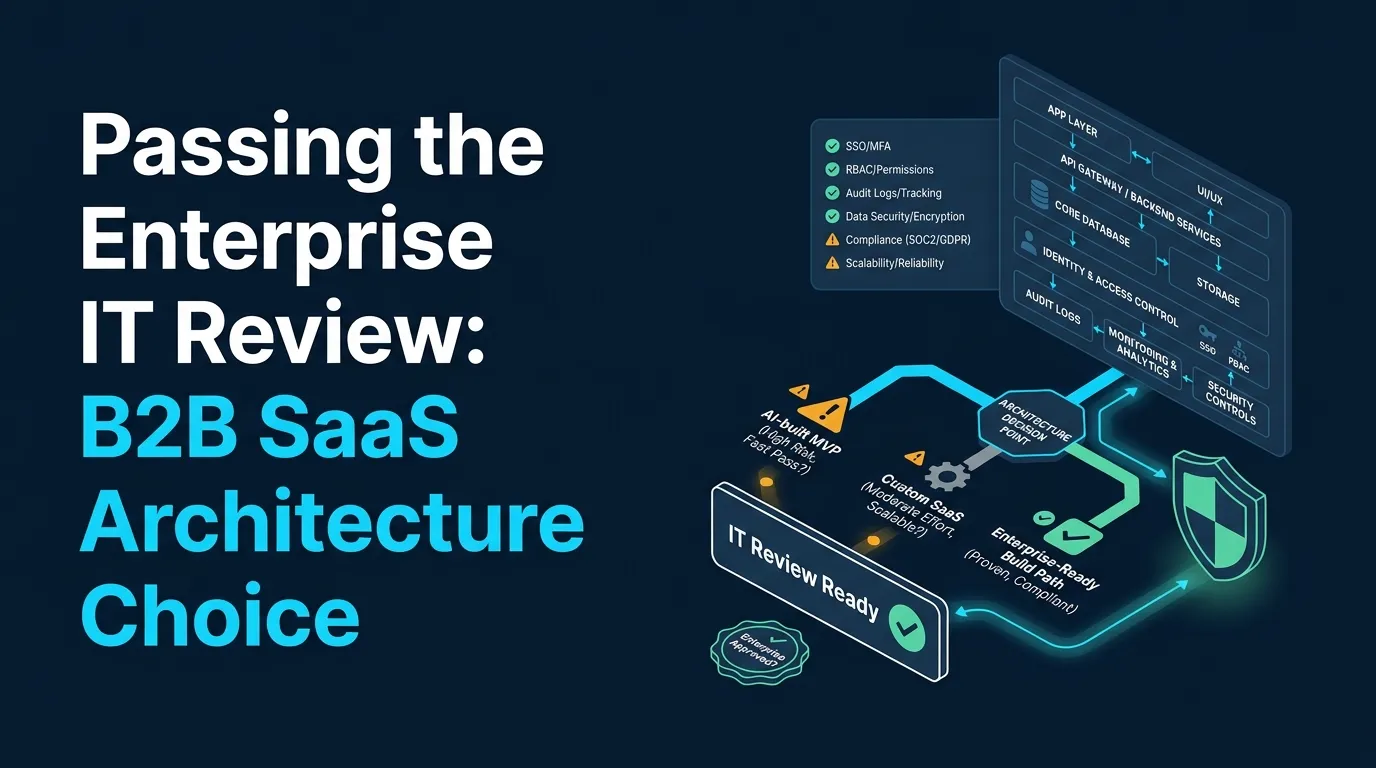
- RBAC, multi-tenancy isolation, API audit trails, secure authentication, and admin visibility are core enterprise layers.
- Architecture risk depends on customer data separation, permission logic, integration security, logging, and compliance readiness.
- A strong SaaS foundation helps founders pass enterprise reviews faster and reduce technical objections during sales.
Enterprise Signals
- Enterprise buyers need clear evidence of data isolation, role permissions, audit logs, API controls, and security policies.
- Admins need control over users, teams, roles, access levels, activity logs, integrations, and account settings.
- Developers need secure APIs, tenant-aware database design, permission checks, documentation, and scalable backend logic.
- Multi-tenancy should prevent one customer from accessing another customer’s records, reports, files, or configuration.
- Audit trails help enterprise teams review login activity, API usage, permission changes, admin actions, and data access history.
Real Insights
- Enterprise IT teams do not approve SaaS products only because the interface looks professional.
- Weak tenant isolation, unclear permissions, and missing audit logs can delay procurement or block large B2B contracts.
- A SaaS product should prove who can access what, when actions happened, and how customer data stays separated.
- Founders should prepare architecture evidence before selling to banks, healthcare groups, universities, and Fortune 500 buyers.
- Miracuves builds B2B SaaS platforms with RBAC, multi-tenancy isolation, API audit trails, secure integrations, scalable architecture, and admin control.
Enterprise SaaS founders often think the biggest challenge is getting a large company interested.
That is only the first gate.
The real test begins when the buyer brings in IT, security, procurement, compliance, legal, and data governance teams. At that point, the conversation changes from product value to architecture evidence. Your demo may impress the business sponsor, but your system still needs to answer harder questions.
Who can access what?
How is customer data separated?
Can every sensitive API action be traced?
Can permissions be changed without breaking the product?
Is the platform stable enough for a high-ticket enterprise contract?
This is where many SaaS products fail. Not because the idea is weak, but because the foundation was never built for enterprise review.
For B2B SaaS founders selling directly to large companies, B2B SaaS architecture is not a backend detail. It is a sales enablement asset that helps the product answer security, access, scalability, and procurement questions before they become deal blockers.
The Tech Gatekeeper: Understanding the Enterprise Procurement Audit
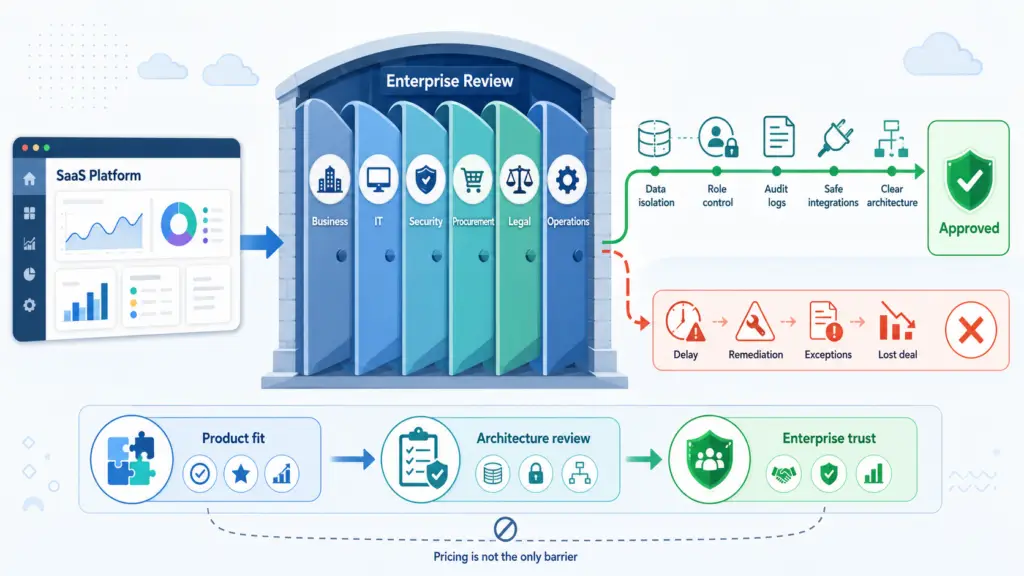
Enterprise procurement is not a single approval. It is a layered review process.
The business team may want your SaaS product because it solves a workflow problem. The IT team wants to know whether it can safely exist inside their technology environment. Security wants to know how access is controlled. Procurement wants to know vendor risk. Legal wants data terms. Operations wants support readiness.
This creates the Enterprise Tech Gatekeeper.
The gatekeeper is not one person. It is a set of objective architecture checks that decide whether your SaaS platform looks safe enough to buy.
For founders, this matters because enterprise contracts usually do not fail only at pricing. They fail when the buyer cannot get comfortable with technical risk.
A weak product foundation creates questions such as:
- Can one company’s data accidentally appear inside another company’s workspace?
- Can administrators assign permissions safely?
- Can the system show who changed a setting, exported data, or triggered an API action?
- Can integrations be limited by role, permission, and environment?
- Can the vendor explain the architecture clearly without rewriting major modules?
If your team cannot answer these questions with confidence, the buyer may delay the deal, request remediation, demand security exceptions, or choose a more mature vendor.
That is why the architecture choice matters before the first enterprise sales call. Founders who understand the benefits of SaaS applications also understand that enterprise buyers are not only buying software convenience; they are buying scalability, control, reliability, and operational confidence.
Why Fragile AI Scripts Are a Fatal Enterprise Procurement Error
AI coding tools can help teams move faster. They can create prototypes, dashboards, internal utilities, and first versions quickly.
But enterprise SaaS is not judged only by whether the software works in a demo.
It is judged by whether the system can support structured access, auditability, data protection, integrations, deployment discipline, and long-term maintainability.
A fragile script may look functional on the surface. The risk appears later when the enterprise buyer asks for:
- Permission documentation
- Admin role controls
- Customer-level data boundaries
- API access records
- Security review responses
- Deployment process clarity
- Incident and support workflows
- Source code ownership and maintainability
This is where untested code becomes expensive.
The founder may save time at the beginning, then lose months during procurement remediation. The product team may need to rebuild permissions, rewrite database access patterns, add logging after the fact, or restructure APIs because the original foundation was never designed for enterprise review.
The problem is not using AI. The problem is relying on ungoverned, untested, disconnected code as the core of a product intended for large corporate buyers.
Enterprise SaaS needs architecture discipline from day one.
Read More: The True Cost of Waiting : Why Fast App Development Beats Long Timelines
The Framework: Evaluating Role-Based Access and Database Isolation
Before choosing custom development or a white-label architecture, founders should evaluate the product through three enterprise gatekeeper variables.
1. Role-Based Access Management
Role-based access is one of the first areas enterprise IT teams examine.
A basic SaaS app may only need an owner and a user. Enterprise SaaS usually needs deeper control.
A serious B2B product may need:
- Super admin
- Organization admin
- Department manager
- Finance user
- Viewer
- Auditor
- Support user
- Integration user
- External collaborator
The founder question is simple: can the platform support different permission levels without custom engineering every time a large buyer asks for a new role?
Strong access management should allow the platform operator to control what each user can view, edit, approve, export, delete, configure, or integrate.
This is not just a security feature. It is an enterprise sales feature.
Large companies rarely buy software for one user. They buy it for teams, departments, regional units, and controlled workflows. If permissions are too basic, the buyer may see the product as immature.
2. Customer Data Isolation
Customer data isolation is the second gate.
Enterprise buyers need confidence that their data remains separated from other customers inside the platform. This affects database design, access logic, API permissions, admin dashboards, reporting, backups, exports, and support access.
A weak architecture may store customer records together without strong access boundaries. A stronger architecture makes data separation part of the core system model.
Founders should ask:
- Is every record tied to the correct customer account or organization?
- Are API calls restricted to the right account scope?
- Can internal support access be limited and logged?
- Can reports and dashboards avoid cross-account exposure?
- Can database queries enforce separation consistently?
This is where many custom builds become risky. If the first version was designed for speed only, customer data boundaries may be added later as patches. That can create long-term technical debt.
A better foundation treats customer data isolation as a core architecture rule, not an afterthought.
3. API Audit Trails
Enterprise SaaS products rarely operate alone.
They connect to CRMs, ERPs, payment systems, HR tools, analytics platforms, workflow engines, identity providers, and internal data warehouses. The more valuable the SaaS product becomes, the more integrations it usually needs.
That makes API audit trails critical.
An enterprise-ready system should help answer:
- Which user or system triggered an API action?
- What endpoint was accessed?
- What changed?
- When did it happen?
- Was the request successful or blocked?
- Which permission allowed the action?
- Can an administrator review sensitive activity?
Without audit trails, the platform becomes harder to trust. The buyer may worry that sensitive actions cannot be investigated later.
API auditability also helps founders during support, dispute resolution, debugging, and security review. It turns system activity into evidence.
Read More: 80ms Connection Trees: Architecting the Database for a Niche B2B Network
The Enterprise Tech Gatekeeper Scorecard
Use this decision framework before choosing your architecture path.
Enterprise Tech Gatekeeper Scorecard
| Gatekeeper Variable | What Enterprise IT Looks For | Founder Risk If Missing | Stronger Architecture Decision |
|---|---|---|---|
| Role-Based Access | Clear user roles, permission boundaries, admin control, and least-privilege access. | Security review delays, manual permission workarounds, and weak buyer confidence. | Choose an architecture with configurable roles, admin workflows, and permission-aware modules. |
| Customer Data Isolation | Reliable separation of customer data across dashboards, APIs, reports, and database logic. | High trust risk, procurement objections, and potential rebuild requirements. | Use a foundation where customer-level data boundaries are designed into the product model. |
| API Audit Trails | Traceable activity for sensitive API requests, integrations, exports, updates, and admin actions. | Poor investigation ability, weak support evidence, and lower enterprise trust. | Build with logging, activity history, admin visibility, and structured API governance. |
| Source Code Ownership | Clear control over code, customization, deployment, and long-term maintainability. | Vendor lock-in, limited flexibility, and slower enterprise-specific customization. | Use a source-code-owned system that can be adapted for buyer requirements. |
Custom Build vs Asset-Gated System Framework
Enterprise SaaS founders usually compare two paths.
The first path is a custom build from zero. This gives flexibility, but it also requires the team to design every access model, database boundary, admin workflow, audit trail, API policy, deployment process, and support layer from the ground up.
The second path is an asset-gated system framework. This means starting from a pre-tested product foundation where core architecture assets already exist, then customizing the product for the business model, buyer workflow, branding, and enterprise requirements.
The important question is not “Which path sounds more custom?”
The real question is “Which path gets us closer to enterprise procurement readiness with less avoidable risk?”
A custom build can make sense when the product has unusual workflows, specialized infrastructure needs, or deep proprietary logic. But for many B2B SaaS founders, the risky part is not the visible user interface. The risky part is the foundation underneath.
That includes authentication, permissions, customer data structure, admin control, logs, APIs, deployment discipline, and support readiness.
Starting from an asset-gated framework can reduce the number of unknowns.
Read More: White-Label Solutions vs Custom Development: How to Choose the Smarter Path
Unlocking High-Ticket Contracts with Pre-Tested Infrastructure
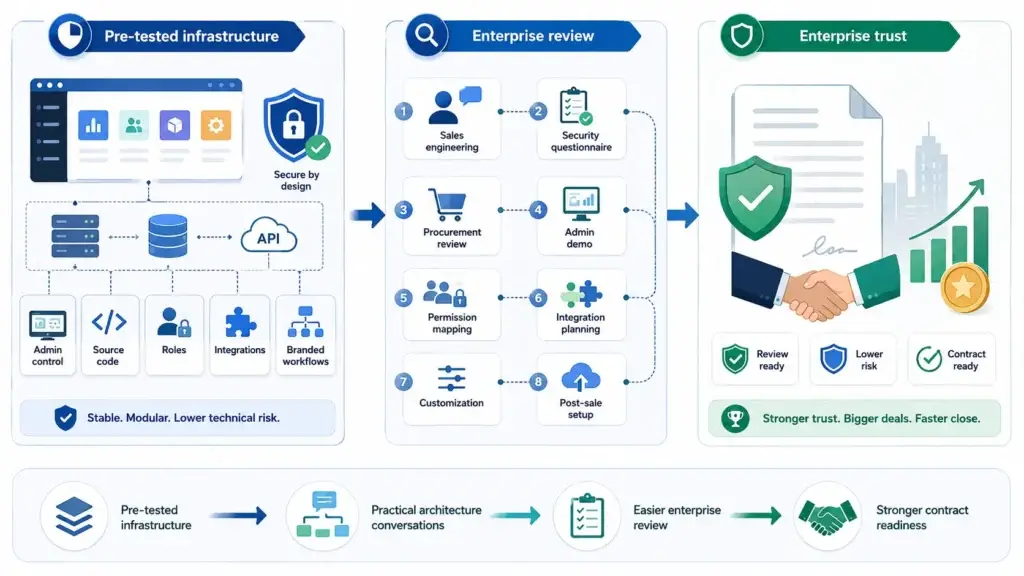
High-ticket enterprise contracts reward trust.
A buyer may love the product vision, but they still need to believe the platform can operate safely inside a corporate environment. This is why pre-tested infrastructure matters.
A pre-tested architecture gives founders a stronger starting point for:
- Sales engineering conversations
- Security questionnaires
- Procurement reviews
- Admin demonstrations
- Role and permission mapping
- Integration planning
- Source-code customization
- Post-sale implementation
Miracuves’ white-label app approach is built around this founder problem. Instead of asking founders to start from a blank codebase, Miracuves helps create a launch-ready product foundation with branded workflows, admin control, source-code ownership, and customization flexibility.
For B2B SaaS founders, that can make the architecture conversation more practical.
You are not only buying development speed. You are buying a stronger starting structure for enterprise review.
Read More: Scaling Beyond Clone: When and How to Transition to Custom Architecture
Why Source-Code Ownership Matters in Enterprise SaaS
Enterprise buyers often ask for custom workflows.
One buyer may need a special approval layer. Another may need regional admin permissions. Another may need integration-specific access rules. Another may need reporting restrictions for sensitive departments.
If the founder does not own the source code, these changes can become slow, expensive, or impossible.
Source-code ownership gives the product owner more control over:
- Custom enterprise workflows
- Security changes
- Integration logic
- Buyer-specific deployment requirements
- Long-term roadmap flexibility
- Internal engineering handoff
- Audit response improvements
This is especially important for SaaS companies selling into large accounts. The first enterprise deal often teaches the founder what the product must become. A locked or limited platform can slow that learning cycle.
A source-code-owned foundation gives the founder more room to adapt.\
Read More: The Truth About White-Label Apps: Why Source Code Ownership Matters
Mistakes Founders Should Avoid Before Enterprise IT Review
Treating Security as a Feature List
Security is not a checklist added at the end. It is a product foundation. If access control, data separation, and auditability are not designed into the architecture, they become expensive to retrofit.
Building Only for the Business Sponsor
The business sponsor may care about workflow value. IT cares about control. Security cares about risk. Procurement cares about vendor readiness. A product that only sells to the business user may still fail the enterprise review.
Depending on Untested Scripts
A script can help you move fast, but high-ticket SaaS contracts require more than speed. They require maintainability, evidence, architecture clarity, and support readiness.
Ignoring Admin Control
Enterprise SaaS needs strong admin control because large buyers want to manage users, permissions, teams, exports, integrations, and activity visibility without relying on vendor support for every change.
Founder Decision Signals
Speed
Choose a white-label foundation when you need to enter enterprise conversations faster without building every access, admin, and API module from zero.
Control
Choose source-code ownership when future enterprise requests may require custom workflows, integrations, or security changes.
Trust
Choose an architecture that can explain permissions, data boundaries, activity history, and operational workflows clearly.
Scale
Choose a foundation that can support multiple customer organizations, admin roles, integrations, and controlled growth.
Where Miracuves Fits in the Architecture Decision
Miracuves helps founders build ready-made and white-label app solutions with source code, branded workflows, admin dashboards, and faster launch paths. For founders who need frontend, backend, database, API, and DevOps execution together, Miracuves’ full stack app development approach can support a stronger enterprise SaaS foundation.
For enterprise SaaS founders, the value is not copying another product. The value is starting from a stronger product foundation that can be customized around a serious business model.
A Miracuves white-label architecture can support founders who need:
- Faster product validation
- Admin-led control
- Source-code ownership
- Custom branding
- Configurable workflows
- Scalable backend planning
- Integration-ready product logic
- A practical route between blank custom development and fragile scripts
The right architecture will not automatically close an enterprise contract. But it can remove avoidable blockers before procurement starts asking hard questions.
Final Thoughts: Architecture Is Now Part of Enterprise Sales
For B2B SaaS founders, enterprise readiness is not only a compliance concern. It is a revenue concern.
Large companies do not only buy features. They buy confidence that the platform can protect data, control access, explain activity, support integrations, and evolve safely after the contract is signed.
That is why the architecture choice matters early.
A fragile first version may help you demo faster, but it can slow you down when procurement gets serious. A custom build may offer flexibility, but it can also create avoidable delays if every enterprise control must be designed from scratch.
The stronger path is to choose a foundation that supports the way enterprise buyers evaluate risk. Working with a capable software development company can help founders align architecture, ownership, scalability, and deployment planning before enterprise buyers start asking technical questions.
For founders selling into large accounts, the product should not merely work. It should be ready to answer the gatekeeper.
FAQs
What is B2B SaaS architecture?
B2B SaaS architecture is the technical foundation that supports users, customer accounts, permissions, data separation, APIs, integrations, admin control, and scalability for business software.
Why does enterprise IT review matter for SaaS founders?
Enterprise IT review matters because large companies evaluate security, access control, data handling, auditability, integration risk, vendor reliability, and operational readiness before approving a SaaS product.
What is the Enterprise Tech Gatekeeper framework?
The Enterprise Tech Gatekeeper framework evaluates whether a SaaS platform can pass core enterprise architecture checks, especially role-based access, customer data isolation, API audit trails, and source-code control.
Is a custom SaaS build better than a white-label architecture?
A custom build can be useful for highly unique requirements, but a white-label architecture can help founders launch faster when the core workflows, admin controls, and system foundation already match the business model.
Why is role-based access important in enterprise SaaS?
Role-based access helps enterprise customers control what each user can view, edit, approve, export, or manage. This supports least-privilege access and makes the platform safer for large teams.
Why are API audit trails important?
API audit trails help track sensitive actions across integrations, admin workflows, exports, and system changes. They support troubleshooting, security review, and enterprise buyer confidence.
How can Miracuves help B2B SaaS founders?
Miracuves helps founders build white-label, source-code-owned SaaS and app foundations with branded workflows, admin dashboards, scalable backend planning, and faster launch support.