



Key Takeaways
- Non-technical founders do not need to become junior developers before launching a serious app business.
- Founder value is stronger in market research, sales, partnerships, monetization, branding, and customer acquisition.
- White-label frameworks help founders start from proven app workflows instead of building every feature from scratch.
- App development risk depends on technical ownership, launch speed, feature quality, source code access, and execution focus.
- A smart development path helps non-technical founders preserve time, capital, and energy for business growth.
Founder Signals
- Founders should focus on validating demand, defining offers, acquiring users, closing partnerships, and improving retention.
- Technical teams should handle architecture, backend logic, mobile apps, testing, deployment, and production support.
- Ready-made solutions should include customer apps, provider panels, admin dashboards, payments, notifications, and reports.
- Source-code ownership helps founders customize, scale, and control the product without being locked into a rented system.
- Operator leverage improves when founders spend less time writing syntax and more time building revenue systems.
Real Insights
- Learning to code can be useful, but it is rarely the fastest path to launching a competitive app business.
- A founder who understands users, pricing, distribution, and operations can outperform a founder stuck building basic features.
- White-label app development works best when the business model already follows proven marketplace, delivery, booking, or SaaS workflows.
- Non-technical founders should judge development partners by ownership, documentation, deployment support, and scalability.
- Miracuves builds apps for non-technical founders with ready-made frameworks, source-code ownership, customization support, deployment help, and admin control.
A dangerous idea has been sold to non-technical founders: before you launch a technology company, you should spend months learning how to code.
It sounds responsible. It feels humble. It gives you the illusion of control.
But for many mid-career professionals, consultants, operators, and executives moving into startup leadership, it is a low-leverage trap.
Your startup does not fail because you cannot write a login function. It fails because you cannot acquire users, convert demand, design a monetization system, position the offer, manage cash, build trust, and move faster than the market window.
That is the real job.
A non-technical founder does need technical literacy. You should understand product flows, admin control, integrations, analytics, security risks, and how development decisions affect the business. But confusing technical literacy with becoming a junior developer is where founders lose time.
The better path is operator leverage: use a launch-ready, white-label technology foundation such as a ready-made clone app solution, then spend your highest-value hours on market growth, user acquisition, pricing, partnerships, retention, and revenue.
That is where companies are built.
The Coding CEO Trap: Why Typing Syntax Is a Business Failure
The coding CEO fantasy is seductive because it makes the founder feel productive.
You open a course. You learn variables. You build a simple form. You connect a database. You fix an error after three hours. You feel closer to the product.
But activity is not leverage.
A founder with ten or fifteen years of business experience should not spend the most valuable hours of the company trying to become a below-average developer. That is not discipline. That is role confusion.
The real cost is not the bootcamp fee. The real cost is the attention you remove from the market.
While you are debugging basic code, no one is building the demand engine. No one is testing acquisition channels. No one is speaking to customers. No one is designing pricing. No one is closing partnerships. No one is turning your professional network into early traction.
A founder’s job is not to prove they can type code. A founder’s job is to make the system work.
For a technology business, the system includes:
| Operator Layer | Why It Matters |
|---|---|
| Market positioning | Defines why users should care now |
| Acquisition strategy | Brings users, vendors, creators, drivers, merchants, or partners into the platform |
| Conversion design | Turns attention into signups, orders, bookings, subscriptions, or transactions |
| Monetization | Converts platform activity into revenue |
| Operations | Keeps support, fulfilment, disputes, payouts, and quality under control |
| Product feedback | Decides what should be improved based on real market behavior |
| Technology leverage | Uses the right app foundation instead of building every module manually |
If you are strong in sales, marketing, domain expertise, partnerships, operations, or capital strategy, your job is to weaponize those strengths.
Learning enough technology to manage a product is smart. Trying to personally code a scalable app from scratch when your premium skill is business execution is usually a misallocation of founder energy, especially when a clone app development company can help you start from a stronger product foundation.
Capitalizing on Your Strengths: The Business of Acquisition and Conversion
Mid-career founders have one unfair advantage that first-time technical builders often lack: market context.
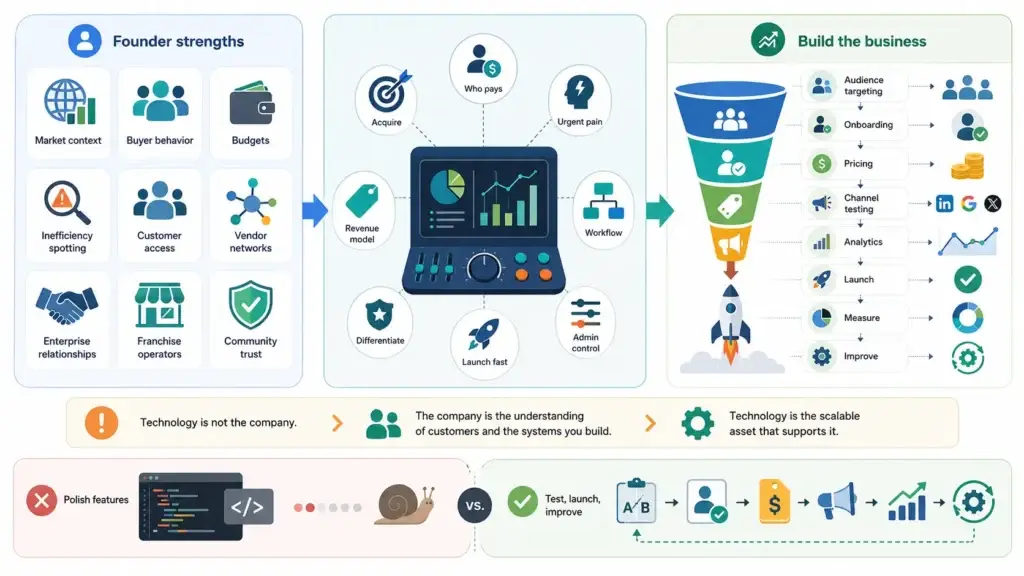
You have seen how buyers behave. You understand budgets. You know where inefficiency hides. You know how decision-makers think. You may already have access to customers, vendors, local networks, enterprise relationships, franchise operators, or community trust. For consultants, agencies, and operator-led founders, this same advantage can also support a white label reseller business built around proven app foundations.
That is not a side advantage. That is the business.
For a non-technical founder, the highest-value questions are not:
“What programming language should I learn first?”
The better questions are:
- “Who will pay for this?”
- “How will we acquire them?”
- “What pain is urgent enough to change behavior?”
- “What revenue model fits this market?”
- “What operational workflow must the app support?”
- “What should the admin dashboard control?”
- “What must be customized to make the platform defensible?”
- “How quickly can we launch, measure, and improve?”
This is where operator founders outperform junior dev CEOs.
A junior dev CEO may spend weeks polishing a feature nobody asked for. An operator CEO tests the offer, validates the channel, improves the onboarding flow, adjusts pricing, and builds distribution before the market forgets the problem.
That difference matters.
Technology is not the company. Technology is the scalable asset that allows the company to operate.
When founders understand that, they stop romanticizing code and start building systems.
Read More: Designing a Peer-to-Peer Rental Engine: Solving the Availability Challenge
Scaling with Leverage: Deploying High-Performance White-Label Frameworks
White-label app development is not about being lazy. It is about refusing to waste time rebuilding common infrastructure.
Most app categories already have known operating patterns:
Food delivery needs customer, restaurant, delivery partner, and admin workflows.
Ride-hailing needs rider, driver, booking, location, fare, and admin flows.
Marketplaces need listings, search, bookings or orders, payments, reviews, and dispute controls.
Creator platforms need feeds, uploads, profiles, moderation, monetization, and payout workflows.
Fintech apps need user verification, wallet logic, transactions, admin risk controls, and reporting workflows.
A founder does not create strategic value by rebuilding these from a blank screen.
The strategic value comes from how the system is positioned, customized, monetized, operated, and grown.
That is why a ready-made clone app solution can be a stronger business move than a long build-from-zero process. You are not buying a shortcut around strategy. You are buying a faster foundation so your strategy can face the market sooner.
Miracuves’ white-label approach helps founders start with a working app base, customize the brand and workflows, retain source-code control where relevant, and focus on market execution instead of foundational development delay.
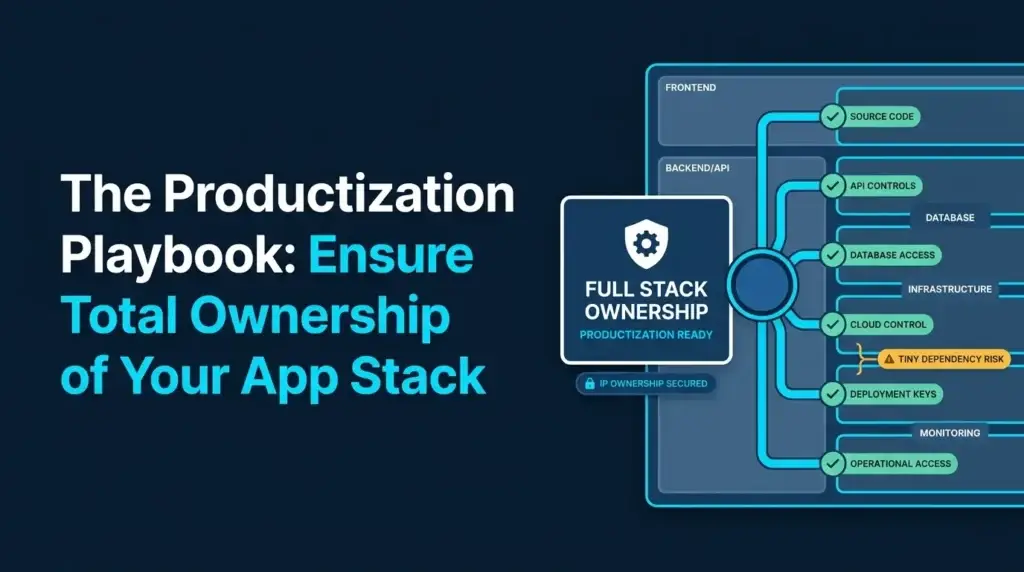
Read More: The Productization Playbook: How to Ensure Total Ownership of Your App Stack
The Operator Leverage Variable: Where a Tech CEO Actually Creates Value
The Operator Leverage Variable is simple:
Founder value = business impact per hour spent.
If one hour spent on customer acquisition can create pipeline, feedback, distribution, or revenue, while one hour spent learning beginner syntax only creates a small internal skill gain, the choice is obvious.
The founder should invest in the activity with higher business impact.
That does not mean technical ignorance is acceptable. It means the founder should learn the right layer of technology.
A strong non-technical CEO should understand:
| What to Understand | Why It Matters |
|---|---|
| User flows | Helps define what customers, vendors, drivers, providers, or creators actually do inside the app |
| Admin dashboard logic | Gives the business control over users, payments, disputes, content, commissions, and reporting |
| Data and analytics | Helps the founder track conversion, retention, revenue, and operational bottlenecks |
| Security basics | Protects trust through access control, secure payments, verification, and activity logs |
| Integration scope | Clarifies what payment gateways, maps, notifications, wallets, APIs, or third-party tools are needed |
| Customization priorities | Prevents wasting money on cosmetic changes while ignoring business-critical workflows |
| Source-code ownership | Reduces dependency and gives the founder more long-term control over the product foundation |
This is the technical knowledge that helps a CEO make better decisions.
You do not need to become the person writing every line. You need to become the person who knows which lines matter to the business.
What Non-Technical Founders Should Learn Instead of Coding
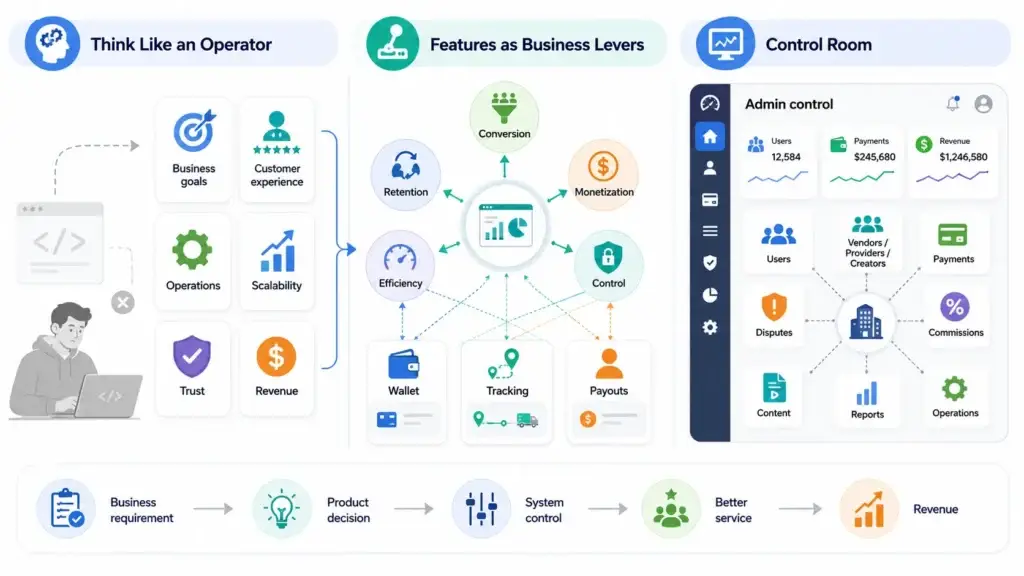
The best non-technical founders do not avoid technology. They simply approach it from the operator’s side instead of the developer’s side. Their goal is not to prove they can personally build every feature. Their goal is to understand how each product decision affects the business model, customer experience, operational workload, and long-term scalability of the platform.
This means learning how to translate business requirements into product decisions. Instead of asking, “Can I build this feature myself?” a stronger founder asks, “What business outcome should this feature create?” That shift changes everything. A feature is no longer treated as a technical task on a development checklist. It becomes a business lever that should improve trust, conversion, retention, monetization, efficiency, or control.
A wallet, for example, is not just a wallet. It is a trust system, a transaction layer, a refund mechanism, a loyalty tool, and a reporting structure. A delivery tracking module is not just a map on the screen. It affects customer confidence, driver accountability, support ticket volume, fulfilment quality, and the overall reliability of the platform. A creator payout system is not just a payment flow. It influences creator retention, fraud risk, platform reputation, monetization confidence, and the willingness of creators to keep producing content inside the ecosystem.
The same is true for the admin panel. It is not just a backend screen that sits behind the app. It is the control room of the entire business, which is why founders should evaluate the backend, dashboard, database, and deployment layers with the same seriousness they would expect from a full stack app development company. It gives the platform operator visibility into users, vendors, providers, creators, payments, disputes, commissions, content, reports, and operational decisions. Without strong admin control, even a good-looking app can become difficult to manage once real users, transactions, and support issues start appearing.
When a founder starts thinking this way, they stop acting like a beginner developer and start acting like a system operator. They understand that technology is not valuable because it exists; it is valuable because it helps the business acquire users, serve them better, manage operations, create trust, and generate revenue. That is the leadership transition most non-technical founders need to make.
Read More: Passing the Enterprise IT Review: The Architecture Choice for B2B SaaS
When White-Label Frameworks Beat Building From Scratch
A white-label framework becomes valuable when the business model is already proven, but your market, niche, brand, operations, or distribution strategy requires a different execution layer. The mistake many founders make is assuming they need to reinvent the entire product architecture to create a differentiated business. In reality, differentiation often comes from how the platform is positioned, how users are acquired, how operations are managed, and how revenue is created. The foundation can be proven while the execution remains completely specific to your market.
You may not need to rebuild food delivery architecture from scratch when the real opportunity is stronger local merchant acquisition, better delivery coordination, and a customer retention model that fits your city or region. You may not need to invent ride-hailing again when your actual advantage is a smarter driver onboarding process, localized pricing logic, and a launch strategy designed around a specific mobility gap. You may not need to create a creator platform from zero when what matters more is community positioning, niche content focus, reliable moderation, and monetization that gives creators a reason to stay active.
The same logic applies to ecommerce and marketplace businesses. You may not need to build a marketplace engine from the ground up when the real business challenge is supplier trust, catalog quality, repeat purchase behavior, vendor management, and better operational control. This is where clone app development for market validation becomes practical. The app foundation helps you reach the market faster, but your operator skill determines whether the platform earns attention, converts demand, builds trust, and generates revenue.
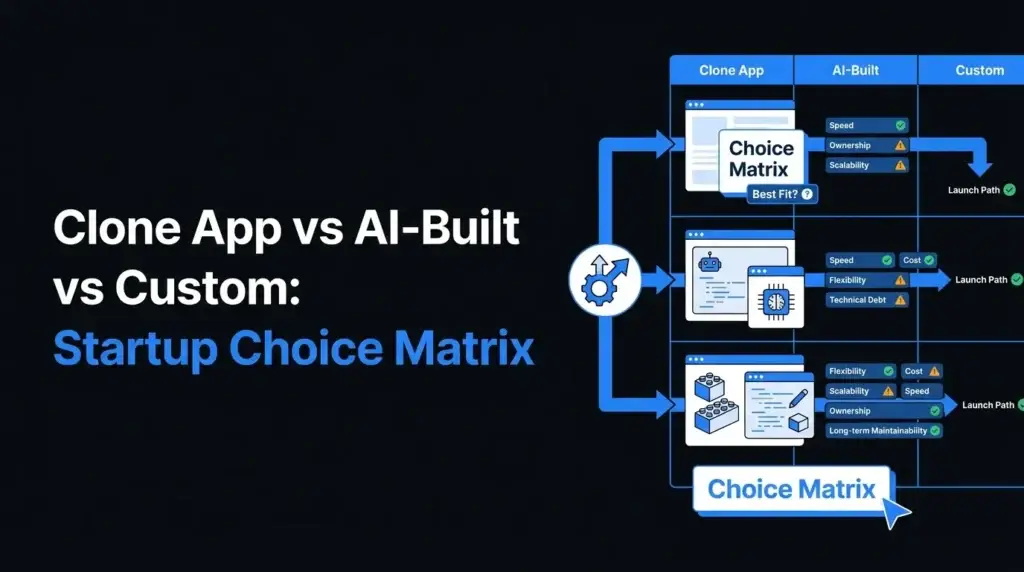
A custom app development path still makes sense when the product depends on highly unique workflows, proprietary technology, unusual infrastructure, or a funded roadmap with enough time and engineering leadership behind it. But when the early goal is to validate demand, launch a branded platform, test monetization, and control operations, a white-label framework is often the more rational starting point. Founders comparing white-label solutions vs custom development should focus on urgency, budget, technical complexity, ownership, and how quickly the product needs to reach real users.
Founder Decision Signals
Speed
If the market window is open now, spending months learning beginner code can delay the only thing that matters: real user feedback.
Cost
The visible cost of coding education is small. The hidden cost is delayed acquisition, delayed sales, and delayed market learning.
Scalability
A founder-written first build may create technical debt if it is not designed around admin control, integrations, security, and operational workflows.
Market Fit
Operators create leverage when they test positioning, pricing, and demand quickly instead of waiting until every feature is built from scratch.
The Smarter Role of a Non-Technical Tech CEO
A non-technical tech CEO should not behave like a passive idea person. That is the other extreme, and it is just as dangerous.
You should not hand a vague idea to developers and expect a business to appear.
Your role is to own the product logic from the business side.
That includes:
- Defining the customer segment
- Prioritizing the core use case
- Designing monetization
- Mapping operational workflows
- Choosing what to customize
- Setting launch priorities
- Reviewing dashboards and user behavior
- Managing support and feedback loops
- Understanding what technical choices mean for scale and control
This is not less serious than coding. It is more strategic.
A founder who can explain exactly how the app should make money, how users should move through the platform, what the admin team needs to control, and where growth will come from is far more valuable than a founder who can write a fragile login page.
Read More: Beyond the Code: The DevOps Guide to Launching Production Architecture
Mistakes Operators Should Avoid When Launching a Tech Business
Mistake 1: Learning code to avoid making a decision
Some founders use coding education as a safe delay. It feels productive, but it postpones the harder work of choosing a market, testing demand, and selling the offer.
Mistake 2: Treating software as the business instead of the asset
The app enables the business, but the business is built through acquisition, retention, monetization, trust, and operational discipline.
Mistake 3: Choosing a framework without owning the operating model
A white-label app is only powerful when the founder knows how the platform will acquire users, generate revenue, manage disputes, and improve after launch.
Why Miracuves Fits the Operator-Led Founder
The Miracuves model is built for founders who want control without unnecessary delay.
A ready-made app foundation gives operators a faster way to enter categories such as delivery, ride-hailing, marketplaces, creator platforms, fintech, ecommerce, rentals, and service platforms. Instead of spending months assembling basic infrastructure, founders can focus on brand positioning, user acquisition, market testing, and revenue design.
For operators, this matters because speed is not just a technical advantage. It is a learning advantage. A structured rapid app development process helps founders reduce the time between idea, launch, feedback, and business validation.
The faster you launch, the faster you learn what users want.
The faster you learn, the faster you adjust.
The faster you adjust, the better your chance of building a real business instead of a theoretical product.
Final Thoughts: Stop Acting Like a Junior Developer and Start Leading the System
The modern non-technical founder does not need to apologize for not being an engineer.
But they do need to stop hiding behind beginner coding progress.
Your job is not to become a slow, inexperienced developer. Your job is to become a high-leverage operator who understands the market, controls the business model, manages the technology foundation, and moves faster than founders stuck in endless build mode.
Learn enough technology to lead intelligently.
Then use leverage.
Use frameworks. Use source-code-owned foundations. Use white-label systems where the category is already proven. Use your time where it compounds: acquisition, conversion, monetization, partnerships, retention, and operations.
Because technology companies are not built by syntax alone.
They are built by operators who know how to turn software into a scalable business system.
FAQs
Should non-technical founders learn to code before building an app?
Non-technical founders should learn enough about technology to make smart product decisions, but they do not need to spend months becoming junior developers. Their stronger role is usually strategy, market validation, acquisition, monetization, and operational control.
Is white-label app development a good option for non-technical founders?
Yes, white-label app development can be a strong option when the founder wants to launch faster using a ready-made product foundation. It works best when the founder already understands the market, audience, monetization model, and operational workflow.
What should a non-technical founder focus on instead of coding?
A non-technical founder should focus on customer acquisition, pricing, positioning, revenue models, partnerships, operations, product feedback, admin control, and market validation. These areas usually create more leverage than learning beginner coding syntax.
Does using a clone app mean copying another brand?
No. A clone app should replicate proven functionality patterns, not another company’s brand identity, trademarks, or exact design. The stronger approach is to use a ready-made foundation and customize it around your own brand, audience, workflows, and business model.
When should a founder choose custom app development instead?
Custom development makes more sense when the product requires unique workflows, proprietary technology, complex infrastructure, or deep differentiation that cannot be handled through a ready-made foundation. For early validation, a white-label foundation may often be faster and more practical.
Why is source-code ownership important for startup founders?
Source-code ownership gives founders more control over future customization, migration, scaling, and technical decision-making. It can reduce long-term dependency and give the business more flexibility as the platform grows.
How does Miracuves help non-technical founders launch faster?
Miracuves helps founders start with ready-made, white-label app solutions that include branding, admin control, source-code ownership where relevant, and faster deployment. This allows founders to focus more energy on market growth instead of building every module from zero.