


Key Takeaways
What You’ll Learn
- Uber for X clone scripts are ready-made on-demand marketplace solutions that allow startups to launch multi-service platforms quickly.
- Core features include real-time booking, GPS tracking, payments, and notifications to support seamless service delivery.
- Multi-panel architecture includes customer app, provider app, and admin dashboard for complete platform control.
- Advanced capabilities like dynamic pricing, service categorization, and analytics dashboards improve efficiency and scalability.
- The biggest advantage is launching a fully functional on-demand business without months of development.
Stats That Matter
- Global development cost for Uber-for-X platforms can exceed with custom builds and long timelines.
- Ready-made clone solutions can start from a few thousand dollars, reducing upfront investment significantly.
- Deployment timelines for clone scripts can be as short as a few days depending on configuration.
- On-demand service marketplaces continue to grow rapidly across multiple industries and categories.
Real Insights
- On-demand platforms succeed through execution, not just features, as logistics and operations define user experience.
- Speed-to-market is a competitive advantage, allowing startups to capture demand early.
- Scalability depends on backend architecture, especially for handling real-time requests and high traffic.
- Multi-service capability increases revenue potential by expanding into different service categories.
- The most successful Uber-for-X platforms succeed by combining technology, logistics, and monetization strategies into one ecosystem.
Back in the early 2010s, Uber changed how we hailed a ride. But something else happened under the radar—it inspired a whole new startup wave across every industry imaginable. Uber for food, Uber for laundry, Uber for mechanics. You name it. And in 2026, this model is still booming. People want services instantly. Entrepreneurs want plug-and-play apps. That’s where Uber for X clone script come in—your shortcut to launching an on-demand empire without the tech headaches
Let’s say you’re eyeing a gap in your local market. Maybe no one’s delivering dog walkers or on-demand tutors. Maybe your city lacks a solid home cleaning app. Whatever the niche, Uber for X is the blueprint that works. A user taps a button, books a service, tracks progress, pays digitally, and rates the experience. It’s universal, flexible, and scalable
At Miracuves, we’ve helped brands build platforms for every vertical from car wash to caregiving. Uber for X clone script are no longer rigid templates—they’re modular, white-label launchpads for ambitious founders. If you’re ready to build something that people depend on every day, let’s break down the best script and what to look for
What Is an Uber for X Clone Script?
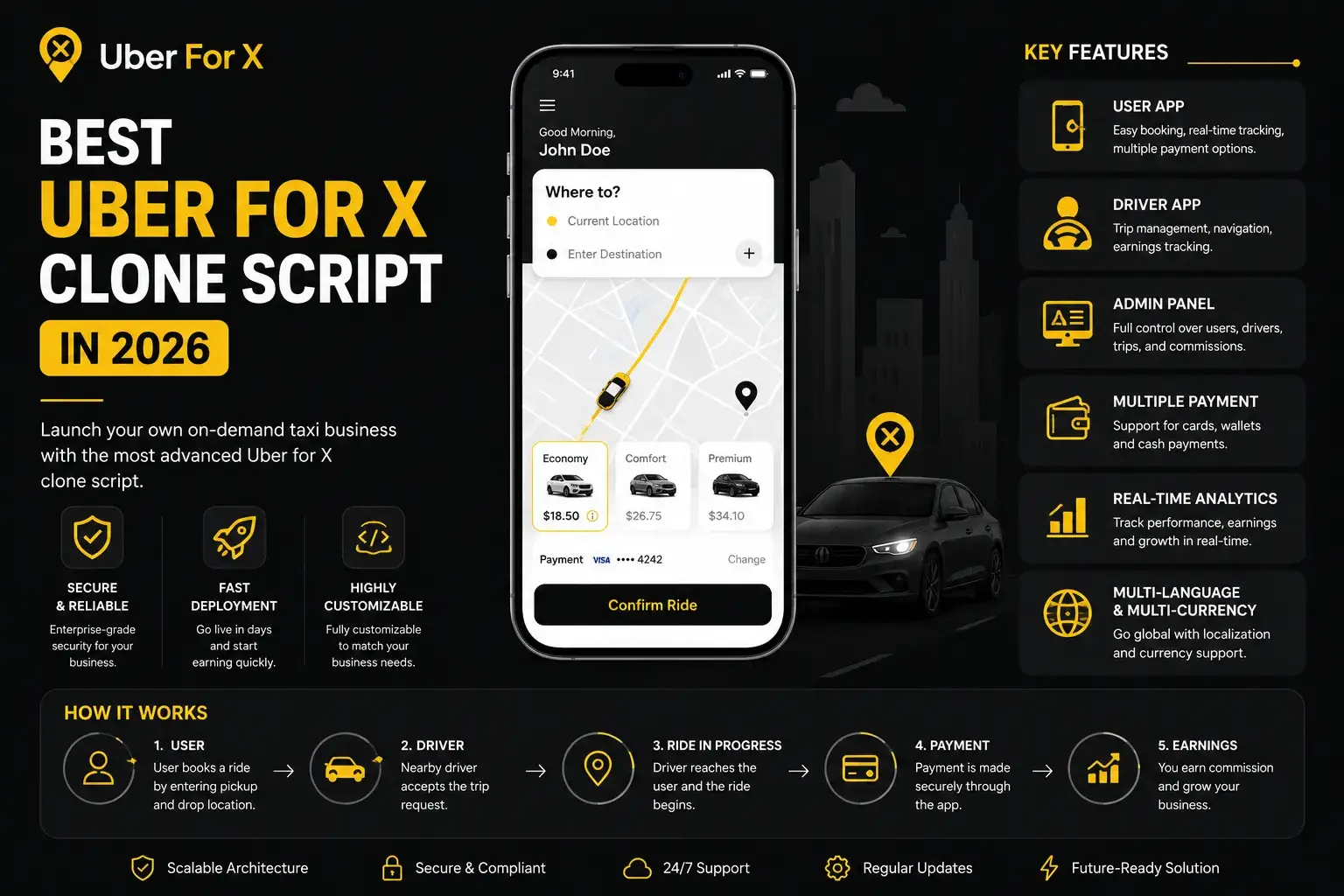
An Uber for X clone is a generic on-demand app framework that can be tailored for any service vertical—plumbing, beauty, car repair, tutoring, moving, babysitting, and so on. It typically includes a customer app, provider app, and admin dashboard. Think of it as the “Lego kit” of the on-demand tech world
Instead of coding from scratch, you get a pre-built architecture that handles real-time booking, location tracking, service availability, payments, ratings, and notifications. You can tweak the service list, booking logic, pricing models, and even the visuals to match your brand. That’s the power of clone tech in 2026—it’s built to bend without breaking
Read More : Uber for X Features That Drive Success
Core Features That Make or Break Uber for X Clone script
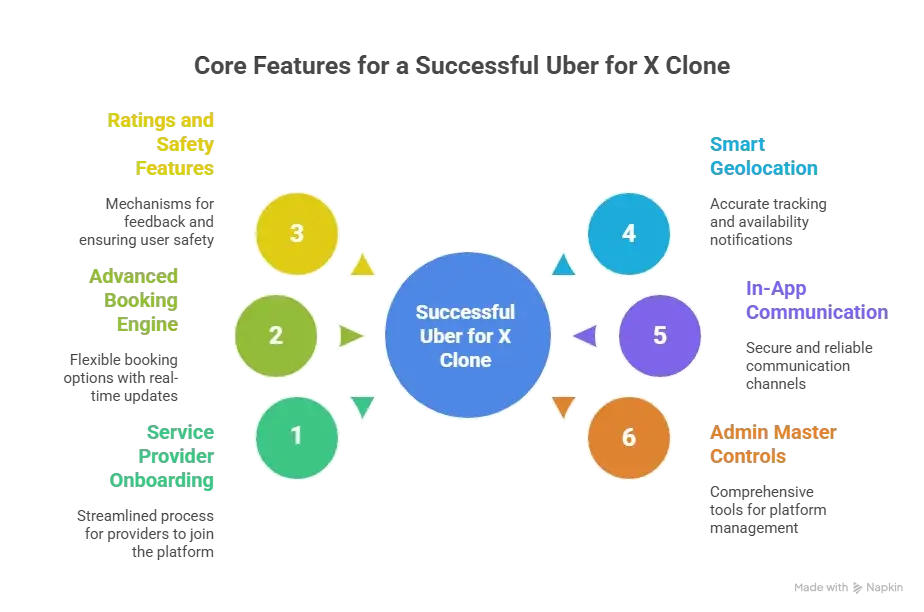
Service Provider Onboarding
Your app should support profile creation, KYC upload, service zone setup, availability scheduling, and service pricing. No clunky dashboards—simplicity wins
Advanced Booking Engine
Let users choose immediate or scheduled service. Support hourly, task-based, or subscription pricing. Real-time status updates are essential
Ratings, Disputes & Safety
Both parties should be able to rate, review, and report issues. Emergency call buttons, masked numbers, and ID verification features add trust
Smart Geolocation & Availability
Your script needs to show nearby service providers, track ETA, and notify users if someone becomes available or cancels
In-App Communication
Chat and voice calling between customers and providers should be encrypted, instant, and uninterrupted—even in low-network areas
Admin Master Controls
An Uber for X isn’t just for users—it’s for operators. The admin panel should offer detailed analytics, payout reports, commission management, promotional controls, and push notification tools
Read More : Launch Smart, Grow Fast: How Our Uber for X Clone Powers Startup Scalability
Global Cost Factors & Pricing Breakdown
PHP/Laravel is often the most practical choice for launching an Uber for X platform quickly and affordably. Node.js/Python supports real-time operations and scaling, while microservices architecture is ideal for enterprise-level platforms handling massive demand.
Miracuves Uber for X-Like App Solution Cost and Tech Stack
Miracuves Pricing for a Uber for X like App developed in PHP/Laravel with Flutter Apps for $2,199 USD (One-Time Price) in just 6 days
Get a fully developed, deployment-ready platform modeled after the Uber-style on-demand service model. Built on a reliable PHP/Laravel backend with Flutter mobile apps, this complete solution helps you launch and scale any service-based marketplace quickly and efficiently.
- Core Workflows: User booking, service provider matching, real-time tracking, job assignment, service completion, and customer-provider communication.
- Built-in Operations: Dynamic pricing logic, commission setup, order/job management, scheduling, notifications, and payment processing.
- Management Hub: Centralized admin panel to manage customers, service providers, bookings, transactions, service categories, and overall platform activity.
- Launch-Ready: Fully prepared for your branding, configuration, and immediate go-to-market execution.
Why is it so affordable?
Most modern on-demand platforms are built using complex architectures like Node.js or microservices. While powerful, these approaches require large engineering teams, longer timelines, and significantly higher development costs.
We took a smarter and more practical approach:
- You Aren’t Paying for Ground-Up Development: Our on-demand marketplace engine is already developed, tested, and ready to deploy. You skip months of development time and avoid the high costs of building from scratch.
- The Power of PHP / Laravel: Built on one of the most trusted and widely used frameworks globally, this solution keeps upfront costs low while ensuring long-term flexibility. With a large developer ecosystem, it becomes easier and more cost-effective to maintain, scale, and customize your platform.
- Built for Practical Growth: You get a strong, market-ready Uber for X platform with essential features like real-time matching, tracking, and service workflows—without the complexity and expense of enterprise-level builds.
You get a scalable, production-ready platform without paying inflated development costs.
Note: This cost is for the solution, re-branding, deployment, and source code only.
Pros and Cons of Uber for X Clone script
Pros
Time-Saving: Skip the dev time—build your niche app in weeksModular: One backend, multiple services. Scale as you growAffordable: Get enterprise-grade tech without VC funding
Cons
Design Similarity: Without solid UX input, your app may look like dozens of othersIntegration Load: Customizing too many services at once can delay launchThird-Party Dependencies: Some clones rely heavily on third-party APIs—watch for license costs
Popular Use Cases That Shine in 2026
- Uber for Mechanics: Roadside assistance with real-time tracking
- Uber for Home Services: Combine cleaning, electrical, plumbing in one app
- Uber for Tutors: One-click booking with lesson tracking and video call integration
- Uber for Pet Services: Grooming, walking, sitting—all in-app
- Uber for Beauty: On-demand makeup artists and stylists with location-based search
Emerging Trends in the Uber for X Space
- Hyperlocal Marketplaces: Think smaller areas, tighter community integration
- Subscription Models: Users pay monthly for a set number of service bookings
- AI Matching: Smart pairing based on user preferences and provider ratings
- AR/VR Support: For remote consultations (especially in wellness and repairs)
- Green Service Filters: Eco-conscious users want to filter providers based on carbon footprint
Conclusion
Uber for X clone script aren’t just technical short-cuts—they’re launchpads for big ideas. Whether you want to disrupt one vertical or unify multiple, the right clone can give you momentum, market traction, and monetization from day one. In a time when users demand everything on tap, your on-demand idea could be the next local favorite or even a global success. The only question is—what’s your X?
At Miracuves, we help innovators launch high-performance app clones that are fast, scalable, and monetization-ready. Ready to turn your idea into reality? Let’s build together
FAQs
Can I launch multiple service categories on one app?
Yes, most Uber for X clones support multi-service options with separate provider modules for each
How do I decide what niche to build for?
Look at your local pain points—what services are missing or inefficient? That’s your X
Do these apps work in countries with low connectivity?
Yes, but make sure to optimize maps, caching, and payment flows for 2G/3G environments
Can I restrict services to certain locations?
Absolutely. Geo-fencing and zone-based service controls are standard in most premium script
How do I ensure provider quality?
Use onboarding filters like background checks, document uploads, and admin approvals before going live
Is it hard to scale an Uber for X app?
Not if the script is modular. You can add services, expand to new cities, and integrate more tools over time without downtime
Related Articles