


Key Takeaways
- A handmade marketplace platform business model connects makers, buyers, product listings, orders, payments, commissions, shipping, and seller payouts within one digital marketplace.
- Makers manage shops, handmade products, pricing, inventory, personalization, orders, fulfillment, and earnings, while buyers discover unique products and complete purchases.
- The platform coordinates discovery, transactions, trust, seller operations, customer support, commissions, refunds, and settlements while earning revenue from marketplace activity.
Maker & Buyer Flow Signals
- Makers need seller onboarding, shop profiles, product listings, categories, variants, customization options, inventory controls, order management, shipping tools, earnings, and payouts.
- Buyers use search, categories, filters, product images, descriptions, reviews, wishlists, carts, secure checkout, order tracking, and seller communication to complete purchases.
- Listings connect both sides by organizing product details, pricing, availability, personalization choices, shipping information, seller identity, ratings, and purchase options.
Marketplace Operations Insights
- Marketplace operators manage seller approvals, listing moderation, commissions, payments, refunds, disputes, promotions, shipping rules, reviews, and platform policies.
- Revenue can come from transaction commissions, seller plans, listing limits, featured placements, advertising, and value-added services while payouts distribute eligible earnings to makers.
- Miracuves develops customizable handmade marketplace platforms with maker onboarding, product listings, buyer workflows, orders, payments, commissions, payouts, analytics, and admin controls.
A handmade marketplace platform is often described as a website where independent makers list products and buyers purchase them.
That description is accurate, but it misses the business model.
The real model is a coordinated system connecting four things:
makers, buyers, listings, and platform operations.
Makers create supply.
Listings turn that supply into something searchable.
Buyers create demand.
The marketplace operator establishes the rules that determine what can be listed, how transactions work, how trust is built, what happens when something goes wrong, and how sellers continue operating.
That creates a much more useful way to understand the handmade marketplace platform business model:
Maker supply → Approved listings → Buyer discovery → Order → Fulfillment → Trust → Repeat activity
Revenue sits around that loop.
It does not create the loop.
For founders planning a seller-led marketplace, understanding that distinction can prevent a common mistake: designing fees, features, and technology before understanding what keeps supply and demand connected.
What Is a Handmade Marketplace Platform Business Model?
A handmade marketplace is a multi-seller model where independent makers use one platform to reach buyers.
Instead of purchasing inventory and reselling it itself, the marketplace coordinates the transaction.
The maker usually controls:
- What they sell
- Product pricing
- Stock or production capacity
- Product descriptions
- Product images
- Processing time
- Order preparation
- Buyer communication
- Fulfillment responsibilities defined by the marketplace
The buyer expects the platform to make that fragmented seller base feel like one trustworthy shopping environment.
That means the operator needs to coordinate:
- Seller onboarding
- Listing standards
- Categories
- Search and discovery
- Checkout
- Payments
- Order status
- Reviews
- Refunds
- Seller balances
- Payouts
- Moderation
- Support
The business model works when those responsibilities reinforce each other.
If you want to understand the buyer and seller journey before going deeper into the business model, this guide explains how a handmade marketplace works across storefronts, discovery, checkout, seller activity, and order management.
The Four Parts of the Marketplace Model
How the Handmade Marketplace Business Model Connects
| Component | Main Role | What the Marketplace Needs From It |
|---|---|---|
| Makers | Create differentiated product supply. | Enough credible sellers, reliable availability, good product information, and dependable fulfillment. |
| Listings | Turn maker supply into searchable marketplace inventory. | Accurate information, strong media, useful categories, appropriate moderation, and clear availability. |
| Buyers | Create demand through browsing, purchasing, reviewing, and returning. | Relevant discovery, trust, checkout convenience, predictable delivery, and support. |
| Platform Operator | Coordinates rules, transactions, quality, support, and marketplace economics. | Visibility across sellers, listings, orders, disputes, payments, payouts, and marketplace health. |
Step 1: Makers Create the Supply Side
A handmade marketplace begins with sellers.
Without makers, there is no catalog.
But seller count alone is a weak metric.
What matters is whether sellers create supply buyers actually want.
A marketplace with 1,000 registered makers and only 150 credible active listings can be weaker than one with 100 makers and 2,000 relevant, well-presented products.
That means founder attention should move from:
How many sellers registered?
to:
How much useful supply became available?
Useful supply depends on:
- Maker quality
- Product quality
- Category relevance
- Listing completeness
- Stock or production availability
- Price fit
- Seller responsiveness
- Fulfillment reliability
Seller acquisition is therefore only the first step.
Seller activation matters more.
Seller Activation Is Different From Seller Registration
A registered maker may never create a product.
A product creator may never publish.
A published seller may never receive buyer interest.
A seller receiving orders may still leave if operating the marketplace is too difficult.
A more useful seller funnel is:
Registered → Approved → Shop created → First listing → First published listing → First order → Repeat seller
Each stage reveals a different marketplace problem.
If registrations are high but listings are low, onboarding may be too difficult.
If listings are high but orders are low, discovery or demand may be weak.
If first orders occur but sellers do not stay active, fulfillment, payout, demand quality, or seller economics may need attention.
The Marketplace Should Reduce the Cost of Being a Small Seller
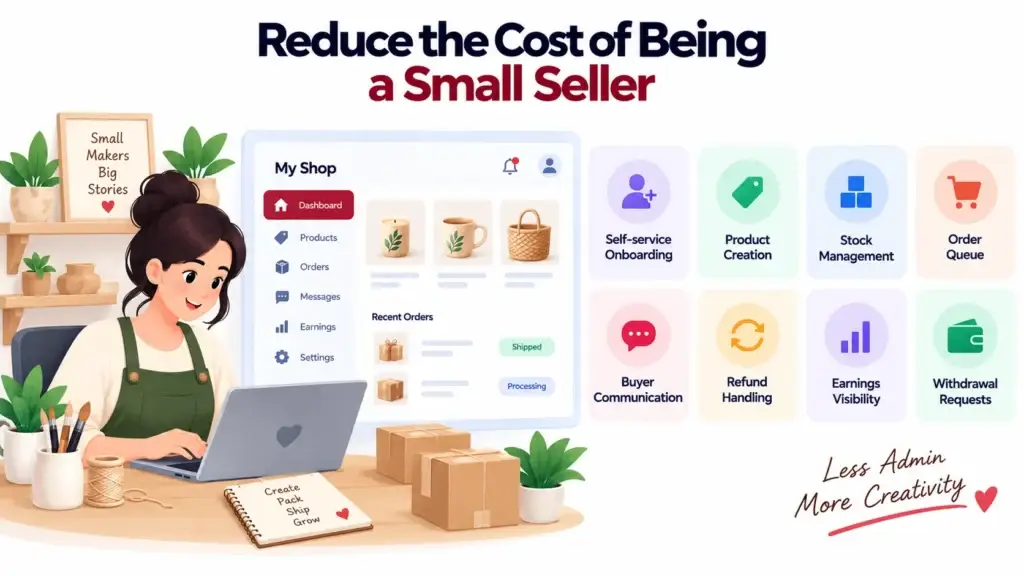
Independent makers often do not have teams.
The same person may:
- Make the product
- Photograph it
- Upload it
- Answer messages
- Pack orders
- Manage stock
- Handle refunds
- Track earnings
That means marketplace workflows should reduce administrative work rather than recreate the complexity of running a standalone store.
Useful seller operations include:
- Self-service onboarding
- Product creation
- Stock management
- Order queue
- Buyer communication
- Refund handling
- Earnings visibility
- Withdrawal requests
The easier those tasks become, the more supply the marketplace can support without requiring proportional operator headcount.
Step 2: Listings Convert Maker Supply Into Discoverable Inventory
Listings are the bridge between sellers and buyers.
Without them, maker supply exists but cannot efficiently be discovered.
A useful listing answers:
- What is the product?
- Who made it?
- What does it cost?
- Is it available?
- What variation can the buyer choose?
- How long will it take?
- What does it look like?
- What should the buyer expect?
For handmade goods, this can be particularly important because products may be:
- Unique
- Limited-run
- Made to order
- Personalized
- Vintage
- Digital
- Produced in small batches
The listing therefore represents much more than a SKU.
It communicates the product’s identity and sets buyer expectations.
Listing Quality Is a Marketplace Growth Lever
A marketplace can acquire buyer traffic successfully and still convert poorly if listing quality is weak.
Common problems include:
- Poor images
- Incomplete descriptions
- Incorrect categories
- Missing variation details
- Misleading stock status
- Unclear processing time
- Duplicate products
These issues create a business-model problem, not merely a content problem.
Weak listings reduce:
search quality → buyer confidence → conversion → seller sales → seller retention
That is why moderation and listing standards belong inside the business model.
Moderation Protects the Discovery Experience
An open seller model creates supply quickly.
It also creates catalog risk quickly.
As more sellers join, operators need to decide:
- Which products are allowed?
- Which categories require extra review?
- Who can publish?
- What happens after a listing is rejected?
- Can an approved seller still publish a prohibited item?
- What happens when a buyer reports a product?
- Can suspended listings be restored?
This creates an important operational principle:
seller approval and listing approval solve different problems.
A credible seller can still create an unsuitable listing.
Marketplace quality therefore needs ongoing moderation rather than a one-time onboarding check.
Step 3: Buyer Demand Gives Seller Supply Economic Value
Seller marketplaces have a classic coordination problem.
Sellers want buyers.
Buyers want product choice.
But:
- Buyers do not stay when the catalog is thin.
- Sellers do not stay when buyer demand is weak.
Founders therefore need to build supply and demand together.
This is the marketplace liquidity problem.
What Marketplace Liquidity Means
Liquidity means a buyer has a reasonable chance of finding something relevant while an active maker has a reasonable chance of receiving meaningful demand.
In a handmade marketplace, liquidity can be highly category-specific.
You may have excellent supply in:
- Jewelry
- Prints
- Home décor
while still having weak liquidity in:
- Furniture
- Personalized stationery
- Craft supplies
A marketplace can therefore look healthy in aggregate while specific categories remain empty.
Founders should examine supply and demand at category level, not only marketplace level.
Discovery Is the Connector Between Supply and Demand
Buyers rarely arrive knowing the exact seller name.
They discover through:
- Categories
- Search
- Filters
- Recommendations
- Collections
- New arrivals
- Popular products
- Editorial curation
- Seller shops
Discovery determines which sellers receive attention.
That gives the operator another responsibility:
attention allocation.
If the same shops always dominate search, new sellers may struggle to gain traction.
If discovery is too random, buyers may see irrelevant products.
If paid placement overwhelms relevance, trust may decline.
The discovery system therefore needs to balance buyer relevance with marketplace opportunity.
Step 4: Trust Converts Browsing Into Transactions
Handmade purchases often involve greater uncertainty than standardized retail products.
The buyer may wonder:
- Will the item look like the photograph?
- Is the maker genuine?
- Will it arrive on time?
- What happens if it is damaged?
- Can I contact the seller?
- Are previous buyers satisfied?
Trust signals help resolve that uncertainty.
Useful signals include:
- Seller profile
- Shop history
- Reviews
- Buyer photographs
- Clear product information
- Order status
- Buyer-to-seller messaging
- Refund process
- Support access
Trust should therefore be treated as part of conversion.
A seller with great products but no credible marketplace trust signals may convert poorly.
Reviews Create Value on Both Sides
Reviews do more than reassure buyers.
They create feedback for sellers.
A strong review system can help makers understand:
- Which products customers value
- Where expectations were unclear
- Whether packaging is working
- Whether processing times are realistic
- Which products create repeat demand
This creates a feedback loop:
More orders → More reviews → More confidence → More conversion → More orders
But review systems need governance.
Because marketplace trust also depends on seller accounts, payments, permissions, moderation, and operational controls, founders should review marketplace security and seller trust as part of their launch planning.
Fake reviews, retaliatory reviews, spam, and abusive responses can damage the same trust the system is intended to create.
Step 5: Checkout Turns Marketplace Intent Into a Transaction
A buyer may purchase from several independent shops during one visit.
The user experience should still feel coherent.
For example, the buyer might have:
- One cart
- One checkout
- One payment experience
while the backend creates seller-specific operational responsibilities.
That distinction matters because one purchase can contain:
- Product from Maker A
- Product from Maker B
- Product from Maker C
Each seller may:
- Prepare separately
- Ship separately
- Complete separately
- Refund separately
The platform must coordinate that complexity without forcing the buyer to think like a marketplace database.
Founders who want the technical implementation perspective can review the guide to handmade marketplace platform architecture, which goes deeper into seller onboarding, listings, orders, payments, and payouts.
Step 6: Fulfillment Determines Whether the Buyer Returns
The business model is not finished when payment succeeds.
For a marketplace, post-purchase operations are critical.
A seller may need to:
- Accept an order
- Prepare it
- Package it
- Update status
- Provide shipment information
- Answer buyer questions
- Respond to return requests
The platform needs enough visibility to know when the seller is failing to meet expectations.
A poor fulfillment experience affects more than one transaction.
It can reduce trust in the whole marketplace.
That creates a fundamental difference between a marketplace and a directory:
The marketplace is judged for transactions it did not physically fulfill itself.
Seller Independence Requires Platform Accountability
A marketplace operator usually does not pack the product.
But buyers still expect the marketplace to help when:
- Nothing arrives
- The item is wrong
- The seller stops responding
- A refund is required
- A payment dispute appears
This means the platform needs a defined responsibility boundary.
Founders should decide:
- When does the seller handle the issue directly?
- When does the operator intervene?
- What evidence is required?
- Who can approve a refund?
- What happens to seller earnings?
- Does repeated failure affect seller status?
Without clear answers, customer support becomes improvised policy.
Step 7: Money Has to Flow Back to the Maker Reliably
The transaction creates value for several parties.
At a high level:
Buyer payment → marketplace transaction → seller earning → settlement → seller payout
The exact commercial deductions and monetization model should be handled separately from this article.
For deeper planning around seller plans, listing limits, featured placement, and commission, review the guide to handmade marketplace monetization strategy.
From an operating-model perspective, the important question is simpler:
Can the maker understand what happened to their money?
A seller should be able to distinguish:
- Gross sale
- Marketplace deductions
- Refund adjustments
- Pending earnings
- Available balance
- Withdrawals
- Completed payouts
For founders who want to go deeper into commission, seller plans, paid placement, and other commercial mechanics, the marketplace revenue and seller economics guide covers the broader monetization layer separately.
Payout trust affects seller retention.
A seller who receives orders but cannot confidently understand their balance is unlikely to consider the marketplace operationally dependable.
Step 8: Platform Operations Hold the Marketplace Together
The operator is the least visible participant to buyers and often the most important.
A marketplace operator may coordinate:
Seller operations
- Applications
- Verification
- Approval
- Suspension
- Reinstatement
Catalog operations
- Categories
- Listing moderation
- Reports
- Takedowns
- Search quality
Order operations
- Order issues
- Cancellation
- Returns
- Refunds
- Disputes
Financial operations
- Seller earnings
- Adjustments
- Withdrawals
- Payout review
Trust operations
- Reviews
- Complaints
- Abuse reports
- Seller quality
Marketplace configuration
- Seller policies
- Product rules
- Categories
- Promotions
- Commercial settings
- Staff permissions
Founders translating these operating responsibilities into actual product workflows can review the core seller marketplace features across onboarding, listing moderation, commission controls, orders, seller balances, payouts, and operator management.
The business model therefore depends heavily on operational efficiency.
If every seller problem requires a developer or founder to edit the database manually, growth becomes expensive.
The Operator’s Real Job Is Exception Management
Most marketplace transactions should happen without operator involvement.
That is the goal.
The operator should spend time on exceptions:
- suspicious seller application
- questionable listing
- disputed order
- refund disagreement
- payout issue
- repeated seller complaints
- unusual account behavior
Good marketplace operations therefore automate normal transactions while giving humans good tools for abnormal ones.
This is an important scaling principle.
Do not automate judgment. Automate the routine work around it.
How the Marketplace Flywheel Works
A healthy marketplace can develop a reinforcing loop:
More credible makers
→ More useful listings
→ Better buyer selection
→ More buyer activity
→ More orders
→ More seller opportunity
→ Better seller retention
→ More credible makers
Trust strengthens the loop:
Better fulfillment
→ Better reviews
→ Higher buyer confidence
→ Higher conversion
→ More seller success
Operator quality protects the loop:
Good moderation
→ Better catalog
→ Better discovery
→ Better buyer experience
This is the heart of the business model.
The technology supports the flywheel.
It is not the flywheel itself.
Why More Sellers Are Not Always Better
Marketplace founders naturally want supply growth.
But uncontrolled seller growth can reduce marketplace quality.
An additional seller creates value only when they add:
- Relevant products
- Good presentation
- Real availability
- Reliable fulfillment
- Useful category depth
Adding 1,000 duplicated or poorly presented products can make search worse.
That means seller growth needs a quality dimension.
Track:
activated sellers, not simply registrations.
Why More Listings Are Not Always Better
Catalog size is also easy to misunderstand.
A massive catalog can create:
- Duplicate products
- Weak search results
- Quality inconsistency
- Buyer choice overload
- Moderation workload
- Poor category structure
The better goal is useful catalog density.
Ask:
Does the marketplace offer enough high-quality products in the categories buyers actually care about?
That is more important than total listing count.
Curated vs Open Marketplace: A Foundational Business Decision
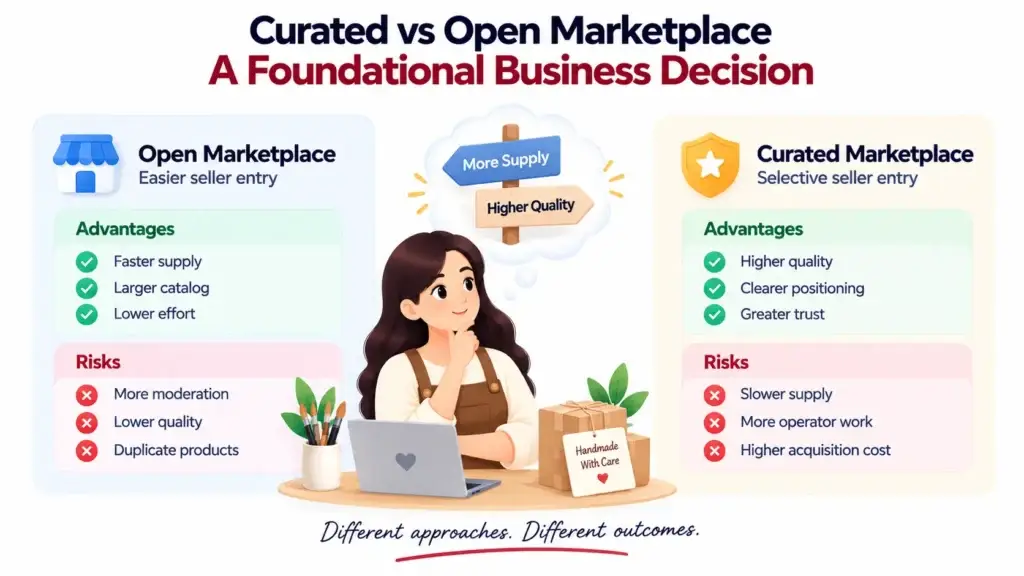
One of the earliest founder choices is how easily sellers enter.
Open model
Prioritizes supply growth.
Advantages:
- Faster seller acquisition
- Faster catalog expansion
- Lower operator onboarding effort
Risks:
- More moderation
- Lower average quality
- More duplicate products
- Greater trust burden
Curated model
Prioritizes seller quality.
Advantages:
- Stronger catalog consistency
- Clearer positioning
- Potentially higher buyer confidence
Risks:
- Slower supply growth
- More operator work
- Higher seller-acquisition cost
Neither model is universally correct.
The choice depends on what makes the marketplace valuable.
Broad Marketplace vs Vertical Marketplace
Another important business-model decision is catalog breadth.
Broad marketplace
May include many categories.
Its challenge is liquidity across all of them.
Vertical marketplace
Focuses on one category or audience.
Examples could include:
- Handmade jewelry
- Local art
- Sustainable homeware
- Wedding crafts
- Personalized gifts
- Regional artisans
A narrow marketplace can sometimes create stronger early liquidity because supply and buyer intent are concentrated.
The founder does not need every category.
They need enough relevance in the categories they choose.
Platform-Led vs Seller-Led Fulfillment
Founders also need to decide who controls delivery.
Seller-led fulfillment
Each maker arranges shipping.
Advantages:
- Lower operator logistics complexity
- Easier geographic expansion
- Sellers retain operational control
Challenges:
- Variable experience
- Harder tracking consistency
- More fulfillment quality variance
Platform-coordinated fulfillment
The operator defines or provides more delivery infrastructure.
Advantages:
- More consistent buyer experience
- Better visibility
- Potential operational efficiencies
Challenges:
- Greater complexity
- Geography matters
- Higher operational overhead
The appropriate model depends on the market, seller density, product type, and geographic scope.
What Metrics Actually Explain Marketplace Health?
Do not judge the business model with one vanity metric.
Supply metrics
- Approved makers
- Activated sellers
- Sellers publishing first listing
- Active listings
- Listings per active seller
- Seller retention
Demand metrics
- Active buyers
- Product views
- Searches
- Add-to-cart activity
- Checkout conversion
- Repeat buyers
Matching metrics
- Searches with useful results
- Category coverage
- Time to first seller order
- Seller utilization
- Buyer-to-seller message activity
Transaction metrics
- Completed orders
- Cancellation rate
- Refund rate
- Fulfillment time
- Repeat purchase rate
Trust metrics
- Review participation
- Average seller rating
- Buyer complaints
- Seller complaints
- Moderation workload
- Dispute resolution time
The most useful dashboard connects the metrics.
For example:
Seller registrations rising + first listings falling = onboarding problem
Listings rising + product views flat = demand or discovery problem
Orders rising + refunds rising faster = quality problem
Buyer traffic growing + seller retention falling = supply economics or operations problem
Founder Decision Signals
Seller Supply Is Still Weak
If buyers regularly search categories with too few credible products, focus on maker recruitment and seller activation before expanding secondary marketplace features.
Listings Exist but Orders Do Not
If catalog depth is healthy but sellers are not receiving orders, investigate buyer acquisition, search quality, product presentation, pricing fit, and marketplace trust.
Orders Grow but Support Load Explodes
If growth creates a proportional increase in manual seller, refund, moderation, and payout work, operator workflows need attention before the next growth push.
Buyers Return to Specific Makers
If repeat purchasing is concentrated around trusted shops, strengthen follows, favorites, shop discovery, reviews, and seller-retention workflows around those relationships.
Handmade Marketplace Business Model Checklist
Before launching or restructuring the marketplace, founders should be able to answer:
- Who are the first makers you want?
- What makes a seller eligible?
- What does seller activation mean?
- How does a maker create a storefront?
- Which products are permitted?
- Does every listing require review?
- What listing quality standards apply?
- Which categories should launch first?
- What supply level makes each category useful?
- How will buyers discover products?
- How does search balance relevance and seller opportunity?
- Can buyers contact sellers?
- How are seller reviews handled?
- Can one buyer purchase from several sellers?
- Who fulfills the order?
- How are cancellations handled?
- How are refunds handled?
- When does the operator intervene?
- What gives buyers a reason to return?
- What gives makers a reason to remain active?
- Can sellers understand earnings and payouts?
- Can operators moderate listings at scale?
- Can support reconstruct an order problem?
- Which metrics indicate marketplace liquidity?
- Which metrics indicate marketplace quality?
Teams moving from business-model validation into product evaluation can also compare ready-made marketplace options across features, implementation scope, and commercial considerations.
If those questions have clear answers, the platform is much closer to having a workable marketplace model.
Mistakes Founders Should Avoid
Measuring Seller Registrations Instead of Seller Activation
A large seller database does not create marketplace value if those sellers never publish credible products or remain available to fulfill orders.
Thinking More Listings Automatically Mean Better Supply
Catalog quantity without relevance, quality, moderation, and availability can make product discovery worse instead of better.
Building Buyer Features Before Solving Seller Operations
A polished storefront cannot compensate for poor seller onboarding, slow moderation, unreliable fulfillment, or confusing payouts.
Treating Trust as Only a Review Feature
Marketplace trust also depends on accurate listings, seller communication, payment handling, predictable order status, refund workflows, moderation, and support.
Designing Revenue Before Marketplace Liquidity
Seller fees do not solve a marketplace where buyers cannot find relevant products or makers receive too little demand. First ensure the core supply-and-demand loop has value.
How Miracuves Supports a Marketplace for Independent Makers
Miracuves provides a ready-made multi-seller marketplace foundation spanning seller onboarding, catalog management, moderation, buyer discovery, multi-seller checkout, orders, seller wallets, payouts, and operator workflows.
Founders who have defined their marketplace operating model can explore Miracuves’ handmade marketplace product foundation when they are ready to evaluate the implementation layer.
For founders moving from marketplace planning into implementation, this guide on choosing a marketplace development partner can help evaluate technical delivery, seller workflows, integrations, source-code ownership, and production readiness.
For deeper product-level detail, the seller marketplace feature set covers seller onboarding, commission controls, subscriptions, moderation, multi-seller checkout, wallets, and payout workflows.
Once seller onboarding, catalog scope, buyer workflows, payment integrations, payout rules, and custom requirements are defined, founders can review handmade marketplace development cost to understand how implementation scope influences the final budget.
If your next question is how the marketplace itself should monetize sellers and transactions, review the handmade marketplace monetization strategy separately rather than mixing revenue design into the operating model.
Businesses planning a broader marketplace across multiple commerce categories can also explore Miracuves’ white-label marketplace software
Where the ready-made scope matches the business requirements, Miracuves can support 6-day solution delivery for the base marketplace platform. Seller recruitment, catalog creation, payment-provider onboarding, market-specific configuration, custom integrations, and broader go-to-market execution still need their own planning.
Founders exploring related retail, niche commerce, and multi-seller business models can also browse Miracuves’ ecommerce marketplace solutions for adjacent marketplace launch options.
Final Thoughts: The Business Model Is the Marketplace Loop
The most useful way to understand a handmade marketplace is not to start with a feature list or fee table.
Start with the loop.
Can you recruit credible makers?
Can those makers turn their products into useful listings?
Can buyers find what they want?
Can the marketplace establish enough trust for a transaction to happen?
Can makers fulfill reliably?
Can buyers get help when something goes wrong?
Can sellers understand their earnings?
Can the operator manage exceptions without manually running every transaction?
When those answers are yes, the marketplace begins to reinforce itself.
More good makers create better supply.
Better supply improves discovery.
Better discovery creates more buyer activity.
More buyer activity produces seller opportunity.
Seller opportunity retains good makers.
Trust and strong operations keep the loop moving.
That is the foundation of a sustainable handmade marketplace platform business model.
FAQs
What is a handmade marketplace platform business model?
It is a two-sided marketplace model connecting independent makers with buyers while the platform manages discovery, transaction infrastructure, trust, seller operations, moderation, support, and marketplace governance.
Who are the main participants in a handmade marketplace?
The core participants are makers, buyers, and the platform operator. Product listings act as the mechanism connecting seller supply with buyer demand.
Why are listings important to the business model?
Listings convert seller supply into searchable inventory. Their quality affects discovery, buyer confidence, conversion, seller performance, and overall marketplace quality.
How does a handmade marketplace create value for makers?
It can provide access to buyers, product discovery, storefront infrastructure, checkout, reviews, communications, order management, financial tracking, and payout workflows without requiring each maker to build those systems independently.
How does the marketplace create value for buyers?
It provides access to products from multiple independent makers through one discovery, trust, checkout, order, and support environment.
What is marketplace liquidity?
Marketplace liquidity describes whether buyers can reliably find relevant supply and whether active sellers can receive meaningful buyer demand. It should often be measured by category rather than only across the whole marketplace.
Why is moderation important in a maker marketplace?
Independent sellers continuously create new product content. Moderation helps maintain catalog quality, marketplace policies, buyer trust, and useful discovery as supply increases.
Does the marketplace need to own inventory?
Not necessarily. In a seller-led model, independent makers can own and manage their inventory while the marketplace coordinates discovery, transactions, trust, and operational rules.
How do seller payouts affect the business model?
Reliable and understandable payouts help retain quality sellers. Sellers need to understand gross sales, deductions, pending earnings, adjustments, available balance, and completed withdrawals.
What should founders validate before launching?
Validate seller supply, seller activation, listing quality, category liquidity, buyer discovery, checkout, fulfillment responsibilities, trust mechanisms, refunds, payouts, moderation, support, and operator workflows.
Miracuves is an independent software development company. We are not affiliated with, connected to, sponsored by, or endorsed by any company or product named in this article.
Terms such as “X Clone” are used descriptively. It is how the software industry refers to building a platform with functionality comparable to a known service, and how clients search for it.
The entire design and codebase of our products is built by our own team. Our products contain no code, design, graphics, or content originating from any third-party website or applications.
All third-party names and marks referenced in this article are the property of their respective owners, referenced solely to identify the services discussed.



