


Key Takeaways
What You’ll Learn
- Grubhub’s revenue model works through multiple income streams instead of depending on just one source.
- Restaurant commissions form the core of the model, with earnings tied to every completed order and service level.
- Customer-facing fees, premium visibility, and subscription plans help expand revenue beyond basic order transactions.
- Corporate and group ordering adds a stronger B2B layer with larger order values and recurring demand.
- The model succeeds because it monetizes restaurants, end users, and business clients in one connected platform.
Stats That Matter
- Restaurant commissions typically range from 15% to 30%, depending on listing and service level.
- Customer delivery fees often range from $2 to $6, with added service or small-order fees in some cases.
- Grubhub+ is positioned at around $9.99 per month, creating recurring subscription-based revenue and stronger retention.
Real Insights
- Grubhub does not rely on orders alone because ads, subscriptions, and enterprise meals make the model more stable.
- Paid restaurant visibility turns discovery inside the app into a monetizable marketing channel.
- Subscription logic improves retention by giving frequent users a reason to order more often.
- Corporate ordering strengthens margins through larger baskets, repeat demand, and long-term contracts.
- The strongest food delivery platforms win financially when commissions, logistics fees, loyalty, and business ordering all work together.
Grubhub is one of the pioneers of the food delivery revolution in the United States. Launched in 2004, the platform has grown into a household name by connecting hungry customers with their favorite local restaurants — all through a few taps on a smartphone. Over the years, it has merged with and acquired competitors, expanded into logistics, and introduced multiple monetization layers.
By 2026, Grubhub processes millions of orders monthly and holds a significant share of the U.S. delivery market, despite stiff competition from DoorDash, Uber Eats, and others. Its success lies not only in its logistics and reach — but in a smart, multi-tiered revenue model that brings in income from restaurants, customers, and promotional partners alike.
In this blog, we’ll break down how Grubhub earns money, why its business model remains effective in 2026, and how you can build your own Grubhub-style food delivery app with a revenue engine.
Turn your food delivery idea into a thriving business with a trusted app development partner who knows how to build Zomato-style success.
How Grubhub Makes Money
Grubhub operates on a multi-sided platform model that earns revenue from restaurants, customers, and advertising partners. Here are its primary revenue streams:
- Restaurant Commissions – Grubhub charges restaurants a commission on each order placed through the platform, typically ranging from 15% to 30%.
- Delivery Fees from Customers – End users pay a service fee and delivery fee on every order.
- Premium Listings & Sponsored Ads – Restaurants can pay to appear higher in search results or run targeted promotions.
- Grubhub+ Subscription – A monthly subscription service offering free delivery and discounts for frequent users.
- Order Processing and Payment Fees – Transaction processing fees are charged to handle digital payments securely.
- Corporate Plans and Group Orders – Revenue from enterprise accounts and catering services for offices and institutions.
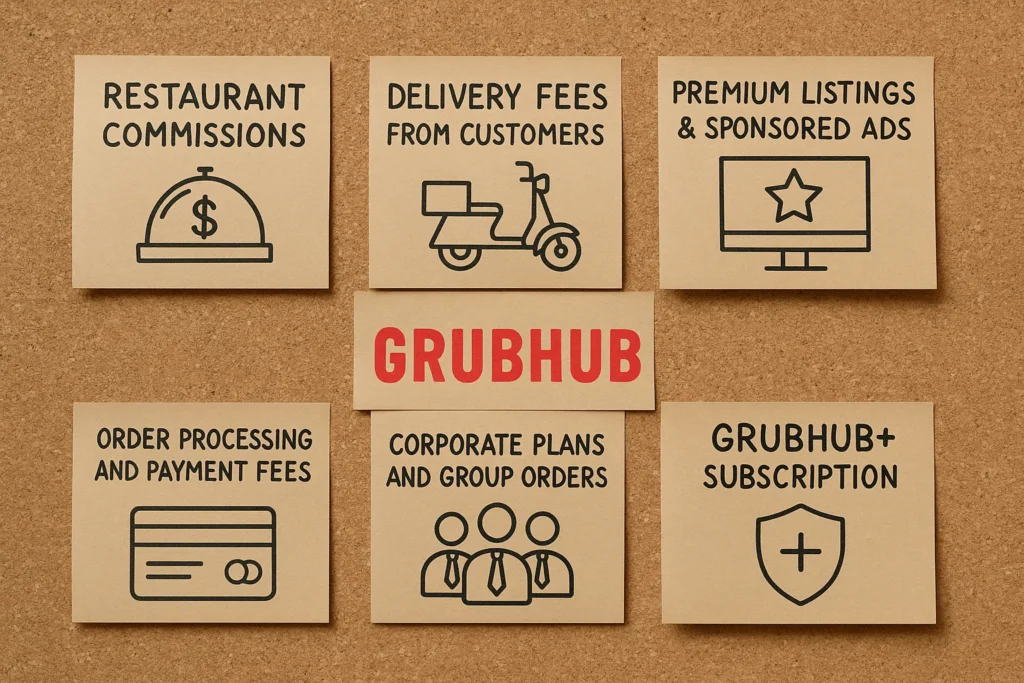
This blended revenue model allows Grubhub to maximize earnings across the entire transaction journey — from restaurant onboarding to user checkout and even post-sale promotions.
Detailed Breakdown of Revenue Channels
Restaurant Commissions
Grubhub’s core revenue stream comes from commissions it charges restaurants for every completed order. These typically range from 15% to 30%, depending on the service level:
- Basic Listing: Lower commission, minimal visibility
- Premium Delivery: Higher commission for inclusion in Grubhub’s delivery network
- Promotional Boosts: Additional fees for marketing and visibility
Who Pays? Restaurants
Why It Scales? More restaurants = more listings = more orders = more revenue
Delivery Fees from Customers
Customers are charged a delivery fee (usually $2–$6), a small order fee, and sometimes a service fee (up to 5%–10% of the order). These charges cover logistics, support, and platform maintenance.
Who Pays? End users placing orders
Why It Scales? Applied to every order, no matter the restaurant
Premium Listings and Sponsored Ads
Grubhub allows restaurants to pay for priority placement in search results, featured spots, and banner promotions. These are often pay-per-click or flat-fee based and offer restaurants higher visibility in crowded local markets.
Who Pays? Restaurants and franchises
Why It Scales? Recurring and performance-based; no cap on participation
Grubhub+ Subscription
Grubhub+ is a monthly subscription (around $9.99) that offers perks like free delivery, lower service fees, and exclusive offers. It’s a loyalty play that boosts order frequency and reduces churn.
Who Pays? Frequent users and foodies
Why It Scales? Recurring monthly revenue with high retention among regular users
Order Processing and Payment Fees
Grubhub charges a processing fee on every transaction, which includes card gateway charges, fraud prevention, and payment handling. These are either passed onto the restaurant, customer, or split.
Who Pays? Shared between restaurants and users
Why It Scales? Charged automatically at volume
Corporate & Group Orders
Grubhub also caters to large offices and institutions through Grubhub Corporate — offering consolidated invoicing, team orders, and catering options. These bulk orders come with higher margins and long-term contracts.
Who Pays? Enterprises, startups, and institutions
Why It Scales? Larger cart sizes, recurring contracts
From real-time order tracking to seamless payments, Grubhub redefines convenience—explore the Grubhub app features every founder should know.
Why This Revenue Model Works in 2026
Grubhub’s revenue model continues to thrive in 2026 because it’s built to adapt — to tech, consumer expectations, and market competition. Here’s why it remains highly effective today:
Continued Growth of Food Delivery
The demand for online food delivery is stronger than ever. In 2026, over 60% of U.S. consumers regularly order meals online, and platforms like Grubhub benefit from increased frequency and order volumes — directly fueling commission and fee-based earnings.
Subscription Loyalty is Booming
Services like Grubhub+ meet the modern appetite for savings and convenience. Subscriptions drive higher customer retention, increased order value, and predictable monthly revenue — all vital in a competitive market.
Restaurant Dependence on Digital Sales
With dine-in traffic fluctuating post-pandemic, restaurants now rely heavily on delivery platforms for visibility and orders. This makes them more willing to pay commissions and invest in advertising — strengthening Grubhub’s B2B revenue side.
Personalized Discovery and Paid Visibility
AI-powered recommendations and geo-targeted ads are now standard. Grubhub’s ability to let restaurants pay for priority listings, while users receive tailored suggestions, keeps both sides engaged and monetized.
Flexible Monetization Across Segments
From small family diners to enterprise-level food chains and corporate offices, Grubhub’s model accommodates multiple monetization paths — not just through food, but through software, services, and data.
Grubhub scaled with hyperlocal campaigns and customer-first storytelling—explore the Grubhub marketing strategy that startups can model.
Can Startups Replicate Grubhub’s Revenue Model?
Yes — but it’s not as simple as just launching an app.
Grubhub’s monetization success comes from years of tech refinement, logistics optimization, restaurant partnerships, and data-driven personalization. Building all that from scratch would require millions in funding, a full-stack tech team, and time — lots of it.
That’s where Miracuves changes the game.
With our powerful, ready-to-launch Grubhub Clone, you can start replicating Grubhub’s revenue model from day one. Here’s how:
- Restaurant commission system with adjustable rates
- Built-in delivery fee and service fee management
- Grubhub+-style subscription model for customer loyalty
- Ad monetization features for restaurant promotions
- Order management with real-time status updates
- Multi-vendor dashboard for full restaurant control
- Corporate ordering module for B2B monetization
Whether you’re targeting a niche city, launching a white-label delivery brand, or building a regional food ordering platform — Miracuves gives you the tools to monetize like a market leader.
Global Cost Factors & Pricing Breakdown
These values reflect global development cost estimates for a Grubhub-like food delivery platform.
Miracuves Grubhub-Like App Solution Cost and Tech Stack
Miracuves Pricing for a R Grubhub-Like Food Delivery Platform developed in PHP/Laravel with Flutter Apps for $2,199 USD (One-Time Price) in just 6 days
Get a fully developed, deployment-ready platform modeled after Grubhub. Built on a reliable PHP/Laravel backend with Flutter mobile apps, this complete solution helps you launch and scale a food delivery business quickly and efficiently.
- Core Workflows: Restaurant listings, menu browsing, cart system, order placement, real-time order tracking, and delivery management.
- Built-in Operations: Pricing logic, delivery fee management, commission setup, order handling, and payment processing.
- Management Hub: Centralized admin panel to manage customers, restaurants, delivery partners, orders, transactions, and overall platform operations.
- Launch-Ready: Fully prepared for your branding, configuration, and immediate go-to-market execution.
Why is it so affordable?
Most modern food delivery platforms are built using complex architectures like Node.js or microservices. While powerful, these approaches require larger engineering teams, longer timelines, and significantly higher development costs.
We took a smarter and more practical approach:
- You Aren’t Paying for Ground-Up Development: Our food delivery engine is already developed, tested, and ready to deploy. You skip months of development time and avoid the high costs of building from scratch.
- The Power of PHP / Laravel: Built on one of the most trusted and widely used frameworks globally, this solution keeps upfront costs low while ensuring long-term flexibility. With a large developer ecosystem, it becomes easier and more cost-effective to maintain, scale, and customize your platform.
- Built for Practical Growth: You get a strong, market-ready food delivery platform with essential features like restaurant onboarding, order workflows, and delivery tracking—without the complexity and expense of enterprise-level builds.
You get a scalable, production-ready platform without paying inflated development costs.
Note: This cost is for the solution, re-branding, deployment, and source code only.
Conclusion
Grubhub’s revenue model is a well-oiled machine — blending commissions, delivery fees, subscriptions, ads, and enterprise solutions into one cohesive ecosystem. It’s a multi-sided marketplace that generates income from every stakeholder: restaurants, users, advertisers, and businesses.
In 2026, its model remains powerful thanks to tech-driven logistics, user loyalty via Grubhub+, and the growing reliance of local restaurants on delivery apps to stay competitive.
For startups and digital agencies aiming to enter this space, you don’t have to start from zero. With the Grubhub Clone by Miracuves, you can launch a custom-branded food delivery platform that includes all the monetization levers — from day one.
FAQs
How does Grubhub generate revenue?
Grubhub earns money through restaurant commissions, delivery and service fees from customers, paid advertising placements, a subscription plan called Grubhub+, and enterprise catering for corporate clients.
Is Grubhub profitable in 2026?
Profitability varies, but Grubhub continues to scale through diversified revenue streams and operational efficiency. Its subscriptions and B2B services have strengthened margins even in a competitive market.
What are the main income sources for Grubhub?
The key sources include restaurant commissions (15–30%), customer delivery fees, Grubhub+ subscriptions, paid listings, and corporate meal plans — making it a well-balanced revenue model.
Can startups use the same revenue model as Grubhub?
Yes, startups can replicate the Grubhub model by using a ready-made platform like the Grubhub Clone from Miracuves. It enables commission management, subscription features, ad tools, and scalable delivery logic out of the box.
Does Miracuves offer a Grubhub clone with monetization features?
Absolutely. Miracuves provides a fully functional Grubhub clone app equipped with revenue features such as commission systems, premium ad modules, subscription billing, and multi-vendor control panels.
Related Articles :-
- Revenue Model of HungerStation: How Saudi Arabia’s Food Delivery Leader Drives Profit
- Revenue Model of Delivery Hero: Inside the Business Behind the Global Food Delivery Giant
- Revenue Model of Foodpanda: How the Food Delivery Giant Makes Money
- Revenue Model of Just Eat: How the Food Delivery Giant Monetizes Every Order