


Key Takeaways
- A food delivery dispatch platform is the operational layer that decides which rider gets which order, when, and on what terms.
- Order assignment, zone rules, and rider availability matter more to delivery cost than the customer app interface.
- Every order transition should capture a named timestamp so delays can be traced to preparation, assignment, pickup, or travel.
- Dispatchers and fleet managers need their own workspace, not a reduced view of the admin dashboard.
- Manual override is a core feature, not a fallback. Automated assignment fails in ways only a human can resolve quickly.
Dispatch Platform Signals
- Support auto-assignment, manual assignment, batching, reassignment, and rejection handling in the same order queue.
- Give riders shift controls, navigation, delivery status actions, proof of delivery, and earnings visibility.
- Let operators draw zones, set distance rules, cap concurrent orders, and throttle intake during peak load.
- Capture preparation time, acceptance time, pickup time, and drop time as separate, queryable records.
- Track assignment latency, rejection rate, idle time, orders per rider hour, and on-time delivery rate.
Real Insights
- A late delivery is rarely a rider problem. It is usually an assignment made too early, too late, or to the wrong person.
- Platforms that log only “delivered” cannot tell an operator whether the kitchen was slow or the queue was empty.
- Rider rejection is an economic signal. When rejection rises in one zone, the payout or the distance rule is wrong.
- Adding more riders does not fix poor dispatch logic. It raises idle time and lowers earnings per rider hour.
- Miracuves builds white-label delivery platforms with customer, restaurant, rider, dispatcher, and admin workflows, source-code ownership, and 6-day delivery for eligible ready-made scopes.
It is 7:40pm in a delivery zone with forty riders online and two hundred orders in the system. Every one of those orders is waiting on a decision nobody will ever see: which rider gets it, and when.
Get that decision right and a rider finishes six deliveries in an hour, the food arrives warm, and the zone turns a contribution margin. Get it wrong and the same forty riders finish four deliveries each, half of them spent standing in restaurant doorways, and the evening loses money while looking busy.
That decision layer is dispatch, and it is the part of a delivery product that almost never appears in a feature comparison.
Most delivery platforms are evaluated on what customers can see. Menu browsing, the cart, the payment screen, the live map. Those screens matter, and they are also the easiest part to build. What separates a delivery business that scales from one that stalls at a few hundred orders a day is the set of rules operating between the moment an order is confirmed and the moment a rider reaches the customer’s door.
A food delivery dispatch platform is the software that makes those rules explicit, configurable, and measurable. This article works through the feature set such a platform needs, role by role, and explains what each feature actually protects in the business. It is written for founders specifying a product, not for engineers implementing one.
Why Dispatch Decides Delivery Economics
Delivery cost is not a fixed number per order. It is the result of how much unproductive rider time sits inside every completed delivery, and dispatch logic is what determines that.
The Same Order, Handled Two Ways
Consider one order from a restaurant that needs eighteen minutes to cook it.
In the first version, the platform assigns a rider the instant the restaurant accepts. The rider is seven minutes away, arrives, and waits eleven minutes for the food. Add a twelve-minute drive to the customer and the order has consumed thirty minutes of that rider’s shift, eleven of which produced nothing.
In the second version, the platform holds the order, estimates preparation time, and offers it to a rider who can arrive as the food is being packed. The same delivery now consumes roughly nineteen minutes of rider time. Nothing about the customer experience changed. The food still left at the same moment and arrived at the same moment.
Across a zone running two thousand orders a week, that eleven-minute difference is the gap between a delivery network that pays for itself and one that needs a larger rider pool to deliver the same volume. You are either paying for riding or paying for waiting, and only dispatch decides the ratio.
Why Screen Count Is the Wrong Evaluation Test
Delivery platforms are often compared by counting screens or listing modules. Two products can both offer a customer app, a restaurant panel, a rider app, and an admin dashboard, and still behave completely differently under load.
The questions that separate them are narrower. Can an operator change the assignment radius at six in the evening without a developer? Can a dispatcher take an order away from a rider who has stopped moving? Does the platform know the difference between a restaurant that is slow and a zone that has no riders?
A feature list answers none of those. The rest of this article is organized around the ones that do.
The Six Roles a Dispatch Platform Has to Serve
A delivery marketplace is usually described as three-sided: customers, restaurants, riders. A dispatch-led platform has six, because somebody has to operate the network itself and somebody else has to reconcile the money it moves.
| Role | What They Do | What They Need From the Platform |
|---|---|---|
| Customers | Order, pay, track, and raise issues | Accurate estimates and visible order progress |
| Restaurants | Accept orders, set preparation time, mark items unavailable | Simple controls that feed dispatch honest data |
| Delivery Partners | Accept offers, collect, travel, complete deliveries | Clear instructions, fair distance, visible earnings |
| Dispatchers | Watch the live queue and intervene on exceptions | Manual assignment, reassignment, order-level context |
| Fleet Managers | Manage rider supply, shifts, documents, performance | Roster tools, availability views, payout records |
| Finance Teams | Reconcile cash, payouts, commissions, refunds | Settlement records tied to individual orders |
Founders routinely specify the first three and discover the last three after launch, usually at the moment a spreadsheet appears beside the platform. Once that spreadsheet exists it tends to stay, and it quietly becomes the real operating system of the business: the place where rider shifts are planned, cash is tracked, and disputes are settled.
The cost is not the spreadsheet itself. It is that none of the decisions recorded in it ever reach the platform’s data, so the reports the founder reads describe a business that is only partly the one being run.
Order Assignment: The Feature Set That Carries the Margin
Assignment is where a delivery platform earns or loses its unit economics. It has to handle four distinct situations, and most products handle only the first one well.
Automatic Assignment and the Rules Behind It
Automatic assignment selects a rider using distance to the restaurant, current load, direction of travel, vehicle type, and recent performance. The valuable part is not that it happens automatically. It is that each input is a setting rather than a line of code.
An operator should be able to change the search radius, decide whether an order is broadcast to several riders at once or offered to one at a time, set how long a rider has to respond, and control how many attempts the platform makes before escalating to a dispatcher.
Broadcast and sequential offers behave very differently, and the right choice changes by time of day. Broadcasting fills orders quickly when riders are plentiful, at the cost of showing the same order to people who will not get it. Sequential offering is fairer and quieter but slower, which hurts during a rush. A platform that hard-codes one of them has removed a decision the operator needs to make twice a day.
Assignment Timing and the Preparation Problem
The single most valuable assignment setting is the one most often missing: how long the platform waits before offering an order at all.
Assign too early and riders queue in restaurant doorways, which is the eleven minutes from the example above. Assign too late and cooked food sits under a heat lamp while the platform hunts for someone to collect it, which is worse, because now the customer receives cold food and the restaurant watches it happen.
Getting this right requires the platform to hold two estimates at once: how long the food will take, and how long a rider will take to reach the restaurant. It should then work backwards from the first to trigger the second. Restaurants need to be able to move their estimate during a rush, and the platform needs to react when they do.
Manual Assignment and Dispatcher Override
Every automated system produces orders it cannot place. A large catering order that will not fit on a bike. A restaurant sitting at the edge of a zone. A customer who has already complained once this week and should not wait again. A rider who is standing outside the restaurant but technically finished their shift four minutes ago.
A dispatcher needs a live queue showing unassigned orders with their true waiting time, available riders on a map with their current state, and the ability to assign directly. They also need to see why the platform failed: no rider within radius, three consecutive rejections, or a restaurant that has not yet confirmed.
Without this workspace, exceptions get handled by phone calls. Those calls resolve the order and record nothing, so the same failure repeats the following evening with nobody able to prove it is a pattern.
Batching and Stacked Orders
Two orders leaving the same restaurant for addresses in the same direction can often travel together. Batching is one of the few features that lowers cost per delivery without lowering rider earnings, because the rider is paid for two orders while riding one route.
It also needs guardrails, and the guardrails are the actual feature. A maximum detour distance. A maximum added wait for whoever ordered first. A rule preventing a hot order and a cold order from sharing a bag. A cap on how many orders one rider may carry at once.
Batching without limits produces a cheaper delivery and an annoyed customer, which is a trade most founders would not make deliberately but many make accidentally.
Rejection and Reassignment Handling
When a rider declines an offer or stops responding, the order has to return to the queue immediately and keep its original timestamp. An order that has already waited nine minutes must not re-enter the queue looking new, or it will sit behind orders that arrived after it.
Rejection data deserves to be kept rather than discarded. A rider declining an order is making an economic judgement about distance, payout, and expected waiting time. When rejections cluster around one restaurant, that restaurant is probably slow. When they cluster in one zone at one hour, the payout for that distance is probably too low.
Treated as noise, rejections are an irritation. Treated as data, they are the earliest warning a delivery network gives before riders start logging off.
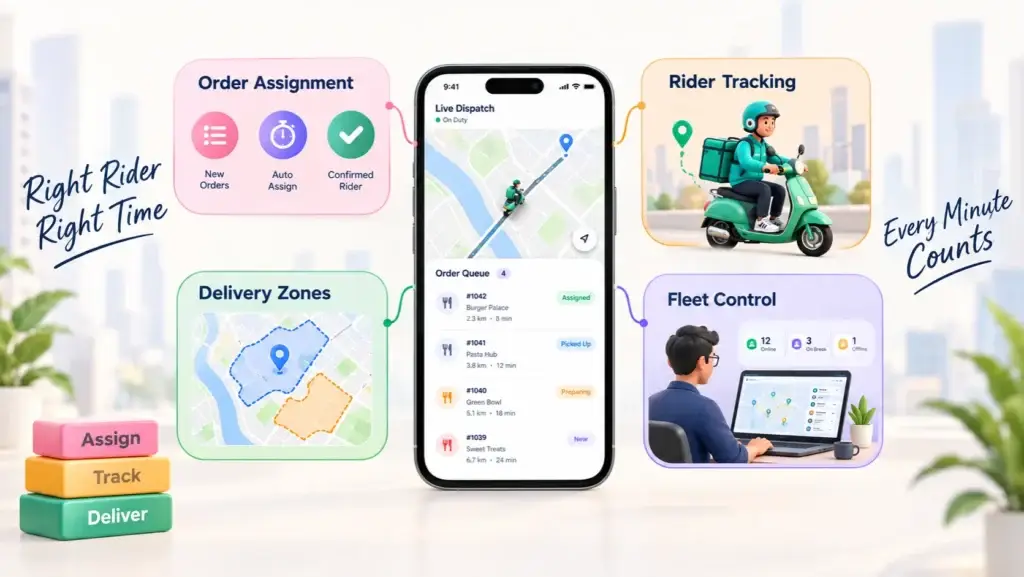
Image Source: AI-generated visual by Miracuves
Order Lifecycle: Every Transition Needs a Named Timestamp
This is the feature founders most often leave out of a specification, and the one whose absence costs the most within six months of launch.
Many platforms store a single order status and overwrite it as the order moves forward. The record ends at “delivered” and every earlier state is gone. When a customer complains that an order took fifty-two minutes, nobody can say which part of the fifty-two minutes was the problem, so the conversation becomes an argument between the restaurant, the rider, and support.
A dispatch platform should write a separate, permanent record for each transition, and never overwrite an earlier one.
Order Lifecycle Timestamps Worth Capturing
| Transition | What It Records | What It Explains Later |
|---|---|---|
| Order Placed | Customer completed checkout | The true age of the order in every report |
| Restaurant Accepted | Kitchen confirmed and set preparation time | Whether the delay started at the restaurant |
| Rider Offered | Order entered the assignment queue | Assignment latency and queue depth |
| Rider Accepted | A delivery partner took the order | Rider supply health in that zone and hour |
| Arrived at Restaurant | Rider reached the pickup point | Waiting time that is paid but unproductive |
| Picked Up | Food handed to the rider | Real preparation time against the estimate |
| Delivered | Order completed with proof captured | Travel time and on-time performance |
What a Complete Timeline Lets an Operator Answer
With these records in place, questions that otherwise turn into opinions become arithmetic. Is that restaurant slow, or was the queue empty when its orders were ready? Are riders waiting longer at one outlet than another? Did on-time delivery fall because of traffic, or because assignment took four minutes instead of forty seconds?
The same timeline also settles disputes. A restaurant claiming the rider arrived late, and a rider claiming the food was not ready, are both answered by two timestamps that already exist.
Over time the timeline becomes the basis for every operational decision worth making: which restaurants need retraining, which zones need more riders at which hour, and whether a pricing change actually improved anything.
Why Location Accuracy Decides Timestamp Accuracy
Timestamps are only as trustworthy as the location data behind them. If rider positions arrive late, drift between buildings, or update every thirty seconds instead of every two, then arrival and pickup events get recorded at the wrong moment and every downstream report inherits the error.
This is why tracking quality is an operational feature rather than a cosmetic one. The engineering side of keeping location updates fast and accurate under real load is covered in Sub-2 Second Tracking: Load-Testing GPS Delivery Updates on Flutter and Laravel, and the failure modes of cheaper implementations in The Ghost Driver Problem: Comparing GPS Accuracy in Cheap Scripts vs. Enterprise Engines.
Rider App Features That Keep Delivery Promises Realistic
The rider application is not a simplified version of the customer app. It is a work tool used outdoors, in traffic, often one-handed, frequently on an older device with intermittent connectivity, by someone being paid per delivery. Every extra tap costs them money.
Shift and Availability Controls
Riders need to go online and offline, choose a zone, and take a break without being penalized silently. A rider who steps away for ten minutes and returns to find their acceptance score damaged will not trust the platform again.
Fleet managers need the other side of the same feature: who is online now, who is approaching the end of a shift, and where supply is thinning before it becomes a problem rather than after.
Order Details and Navigation
An offer should show pickup point, drop point, total distance, expected payout, and rough order size before the rider accepts. Hiding payout until after acceptance raises acceptance rates briefly and damages trust permanently.
After acceptance the rider needs turn-by-turn navigation, contact with the customer through a masked number, and any delivery note that matters on arrival: a gate code, a floor number, an instruction not to ring the bell.
Status Actions and Proof of Delivery
Each transition needs a deliberate action rather than an inference: arrived, picked up, delivered. Inferring arrival from location alone produces false events whenever a rider passes a restaurant on the way somewhere else.
Proof of delivery can be a photograph, a one-time code read out by the customer, or a signature, depending on order value and local practice. High-value orders and contactless drops usually justify different proof. This one feature removes most disputed-delivery arguments, and it pays for itself the first time a refund is refused on evidence.
Earnings and Payout Visibility
Riders should see earnings per order, a running daily total, progress toward any active incentive, and the date of the next payout. None of this is technically difficult, and its absence is one of the most common reasons delivery partners move to a competing network.
Payout opacity also creates support load that lands on the operations team. Every rider who cannot see what they earned asks someone, and that someone has to look it up.
Cash Handling
In markets where cash on delivery is common, the rider app needs a running cash balance, a deposit limit that stops offering cash orders once the balance is exceeded, and a settlement record showing what has been handed in.
Without those three controls, cash reconciliation becomes a weekly manual exercise and the platform carries an unmeasured liability in riders’ pockets. The deposit limit in particular is a risk control disguised as a product feature.
Designing for Real Devices and Weak Connections
Rider applications fail in conditions customer apps never meet: basement car parks, lift shafts, dense urban areas where signal drops for ninety seconds at a time.
Status actions should queue locally and sync when the connection returns, rather than failing and forcing the rider to retry. Location updates should batch rather than drop. Battery consumption matters, because a rider whose phone dies at eight in the evening stops earning and the platform loses a unit of supply during its busiest hour.
Founder Decision Signals
Speed
If the first zone must go live within weeks, assignment logic, rider apps, and dispatcher tools should already exist rather than being specified from scratch.
Cost
Dispatch quality shows up as cost per delivery. Weak assignment logic is paid for on every single order, not once during development.
Scalability
Adding a second city should mean drawing a zone and setting rules, not writing code. Configurability is the real scalability test.
Market Fit
Cash handling, vehicle types, address formats, and rider supply differ sharply by market. The dispatch layer has to bend to local reality.
Delivery Zone and Coverage Features
A zone is the unit that makes delivery operations manageable. Almost every control worth having is easier to reason about when it applies to a defined area rather than an entire city.
Zone Drawing and Overlap Rules
Operators should draw service areas on a map rather than describe them by postcode, because delivery reality follows roads, rivers, bridges, and one-way systems. Two addresses four hundred metres apart can be a twenty-minute ride if a railway line runs between them, and no postcode boundary captures that.
Where zones overlap, the platform needs an explicit rule deciding which one owns the order, and that rule has consequences: it determines which rider pool is searched, which fee table applies, and which team is accountable when the order is late.
Distance Rules and Delivery Fees
Delivery fees should be configurable by distance band, order value, time of day, and current demand. A founder needs to change these without waiting for a release, because the first pricing model is almost never the right one and the second rarely is either.
Fee structure and rider payout are two halves of one decision. Raising the customer delivery fee without raising the rider payout in the same distance band improves margin on paper and raises rejection rates in practice, which then costs more than the fee earned.
Capacity Limits and Order Throttling
During peak hours a zone can accept more orders than it can physically deliver. A platform needs graduated responses rather than one blunt switch: extend the delivery estimate shown at checkout, pause new orders from a single overloaded restaurant, or stop intake across the zone temporarily.
Refusing an order feels like losing revenue, and founders resist building this. Accepting an order that arrives forty minutes late costs a refund, a support conversation, a damaged restaurant relationship, and often the customer permanently. The throttle is cheaper than all of that.
Opening the Second Zone
The first zone is built by hand and held together by attention. The second is the test of whether the platform is actually configurable.
Opening a new area should mean drawing a boundary, setting fee bands, defining rider payout, and onboarding restaurants. If it also requires a developer, then every future city carries an engineering cost, and expansion speed is capped by a release cycle rather than by commercial readiness.
Fleet Management Features for Operations Teams
Rider supply stops being self-managing somewhere around a few dozen delivery partners. Past that point it is an asset that has to be planned, measured, and kept honest.
Fleet Controls a Delivery Operator Needs
| Control | What It Does | Founder Decision |
|---|---|---|
| Rider Onboarding | Collects documents, licences, and verification before activation | Decide what is mandatory and what blocks going online |
| Shift Planning | Sets expected rider coverage per zone and time slot | Match supply to known demand peaks rather than guessing |
| Live Fleet View | Shows every rider, their state, and their current order | The main screen for anyone operating the network |
| Performance Records | Tracks acceptance, on-time rate, ratings, cancellations | Define fair thresholds before enforcement, not after |
| Incentive Rules | Adds surge pay, trip bonuses, or peak-hour boosts | Use targeted incentives instead of permanent rate rises |
| Payout Processing | Calculates earnings, deductions, and settlement cycles | Decide payout frequency early since it drives retention |
Two of these deserve more attention than they usually get. Performance thresholds should be defined and published before they are enforced, because retroactive standards destroy trust faster than low pay does. And incentive rules should be targeted at a zone and an hour rather than applied across the network, since a permanent rate rise is almost impossible to reverse once riders have planned around it.
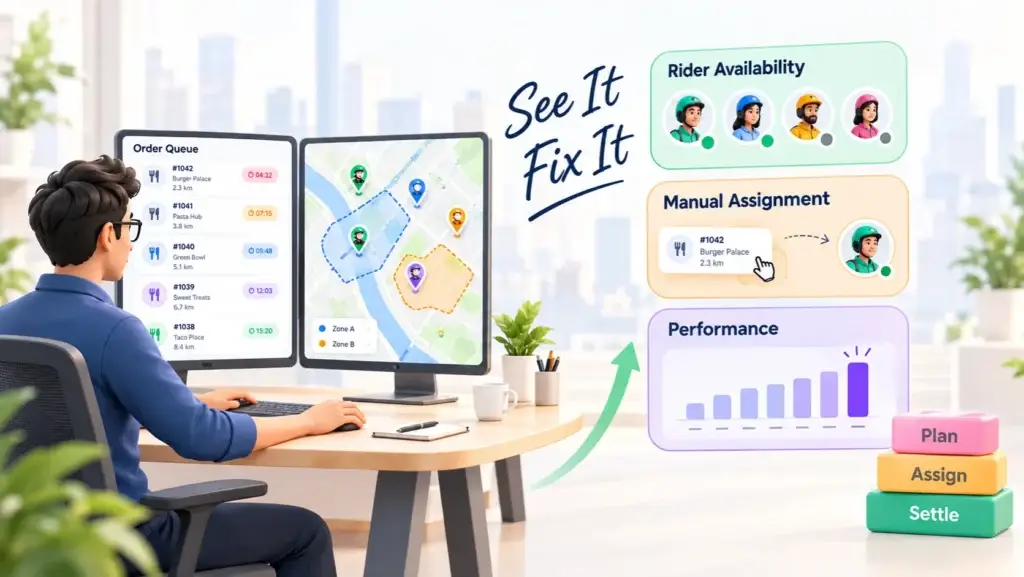
Image Source: AI-generated visual by Miracuves
Restaurant-Side Features That Protect Dispatch Accuracy
Dispatch quality depends entirely on the honesty of the data restaurants provide. A platform can have excellent assignment logic and still perform badly if every preparation estimate is wrong by ten minutes.
Preparation Time Signals
A restaurant should be able to set a realistic preparation time per order and raise it during a rush, in one tap, from the screen they are already looking at. If the platform assumes a fixed figure, riders arrive too early during peaks and too late during quiet hours, and both errors cost money.
The platform should also learn. A restaurant that consistently states fifteen minutes and takes twenty-four is not being dishonest so much as optimistic, and dispatch should weight the observed figure rather than the stated one.
Item Availability
Marking an item unavailable should take one tap and apply immediately across the customer app. When availability data is stale, orders get accepted and then cancelled after a rider has already been assigned and travelled, which wastes rider time, disappoints the customer, and strains the restaurant relationship all at once.
The commercial damage this causes, and why it is so often a symptom of a cheap underlying platform, is examined in The Out-of-Stock Trap: Why Cheap Delivery Scripts Ruin Restaurant Relationships.
Acceptance Windows and Escalation
Orders that sit unacknowledged need an automatic path rather than a human noticing. The platform should escalate to a second device or a phone alert, then offer the order to another outlet of the same brand where one exists, then cancel and inform the customer early rather than late.
A cancellation at four minutes is a mild disappointment. The same cancellation at twenty-two minutes, after the customer has told someone food is coming, is the kind of experience that ends a customer relationship. The full role-by-role breakdown of these panels is set out on the delivery platform feature breakdown.
Customer-Facing Tracking Features That Reduce Support Load
Customer tracking is usually specified as a delight feature. In practice it is a cost-control feature, because a customer who can see accurate progress does not contact support, and support contacts are one of the largest variable costs in a young delivery business.
The useful elements are modest. An order state that matches reality rather than an optimistic script. A delivery estimate that updates when conditions change. Rider location once the order has been collected, not before, since showing a rider who has not yet been assigned creates more questions than it answers. Masked contact. A clear path to report a problem that does not require finding an email address.
An estimate that never moves is worse than no estimate at all. When the platform knows an order is running fifteen minutes late and continues displaying the original time, the customer discovers the delay at the exact moment they are least willing to hear about it. A revised estimate delivered early is usually accepted; the same information delivered late reads as dishonesty.
Admin and Reporting Features That Make Dispatch Measurable
An operator cannot improve what the platform does not record. A dispatch-capable admin layer should report at least the following, and each one should map onto a decision rather than sit on a dashboard.
- Assignment latency. Time between an order becoming ready to assign and a rider accepting it. Rising latency means rider supply or payout needs attention in that zone.
- Rejection rate by zone, restaurant, and hour. Clustering identifies whether the problem is a slow kitchen or an underpriced distance band.
- Rider waiting time at pickup. Exposes restaurants whose preparation estimates are wrong, and assignment timing that is firing too early.
- Orders per rider hour. The clearest single measure of whether dispatch logic is working. Falling numbers usually mean zones are too large or batching is switched off.
- On-time rate against the customer estimate. Measured against what the customer was told, not an internal target, because only one of those affects retention.
- Cancellation reasons by stage and by party. A cancellation before assignment and one after pickup are different failures with different fixes.
- Cash held by riders. With an alert when a balance passes its deposit limit, since this is an unsecured liability.
The test of a reporting layer is not how many charts it draws. It is whether an operations lead can open it at nine in the evening, see which zone is failing, and know what to change before the rush ends.
Settlement Features: Where Operations Meet Finance
Every completed delivery creates several financial movements at once. The customer pays. The restaurant earns its share minus commission. The rider earns a delivery fee plus any incentive that applied. The platform retains what is left, and sometimes gives part of it back as a refund.
These need to be recorded per order as they happen, not reconstructed at month end from three separate exports. A founder should be able to open any single order and see exactly who was owed what, including adjustments, discounts funded by the platform, discounts funded by the restaurant, and any refund with its reason.
Discount attribution is worth specifying carefully, because it is the most common source of disputes with restaurant partners. A promotion where nobody agreed in advance who was funding it will be argued about at every settlement cycle.
How these flows combine into a working revenue model is covered on the delivery platform business model page, and the wider marketplace economics in Food Delivery Marketplace Business Model: How Restaurants, Customers, Riders, and Platform Economics Connect.
Mistakes Founders Should Avoid When Specifying Dispatch Features
Treating dispatch as a map screen
A live map showing rider positions looks like dispatch but decides nothing. The feature that matters is the rule set choosing who receives an order and when, plus the ability to change those rules without a release.
Automating assignment with no manual override
Exceptions arrive every evening. Without a dispatcher workspace they are handled by phone calls that leave no timestamp, no record, and no way to prove a pattern exists.
Storing one order status instead of a timeline
Overwriting status as the order progresses destroys the evidence needed to explain a late delivery. Each transition should be a separate, permanent record.
Assigning riders the moment an order is accepted
It feels responsive and it buys nothing. The rider simply waits at the restaurant instead of waiting somewhere else, and that waiting is paid time producing no deliveries.
Ignoring rider economics in the product
Unclear payouts, unfair distances, and invisible incentives push delivery partners to other networks. Retention is a product problem long before it becomes a recruitment problem.
Launching a zone larger than the fleet can serve
Wide coverage on day one produces long distances, idle riders, and late orders. A smaller area served reliably builds repeat customers far faster than a large one served badly.
Build or Adapt: How Founders Usually Get These Features
Almost nothing described above is novel. Assignment logic, zone rules, rider applications, and settlement records exist in every mature delivery operation. What differs between founders is how many months they spend rebuilding them before the first order is delivered.
Building from zero gives complete freedom and a long timeline. The dispatch layer is usually the part that takes longest, and the part most likely to be underestimated, because its edge cases only appear under real load with real riders. A team can ship a working customer app in weeks and still spend months learning why orders stack up at 7:40pm.
Starting from a ready-made food delivery solution shortens that path, on two conditions. The platform has to be genuinely configurable rather than merely rebrandable, and the source code has to belong to the founder, or the saving on day one becomes a constraint in year two.
The long-run cost difference between those routes is worked through in The 36-Month TCO Comparison: SaaS Delivery Builders vs. Owned White-Label Engines, and the migration path away from a hosted builder in Migrating from SaaS to Owned Infrastructure: A Peak-Hour Performance Comparison.
How Miracuves Helps Founders Launch a Dispatch-Ready Delivery Platform
Miracuves builds white-label delivery platforms that ship with the operational layer already in place: customer ordering, restaurant panels, rider applications, dispatcher tools, zone configuration, payment and payout workflows, and admin reporting.
Founders receive source-code ownership, branded design, and a configurable rule set rather than a fixed product, which matters most in the settings covered throughout this article: assignment radius, offer behaviour, batching limits, fee bands, payout rules, and zone capacity.
For eligible ready-made scopes, deployment runs on a 6-day timeline, with customization handled as a separate scoped phase. Teams needing something further from the standard model can work through food delivery app development as a custom engagement, or review the wider range of ready-made and white-label app solutions.
Dispatch Feature Checklist Before Launch
A practical way to evaluate any delivery platform, whether built or bought, is to ask whether an operator could do each of the following without involving a developer.
- Change assignment radius, offer behaviour, and response window
- Delay assignment until a rider can arrive as the food is ready
- Manually assign or reassign any order in the live queue
- Set a maximum detour and maximum added wait for batched orders
- Open any order and read every transition timestamp it recorded
- Show riders expected payout before acceptance and earnings after completion
- Capture proof of delivery in a form suited to the market
- Draw, edit, cap, and pause a delivery zone
- Let restaurants change preparation time and item availability instantly
- Track cash per rider against a deposit limit
- Explain one order’s settlement line by line, including who funded each discount
- Open a second zone without a code release
Final Thoughts: Dispatch Decides Whether Delivery Scales
Customer-facing features earn a delivery platform its first orders. Dispatch features decide whether the two hundredth order of the evening arrives warm, on time, and at a cost the business can sustain.
That distinction matters most at the point where a delivery business starts working. Demand is rarely the thing that breaks first. What breaks is the assumption that a network which coped with fifty orders a day will cope with five hundred, when the logic underneath it was never designed to be adjusted.
A platform whose rules are visible, editable, and recorded can be tuned every week as the operation learns. One whose rules are buried in code can only be rebuilt. The questions worth asking before choosing are the narrow, practical ones from the checklist above, and a platform that answers yes to most of them is ready to operate rather than merely ready to demonstrate.
FAQs
What is a food delivery dispatch platform?
A food delivery dispatch platform is the operational layer of a delivery business. It decides which delivery partner receives each order, when the offer is made, how rejections and reassignments are handled, how orders are batched, and how delivery zones behave under load. It also records the order lifecycle so delays can be traced and settlement can be explained per order.
What features does order assignment need in a delivery platform?
Order assignment needs four capabilities working together: automatic assignment using distance, rider load and direction of travel; manual assignment so a dispatcher can handle exceptions; batching with limits on detour and added customer wait; and rejection handling that returns an order to the queue with its original timestamp intact. The assignment rules should be editable by an operator without a code release.
Why do order lifecycle timestamps matter in food delivery?
Many platforms store a single order status and overwrite it as the order progresses, which destroys the evidence needed to explain a late delivery. Recording a separate timestamp for order placed, restaurant accepted, rider offered, rider accepted, arrived at restaurant, picked up and delivered lets an operator tell whether a delay came from the kitchen, the assignment queue, rider supply, or travel.
What should a delivery rider app include?
A rider app should include shift and availability controls, order details with expected payout shown before acceptance, turn-by-turn navigation, masked customer contact, deliberate status actions for arrival, pickup and delivery, proof of delivery, earnings and payout visibility, and a running cash balance with a deposit limit in markets where cash on delivery is common.
How do delivery zones affect dispatch performance?
Zones make delivery operations manageable because fees, capacity, rider supply and pricing rules can all be scoped to a defined area. Operators should be able to draw zones on a map rather than use postcodes, set a rule for overlapping areas, configure delivery fees by distance band and demand, cap concurrent orders, and pause intake temporarily during peak load.
Which metrics show whether dispatch logic is working?
The most useful measures are assignment latency, rider rejection rate by zone and restaurant, rider waiting time at pickup, orders per rider hour, on-time delivery rate measured against the estimate shown to the customer, cancellation reasons by stage, and cash held by riders. Each one points to a specific operational decision rather than a general trend.
Should founders build dispatch features from scratch or start from a ready-made platform?
Building from zero gives complete freedom and a longer timeline, and the dispatch layer usually takes longest because its edge cases only appear under real load. A ready-made platform shortens that path when it is genuinely configurable and the source code belongs to the founder. Miracuves provides white-label delivery platforms with dispatch, rider, restaurant and admin workflows included, with 6-day deployment for eligible ready-made scopes.
Miracuves is an independent software development company. We are not affiliated with, connected to, sponsored by, or endorsed by any company or product named in this article.
Terms such as “X Clone” are used descriptively. It is how the software industry refers to building a platform with functionality comparable to a known service, and how clients search for it.
The entire design and codebase of our products is built by our own team. Our products contain no code, design, graphics, or content originating from any third-party website or applications.
All third-party names and marks referenced in this article are the property of their respective owners, referenced solely to identify the services discussed.



