Key Takeaways
- The cold start is not a motivational obstacle: customers, restaurants and drivers are each making the correct decision by waiting for the other two, so the standoff only ends when you deliberately pay one side to stop waiting.
- Density is a function of area rather than ambition, which is why a first zone should be one to three square kilometres, small enough for a driver to cross in ten minutes and for a founder to walk in half an hour.
- Drivers are the right side to over-supply, because a customer who waits fifty minutes never returns and a restaurant with no orders stops watching the screen, while a driver paid for an idle hour is merely expensive.
- Six kitchens that people already travel for will outperform forty that nobody was looking for, and a menu nobody searches for adds maintenance work without adding a single order.
- In week one you can honestly promise a small number of restaurants delivered reliably inside a defined area, and you cannot promise selection, because implied breadth produces silent and permanent churn.
Cold Start Decision Signals
- Draw a delivery boundary small enough to embarrass you slightly when you show it to somebody.
- Write the first loss into the launch budget as one line, spent on guaranteed driver hours, with an end date.
- Sign six restaurants that already have a queue rather than forty that said yes because it was free.
- Close the app during the hours you have not bought capacity for, and say so plainly in every message.
- Hand-dispatch the first fifty orders yourself and write down every failure the same evening.
Real Insights
- A budget split evenly across customers, restaurants and drivers buys a thin version of all three and breaks the deadlock on none of them.
- Guaranteed driver pay gets cheaper on its own as volume arrives, because more shifts clear the floor on their own earnings without anybody renegotiating.
- The clearest early evidence is qualitative: a second order from the same street at full price, an owner asking about their other outlet, a driver choosing your shift.
- Widen only when the existing area is saturated rather than when it first looks profitable, because a small zone can look profitable simply by being under-served.
- Miracuves builds white-label food delivery dispatch platforms with zone-scoped dispatch, named timestamps and fleet controls already in place, deployed in 6 days of build time for eligible ready-made scopes.
There is a map on the wall with a boundary drawn on it and nothing inside. The software works. The dispatch console opens, the rider app installs, payments run in test mode, and everything waits for a first order. None of that is the problem.
The problem is three conversations you are about to have, and all three end the same way. The restaurant owner asks how many customers you have. The customer asks which restaurants you carry. The driver asks how many orders an hour he can expect. Each is asking for evidence of the other two, and you have none of it.
This is the three-sided cold start, and it happens exactly once. Every zone after this one launches from a playbook the first one wrote. A food delivery dispatch app is not hard to build any more. What is hard is the first fortnight, in the first small area, before anything has proved that any of it works.
Grubhub had to break this deadlock in every city it entered, one zone at a time.
The Three-Sided Cold Start in a Delivery Dispatch Zone
A platform like Grubhub cannot solve three sides at once, and the order it solves them in is the strategy.
The deadlock gets described as a chicken and egg problem, which makes it sound like a riddle with a clever answer. It is not a riddle. It is three people each making a correct decision with the information in front of them.
The Customer Is Right to Wait
Installing a new delivery app costs a customer nothing in money and quite a lot in risk. The risk is the evening. If the list is short and the food arrives cold at nine fifteen, dinner is spoiled and no refund fixes it.
The alternative already works, so the rational move is to let somebody else test the new thing first. Customers are not withholding support. They are protecting a Tuesday evening, which is a reasonable thing to protect.
The Restaurant Is Right to Ignore You
A restaurant is a business with a lease, a payroll and a kitchen already under pressure at eight on a Friday. A new channel costs it the scarcest thing it owns, the attention of the person at the pass during service.
Most owners will not refuse you. They will sign, take the tablet, put it next to the till and never look at it. That is worse than a refusal, because it produces a signature you can count and a restaurant that does not actually exist on your platform. What happens afterwards is its own subject, covered in How to Keep Restaurants, Riders, and Customers Happy Simultaneously.
The Driver Is Right to Stay Where the Orders Are
A driver’s income is orders completed per hour, minus fuel, minus the hours nothing arrives. He is not choosing between your app and staying home. He is choosing between your app and one that already has volume at that hour on that street.
Three people, three correct decisions, one market that does not move. None of it dissolves because you explain the vision well or because your product is better. It is a standoff, and standoffs end when somebody stops waiting.
Breaking a Delivery Dispatch Deadlock by Overpaying on Purpose
The only reliable reason for one side to stop waiting is that you paid it to. So the first question of a cold start is not how to avoid losing money in month one. It is which of the three losses you are deliberately buying.
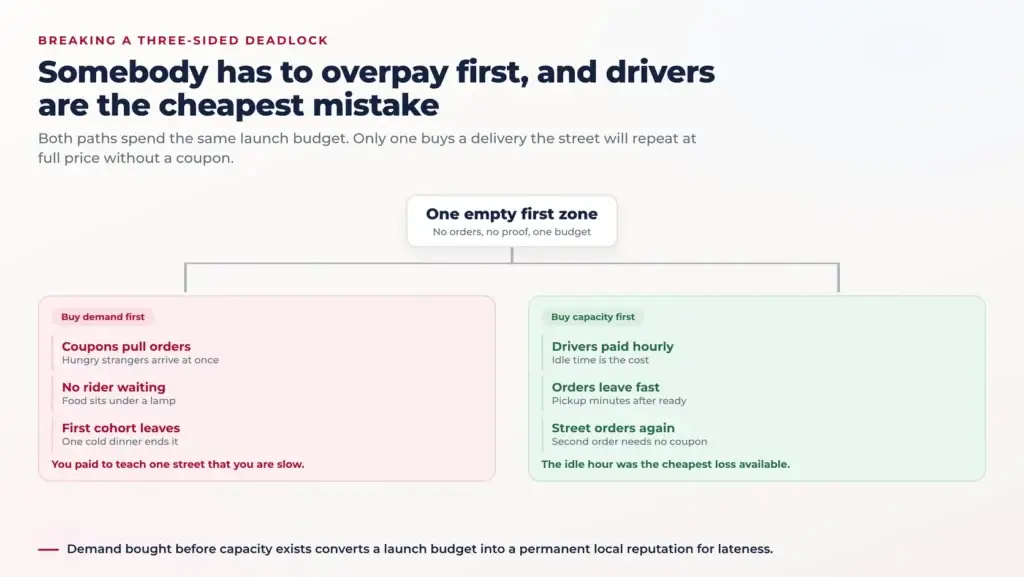
Image Source: AI-generated visual by Miracuves
The First Loss Is a Line Item, Not an Accident
Operators who plan a launch budget as marketing spend buy the wrong side, because marketing spend points at customers by default. Plan it as the price of removing one party from the standoff and it becomes obvious that the money could go to capacity instead of coupons.
Put a figure on it before launch and give it an end date. An unbounded subsidy is how a cold start turns into a permanent business model, and the way the revenue lines actually work assumes an operation that eventually charges for what it delivers.
It also competes with the build, because every week of engineering is a week of driver guarantees you did not buy. A first zone needs dispatch that works and named timestamps, not a novel assignment engine, and Which Features Does a Food Delivery Dispatch App Need for Order Assignment, Rider Tracking, and Fleet Control? covers what a competent platform already contains. What sits outside a build timeline, including gateway onboarding and live keys, is on the facts page.
Why It Cannot Be Split Three Ways
The instinct is to hedge. Some money for customer offers, some for onboarding, some for driver incentives, a third each. This is the most expensive plan available and it is the one most first zones run.
A third of a budget buys a thin version of each side, and thin demand, thin supply and thin capacity add up to a platform where every order is a coin toss. One side has to be visibly, almost embarrassingly over-supplied, because the only thing that converts the other two is watching the deadlock break in front of them.
Why a First Delivery Dispatch Zone Should Be Absurdly Small
Before you decide which side to overpay, decide how much ground that payment has to cover. Get this wrong and no budget is large enough, because the thing that makes all three sides work is density, and density is arithmetic.
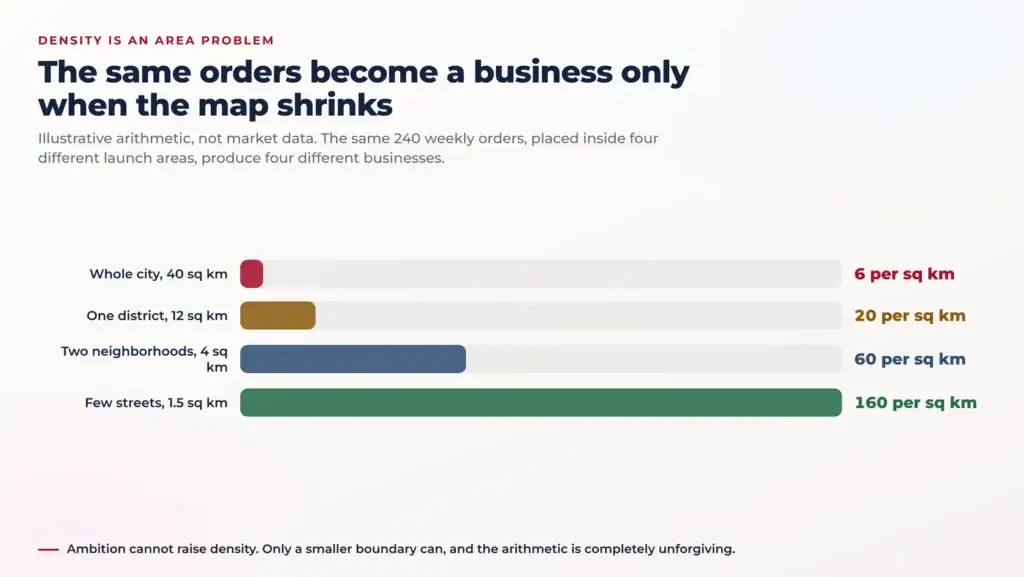
Image Source: AI-generated visual by Miracuves
How Small Is Small
Small enough that a driver can cross it in ten minutes and a founder can walk it in half an hour. In most cities that lands between one and three square kilometres. Not a city, not a suburb, not a postcode. A market street and the four roads behind it. A university block. One office cluster and the lanes that feed it.
Founders resist this because it feels unambitious and because the pitch deck says city. The deck can keep saying city. The delivery boundary should embarrass you slightly when you show it to somebody.
Density Is a Function of Area, Not Ambition
Take an illustrative number. Suppose your launch produces two hundred and forty orders in a week, which for a first zone is a respectable result. Spread across forty square kilometres, that is six orders per square kilometre, which is indistinguishable from nothing.
The same two hundred and forty orders inside one and a half square kilometres is a hundred and sixty. Same orders, same money, same team. One of those is a market with a heartbeat and the other is a rounding error, and the only variable that changed was the line on the map.
Density is what makes short trips possible, which makes driver earnings per hour possible, which makes drivers stay. Every mechanism you are counting on runs downstream of it.
Draw the Boundary Where the Kitchens Already Are
The boundary is not a circle around your office. It is drawn around a cluster of kitchens that already have a queue on a weekday evening, extended far enough to include the homes and desks of the people standing in it.
Walk it before you draw it. Note where traffic stops moving at seven, which lane the two-wheelers cannot enter, which gated complex takes six minutes to get past the guard. Those minutes are the real cost of your zone and none of them appear on a mapping tool. Zone-scoped dispatch and capacity are standard in a white label delivery app. The shape of the zone is a judgement only a person on the ground can make.
Over-Supply Riders First in a New Delivery Dispatch Zone
Three sides, three possible losses, and they are not equal in what they cost when they go wrong. Two damage something you cannot repurchase. One just costs money.
A Customer Who Waits Fifty Minutes Does Not Come Back
Over-supply demand first and you have invited strangers to test an operation that cannot serve them. The food is ready at seven forty with nobody to carry it. It leaves at eight and arrives cold.
You did not just lose that order. You spent money to teach one street that you are slow, and that lesson does not expire. Live tracking softens a wait rather than shortening it, as Sub-2 Second Tracking: Load-Testing GPS Delivery Updates on Flutter and Laravel sets out. It cannot rescue a delivery that had no driver to begin with.
A Restaurant With No Orders Simply Stops Looking
Over-supply restaurant sign-ups first and you get a roster of forty names and a tablet gathering grease in each of them. Nothing arrives on it for nine days. On the tenth day an order does arrive, and nobody notices for eleven minutes.
That failure is cheap in cash and expensive in credibility, because you now have to re-sell forty owners who have already decided you do not work. Getting a kitchen to watch the screen requires order volume, which is precisely what you do not have.
A Driver Paid for an Idle Hour Is Merely Expensive
Now the third. Over-supply drivers and the worst outcome is paying four people to sit on their bikes near a market street for two hours while three orders come in. That is money spent and nothing else. Nobody’s dinner was ruined and no owner concluded you are useless.
Better still, that idle capacity is what makes the other two sides believable. The customer gets food in twenty-two minutes and orders again. The owner sees a rider appear four minutes after the ticket prints and starts watching the screen.
Which Side to Over-Supply First, and What It Costs When It Fails
| The side you over-supply | What the spend looks like | What it costs when it goes wrong |
|---|---|---|
| Customers | Discounts, first-order offers, local advertising | Strangers experience an operation that cannot serve them, and a street learns you are slow. Not repurchasable. |
| Restaurants | Onboarding effort, photography, waived fees, hardware | Forty kitchens decide you do not work before you have volume, and each one has to be re-sold by a person. |
| Drivers | Guaranteed hourly pay for declared shifts | You pay for hours that produced few deliveries. The loss is cash, it is visible daily, and it can be reduced next week. |
What Guaranteed Availability Costs and What It Buys
Paying for driver availability before you have volume feels wrong, because it means paying for an outcome that has not happened. That is exactly what it is, and it is the cheapest of the three losses because it is so easy to see and so easy to stop.
You Are Buying Hours, Not Deliveries
The arrangement is a declared shift with a floor. A driver commits to be inside the zone between six and ten, and you guarantee a minimum for that window whether orders come or not. If his deliveries earn more than the floor, he keeps the higher number and the guarantee costs nothing that evening.
That structure gets cheaper by itself. As volume arrives, more shifts clear the floor on their own earnings and the subsidy shrinks without anybody negotiating it down. Employment classification, insurance and background checks are your own arrangements with local advisers, not something any software ships with.
Open Only the Hours You Have Bought
The corollary is that the app should be closed the rest of the time. Not quietly worse, actually closed. A platform that accepts an order at three with no rider within reach is generating its own bad reviews.
Two dinner services and one lunch is a perfectly respectable first zone. Capacity, coverage hours and fee rules all belong to the zone in a well-built system, and the dispatch and fleet feature set assumes you will use those controls rather than run everything permanently open.
Sign Few Restaurants, and Sign for Pull
The supply side is where cold starts quietly go wrong, because signing restaurants feels like progress and is easy to measure. Six kitchens people already travel across the neighborhood for will outperform forty nobody was looking for.
What High Pull Actually Means
Pull is when the restaurant’s name is the reason the app gets opened. It shows up as a queue at the counter on a normal Wednesday, a dish people describe by name to each other, or a place that already turns away phone orders.
The test runs on foot. Stand outside at seven for twenty minutes and count. A kitchen with real pull brings its own demand, which means part of your customer acquisition is being done by somebody else’s reputation.
A Menu Nobody Searches For Adds Work
Every additional restaurant is a menu to keep accurate, items that go out of stock, hours that change, a person to call when a ticket is missed. That work is identical whether it produces forty orders a week or none.
An inaccurate menu is worse than an absent one, because the customer finds out at the worst possible moment. Anyone who has run a platform on a cheap script knows how this goes, which is the subject of The Out-of-Stock Trap: Why Cheap Delivery Scripts Ruin Restaurant Relationships.
Forty Signatures Is a Warning, Not a Milestone
If forty restaurants in a small square agreed to join in the first fortnight, almost none did so because they wanted the orders. They agreed because it was free and saying yes was faster than saying no.
Six who asked what the commission is, asked what happens when a driver is late and pushed back on something is a better roster. A restaurant that argued about terms intends to use the thing.
Seed the Demand Side Locally and Unglamorously
With capacity bought and a short list of kitchens people already want, demand is the easy side. It is easy only if you resist every instinct that comes from watching how large platforms advertise.
Address the Streets, Not the City
Say the street names. A message written for a specific set of lanes converts far better than a city-wide one, and it has the virtue of not reaching people you cannot serve.
The unglamorous channels are the right ones: a card at the counter of the six restaurants, a note with a takeaway bag, the resident group for two apartment complexes, a table at the office cluster at lunchtime. A city billboard for a zone this size is almost entirely waste.
Scope the Offer to a Radius
Offers should be bounded by geography, not by budget. A budget-bounded offer runs until the money is gone, which means it is still running when it reaches somebody four kilometres outside your zone who then has a bad first experience.
Tie the offer to the delivery area and the open hours and it stops being an acquisition cost and becomes a density tool. Keep it small. The purpose is to get a first order placed, not to make your food permanently cheaper than the restaurant’s own counter.
Promise Reliability, Never Promise Selection
In week one you have one honest claim available, and it is a good one. A small number of genuinely good kitchens will arrive reliably and quickly inside a defined area. That is a real proposition and it is true.
What Week One Can Honestly Claim
Name the six restaurants in the message. Name the hours. Name the area. Specificity reads as confidence and it is the only confidence you have earned. A curated list has its own appeal, and plenty of customers prefer it to two thousand options.
What you must not do is imply breadth. A line about every restaurant in the city sets an expectation your first screen immediately contradicts, and the customer concludes not that you are small but that you are dishonest.
Over-Promised Selection Is Permanent Churn
The customer acquired by a promise of selection opens the app, searches for what they wanted, does not find it and closes it. They do not complain. They do not uninstall in a temper. They never open it again, and you have no signal that any of it happened.
This is the most expensive churn there is, because it is invisible and final. You burned the one introduction you get to that person, in the week when you had the fewest people left to introduce yourself to.
The First Fifty Orders Are an Operations Exercise
The first fifty orders are not a marketing result and should not be treated as one. They are a live test of whether what you built survives a kitchen, a two-wheeler and a fourth-floor flat with a broken lift.
Hand-Dispatch Until You See the Pattern
Run the first orders manually, even though automatic assignment exists and works. Watch each one, pick the driver yourself, and notice why you picked him. You are extracting the rules your automation should follow in this zone.
Those rules are always local. The kitchen on the corner runs eight minutes behind its stated time. The lane behind the market is one-way after six. None of that is in the software unless somebody watched it happen first.
Call the Kitchen Before the Customer Calls You
If an order has been accepted for fourteen minutes and nothing has moved, call. Not to complain, just to ask whether the driver should come now or in five minutes. A rider who arrives at exactly the right moment is worth more to a kitchen than any commission conversation.
These calls are also your data collection. Twenty of them tell you more about prep times in your zone than three months of dashboards, and you build a relationship with six owners while doing it.
Write Down Every Failure While It Is Still Warm
Every late order, wrong item, failed handover and driver who did not show up is information with a short shelf life. Written down the same evening, it becomes a rule. Left for a week, it becomes a vague sense that things are a bit rough.
This is the period where a founder should be doing work that does not scale, because nobody else can. The person who hand-dispatched fifty orders is the only one who can write the operating manual for zone two.
What Working Looks Like Before You Have Statistics
Fifty orders will not give you a retention curve, and any percentage calculated on them is noise. The early signals are qualitative, specific, and surprisingly reliable if you know which ones to look for.
A Second Order From the Same Street
The first genuinely good sign is a repeat order from an address you have already delivered to, placed without a coupon. The first delivery was good enough to repeat at full price, which is the only verdict that matters.
Two flats in the same building is better still. Density is starting to do what you built the small zone for, and word inside a building moves faster than any campaign you could run.
A Restaurant Asking About Its Other Outlet
When an owner asks when you will cover their second branch, the economics have changed sides. They are no longer doing you a favour. They are describing revenue they want more of, which means your orders became material to their week.
The same signal appears as a kitchen calling about a late rider. Complaints from restaurants are a good sign in a cold start. Silence is the bad one, because it means the screen is not being watched.
A Driver Who Chooses You at the Same Hour
The third signal is a driver turning up for your evening shift when he could have worked an established app at the same hour, on a shift where the guarantee no longer applies because his deliveries clear it on their own.
That is the deadlock actually broken. One side is staying for its own reasons rather than yours, and the money you spent holding it there can start to come down.
Founder Decision Signals
Speed
A first zone can be live within days of the software being ready, because the work that gates launch is signing six kitchens and buying driver hours, not building features.
Cost
Budget the first loss as one deliberate line, spent almost entirely on guaranteed driver availability, with an end date attached before launch rather than after.
Scalability
Nothing about the first zone scales, and it is not supposed to. Its output is a written playbook, a set of local rules and evidence that the model works somewhere.
Market Fit
Fit shows up as a repeat order at full price, a restaurant asking about its second outlet and a driver choosing your shift. Not as a download count.
When to Widen, and by How Much
The temptation to expand arrives in the first good week and it is almost always premature. A good week proves the zone can work. It does not prove the zone is finished, and widening an unfinished zone undoes the only advantage you have.
Saturation Is the Test, Not Profitability
The honest question is whether the existing area is used up. Are the households inside the boundary who would ever order already ordering? Are your six kitchens near the limit of a dinner service? Are drivers running back to back with no idle gaps at peak?
If any of those still have slack, growth is available inside the boundary at a fraction of the cost of new ground. Profitability is a weaker signal, because a small zone can look profitable simply by being under-served.
Widen Along Demand, Not Along the Map
When you widen, extend towards where orders are already being attempted and refused, not symmetrically in every direction. Your own rejected address list is the best expansion research you will get, and it is free.
Make the step small enough that density barely dips, then let it recover before the next. Doubling the area halves the density, which is how a working first zone quietly becomes a struggling medium one. Structuring zones properly is part of how a food delivery app development project is scoped, and it matters far more in year two than year one.
What Must Be Written Down Before Zone Two
The output of a first zone is not revenue. It is a document, and writing it is the part everyone skips. The second zone is a different exercise, launched from a playbook with supply gates and stopping rules, and that is only possible if the first zone produced one.
Write down the numbers that became gates: how many driver hours per hundred orders the zone actually needed, what your real prep times are by kitchen, the minimum roster you would launch with again, the delivery radius at which your cycle time stopped being acceptable.
Then write down what currently lives only in your head, because it will not survive a handover. The order in which you approached restaurants and which pitch worked. The shift pattern drivers accepted. What you said to an owner who wanted exclusivity. The failures you have decided never to repeat. That becomes the operating content of your own food delivery solution rather than anything a vendor supplies.
The Mistakes That Kill a Cold Start
Cold starts fail in a small number of recognizable ways, and the failures are usually decisions made in week zero rather than anything that broke later. The build is rarely the problem, which is part of why the Ready-Made Delivery Food delivery dispatch app vs Custom Development: What Should Food Delivery Startups Choose? question resolves the way it usually does.
Launching a whole city
The most common and the most fatal. A city-sized boundary divides every order you win by a hundred, so no amount of spending produces the density that makes drivers earn, kitchens notice or customers repeat.
Buying demand before capacity exists
Paid customers arriving at an operation with no riders is money spent teaching a neighborhood that you are slow. That impression is not repurchasable and it outlives the campaign that created it.
Discounting to create volume you cannot serve
A large enough discount will always produce orders. If the orders exceed your bought capacity, the discount has purchased a worse first experience for more people, at a higher cost per person.
Signing every restaurant that says yes
Forty easy signatures means forty owners who agreed because it was free. Six who negotiated terms and asked hard questions will produce more orders and far less maintenance work.
Promising selection instead of reliability
Implying breadth you do not have creates a customer who opens the app once, fails to find what they came for, and silently never returns. It is the most expensive churn available.
Judging week one against a mature platform
Comparing your first fifty orders to an established operator’s metrics produces panic and then bad decisions, usually widening the zone or increasing discounts. Judge week one against week zero instead.
Final Thoughts: The First Zone Is Bought, Not Won
Grubhub broke the cold start zone by zone. There is no version of this that happens everywhere at once.
The three-sided cold start is not a motivational challenge and it does not respond to persistence. It is a standoff between three parties who are each behaving sensibly, and it ends when you pay one of them to stop waiting. Choosing drivers, on a boundary small enough to feel slightly ridiculous, is the cheapest way to pay.
Everything else follows. Six kitchens instead of forty. Dinner hours instead of all day. A promise about reliability instead of selection. Fifty hand-dispatched orders and a notebook. None of it looks like a platform launch and all of it produces one.
Do it once, write it down, and the second zone becomes a procedure rather than a gamble. If you are drawing your first boundary now and want to work through the zone size, the driver guarantee and the restaurant shortlist with people who have watched this go both ways, book a consultation. If the build is still open, the team is described on the development company page, with the scope and pricing detail alongside it.
FAQs
What is the Grubhub marketing strategy for a new delivery zone?
Because each side is rationally waiting for the other two. The customer is protecting an evening, the restaurant is protecting the attention of the person at the pass during service, and the driver is protecting his earnings per hour. None of those decisions changes because your product is better. One side has to be paid to stop waiting, and that payment is the actual cost of a cold start.
How small should a first food delivery dispatch zone be?
Small enough that a driver can cross it in ten minutes and you can walk it in half an hour, which in most cities means one to three square kilometres. A market street and the roads behind it. A university block. One office cluster and the lanes that feed it. If the boundary does not feel slightly embarrassing to show somebody, it is probably still too big.
Why over-supply riders first when launching delivery dispatch?
Because the three losses are not equal. A customer who waits fifty minutes does not come back, and that impression cannot be repurchased. A restaurant with no orders stops watching the screen and has to be re-sold by a person. A driver paid for an idle hour simply cost you money, the loss is visible daily, and it can be reduced next week.
What does guaranteed driver availability mean in practice?
A declared shift with a floor. A driver commits to be inside the zone between fixed hours and you guarantee a minimum for that window whether orders arrive or not. If his completed deliveries earn more than the floor, he keeps the higher figure and the guarantee costs nothing that evening. The subsidy then shrinks by itself as volume grows.
How many restaurants before launching a delivery dispatch zone?
Fewer than you think, chosen for pull rather than count. Six kitchens people already travel across the neighborhood for will bring their own demand. Forty easy signatures usually means forty owners who agreed because it was free, and each inactive listing still costs you menu accuracy, stock updates and phone calls without producing orders.
What can I honestly promise customers in week one?
That a small number of good kitchens will arrive reliably and quickly inside a named area during named hours. Name the restaurants, the streets and the hours. What you must never imply is selection. A customer who arrives expecting breadth, fails to find what they wanted and quietly never returns is the most expensive churn available, because you get no signal it happened.
How do I know it is working before I have real statistics?
Look for three specific events rather than percentages. A repeat order from an address you have already delivered to, placed without a coupon. A restaurant asking when you will cover their second outlet. A driver turning up for your shift when he could have worked an established app at the same hour. Each one means a side is now staying for its own reasons.
When should I widen the zone?
When the existing area is saturated, not when it first looks profitable. Ask whether the households inside the boundary who would ever order are already ordering, whether your kitchens are near their dinner service limit, and whether drivers run back to back at peak. If any of those have slack, growth is cheaper inside the boundary than outside it.
Miracuves is an independent software development company. We are not affiliated with, connected to, sponsored by, or endorsed by any company or product named in this article.
Terms such as “X Clone” are used descriptively. It is how the software industry refers to building a platform with functionality comparable to a known service, and how clients search for it.
The entire design and codebase of our products is built by our own team. Our products contain no code, design, graphics, or content originating from any third-party website or applications.
All third-party names and marks referenced in this article are the property of their respective owners, referenced solely to identify the services discussed.