


Key Takeaways
- Building an app like Alibaba requires more than ecommerce screens; it needs buyer, supplier, product, RFQ, order, payment, logistics, and admin workflows.
- The backend should support vendor onboarding, product catalogs, bulk pricing, MOQ rules, quote requests, negotiations, inventory, and order tracking.
- Search performance is critical because B2B buyers need to filter suppliers, categories, product specs, locations, prices, and minimum order quantities quickly.
- A strong Alibaba-like app should include secure payments, buyer-supplier chat, dispute handling, supplier verification, analytics, and scalable database design.
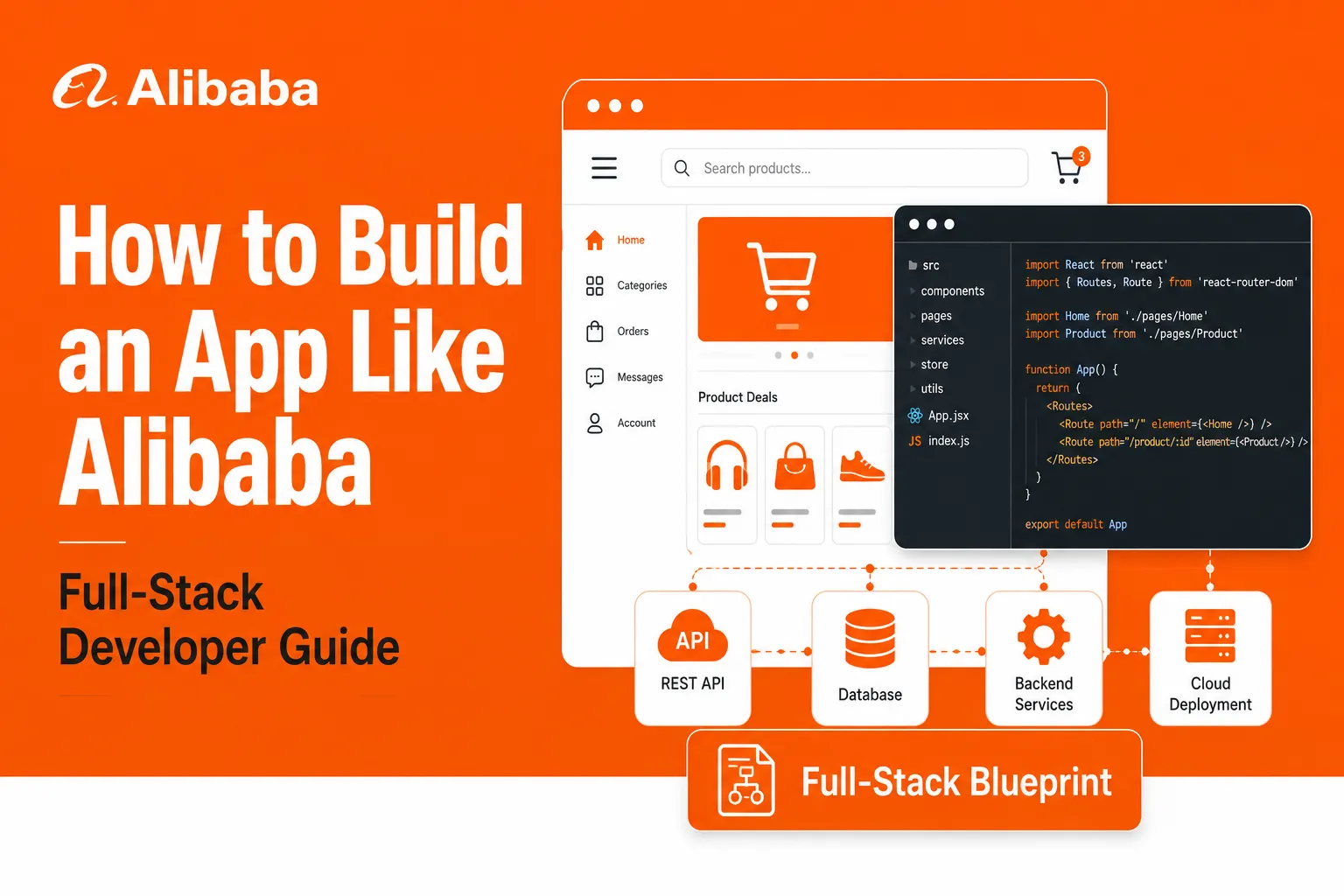
- Developers should plan APIs, database relationships, caching, queues, permissions, and mobile-first UX before starting the marketplace build.
Developer Build Signals
- Database design should separate buyers, suppliers, products, variants, listings, RFQs, quotes, carts, orders, payments, disputes, and admin logs.
- API architecture should support authentication, role-based access, product search, supplier management, quote workflows, checkout, and notifications.
- Inventory logic should track available stock, reserved stock, warehouse quantity, bulk order rules, product status, and supplier-level updates.
- Performance planning should include indexing, Redis caching, background jobs, image optimization, search indexing, and queue-based order processing.
- Security planning should include encrypted data, payment tokenization, access control, audit logs, supplier verification, and admin approval workflows.
Real Insights
- An Alibaba-like platform is a B2B trade engine, not a simple shopping app, so architecture must support supplier scale and buyer negotiation.
- Poor RFQ and quote logic can break the buying journey because many B2B orders need custom pricing before checkout.
- Developers should avoid storing all marketplace logic in one product table because vendors, variants, warehouses, prices, and orders need separate relationships.
- As traffic grows, search, image loading, inventory sync, payment callbacks, notifications, and analytics should move into scalable services or background jobs.
- Miracuves helps founders build Alibaba-like marketplace apps with buyer-supplier workflows, admin control, API integrations, and scalable B2B architecture.
Building an app like Alibaba is very different from building a normal ecommerce store. Alibaba is not just a product listing platform. It is a B2B marketplace ecosystem where buyers, suppliers, manufacturers, wholesalers, exporters, and trade businesses interact through product catalogs, bulk pricing, RFQs, MOQ rules, quote negotiation, secure payments, shipment workflows, and marketplace-level admin control.
For founders, the real question is not only, “Which tech stack should I use?” The better question is: what kind of B2B marketplace are you trying to launch, how quickly do you need to validate demand, and which workflows must be ready before buyers and suppliers can actually use the platform?
This guide explains how to build an app like Alibaba from both a founder and developer perspective. You will learn the core business model, must-have marketplace features, buyer-supplier workflows, RFQ and MOQ logic, tech stack options, database structure, API architecture, security layers, revenue models, and the difference between custom development and a ready-made Alibaba clone solution.
For founders who want to launch faster, Miracuves offers an Alibaba Clone solution with white-label branding, source code, admin control, buyer, seller, and delivery apps, and deployment support for faster B2B marketplace launch.
What Is an Alibaba-Like B2B Marketplace?
An Alibaba-like B2B marketplace is a digital platform where suppliers, manufacturers, exporters, wholesalers, and business buyers connect to trade products in bulk. Unlike a standard ecommerce app, the buyer journey is not always based on fixed prices and instant checkout. Many B2B purchases involve inquiries, custom quotes, minimum order quantities, sample requests, private-label discussions, shipping conversations, and long-term supplier relationships.
This is why an Alibaba clone app needs a different product foundation. It must support product discovery, supplier credibility, quote requests, bulk order management, buyer-seller communication, payment security, logistics visibility, and admin-level marketplace governance.
For founders, this model works especially well when targeting wholesale trade, export-import marketplaces, industrial supplies, regional manufacturing networks, niche supplier directories, B2B product sourcing, or category-specific procurement platforms.
A normal ecommerce app asks: “How do we help customers buy products?”
An Alibaba-like marketplace asks: “How do we help businesses discover, verify, negotiate, purchase, and manage supplier relationships at scale?”
How Alibaba’s Marketplace Model Works for Founders
Alibaba works because it solves a serious business problem: buyers want reliable suppliers, and suppliers want qualified business leads. The platform does not simply list products. It creates a structured trade environment where buyers can search products, compare suppliers, request quotes, negotiate terms, review company profiles, and manage bulk buying decisions.
A founder building an Alibaba-like platform should think in terms of four connected layers: the buyer layer, supplier layer, admin layer, and trust layer.
| Marketplace Layer | What It Controls | Why It Matters |
|---|---|---|
| Buyer Layer | Search, RFQ, inquiries, orders, payments, tracking | Helps businesses source products faster and compare suppliers confidently. |
| Supplier Layer | Product listings, MOQ, pricing, quote replies, inventory, orders | Allows manufacturers and wholesalers to manage demand from one dashboard. |
| Admin Layer | Users, suppliers, commissions, disputes, content, categories, reports | Gives the platform operator control over marketplace quality and operations. |
| Trust Layer | Verification, secure payments, reviews, moderation, dispute handling | Builds confidence in high-value B2B transactions. |
For founders, this structure matters because a B2B marketplace succeeds only when both sides receive value. Buyers must trust the suppliers. Suppliers must receive quality inquiries. The admin team must control quality, disputes, visibility, and monetization.
Core Features Every Alibaba Clone App Should Include
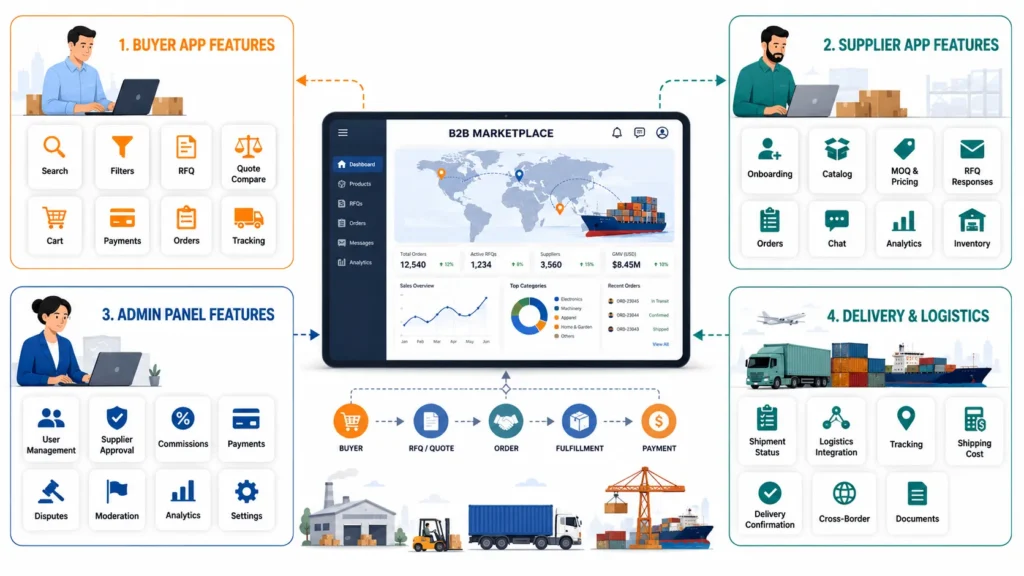
An Alibaba-style marketplace needs features for buyers, suppliers, admins, and delivery operations. The strongest platforms are not built around screens alone. They are built around trade workflows.
Buyer App Features
A buyer app should help businesses discover products, compare suppliers, request quotes, and manage orders without friction.
Important buyer-side features include:
- Buyer registration and business profile management
- Product search with filters by category, supplier, MOQ, region, and availability
- RFQ submission for custom product requirements
- Quote comparison and supplier communication
- Wishlist, cart, bulk order, and reorder options
- Secure checkout and payment gateway integration
- Order history, shipment tracking, ratings, and reviews
- Document upload for trade requests, purchase orders, or business verification
- Saved suppliers and repeat-order workflows
- Notifications for quote replies, order updates, and supplier messages
Supplier App Features
A supplier app should help manufacturers, wholesalers, and exporters manage their product catalog, respond to buyer inquiries, and track marketplace performance.
Important supplier-side features include:
- Supplier onboarding and company profile setup
- Product catalog management with images, specifications, variants, and documents
- MOQ, bulk pricing, stock availability, and product visibility control
- RFQ response dashboard
- Order management and invoice handling
- Buyer chat and inquiry management
- Sales reports and supplier performance analytics
- Promotional listing and featured product options
- Product approval status and admin moderation updates
- Inventory and shipping status controls
Admin Panel Features
The admin panel is where the marketplace operator controls the full business ecosystem. This is especially important in B2B because supplier quality, disputes, payments, product moderation, and commissions directly affect marketplace trust.
Important admin features include:
- User, supplier, product, category, and order management
- Supplier verification and approval workflows
- Commission, subscription, and featured listing controls
- Payment, refund, and dispute management
- Content moderation and abuse reporting
- Analytics for buyers, suppliers, revenue, orders, and RFQ activity
- Role-based access control for internal teams
- Platform settings for currencies, languages, taxes, shipping rules, and notifications
- Banner, homepage, and promotional content management
- Supplier performance monitoring
Delivery and Logistics Features
An Alibaba-like marketplace may support domestic shipping, international shipping, third-party logistics, supplier-managed delivery, or platform-managed fulfillment.
Important logistics features include:
- Shipment status updates
- Delivery partner or logistics provider integration
- Tracking number and delivery timeline management
- Shipping charge calculation
- Delivery confirmation and buyer feedback
- Support for local, domestic, or cross-border fulfillment workflows
- Shipment document management
- Delivery dispute reporting
RFQ, MOQ, Bulk Pricing, and Quote Negotiation Logic
The most important difference between an Alibaba clone and a normal ecommerce app is the buying logic. In B2C ecommerce, a customer usually sees a fixed price and checks out. In B2B trade, the buyer may need custom packaging, a sample order, private labeling, or destination-based shipping terms.
That is where RFQ, MOQ, and quote workflows become essential.
| B2B Feature | What It Means | Business Value |
|---|---|---|
| RFQ | Request for quotation submitted by the buyer | Allows buyers to ask suppliers for custom pricing and trade terms. |
| MOQ | Minimum order quantity set by the supplier | Protects supplier profitability and supports wholesale buying. |
| Bulk Pricing | Different prices based on order quantity | Encourages larger orders and flexible supplier pricing. |
| Quote Negotiation | Buyer and supplier discuss pricing, shipping, and delivery | Creates a realistic B2B trade experience instead of forcing fixed checkout. |
For a founder, this logic matters because RFQ activity can also become a monetization signal. You can charge suppliers for premium RFQ access, verified supplier badges, sponsored visibility, or advanced lead management features.
A marketplace that ignores RFQ and MOQ may look like Alibaba on the surface, but it will behave like a basic ecommerce app underneath. That gap can hurt supplier adoption because serious B2B sellers need pricing flexibility, buyer qualification, and negotiation workflows.
Supplier Verification and Trust Layer
Trust is one of the most important parts of a B2B marketplace. Buyers may be placing high-value orders, sharing product requirements, negotiating long-term supply contracts, or sourcing goods from new regions. If they cannot trust the supplier, they will not trust the platform.
An Alibaba-like marketplace should include supplier verification workflows that allow the admin team to review supplier details before approving public visibility. This may include company name, business registration documents, product category, address, trade licenses, warehouse details, or tax information depending on the market.
The trust layer can also include verified supplier badges, buyer reviews, product ratings, dispute records, secure messaging, audit logs, and admin-led moderation. For marketplace founders, this directly affects conversion because buyers are more likely to submit RFQs and orders when supplier credibility is visible.
Trust is not only a safety feature. It is a growth feature. The stronger the marketplace trust layer, the more confident buyers become when submitting inquiries, comparing suppliers, and placing larger orders.
Read More:Best Alibaba Clone Script in 2026: Features & Pricing Compared
Tech Stack: Choosing Between JavaScript and PHP Approaches
When I started building the Alibaba clone, the first major decision was choosing the tech stack. Since our clients range from startups to enterprise agencies, I built and tested the platform with two parallel stacks—one using JavaScript (Node.js + React), and another using PHP (Laravel). Both have their strengths depending on your project’s scale, speed, and team capabilities.
JavaScript Stack: Node.js + React
This stack is ideal for high-performance, modern applications that need fast real-time features, microservices, and a dynamic frontend. Here’s how I structured it:
- Backend: Node.js (Express.js)
- Frontend: React with Redux for state management
- Real-time features: Socket.IO (for chat, order tracking, notifications)
- API handling: RESTful services, with future support for GraphQL
- Tooling: Webpack, Babel, ESLint, PM2 for production process management
Node.js is non-blocking and event-driven, which helps when you’re handling thousands of concurrent product views, quote requests, and seller interactions. With React on the frontend, you get a clean, modular UI structure with reusable components, ideal for scaling feature sets quickly.
PHP Stack: Laravel
Laravel is my go-to when the client prefers structured MVC, quick iteration, and robust backend capabilities without reinventing the wheel. Here’s the breakdown:
- Backend: Laravel (with Eloquent ORM and Laravel Sanctum for auth)
- Frontend: Blade templating or Vue.js (if dynamic UI is needed)
- Admin dashboard: Laravel Nova or Voyager
- Task scheduling & queues: Laravel Scheduler + Horizon
- Tooling: Composer, Artisan CLI, Laravel Mix for frontend assets
Laravel shines with built-in features—routing, migrations, validation, queues—that simplify backend-heavy marketplaces. Its ecosystem helps you move fast, and the community packages (like Cashier for payments) are well-maintained and production-ready.
CodeIgniter (Alternate PHP Choice)
For lighter versions or budget-conscious builds, I’ve also used CodeIgniter. It’s faster to deploy but lacks some of Laravel’s developer conveniences. I recommend it for MVPs or tightly scoped vertical marketplaces.
When to Choose What?
- Go with Node.js + React if: you need real-time features, plan to scale fast, or your team already uses JavaScript across the stack
- Go with Laravel if: you want a stable, structured backend, faster development cycles, and rich built-in utilities for admin-heavy systems
- Use CodeIgniter only if: you’re optimizing for speed, simplicity, or have a legacy PHP team
Both stacks can power an Alibaba-level marketplace. The key is aligning the tech choice with your scaling roadmap, team structure, and feature priorities.
Database Design for a Scalable B2B Marketplace
Designing the database for an Alibaba-like platform is one of the most critical tasks. You are not just dealing with buyers and products. You are architecting a multi-supplier B2B marketplace system that handles suppliers, catalogs, RFQs, tiered pricing, chat logs, reviews, shipping zones, and admin control.
JavaScript Stack: MongoDB (NoSQL with Mongoose)
MongoDB was my choice for the Node.js build because of its flexible schema. Here’s a simplified schema overview:
- Users Collection:
{_id, name, email, role, companyProfile, isVerified} - Products Collection:
{_id, sellerId, title, description, pricing: [{minQty, price}], categories, specs, images, MOQ} - RFQ Collection:
{_id, buyerId, productId, quantity, message, status} - Orders Collection:
{_id, buyerId, sellerId, productIds, totalPrice, status, trackingDetails} - Chats Collection:
{_id, participants: [userId], messages: [{senderId, text, timestamp}]} - AdminLogs Collection:
{_id, action, userId, timestamp}
Why MongoDB works well: Sellers may have different spec fields (e.g., textile vs electronics), so nested fields and dynamic sub-documents make the platform adaptable without rigid joins. Plus, performance scales linearly when using sharding and indexes right.
PHP Stack: MySQL (Relational with Laravel Eloquent)
For the PHP/Laravel build, I used MySQL and Eloquent ORM. Laravel’s migrations made managing changes easy, and relationships are clearly defined. Here’s a relational schema outline:
userstable:id, name, email, password, role, company_profile_idcompaniestable:id, user_id, description, logo, certificationsproductstable:id, user_id, title, description, price_tiers (JSON), category_idrfqstable:id, buyer_id, product_id, qty, message, statusorderstable:id, buyer_id, seller_id, total, status, shipped_atmessagestable:id, conversation_id, sender_id, text, sent_atconversationstable:id, buyer_id, seller_id
For nested product data like specifications, I stored specs as JSON fields within products. Laravel 8+ supports JSON column queries, so filtering and updates are efficient. For indexing high-traffic tables like products and orders, I used compound indexes on user ID + status to speed up seller dashboards.
Scalability Considerations
- Sharding (MongoDB): Used for RFQs and Orders to distribute write load
- Read Replicas (MySQL): Added to scale frontend product browsing
- Caching: Redis for both stacks, especially for search filters and category trees
- Cloud Storage: Images and documents (like compliance certs) stored in S3-compatible buckets
Both stacks support enterprise-level growth, but your data model must anticipate vendor diversity, buyer behavior, and admin interventions. Start normalized, but be ready to optimize denormalization for read-heavy use cases like homepage loading and search.
Custom Alibaba App Development vs Ready-Made Alibaba Clone
Founders usually have two main paths: build every marketplace module from scratch or start with a ready-made Alibaba clone foundation and customize it for their business model.
| Build Approach | Best For | Strength | Limitation |
|---|---|---|---|
| Full Custom Development | Funded startups, enterprise platforms, unique trade workflows | Maximum flexibility and custom architecture | Longer development cycle and more planning risk |
| Marketplace Builder | Simple marketplace experiments | Faster setup for basic listing models | Limited control over RFQ, source code, scaling, and advanced B2B workflows |
| Ready-Made Alibaba Clone | Founders who want faster B2B marketplace launch | Pre-built buyer, supplier, admin, product, order, and marketplace modules | Customization scope should be checked before purchase |
| Miracuves Alibaba Clone | Businesses needing white-label branding, source code, app publishing, and faster deployment | Launch-ready foundation with source code, rebranding, admin control, buyer/seller/delivery apps, and support | Final scope depends on selected features, integrations, and custom requirements |
If your goal is to validate a B2B marketplace quickly, a ready-made Alibaba clone app development approach can reduce the time spent building standard marketplace modules from zero. You can focus more on supplier onboarding, category strategy, buyer acquisition, and revenue model testing.
Custom development is the better route when your business model is completely unique or when you need deep platform-specific workflows from day one. But if your core requirement is a B2B marketplace with buyer, supplier, product, order, RFQ, and admin workflows, a launch-ready Alibaba clone can be a more practical starting point.
Founder Decision Signals
Speed
If the priority is fast validation, a ready-made Alibaba clone helps reduce the time spent building standard marketplace modules from zero.
Control
If long-term flexibility matters, source-code ownership and admin control help founders adjust workflows, categories, supplier rules, and monetization later.
Scalability
If the marketplace will handle many suppliers, products, orders, and RFQs, backend architecture, search indexing, caching, and admin control become critical.
Market Fit
If supplier onboarding and buyer demand are still untested, launch with a practical first version and improve based on real marketplace behavior.
Speed
If the priority is fast validation, a ready-made Alibaba clone helps reduce the time spent building standard marketplace modules from zero.
Control
If long-term flexibility matters, source-code ownership and admin control help founders adjust workflows, categories, supplier rules, and monetization later.
Scalability
If the marketplace will handle many suppliers, products, orders, and RFQs, backend architecture, search indexing, caching, and admin control become critical.
Market Fit
If supplier onboarding and buyer demand are still untested, launch with a practical first version and improve based on real marketplace behavior.
Key Modules & Features Breakdown (with Code and Structure)
Building a clone of Alibaba means replicating a sophisticated B2B ecosystem. I focused on modular development to isolate and optimize each critical component. Below, I’ll break down the major modules and how I built them using both the JavaScript and PHP stacks.
1. Vendor & Product Management
This is the backbone of the marketplace. Sellers should be able to register, manage their storefronts, add products, set pricing tiers, and track orders.
JavaScript (Node.js + MongoDB)
- Vendor routes:
POST /api/vendor/register,GET /api/vendor/products,PUT /api/vendor/profile - Product model example:
const ProductSchema = new mongoose.Schema({
  sellerId: mongoose.Schema.Types.ObjectId,
  title: String,
  description: String,
  pricing: [{ minQty: Number, price: Number }],
  specs: Object,
  category: String,
  images: [String]
})
PHP (Laravel + MySQL)
- Routes:
/vendor/register,/vendor/products, handled via controller methods - Product model uses Eloquent relationships:
public function seller() {
  return $this->belongsTo(User::class, 'user_id');
}- Blade form + validation for tiered pricing input
2. Quotation (RFQ) System
RFQs are essential in B2B trade. Buyers request a quote from multiple vendors, often negotiating before placing an order.
JavaScript
POST /api/rfqcreates a new request; vendors get notified via Socket.IO- Quotes stored in a separate
quotescollection and linked torfqId
PHP
- RFQ stored in
rfqstable; Laravel Notifications system alerts vendors - Admin can manage quote approvals via Nova dashboard
3. Advanced Search & Filters
Buyers need to filter by MOQ, price range, categories, certifications, and shipping options.
JavaScript
- Implemented with MongoDB’s aggregation pipelines:
Product.aggregate([
  { $match: { category: "Machinery", "pricing.price": { $lte: 1000 } } },
  { $sort: { createdAt: -1 } }
])
PHP
- Laravel query builder with scopes:
Product::filter($filters)->orderBy('created_at', 'desc')->get();- Used Laravel Scout + MeiliSearch for full-text product search
4. Multi-role Admin Panel
Admins manage sellers, products, disputes, payouts, and content moderation.
JavaScript
- React-based admin dashboard with role-based access control (RBAC)
- Backend APIs like
GET /admin/vendors,PATCH /admin/ban-product
PHP
- Laravel Nova integrated for out-of-the-box admin UI
- Custom tools built for bulk approval, payout settlements
5. Chat & Messaging
Alibaba allows real-time communication between buyers and suppliers.
JavaScript
- WebSocket server with Socket.IO
- Messages stored in
chatscollection with room-based architecture
PHP
- Laravel WebSockets + Redis for broadcast
- Used
laravel/echofor frontend events
6. Order & Delivery Tracking
Tracking bulk or sample orders is crucial for transparency.
JavaScript
- Order status flow:
pending → confirmed → shipped → delivered - Used third-party webhook from logistics API to auto-update
trackingDetails
PHP
- Order status enums + timestamps in MySQL
- Admin override tools to manually change order status when needed
Each module is built to scale independently—whether you’re deploying a vertical B2B platform or a general-purpose wholesale engine. By isolating these concerns, you can expand features like escrow, procurement APIs, or international shipping later without reworking the foundation.
Read More : Reasons startup choose our Alibaba clone over custom development
Data Handling: Third-Party APIs & Manual Listings via Admin
One of the big technical choices in building an Alibaba-like platform is how product and vendor data enters the system. Some clients prefer manual uploads and moderation for tight control, while others want to integrate third-party product feeds or supplier networks. I built support for both approaches, across the JavaScript and PHP stacks.
Manual Listings via Admin Panel
This is the default for most B2B platforms. Admins or sellers manually add products, with structured inputs for attributes, pricing, images, and shipping info.
JavaScript (Node.js + React)
- Sellers access a React-based product upload form at
/vendor/products/new - File uploads (images, certifications) are handled via Multer to an S3-compatible bucket
- Data is validated client-side with Formik + Yup, and server-side using custom Express middlewares
PHP (Laravel + Blade)
- Blade templates for product creation, using Laravel’s FormRequest validation
- Image handling through Laravel’s
Storagefacade, with configurable disks (local, S3, etc.) - Admins can bulk-upload using CSV importers powered by Laravel Excel
Third-Party API Integration
In cases where clients want to pull supplier/product data from external services (like AliExpress, Banggood, or other wholesale APIs), I built structured data pipelines.
JavaScript Stack Example
- Used Axios to fetch supplier feeds via cron jobs
- Normalized external product fields into our MongoDB format
const normalizeProduct = (externalData) => ({
  title: externalData.name,
  pricing: [{ minQty: 1, price: externalData.sale_price }],
  images: externalData.images,
  category: mapCategory(externalData.category),
  specs: extractSpecs(externalData)
})
- Data stored in a
sourcefield for traceability, with auto-flag for moderation
PHP Stack Example
- Created scheduled jobs via Laravel’s Task Scheduler to pull product JSON
- Products parsed and inserted using
Product::create([...])with queue batching - Added
source_url,imported_from, andlast_synced_atfields to track freshness
Hybrid Mode: Assisted Entry
In some builds, I implemented a hybrid mode—where sellers start from third-party templates (auto-filled product data) and then customize before publishing. This improves onboarding and reduces drop-off for new vendors.
Whether you’re building a closed ecosystem or aggregating external suppliers, your data ingestion layer must ensure format consistency, safe mapping, and moderation control to protect the integrity of your catalog.
API Integration: Endpoint Samples in JS & PHP
Integrating APIs effectively is at the heart of building a scalable Alibaba-style platform. From internal APIs for product management to external integrations for shipping, payment, and search, I structured the backend to expose clean, RESTful endpoints in both stacks. Here’s how I approached it.
Internal API Design Philosophy
I kept endpoints modular and versioned (/api/v1/), using REST with optional GraphQL support for some frontend-heavy clients. Every feature (like orders, RFQs, messaging) had its own controller/service layer. Authentication was handled with JWTs in Node.js and Laravel Sanctum in PHP.
JavaScript Stack (Node.js + Express)
Sample 1: Create a New RFQ
// POST /api/v1/rfq
router.post('/rfq', authMiddleware, async (req, res) => {
  const { productId, quantity, message } = req.body
  const rfq = await RFQ.create({
    buyerId: req.user._id,
    productId,
    quantity,
    message,
    status: 'pending'
  })
  res.status(201).json({ success: true, data: rfq })
})
Sample 2: Product Search with Filters
// GET /api/v1/products?category=Apparel&maxPrice=500
router.get('/products', async (req, res) => {
  const { category, maxPrice } = req.query
  const filters = {}
  if (category) filters.category = category
  if (maxPrice) filters['pricing.price'] = { $lte: Number(maxPrice) }
  const products = await Product.find(filters)
  res.json(products)
})
Sample 3: Send Message in Chat
// POST /api/v1/chats/:chatId/message
router.post('/chats/:chatId/message', authMiddleware, async (req, res) => {
  const message = {
    senderId: req.user._id,
    text: req.body.text,
    timestamp: new Date()
  }
  const chat = await Chat.findByIdAndUpdate(
    req.params.chatId,
    { $push: { messages: message } },
    { new: true }
  )
  io.to(req.params.chatId).emit('newMessage', message)
  res.json(chat)
})
PHP Stack (Laravel)
Sample 1: Create RFQ
Route::middleware('auth:sanctum')->post('/rfq', function(Request $request) {
  $rfq = RFQ::create([
    'buyer_id' => auth()->id(),
    'product_id' => $request->product_id,
    'quantity' => $request->quantity,
    'message' => $request->message,
    'status' => 'pending'
  ]);
  return response()->json(['data' => $rfq], 201);
});
Sample 2: Product Search
Route::get('/products', function(Request $request) {
  $products = Product::when($request->category, function($q) use ($request) {
      $q->where('category', $request->category);
    })
    ->when($request->maxPrice, function($q) use ($request) {
      $q->whereJsonContains('price_tiers', [['price', '<=', $request->maxPrice]]);
    })
    ->get();
  return response()->json($products);
});
Sample 3: Chat Messaging
Route::post('/chats/{chat}/message', function(Request $request, Chat $chat) {
  $message = $chat->messages()->create([
    'sender_id' => auth()->id(),
    'text' => $request->text
  ]);
  broadcast(new NewMessageEvent($message))->toOthers();
  return response()->json($chat->load('messages'));
});
External API Hooks
I also built integrations with services like:
- Shipping: EasyPost, Shippo (for tracking)
- Payments: Stripe, Razorpay (covered later)
- Compliance: GSTIN validation APIs for Indian vendors
- Product Feeds: AliExpress, Banggood (for data sync)
These APIs are abstracted via service classes (JS) or Laravel service containers (PHP) to allow easy swapping or mocking during tests.
Read More : Business Model of Alibaba : Revenue Streams & Strategy
Frontend & UI Structure in React and Blade
Creating a seamless, scalable UI for a platform like Alibaba is no small feat. You’re dealing with different user roles—buyers, suppliers, and admins—each needing tailored experiences. I focused on clarity, responsiveness, and modularity across both React (JavaScript) and Blade (PHP) implementations. Here’s how I structured the frontend layer.
React Frontend (with Redux and TailwindCSS)
Component Structure
I built a component-driven structure using atomic design principles:
/components
  /common → buttons, modals, loaders
  /product → productCard, priceTier, specTabs
  /vendor → dashboardWidgets, RFQForm
  /buyer → quotationList, messageThreads
/pages
  /home
  /products
  /vendor
  /admin
Routing
Used react-router-dom for routing and redux-persist to store auth state across sessions. Protected routes wrap around layouts using role guards.
UI Libraries
- TailwindCSS for fast, utility-first styling
- Headless UI and Heroicons for consistent UI behavior
- Chart.js for admin analytics
Responsiveness & UX
- Mobile-first design, fully responsive using Tailwind’s breakpoints
- Collapsible sidebars for mobile dashboards
- Sticky search filters on product listing pages
Dynamic Features
- Infinite scrolling for product pages using
IntersectionObserver - Lazy-loaded image galleries
- Quick-view modal for products with quote CTA
Blade Templates with Laravel
If the client prefers PHP stack, Laravel’s Blade templating does the job efficiently, especially when paired with Alpine.js or Vue.js for interactivity.
Layout Structure
/resources/views
  /layouts → base.blade.php, admin.blade.php
  /components → alert.blade.php, modal.blade.php
  /pages → home.blade.php, product-detail.blade.php
Blade Directives
Used Laravel’s components and slots to keep templates DRY:
<x-product.card :product="$product" />
<x-alert type="success" message="Quote submitted successfully" />
Livewire & Alpine.js
In some cases (like RFQ forms or product filtering), I used Livewire for dynamic interactivity without needing a full SPA. Alpine.js handled simple UI toggles and modal triggers.
Responsive Design
Bootstrap 5 worked well for admin panels; Tailwind was preferred on the public-facing site for faster custom layouts. Blade also lets you swap layouts easily between roles.
Admin Templates
For Laravel Nova or Voyager, I extended built-in templates and added features like search filters, payout status toggles, and approval queues.
Whether in React or Blade, the goal was clear—optimize for clarity, mobile usability, and speed while keeping role-based complexity manageable. I also emphasized reusability: components built for vendors (like product forms) are easily mirrored in admin tools with slight permission tweaks.
Get Your Budget Blueprint—Discover How Much It Costs to Build an Alibaba-Style Marketplace and Start Planning Today!
Customs, Duties, VAT, and Landed Cost Logic
For cross-border B2B marketplaces, product price alone is not enough. Buyers also need to understand shipping charges, customs duties, VAT, GST, import fees, and total landed cost before making a purchase decision.
An Alibaba-style platform can become more useful when it supports landed cost visibility. This helps buyers estimate the real cost of ordering from another country or region.
Important cross-border commerce logic can include:
- HS code mapping
- Customs duty calculation
- VAT or GST calculation
- Import tax rules
- Shipping fee estimation
- Insurance cost
- Currency conversion
- Invoice tax breakdown
- Country-wise tax rules
- Admin tax configuration
- Landed cost display at checkout
- Third-party customs and tax API integration
This is especially useful for platforms that support international suppliers, bulk orders, industrial goods, wholesale products, or importer-exporter transactions.
A strong Alibaba clone app should allow the admin to manage tax rules, shipping zones, currency settings, supplier regions, and invoice logic from the backend. This makes the platform more transparent for buyers and easier to manage for the business owner.
Read More:Customs, Duties, and Tax (VAT) Calculation APIs for Cross-Border B2B Platforms
Authentication & Payments: JWT/Auth Guards, Stripe & Razorpay Integration
Authentication and payment workflows are critical to any B2B platform. Alibaba-style systems have multi-role access (buyer, seller, admin), and financial transactions involve order payments, vendor commissions, and in some cases, escrow. I implemented secure, scalable auth and payments in both JavaScript and PHP stacks.
Authentication – Node.js (JWT) Approach
I used JWT (JSON Web Tokens) for sessionless authentication in the Node.js stack. Each user is issued a token upon login, stored in localStorage and passed via Authorization: Bearer headers on protected routes.
Key Middleware Logic
const authMiddleware = (req, res, next) => {
  const token = req.headers['authorization']?.split(' ')[1]
  if (!token) return res.status(401).json({ message: 'Token missing' })
  try {
    const decoded = jwt.verify(token, process.env.JWT_SECRET)
    req.user = decoded
    next()
  } catch (err) {
    return res.status(403).json({ message: 'Invalid token' })
  }
}
Access control was enforced with role-based middleware (e.g., isSeller, isAdmin) so vendors couldn’t access buyer endpoints and vice versa.
Authentication – Laravel (Sanctum + Guards)
In Laravel, I used Sanctum for token-based auth. It works great with SPA frontends or native mobile apps and integrates seamlessly with Laravel’s middleware system.
Guard Setup
'guards' => [
  'web' => [...],
  'api' => [
    'driver' => 'sanctum',
    'provider' => 'users'
  ]
]
API routes are protected using auth:sanctum, and roles are checked in controller logic or middleware:
if (auth()->user()->role !== 'vendor') {
  abort(403, 'Unauthorized')
}
Payment Integration – Stripe & Razorpay
I built both Stripe (for global clients) and Razorpay (for Indian businesses) integrations to support credit card payments, order handling, and commission distribution.
Stripe – Node.js Flow
- Buyers place an order → system generates a Stripe Checkout session via Stripe API
- After successful payment, Stripe sends a webhook (
checkout.session.completed) - Order status is updated, and seller notified
Code Sample
const session = await stripe.checkout.sessions.create({
  payment_method_types: ['card'],
  line_items: [...],
  mode: 'payment',
  success_url: YOUR_URL + '/success',
  cancel_url: YOUR_URL + '/cancel'
})
Webhook handlers are deployed using Stripe CLI locally, and securely through stripe-signature middleware in production.
Razorpay – Laravel Flow
- Used the
razorpay/razorpaySDK to initiate orders - Razorpay checkout UI is rendered on the client
- Post-payment, Razorpay webhook hits
/api/payment/verify - Laravel verifies signature and marks order as paid
Code Snippet
$razorpay = new Api($key, $secret);
$order = $razorpay->order->create([
  'receipt' => $orderId,
  'amount' => $amountInPaise,
  'currency' => 'INR'
]);
Webhooks are verified using HMAC signature and processed via Laravel queues for reliability.
Other Payment Notes
- Payouts to vendors are handled via admin panel batch processing (Stripe Connect or manual bank exports)
- I added optional escrow logic for milestone payments and delivery confirmation
- Refunds and disputes are logged in a dedicated
payments_logtable (MySQL) or collection (MongoDB)
Security, role isolation, and financial traceability were top priorities here. By integrating auth and payments cleanly at the API layer, the platform remains flexible—ready for Stripe today, crypto tomorrow.
Read More : Unlocking the Secrets of Alibaba App Marketing Success
Testing & Deployment: CI/CD Pipelines, Dockerization, PM2 & Apache Configs
Once the core features were stable, I shifted focus to automating the deployment pipeline and ensuring the platform runs smoothly in production. I implemented environment-specific configurations, end-to-end testing, containerization, and process managers tailored to both JavaScript and PHP stacks.
Testing Strategy
Node.js Stack
- Unit testing with Jest (services, controllers, utils)
- Integration tests using Supertest on API routes
- MongoDB Test Containers for isolated DB testing during CI
- Sample test for RFQ creation:
describe('POST /api/rfq', () => {
  it('should create a new RFQ', async () => {
    const res = await request(app)
      .post('/api/rfq')
      .set('Authorization', `Bearer ${token}`)
      .send({ productId, quantity: 100, message: 'Need quote' })
    expect(res.statusCode).toBe(201)
  })
})
Laravel Stack
- PHPUnit for controller, model, and feature tests
- Laravel Dusk for browser testing (useful for admin panels)
- Factory classes to mock data during tests
php artisan testruns all suites in CI
CI/CD Pipeline Setup
GitHub Actions
Both stacks used GitHub Actions for CI/CD:
on: pushtriggers for main and staging branches- Jobs included:
- Linting (ESLint / PHPStan)
- Testing
- Build (React/Vue)
- Docker image build & push to registry (GHCR or Docker Hub)
- Auto-deploy to server via SSH or webhook
Sample Node.js deployment step:
- name: Deploy to Production
  run: ssh user@host 'cd /var/www/app && git pull && pm2 restart all'
Dockerization
I containerized both versions for consistency across environments.
Node.js Stack
- Multi-stage Dockerfile (for build and runtime separation)
- Used
node:18-alpinebase image - PM2 used as the production process manager
Laravel Stack
- Based on
php:8-fpm-alpineimage - Nginx configured via separate container using Docker Compose
- Included
php-cli,pdo_mysql,zip, andgdextensions - Laravel queue workers, scheduler, and web app split across separate services
Both stacks supported .env injection via docker-compose or CI secrets
Production Process Management
Node.js with PM2
PM2 handled process restarts, logging, and memory monitoring. Key configs:
ecosystem.config.jsfor service definitionspm2 logsandpm2 monitused during live debugging
Laravel with Apache/Nginx
Used Apache with mod_rewrite in traditional hosting environments. On Dockerized setups, I preferred Nginx reverse proxy with separate services:
nginx.confset up to handle routing to Laravel and static files- Supervisor handled queue workers and schedule triggers
Monitoring & Logs
- Logs piped to CloudWatch (AWS) or third-party log viewers (Logtail, Loggly)
- Integrated health checks and
/pingendpoints to detect downtime - Redis used for caching and job queues; Laravel Horizon used to monitor worker activity
With clean CI/CD and robust process management, the app is ready for frequent updates and zero-downtime rollouts—critical for a marketplace serving hundreds of concurrent users.
Pro Tips from Real-World Dev: Scaling, Caching, and Mobile UX Hacks
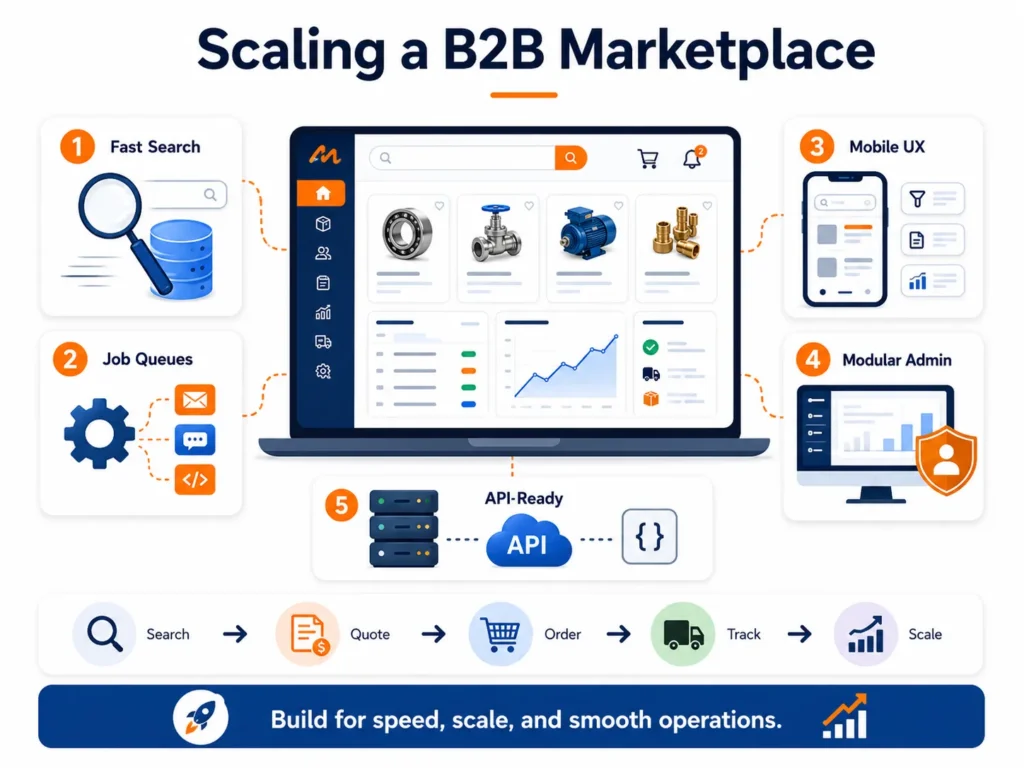
After building and deploying multiple versions of the Alibaba clone, I’ve hit several real-world challenges—some predictable, others sneaky. Here are the lessons I’ve learned that could save your project time, money, and scaling headaches.
1. Search Performance Will Haunt You
Don’t underestimate search. Once your platform crosses 10,000+ products, filtering, full-text search, and category queries can bottleneck your DB fast.
What Worked
- On Node.js + MongoDB: I indexed critical fields (
category,pricing.price,title) and used MongoDB Atlas Search (built on Lucene) for full-text queries - On Laravel + MySQL: I plugged in Laravel Scout + Meilisearch, which is lightweight, ultra-fast, and easy to scale. For large-scale clients, ElasticSearch is better, but Meili is MVP-friendly
Pro Tip
Cache product filter combinations using Redis with a TTL (time to live) so you don’t hit the DB for common queries like “all Electronics under $500”
2. Use Job Queues Aggressively
Everything that’s not a real-time user action should go into the queue—notifications, vendor approvals, webhook processing, invoice generation.
What Worked
- Node.js: I used BullMQ with Redis to create isolated queues per module (e.g.,
orderQueue,rfqQueue) - Laravel: Queues and jobs are built-in; Horizon + Redis makes it easy to track and retry failures
Pro Tip
Queue your email + notification logic during signup and quote submissions to improve frontend performance by 30–40%
3. Mobile UX is Not Optional
More than 65% of users came from mobile during tests, especially in B2B regions like India, China, and Africa. But B2B workflows aren’t naturally mobile-friendly—quoting, bulk orders, and chat threads need special attention.
What Worked
- Collapsible filters and sticky search bars in React
- Bottom navigation for seller dashboards on mobile (like a native app)
- Mobile-first Blade views with separate breakpoints for seller vs buyer roles
Pro Tip
Limit form steps per screen. On mobile, break RFQ submission into 2–3 screens. Let users save drafts and come back later
4. Avoid Overloading the Admin Panel
Don’t try to cram every feature into the admin dashboard. Think modular. Give admins scoped roles—compliance officer, seller support, catalog team—so the UI and logic stay clean.
What Worked
- React admin split into tabs per role (e.g., payouts, seller review, disputes)
- Laravel Nova with custom tools per user role
Pro Tip
Build a log viewer inside the admin. I created a read-only view of actions_log so support teams could debug issues without dev access
5. Keep It API-Ready From Day 1
Even if you’re only launching a web app now, a mobile app or third-party API will be next. Structure your backend like a headless system.
What Worked
- Versioned endpoints (
/api/v1/) with modular routes - Centralized response formatting in Laravel using Resource classes and in Node via response helpers
Pro Tip
Standardize error messages and response codes from day one—it saves hours during frontend integration and debugging
These aren’t just developer tricks—they’re operational patterns that make your platform more maintainable, more scalable, and less painful to operate as you grow.
Mistakes Founders Should Avoid
Building Only a Basic Ecommerce App
An Alibaba-like marketplace needs RFQ, MOQ, supplier verification, bulk pricing, quote negotiation, and admin control. A simple cart-and-checkout ecommerce app will not support real B2B buying behavior.
Ignoring Supplier Trust
Supplier verification, reviews, company profiles, and dispute workflows are essential because B2B buyers need confidence before placing high-value orders.
Underestimating Admin Control
Without strong admin controls, the platform operator may struggle to manage suppliers, products, disputes, payments, commissions, and marketplace quality.
Choosing Technology Without Business Logic
The tech stack should support the marketplace model. Search, RFQ, chat, payments, supplier dashboards, and order workflows should guide technical decisions.
Delaying Launch for Too Long
Many founders spend months building features before validating supplier interest and buyer demand. A launch-ready foundation can help test the market faster.
Building Only a Basic Ecommerce App
An Alibaba-like marketplace needs RFQ, MOQ, supplier verification, bulk pricing, quote negotiation, and admin control. A simple cart-and-checkout ecommerce app will not support real B2B buying behavior.
Ignoring Supplier Trust
Supplier verification, reviews, company profiles, and dispute workflows are essential because B2B buyers need confidence before placing high-value orders.
Underestimating Admin Control
Without strong admin controls, the platform operator may struggle to manage suppliers, products, disputes, payments, commissions, and marketplace quality.
Choosing Technology Without Business Logic
The tech stack should support the marketplace model. Search, RFQ, chat, payments, supplier dashboards, and order workflows should guide technical decisions.
Delaying Launch for Too Long
Many founders spend months building features before validating supplier interest and buyer demand. A launch-ready foundation can help test the market faster.
How Miracuves Helps Founders Launch an Alibaba-Style Marketplace Faster
Building an Alibaba-style marketplace requires multiple connected modules. A founder needs buyer registration, supplier onboarding, product listing, category management, RFQ flow, quotation management, secure payments, order tracking, admin controls, and scalable backend architecture.
Miracuves helps businesses launch an Alibaba clone with a ready-made foundation that can be customized based on brand, industry, region, business model, and marketplace requirements.
The platform can support:
- Buyer panel
- Supplier panel
- Admin dashboard
- Product catalog management
- RFQ and quotation workflow
- Bulk order support
- Multi-vendor marketplace logic
- Payment gateway integration
- Shipping and logistics integration
- Supplier verification
- Reviews and ratings
- Notification system
- Analytics and reporting
- White-label branding
- Source-code ownership
- Custom feature upgrades
This approach helps founders avoid starting from a blank development cycle. Instead, they can begin with a structured Alibaba-style marketplace foundation and customize it for their target industry, supplier base, and buyer audience.
For businesses planning to build a B2B marketplace, wholesale platform, supplier discovery app, or cross-border trade marketplace, Miracuves provides a faster and more practical path to launch.
Read More : Alibaba Features Explained: A Guide for Startup Founders
Final Thoughts
An Alibaba-like marketplace is not just an ecommerce app with more sellers. It is a B2B trade ecosystem built around suppliers, buyers, RFQs, MOQs, bulk pricing, trust, logistics, payments, and marketplace control.
If you build from scratch, focus on architecture, supplier workflows, search, admin control, payment security, and long-term scalability. If your priority is faster launch and market validation, a ready-made Alibaba clone can reduce avoidable development effort and help you focus on supplier acquisition, buyer demand, and revenue model clarity.
For founders, the strongest product decision is not always the longest or most complex build. It is the build that gives you enough control to enter the market, learn from real users, and scale with confidence.
A marketplace like Alibaba succeeds when product, technology, supplier trust, buyer experience, and admin operations work together. Start with the right foundation, validate the right workflows, and improve based on real marketplace behavior.
To explore the right launch approach for your B2B marketplace idea, you can schedule a consultation with Miracuves and discuss your Alibaba clone requirements.
FAQS
What features are needed in an Alibaba clone app?
An Alibaba clone app should include buyer registration, supplier dashboards, product catalogs, RFQ, MOQ pricing, quote negotiation, bulk order management, secure payments, order tracking, reviews, supplier verification, admin controls, dispute management, and analytics.
What is the best tech stack for an Alibaba-like app?
The best tech stack depends on scale, team skills, and customization needs. Common options include PHP/Laravel, Node.js, React, Flutter, MySQL, MongoDB, Redis, cloud hosting, secure payment APIs, and notification services.
Can I launch an Alibaba clone faster with a ready-made solution?
Yes. A ready-made Alibaba clone helps founders avoid building every standard marketplace module from zero. It gives a faster foundation for buyer apps, supplier apps, admin panels, product catalogs, orders, payments, and deployment, while still allowing customization based on business needs.
Why is RFQ important in a B2B marketplace like Alibaba?
RFQ is important because B2B buyers often need custom pricing, bulk quantities, product specifications, samples, delivery terms, and negotiated trade conditions. RFQ lets buyers submit requirements and suppliers respond with tailored quotations.
What is MOQ in an Alibaba clone app?
MOQ means Minimum Order Quantity. It defines the minimum number of units a buyer must order from a supplier. MOQ is essential in wholesale and manufacturing marketplaces because suppliers often need volume commitments to maintain profitability.
Does an Alibaba clone need supplier verification?
Yes. Supplier verification helps build buyer trust, reduce fraud risk, improve marketplace quality, and support safer B2B transactions. Verification can include business documents, approval workflows, admin checks, ratings, and verified supplier badges.
Can Miracuves customize an Alibaba clone app?
Yes. Miracuves can customize the Alibaba Clone solution based on branding, workflows, payment gateways, supplier features, admin requirements, integrations, and launch scope. Final customization should be confirmed during consultation.
Is an Alibaba clone app suitable for niche B2B marketplaces?
Yes. An Alibaba clone app can be adapted for niche B2B marketplaces such as industrial supplies, wholesale fashion, construction materials, electronics sourcing, export-import trade, agricultural products, machinery, or regional supplier networks.
Related Articles