

Key Takeaways
- Alibaba markets an ecosystem, not just a shopping app.
- Cross-app integration keeps users inside the commerce network.
- Live commerce turns product discovery into entertainment.
- SEO and ASO strengthen long-term marketplace visibility.
- Localization helps campaigns match regional buyer behavior.
Marketing Signals
- Use deep links and retargeting across marketplace channels.
- Combine live shopping with creator-led product demos.
- Add gamified deals, rewards, and flash promotions.
- Personalize campaigns using AI and user behavior.
- Work with niche creators to build buyer trust.
Real Insights
- Marketplace experiences can outperform product-only marketing.
- Gamification encourages repeat visits and engagement.
- Hyperlocal campaigns improve relevance across markets.
- Startups should own one niche before expanding.
- Miracuves builds Alibaba Clone platforms with scalable B2B marketplace workflows.
Ever feel like your startup’s marketing efforts are a tiny raft next to Alibaba’s luxury cruise ship? You’re not alone. The e-commerce behemoth didn’t just scale — it bulldozed its way into millions of smartphones with a blend of sharp marketing, smart tech, and uncannily accurate timing. But what’s more fascinating than Alibaba’s rise? How it continues to reinvent itself in a world that scrolls faster than it shops.
For early-stage founders and digital business owners, Alibaba isn’t just another Goliath. It’s the playbook. Whether you’re building a B2B app, a dropshipping business, or a hyperlocal e-marketplace, understanding Alibaba’s app marketing moves can help you unlock real growth. That’s why studying Alibaba’s strategy is useful for startups planning to launch an Alibaba clone with marketplace-ready features, scalable commerce workflows, and strong buyer-seller engagement.
This isn’t about copying Alibaba line-for-line. It’s about learning the blueprint—and then hacking it with your twist. And if you’re dreaming of building a marketplace app without burning years and millions, Miracuves is your secret weapon.
The Core of Alibaba’s Marketing Strategy & Features
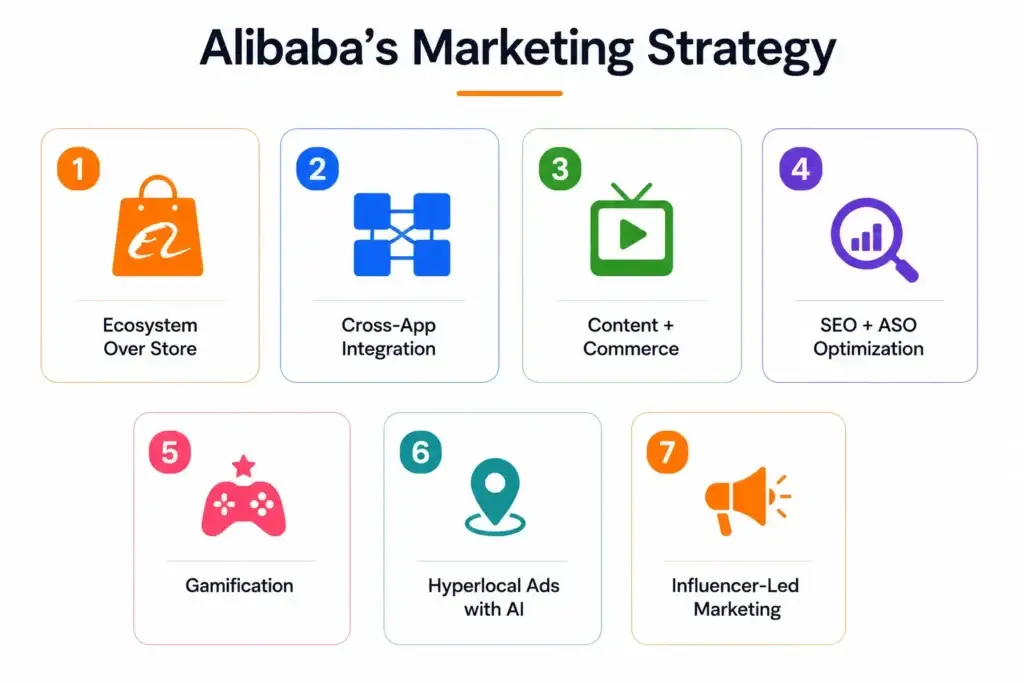
1. From E-Commerce to Ecosystem: Build More Than a Store
Alibaba didn’t just build an app. It built a living ecosystem. Its marketing revolves around utility-first experiences across platforms—Alibaba, Taobao, AliExpress, Lazada, and Tmall. Each app speaks to a segment: B2B traders, budget shoppers, premium buyers, international markets, etc.
The takeaway? Don’t market a product. Market an experience. Use your app to solve problems and let your marketing echo that—consistently, across channels.
2. Dominate via Cross-App Integration
Alibaba’s superpower? User funnel recycling. Let’s say someone browses Taobao, then they see a Lazada ad on Instagram, and finally land on Alibaba’s main app via a Facebook pixel. That’s no coincidence—it’s calculated choreography.
They use deep links, retargeting, and seamless UX to keep users bouncing within their own suite (err, ecosystem) until they convert.
3. Content + Commerce = Clicks Galore
You’ve probably seen it—Taobao Live. That’s Alibaba turning shopping into a reality show. Sellers pitch products live, answer questions, and dish out discounts, all within the app. It’s QVC meets TikTok, and it converts like crazy.
Instead of dull product pages, think: influencer collabs, live demos, UGC reviews, interactive feeds. Alibaba pioneered shoppertainment, and the engagement numbers don’t lie.
According to Statista, Taobao Live’s GMV surpassed $76 billion in 2020—and it’s only grown.
4. SEO + ASO: Alibaba’s Dual Engine
Alibaba doesn’t leave search to chance. Their Search Engine Optimization (for web) and App Store Optimization (for mobile) are laser-focused.
They optimize product listings using natural language + search data (think: “cheap Bluetooth earphones free shipping”), and they dominate app stores using keyword-rich descriptions, seasonal promotions, and app update cycles.
For your clone or marketplace app, don’t sleep on keyword layering, image tags, and deep linking in app store listings.
5. Gamification: Make Users Feel Like They’re Winning
Spin-the-wheel discounts, scratch cards, red envelopes, and flash deals—Alibaba’s entire marketing UX is gameified to the bone.
It’s dopamine on demand. Even scrolling feels rewarding. Users are nudged to check back daily. Points, levels, and badges turn shopping into a hobby.
Want to drive DAU and user retention? Start treating your app like Candy Crush (but with cart checkouts).
6. Hyperlocal Ads with AI Precision
One size doesn’t fit all, and Alibaba knows it. In Malaysia, you’ll see Ramadan deals on Lazada. In Spain, AliExpress pushes EU-specific shipping badges. They geo-segment every campaign—right down to the language, price point, and even product type.
They rely on machine learning and AI to predict what a user wants before they even open the app.
Real-Life Scenario: A new mom in Delhi might see baby products, free delivery, and “mommy influencer” reviews, while a college student in Jakarta sees cheap gadgets + cashback.
7. Influencer-Led Virality: Less Ads, More Advocacy
Forget faceless banners. Alibaba’s marketing lives on real people selling real stuff in real time. Micro-influencers, KOLs (Key Opinion Leaders), and niche vloggers dominate their social proof.
Their strategy: tap creators who are already trusted by tight-knit communities. Let them demo, unbox, and review—raw, unscripted, and unpolished. That’s how trust is built in 2026.
Want your Alibaba clone to go viral? Start with nano-influencers before chasing unicorns.
Learn More: Alibaba Features Explained: A Guide for Startup Founders
Lessons for Startups: Marketing Your Own Alibaba Clone
Think Like a Platform, Not a Store
The biggest mistake? Building an app that sells instead of one that enables selling. Your job isn’t to list products. It’s to orchestrate transactions between people, solve logistics, and build trust.
Your Growth Channels Matter More Than Your Tech Stack
You can have the slickest app, but if no one hears about it? Crickets. Focus early on:
- Creator collabs
- Paid social (Instagram, TikTok, YouTube Shorts)
- Referral programs with real cash rewards
- Influencer-led onboarding (yes, it works!)
Don’t Market Everything to Everyone
Alibaba didn’t win by being everything for everyone from Day 1. They started with wholesale traders. Know your niche. Own it. Then expand sideways.
Conclusion
Alibaba didn’t just build an app. They designed a user magnet—one that spins data, emotion, content, and community into nonstop engagement.
Now here’s the twist: You don’t need to be a billionaire conglomerate to pull off a winning marketplace app. You just need the right team, the right tools, and the right game plan.
At Miracuves, we help innovators launch high-performance app clones that are fast, scalable, and monetization-ready. Ready to turn your idea into reality? Let’s build together.
FAQs
What makes Alibaba’s marketing strategy unique?
It blends entertainment, AI, influencer power, and hyperlocal targeting—all inside one app ecosystem. It’s less ads, more experiences.
How does Alibaba use influencers?
They work with micro and nano-influencers who sell directly through live streams and product demos inside the app—especially on Taobao Live.
Can I replicate this strategy on a small budget?
Absolutely. Start with hyper-targeted content, creator outreach, and gamified features. The key is focus, not funding.
What is shoppertainment?
It’s a mix of shopping and entertainment—think live product demos, flash deals, and interactive games. Alibaba made it mainstream.
Why is localization so important in Alibaba’s strategy?
Different regions have different buying habits. Alibaba customizes pricing, language, and deals for maximum relevance and conversion.
How can Miracuves help with an Alibaba-style app?
We build ready-to-launch Alibaba clone apps with advanced features, live commerce integration, and full customization options.
Related Articles:
Miracuves is an independent software development company. We are not affiliated with, connected to, sponsored by, or endorsed by any company or product named in this article.
Terms such as “X Clone” are used descriptively. It is how the software industry refers to building a platform with functionality comparable to a known service, and how clients search for it.
The entire design and codebase of our products is built by our own team. Our products contain no code, design, graphics, or content originating from any third-party website or applications.
All third-party names and marks referenced in this article are the property of their respective owners, referenced solely to identify the services discussed.