


Key Takeaways
What You’ll Learn
- Prime Video-style streaming platforms handle massive volumes of sensitive user data including viewing history, payment information, subscription details, and streaming activity.
- Streaming app security goes beyond user authentication because content protection, DRM systems, API security, piracy prevention, and payment security are equally critical.
- Digital rights management is one of the biggest security priorities helping prevent unauthorized downloads, account sharing abuse, and illegal content redistribution.
- Scalable cloud infrastructure improves platform reliability and protection through secure streaming pipelines, encrypted communication, and distributed content delivery systems.
- The biggest takeaway for founders is that Prime Video-style platforms must combine content protection, user privacy, payment security, and scalable streaming infrastructure.
Stats That Matter
- The article positions streaming platform security as a critical requirement for OTT ecosystems supporting video delivery, subscriptions, media storage, and large-scale viewer engagement.
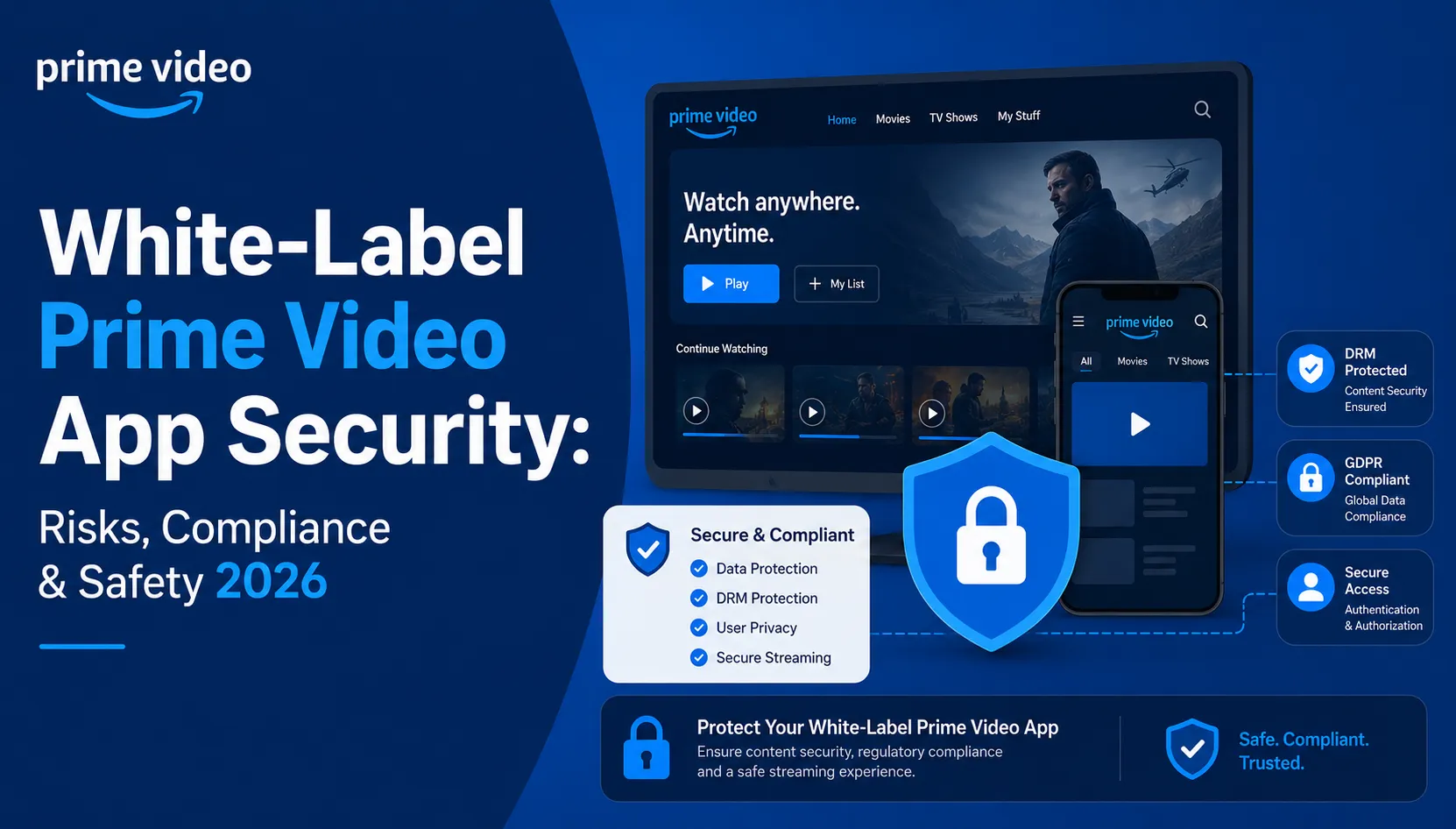
- Core security layers include encrypted streaming, DRM protection, secure payment gateways, multi-factor authentication, API security, and user access management.
- Advanced security systems may include AI-powered fraud detection, piracy monitoring, account abuse prevention, CDN protection, and real-time analytics monitoring.
- Streaming platforms face multiple risks including account takeover attacks, subscription fraud, content piracy, API vulnerabilities, data breaches, and payment-related threats.
- Miracuves positions scalable streaming security architecture as essential for OTT businesses managing high traffic, premium content libraries, and global user access.
Real Insights
- The real challenge in streaming platform security is protecting both users and premium content because OTT platforms must secure subscriptions while preventing illegal redistribution.
- DRM and content protection directly affect profitability since piracy and unauthorized sharing can significantly reduce streaming revenue.
- API and payment security become more critical as platforms scale because subscription systems, mobile apps, and third-party integrations increase security complexity.
- Reliable infrastructure improves both performance and trust since users expect uninterrupted streaming, secure transactions, and safe account management experiences.
- For entrepreneurs, the biggest lesson is to build a Prime Video-style streaming platform around DRM protection, secure payment systems, scalable cloud infrastructure, encrypted streaming delivery, and real-time threat monitoring.
You’ve probably heard the horror stories. Streaming apps leaking user data, hacked admin panels, pirated content spreading overnight, or payment information being compromised. In 2026, security failures don’t just hurt revenue—they destroy trust permanently.
If you’re considering a white-label Prime Video app, safety is no longer a “technical detail.” It’s a business-critical decision. OTT platforms handle sensitive data: user identities, payment credentials, viewing behavior, DRM-protected content, and licensing agreements. One weak link can expose everything.
This guide gives you an honest, security-first assessment of how safe a white-label Prime Video app really is in 2026—what risks exist, what standards matter, and how to launch securely without cutting corners. We’ll also show how security-focused providers like Miracuves design OTT apps to meet enterprise-level safety expectations from day one.
Understanding White-Label Prime Video App Security Landscape
What “White-Label App Security” Really Means
In 2026, white-label Prime Video app security is not about using prebuilt software. It’s about how securely that software is engineered, deployed, and maintained. A white-label app shares a core architecture across multiple businesses, but security depends on isolation, access control, encryption, and governance.
A secure white-label Prime Video app ensures:
- Each business has isolated user data
- Content access is tightly controlled
- Payments and subscriptions are protected
- Admin privileges are role-based and logged
Security is not weakened by white-labeling itself. It is weakened by poor implementation.
Read more : – What is Prime Video App and How Does It Work?
Why People Worry About White-Label Prime Video Apps
Security concerns usually come from:
- Past OTT data breaches reported globally
- Piracy and illegal content redistribution
- Fear of license violations and legal exposure
- Payment fraud and subscription abuse
- Weak admin panel security
These fears are valid—but solvable.
Current Threat Landscape for Prime Video–Style Apps in 2026
OTT and streaming platforms face:
- Account takeover attacks using credential stuffing
- API abuse targeting streaming endpoints
- DRM circumvention and illegal restreaming
- Payment fraud and refund exploitation
- Insider threats via compromised admin access
- Cloud misconfigurations exposing media storage
According to global app security reports in 2026, media and entertainment apps account for over 18% of reported API-based attacks, making security architecture non-negotiable.
Security Standards That Matter in 2026
A white-label Prime Video app in 2026 is expected to align with:
- Zero-trust architecture principles
- API-first security models
- Cloud-native security controls
- Continuous vulnerability monitoring
- Compliance-driven development
Modern buyers no longer ask if security exists—they ask how it’s proven and maintained.
Real-World Security Statistics
- Over 60% of OTT breaches originate from insecure APIs
- 45% of streaming platforms report credential abuse attempts monthly
- Apps without DRM enforcement lose up to 25–30% of licensed content value
- Platforms with regular penetration testing reduce breach risk by over 70%
These numbers explain why white-label Prime Video app security is under intense scrutiny in 2026.
Read more : – Prime Video Revenue Model: How Prime Video Makes Money in 2026
Key Security Risks & How to Identify Them
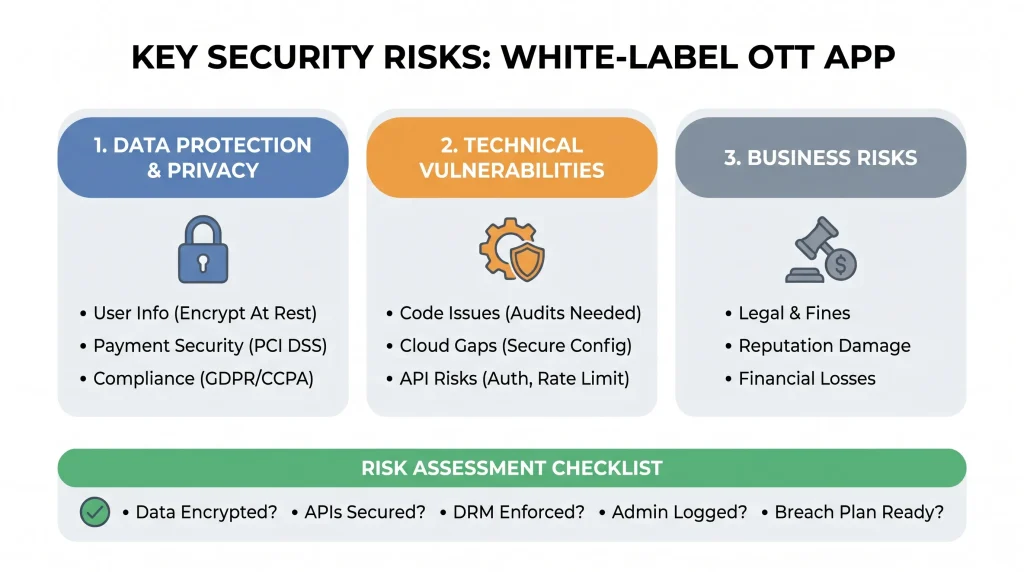
High-Risk Area 1: Data Protection & Privacy
User Personal Information
A white-label Prime Video app stores sensitive data such as names, emails, phone numbers, device identifiers, and viewing history. If this data is not encrypted at rest and in transit, it becomes an easy target for attackers.
Payment Data Security
Subscription-based streaming apps process recurring payments. Weak tokenization, insecure gateways, or improper PCI DSS implementation can expose card data and lead to financial fraud.
Location & Usage Tracking
OTT apps collect IP-based location data and behavioral analytics. In 2026, improper handling of this data can violate GDPR, CCPA, and regional data localization laws.
GDPR / CCPA Compliance Risks
Failure to implement consent management, data deletion requests, and transparency controls can result in heavy regulatory penalties and forced app takedowns.
High-Risk Area 2: Technical Vulnerabilities
Code Quality Issues
Poorly written or reused code without audits can introduce:
- Authentication bypasses
- Hardcoded credentials
- Insecure session handling
Server & Cloud Security Gaps
Misconfigured cloud storage, exposed media buckets, and unsecured load balancers are common causes of OTT data leaks in 2026.
API Vulnerabilities
Streaming apps rely heavily on APIs. Weak rate limiting, missing authentication layers, or exposed endpoints can allow:
- Content scraping
- Subscription abuse
- Account enumeration
Third-Party Integrations
Analytics tools, ad networks, and payment providers can become attack vectors if not properly vetted and isolated.
High-Risk Area 3: Business-Level Security Risks
Legal Liability
Data breaches can make the app owner legally responsible—even if the underlying platform is white-label.
Reputation Damage
One publicized security incident can permanently damage brand trust and user retention.
Financial Losses
Losses can come from:
- Chargebacks
- Regulatory fines
- Platform bans
- Licensing disputes
Regulatory Penalties
In 2026, non-compliance with data protection laws can result in fines reaching millions, especially for media platforms handling international users.
White-Label Prime Video App Risk Assessment Checklist
- Is all user and payment data encrypted?
- Are APIs protected with authentication and rate limiting?
- Is DRM enforced on all media content?
- Are admin actions logged and monitored?
- Are compliance requirements documented?
- Is there a breach response plan in place?
If any answer is unclear, the app carries high security risk.
Security Standards Your White-Label Prime Video App Must Meet
Essential Certifications and Compliance in 2026
ISO 27001 Compliance
ISO 27001 is the baseline for information security management in 2026. It verifies that the provider follows a structured ISMS approach for risk management, access control, incident handling, vendor governance, and continuous improvement.
SOC 2 Type II
SOC 2 Type II validates that security controls are not only designed correctly, but also operate consistently over time. For OTT platforms, this matters because you are running always-on infrastructure, storage, APIs, and admin systems that must be continuously protected.
GDPR Compliance
If you serve users in the EU, GDPR requirements in 2026 still demand:
- Lawful basis for data processing
- Consent and preference controls
- Right to access and deletion workflows
- Data minimization and retention policies
- Breach notification processes
CCPA / CPRA Compliance
If you serve users in California, you need:
- Clear disclosure of data collection and sharing
- Opt-out mechanisms for data selling/sharing (where applicable)
- Consumer request handling and verification workflows
PCI DSS for Payments
If your Prime Video-style app takes subscription payments, PCI DSS remains mandatory in 2026. Even when you use a payment gateway, your app must follow secure payment handling practices (tokenization, secure redirect or SDK flows, and proper logging hygiene).
HIPAA (If Applicable)
Most OTT apps do not need HIPAA. But if your content or features involve patient data (for example, therapy sessions, wellness consultations, or health-linked programs), you must evaluate HIPAA applicability in 2026.
Technical Security Requirements in 2026
End-to-End Encryption Where Needed
For OTT, “end-to-end encryption” is not always the right phrase for content delivery, but encryption must be enforced across:
- TLS 1.2+ (preferably TLS 1.3) for data in transit
- Strong encryption for sensitive data at rest (user data, tokens, keys)
Secure Authentication
Your app must support modern authentication patterns in 2026:
- OAuth 2.0 / OpenID Connect where applicable
- Optional 2FA for high-risk accounts (admin and support)
- Strong session management and token rotation
Regular Security Audits and Code Review
Security cannot be a one-time checklist. You need:
- Secure code review gates before every major release
- Dependency scanning for known vulnerabilities
- Configuration reviews for cloud and storage
Penetration Testing
Pen testing validates real exploit paths:
- API penetration testing is critical for OTT platforms
- Admin panel and role-based access testing is mandatory
- Cloud and storage attack surface testing prevents media leaks
SSL/TLS Certificates and HSTS
TLS certificates must be correctly deployed across:
- App APIs
- Admin dashboards
- CDN and media access endpoints
HSTS prevents downgrade and SSL stripping attacks.
Secure API Design
In 2026, OTT apps are API-first, so APIs must include:
- Strong authentication and authorization
- Rate limiting and abuse prevention
- Input validation and anti-injection protection
- Audit logging for sensitive actions
Security Standards Comparison Table
| Standard / Control (2026) | What It Proves | Why It Matters for Prime Video–Style Apps | Typical Evidence You Should Ask For |
|---|---|---|---|
| ISO 27001 | Formal security management system (ISMS) | Reduces operational security gaps across teams, infra, vendors | ISO certificate, scope statement, ISMS policy summary |
| SOC 2 Type II | Controls work consistently over time | Validates real operational security for always-on platforms | SOC 2 Type II report (relevant trust principles) |
| GDPR | EU privacy compliance | User data rights, consent, breach process, retention control | DPA, RoPA summary, privacy workflows, deletion process |
| CCPA/CPRA | California privacy compliance | Transparency + consumer rights in the US market | Privacy notice mapping, DSAR process, opt-out handling |
| PCI DSS | Payment security baseline | Protects subscription payments and reduces fraud exposure | PCI attestation (or gateway scope proof), secure payment flow docs |
| Encryption (TLS + at rest) | Data is protected in transit and storage | Prevents interception and database compromise damage | TLS configuration, key management approach, encryption policy |
| Pen Testing | Real-world exploit testing | Finds API and admin vulnerabilities before attackers do | Latest pen test report, remediation evidence |
| Secure Auth (OAuth/2FA) | Identity protections | Prevents account takeover and admin compromise | Auth architecture doc, role matrix, 2FA policy for admins |
| Logging + Monitoring | Detects and investigates incidents | OTT apps face abuse, scraping, and credential attacks | SIEM or monitoring overview, alerting rules, log retention policy |
| DRM + Content Protection | Prevents piracy and license risk | Protects premium media rights and reduces illegal redistribution | DRM provider details, watermarking approach, tokenized streaming |
Red Flags: How to Spot Unsafe White-Label Providers
Warning Signs in 2026 That Should Stop You Immediately
No Security Documentation
If a provider cannot share security architecture basics, access control approach, encryption details, and incident response procedures, treat it as a major red flag. In 2026, “we are secure” without documentation is meaningless.
Cheap Pricing Without Explanation
Ultra-low pricing often indicates:
- No dedicated security team
- No compliance work
- No audit budget
- Shared hosting or weak infrastructure
Security is not free, especially for Prime Video–style OTT apps handling subscriptions and licensed media.
No Compliance Certifications or Roadmap
Even if a provider is not certified yet, they must have a clear compliance roadmap. A provider that dismisses ISO 27001, SOC 2 Type II, GDPR, or PCI DSS is not enterprise-ready in 2026.
Outdated Technology Stack
Legacy stacks with unpatched dependencies, old frameworks, or unsupported libraries increase breach probability. OTT apps are API-heavy, and outdated stacks usually mean weak API security.
Poor Code Quality and No Secure SDLC
If the provider does not follow secure development lifecycle practices like code review, dependency scanning, and vulnerability management, you inherit long-term risk.
No Security Updates Policy
In 2026, threats change monthly. Providers must commit to:
- Regular security patches
- Dependency upgrades
- Emergency hotfix workflows
If they cannot explain their update cadence, the app will age into insecurity.
Lack of Data Backup and Disaster Recovery
Streaming apps cannot afford downtime. Missing backup systems leads to:
- Permanent user data loss
- Subscription and billing disputes
- High churn after outages
No Insurance Coverage or Risk Ownership
A serious provider understands liability and risk management. If they have no professional coverage, no contractual responsibility clauses, and no breach support, you are exposed.
Evaluation Checklist: What to Ask Before You Buy
Questions to Ask Providers
- What encryption do you use for user data and tokens in 2026?
- How do you isolate data between different businesses using the same core platform?
- How do you secure APIs against abuse, scraping, and credential stuffing?
- What DRM and content protection mechanisms do you support?
- Do you provide admin 2FA and role-based permissions by default?
- What is your security patch and update policy?
- What monitoring and alerting do you provide post-launch?
- What is your incident response process and breach notification timeline?
Documents to Request
- Security architecture overview (high-level is fine, but must be real)
- Compliance mapping (GDPR, PCI DSS, regional privacy rules)
- Penetration testing summary and remediation proof
- Secure SDLC process outline (code review, scanning, release controls)
- Data retention and deletion policy
- Backup and disaster recovery plan
Testing Procedures to Demand
- API penetration testing before launch
- Admin panel access testing (RBAC validation)
- Vulnerability scan reports (SAST/DAST)
- Cloud configuration review (storage, CDN, IAM policies)
- Payment flow verification to confirm PCI scope boundaries
Due Diligence Steps
- Run a third-party security assessment before production launch
- Validate that keys and secrets are managed properly (no hardcoding)
- Confirm monitoring and logs are accessible for investigations
- Ensure contracts define who handles security updates and timelines
A safe white-label Prime Video app in 2026 is not chosen on features alone. It is chosen on proof: audits, controls, processes, and accountability.
Best Practices for Secure White-Label Prime Video App Implementation
Pre-Launch Security Foundations
Security Audit Before Deployment
Before launching a white-label Prime Video app in 2026, a full security audit is essential. This includes reviewing architecture, infrastructure, APIs, and data flows. The goal is to identify weaknesses before real users and attackers do.
Secure Code Review Requirements
All core modules, especially authentication, payments, subscriptions, and streaming endpoints, must go through structured code reviews. Secure coding standards reduce the risk of injection flaws, broken access control, and logic abuse.
Infrastructure Hardening
Your cloud and server environment should be locked down using:
- Least-privilege access policies
- Secure network segmentation
- Protected storage for media and user data
- Hardened admin access paths
Misconfigured infrastructure is still one of the leading causes of OTT breaches in 2026.
Compliance Verification
Before launch, verify that:
- Privacy policies reflect actual data handling
- Consent mechanisms are correctly implemented
- Payment flows follow PCI DSS boundaries
- Data retention rules align with regional regulations
Compliance should be validated, not assumed.
Staff Training and Access Control
Even the most secure app can be compromised by human error. Limit access to production systems, enforce strong authentication for admins, and train staff on security hygiene and incident awareness.
Post-Launch Security and Ongoing Protection
Continuous Security Monitoring
In 2026, security is continuous. A Prime Video–style app should monitor:
- Login abuse and account takeover attempts
- API traffic anomalies
- Streaming abuse and scraping behavior
- Payment fraud indicators
Early detection prevents small incidents from becoming public breaches.
Regular Updates and Patch Management
Dependencies, frameworks, and libraries must be updated frequently. A defined patch cycle ensures vulnerabilities are closed before they are exploited at scale.
Incident Response Planning
You must have a documented incident response plan covering:
- Detection and triage
- Containment and remediation
- User and regulator notification
- Post-incident review and improvement
Speed and clarity matter when something goes wrong.
User Data Management
In 2026, users expect control. Your app should support:
- Data access and deletion requests
- Consent updates
- Transparent privacy controls
Ignoring these expectations creates legal and reputational risk.
Backup and Disaster Recovery
Reliable backups protect against ransomware, outages, and operational mistakes. Regular testing of recovery procedures ensures you can restore service without data loss or long downtime.
Secure White-Label Prime Video App Implementation Timeline
- Week 1–2: Architecture review, threat modeling, compliance mapping
- Week 3–4: Code review, API security testing, infrastructure hardening
- Week 5: Penetration testing and remediation
- Week 6: Final compliance checks, documentation, and go-live approval
- Ongoing: Monitoring, updates, audits, and incident readiness
A secure implementation is not rushed. It is planned, verified, and continuously improved.
Legal & Compliance Considerations for a White-Label Prime Video App
Regulatory Requirements in 2026
Data Protection Laws by Region
A white-label Prime Video app operating in 2026 must comply with multiple data protection frameworks depending on user location:
- EU: GDPR governs user consent, data processing, storage, and breach reporting
- USA: CCPA/CPRA applies to personal data collection, sharing, and consumer rights
- UK: UK GDPR with additional ICO enforcement expectations
- India: Digital Personal Data Protection Act (DPDPA) mandates consent-based processing and data security
- Middle East & APAC: Data localization and cross-border transfer rules are increasingly enforced
Failing to map data flows by region creates legal exposure even before a breach occurs.
Industry-Specific Regulations
OTT platforms face additional compliance pressure due to:
- Licensed and copyrighted content handling
- DRM enforcement obligations
- Regional content distribution restrictions
- Advertising and subscription transparency rules
These are not optional in 2026. They are contractually enforced by content licensors and regulators.
User Consent Management
A compliant Prime Video–style app must:
- Clearly explain what data is collected and why
- Capture explicit consent where required
- Allow users to modify preferences
- Log consent actions for audit purposes
Consent is a system feature, not just a legal statement.
Privacy Policy and Disclosure Requirements
Your privacy policy must accurately reflect:
- Data collection practices
- Storage duration
- Third-party integrations
- User rights and contact mechanisms
In 2026, regulators actively penalize misleading or generic privacy policies.
Terms of Service Essentials
Terms must define:
- User responsibilities
- Content usage rights
- Subscription and refund policies
- Limitation of liability
- Dispute resolution mechanisms
Poorly written terms increase legal risk during disputes and security incidents.
Liability Protection and Risk Management
Insurance Requirements
For OTT platforms in 2026, the following coverage is increasingly expected:
- Cyber liability insurance
- Data breach response coverage
- Professional indemnity insurance
This protects the business when incidents occur despite best efforts.
Legal Disclaimers and Responsibility Allocation
Contracts with your white-label provider must clearly state:
- Who handles security updates
- Who responds to breaches
- Who communicates with regulators and users
- Who bears financial responsibility
Ambiguity here becomes expensive during real incidents.
Incident Reporting Protocols
You must define:
- Internal escalation timelines
- Regulatory notification windows
- User communication templates
GDPR and similar laws enforce strict breach reporting deadlines in 2026.
Ongoing Compliance Monitoring
Compliance is not static. Laws evolve, and enforcement tightens. Regular legal reviews ensure your Prime Video–style app remains compliant as regulations change.
Compliance Checklist by Region (2026)
- GDPR compliance for EU users
- CCPA/CPRA compliance for California users
- DPDPA compliance for Indian users
- Payment regulations and PCI DSS alignment
- Content licensing and DRM enforcement
- Breach notification readiness
Legal and compliance planning reduces long-term risk and protects the business beyond technology.
Why Miracuves White-Label Prime Video App Is the Safest Choice in 2026
Miracuves’ Security-First Architecture
In 2026, Miracuves designs white-label Prime Video apps with security treated as core infrastructure, not an add-on. The platform is built using enterprise-grade architecture that separates data, isolates tenants, and enforces strict access control at every layer.
Every app deployment follows a security-by-design approach, ensuring protection from the database level to streaming delivery endpoints.
Enterprise-Grade Security Controls
Miracuves white-label Prime Video apps include:
- Encrypted data transmission using modern TLS standards
- Strong encryption for sensitive data at rest
- Secure API architecture with authentication, authorization, and rate limiting
- Role-based admin access with detailed activity logging
- DRM-backed content protection to reduce piracy and license risk
These controls align with what enterprises and regulators expect in 2026.
Compliance Built In, Not Bolted On
Miracuves platforms are designed to support compliance requirements from day one:
- GDPR and CCPA compliance by default
- PCI DSS–aligned payment handling for subscriptions
- Region-aware data handling for global OTT operations
- Privacy and consent workflows aligned with 2026 regulations
This reduces legal risk and shortens time-to-market.
Continuous Monitoring and Ongoing Protection
Security does not stop at launch. Miracuves provides:
- Continuous monitoring for suspicious activity
- Regular security updates and dependency patching
- Periodic audits and vulnerability assessments
- Defined incident response processes
This proactive model helps prevent breaches rather than reacting to them.
Proven Track Record and Risk Coverage
With 9k+ successful projects delivered, Miracuves maintains a strong security record with zero major reported breaches. Professional insurance coverage and clear contractual responsibility further reduce client exposure in 2026.
Final Thought
Don’t compromise on security. Miracuves white-label Prime Video app solutions are built with enterprise-grade protection, compliance readiness, and long-term risk management. Talk to Our Security Experts Now and see why businesses trust Miracuves for safe, compliant streaming platforms in 2026.
A secure white-label Prime Video app is not defined by promises or pricing. It is defined by architecture, compliance, monitoring, and accountability. Choosing a security-first provider like Miracuves reduces long-term risk, protects brand trust, and allows you to scale confidently in a highly regulated streaming ecosystem.
FAQs
1. How secure is a white-label Prime Video app compared to custom development in 2026?
In 2026, a professionally built white-label Prime Video app can be as secure or more secure than custom development. Mature platforms benefit from repeated audits, hardened architecture, and real-world testing that many custom apps lack.
2. What happens if there is a security breach?
A proper incident response plan includes rapid containment, forensic investigation, user and regulator notification, and remediation. Responsibility depends on contractual terms between the app owner and the white-label provider.
3. Who is responsible for security updates?
In 2026, security updates should be handled by the white-label provider under a defined patch and maintenance policy, while the app owner ensures compliance and operational readiness.
4. How is user data protected in a white-label Prime Video app?
User data is protected through encryption in transit and at rest, strict access control, monitoring, and compliance-driven data handling processes aligned with GDPR and regional laws.
5. What compliance certifications should I look for?
At minimum, look for ISO 27001 alignment, SOC 2 Type II readiness, GDPR and CCPA compliance, and PCI DSS–aligned payment processing in 2026.
6. Can white-label Prime Video apps meet enterprise security standards?
Yes. In 2026, enterprise-grade white-label Prime Video apps meet the same security expectations as large OTT platforms when built with proper architecture and controls.
7. How often should security audits be conducted?
Security audits should be performed before launch and at least annually, with additional reviews after major updates or infrastructure changes.
8. What is included in the Miracuves security package?
Miracuves provides encrypted data handling, secure APIs, compliance-ready architecture, monitoring, regular updates, and incident response support in 2026.
9. How do I handle security across multiple countries?
You must map data flows by region, apply region-specific privacy rules, and ensure consent, storage, and breach reporting align with local laws in 2026.
10. What insurance is needed for app security?
Cyber liability and data breach insurance are strongly recommended in 2026 to cover response costs, legal exposure, and regulatory penalties.
Related Artices: