
Key Takeaways
- Video Streaming Platform Monetization can combine subscriptions, rentals, advertising, purchases, pay-per-view, and hybrid access models depending on content value and audience behavior.
- Subscriptions work best for repeat viewing and ongoing content libraries, while rentals and purchases are better suited to premium or occasional content.
- Ad-supported streaming can lower the entry barrier for price-sensitive users, but ad frequency and placement need careful control.
- Pay-per-view works well for live events, premieres, sports, concerts, and other high-intent viewing moments.
- Every monetization model depends on accurate payment, entitlement, access, reporting, and admin logic behind the viewer experience.
Monetization Signals
- Subscription models need recurring billing, plan management, renewals, cancellations, upgrades, failed-payment handling, and churn reporting.
- Rental models need content-level pricing, start and expiry windows, playback limits, transaction history, and clear access messaging.
- Purchase models need long-term entitlement records, purchase history, refund handling, cross-device access, and a user library.
- Hybrid platforms need flexible admin controls to decide which content is free, ad-supported, subscription-only, rentable, purchasable, or available through PPV.
- Revenue reports should show which plans, titles, regions, campaigns, and access models generate the strongest business results.
Real Insights
- The monetization model should be decided before development because it directly affects payment flows, entitlement rules, admin dashboards, and user experience.
- Subscriptions can underperform when the platform does not provide enough recurring content value to justify continued payments.
- A large price-sensitive audience may respond better to advertising or freemium access than a subscription-only model.
- Hybrid monetization gives founders more flexibility but also increases backend complexity because multiple access rules must work together clearly.
- The strongest decision path is: evaluate content type → understand audience willingness to pay → choose the primary revenue model → define entitlement logic → add complementary monetization as the platform grows.
Video Streaming Platform Monetization can make money in more than one way. Some rely on monthly subscriptions. Some sell or rent individual movies. Some run ads before or during content. Others combine subscriptions, rentals, purchases, pay-per-view events, premium bundles, and free ad-supported access in one platform.
For founders, this creates an important business decision: which monetization model fits your audience, content type, pricing power, and growth stage?
A video streaming platform is not only a video player. It is a revenue system built around content access. Every monetization model changes how users discover content, how they pay, what they can watch, how long they can access it, and how the admin team controls revenue.
A subscription-first platform needs recurring billing and plan management. A rental platform needs expiry rules. An ad-supported platform needs ad placement and reporting. A purchase-based platform needs long-term access rights. A hybrid platform needs all of these layers working together without confusing users.
That is why monetization should be planned before development begins. If the revenue model is unclear, the platform may launch with the wrong payment flow, weak admin controls, limited reporting, or a user experience that does not match the business goal.
Miracuves helps founders build ready-made and white-label video streaming platforms with branded design, admin control, monetization workflows, and source-code ownership. For founders planning a streaming product, the real opportunity is not simply launching content online. It is building a platform where content, pricing, access, payments, and viewer experience work together.
Why Monetization Strategy Matters Before Building a Streaming Platform
Many founders start with the content library first. That is understandable. Content is the visible asset users come to watch. But the monetization model decides how that content becomes revenue.
A platform with documentaries may perform well with subscriptions if users expect ongoing access. A platform with new movie releases may need rentals or purchases. A sports or concert platform may depend on pay-per-view. A regional entertainment app may combine ads with low-cost subscriptions. An educational video platform may sell courses, bundles, or lifetime access.
Each model creates different product requirements.
A subscription model needs recurring billing, plan tiers, renewal reminders, failed payment handling, upgrade and downgrade flows, and cancellation management. A rental model needs time-based access, expiry rules, and clear user messaging. An ad-supported model needs ad inventory, impression tracking, frequency control, and placement logic. A purchase model needs long-term access, transaction history, and entitlement records.
This is why monetization is not just a marketing decision. It affects product architecture, backend logic, admin dashboards, payment gateways, analytics, and customer support.
Founders building secure streaming products can also explore Miracuves’ entertainment app solutions to understand how streaming, creator, short video, and digital entertainment products fit into the wider app ecosystem.
Main Monetization Models for Video Streaming Platforms
Most Video Streaming Platforms use one or more of four core models: subscriptions, rentals, ads, and purchases. These are often described as SVOD, TVOD, AVOD, and EST or direct purchases.
| Monetization Model | How It Works | Best For | Main Platform Requirement |
|---|---|---|---|
| Subscription | Users pay recurring fees for ongoing access | Large libraries, series, education, fitness, niche communities | Plan management, recurring billing, renewal logic |
| Rental | Users pay to access specific content for a limited time | Movies, premium releases, events, courses, sports replays | Expiry rules, content-level pricing, access windows |
| Ads | Users watch free or lower-cost content with advertisements | Large audiences, free content, regional entertainment, FAST-style channels | Ad placements, reporting, viewer segmentation |
| Purchases | Users buy long-term or permanent access to content | Premium films, courses, exclusive workshops, collectibles, event recordings | Purchase history, entitlement records, content ownership logic |
| Hybrid | Platform combines two or more models | Scaling platforms with multiple audience segments | Flexible admin control and mixed access rules |
The right choice depends on how often users return, how valuable the content is, how price-sensitive the audience is, and whether the platform wants fast reach, stable revenue, or premium transaction value.
A secure streaming product usually starts with the right foundation. Before adding subscription plans, rental windows, ad placements, or purchase flows, founders should define the type of video product they want to launch. Miracuves’ video content platform solutions help founders understand how OTT, creator-led, short video, and streaming platforms can be structured for growth.
Subscription Monetization: Building Recurring Revenue From Loyal Viewers
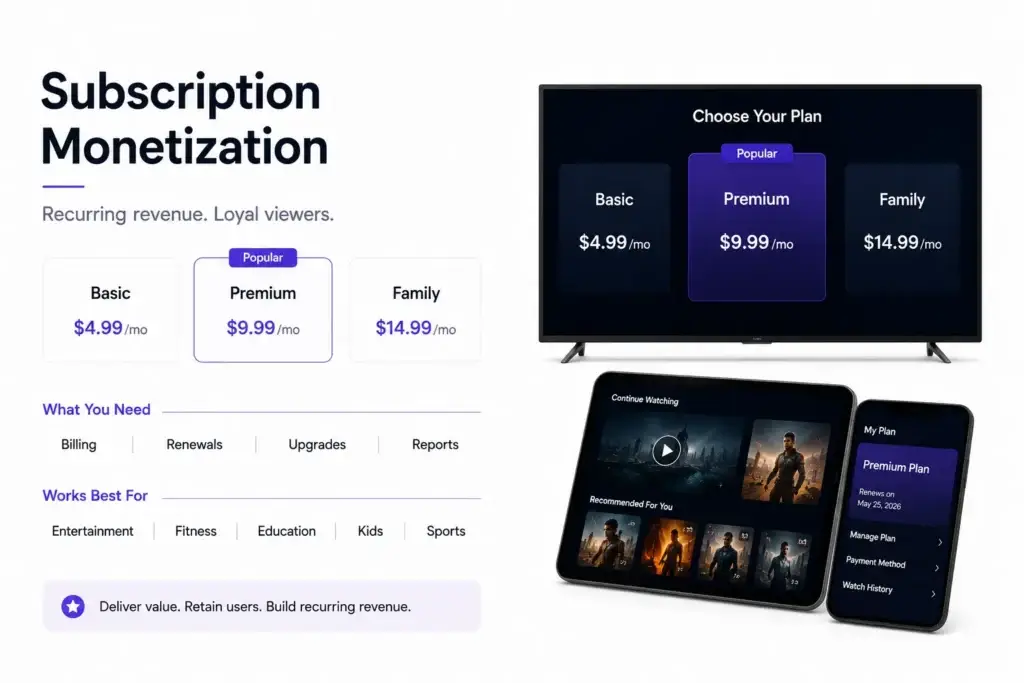
Subscription monetization works when users pay on a recurring basis to access a content library or premium experience. This is one of the most familiar models for video streaming platforms because it turns content access into predictable recurring revenue.
A subscription model may include:
- Monthly plans
- Annual plans
- Mobile-only plans
- Family plans
- Premium ad-free plans
- Student or regional pricing
- Creator-specific subscriptions
- Niche content memberships
- Free trials or limited trial access
The main advantage of subscriptions is revenue consistency. Instead of relying on one-time transactions, the platform earns recurring payments as long as users continue to see value.
However, subscriptions also create pressure. Users will keep paying only if the platform delivers enough content, personalization, reliability, and perceived value. If the library feels thin, the app experience is poor, or users forget why they subscribed, churn increases.
What a Subscription-Based Streaming Platform Needs
A subscription model needs more than a payment button. It needs a subscription engine that manages user access throughout the billing lifecycle.
Important modules include:
- Plan creation and management
- Trial configuration
- Recurring billing
- Upgrade and downgrade flows
- Renewal reminders
- Failed payment retries
- Cancellation flow
- Grace periods
- Refund logic
- Device limits by plan
- Profile limits by plan
- Admin reporting
- Subscription analytics
The admin dashboard should allow platform operators to create plans, adjust pricing, view active subscribers, track cancellations, manage promotional offers, and understand churn signals.
For example, a fitness streaming platform may offer a basic plan for recorded workouts and a premium plan with live classes. A children’s learning platform may offer monthly and annual subscriptions with parent controls. A regional movie app may use low-cost monthly plans to grow faster in price-sensitive markets.
When Subscriptions Work Best
Subscriptions work best when the platform has repeatable content value. Users need a reason to return every week or every month.
This model is strong for:
- Series-based entertainment
- Fitness and wellness videos
- Educational libraries
- Kids’ content
- Regional content platforms
- Spiritual or devotional video libraries
- Creator-led premium communities
- Professional training libraries
- Sports analysis and replay platforms
The founder’s key question should be: Will users see enough ongoing value to keep paying after the first month?
If the answer is yes, subscriptions can become the core revenue engine. If the content is mostly one-time viewing, rentals or purchases may work better.
Rental Monetization: Selling Time-Limited Access to Premium Content
Rental monetization allows users to pay for a specific video and watch it for a limited time. This model is especially useful when the content has high one-time value but does not require ongoing subscription access.
A rental model may work for:
- New movie releases
- Regional films
- Concert recordings
- Sports replays
- Webinars
- Educational workshops
- Limited-access documentaries
- Festival screenings
- Premium creator content
In a rental model, the user does not buy the full platform experience. They pay for one content item or event. This can lower the barrier to purchase because users do not need to commit to a monthly plan.
What a Rental-Based Streaming Platform Needs
Rental monetization depends on clear access rules. Users should know exactly what they are paying for and how long they can watch.
A rental flow should define:
- Rental price
- Access start time
- Access expiry time
- Playback window
- Refund rules
- Device restrictions
- Download availability
- Reminder before expiry
- Transaction history
- Admin-level pricing control
For example, a platform may allow users to rent a movie for 48 hours after starting playback. Another platform may give users seven days to start watching and 24 hours to finish after playback begins. These rules must be clear in the user interface and accurate in the backend.
Content protection also depends on how video libraries are sourced, organized, and updated. If a platform relies on licensed catalogs, third-party metadata, or external content providers, the integration layer should be planned carefully. Founders can learn more about this in Miracuves’ guide on content acquisition APIs for video streaming platforms.
When Rentals Work Best
Rentals work best when the content has strong event value, release value, or premium value. Users may not want to subscribe, but they are willing to pay for a specific title.
This model is useful when:
- Content is expensive to license
- Users want occasional access
- New releases need premium pricing
- Events have short-term demand
- The platform wants to test content demand before adding it to subscription plans
- The audience prefers pay-as-you-watch access
The founder’s key question should be: Is the content valuable enough for users to pay for it individually?
If yes, rentals can become a strong transactional revenue stream.
Ad Monetization: Turning Free Viewing Into Revenue
Ad monetization allows users to watch content for free or at a lower cost while advertisers fund the viewing experience. This model is commonly used by platforms that want fast audience growth, broad reach, or a free entry point.
Ad-supported streaming may include:
- Pre-roll ads before video playback
- Mid-roll ads during longer videos
- Post-roll ads after playback
- Banner ads inside the app
- Sponsored content rows
- Brand placements
- FAST-style scheduled channels
- Rewarded ads for unlocking content
- Regional ad targeting
- Contextual ads based on content category
The main advantage of ads is accessibility. Users can start watching without paying upfront. This can help platforms grow faster in markets where subscription fatigue or price sensitivity is high.
The challenge is balance. Too many ads can hurt retention. Poorly placed ads can interrupt the viewer experience. Irrelevant ads can reduce advertiser value and user satisfaction.
What an Ad-Supported Streaming Platform Needs
Ad monetization requires both product and reporting infrastructure.
Important modules include:
- Ad placement control
- Ad server integration
- Pre-roll, mid-roll, and post-roll logic
- Impression tracking
- Click tracking where applicable
- Frequency capping
- Fill-rate reporting
- Ad revenue analytics
- User segmentation
- Content category targeting
- Brand-safe content controls
- Admin-level ad campaign management
For long-form content, mid-roll timing matters. Ads should not interrupt important scenes or learning moments. For short-form or snackable content, ads may need to appear between videos instead of inside videos. For kids’ content, advertising policies and content suitability require extra care depending on the target market.
When Ads Work Best
Ads work best when the platform can attract meaningful watch time and a large enough audience. Advertisers usually care about attention, targeting, context, and measurable engagement.
Ad monetization is useful for:
- Free entertainment platforms
- Regional video apps
- News and media platforms
- Sports highlights
- Short video platforms
- Creator-led platforms
- FAST channels
- Educational platforms with free lessons
- Freemium streaming products
The founder’s key question should be: Can the platform generate enough watch time and audience scale to make ads meaningful?
If the audience is small but highly committed, subscriptions or purchases may produce better revenue. If the audience is large and price-sensitive, ads may help the platform grow faster.
Purchase Monetization: Selling Long-Term Content Access
Purchase monetization allows users to buy individual videos, courses, events, or bundles for long-term access. This model is useful when the content has lasting value.
Purchases may include:
- Digital movie purchases
- Course purchases
- Workshop recordings
- Fitness program bundles
- Premium documentaries
- Sports event replays
- Creator masterclasses
- Spiritual discourses
- Certification video content
- Kids’ learning packs
Unlike rentals, purchases usually give users longer access. The access may be permanent, lifetime, or valid for a defined long-term period depending on business rules and licensing rights.
What a Purchase-Based Streaming Platform Needs
Purchase monetization needs strong entitlement tracking. Once users buy content, the system must remember their access rights across devices and sessions.
Important modules include:
- Buy-now checkout
- Content ownership records
- Purchase history
- Invoice or receipt records
- Refund handling
- Bundle access
- Download permissions
- Cross-device access
- Library or “My Purchases” section
- Admin-level purchase reporting
- Access restoration for returning users
The platform must also communicate clearly whether users are buying lifetime access, limited-time ownership, offline download rights, or streaming-only access. Confusing terms can create refund requests and user frustration.
When Purchases Work Best
Purchases work best when content has durable value and users want to own access instead of subscribing.
This model is strong for:
- Education and skill development
- Premium creator content
- Professional training
- Niche documentaries
- Kids’ learning libraries
- Fitness programs
- Event recordings
- Independent films
- Religious or spiritual content libraries
The founder’s key question should be: Will users want to return to this content repeatedly after buying it?
If yes, purchases can create high-intent revenue without relying only on subscriptions.
Pay-Per-View: Monetizing Events and Limited-Time Demand
Pay-per-view is close to rental monetization, but it is usually tied to a specific event or high-demand moment. Users pay to watch a live stream, premiere, sports match, concert, conference, webinar, creator session, or special release.
Pay-per-view works because urgency increases willingness to pay.
Common PPV use cases include:
- Live sports matches
- Concerts
- Comedy shows
- Film premieres
- Online conferences
- Creator live sessions
- Religious events
- Fitness workshops
- Esports tournaments
- Award shows
A PPV model needs strong access control because demand often spikes around the event time. The platform must handle payment, ticketing, access validation, stream reliability, refunds, and post-event replay rules.
For founders exploring live monetization, Miracuves’ guide on live streaming monetization for video platforms gives additional context on creator payments, subscriptions, gifting, and event-based revenue.
Hybrid Monetization: Combining Subscriptions, Rentals, Ads, and Purchases
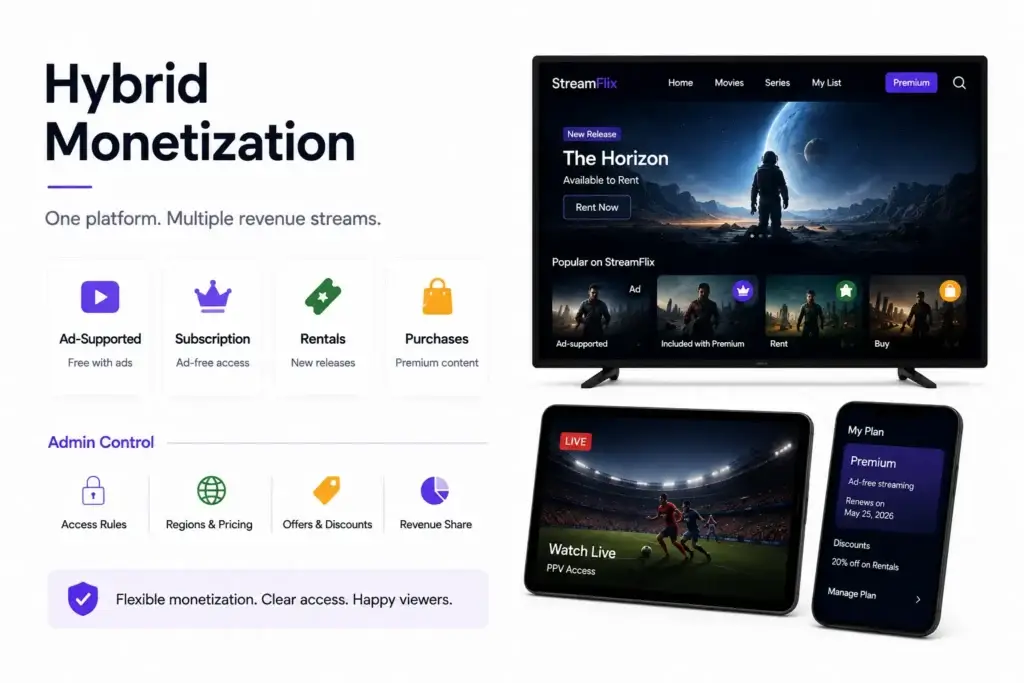
Many successful Video Streaming Platforms do not depend on one revenue stream. They combine multiple models to serve different viewer segments.
A hybrid model may look like this:
- Free users watch ad-supported content.
- Paid subscribers get ad-free access to the main library.
- New releases are available as paid rentals.
- Premium courses or events are sold as one-time purchases.
- Live events are sold through pay-per-view.
- Annual subscribers receive discounts on rentals.
- Some regions receive lower-cost plans with ads.
- Creators earn through subscriptions, tips, or revenue sharing.
Hybrid monetization is powerful because not all users have the same intent. Some users want free content. Some want unlimited access. Some only want one movie. Some want premium content. Some prefer ad-free viewing. Some are willing to pay more for exclusivity.
The challenge is complexity. If the platform does not explain access clearly, users may feel confused.
What a Hybrid Streaming Platform Needs
A hybrid model requires flexible admin control.
The platform should allow admins to define:
- Which content is free
- Which content is subscription-only
- Which content is ad-supported
- Which content is rentable
- Which content is purchasable
- Which content is available as PPV
- Which regions can access each model
- Which users get discounts
- Which plans include ad-free access
- Which creators or partners receive revenue share
Security should be planned alongside the platform’s core product modules. Features such as subscription access, video libraries, watchlists, downloads, payment flows, admin dashboards, and multi-device streaming all create different monetization requirements. Founders can review broader video streaming platform features to understand how these modules connect with access control and viewer experience.
Choosing the Right Monetization Model for Your Streaming Platform
The right monetization model depends on audience behavior, content type, pricing power, and platform maturity. Founders should not choose a model only because another streaming company uses it.
Use this decision framework:
| Founder Question | Better Monetization Direction |
| Will users watch content repeatedly every month? | Subscription |
| Is the content premium but watched occasionally? | Rental or purchase |
| Is the audience large but price-sensitive? | Ads or freemium |
| Is the content tied to live demand? | Pay-per-view |
| Is the content educational or reusable? | Purchase or subscription |
| Is the library broad with mixed content value? | Hybrid monetization |
| Is the platform creator-led? | Subscriptions, PPV, tips, revenue share |
| Is the content expensive to license? | Rentals, premium subscriptions, or bundles |
A niche platform does not need to copy the monetization style of large streaming brands. A regional film app, creator learning platform, kids’ education platform, spiritual content platform, sports replay app, and indie film marketplace may all need different pricing logic.
Viewer data becomes especially important when the platform uses recommendations, watch history, genre-based rows, personalized feeds, or continue-watching features. The goal is to improve discovery without overcomplicating monetization. For founders planning personalization workflows, Miracuves’ guide on video streaming content discovery explains how discovery systems can improve engagement.
Founder Decision Signals for Streaming Monetization
Content Depth
If your library has enough fresh or repeatable content, subscriptions can support recurring revenue. If your library is small but premium, rentals or purchases may work better.
Audience Willingness to Pay
If users are price-sensitive, start with ads or freemium access. If the audience is highly committed, subscriptions, purchases, or PPV can create stronger revenue per user.
Content Rights
Licensed content may have rules around regions, access windows, rentals, downloads, or purchase rights. These rules should shape monetization before launch.
Platform Control
The more revenue models you combine, the stronger your admin dashboard, payment logic, entitlement rules, and reporting system need to be.
How Monetization Affects Platform Features
Monetization should not be added after the platform is built. It should influence the feature roadmap from the beginning.
Monetization Features and Their Business Value
| Feature | Business Value | Founder Impact |
|---|---|---|
| Subscription Plans | Creates recurring revenue from loyal users | Helps build predictable revenue if retention is strong |
| Rental Access | Allows users to pay for specific premium content | Useful for new releases, events, and occasional viewers |
| Ad Monetization | Turns free viewing into revenue | Supports growth in price-sensitive markets |
| Content Purchases | Sells long-term access to high-value videos | Works well for education, courses, workshops, and premium content |
| Pay-Per-View | Captures high-intent event demand | Useful for live sports, concerts, conferences, and premieres |
| Coupons and Promotions | Improves acquisition and conversion | Allows founders to test pricing without changing the core product |
| Revenue Reports | Shows which content and plans generate income | Helps founders make pricing, licensing, and marketing decisions |
Payment and Entitlement Logic: The Backend of Streaming Revenue
Every monetization model depends on entitlement logic. Entitlement simply means the platform knows what each user is allowed to watch.
For example:
- A monthly subscriber can watch subscription content until the plan expires.
- A rental user can watch one movie for a limited period.
- A purchaser can access bought content from their library.
- A free user can watch ad-supported videos.
- A PPV buyer can watch a live event and possibly its replay.
- A premium subscriber may receive ad-free viewing.
- A regional user may only access content available in their country.
Without entitlement logic, monetization breaks. Users may pay but not get access. Canceled users may continue watching. Rental windows may not expire correctly. Refunds may not remove access. Admins may not know why a user can or cannot view a video.
A strong streaming backend should connect:
- Payment gateway events
- Subscription status
- Rental windows
- Purchase records
- User roles
- Device limits
- Content availability
- Regional access
- Refunds and chargebacks
- Admin overrides
- Analytics and reporting
This is where monetization becomes technical. A founder may think they are choosing between subscriptions and ads, but the development team must translate that decision into access rules, billing events, dashboard controls, and user-facing messages.
Security choices can also influence development scope. DRM, secure offline downloads, payment gateway workflows, fraud monitoring, admin permissions, and privacy controls may all affect the final build plan. Founders should define these requirements early when estimating video streaming platform development cost.
Common Monetization Mistakes Founders Should Avoid
Choosing Subscriptions Without Enough Repeat Value
Subscriptions work only when users have a reason to return regularly. A small or slow-moving content library may struggle unless it serves a highly committed niche.
Adding Ads Too Aggressively
Ads can support free access, but excessive interruptions can reduce watch time, hurt retention, and weaken the user experience.
Ignoring Rental and Purchase Windows
Users need clear rules around how long rented or purchased content remains available. Confusing access terms can increase refund requests and support issues.
Launching Without Revenue Reporting
Founders need to know which plans, videos, regions, and campaigns generate revenue. Without reporting, pricing decisions become guesswork.
How Admin Control Helps Streaming Platforms Monetize Better
The admin dashboard is where monetization becomes manageable. Without admin control, every pricing change, plan update, refund, coupon, content access rule, or reporting request may require developer involvement.
A monetization-ready admin dashboard should help platform operators:
- Create subscription plans
- Add rental pricing
- Set purchase pricing
- Enable or disable ads
- Configure free trials
- Manage coupons
- Control premium bundles
- Review revenue reports
- Track subscriber growth
- View churn signals
- Manage refunds
- Monitor failed payments
- Assign content access rules
- View top-performing content
- Manage partner or creator payouts where relevant
For founders, this control matters because pricing strategy changes after launch. The first plan structure may not be the final one. The platform may start with subscriptions, then add rentals. It may launch with free content, then add ad-supported access. It may test premium event pricing later.
A flexible dashboard lets founders experiment without rebuilding the product every time the business model changes.
Monetization and security are closely connected in streaming products. A subscription, rental, pay-per-view, freemium, when access starts, and when access expires. Founders planning revenue logic can explore Miracuves’ guide to the video streaming platform business model.
How Miracuves Helps Founders Build Monetization-Ready Video Streaming Platforms
Miracuves helps founders build ready-made and customisable video streaming platforms with white-label branding, source-code ownership, admin control, secure payment workflows, and monetization-ready modules.
Depending on the launch scope, a streaming platform foundation can support:
- Subscription plans
- Rental access
- Pay-per-view events
- Content purchases
- Ad-supported streaming
- Free trials
- Coupons and promotional offers
- Multi-device access
- User profiles
- Content library management
- Watchlists and recommendations
- Admin dashboards
- Revenue reporting
- Payment gateway integration
- Access and entitlement logic
- Creator or partner revenue workflows where applicable
Building a monetization-ready streaming platform requires more than attractive screens. Founders need the right mix of content strategy, payment logic, admin controls, user access rules, subscription flows, and revenue reporting. Working with an experienced video streaming platform development company can help align these layers from the foundation stage instead of fixing them after launch.
If your business needs a launch-ready OTT foundation, you can explore Miracuves’ white-label OTT streaming platform foundation designed for branded streaming experiences, admin control, monetization workflows, and scalable product execution.
Final Thoughts: Streaming Monetization Is About Access, Not Just Payments
Video Streaming Platforms monetize successfully when pricing, content value, user experience, and access control work together.
Subscriptions are strong for recurring content value. Rentals work for premium one-time viewing. Ads help platforms reach free users and price-sensitive markets. Purchases work when users want long-term access. Pay-per-view is useful for events and limited-time demand. Hybrid monetization gives founders flexibility, but it also requires stronger admin control and backend logic.
The real decision is not simply “subscriptions or ads.” The better decision is: which revenue model matches your content, your audience, and your launch stage?
A founder with a niche content library may start with subscriptions. A founder with premium films may use rentals. A creator-led platform may combine subscriptions, PPV, and purchases. A regional entertainment platform may begin with ads and later introduce paid tiers.
The stronger the monetization foundation, the easier it becomes to test pricing, add new plans, improve retention, and scale revenue over time.
FAQs
How do Video Streaming Platforms make money?
Video Streaming Platforms make money through subscriptions, rentals, ads, purchases, pay-per-view events, sponsorships, premium bundles, and hybrid monetization models. The right model depends on content type, audience behavior, pricing power, and platform goals.
What is the subscription model in video streaming?
The subscription model allows users to pay a recurring fee for access to a content library or premium experience. It works best for platforms with ongoing content value, such as series, education, fitness, regional entertainment, or niche communities.
How do rentals work in video streaming platforms?
Rentals allow users to pay for specific content for a limited time. The platform defines rental price, access window, expiry rules, device limits, and refund logic. Rentals work well for movies, events, workshops, and premium releases.
What is ad-supported video monetization?
Ad-supported video monetization allows users to watch free or lower-cost content while the platform earns revenue from advertisements. Ads may appear before, during, or after videos, or through sponsored placements inside the app.
What is the difference between rentals and purchases in streaming?
Rentals provide temporary access to specific content, while purchases usually provide long-term or permanent access depending on the platform’s rules and content rights. Purchases work well for courses, premium videos, workshops, and reusable content.
Should a streaming platform use one monetization model or a hybrid model?
A new platform can start with one model if the content strategy is focused. However, hybrid monetization can work better as the platform grows because different users may prefer subscriptions, free ad-supported access, rentals, purchases, or pay-per-view.
Why is entitlement logic important for streaming monetization?
Entitlement logic decides what each user is allowed to watch based on subscription status, rental expiry, purchase history, region, device limit, refund status, or payment confirmation. Without it, payments and content access can become inaccurate.
What monetization model is best for a new video streaming platform?
There is no single best model for every platform. Subscriptions work for repeat content, rentals work for premium one-time viewing, ads work for large free audiences, purchases work for reusable content, and pay-per-view works for live events or limited-time demand.
Miracuves is an independent software development company. We are not affiliated with, connected to, sponsored by, or endorsed by any company or product named in this article.
Terms such as “X Clone” are used descriptively. It is how the software industry refers to building a platform with functionality comparable to a known service, and how clients search for it.
The entire design and codebase of our products is built by our own team. Our products contain no code, design, graphics, or content originating from any third-party website or applications.
All third-party names and marks referenced in this article are the property of their respective owners, referenced solely to identify the services discussed.