


Key Takeaways
- A Zipcar clone script helps founders launch a membership-based car sharing and short-term rental platform faster.
- Core features include car listings, hourly booking, membership plans, location-based search, digital access, payments, and admin controls.
- Pricing depends on app complexity, fleet size, booking flow, user roles, vehicle access system, payment setup, and customization level.
- Car rental companies, urban mobility startups, fleet operators, universities, corporates, and local transport businesses are strong target users.
- Long-term success depends on easy booking, vehicle availability, secure access, automated billing, fleet tracking, and smooth customer support.
Market Signals
- Car sharing platforms are growing because urban users want flexible vehicle access without ownership, parking, insurance, or maintenance pressure.
- Important features include nearby car search, real-time availability, hourly pricing, reservation management, driver verification, and GPS tracking.
- Revenue can improve through membership plans, hourly rentals, late return fees, premium vehicles, corporate packages, and add-on services.
- These platforms can serve students, office commuters, travelers, residential communities, corporate teams, and city-based mobility users.
- Development cost changes based on tech stack, mobile apps, fleet dashboard, payment gateway, smart lock integration, automation, and third-party APIs.
Real Insights
- A Zipcar-style platform works best when it makes short-term car access simple, predictable, and membership-friendly.
- Fleet visibility, location-based availability, and smooth reservation flow are critical for better customer experience.
- Smart pricing helps manage demand across vehicle types, rental duration, peak hours, weekends, and high-traffic locations.
- Admin automation improves fleet control, booking updates, billing, refunds, user verification, and customer support.
- The strongest car sharing platforms combine membership management, fleet tracking, booking automation, secure payments, digital access, and reliable operations.
What started as a simple idea to reduce car ownership has grown Zipcar into one of the world’s most recognized car-sharing platforms, transforming how people access vehicles in urban environments. In 2026, shared mobility is no longer an alternative it is a necessity. Rising fuel costs, parking challenges, and sustainability goals have pushed users toward flexible, app-based car access instead of owning vehicles.
For entrepreneurs, the Zipcar clone model represents a strong opportunity in the mobility and smart transportation space. The global car sharing market exceeded $7 billion in 2025 and continues to grow as cities encourage shared mobility and reduce congestion. Users now expect instant vehicle access, keyless entry, real-time availability, and transparent pricing through a mobile app. With Zipcar Clone Development, founders can launch city-focused or niche car-sharing platforms tailored to students, corporates, or residential communities. Miracuves helps entrepreneurs turn this proven mobility model into a market-ready solution using the Best Zipcar Clone Script 2026, engineered for performance, security, and scalable growth in 2026.
What Makes a Great Zipcar Clone?
A great Zipcar Clone in 2026 is not just about renting cars by the hour it is about delivering seamless access, trust, and operational efficiency in shared mobility. Users expect instant vehicle availability, smooth booking, and keyless access without friction, while operators need real-time fleet control and cost optimization. Successful Zipcar Clone Development focuses on combining smart mobility technology with a user-first experience.
Performance and reliability are critical because users rely on these platforms for daily transportation. Modern Zipcar-style platforms are designed for real-time vehicle availability, instant booking confirmation, and stable system performance even during peak hours. Trust and safety are equally important, with secure identity verification, vehicle condition tracking, and transparent usage logs forming the backbone of user confidence. At Miracuves every Zipcar Clone Script is built on scalable cloud infrastructure integrated with IoT-ready systems for smart fleet management.
Core Qualities of a High-Performing Zipcar Clone in 2026
• Instant car discovery and booking
• Keyless vehicle access through mobile app
• Real-time vehicle location and availability
• Transparent pricing and usage tracking
• Secure payments and user verification
• Scalable architecture for city-wise expansion
Must-Have 2026 Technologies in Zipcar Clone Development
IoT integration enables remote vehicle access, ignition control, and real-time status monitoring. GPS and telematics provide live tracking, trip history, and vehicle diagnostics. AI-based demand prediction helps optimize fleet placement and availability across locations.
Comparison Table: Modern Zipcar Clones vs Traditional Car Rentals
| Feature Area | Traditional Car Rentals | Modern Zipcar Clone by Miracuves |
|---|---|---|
| Booking | Manual or advance-only | Instant app-based booking |
| Vehicle Access | Physical keys | Keyless mobile access |
| Pricing | Daily rates | Hourly or usage-based |
| Availability | Limited hours | 24/7 real-time access |
| Fleet Management | Manual tracking | Smart IoT-enabled control |
| Scalability | Location-bound | City-wise expansion ready |
Essential Features Every Zipcar Clone Must Have
A modern Zipcar Clone in 2026 must operate as a fully automated smart mobility platform rather than a traditional rental system. Users want instant access, flexibility, and transparency, while operators need full control over vehicles, usage, and maintenance. Effective Zipcar Clone Development focuses on feature layers that serve users, fleet operators, and system intelligence seamlessly. Miracuves designs Zipcar-style platforms with modular architecture so fleets and cities can scale without operational friction.
User Experience Layer
From the user’s perspective, booking and accessing a car should feel effortless. The app must provide real-time availability, quick reservations, and seamless vehicle access without paperwork. A clean interface and reliable performance significantly increase repeat usage.
Key User Features
• Real-time car discovery with location-based filters
• Instant booking with hourly or usage-based pricing
• Keyless car unlock and ignition via mobile app
• Live trip tracking and usage history
• Secure in-app payments and digital receipts
• Ratings and feedback for vehicle condition
Fleet Operator & Admin Control Layer
For operators, the admin dashboard is the command center. It provides visibility into fleet utilization, revenue, and vehicle health. Miracuves builds admin systems that allow automation and data-driven fleet decisions.
Admin Capabilities
• Fleet management and vehicle assignment
• Real-time tracking and usage analytics
• Pricing, penalties, and membership control
• Maintenance scheduling and alerts
• User verification and compliance monitoring
Smart Mobility & System Intelligence Layer
This layer powers the intelligence behind a Zipcar clone. AI and IoT integrations help optimize fleet usage, reduce downtime, and improve availability. Telematics data enhances safety and operational efficiency.
Advanced 2026 Features
• IoT-enabled remote lock and ignition control
• GPS and telematics integration
• AI-based demand forecasting and fleet optimization
• Damage detection and usage analytics
• Multi-city and zone-based operations
Technical Architecture Requirements
A production-ready Zipcar Clone must handle high concurrency and real-time updates. Miracuves uses cloud-native microservices, secure APIs, and auto-scaling infrastructure to ensure fast response times, stable performance, and secure vehicle communication.
Miracuves Zipcar-Like Platform Solution Cost and Tech Stack
Miracuves Pricing for a Zipcar-Like Smart Car Sharing Platform developed using JavaScript architecture is available on request. Final pricing depends on car sharing modules, membership workflows, vehicle booking logic, smart access features, payment systems, scalability needs, and deployment scope. Estimated delivery timeline: 30 to 90 days.
Get a fully developed, custom car sharing platform modeled after Zipcar. Built on a modern JavaScript foundation, this solution can be customized for car rental startups, mobility businesses, fleet operators, corporate car sharing providers, university transport programs, and city-based shared mobility platforms.
- Core Workflows: User registration, membership plans, vehicle search, car booking, availability calendar, pickup scheduling, smart access flow, trip management, cancellation handling, and customer notifications.
- Built-in Revenue Logic: Membership fees, hourly rentals, daily rentals, mileage-based charges, late return fees, cancellation fees, insurance add-ons, corporate plans, and location-based pricing rules.
- Management Hub: Admin dashboard, fleet management, member management, booking tracking, vehicle availability control, payment records, refund handling, damage reports, branch/location management, and rental analytics.
- Smart Car Sharing-Ready Architecture: Prepared for fleet-based rentals, membership-based access, location-based vehicle discovery, smart lock integrations, payment gateway setup, verification workflows, and long-term mobility platform growth.
Why Does a Zipcar-Like Platform Require JavaScript Architecture?
A Zipcar-like platform needs more than a basic rental booking system. It handles member accounts, vehicle availability, hourly bookings, location-based search, smart car access, payments, usage tracking, cancellation flows, fleet records, and real-time marketplace activity. A modern JavaScript architecture helps manage these workflows smoothly across customers, admins, fleet teams, and location operators.
We recommend JavaScript architecture for this type of platform because:
- Built for Booking and Availability Logic: JavaScript-based backend systems can manage vehicle availability, hourly rental slots, membership access, reservation updates, pickup schedules, and high-volume booking activity.
- Advanced Frontend Experience: React.js or other JavaScript frameworks can power smooth car search pages, booking flows, map-based discovery, member dashboards, pricing screens, and admin panels.
- Scalable Mobility Operations: This architecture is suitable for managing multiple cities, vehicle categories, fleet locations, member accounts, payment flows, usage records, and growing car sharing demand.
- Flexible Integration Layer: The platform can connect with map APIs, payment gateways, smart lock systems, telematics tools, document verification systems, SMS/email tools, CRM platforms, analytics tools, and customer support systems.
You get a scalable smart car sharing platform designed for flexible rentals, fleet control, member convenience, and long-term mobility business growth.
Note: Final pricing depends on selected car sharing modules, membership workflows, fleet management needs, smart access integrations, payment setup, deployment infrastructure, and custom feature development.
Customization & White-Label Options
Building a Zipcar-style car-sharing platform requires more than short-term vehicle rentals. Users expect instant access to cars, predictable pricing, seamless reservations, and a reliable self-service experience. The platform must support membership-based access, real-time availability, and frictionless trip management.
A fully white-label Zipcar-style solution can be customized to match your brand, city footprint, and mobility strategy—whether you’re launching a station-based car-sharing service, a corporate mobility program, or an urban transportation platform.
Why Customization Matters
Station-based car-sharing platforms depend on convenience, reliability, and operational efficiency. Businesses building Zipcar-style solutions typically need:
- Membership-based access and user management
- Instant car reservations with fixed locations
- Keyless entry and in-app vehicle access
- Predictable pricing and billing transparency
- Real-time vehicle availability and status
- Fleet management and utilization tracking
- Insurance, compliance, and safety controls
- Admin tools for operations and support
Customization ensures consistent user experiences across cities and fleets.
What You Can Customize
UI/UX & Branding
Custom member apps, booking flows, maps, trip timelines, and branded experiences.
Membership & Access Control
User verification, subscription plans, eligibility rules, and access permissions.
Fleet & Station Management
Vehicle onboarding, station locations, availability schedules, and maintenance workflows.
Booking & Trip Management
Reservations, extensions, cancellations, mileage tracking, and trip summaries.
Smart Access & Hardware Integration
Keyless entry, vehicle status monitoring, fuel/charge tracking, and IoT device integration.
Pricing & Billing
Hourly/daily pricing, membership fees, overage charges, and automated invoicing.
Safety & Compliance
Insurance handling, driver eligibility checks, incident reporting, and audit logs.
Backend Integrations
Maps, GPS, payment gateways, identity verification, analytics, and support systems.
Monetization Add-Ons
Membership upgrades, corporate plans, insurance add-ons, and city partnerships.
How We Handle Customization
- Requirement Analysis
Define cities, fleet size, membership models, and regulatory needs. - Sprint Planning
Deliver features in phases—from core reservations to advanced fleet optimization. - Design & Development
Build member apps, fleet systems, booking logic, and admin dashboards. - Testing & QA
Validate access reliability, booking accuracy, and operational workflows. - Deployment
Launch a fully branded car-sharing platform with member apps, fleet tools, analytics, and support systems.
Real Examples for a Zipcar-Style Platform
- City-based station car-sharing programs
- Corporate and campus mobility solutions
- Residential and mixed-use property car-sharing
- Electric vehicle sharing fleets
- White-label urban mobility platforms
Launch Strategy & Market Entry for a Zipcar Clone
Launching a Zipcar Clone in 2026 requires aligning technology readiness with real-world mobility operations. Car-sharing platforms succeed when vehicles are easy to access, availability is reliable, and users trust the system from their first ride. Entrepreneurs who plan launch as a phased market entry rather than a single release build stronger adoption and long-term partnerships. Miracuves supports founders through both platform deployment and operational rollout to ensure a confident entry into the shared mobility market.
Pre-Launch Readiness Checklist
Before going live, the platform must be validated across digital and physical touchpoints. Vehicle access, booking flows, and payment systems must work seamlessly to avoid operational friction and customer dissatisfaction.
Critical Pre-Launch Actions
• End-to-end testing of booking, unlock, and return workflows
• IoT device and telematics validation on vehicles
• User verification and payment authorization setup
• Admin and fleet monitoring dashboard testing
• Customer support and incident response planning
City-Level and Niche Market Entry Strategies
Car-sharing adoption depends heavily on location and use case. Urban residents value short-term access and convenience, while campuses and corporate users prioritize controlled access and predictable pricing. Miracuves helps entrepreneurs launch Zipcar-style platforms city by city or niche by niche, starting with high-density zones such as residential complexes, universities, or business districts before expanding coverage.
User Acquisition Frameworks for Shared Mobility
Successful car-sharing platforms rely on partnerships and convenience-led marketing. Collaborations with property managers, universities, corporate offices, and parking providers accelerate adoption. Referral incentives and membership perks encourage repeat usage and organic growth within communities.
Monetization Models Proven for Zipcar Clones
Revenue is typically generated through usage-based pricing, membership subscriptions, premium vehicle access, penalties for late returns, and corporate fleet agreements. Platforms that offer flexible plans and transparent billing often achieve higher utilization and customer loyalty.
Miracuves End-to-End Launch Support
Miracuves assists founders with infrastructure deployment, IoT integration validation, compliance readiness, and post-launch monitoring. Each client receives a structured launch and growth roadmap covering fleet onboarding, user acquisition, and operational optimization. This allows entrepreneurs to focus on partnerships and expansion while Miracuves manages the technical foundation.
Why Choose Miracuves for Your Zipcar Clone
Choosing the right technology partner is a decisive factor when building a Zipcar Clone, especially in a mobility business where reliability, safety, and operational efficiency directly impact user trust. In 2026 car-sharing platforms must work flawlessly across software, hardware, and real-world operations. Miracuves stands out by acting as a long-term mobility technology partner, not just a development vendor, helping entrepreneurs build scalable and dependable car-sharing ecosystems.
Miracuves brings strong expertise in shared mobility architecture, IoT-enabled fleet systems, and high-availability platforms. Every Zipcar Clone Development project is engineered with a future-ready foundation that supports real-time bookings, keyless vehicle access, fleet monitoring, and multi-city scalability. This approach has helped founders move from concept to live car-sharing platforms with greater confidence and operational control than traditional development models.
What Makes Miracuves a Trusted Partner for Mobility Entrepreneurs
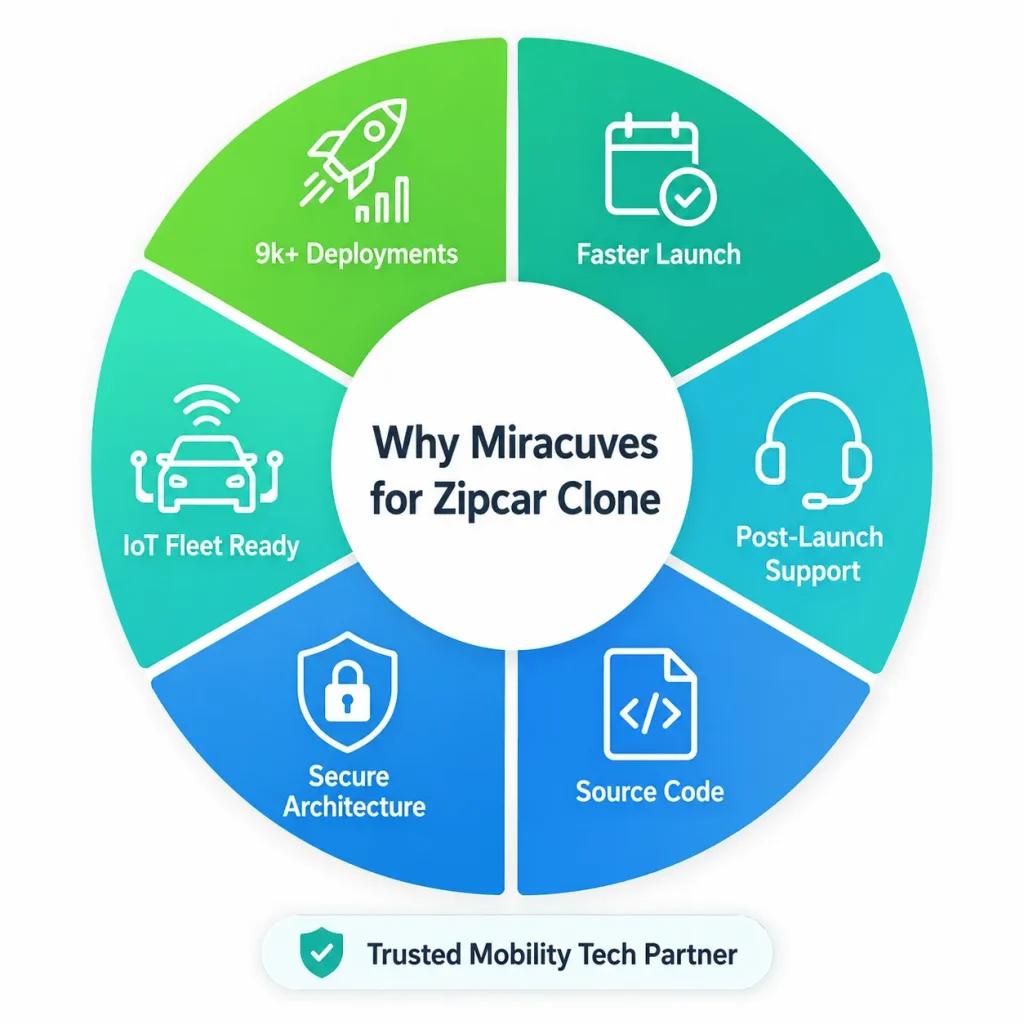
• 9k+ successful deployments across mobility, IoT, and on-demand platforms
• Optimized delivery cycles for faster platform readiness
• Post-launch support to ensure stability and smooth operations
• Complete source-code ownership with no vendor lock-ins
• Secure and scalable architecture built for real-time vehicle operations
Entrepreneurs working with Miracuves often see strong early adoption because the platform is designed with user experience, fleet efficiency, and monetization in mind. One founder launched a Zipcar-style platform for residential communities with controlled access and subscription plans, while another built a city-focused car-sharing service integrated with smart parking and IoT-based vehicle controls.
Miracuves believes in partnership rather than one-time delivery. Founders receive ongoing guidance on feature prioritization, pricing strategies, fleet expansion planning, and system optimization. This collaborative approach ensures your Zipcar Clone evolves with mobility trends, regulatory changes, and customer expectations while remaining reliable and competitive.
Final Thought
Building a successful Zipcar Clone in 2026 goes far beyond offering cars on demand. It is about creating a smart mobility ecosystem where convenience, reliability, and operational intelligence work together seamlessly. Zipcar’s success shows that users value instant access, transparent pricing, and frictionless vehicle usage more than traditional ownership models. Entrepreneurs who understand this shift are well positioned to build mobility platforms that align with modern urban lifestyles.
With Miracuves Clone Solutions, founders can transform this proven car-sharing model into a scalable, secure, and future-ready platform without the typical complexities of mobility tech. By combining robust software architecture, IoT-enabled fleet management, and expert execution, Miracuves empowers entrepreneurs to launch confidently, adapt to city-level mobility needs, and build long-term value in the shared transportation space.
Ready to launch your Zipcar clone? Get a free consultation and a detailed project roadmap from Miracuves trusted by entrepreneurs worldwide.
FAQs
What is included in a Zipcar clone developed by Miracuves?
The solution includes user booking apps, admin and fleet management dashboards, real-time vehicle tracking, keyless access integration, secure payments, analytics, and system deployment support.
Do I get full source-code ownership for my Zipcar clone?
Yes, Miracuves provides complete source-code ownership, giving you full control to customize, expand, and maintain your car-sharing platform without any vendor lock-ins.
Can the Zipcar clone support keyless vehicle access?
Yes, the platform is built to integrate with IoT devices, enabling keyless car unlock, ignition control, and real-time vehicle status monitoring through the mobile app.
Is the platform suitable for multi-city or campus-based car sharing?
Absolutely. The Zipcar clone supports city-wise operations, zone-based access, and niche deployments such as campuses, residential communities, and corporate fleets.
How does Miracuves ensure platform security and reliability?
Miracuves uses secure APIs, encrypted data storage, role-based access controls, and continuous monitoring to ensure high reliability and protection across software and vehicle integrations.
Can pricing models be customized?
Yes, founders can configure hourly, daily, subscription-based pricing, penalties, and premium vehicle plans based on business needs.
Does the Zipcar clone support electric vehicles?
Yes, the platform can manage mixed fleets including electric vehicles, with support for charging schedules, usage tracking, and EV-specific analytics.
Is post-launch support available?
Yes, Miracuves provides post-launch support to ensure system stability, performance optimization, and smooth operational continuity.
Can the platform integrate with third-party services?
The Zipcar clone supports integrations with payment gateways, mapping services, telematics providers, and parking management systems.
Can Miracuves deliver a white-label Zipcar clone?
Yes, Miracuves offers full white-label solutions, allowing you to launch the platform under your own brand name, domain, and app store identity.
Related Articles