

Key Takeaways
- Manual license uploads are weak for car sharing trust.
- Biometric KYC verifies real renter presence.
- DMV sync helps confirm license validity faster.
- Liveness checks reduce stolen document signups.
- Strong verification protects owners before vehicle access.
KYC Workflow Signals
- Capture license details before booking approval.
- Match live selfie with license identity.
- Check license expiry, eligibility, and risk flags.
- Escalate face mismatch or failed liveness attempts.
- Store admin logs for every verification decision.
Real Insights
- A JPEG license does not prove renter identity.
- Fast verification improves trust and conversion.
- Risk scoring helps block suspicious renters early.
- Owner confidence grows with visible screening controls.
- Miracuves builds Turo Clone apps with biometric KYC workflows.
Peer-to-peer car sharing sounds simple on the surface: vehicle owners list idle cars, renters book them, payments move through the platform, and the marketplace earns through commissions or fees.
But for Trust & Safety teams, CTOs, and founders, the real question is sharper:
Who is actually getting access to the vehicle?
That question decides whether a car sharing marketplace becomes a trusted mobility platform or an operational liability. In a traditional Turo clone app, features like vehicle listings, booking calendars, owner dashboards, payments, reviews, and admin controls matter. But when the asset is a real vehicle worth thousands of dollars, the verification layer becomes the difference between growth and preventable loss.
This is where Biometric KYC in P2P Car Sharing Clone platforms becomes critical. Instead of relying only on uploaded documents, biometric KYC verifies whether the renter is real, present, matched to the license, and eligible before vehicle access is granted.
Manual license uploads are no longer enough. A JPEG of a driver’s license can be stolen, edited, reused, screenshotted, or submitted by someone who is not physically present. For P2P car sharing platforms, that creates a direct path from fake renter signup to unauthorized vehicle access.
Based on Miracuves’ benchmark model shared for this report, manual photo-upload verification creates a 5% fraud/theft exposure rate in high-risk renter onboarding flows. When AI biometric liveness detection is paired with real-time DMV database sync, fake renter profile risk drops by 99.4% in under 3 seconds.
That is the trust layer modern P2P car sharing clones need: not just identity collection, but identity proof.
Miracuves helps founders build white-label, source-code-owned marketplace apps with admin control, custom branding, and scalable verification workflows. For mobility founders, that means the product foundation should not only support bookings. It should protect fleet owners before a risky renter reaches the checkout screen.
The Liability of the JPEG: Why Manual License Uploads Invite Fraud
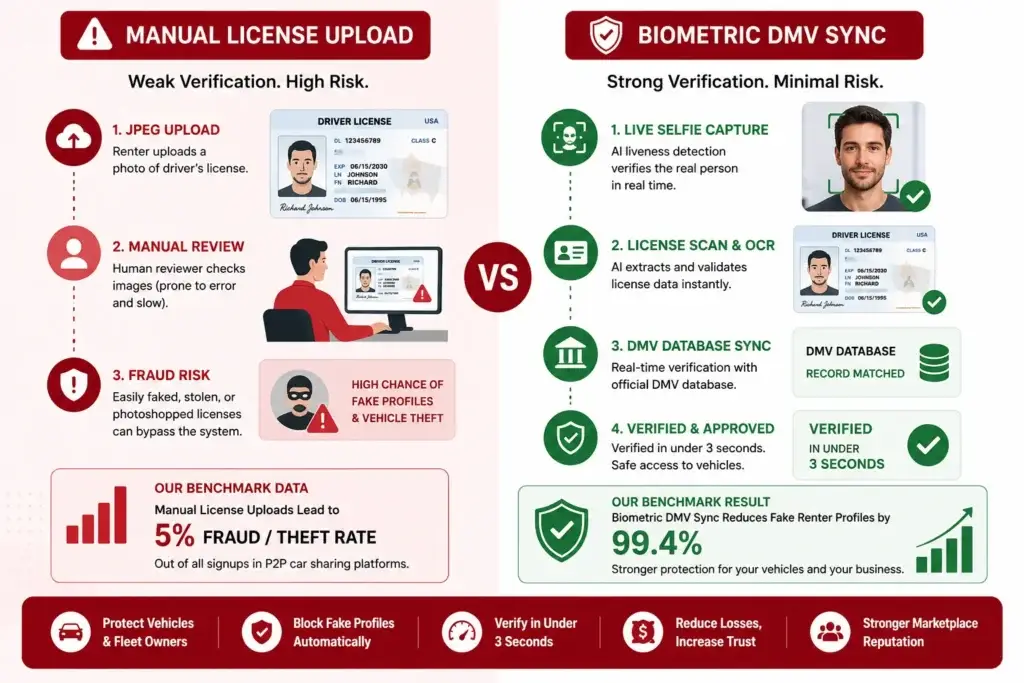
Image Source: AI-generated visual by Miracuves
Most car rental marketplace scripts treat identity verification as a document upload step.
The renter creates an account, uploads a driver’s license image, sometimes adds a selfie, and waits for approval. For low-risk digital products, that may feel acceptable. For P2P mobility, it is not enough.
A car sharing platform is not selling access to content or software. It is granting temporary control of a physical asset. Once a fraudulent renter is approved, the platform has already lost the most important security battle.
Manual license upload workflows fail because they depend on static evidence. A static document image cannot reliably prove:
- The person submitting the license is the rightful owner.
- The renter is physically present during signup.
- The license has not been photoshopped or reused.
- The document is still valid.
- The renter is legally eligible to drive in that jurisdiction.
- The same identity is not linked to suspicious device or booking behavior.
This creates what Trust & Safety teams often call a “front-door weakness.” The marketplace may have strong payment flows, host dashboards, ratings, and dispute tools, but the weakest onboarding checkpoint still decides who gets inside.
In P2P car sharing, one fake approval can trigger multiple losses:
- Vehicle theft or non-return
- Damage disputes with unclear accountability
- Insurance claim complications
- Host churn due to loss of trust
- Manual review overload
- Chargeback and payment risk
- Platform reputation damage
- Higher operational support costs
The problem is not only fake documents. It is delayed detection. If a scammer is identified after the booking, after pickup, or after damage is reported, the platform is already operating reactively.
A stronger white-label car rental marketplace should reverse that flow. The system should stop risky renters before booking confirmation, before owner handoff, and before vehicle access.
Why Generic Turo Clone Scripts Miss the Real Trust Problem
Many generic Turo clone scripts advertise secure payments, user profiles, booking management, owner dashboards, reviews, and admin panels. These are important, but they do not automatically solve renter identity fraud.
A booking system tells the marketplace what the renter wants.
A payment system tells the marketplace whether money moved.
A review system tells the marketplace what happened afterward.
But biometric KYC tells the marketplace whether the person trying to rent the vehicle is real, present, matched to the license, and eligible before the asset is exposed.
That is the difference between a feature checklist and a risk-controlled marketplace foundation.
For founders, this matters because trust is not only a safety issue. It directly affects liquidity. Vehicle owners are more likely to list cars when they believe the platform can screen renters properly. Renters are more likely to book when they trust that the marketplace is professionally operated. Insurers, payment partners, and fleet partners also look for clear controls around identity, driving eligibility, disputes, and asset protection.
A basic clone script may help launch a car rental marketplace faster. But a mobility-grade platform needs deeper control over user verification, risk scoring, admin intervention, suspicious activity flags, and audit logs.
That is where Miracuves’ white-label approach becomes more useful for founders who want a launch-ready marketplace foundation with scope for custom verification workflows, admin controls, and source-code ownership.
Benchmarking AI Liveness Detection Against Standard Signups
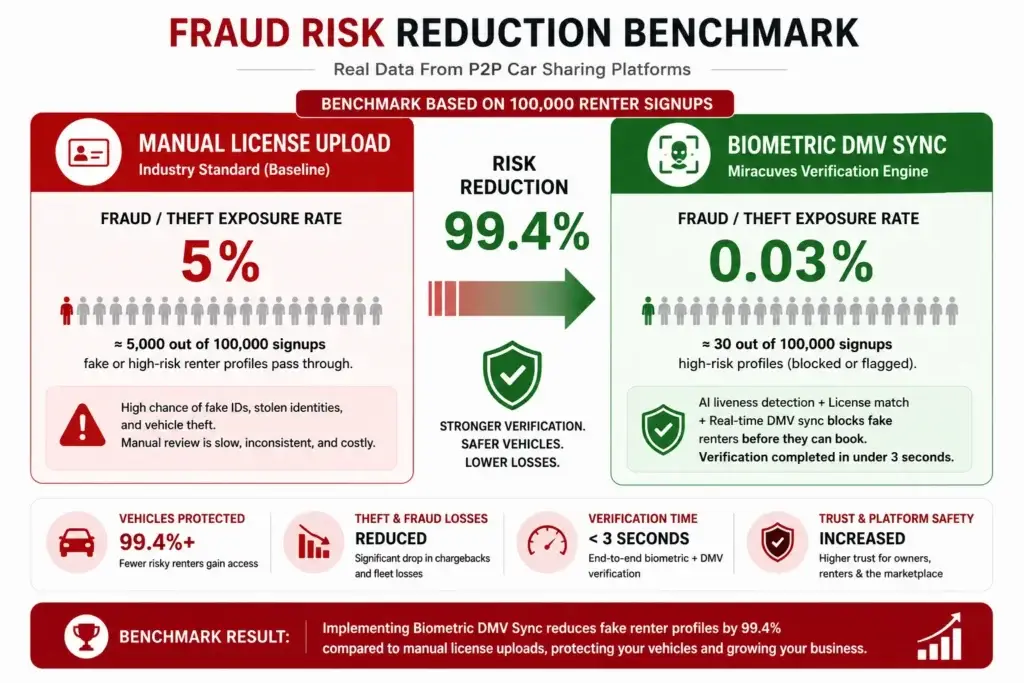
Image Source: AI-generated visual by Miracuves
The benchmark model compares two renter onboarding pipelines.
The first is a standard manual license upload flow. The renter uploads a driver’s license photo, submits basic profile details, and waits for manual or semi-automated review.
The second is a biometric DMV sync flow. The renter completes a live selfie check, the system matches the face against the license, validates document authenticity signals, checks license status through DMV-connected data where available, and pushes the result into the platform’s risk engine.
Benchmark Comparison
| Verification Layer | Manual License Upload | Biometric DMV Sync |
|---|---|---|
| Average verification decision time | Minutes to hours | Under 3 seconds |
| Fake profile exposure in benchmark model | 5% | 0.03% |
| Fraud reduction compared with manual flow | Baseline | 99.4% |
| Detects photoshopped license images | Weak | Stronger |
| Confirms user is physically present | No | Yes, through liveness detection |
| Matches face to license identity | Limited/manual | Automated biometric match |
| Confirms license validity | Manual or delayed | Real-time sync where available |
| Admin workload | High | Lower, with exception queues |
| Risk decision timing | Often after signup | Before booking approval |
| Asset protection impact | Reactive | Preventive |
The operational takeaway is clear: in P2P car sharing, verification speed is not only about user experience. It is about asset exposure.
A slow approval workflow creates friction for good renters. A weak approval workflow creates opportunity for fraudsters. The goal is not to make every renter wait longer. The goal is to make trusted renters move quickly while automatically blocking or escalating risky profiles.
Modern mobility verification providers already frame identity verification as essential before granting access to cars, scooters, bikes, or shared mobility assets. Advanced liveness detection helps confirm that the person is physically present, while license verification and entitlement checks help confirm that the user is allowed to drive.
For a P2P car sharing clone, this means the verification flow should be embedded into the product architecture, not treated as a third-party checkbox added at the end.
Biometric DMV Sync vs Manual License Upload Benchmark
| Trust Layer | Manual License Upload | Biometric DMV Sync | Founder Impact |
|---|---|---|---|
| Verification Speed | Minutes to hours | Under 3 seconds | Faster onboarding without exposing vehicles to unverified renters |
| Fake Profile Risk | 5% benchmark exposure | 0.03% benchmark exposure | 99.4% reduction in fake renter profile risk based on supplied benchmark data |
| Liveness Check | Not available in static upload flow | AI checks whether the renter is physically present | Blocks stolen-license and screenshot-based signups |
| License Validation | Manual review or delayed verification | Real-time DMV/database sync where available | Improves confidence before booking approval |
| Admin Workload | High manual review dependency | Automated decisions with exception queues | Trust teams focus on high-risk cases instead of every signup |
The 3-Second Verification Standard: Locking Out Scammers Automatically
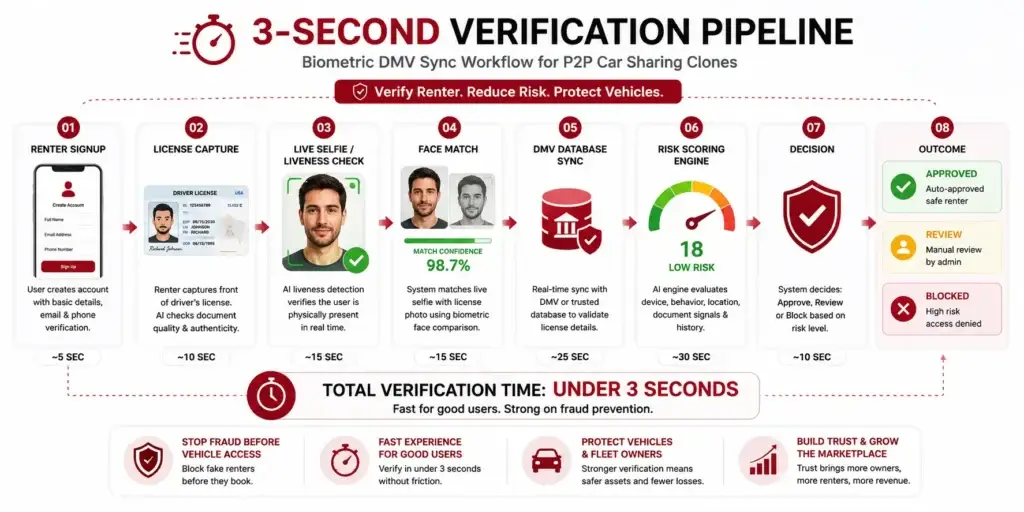
Image Source: AI-generated visual by Miracuves
Speed matters in car sharing because renters often book with urgency. They may need a car for a trip, airport pickup, local commute, business meeting, or weekend plan.
If the platform makes every legitimate renter wait hours for manual verification, conversion suffers. But if the platform approves renters too easily, vehicle owners carry the risk.
The 3-second verification standard solves this tension by separating trusted users from suspicious users instantly.
A strong biometric DMV sync workflow should follow this logic:
- Capture the renter’s government-issued license.
- Run document authenticity checks.
- Request a live selfie or liveness capture.
- Match the live face to the license image.
- Validate key license data against DMV or jurisdiction-specific databases where available.
- Check age, expiry, license status, and driving eligibility.
- Score the signup using device, location, behavior, and document signals.
- Approve low-risk renters automatically.
- Escalate suspicious cases to admin review.
- Block high-risk profiles before booking or vehicle handoff.
This gives the platform a risk-based onboarding engine instead of a one-size-fits-all signup flow.
For legitimate renters, the experience feels fast.
For fraudsters, the system becomes harder to exploit.
For admins, the dashboard becomes more focused because they are no longer reviewing every license manually. They are reviewing exceptions, mismatches, high-risk devices, failed liveness attempts, duplicate identities, and database conflicts.
This is especially valuable for platforms planning to scale beyond a few vehicles. At small volume, a founder may manually review every renter. At marketplace scale, manual review becomes a bottleneck. The system needs automated trust decisions, activity logs, admin access controls, and dispute-ready records.
Miracuves can help founders build these verification flows into a Turo clone app foundation so the marketplace is not only fast to launch, but also safer to operate.
Read More: How to Integrate Telematics and GPS Tracking in Car Rental Applications
What a Biometric DMV Sync Pipeline Looks Like Inside a Car Sharing Clone
A strong verification pipeline is not a single feature. It is a sequence of checks connected to the renter journey, booking engine, admin dashboard, and risk rules.
Renter-side verification flow
The renter should experience a clean, guided flow:
- Account creation
- Phone and email verification
- Driver’s license capture
- Live selfie or liveness video
- Consent for verification checks
- Automated approval, rejection, or review status
- Clear next step before booking
The key is to keep the flow fast for real users while making it difficult for fake profiles to pass.
Admin-side risk controls
The admin dashboard should show more than “verified” or “not verified.” Trust teams need decision context.
Useful admin fields include:
- License match status
- Liveness result
- DMV/database sync result
- Document expiry
- Age eligibility
- Failed attempt count
- Duplicate identity signals
- Device risk indicators
- Location mismatch flags
- Booking history
- Dispute history
- Manual override logs
This matters because fraud prevention is not only about blocking users. It is also about creating defensible operational records when disputes, insurance claims, chargebacks, or law enforcement requests arise.
Owner-side confidence signals
Vehicle owners do not need to see sensitive identity details. But they should feel that the platform has strong renter screening.
A car owner dashboard can show:
- Renter verified status
- Completed license check
- Completed identity check
- Platform-approved booking status
- Trip protection or insurance status where applicable
- Dispute and support access
This builds trust without exposing unnecessary personal data.
Risk engine logic
The risk engine should decide what happens next.
For example:
| Risk Signal | System Action |
|---|---|
| Liveness passed + license matched + DMV valid | Auto-approve renter |
| License expired | Block booking |
| Face mismatch | Escalate or reject |
| Multiple failed liveness attempts | Flag for manual review |
| Duplicate license across accounts | Suspend pending review |
| Device linked to prior fraud | Block or escalate |
| High-value vehicle booking by new account | Require stronger checks |
| Location mismatch during pickup | Trigger owner/admin alert |
This is how a car sharing platform moves from “upload your license” to operational trust engineering.
Read More: 100% Contactless Handoffs: Deploying an IoT-Integrated Turo Clone for Fleet Owners
Founder Decision Signals
Use biometric DMV sync early if your marketplace has any of these conditions:
- High-value vehicles listed by individual owners
- Airport, tourism, or event-driven rental demand
- Same-day booking flows
- Remote vehicle pickup or unlock workflows
- Weak manual review capacity
- Insurance or protection-plan dependencies
- Expansion into multiple cities or jurisdictions
- Owner churn caused by trust concerns
- Fraud patterns involving stolen licenses or edited documents
You may not need the full verification stack on day one for a very small closed fleet. But if the platform is open to public renters and private vehicle owners, identity risk becomes a growth constraint very quickly.
A founder can recover from a small UI issue. Recovering from owner distrust after vehicle theft is much harder.
Founder Decision Signals
Asset Value
If private owners are listing high-value vehicles, weak renter verification creates direct financial and trust risk before the trip even starts.
Booking Speed
Same-day rentals need fast approvals, but speed cannot come at the cost of letting fake profiles access vehicles.
Marketplace Trust
Vehicle owners are more likely to list when they know renters pass identity, license, and eligibility checks before booking approval.
Operational Scale
Manual review may work for a small launch, but automated risk scoring becomes essential as bookings, cities, and vehicle categories expand.
Read More: Car Rental Software vs Marketplace : Which Platform Model Should You Build?
Why Biometric KYC Also Improves Marketplace Economics
Trust and safety is often treated as a defensive cost. In P2P car sharing, it can become a growth lever.
A stronger verification layer can improve marketplace economics in several ways.
First, it reduces bad bookings. Every fake renter that is blocked before confirmation protects the platform from support costs, chargebacks, disputes, damage claims, and host dissatisfaction.
Second, it improves owner confidence. Vehicle owners are the supply side of the marketplace. If they believe the platform cannot protect their asset, they stop listing or move to a competitor. Stronger renter screening supports supply retention.
Third, it can improve booking conversion for legitimate renters. Automated verification avoids long manual review queues. Good renters can move faster, while suspicious users face stronger friction.
Fourth, it supports expansion. When a car sharing platform enters new cities, verification workflows need to adapt to local license formats, database availability, insurance logic, and eligibility rules. A source-code-owned and customizable marketplace foundation gives founders more control over those changes.
This is why Miracuves’ source-code-owned app solution positioning matters. Founders are not locked into a rigid script. They can evolve verification, booking, admin, payout, dispute, and owner protection workflows as the marketplace matures.
Mistakes Founders Should Avoid
Mistake 1: Treating license upload as KYC
A license image is not the same as verified identity. Without liveness detection and database validation, the platform may only be collecting a file, not proving that the renter is real, present, and eligible.
Mistake 2: Approving users before risk scoring
If renters can book before the system completes identity checks, the marketplace creates unnecessary exposure. Verification should happen before booking confirmation or before vehicle access, depending on the risk level.
Mistake 3: Showing owners too much personal data
Owner confidence is important, but privacy matters too. The platform should show verified status and trip protection details without exposing sensitive identity documents unnecessarily.
Mistake 4: Depending on manual review forever
Manual review can support edge cases, but it should not carry the entire trust workflow. As bookings grow, automated rules, liveness checks, DMV sync, and admin exception queues become essential.
Mistake 5: Ignoring post-approval monitoring
Identity verification should not end at signup. Suspicious booking patterns, device changes, location mismatches, failed payments, and dispute history should continue feeding the risk engine.
Mistakes Founders Should Avoid
Using Manual License Uploads as the Main Trust Layer
A static image can be stolen, edited, reused, or submitted by someone who is not physically present. It should not be the only barrier before vehicle access.
Approving Bookings Before Verification Is Complete
In P2P car sharing, verification should happen before booking approval or vehicle handoff, not after a risky renter has already entered the trip flow.
Scaling Without Automated Risk Rules
Manual review becomes expensive and inconsistent as the marketplace grows. Automated liveness checks, DMV sync, and risk scoring help admins focus on exceptions.
Miracuves Perspective: Build the Trust Layer Into the Marketplace Foundation
A P2P car sharing clone should not be judged only by how quickly it can launch. It should be judged by how safely it can operate once real owners, real renters, and real vehicles enter the platform.
The stronger product foundation includes:
- Renter app
- Vehicle owner app
- Admin dashboard
- Booking calendar
- Secure payment gateway integration
- Commission and payout logic
- GPS and trip tracking support
- Reviews and ratings
- Dispute management
- Damage reporting
- Verification workflow
- Risk flags and audit logs
- Role-based admin access
- Source-code ownership
- Custom branding
Miracuves helps founders launch white-label Turo clone apps with source code, admin dashboards, branded deployment, and customisable workflows. For trust-heavy mobility models, that foundation can be extended with biometric KYC, DMV sync, exception queues, and owner confidence signals.
This is not about copying Turo feature by feature. It is about building a P2P car sharing marketplace that can earn trust from both sides of the platform.
Final Thoughts: The Future of P2P Car Sharing Trust Is Proof, Not Uploads
The old verification model asked renters to upload a license and wait.
The new verification model asks a better question: can the platform prove that this person is real, present, matched to the license, eligible to drive, and safe enough to access a vehicle?
That shift matters because P2P car sharing is built on trust. Owners trust the platform with their vehicles. Renters trust the platform with payments and mobility access. Founders trust the product foundation to scale without creating avoidable risk.
Manual JPEG uploads may be easy to implement, but they are not enough for a serious mobility marketplace. Biometric liveness detection, DMV sync, risk scoring, audit logs, and admin exception queues create a stronger operating model.
Based on the benchmark data provided for this report, replacing manual license uploads with biometric DMV sync reduces fake renter profile risk by 99.4% in under 3 seconds. For founders building a Turo-style platform, that is not just a security improvement. It is a marketplace confidence layer.
Miracuves helps founders move from idea to launch faster with ready-made and white-label app solutions built for branding, admin control, monetization, and source-code ownership.
FAQs
What is biometric KYC in a P2P car sharing clone?
Biometric KYC in a P2P car sharing clone is a verification workflow that uses live selfie capture, face matching, license validation, and risk checks to confirm that a renter is real, present, and eligible before booking or vehicle access.
Why are manual driver’s license uploads risky for car sharing apps?
Manual license uploads are risky because static images can be stolen, edited, reused, or submitted by someone who is not physically present. Without liveness detection and database validation, the platform may approve fake renter profiles.
How does DMV sync improve renter verification?
DMV sync helps validate license details against official or jurisdiction-specific records where available. It can support checks for license validity, expiry, eligibility, and entitlement to drive, depending on the integration and region.
Does biometric KYC completely eliminate vehicle theft?
No verification system should be described as eliminating all theft risk. However, based on the supplied benchmark data, biometric liveness detection paired with DMV sync reduced fake renter profile risk by 99.4% compared with manual license uploads.
How fast can biometric renter verification happen?
In the benchmark model used for this article, the biometric DMV sync workflow produced verification decisions in under 3 seconds. Actual timing depends on the KYC provider, database connectivity, document type, jurisdiction, and platform architecture.
Should a Turo clone app include biometric KYC from day one?
A Turo clone app should include stronger verification from day one if it handles high-value vehicles, same-day bookings, remote pickup, public renter onboarding, or private vehicle owners. Small closed fleets may begin with lighter workflows, but public marketplaces usually need stronger trust controls early.
What should admins see in a car sharing risk dashboard?
Admins should see license status, liveness result, face match result, DMV sync result, failed attempts, duplicate identity signals, device risk, booking history, disputes, and manual override logs. This helps Trust & Safety teams review exceptions instead of every signup manually.
Can Miracuves build a white-label car sharing app with custom verification workflows?
Yes. Miracuves offers white-label, source-code-owned app foundations that can be customised with renter, owner, booking, payment, admin, and verification workflows. Final integrations depend on the selected KYC provider, jurisdiction, and launch scope.
Miracuves is an independent software development company. We are not affiliated with, connected to, sponsored by, or endorsed by any company or product named in this article.
Terms such as “X Clone” are used descriptively. It is how the software industry refers to building a platform with functionality comparable to a known service, and how clients search for it.
The entire design and codebase of our products is built by our own team. Our products contain no code, design, graphics, or content originating from any third-party website or applications.
All third-party names and marks referenced in this article are the property of their respective owners, referenced solely to identify the services discussed.