
Key Takeaways
- A niche rental marketplace focuses on specific traveler needs, property categories, destinations, or stay experiences instead of serving every rental segment.
- Specialized search, curated listings, tailored amenities, targeted trust signals, and relevant booking filters can make property discovery more useful for defined audiences.
- Niche positioning helps rental platforms differentiate through traveler intent, host quality, inventory relevance, booking experience, and community-focused value.
Niche Marketplace Signals
- Marketplaces can specialize around luxury stays, family rentals, pet-friendly homes, long stays, remote work, outdoor properties, regional travel, or professionally managed inventory.
- Niche-specific filters, host verification, pricing rules, availability calendars, local recommendations, reviews, and booking policies help support more relevant travel decisions.
- Focused host acquisition and destination-based marketing can improve supply quality while making it easier to attract travelers with a clear booking intent.
Travel Experience Insights
- Travelers benefit when search results, property recommendations, amenities, pricing, and local information are aligned with the purpose of their trip.
- Clear listings, accurate availability, secure payments, responsive host communication, reviews, and personalized recommendations can improve trust and booking confidence.
- Miracuves develops customizable niche rental marketplaces with property discovery, host management, booking workflows, calendars, payments, reviews, recommendations, analytics, and admin controls.
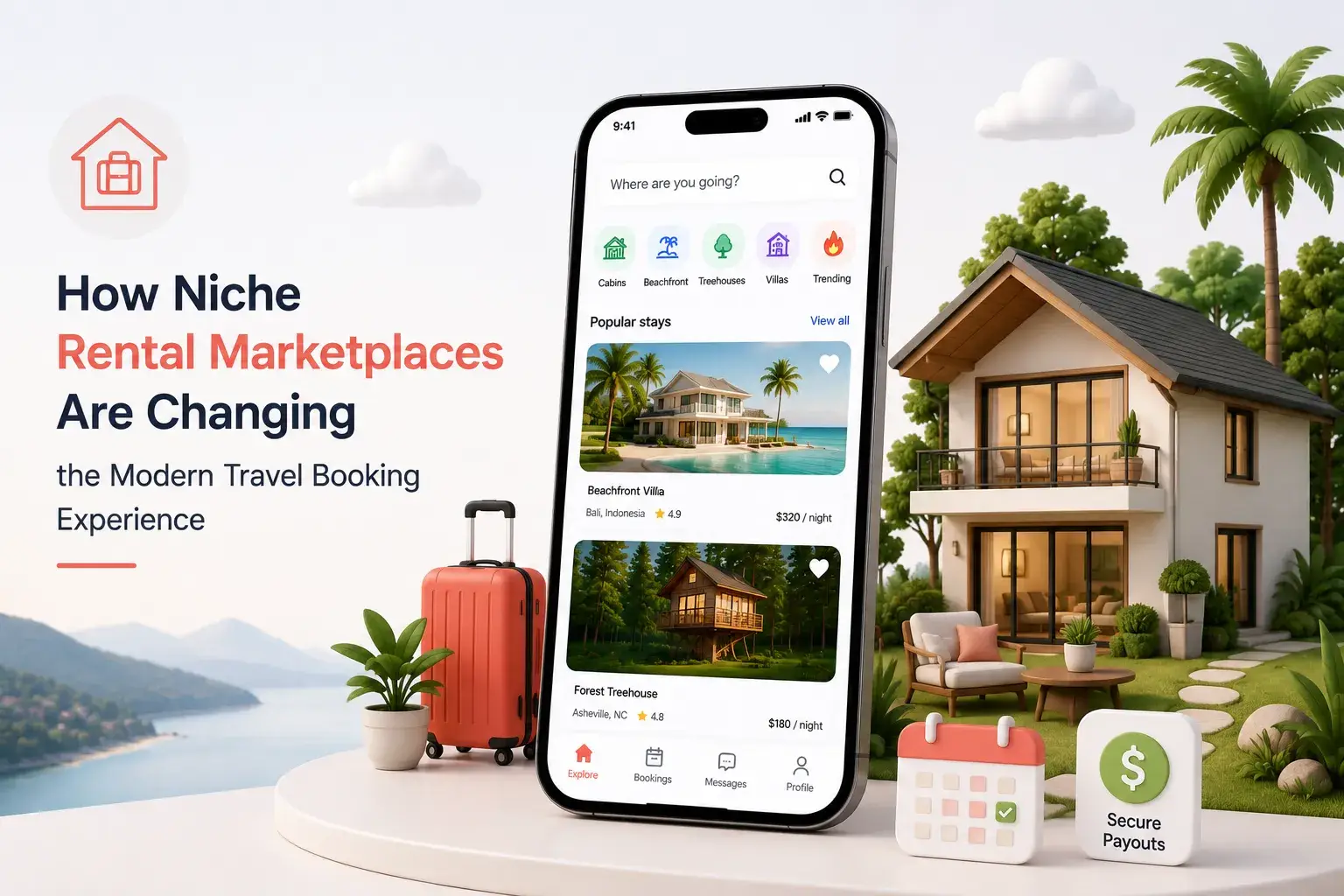
The way people book travel stays has changed. Travelers no longer want only standard hotel rooms or one-size-fits-all accommodation options. Many now look for local stays, private homes, furnished apartments, villas, shared spaces, workation-friendly properties, event spaces, and unique experiences that match the purpose of their trip.
This shift has opened a strong opportunity for niche rental marketplaces.
A niche rental marketplace connects guests with specific types of stays or bookable spaces. Instead of trying to serve every traveler in every category, it focuses on a clear audience, location, property type, or travel need. For founders, this creates a smarter path into the travel booking space because the platform can be built around focused demand instead of broad competition.
The real opportunity is not just building another rental website. It is creating a booking experience where guests search faster, hosts manage listings better, and the platform operator controls bookings, payments, reviews, commissions, and support from one backend.
Miracuves helps founders build ready-made vacation rental marketplace platforms that can be customized for niche travel, stay booking, and property rental businesses. For founders who want to enter this space faster, the right foundation can reduce avoidable development complexity and make the launch more practical.
Why Travel Booking Is Moving Toward Niche Rental Marketplaces
Traditional travel booking was once dominated by hotels, travel agents, and broad accommodation portals. That model still works, but it does not fully match how many travelers search today.
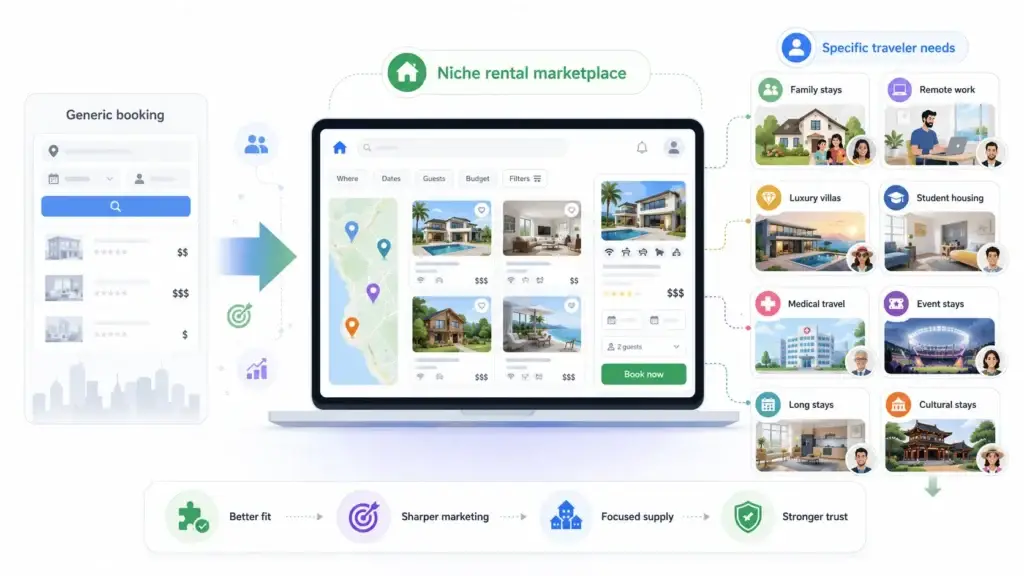
A family may want a full home with a kitchen. A remote worker may need monthly pricing, reliable Wi-Fi, and workspace filters. A group of friends may want a villa with privacy. A business team may need furnished apartments near a commercial district. A couple may want a local stay close to cultural attractions.
These needs are too specific for generic travel booking experiences.
That is where niche rental marketplaces create value. They help users find stays based on context, not just location and price. The platform can be designed around a specific audience, such as digital nomads, family travelers, luxury villa guests, student housing seekers, medical travelers, event visitors, or long-stay professionals.
For founders, this matters because focused positioning can make marketing, host acquisition, feature planning, and monetization easier. A niche platform does not need to win the whole travel market. It needs to solve one valuable booking problem better than broader platforms.
What Makes a Rental Marketplace “Niche”?
A niche rental marketplace is not defined only by property type. It is defined by the specific problem it solves.
For example, a rental marketplace can focus on:
- Family vacation homes with child-friendly amenities.
- Workation stays with Wi-Fi, workspace, and monthly booking options.
- Luxury villas with premium verification and concierge support.
- Student housing near universities.
- Furnished apartments for business travelers.
- Local homestays for culture-focused travelers.
- Event spaces for parties, workshops, and business gatherings.
- Pet-friendly rental stays.
- Wellness retreats, farm stays, or nature-based experiences.
The more specific the audience, the easier it becomes to design the search filters, listing details, pricing logic, host onboarding process, and trust systems around real user expectations.
For founders exploring different rental models, Miracuves’ rental solutions category is useful because it connects short-stay rentals, property rentals, furnished stays, car rentals, boat rentals, and other rental marketplace formats under one broader platform ecosystem.
For founders exploring broader marketplace opportunities beyond stay booking, Miracuves’ listing marketplace solutions can also support rental, travel, property, booking, and local discovery models where listings, search, user trust, and admin control are central to the platform.
A broad platform usually says, “Find a place to stay.”
A niche platform says, “Find the right stay for this exact travel purpose.”
That difference changes the entire product strategy.
How Niche Rental Platforms Improve the Guest Experience
A guest does not judge a rental marketplace only by how many listings it has. The guest judges it by how quickly they can find a trustworthy option and complete a booking without confusion.
A strong guest experience usually depends on five layers.
First, the search experience must be specific. Location, dates, price, amenities, guest count, stay type, ratings, house rules, cancellation policy, and map-based discovery should be easy to use. For niche platforms, custom filters are especially important because users are looking for a very specific match.
Second, listing pages must answer real booking questions. Guests want clear photos, accurate descriptions, availability, pricing, amenities, nearby attractions, rules, reviews, and host information. If the listing does not reduce uncertainty, users may leave before checkout.
Third, payments must feel safe. Secure payment gateway integration, clear fee breakdowns, booking confirmation, refunds, and transaction records all support trust.
Fourth, communication matters. Messaging between guest and host helps clarify check-in details, property rules, special requirements, or arrival timing. Poor communication creates support issues and cancellation risk.
Fifth, reviews and ratings close the trust loop. Guests rely on past experiences to decide whether a property is worth booking. A rental marketplace without a review layer feels incomplete because users have no social proof before making a decision.
When these layers work together, the platform becomes more than a listing website. It becomes a booking ecosystem.
Why Host Experience Is Just as Important as Guest Experience
Many founders focus heavily on guests but underestimate the host side of the platform. This is a mistake.
A rental marketplace cannot grow without strong supply. Hosts need tools that make listing, pricing, availability, communication, and payouts simple. If the host dashboard is confusing, property owners may not keep their listings updated. That leads to stale inventory, double-booking risk, slow responses, and poor guest satisfaction. For rental marketplaces where availability accuracy is critical, calendar sync and double-booking prevention should be planned early.
A practical host experience should include listing creation, image uploads, pricing control, calendar management, booking requests, guest messaging, payout tracking, cancellation rules, and performance insights.
For niche rental marketplaces, host onboarding can also include verification steps. This may include identity checks, property document review, location validation, amenities confirmation, and photo quality guidelines. These controls help improve listing quality and reduce operational risk.
The better the host experience, the stronger the marketplace becomes. Guests get better listings. Hosts get better booking control. The platform operator gets fewer disputes and more reliable revenue.
Trust Is the Real Engine Behind Rental Marketplace Growth
Travel booking involves money, location, personal safety, expectations, and time. That makes trust one of the most important parts of any rental marketplace.
Trust is not created by design alone. It is created through product systems.
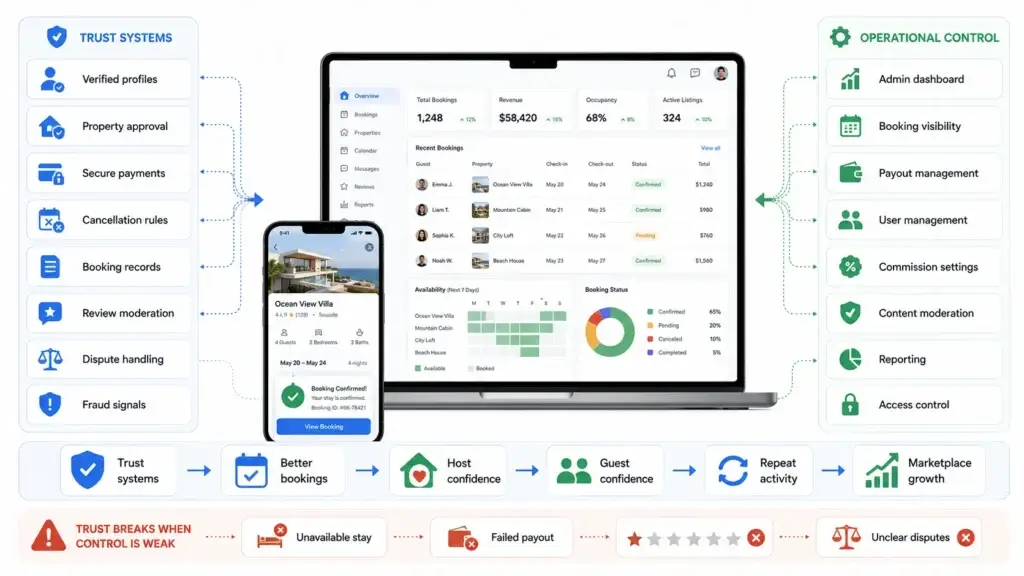
A trust-ready rental marketplace should include verified profiles, property approval workflows, secure payments, transparent cancellation policies, booking records, review moderation, dispute handling, fraud signals, and admin access controls.
For a deeper breakdown of trust, pricing, and safety systems, founders can read this short-term rental platform development guide before finalizing their product architecture.
For founders, this is where the backend matters. A beautiful frontend can attract users, but the backend decides whether the business can manage real bookings at scale.
If a guest pays but the property is unavailable, trust breaks.
If a host does not receive payouts correctly, trust breaks.
If reviews are fake or unmanaged, trust breaks.
If support teams cannot track disputes, trust breaks.
A serious rental marketplace needs operational control from the beginning. This includes admin dashboards, booking visibility, payout management, user management, commission settings, content moderation, and reporting.
Miracuves’ rental marketplace approach focuses on this control layer so founders are not only launching screens but building the operational foundation needed to run the platform.
Important Features for a Niche Rental Marketplace
Features should not be added only because competitors have them. Each feature should solve a business problem. Founders who want to understand the full module layer can explore the key rental marketplace feature modules before finalizing their product scope.
A niche rental marketplace usually needs these core modules:
- Guest registration and profile management.
- Host onboarding and listing management.
- Property or space listing pages.
- Advanced search and filters.
- Map-based discovery.
- Availability calendar.
- Date-based pricing.
- Booking request or instant booking flow.
- Secure payment gateway integration.
- Guest-host messaging.
- Reviews and ratings.
- Cancellation and refund workflow.
- Host payout management.
- Admin dashboard.
- Commission management.
- Promotions or featured listings.
- Notifications through email, SMS, or app alerts.
- Content and listing moderation.
- Reporting and analytics.
For a founder, the question is not “How many features can we add?” The better question is “Which features reduce friction for our niche audience?”
A platform for luxury villas may need premium verification and concierge-style support. A student housing platform may need document verification and monthly rental logic. A workation stay platform may need Wi-Fi, workspace, long-stay discounts, and flexible cancellation filters.
The niche decides the feature priority.
Niche Rental Marketplace Business Models
A rental marketplace becomes commercially useful when the monetization model is clear. Founders should decide how the platform will earn before deciding the final feature scope. A detailed rental marketplace business model can help clarify whether commissions, host subscriptions, service fees, featured listings, or add-on services make the most sense for the platform.
Common revenue models include commission on each booking, host subscription plans, guest service fees, featured listing fees, advertising placements, premium host tools, cancellation or processing fees, and add-on services.
Commission is often the most natural model because the platform earns when bookings happen. Subscription plans can work well when hosts want predictable listing access or premium placement. Featured listings can help hosts gain visibility in competitive locations. Add-on services can include cleaning, insurance, photography, local experiences, airport pickup, or concierge support.
The right model depends on the niche.
For example, a luxury stay marketplace may support higher commissions because booking values are larger. A student housing platform may work better with listing subscriptions. A local homestay marketplace may start with lower commissions to attract early hosts.
The business model should support supply growth, guest trust, and platform sustainability at the same time.
Founder Decision Signals Before Building a Rental Marketplace
Audience Clarity
Know whether your platform is for families, professionals, students, luxury travelers, local explorers, event users, or another specific group.
Supply Strategy
Decide how you will onboard hosts, verify listings, maintain availability, and keep property quality consistent.
Trust Controls
Plan verification, secure payments, reviews, dispute workflows, cancellation rules, and admin monitoring before launch.
Monetization Fit
Select a revenue model that matches your niche, booking value, host behavior, and expected transaction volume.
Why a Focused Marketplace Can Beat a Generic Booking Platform
Generic booking platforms often win on inventory size. Niche rental marketplaces can win on relevance.
A focused platform can create stronger user experiences because it understands a specific booking context. It can use better filters, better content, better onboarding, and better trust rules for one clear audience.
For example, a platform for remote workers can highlight desk setup, Wi-Fi quality, quiet hours, monthly pricing, nearby coworking spaces, and long-stay discounts. A platform for pet-friendly stays can include pet policies, yard access, cleaning rules, pet fees, and nearby parks. A platform for event spaces can focus on capacity, equipment, timing, catering rules, parking, and security deposits.
This specificity helps users make faster decisions.
From a marketing perspective, niche positioning also helps founders create clearer campaigns. Instead of targeting everyone who travels, the platform can target a more defined segment with sharper messaging. A focused rental marketplace marketing strategy can help founders plan SEO, paid ads, host acquisition, partnerships, and referral campaigns around one clear audience.
That makes SEO, paid ads, partnerships, host acquisition, and referral campaigns easier to structure.
Common Mistakes Founders Should Avoid
Trying to Serve Every Travel Category From Day One
A broad platform needs broad inventory, broad marketing, and broad support. A niche launch is often easier to validate because the audience, property type, and value proposition are clearer.
Ignoring Host Operations
Guests cannot book what hosts do not manage properly. Listing quality, calendar accuracy, payout clarity, and host communication directly affect marketplace trust.
Underbuilding the Admin Dashboard
The admin layer is where the platform operator manages users, listings, bookings, disputes, commissions, payouts, and reports. Without it, scaling becomes difficult.
Adding Features Without Business Logic
Every feature should support a real decision: better search, higher trust, smoother booking, stronger retention, or clearer monetization.
When a Ready-Made Rental Marketplace Foundation Makes Sense
Building every marketplace module from zero can take time. Founders need guest flows, host tools, admin controls, booking logic, payment integration, reviews, notifications, listing management, and payout workflows before the platform can function properly. Reviewing the development cost breakdown for rental marketplaces can also help founders understand how features, integrations, customization, and launch scope influence the final investment.
A ready-made rental marketplace foundation can make sense when the founder wants to validate faster, customize the platform around a niche, reduce development risk, and keep source-code ownership for future flexibility.
This does not mean copying another platform. It means starting with a proven booking structure and adapting it for a specific market.
For example, a founder may want to launch a platform for boutique stays, furnished apartments, villas, shared spaces, or local travel rentals. The core booking logic may be similar, but the positioning, filters, content, verification process, pricing rules, and marketing strategy should be customized.
Miracuves can help founders turn this kind of rental marketplace idea into a white-label, source-code-owned platform with guest, host, and admin workflows. For readers who are ready to evaluate the product foundation, the next step is to explore Miracuves’ <a href=”https://miracuves.com/airbnb-clone/”>ready-made vacation rental marketplace solution</a>.
How to Position a Niche Rental Marketplace for Growth
The strongest rental platforms do not grow only because they have technology. They grow because they match a clear supply base with a clear demand segment.
This is why niche rental marketplaces should be planned as part of a wider travel and hospitality technology strategy, where booking experience, guest trust, host supply, payments, and platform operations work together.
Founders should start by answering a few practical questions.
Who is the primary traveler?
What type of stay or space are they looking for?
What problem do existing booking platforms fail to solve for them?
Why would hosts join this marketplace?
What trust controls will make guests comfortable?
How will the platform earn revenue?
Which location or niche should be launched first?
A focused launch helps the platform learn faster. Instead of spreading across too many cities or property types, the founder can test one category, improve onboarding, refine search filters, study booking behavior, and then expand.
This is where product strategy and technology should work together. The platform should not just support bookings. It should support learning, optimization, and scaling.
Security and Trust Layers Founders Should Plan Early
Security should be treated as a foundation, not a launch add-on.
A rental marketplace handles user data, host data, payment activity, booking history, private messages, identity signals, and dispute records. This means the platform should include secure payment gateway integration, encrypted data transfer, role-based access control, admin activity logs, booking records, and permission-based dashboards.
For marketplaces with higher trust requirements, founders may also need provider or host verification, document review workflows, content moderation, refund tracking, dispute management, and fraud monitoring signals. Founders can also review these rental marketplace security guidelines to better understand the trust, access control, payment safety, and operational risk layers involved.
Final compliance requirements depend on the target market, legal review, payment partners, data policies, and operating model. Still, building the right control systems early helps founders prepare for safer operations as the marketplace grows.
Final Thoughts
Niche Rental Marketplace are changing modern travel booking because they focus on specific user needs instead of generic accommodation discovery. Travelers want more relevant stays. Hosts want better tools. Platform operators need control over bookings, payments, listings, commissions, reviews, and disputes.
For founders, the opportunity is not simply to launch a rental app. The opportunity is to build a focused marketplace that solves one travel booking problem clearly and commercially.
A strong rental marketplace should combine niche positioning, guest experience, host tools, trust systems, monetization logic, and admin control. When these layers work together, the platform has a better chance of attracting the right users and building long-term value.
Miracuves helps founders move faster with ready-made and white-label rental marketplace solutions that can be customized for niche travel and property booking models.
FAQs
What is a niche rental marketplace?
A niche rental marketplace is an online platform that connects guests with specific types of stays, spaces, or rental properties. Instead of targeting every traveler, it focuses on a defined audience such as families, remote workers, students, luxury travelers, event planners, or long-stay guests.
Why are niche rental marketplaces becoming popular?
They are becoming popular because travelers want more personalized booking options. Many users now search for stays based on lifestyle, trip purpose, budget, amenities, location, flexibility, and trust signals rather than only hotel availability.
What features should a rental marketplace include?
A rental marketplace should include guest profiles, host onboarding, property listings, search filters, map discovery, booking calendars, secure payments, messaging, reviews, payouts, commission management, notifications, and an admin dashboard.
How do rental marketplaces make money?
Rental marketplaces can earn through booking commissions, guest service fees, host subscription plans, featured listings, advertising, premium tools, cancellation fees, and add-on services such as cleaning, insurance, or concierge support.
Why is host onboarding important for a rental platform?
Host onboarding is important because hosts create the supply side of the marketplace. Clear listing tools, pricing control, calendar management, verification, and payout tracking help hosts stay active and improve the guest booking experience.
What makes a rental marketplace trustworthy?
Trust comes from verified listings, secure payments, transparent pricing, clear cancellation policies, real reviews, dispute management, host verification, booking records, and strong admin controls.
Should founders build a rental platform from zero?
That depends on budget, timeline, customization needs, and business model. A ready-made marketplace foundation can help founders launch faster, while custom development may be useful for highly unique workflows. Many founders start with a ready-made foundation and customize it for their niche.
How can Miracuves help with a rental marketplace idea?
Miracuves helps founders create white-label rental marketplace platforms with source code, branded design, guest and host workflows, booking logic, payment integration, admin dashboards, and customization support.
Miracuves is an independent software development company. We are not affiliated with, connected to, sponsored by, or endorsed by any company or product named in this article.
Terms such as “X Clone” are used descriptively. It is how the software industry refers to building a platform with functionality comparable to a known service, and how clients search for it.
The entire design and codebase of our products is built by our own team. Our products contain no code, design, graphics, or content originating from any third-party website or applications.
All third-party names and marks referenced in this article are the property of their respective owners, referenced solely to identify the services discussed.