Key Takeaways
What You’ll Learn
- Bumble operates on a freemium model, where free usage drives scale and premium features unlock revenue.
- Subscriptions are the primary revenue driver, offering better visibility, filters, and control over matches.
- In-app purchases like Spotlight and SuperSwipe generate high-margin microtransaction income.
- Advertising and partnerships add additional revenue without disrupting the user experience.
- A diversified monetization approach improves stability by combining recurring and one-time revenue streams.
Stats That Matter
- Bumble generates over $1B annually, showing strong global demand.
- Revenue growth remains consistent, driven by subscriptions and in-app purchases.
- Microtransactions contribute significantly to overall platform revenue.
- Subscription models provide predictable cash flow for long-term sustainability.
Real Insights
- The real advantage lies in monetization design, not just swipe-based interaction.
- Subscriptions create predictable revenue, while microtransactions increase per-user value.
- Low-ad experience improves retention, encouraging users to upgrade.
- Feature-based pricing aligns with user intent, improving conversions.
- Successful platforms balance user experience and monetization without breaking trust.
Bumble generated more than $243 million in Q4 2024 alone, continuing its strong upward momentum into 2026. As dating apps grow into multi-billion-dollar businesses, understanding how Bumble actually makes money is essential for entrepreneurs planning to build similar platforms. Bumble’s revenue engine combines premium subscriptions, in-app purchases, advertising, and innovative monetization that many modern platforms — including those built with Miracuves — can adopt for fast revenue generation.
Bumble Revenue Overview – The Big Picture
Bumble’s parent company, Bumble Inc., closed 2024 with $1.05 billion+ in annual revenue, with 2026 projections showing mid-single-digit annual growth driven by international expansion and higher ARPU (Average Revenue Per User).
Valuation in early 2026 sits near $2.2–$2.5 billion, fluctuating with market trends.
Year-over-year growth: Bumble App revenue increased approx. 12% YoY between 2023–2024 due to stronger monetization.
Regional revenue split:
– North America: ~63%
– Europe: ~22%
– APAC & Latin America: ~15%
Profit margins: Gross margins remain high at ~75%, but net margins fluctuate due to marketing and product development costs.
Bumble holds a strong market position as the #2 most popular dating app in the US after Tinder, but leads in safety-first and women-first markets globally.
Read More: How to Build an App Like Bumble – Full Developer Guide
Primary Revenue Streams – Deep Dive
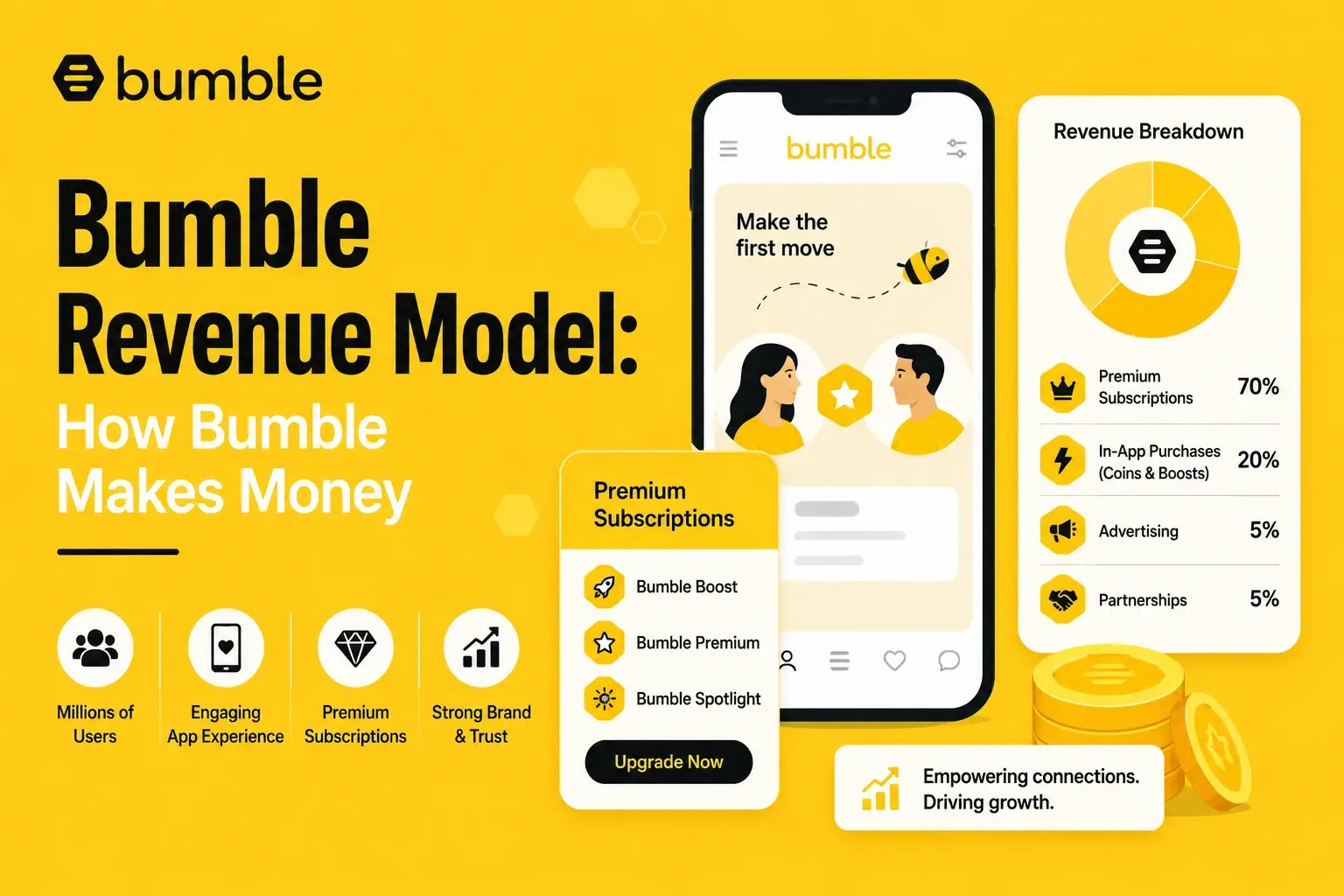
Revenue Stream #1: Premium Subscriptions (Bumble Boost & Bumble Premium)
- How it works: Users pay for enhanced visibility, unlimited swipes, and advanced filters.
- % of total revenue: ~55%
- Pricing: $14.99–$39.99 monthly depending on region and tier
- Trend: Subscription ARPU is increasing steadily at 9–12% YoY.
- Example: If Bumble has ~3.9M paying users globally, at $18 avg ARPU/month → ~$70M monthly revenue.
Revenue Stream #2: In-App Purchases (Spotlights, SuperSwipes)
- How it works: Users pay for boosts to increase profile visibility.
- % of total revenue: ~27%
- Pricing: $1.99–$7.99 per item
- Trend: Microtransaction usage is growing faster than subscriptions in emerging markets.
- Example: If 20M users purchase 1 Spotlight/month at $3 → $60M monthly potential.
Revenue Stream #3: Advertising & Brand Partnerships
- How it works: Brands pay for placements, interactive ads, and sponsored campaigns.
- % of revenue: ~10%
- Rates: $6–$18 CPM depending on region
- Trend: Rising as Bumble launches in-app video ads.
Revenue Stream #4: Bumble for Business (Networking)
Still early-stage, but growing steadily.
- % of revenue: ~3%
- Trend: Expected to grow 40–50% by 2026 as networking apps expand.
Revenue Stream #5: New Services (AI safety tools, background checks)
- % of revenue: ~5%
- Users pay for advanced verification or safety add-ons.
Revenue streams percentage breakdown
| Revenue Stream | % Contribution | 2026 Trend |
|---|---|---|
| Subscriptions | 55% | Steady growth |
| In-App Purchases | 27% | Fast growth |
| Advertising | 10% | Moderate growth |
| Business Networking | 3% | Emerging |
| Safety/AI Tools | 5% | Strong potential |
Read More: Bumble Marketing Strategy: Swiping Right on Growth
The Fee Structure Explained
User-Side Fees
– Premium subscriptions
– Pay-per-use boosts
– Profile highlighting
– Safety-verification add-ons
Provider-Side Fees
Unlike Uber/Airbnb, Bumble doesn’t charge providers — it monetizes users exclusively.
Hidden Revenue Tactics
– Algorithmic placement boosting
– Personalized pricing tests
– Region-specific in-app purchase pricing
Regional Price Variations
Prices in North America are ~40% higher than Asia and Latin America.
Complete fee structure by user type
| User Type | Fees | Notes |
|---|---|---|
| Free User | None | Limited access |
| Premium User | Monthly/Yearly | Access to advanced features |
| Pay-Per-Use | Per boost | High-margin items |
| Safety Services | Add-on price | Region-specific |
How Bumble Maximizes Revenue Per User
Bumble’s monetization strategy is built on strong ARPU expansion.
- User segmentation: Women-first approach increases trust and retention.
- Upselling: Feature previews to encourage upgrading.
- Cross-selling: Bundled boosts + premium packs.
- Dynamic pricing: Region-based income targeting.
- Retention monetization: Weekly incentives, badge unlocks.
- Lifetime value optimization: Discounts for long-term plans.
- Psychological pricing: Odd-number pricing ($14.99 instead of $15).
- Real examples: Premium ARPU increased from $22 to $25 in mature markets in 2024.
Read More: Business Model of Bumble: How the App Makes Money
Global Cost of Development for a Bumble Clone App
Bumble-Like Dating App Development — Market Price by Tech Stack
The tech stack affects the cost, speed, and scalability of a Bumble-like dating app. PHP/Laravel works well for cost-effective launches, Node.js/React.js supports real-time chat and activity, while Go microservices suit large-scale platforms with high user concurrency.
PHP/Laravel is often the most practical choice for launching a dating app quickly and affordably. Node.js/Python supports real-time interactions and engagement, while microservices architecture is ideal for large-scale platforms.
Miracuves Bumble-Like App Solution Cost and Tech Stack
Miracuves Pricing for a Bumble-Like App developed in PHP/Laravel with Flutter Apps for $3,399 USD (One-Time Price) in just 6 days
Get a fully developed, deployment-ready platform modeled after the Bumble-style dating and social networking model. Built on a reliable PHP/Laravel backend with Flutter mobile apps, this complete solution helps you launch and scale a modern dating app quickly and efficiently.
- Core Workflows: User registration, profile creation, swipe-based matching, chat initiation (women-first logic if needed), messaging, and user interaction.
- Built-in Operations: Matching algorithm setup, profile management, subscription logic, notification system, moderation tools, and payment handling for premium features.
- Management Hub: Centralized admin panel to manage users, matches, reports, subscriptions, conversations, and overall platform activity.
- Launch-Ready: Fully prepared for your branding, configuration, and immediate go-to-market execution.
Why is it so affordable?
Most modern dating platforms are built using complex architectures like Node.js or microservices. While powerful, these approaches require large engineering teams, longer timelines, and significantly higher development costs.
We took a smarter and more practical approach:
- You Aren’t Paying for Ground-Up Development: Our dating app engine is already developed, tested, and ready to deploy. You skip months of development time and avoid the high costs of building from scratch.
- The Power of PHP / Laravel: Built on one of the most trusted and widely used frameworks globally, this solution keeps upfront costs low while ensuring long-term flexibility. With a large developer ecosystem, it becomes easier and more cost-effective to maintain, scale, and customize your platform.
- Built for Practical Growth: You get a strong, market-ready Bumble-like app with essential features like swipe matching, real-time chat, and user engagement systems—without the complexity and expense of enterprise-level builds.
You get a scalable, production-ready platform without paying inflated development costs.
Note: This cost is for the solution, re-branding, deployment, and source code only.
Future Revenue Opportunities & Innovations
Bumble is testing:
– AI-driven matchmaking (paid upgrades)
– Video-first dating features
– Virtual dates & live events
– Expansion to India, SEA, LatAm
2025–2027 predictions:
– ARPU will increase 15–20%
– In-app purchases will overtake subscriptions
– AI personalization will become a major revenue driver
Threats: Competition, regulatory pressure, shifting user behavior
New opportunities emerge for entrepreneurs building Bumble-like platforms with partners like Miracuves, who offer customizable monetization modules.
Lessons for Entrepreneurs & Your Opportunity
Key takeaways from Bumble’s model:
– Simplicity works: monetize visibility, not dating itself
– Microtransactions create predictable recurring revenue
– Safety features can be monetized sustainably
– AI personalization boosts retention
Market gaps to exploit:
– Hyperlocal dating
– Community-specific matchmaking
– Video-first dating
– Verified-only dating services
Final Thought
Bumble’s growth comes from steady subscription revenue, well-timed in-app upgrades, and a brand built around trust and clarity. It’s a formula that keeps users engaged while giving the business a predictable, scalable income engine. Founders who adopt the same mix of strong positioning and diversified revenue streams can grow far faster in today’s competitive market.
With Miracuves as a development partner, that journey becomes even quicker. Their ready-to-launch platforms remove months of heavy lifting, letting entrepreneurs focus on brand, features, and user growth instead of long technical builds. It’s a shortcut to launching a polished, high-performing app that earns from day one.
FAQs
1. How much does Bumble make per transaction?
In-app purchases average $1.99–$7.99, with high margins.
2. What’s Bumble’s most profitable revenue stream?
Premium subscriptions contribute the largest share at ~55%.
3. How does Bumble’s pricing compare to competitors?
Bumble is slightly cheaper than Tinder Gold but more premium than Hinge subscriptions, striking a perfect balance — and with Miracuves, you can build a Bumble-style dating app starting at just $3,399.
4. What percentage does Bumble take from providers?
Bumble does not charge providers or creators; monetization focuses on users.
5. How has Bumble’s revenue model evolved?
Shifted from subscription-first to hybrid monetization with in-app purchases and AI tools.
6. Can small platforms use similar models?
Yes, especially using clone frameworks like those built by Miracuves.
7. What’s the minimum scale for profitability?
Most dating apps require 100k–300k active users for meaningful subscription monetization.
8. How to implement similar revenue models?
Use modular monetization: subscriptions, boosts, ads, safety tools.
9. What are alternatives to Bumble’s model?
Commission-based dating services, community memberships, virtual events.
Related Articles:
Miracuves is an independent software development company. We are not affiliated with, connected to, sponsored by, or endorsed by any company or product named in this article.
Terms such as “X Clone” are used descriptively. It is how the software industry refers to building a platform with functionality comparable to a known service, and how clients search for it.
The entire design and codebase of our products is built by our own team. Our products contain no code, design, graphics, or content originating from any third-party website or applications.
All third-party names and marks referenced in this article are the property of their respective owners, referenced solely to identify the services discussed.