Key Takeaways
- A dog walking business needs owner, walker, and admin workflows.
- Local demand should be validated before app launch.
- Booking, GPS tracking, payments, and reviews are core features.
- Walker verification helps improve safety and trust.
- A focused launch zone helps manage operations better.
Business Launch Signals
- Start with pet-friendly neighborhoods and busy professionals.
- Offer clear walk types, pricing, and service areas.
- Use pet profiles to track dog needs and behavior.
- Add live route updates and photo proof after walks.
- Track bookings, cancellations, earnings, and walker performance.
Real Insights
- Pet care businesses grow through trust and reliability.
- Poor scheduling can cause missed walks and refunds.
- Subscriptions can improve repeat weekly bookings.
- Clear cancellation rules reduce support issues.
- Miracuves builds dog walking apps with booking and GPS workflows.
Starting a dog walking business in 2026 is no longer just about printing flyers, taking calls, and managing walkers manually. Pet parents now expect convenience, live updates, trusted walkers, secure payments, recurring bookings, and a smooth mobile experience. That is why many founders are exploring a Rover clone as a faster way to launch a dog walking and pet care marketplace.
A Rover clone app helps you create a digital platform where pet owners can book dog walkers, pet sitters, boarding providers, trainers, or drop-in caregivers from one place. Instead of building every workflow from zero, founders can start with a ready-made app foundation and customize it for their city, niche, pricing model, and brand.
For founders, the real opportunity is not to copy Rover exactly. The opportunity is to build a localized, trust-first pet care business that solves a specific market gap better than generic platforms.
What Is a Rover Clone App?
A Rover clone app is a ready-made or custom-built pet care marketplace inspired by the core workflows of Rover. It connects pet owners with service providers such as dog walkers, pet sitters, boarding hosts, daycare providers, and trainers.
In a dog walking business, the app usually manages:
- Pet owner registration
- Pet profile creation
- Walker discovery
- Booking and scheduling
- Live GPS walk tracking
- In-app chat
- Secure payments
- Ratings and reviews
- Walker earnings
- Admin approvals
- Commission management
- Disputes and refunds
The value of a Rover clone is speed. Instead of spending months designing every marketplace workflow from scratch, founders can start with a launch-ready foundation and focus on localization, branding, walker supply, customer acquisition, and service quality.
Why Start a Dog Walking Business with an App in 2026?
The pet care market is becoming more digital because pet owners want reliability and visibility. A phone call does not show where the walker is. A spreadsheet cannot manage recurring bookings at scale. A manual payment process creates delays and disputes.
An app solves these problems by giving every stakeholder a clear workflow.
Pet owners can book and track walks. Walkers can accept jobs and manage earnings. The business owner can control commissions, users, cancellations, ratings, payouts, and service quality from an admin dashboard.
For founders, this matters because dog walking is not only a service business. It can become a marketplace business.
You can begin with one city, one niche, and one service. Once trust is built, you can expand into pet sitting, boarding, grooming, training, daycare, vet appointment support, or pet product partnerships.
Choose the Right Dog Walking Business Model Before Building the App
Before investing in a Rover clone app, decide what kind of business you want to operate. The model you choose affects features, operations, pricing, and growth strategy.
| Business Model | How It Works | Best For | Founder Consideration |
|---|---|---|---|
| Agency model | You hire or manage your own walkers | Local dog walking companies | More control, but higher operational responsibility |
| Marketplace model | Independent walkers join and accept bookings | Startup founders building a platform | Scalable, but requires strong verification and trust systems |
| Hybrid model | You start with in-house walkers and later onboard partners | Founders validating a city first | Balanced control and scalability |
| Premium pet care model | Verified, trained, or specialist walkers serve higher-income users | Urban or luxury pet care markets | Higher pricing, but stronger trust expectations |
| Multi-service pet care model | Dog walking expands into sitting, boarding, grooming, and training | Founders building a broader pet care brand | More revenue streams, but more operational complexity |
The safest route for many founders is the hybrid model. You can start with a controlled group of trusted walkers, prove demand, build reviews, and then expand into a marketplace once the booking flow is stable.
Read More: How to Develop a Rover Alternative: Smart Way to Tap Into the Pet Services Boom
Step-by-Step Guide to Start a Dog Walking Business with a Rover Clone App
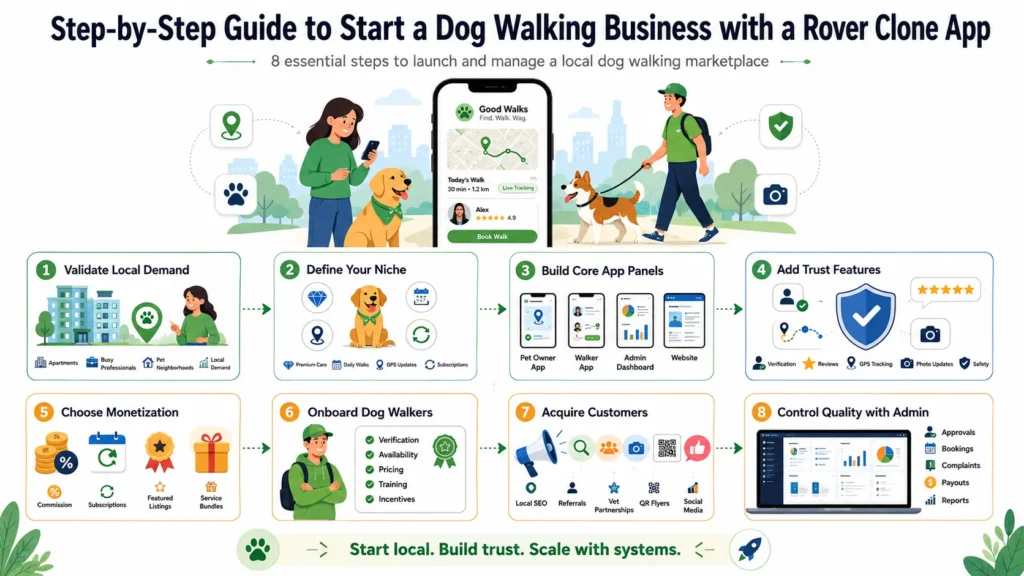
Image Source: AI-generated visual by Miracuves
Step 1: Validate Local Demand Before Building Too Much
Do not start by building every feature. Start by proving that pet owners in your target area need app-based dog walking.
Look for signals such as:
- High number of apartment communities
- Busy working professionals
- Pet-friendly neighborhoods
- Existing walkers operating informally
- Local Facebook, WhatsApp, or community groups asking for pet services
- Grooming shops, vet clinics, and pet stores with customer traffic
This research helps you decide your first launch zone. A dog walking marketplace becomes easier to manage when the first city or neighborhood is tightly defined.
Step 2: Define Your Niche and Service Promise
A generic “dog walking app” is harder to position. A focused service promise is easier to market.
You could position your Rover clone around:
- Verified dog walkers in one city
- Daily walks for working professionals
- Premium pet care for apartment communities
- Walks with GPS and photo updates
- Senior dog care
- Puppy walking and short visits
- Pet sitting plus walking bundles
- Last-minute dog walking
- Subscription-based weekly walks
Your niche decides the app experience. For example, a subscription-first dog walking app needs recurring bookings and automated billing. A premium service app needs walker verification, certifications, profile depth, and strong customer support.
Step 3: Build the Core App Panels
A Rover clone app should not be built only from the customer side. The real operational value comes from connecting customer, walker, and admin workflows.
Core Rover Clone App Panels
| Panel | Key Features | Business Value |
|---|---|---|
| Pet Owner App | Signup, pet profiles, service search, booking, GPS tracking, chat, payment, reviews | Creates convenience and trust for pet parents |
| Walker App | Profile, availability, job requests, route updates, earnings, service history | Helps walkers manage work and accept bookings efficiently |
| Admin Dashboard | User management, walker approval, commissions, bookings, disputes, reports, payouts | Gives the founder control over operations and marketplace quality |
| Optional Website | Landing pages, SEO pages, service listings, booking entry points | Supports search visibility, local trust, and lead generation |
Step 4: Add Trust Features from Day One
Trust is the center of a dog walking business. Pet owners are not booking a taxi or ordering food. They are handing over a pet they love.
Your Rover clone should include:
- Walker profile verification
- ID and document upload
- Experience and skill details
- Pet handling preferences
- Ratings and reviews
- In-app chat
- Booking history
- GPS walk tracking
- Photo and status updates
- Emergency contact details
- Cancellation rules
- Refund and dispute workflows
- Admin approval controls
A strong trust layer reduces booking hesitation. It also protects your brand from becoming a random directory of unverified service providers.
Step 5: Decide Your Monetization Model
A dog walking app can make money in more than one way. The right model depends on whether you operate as an agency, marketplace, or hybrid platform.
| Revenue Stream | How It Works | When to Use It |
| Commission per booking | You take a percentage from every completed walk | Best for marketplace models |
| Subscription plans | Pet owners pay monthly for recurring walks or benefits | Best for regular dog walking demand |
| Walker membership | Walkers pay for leads, premium visibility, or platform access | Useful once walker demand is strong |
| Featured listings | Walkers pay to appear higher in search results | Works after the platform has enough customer traffic |
| Cancellation fees | Fees apply for late cancellations | Protects walker time and platform reliability |
| Service bundles | Walking, sitting, boarding, and grooming are bundled | Useful for increasing average order value |
| Pet brand partnerships | Promote pet food, grooming, insurance, or accessories | Works after building a pet-owner audience |
For early-stage founders, commission plus subscriptions is usually easier to understand and scale. Keep the pricing transparent so pet owners and walkers both understand how the platform earns.
Step 6: Build a Supply Strategy for Dog Walkers
Many dog walking startups fail because they focus only on the customer app. But a marketplace needs supply before demand can convert.
Your walker onboarding plan should include:
- Clear eligibility criteria
- Profile verification
- Service area selection
- Availability calendar
- Pricing guidance
- Training content
- Safety rules
- First-booking incentives
- Rating quality standards
You can begin with a small controlled group of walkers in one city. This gives your admin team more control over service quality, response time, customer complaints, and reviews.
Step 7: Plan the Customer Acquisition Strategy
Your first customers will likely come from local channels, not broad national advertising.
Start with:
- Local SEO pages for “dog walking in [city]”
- Google Business Profile
- Apartment community partnerships
- Vet clinic and grooming shop tie-ups
- Instagram and Facebook pet communities
- Referral rewards for pet parents
- Introductory first-walk offers
- Partnerships with pet stores
- Flyers with QR codes in pet-friendly neighborhoods
A Rover clone app gives you the transaction layer. Your marketing strategy creates the first wave of bookings.
Step 8: Use the Admin Dashboard to Control Quality
The admin dashboard is where your dog walking business becomes manageable.
A strong admin panel should help you:
- Approve or reject walkers
- Track active bookings
- Monitor completed walks
- Manage commissions
- View customer complaints
- Handle refunds and cancellations
- Control service categories
- Adjust pricing or platform fees
- Manage payouts
- Review ratings
- Detect unusual booking patterns
- Generate reports
Without admin control, founders end up handling everything manually. That becomes risky once bookings, walkers, cancellations, and payments increase.
Founder Decision Signals Speed
If your goal is to validate demand quickly, a ready-made Rover clone can reduce the time spent building standard booking, payment, tracking, and admin workflows from scratch.
Cost
Final pricing depends on features, integrations, branding, and customization scope. A ready-made foundation is usually more cost-efficient than a fully custom build for early launch validation.
Scalability
Choose an app foundation that can expand from dog walking into pet sitting, boarding, grooming, daycare, and training without rebuilding the full platform later.
Market Fit
Launch in a focused area first, measure repeat bookings, walker acceptance rates, cancellation patterns, and customer reviews before expanding city-wide.
Speed
If your goal is to validate demand quickly, a ready-made Rover clone can reduce the time spent building standard booking, payment, tracking, and admin workflows from scratch.
Cost
Final pricing depends on features, integrations, branding, and customization scope. A ready-made foundation is usually more cost-efficient than a fully custom build for early launch validation.
Scalability
Choose an app foundation that can expand from dog walking into pet sitting, boarding, grooming, daycare, and training without rebuilding the full platform later.
Market Fit
Launch in a focused area first, measure repeat bookings, walker acceptance rates, cancellation patterns, and customer reviews before expanding city-wide.
Read More: How to Market a PetCare Marketplace App After Successful Launch
Essential Features of a Rover Clone App
A good Rover clone app should balance simplicity for users with operational depth for the founder.
Pet Owner Features
Pet owners need a smooth booking experience. The app should allow them to create profiles, add pet details, choose services, book walks, track routes, pay securely, and review walkers.
Important features include:
- User signup and login
- Pet profile with breed, age, habits, and care notes
- Service search by location
- Walker profiles
- Booking calendar
- Recurring booking option
- Real-time GPS tracking
- In-app chat
- Photo and walk updates
- Secure payment gateway
- Ratings and reviews
- Booking history
- Support and dispute request
Dog Walker Features
Walkers need a simple way to manage work. If the walker app is confusing, response rates drop and customer bookings suffer.
Key walker features include:
- Walker registration
- Profile and service details
- Availability calendar
- Booking requests
- Accept or reject jobs
- Walk start and end button
- GPS route update
- Customer chat
- Earnings dashboard
- Ratings and feedback
- Payout history
Admin Features
The admin panel is the founder’s control room. It should help manage marketplace quality, service standards, payments, and growth.
Admin features include:
- Dashboard overview
- Customer management
- Walker verification
- Booking management
- Commission setup
- Payment and payout control
- Service category management
- Promo code management
- Cancellation and refund rules
- Rating moderation
- Reports and analytics
- Dispute management
- Notification management
Ready-Made Rover Clone vs Custom Dog Walking App Development
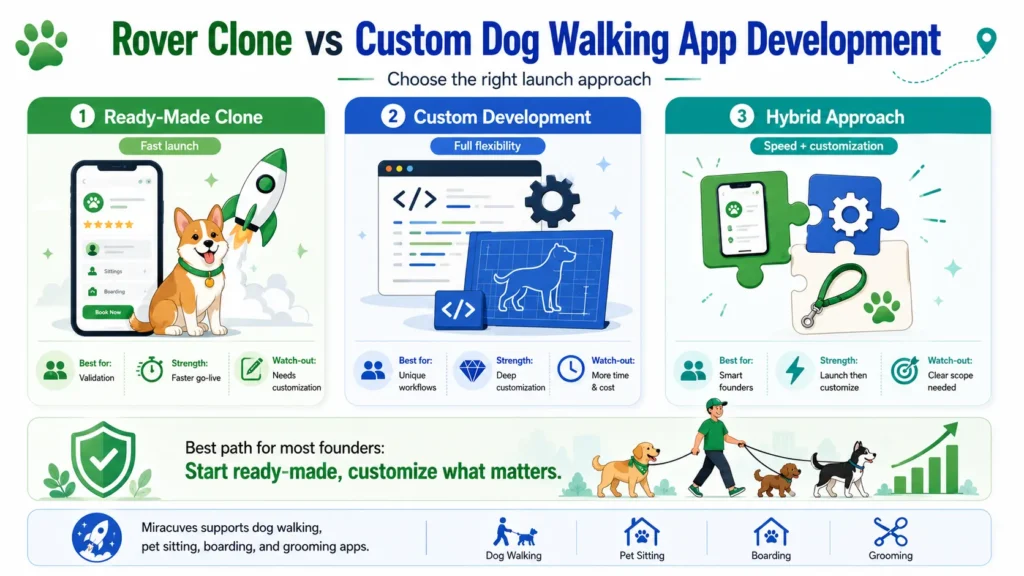
Image Source: AI-generated visual by Miracuves
Founders often struggle with this decision. Should you build everything from scratch or start with a ready-made foundation?
| Option | Best For | Strength | Limitation |
| Ready-made Rover clone | Founders who want faster launch and validation | Faster deployment, lower early build risk, proven workflows | Requires thoughtful customization to avoid looking generic |
| Custom app development | Businesses with unique workflows or large funding | Full flexibility and deeper differentiation | More time, higher planning effort, and more development dependency |
| Hybrid approach | Founders who want speed plus customization | Launch faster while customizing important business logic | Requires clear scope control |
For many startup founders, the smart approach is not “clone or custom.” It is starting with a ready-made foundation and customizing the parts that directly affect trust, branding, monetization, and market fit.
This is where Miracuves can support founders with ready-made, white-label, source-code-owned app solutions that can be customized for dog walking, pet sitting, boarding, grooming, and broader pet care marketplace use cases.
Global Cost Factors & Pricing Breakdown
These values reflect the global development cost of building a dog walking app like Rover using different backend architectures. The final cost depends on booking workflows, real-time tracking, chat systems, scalability goals, service categories, payment integrations, and operational geography.
Miracuves Dog Walk-Like App Solution Cost and Tech Stack
Miracuves Pricing for a Dog walk-Like Super App developed in PHP/Laravel with Flutter Apps for $2,499 USD (One-Time Price) in just 6 days
Get a fully developed, deployment-ready platform modeled after a dog walking and pet care service app. Built on a rock-solid PHP/Laravel foundation, this complete package includes everything you need to launch and scale:
Core Workflows: Pet service bookings, dog walking scheduling, sitter matching, and on-demand service categories.
Built-in Finance: In-app wallet logic, pricing operations, and payout setups.
Management Hub: Comprehensive provider (walkers/sitters) management and a centralized admin backend.
Launch-Ready: Fully prepped for your custom branding, configuration, and immediate market entry.
Why Miracuves’s Dog walk Like App is so affordable?
Most complex on-demand service apps force you into expensive architectures like Node.js or Go. Building from scratch with those frameworks requires highly specialized, expensive engineering teams, which drives the cost into the tens or hundreds of thousands of dollars.
We took a smarter, more practical approach:
You Aren’t Paying for Ground-Up Development: Our service marketplace engine is already developed, battle-tested, and ready to deploy. You skip the inflated costs and months of waiting associated with building from scratch.
The Power of PHP / Laravel: We built this on one of the most reliable, globally adopted frameworks in the world. Not only does this keep our upfront costs down, but it also protects your future budget. PHP has a massive global talent pool, making it incredibly easy and cost-effective for you to find developers for future scaling or customizations.
You get an enterprise-capable, heavy-duty foundation without the inflated Silicon Valley price tag.
Note: This cost is for the solution, re-branding, deployment and source code only.
Mistakes Founders Should Avoid
Mistakes Founders Should Avoid Launching without walker verification
Trust is the biggest conversion factor in pet care. If users cannot see verified profiles, reviews, and safety signals, bookings will be harder to earn.
Trying to launch in too many cities at once
A dog walking marketplace needs local density. Starting with one focused area helps you control quality, build reviews, and improve operations before scaling.
Ignoring admin workflows
Founders often focus on the mobile app and forget the backend. Without admin controls for bookings, payments, disputes, and payouts, daily operations become difficult.
Copying Rover without localization
A Rover clone should be adapted to your market. Local pricing, service expectations, pet-owner behavior, walker supply, and trust requirements may differ from Rover’s core markets.
Launching without walker verification
Trust is the biggest conversion factor in pet care. If users cannot see verified profiles, reviews, and safety signals, bookings will be harder to earn.
Trying to launch in too many cities at once
A dog walking marketplace needs local density. Starting with one focused area helps you control quality, build reviews, and improve operations before scaling.
Ignoring admin workflows
Founders often focus on the mobile app and forget the backend. Without admin controls for bookings, payments, disputes, and payouts, daily operations become difficult.
Copying Rover without localization
A Rover clone should be adapted to your market. Local pricing, service expectations, pet-owner behavior, walker supply, and trust requirements may differ from Rover’s core markets.
How Miracuves Helps You Launch a Rover Clone App Faster
Miracuves helps founders build ready-made and white-label app solutions with source-code ownership, branded design, admin dashboards, and faster deployment.
For a dog walking business, Miracuves can help you create a Rover-style pet care marketplace with customer, walker, and admin workflows. The app can be customized for dog walking, pet sitting, boarding, grooming, training, daycare, or multi-service pet care expansion.
The goal is not to create a generic copy of Rover. The goal is to give your business a strong product foundation so you can validate demand, onboard walkers, manage bookings, and build a trusted pet care brand faster.
Final Thoughts: Build a Dog Walking Business Around Trust, Not Just Technology
A Rover clone app can help you start faster, but technology alone does not create a successful dog walking business. The real foundation is trust.
Pet owners need confidence. Walkers need steady bookings. The platform owner needs visibility and control. A strong app brings these parts together through booking workflows, GPS tracking, secure payments, verification, reviews, admin dashboards, and support systems.
If you want to start a dog walking business in 2026, begin with a focused market, a clear service promise, verified walkers, and a scalable app foundation. With the right Rover clone strategy, you can launch faster, validate demand, and build a pet care brand that expands beyond walking into a broader marketplace.
FAQ
What is a Rover clone app?
A Rover clone app is a pet care marketplace app inspired by Rover’s core model. It helps pet owners book services such as dog walking, pet sitting, boarding, daycare, drop-in visits, and training through a digital platform.
How do I start a dog walking business with an app?
Start by validating local demand, choosing a business model, onboarding verified walkers, building a customer and walker app, setting up payments, and launching in one focused service area before expanding.
Is a Rover clone good for startups?
Yes, a Rover clone can be useful for startups because it provides a ready-made foundation for booking, tracking, payments, walker management, and admin control. Founders should still customize branding, trust workflows, pricing, and local service rules.
What features should a dog walking app include?
A dog walking app should include pet profiles, walker profiles, booking calendar, GPS tracking, in-app chat, secure payments, notifications, reviews, admin dashboard, commission settings, and dispute management.
How does a dog walking app make money?
A dog walking app can earn through booking commissions, subscriptions, walker memberships, featured listings, cancellation fees, pet care bundles, and partnerships with pet brands or local service providers.
Can I start with dog walking and expand later?
Yes. Many founders start with dog walking because it is easier to validate locally. Once the app gains customers and walker supply, the platform can expand into pet sitting, boarding, daycare, grooming, training, and vet-related services.
How much does it cost to build a Rover clone app?
The cost depends on app features, platforms, integrations, customization, admin dashboard, maps, payments, and support needs. A ready-made Rover clone foundation can reduce development time compared with building everything from scratch.
Why choose Miracuves for a Rover clone app?
Miracuves helps founders launch ready-made, white-label, source-code-owned app solutions with branded design, admin control, and faster deployment. For pet care businesses, this can help reduce early build complexity and support faster market validation.
Related Articles:
Miracuves is an independent software development company. We are not affiliated with, connected to, sponsored by, or endorsed by any company or product named in this article.
Terms such as “X Clone” are used descriptively. It is how the software industry refers to building a platform with functionality comparable to a known service, and how clients search for it.
The entire design and codebase of our products is built by our own team. Our products contain no code, design, graphics, or content originating from any third-party website or applications.
All third-party names and marks referenced in this article are the property of their respective owners, referenced solely to identify the services discussed.