Key Takeaways
- Cheap OTT scripts can expose premium video content to piracy, screen recording, and direct-download risks.
- Serious SVOD platforms need DRM-ready architecture instead of basic video upload and playback logic.
- Widevine, FairPlay, encrypted streaming, signed URLs, access control, and device limits are core protection layers.
- Content security depends on streaming architecture, player setup, CDN rules, and backend permission checks.
- A protected OTT app helps creators, filmmakers, and media brands reduce content leakage risk after launch.
Security Signals
- Viewers need secure login, subscription access, protected playback, device control, and payment safety.
- Creators and content teams need secure uploads, content approval, access rules, watermarking, and asset protection.
- Admins need control over users, subscriptions, video rights, reports, suspicious access, and analytics.
- DRM, tokenized playback links, encrypted storage, and CDN restrictions help protect premium video assets.
- Real-time alerts help detect account abuse, abnormal playback activity, unauthorized access, and piracy signals.
Real Insights
- A cheap OTT script may stream videos, but that does not mean it can protect paid content.
- Weak playback links can make it easier for users to download, share, or leak premium video files.
- DRM protection works best when combined with secure APIs, watermarking, device limits, and audit logs.
- Premium content platforms should plan security before launch, not after piracy complaints appear.
- Miracuves builds OTT apps with DRM-ready streaming, secure playback, subscriptions, content protection, and admin control.
For a content creator or independent filmmaker, the biggest risk in launching a subscription video platform is not always slow app development. It is launching a platform that looks finished but cannot protect the content behind the paywall.
A cheap OTT script may give you user login, video upload, categories, subscription plans, and a player screen. That may be enough for a demo. It is not enough for premium SVOD.
The real question is simple: when a paying user presses play, is your film actually protected, or is it just being streamed in a way that can be recorded, downloaded, copied, and redistributed within hours?
That is the piracy leak most founders do not see early enough.
Google describes Widevine as its content protection system for premium media, used by major streaming platforms globally. Apple’s FairPlay Streaming is built to secure delivery of streaming media through HLS by encrypting content and protecting playback across Apple platforms. For a serious VOD business, this is not technical decoration. It is revenue protection.
Miracuves helps founders build video streaming and OTT platforms with a stronger product foundation: branded apps, admin control, monetization workflows, source-code ownership, and security-conscious architecture for serious content businesses.
The Screen-Record Vulnerability of Basic OTT Apps
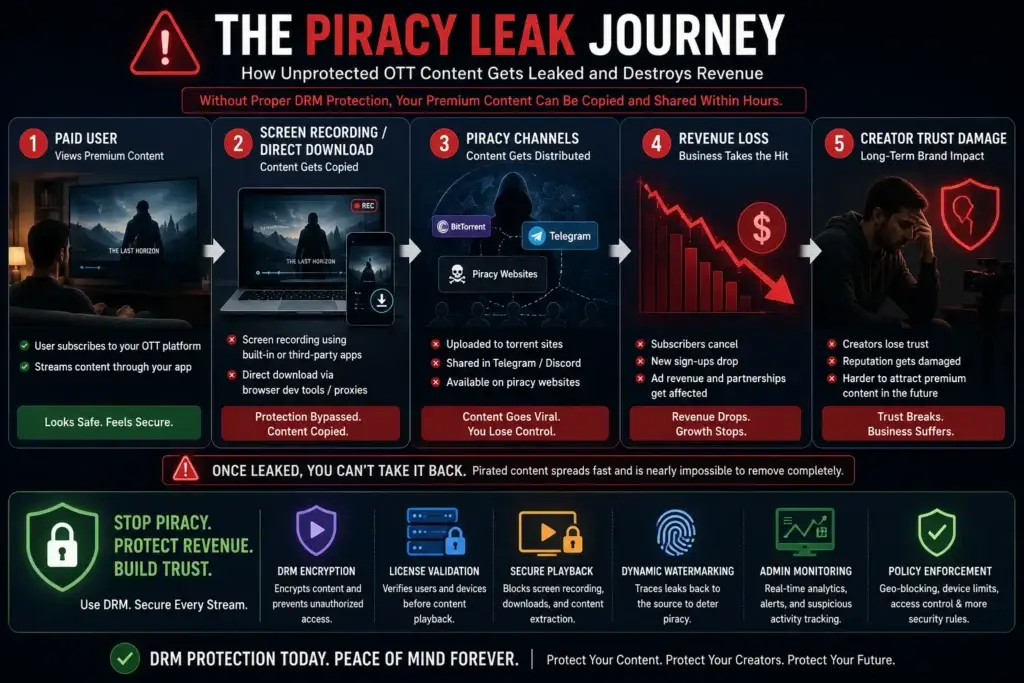
A basic OTT script usually solves the visible problem. It lets users browse content, log in, pay, and watch videos.
But piracy does not attack only the visible interface. It attacks the playback chain.
The weak points usually sit behind the player:
- unprotected video URLs
- basic MP4 streaming without strong encryption
- downloadable media paths exposed in browser tools
- weak token expiry
- no license server workflow
- no hardware-backed DRM support
- no device-level playback policy
- no watermarking or leak tracing
- no meaningful admin visibility into abuse patterns
This is why “the app works” is not the same as “the content is protected.”
For a creator selling free clips, this may not be catastrophic. For an independent filmmaker selling a $49 annual subscription, a paid premiere, a course library, festival content, documentary access, or licensed creator catalog, one unprotected 1080p recording can become the unofficial free version of the platform.
The damage is not only lost subscription revenue. It can also weaken future licensing conversations, creator trust, brand credibility, and investor confidence.
Read More: What is Netflix App and How Does It Work?
Why Cheap OTT Scripts Often Fail the Piracy Test
Low-cost OTT scripts usually compete on speed and price. They are built to show the platform, not necessarily to defend the platform.
That means the founder may get:
- login screens
- video categories
- subscription checkout
- admin upload
- mobile app UI
- web player
- basic content management
But serious content protection requires a different architecture.
A proper OTT security layer needs encrypted video packaging, DRM license exchange, player-level compatibility, device-level rules, secure streaming URLs, backend authorization, and monitoring workflows. Dolby’s THEOplayer guidance notes that a suitable multi-DRM setup can help prevent screen recording on supported devices and platforms, especially where hardware DRM is available.
The problem is that many founders discover this too late.
They buy a script. Upload content. Launch subscriptions. Promote the premiere. Then someone records or extracts the stream and posts it on Telegram, torrent sites, private groups, or illegal streaming channels.
A 2026 academic study on Telegram video piracy found large-scale copyrighted content distribution across 1,057 channels, with 19,033 unique copyrighted titles and billions of views. That is the environment your SVOD product enters the moment your content goes live.
Read More: Best Netflix Clone Script in 2026: Features & Pricing Compared
Widevine, FairPlay, and True Enterprise DRM
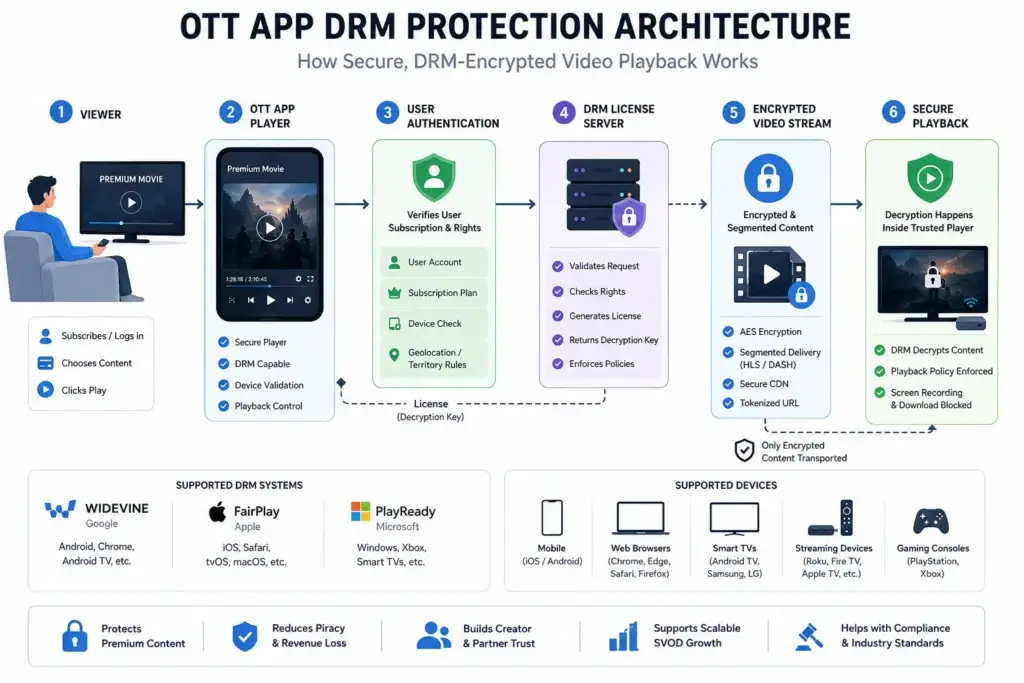
DRM stands for Digital Rights Management. In OTT, DRM protects how video content is encrypted, licensed, decrypted, and played back on user devices.
The goal is not simply to hide the video file. The goal is to control playback rights.
A serious DRM-ready video platform typically considers:
| DRM Layer | What It Does | Why It Matters for SVOD Founders |
|---|---|---|
| Widevine | Protects playback across Android, Chrome, Chromecast, Android TV, and many connected devices | Essential for Android-heavy markets and browser-based video access |
| FairPlay Streaming | Protects HLS playback across Apple platforms | Important for iPhone, iPad, Safari, and Apple TV users |
| PlayReady | Supports Microsoft and many smart TV environments | Useful for connected TV and multi-device streaming strategies |
| License server | Issues playback permissions after verifying the user and session | Prevents unauthorized playback even if someone finds stream references |
| Encrypted packaging | Encrypts video assets before delivery | Reduces direct-download exposure |
| Tokenized access | Controls how long playback URLs remain valid | Limits link sharing and unauthorized reuse |
| Watermarking | Adds visible or forensic identity markers | Helps trace leaks back to accounts or sessions |
| Device/session control | Limits simultaneous playback and suspicious usage | Protects subscriptions from abuse and shared accounts |
The key point is that DRM is not just one plugin. It is an ecosystem of content packaging, encryption, playback policy, user authorization, and device compatibility.
Google’s Widevine documentation describes it as a premium media protection system used by major platforms, including Google Play, YouTube, Netflix, Disney+, Amazon Prime Video, HBO Max, Hulu, Peacock, Discovery+, and Paramount+. Apple’s FairPlay Streaming secures media delivery through HLS with encrypted content and protected key exchange across Apple platforms.
That is the standard premium content owners expect.
Read More: Business Model of Netflix in 2026: How It Works & Why Founders Want to Clone It
The Real Cost of a Piracy Leak Is Bigger Than One Subscription
The proposed “$10,000 piracy leak” is not about claiming every founder loses exactly $10,000. It is a decision signal.
For a small SVOD business, a leak can quickly become more expensive than the script itself.
Consider the real exposure:
| Risk Area | What Happens When Content Leaks |
|---|---|
| Subscription loss | Users may choose pirated access instead of paying |
| Launch momentum loss | A premiere loses exclusivity within hours |
| Creator trust loss | Filmmakers may hesitate to license future work |
| Brand damage | The platform looks technically immature |
| Takedown cost | Manual reporting and legal escalation consume time |
| Investor concern | Weak content protection signals product risk |
| Partner hesitation | Premium creators may demand stronger controls before onboarding |
This matters especially for independent filmmakers. Unlike major studios, smaller creators often do not have large enforcement teams, legal departments, or anti-piracy monitoring budgets. The platform architecture must carry more of the protection burden from day one.
A 2025 report on India’s video sector estimated that piracy caused approximately US$1.2 billion in revenue loss in 2024 and could cost the digital video sector US$2.4 billion by 2029 without action. Even if your platform is much smaller, the principle is the same: piracy turns attention into leakage instead of revenue.
Read More: Reasons startup choose our netflix clone over custom development
Why Premium Creators Will Not License to Insecure Platforms
Creators do not only ask, “How many users do you have?”
They ask:
- Who can access my content?
- Can users download or record it easily?
- Can you restrict playback by device, region, or subscription tier?
- Can you trace leaks?
- Can you remove unauthorized access quickly?
- Can your platform support premium releases without exposing the files?
For creators transitioning to SVOD, the content library is the business. Their film, series, workshop, documentary, or exclusive archive may represent years of production cost.
If your platform cannot explain its content protection model, premium creators may not trust it with their assets.
This is where many “Netflix clone” or OTT scripts fail commercially. They can copy the visible app pattern, but they do not always prove the trust layer required for serious licensing.
A stronger SVOD platform should make creators feel that their content is being handled with the same seriousness as payment data, user data, and business IP.
Read More: How Netflix Makes Money in 2026
What a Secure SVOD Architecture Should Include
A serious SVOD product should be designed around the content lifecycle: upload, encode, package, encrypt, distribute, play, monitor, and revoke.
That means the architecture should include more than a player screen.
1. Secure Content Upload and Processing
The admin or creator dashboard should allow controlled uploads, metadata management, content approval, category management, trailer uploads, subscription mapping, and release scheduling.
Behind the dashboard, video should move into a secure processing pipeline for encoding, adaptive bitrate versions, thumbnails, subtitles, and encrypted packaging.
2. Encrypted Streaming and DRM Packaging
Instead of exposing a simple downloadable file, the platform should prepare content for protected playback. This may involve HLS/DASH packaging, encryption, DRM policy configuration, and compatibility testing across devices.
3. License-Based Playback
A proper DRM workflow checks whether the viewer has permission before playback. The app should verify subscription status, device rules, region rules, session validity, and access tier before granting playback rights.
4. Tokenized URLs and Session Controls
Stream access should not stay open forever. Tokenized access helps limit URL sharing and unauthorized reuse. Session controls can also prevent excessive simultaneous viewing from one account.
5. Watermarking and Leak Tracing
For premium content, watermarking creates accountability. Visible watermarking can discourage casual recording, while forensic watermarking can support leak investigation where implemented.
6. Admin Monitoring and Abuse Management
The admin panel should help platform operators detect suspicious behavior: repeated logins, abnormal device switching, high playback attempts, failed authorization, refund abuse, or unusual regional access.
Security should not be invisible to the business owner. It should be manageable.
Read More: White-Label Netflix App Security: Risks, Compliance & Safety in 2026
Cheap OTT Script vs DRM-Ready SVOD Platform
| Decision Factor | Cheap OTT Script | DRM-Ready SVOD Platform |
|---|---|---|
| Main focus | Fast visible launch | Protected commercial launch |
| Video delivery | Often basic streaming | Encrypted streaming workflow |
| DRM support | Often missing or unclear | Widevine, FairPlay, PlayReady planning where required |
| Screen recording protection | Weak or unsupported | Device and DRM-policy dependent protection |
| Content licensing readiness | Low | Stronger creator and rights-holder confidence |
| Admin control | Basic upload and user management | Content, subscription, abuse, access, and reporting control |
| Monetization safety | Payment exists, but content may leak | Revenue model is supported by protection logic |
| Best for | Demo or low-risk content | Paid films, courses, creator libraries, documentaries, premium SVOD |
The key difference is not just price. It is the cost of risk.
A cheaper script may look attractive before launch. But if the app cannot protect the content library, the founder may end up paying more in emergency fixes, migration, re-architecture, legal cleanup, failed creator deals, and lost credibility.
Founder Decision Signals Before Buying an OTT Script
Founder Decision Signals
Content Value
If your catalog includes paid films, courses, documentaries, or licensed creator content, DRM should be part of the foundation, not a later upgrade.
Creator Trust
If creators are expected to upload or license premium content, your platform must clearly explain how playback, access, and leak control work.
Revenue Protection
If subscriptions, pay-per-view, rentals, or premium memberships drive revenue, piracy prevention directly affects monetization.
Platform Maturity
If you want to grow beyond a small audience, security, DRM, admin control, and monitoring must scale with the business.
The Miracuves Perspective: Build the Platform Around the Asset, Not Just the App
A serious OTT business should not start with the question, “Can users watch videos?”
It should start with a stronger question: “Can users watch videos only under the rules our business controls?”
That changes the product strategy.
For a creator-led SVOD platform, the foundation should include:
- branded viewer apps
- content management dashboard
- subscription and paywall logic
- payment gateway integration
- video encoding and delivery workflow
- DRM-ready architecture
- user and device access control
- analytics and admin reporting
- secure API integrations
- privacy-conscious data handling
- monetization-ready platform structure
Miracuves Solutions helps founders build ready-made and custom video streaming platforms with a focus on launch speed, business control, white-label branding, and source-code ownership. For entertainment founders exploring a Netflix-style or creator-led video product, Miracuves’video content platform solutions clone app development ecosystem can help create a stronger starting point than a fragile low-cost script.
The right approach is not to overbuild everything from day one. It is to avoid launching with a weak protection model when the business depends on premium content.
Mistakes Founders Should Avoid
Mistakes Founders Should Avoid
Choosing a Script Only Because It Has a Video Player
A player proves playback, not protection. Ask how the platform handles encryption, DRM, stream authorization, device control, and content access rules.
Adding DRM After the First Leak
Retrofitting DRM after launch can require changes to encoding, storage, playback, backend authorization, and app compatibility. It is better to plan the protection layer before premium content goes live.
Assuming Login Is the Same as Content Security
User login protects the account layer. DRM protects the playback layer. Both matter, but they solve different problems.
Ignoring Creator Licensing Expectations
Premium creators and filmmakers need confidence that their content will not be exposed through weak URLs, downloadable files, or basic browser-level playback.
Final Thoughts: If Content Is the Business, DRM Is Not Optional
The cheapest OTT script is not always the most cost-efficient path.
If your platform is built around premium films, creator subscriptions, documentaries, paid courses, festival content, private screenings, or licensed video libraries, then content protection is part of the business model.
Without proper DRM planning, a founder may launch fast but lose control of the asset that creates revenue.
The smarter move is to build a platform where subscription, playback, encryption, access control, and admin visibility work together. That is what separates a basic video app from a serious SVOD business.
Miracuves helps founders launch faster with white-label and custom video streaming platforms built for branding, monetization, admin control, source-code ownership, and scalable product execution.
FAQs
What is DRM in an OTT app?
DRM, or Digital Rights Management, is a content protection system that controls how video is encrypted, licensed, decrypted, and played on user devices. For OTT platforms, DRM helps prevent unauthorized downloads, stream extraction, casual screen recording, and illegal redistribution.
Why do cheap OTT scripts put video content at risk?
Many low-cost OTT scripts focus on visible app features such as login, video upload, subscriptions, and playback. They may not include secure video packaging, DRM license workflows, hardware-backed playback protection, tokenized streaming, or leak tracing. That creates risk for premium SVOD content.
Is DRM necessary for independent filmmakers?
Yes, if the filmmaker is selling premium access, rentals, subscriptions, festival screenings, or licensed content. DRM helps protect the commercial value of the film and gives partners more confidence in the platform.
What is the difference between encryption and DRM?
Encryption protects the video file or stream from being read directly. DRM goes further by managing playback rights, license checks, device rules, and access permissions. A secure OTT app often needs both encryption and DRM planning.
Can DRM fully stop all piracy?
No platform can honestly guarantee zero piracy. DRM reduces risk by making unauthorized copying, playback, and redistribution harder. Stronger protection may also include watermarking, monitoring, tokenized URLs, device limits, takedown workflows, and admin abuse controls.
What DRM systems are commonly used for OTT platforms?
Common DRM systems include Google Widevine, Apple FairPlay Streaming, and Microsoft PlayReady. The right combination depends on target devices, browsers, operating systems, smart TVs, and business requirements.
Should DRM be added before or after OTT app launch?
For premium content, DRM should be planned before launch. Adding it later may require changes to encoding, storage, playback, backend authorization, and app compatibility.
How can Miracuves help with secure OTT app development?
Miracuves helps founders build ready-made and custom OTT platforms with branded apps, admin dashboards, subscription workflows, secure architecture planning, source-code ownership, and scalable product execution. Final DRM implementation depends on the selected platforms, integrations, content protection requirements, and launch scope.
Miracuves is an independent software development company. We are not affiliated with, connected to, sponsored by, or endorsed by any company or product named in this article.
Terms such as “X Clone” are used descriptively. It is how the software industry refers to building a platform with functionality comparable to a known service, and how clients search for it.
The entire design and codebase of our products is built by our own team. Our products contain no code, design, graphics, or content originating from any third-party website or applications.
All third-party names and marks referenced in this article are the property of their respective owners, referenced solely to identify the services discussed.