



























Key Takeaways
- PCI-DSS matters when astrology apps accept card payments.
- Wallet refill should depend on backend verification.
- Frontend payment success should not credit wallet balance.
- A wallet ledger tracks every recharge and deduction.
- Secure payments reduce refunds, fraud, and user complaints.
Payment Security Signals
- Use trusted payment gateways for wallet recharge.
- Avoid storing raw card data inside the app.
- Verify payment status, amount, and order ID.
- Use secure webhook verification for payment updates.
- Restrict refund and wallet adjustment access.
Real Insights
- Wallet balance is directly linked to user trust.
- Duplicate credits can create financial loss.
- Refund rules should be clear before launch.
- Admin logs help prevent manual wallet misuse.
- Miracuves builds astrology apps with secure wallet and payment flows.
Astrology consultation apps are no longer simple horoscope platforms. A modern astrology app works like a complete digital consultation marketplace where users recharge their wallet, connect with astrologers, pay per minute for chat or calls, buy reports, join live sessions, and sometimes purchase spiritual products.
Because money moves through so many touchpoints, payment security becomes one of the most important parts of the product.
For founders building an Astrotalk-style app, payment security is not only about adding a payment gateway. It is about designing the complete money flow: wallet refill, payment confirmation, consultation billing, cashback, refund handling, astrologer commission, payout records, admin logs, and fraud protection.
PCI-DSS Payments in Astrology Apps also become important when card payments are involved. The PCI Security Standards Council explains that PCI DSS defines security requirements for environments where payment account data is stored, processed, or transmitted.
This guide explains how PCI-DSS payments and wallet refills work in astrology consultation apps, what founders should avoid, and how to build a secure payment architecture for an astrology consultation platform.
For businesses planning to build a full astrology consultation app, Miracuves offers an Astrotalk Clone solution with wallet recharge, chat, voice/video consultation, astrologer panel, admin dashboard, and payment integration.
Why Payment Security Matters in Astrology Consultation Apps
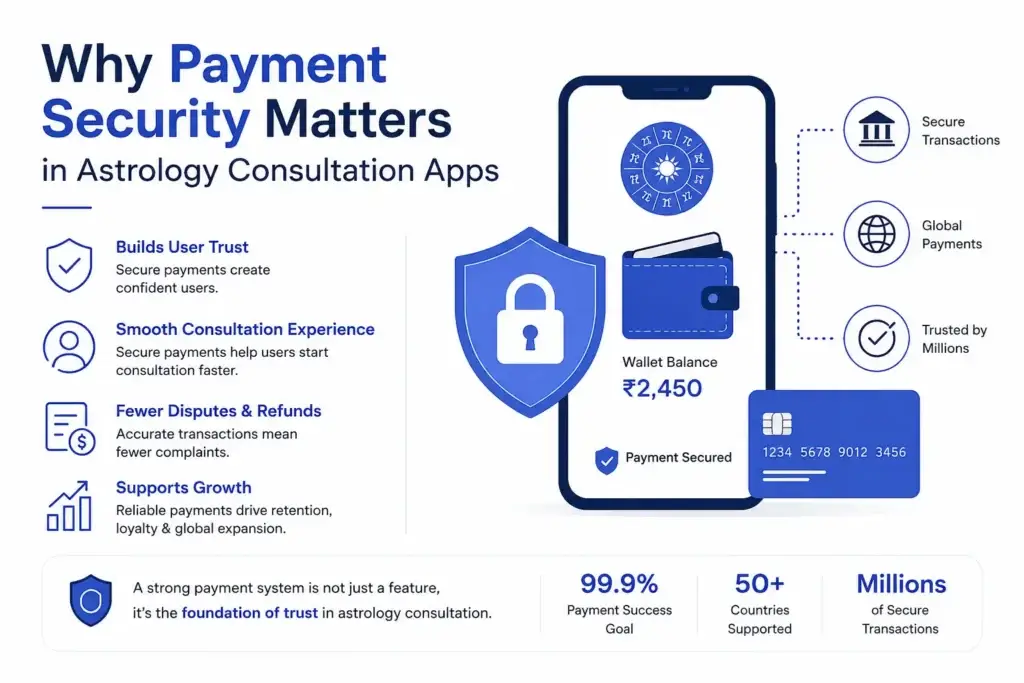
Payment security is critical in astrology consultation apps because users often pay before they receive the service. In a typical astrology consultation flow, the user adds money to the wallet first and then uses that balance for chat, voice calls, video calls, reports, or live sessions.
This creates a trust-sensitive payment journey.
If the wallet is not credited after payment, the user loses trust. If a call disconnects but balance is deducted, the user may raise a refund request. If bonus balance rules are unclear, users may complain. If admin teams cannot track transactions clearly, support becomes slow and messy.
A weak payment system can create problems such as:
- Failed wallet recharge complaints
- Duplicate payment issues
- Wallet balance mismatch
- Fake payment screenshot claims
- Refund disputes
- Cashback confusion
- Payment gateway callback errors
- Chargeback cases
- Astrologer payout disputes
- Manual wallet adjustment misuse
In an astrology consultation app, the payment system is directly connected to user experience. A smooth payment flow helps users start consultation faster. A weak flow creates frustration before the user even talks to an astrologer.
Astrotalk’s Razorpay case study also shows how important payments are for astrology platforms that want to support both domestic and international customers. Razorpay noted that Astrotalk needed reliable domestic and international payment methods because payment failures could affect user experience and growth.
Read more: What is AstroTalk and How Does It Work? Complete Guide 2026
What PCI-DSS Means for Astrology App Payments
PCI-DSS stands for Payment Card Industry Data Security Standard. It is a global payment security standard created to protect cardholder data during online and offline payment transactions.
For an astrology consultation app, PCI-DSS becomes important when users recharge their wallet using debit cards, credit cards, or other card-based payment methods. Even if the app is mainly used for astrologer chat, voice calls, video calls, Kundli reports, or live sessions, the moment card payments are accepted, payment security becomes a serious part of the product architecture.
In simple words, PCI-DSS is not only for banks or payment gateway companies. It can also affect astrology apps, wallet-based consultation platforms, and digital marketplaces that accept card payments, depending on how their payment flow is designed.
For example, if an astrology app directly collects card number, CVV, expiry date, or other sensitive card details on its own server, the compliance responsibility becomes much higher. But if the app uses a trusted PCI-compliant payment gateway, hosted checkout, SDK-based payment flow, or tokenized payment method, the app can reduce direct exposure to sensitive payment data.
For astrology app founders, the safest approach is to design the payment system in a way where sensitive card details never touch the app backend.
The app should avoid:
• Storing card numbers inside the app
• Storing CVV or PIN
• Storing full expiry details unnecessarily
• Processing raw card information on its own server
• Saving sensitive authentication data
• Exposing payment gateway secret keys in frontend code
• Trusting only frontend payment success messages
Instead, the astrology app should use:
• A trusted PCI-compliant payment gateway
• Hosted checkout or gateway-managed checkout flow
• SDK-based checkout where suitable
• Tokenization for saved payment methods
• Backend payment verification
• Secure webhook validation
• Transaction references instead of raw card data
• Wallet ledger records for every recharge and deduction
Instead, the astrology app should use:
• A trusted PCI-compliant payment gateway to handle sensitive payment data securely
• Hosted checkout or gateway-managed checkout flow to keep card details away from the app backend
• SDK-based checkout where suitable for smoother in-app payment experience
• Tokenization for saved payment methods instead of storing raw card details
• Backend payment verification before wallet balance is credited
• Secure webhook validation to confirm payment success or failure
• Transaction references instead of raw card data for tracking payments
• Wallet ledger records for every recharge, deduction, refund, bonus, and adjustment
This is important because the astrology app does not need raw card details to run its wallet system. It only needs verified payment confirmation and proper wallet records.
The goal is simple: keep sensitive card data away from the astrology app backend as much as possible.
This reduces compliance risk, improves payment security, protects user trust, and makes the wallet refill architecture safer for long-term growth.
How Wallet Refills Work in an Astrology Consultation App
Wallet refill is one of the most important flows in an astrology consultation app because most platforms follow a prepaid wallet model. Users usually add money to their wallet first, and then use that balance for astrologer chat, voice calls, video consultations, Kundli reports, live sessions, remedies, subscriptions, or other paid astrology services.
Why Astrology Apps Use a Prepaid Wallet Model
This wallet-based model makes the consultation experience faster because users do not need to make a fresh payment every time they want to talk to an astrologer. Once the wallet is credited, the app can instantly deduct the balance based on consultation time, report purchase, or service usage.
For astrology consultation apps, this is especially important because wallet balance is directly connected to per-minute billing. Once the wallet is credited, users can immediately start a paid chat, voice call, or video call with an astrologer. The app then deducts balance based on the astrologer’s rate and session duration.
Basic Wallet Refill Flow
A basic wallet refill flow starts when the user opens the wallet section inside the astrology app and selects a recharge amount or recharge plan. The backend then creates a payment order and connects the user to a payment gateway checkout. The user can pay through UPI, debit card, credit card, net banking, wallet, or any other available payment method.
After the payment is completed, the payment gateway sends the transaction response to the backend. The backend verifies whether the payment is successful, failed, or pending. Only after proper verification should the user wallet be credited. This is important because the app should not add wallet balance only because the frontend shows a success message.
Step-by-Step Wallet Refill Process
A secure wallet refill system should follow this flow:
• User opens the wallet section inside the astrology app
• User selects a recharge amount or recharge plan
• Backend creates a unique payment order
• Payment gateway opens the checkout page or payment screen
• User completes payment through UPI, card, net banking, wallet, or another method
• Payment gateway sends transaction response to the backend
• Backend verifies payment status, order ID, amount, and user details
• Wallet ledger records the recharge transaction
• User wallet balance is credited after successful verification
• Admin dashboard stores the payment record for tracking and support
• User receives confirmation through app notification, SMS, email, or WhatsApp
Why Backend Verification Is Important
This flow may look simple from the user side, but the backend must be built carefully because payment and wallet issues can directly affect user trust. If payment is deducted from the user’s bank account but the wallet is not credited, the user may immediately lose confidence in the app. If the same transaction is credited twice, the platform may lose money. If a failed transaction is marked successful by mistake, it can create accounting and refund problems.
That is why the wallet refill system should handle payment delays, pending transactions, duplicate gateway responses, app closure after payment, server downtime, cashback rules, and refund cases properly. Every recharge should be connected with a unique transaction ID, gateway order ID, user ID, recharge amount, payment method, and wallet ledger entry.
Role of Webhook Verification
The backend should also use webhook verification to confirm payment updates directly from the payment gateway. This helps the app update wallet balance even if the user closes the app after payment or the frontend does not receive the final response.
A strong backend flow ensures that the wallet is credited only after verified payment confirmation.
How Secure Wallet Refill Reduces Disputes
A strong wallet refill system helps prevent duplicate credits, fake payment claims, missing wallet balance issues, cashback confusion, refund disputes, and support delays. It also gives the admin team a clear record of every transaction, making it easier to resolve payment complaints quickly.
In short, the wallet refill flow should not depend only on frontend payment success. The backend should verify every transaction, update the wallet ledger, credit the user balance, and store the complete payment record before allowing the balance to be used for consultation.
Why Wallet Ledger Is More Important Than Simple Balance
A beginner-level wallet system only stores one value: the user’s current balance. That may work for a very small app, but it is not enough for a serious astrology consultation platform.
In an astrology app, wallet balance changes many times. A user may recharge the wallet, receive bonus credit, start a paid chat, join a voice call, buy a Kundli report, request a refund, or receive cashback. If the system only shows the final balance, the support team cannot clearly understand how that balance was calculated.
That is why a real wallet system should maintain a complete wallet ledger.
A wallet ledger records every money movement inside the user account. It works like a transaction history for the wallet. Every recharge, deduction, refund, cashback, bonus expiry, manual adjustment, and dispute-related action should be recorded properly.
A strong wallet ledger should include:
• Recharge amount
• Gateway transaction ID
• Payment status
• Bonus or cashback added
• Consultation deduction
• Chat, call, or video session ID
• Refund adjustment
• Manual admin adjustment
• Admin action reason
• Remaining balance after transaction
• Date and timestamp
For example, if a user says, “I recharged ₹500 but my wallet shows only ₹300,” the support team should not depend on screenshots or guesswork. They should open the wallet ledger and check the complete journey of that ₹500 recharge.
The ledger can show whether ₹500 was credited, whether any bonus was added, whether the user spent ₹200 on a consultation, whether any refund was processed, and what the final wallet balance should be.
This helps the platform solve payment complaints faster and more accurately.
A wallet ledger also becomes important during consultation disputes. If a user claims that balance was deducted incorrectly during a call, the admin can check the consultation ID, astrologer rate, start time, end time, billable duration, total deduction, and remaining balance after the session.
Without a proper ledger, the platform becomes dependent on screenshots, support chats, and manual assumptions. This can create confusion for users, extra workload for the support team, and financial loss for the business.
A complete wallet ledger protects both the user and the platform. Users get transparent wallet history, and the business gets clear records for refunds, disputes, accounting, fraud checks, and admin review.
For astrology consultation apps, a wallet ledger is not just a backend record. It is the foundation of payment trust.
Read more: Business Model of Astrotalk : Complete Strategy Breakdown 2026
What Payment Data Should Stay Outside the App
A secure astrology consultation app should avoid storing sensitive card data inside its own app, website, or backend server. This is one of the most important rules for reducing PCI-DSS risk.
When users recharge their wallet through debit cards, credit cards, UPI, net banking, or other payment methods, the app does not need to directly handle sensitive card details. That responsibility should stay with a trusted payment gateway.
The astrology app should not store:
• Card number
• CVV
• PIN
• Full magnetic stripe data
• Raw card credentials
• Sensitive authentication data
• Unencrypted payment data
• Payment gateway secret keys in frontend code
Instead, the app should store only safe payment references that are needed for tracking, wallet credit, refund handling, and support.
The app can store safer payment references such as:
• Payment gateway order ID
• Transaction reference number
• Payment status
• Gateway response code
• Wallet credit entry
• Refund ID
• Invoice number
• User ID
• Recharge plan ID
• Consultation ID
• Payment method type
• Date and timestamp
This difference is very important. The astrology app needs payment history, wallet records, invoice details, refund logs, and consultation billing records. But it does not need raw card data to run these functions.
For example, if a user says their payment was deducted but the wallet was not credited, the admin team can check the payment gateway order ID, transaction reference number, payment status, and wallet ledger entry. They do not need to see the user’s card number or CVV.
Similarly, if a refund request is raised, the system can use the refund ID, transaction reference, user ID, and payment status to process or track the refund. Sensitive card details are still not required.
This keeps the app safer because the payment gateway handles the sensitive payment information, while the astrology app only stores verified transaction records.
For founders, the rule is simple: store what is needed for business operations, but avoid storing sensitive cardholder data.
This approach reduces PCI-DSS exposure, improves payment security, protects user trust, and makes the wallet refill system easier to manage safely.
Payment Gateway Options for Astrology Apps
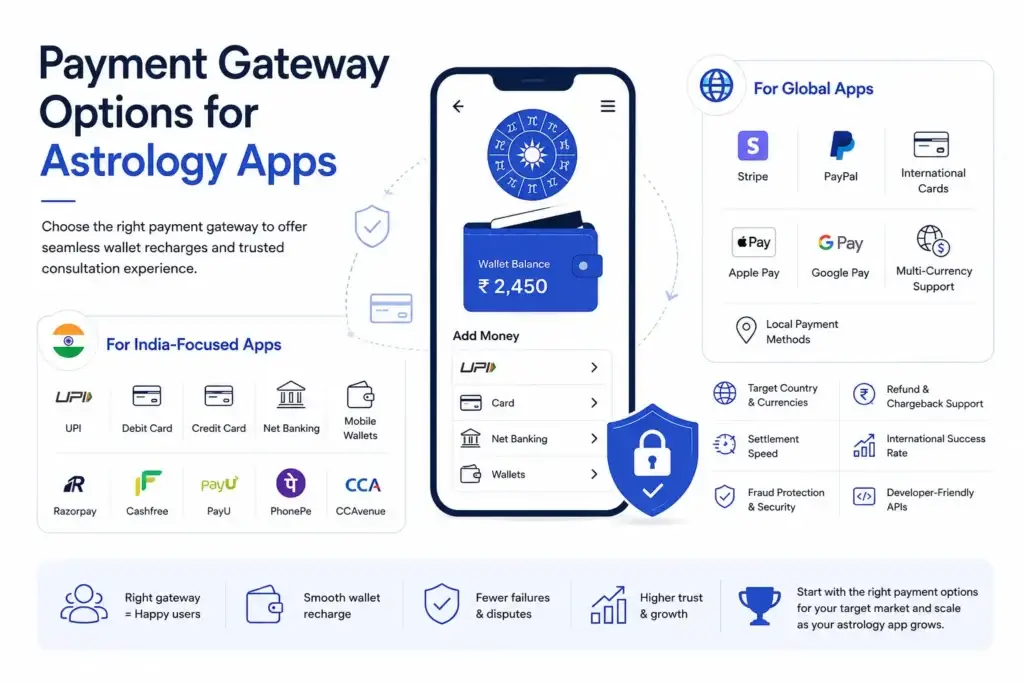
Astrology apps can integrate different payment gateways depending on the target market, user location, currency, payment habits, and business model. A wallet-based astrology consultation app should support payment methods that users already trust, because wallet refill is often the first paid action inside the app.
For India-focused astrology apps, common payment options include:
• UPI
• Debit card
• Credit card
• Net banking
• Mobile wallets
• Razorpay
• Cashfree
• PayU
• PhonePe
• CCAvenue
For global astrology apps, payment options may include:
• Stripe
• PayPal
• International cards
• Apple Pay
• Google Pay
• Multi-currency payment support
• Local payment methods based on region
The best payment gateway depends on several factors, such as target country, supported currencies, approval process, settlement speed, refund support, chargeback handling, international payment success rate, fraud protection, and developer-friendly APIs.
For example, an astrology app targeting Indian users may need UPI, debit cards, credit cards, net banking, and wallet payments. But an astrology app targeting users in the USA, UAE, UK, Canada, or Australia may also need international card support, PayPal, Apple Pay, Google Pay, and multi-currency checkout.
This becomes more important when the platform wants to serve users outside India. International users may not use UPI or Indian wallet options. They may prefer cards, PayPal, Apple Pay, Google Pay, or region-specific payment methods.
Razorpay’s Astrotalk case study also shows why payment gateway selection matters for astrology platforms. Astrotalk needed reliable payment support for both domestic and international customers, and payment success rate was important because failed payments could affect user experience and business growth.
If an astrology app wants to expand globally, international card support and multi-currency payment flow become important. A strong payment gateway setup helps users recharge their wallet smoothly, reduces failed transactions, supports refunds, and improves trust during paid consultations.
For founders, the goal should not be to add every payment gateway from day one. The smarter approach is to choose payment methods based on the target market first, then expand payment options as the app grows.
Recharge, Bonus, and Cashback Wallet Logic
Wallet recharge in astrology apps is not always a simple add-money flow. Many astrology consultation platforms use bonus, cashback, coupons, referral credit, and first-consultation offers to increase user activation and encourage repeat usage.
Why Recharge Offers Matter in Astrology Apps
Recharge offers help users take the first paid action inside the app. If a new user is unsure about starting a consultation, a bonus or cashback offer can encourage them to recharge and try chat, voice call, video consultation, Kundli report, or live session features.
For example, a platform may offer:
• Recharge ₹100 and get ₹50 bonus
• First chat free for 5 minutes
• Add ₹500 and get 10% cashback
• Limited-time festival recharge offer
• Bonus valid only for 7 days
• Cashback usable only for chat, not reports
• Referral credit for inviting a friend
• Coupon-based wallet recharge discount
Why Wallet Logic Should Be Separate
These offers can improve conversions, but they also create a second layer of wallet logic. The app cannot treat every rupee inside the wallet in the same way. A user’s real paid balance, bonus balance, cashback credit, referral credit, and promotional credit may all have different rules.
A strong wallet system should separate:
• Main balance
• Bonus balance
• Cashback balance
• Promotional credit
• Referral credit
• Refundable amount
• Non-refundable amount
• Expired bonus
• Locked amount during active consultation
Main Balance vs Bonus Balance
This separation is important because the refund policy for main balance and bonus balance may be different. For example, if a user recharges ₹500 and receives ₹100 bonus, the platform should clearly define whether the ₹100 bonus is refundable, transferable, withdrawable, or usable only inside the app.
The paid balance may be refundable in some cases, but bonus balance is usually promotional credit. That is why the app should clearly show what amount belongs to the user’s actual recharge and what amount is added as an offer.
Usage Rules for Bonus and Cashback
The app should also define where bonus balance can be used. Some platforms may allow bonus credit only for chat consultation, while others may allow it for voice calls, video calls, Kundli reports, or live sessions.
If these rules are not clear, users may expect bonus balance to work everywhere and raise complaints when it does not. Clear usage rules reduce confusion and help the support team handle complaints more easily.
Cashback Expiry and Refund Rules
Cashback expiry is another important part of wallet logic. If cashback is valid only for 7 days or 30 days, the app should show the expiry date clearly inside the wallet section.
The user should know how much balance is real money, how much is bonus credit, how much is cashback, and how much will expire soon. The platform should also define whether expired cashback can be restored or not.
Admin Control for Recharge Offers
The admin dashboard should allow the business team to manage recharge offers safely. Admins should be able to create recharge plans, define bonus percentages, set cashback expiry, limit coupon usage, and decide whether promotional credit can be refunded or not.
The dashboard should also track how users are using bonus and cashback credits. This helps the business understand which offers are increasing real consultation activity and which offers are only creating discount abuse.
Why Clear Wallet Rules Reduce Disputes
Without clear wallet logic, cashback and bonus offers can become dispute triggers. Users may complain about expired credits, non-refundable bonuses, or balance not applying to certain services.
For an astrology consultation app, the best approach is to keep wallet rules transparent. The app should clearly show paid balance, bonus balance, cashback balance, expiry date, refund eligibility, and usage restrictions.
This helps reduce user confusion, improves trust, and makes refund handling easier for the support team.
Per-Minute Billing for Chat, Voice, and Video Consultation
Astrology consultation apps usually work on a per-minute billing model. This means users are charged based on the time they spend with an astrologer through chat, voice call, or video consultation.
Before a session starts, the app checks whether the user has enough wallet balance. If the wallet balance is sufficient, the user can start the consultation. If the balance is low, the app should ask the user to recharge before connecting with the astrologer.
For example:
• Astrologer rate: ₹20 per minute
• Session duration: 5 minutes
• Total deduction: ₹100
This billing logic looks simple, but the backend must track every session carefully. The system should know when the session started, when it ended, how long the user was actually connected, and how much balance should be deducted.
During every consultation, the system should track:
• Consultation start time
• Consultation end time
• Actual connected duration
• Astrologer rate per minute
• Total billable minutes
• Total deduction
• Wallet balance before session
• Wallet balance after session
• Consultation ID
• Astrologer ID
• User ID
• Session type: chat, voice, or video
Low-balance alerts are also important. If the user’s wallet balance is about to end, the app should send a warning before the session is disconnected. The platform can either ask the user to recharge during the session or automatically end the consultation when the balance reaches the minimum limit.
This prevents negative wallet balance, billing confusion, and user disputes.
For voice and video consultations, the app should also handle connection failures properly. If the call does not connect, the app should not deduct the full amount. If the call connects but disconnects quickly because of network issues, the system should record the actual connected duration and apply the refund or deduction rule based on platform policy.
A strong per-minute billing system protects both sides. Users get fair billing based on actual usage, and astrologers get accurate earnings based on completed consultation time.
For the admin team, every billing record should be connected with the wallet ledger. This makes it easier to check disputes, review deductions, calculate astrologer commission, and maintain transparent transaction history.
Refund and Dispute Handling in Astrology Apps
Refund and dispute management is one of the most sensitive parts of an astrology consultation app. Since users add money to the wallet before taking a consultation, even a small payment issue can quickly become a trust problem. If money is deducted but the wallet is not credited, if a call does not connect properly, or if a user feels the session ended too early, the platform needs a clear process to handle the complaint.
Astrotalk’s refund policy shows how detailed these rules can become in a real astrology consultation business. It includes cases such as duplicate payments, connected call conditions, and possible deductions for bank or payment gateway charges in some refund situations. This proves that astrology apps should not handle refunds manually or casually. They need a proper refund workflow inside the admin dashboard.
A refund request can come from many situations. Sometimes the user completes payment but the wallet balance is not updated. Sometimes the user makes a duplicate payment by mistake. In some cases, the call may not connect, the video session may disconnect early, or the user may raise a complaint after the consultation. Refund issues may also happen when a report order is cancelled before processing, when the report has already been assigned to an astrologer, when the user enters incorrect birth details, or when the payment gateway shows a timeout.
A strong refund system should help the admin team check the complete transaction journey before approving or rejecting the request. The admin should be able to review the payment status, wallet credit status, gateway confirmation, consultation connection status, call or chat duration, astrologer assignment status, user complaint reason, refund eligibility, gateway charges, refund mode, and admin approval history.
This is important because every refund case is not the same. A failed wallet credit may need quick correction. A duplicate payment may need refund or wallet credit. A completed consultation may follow a different policy. A disconnected call may depend on actual connected duration and platform rules.
Refunds can usually be handled in two ways: refund to the original payment method or refund to the app wallet. Refund to the original payment method depends on the payment gateway, bank processing time, and transaction status. Refund to wallet is usually faster inside the app, but it should be clearly mentioned in the platform’s refund policy.
For astrology consultation apps, the best approach is to keep refund rules transparent from the beginning. Users should know when refunds are allowed, how long they may take, whether gateway charges can be deducted, and whether the amount will return to the original payment method or app wallet.
A clear refund and dispute workflow protects user trust, reduces support pressure, prevents manual confusion, and helps the platform manage payment complaints professionally.
Admin Dashboard Features for Payment and Wallet Control
The admin dashboard should give complete control over wallet and payment activity inside an astrology consultation app. Since users recharge their wallet before taking consultations, the admin team must be able to track every payment, wallet credit, deduction, refund, cashback, and dispute from one place.
A strong admin dashboard helps the business manage financial activity clearly and solve user complaints faster. If a user says the wallet was not credited, the admin should be able to check the transaction status immediately. If a refund request is raised, the admin should be able to review payment history, consultation records, and wallet ledger before taking action.
Important admin dashboard features include:
• View all wallet recharges
• Track successful, failed, and pending payments
• Filter transactions by user, date, gateway, and amount
• Check gateway transaction ID
• View wallet ledger history
• Approve or reject refund requests
• Manage cashback and bonus rules
• Set recharge plans
• Create coupon-based recharge offers
• Check call and chat billing history
• View astrologer commission records
• Track payout status
• Detect suspicious wallet activity
• Create manual wallet adjustment with reason
• Lock wallet if fraud is suspected
• Export transaction reports
• View dispute history
• Check payment gateway settlement records
• Monitor failed recharge trends
• Review refund approval logs
The dashboard should also show a clear wallet ledger for every user. This helps the support team understand how the wallet balance changed over time. They should be able to see when the user recharged, how much bonus was added, how much was deducted for consultation, whether any refund was processed, and what the final wallet balance is.
Refund management should also be handled carefully inside the admin panel. Admins should not approve refunds blindly. They should be able to check payment status, consultation duration, call connection status, astrologer assignment, gateway response, and user complaint reason before approving or rejecting the request.
Manual wallet adjustment should never be open to everyone. Only authorized admins should have access to this feature. Every manual wallet credit or debit should require a clear reason, admin name, date, timestamp, and audit log entry.
This protects the platform from internal misuse and keeps financial records transparent.
For astrology consultation apps, the admin dashboard is not just a backend panel. It is the control center for payment trust, wallet accuracy, refund handling, astrologer earnings, and business reporting.
Fraud Risks in Astrology Wallet Systems
Wallet-based astrology apps can face several types of fraud because users add money before using the service. Since the wallet is connected with recharge, cashback, consultation billing, refunds, and astrologer payouts, even a small weakness in the payment flow can create financial loss or user disputes.
One common risk is fake payment proof. Some users may upload or share fake payment screenshots and claim that their wallet was not credited. This is why the backend should never trust screenshots or frontend success messages. The app should always verify payment status directly from the payment gateway before adding balance to the wallet.
Another major risk is duplicate payment processing. Sometimes a payment gateway webhook may be received more than once. If the backend does not handle this properly, the same payment can be credited twice. To avoid this, every recharge should be connected with a unique order ID, transaction ID, and wallet ledger entry.
Bonus and cashback abuse is also common in wallet-based apps. Users may create multiple accounts to claim first-user bonuses, referral rewards, or recharge offers again and again. The app should detect repeated account creation from the same device, same payment method, same IP pattern, or suspicious referral activity.
Refund abuse can also become a serious issue. Some users may request refunds after completing consultations, claim failed calls even when the session was connected, or raise repeated disputes for small deductions. A strong refund system should check consultation duration, call connection logs, payment status, wallet ledger, and previous refund history before approving any refund.
Astrologer-user collusion is another risk in consultation platforms. In some cases, users and astrologers may try to misuse wallet credits, fake sessions, or commission logic. This is why the platform should monitor unusual consultation patterns, repeated sessions between the same accounts, abnormal refund activity, and suspicious earning behavior.
Internal misuse should also be controlled. If staff members can manually credit or debit wallets without proper approval, it can create financial leakage. Manual wallet adjustment should be limited to authorized admins only, and every change should include a reason, admin name, timestamp, and audit log.
Fraud prevention is not only the responsibility of the payment gateway. The app backend, wallet ledger, admin dashboard, refund workflow, cashback rules, and support process should all work together to detect suspicious activity and protect the platform.
A secure astrology wallet system should verify every transaction, record every wallet change, monitor unusual user behavior, and give admins clear fraud signals before financial damage happens.
Security Best Practices for Wallet Refill Architecture
A secure astrology wallet system should follow strong backend, payment, and admin security practices. Wallet refill is directly connected with user money, consultation billing, refunds, cashback, and platform revenue, so the architecture should not depend on weak frontend confirmation or manual handling.
For founders, the main principle is simple: the frontend can start the payment, but the backend should confirm the payment. The backend should be the final authority before wallet balance is added to the user account.
Use PCI-Compliant Payment Gateways
The astrology app should use trusted PCI-compliant payment gateways for card payments and wallet refills. Sensitive card details such as card number, CVV, PIN, and raw payment credentials should not be stored inside the app backend.
The payment gateway should handle sensitive payment data, while the app stores only safe references such as order ID, payment status, transaction ID, wallet entry, and refund details.
Verify Every Payment on the Backend
The backend should verify every payment before crediting wallet balance. The app should not add money to the user wallet only because the frontend shows a success message.
A secure backend should check payment signature, gateway response, order ID, amount, user ID, and transaction status. This helps prevent fake success messages, tampered responses, and incorrect wallet credits.
Validate Gateway Webhooks Securely
Payment gateways usually send webhook updates for successful, failed, pending, or refunded transactions. These webhooks should be verified properly before updating the wallet ledger.
The backend should validate webhook signatures, confirm the payment status from the gateway, and match the webhook with the correct user and order ID. This helps the system update wallet balance even if the user closes the app after payment.
Prevent Duplicate Wallet Credits
Duplicate wallet credit is a common risk in payment systems. Sometimes the same webhook may be received more than once, or the user may refresh the payment flow.
To prevent this, the backend should use idempotency keys, unique order IDs, and transaction status checks. One successful payment should create only one wallet credit entry, even if the gateway sends multiple responses.
Secure Wallet Ledger and Transaction History
Every wallet movement should be recorded in the wallet ledger. This includes recharge, bonus, cashback, consultation deduction, refund, expired credit, and manual adjustment.
The ledger should store transaction ID, user ID, amount, payment method, status, timestamp, and remaining balance. This makes payment complaints, refund checks, and dispute handling much easier for the admin team.
Protect Admin Access and Manual Adjustments
The admin dashboard should use role-based access control. Not every admin should be allowed to approve refunds, change wallet balance, or create manual credits.
Manual wallet adjustments should require a clear reason, admin identity, date, timestamp, and audit log. This protects the platform from internal misuse and keeps financial records transparent.
Add Fraud Monitoring Rules
The system should monitor suspicious payment and wallet activity. This includes repeated failed payments, multiple accounts using the same device, repeated refund requests, high cashback usage, duplicate recharge claims, and unusual consultation patterns.
Suspicious users should be flagged for review before refunds, bonuses, or manual credits are approved.
Secure APIs and Payment Keys
Payment APIs should use secure authentication, HTTPS, rate limiting, and proper access controls. Payment gateway secret keys should never be exposed in frontend code, mobile apps, JavaScript files, or public repositories.
All sensitive keys should be stored securely on the server side and rotated when needed.
Protect Refund Approval Workflow
Refund approval should follow a proper workflow. The admin should check payment status, wallet credit status, consultation duration, call connection logs, refund eligibility, and previous dispute history before approving a refund.
This helps prevent refund abuse and keeps the process fair for both users and the platform.
Run Regular Security Testing
A wallet-based astrology app should be tested regularly for security issues. This includes API testing, payment flow testing, webhook testing, admin access testing, and vulnerability checks.
Regular testing helps identify weak points before they create payment loss, data exposure, or user trust issues.
A secure wallet refill architecture protects the user, the astrologer, and the business. It reduces failed recharge complaints, duplicate wallet credits, fake payment claims, refund abuse, and admin misuse.
For astrology consultation apps, payment security is not just a technical feature. It is the foundation of user trust and long-term platform growth.
Wallet Refill Architecture Example
A secure wallet refill architecture should connect the user app, backend, payment gateway, wallet ledger, notification system, and admin dashboard in a controlled flow. The goal is to make sure that wallet balance is credited only after verified payment confirmation.
A simple wallet refill architecture can look like this:
User App → Backend API → Payment Gateway → Webhook Verification → Wallet Ledger → User Notification → Admin Dashboard
User App
The user app allows the customer to open the wallet section, select a recharge amount, apply a coupon if available, and start the payment process. From the user side, the flow should look simple and fast. The user should clearly see the recharge amount, bonus if applicable, payment method, and final wallet credit.
Backend API
The backend API creates a unique payment order before the user is sent to the payment gateway. It stores the pending transaction with details such as user ID, recharge amount, order ID, selected plan, payment status, and timestamp. This helps the system match the payment response with the correct user account later.
Payment Gateway
The payment gateway handles the actual payment through UPI, card, net banking, wallet, international card, or other supported methods. Sensitive payment information should stay with the gateway instead of being stored inside the astrology app backend.
Webhook Verification
After payment, the gateway sends a webhook or payment response to the backend. The backend verifies the payment status, signature, amount, order ID, and transaction ID. This step is very important because the app should not credit wallet balance only based on frontend success messages.
Wallet Ledger
Once the payment is verified, the wallet ledger records the recharge entry. It should save the recharge amount, bonus amount, payment method, transaction ID, wallet balance before recharge, wallet balance after recharge, and timestamp. This creates a clear transaction history for users, admins, refunds, and disputes.
User Notification
After the wallet is credited, the user should receive a confirmation through app notification, SMS, email, or WhatsApp. The notification should mention the recharge amount, updated wallet balance, and transaction status so the user feels confident that the payment was processed successfully.
Admin Dashboard
The admin dashboard should show the complete payment record. Admins should be able to view transaction status, wallet credit history, failed payments, pending payments, refund requests, gateway transaction IDs, and dispute records. This helps the support team solve payment complaints quickly.
This architecture helps prevent wrong wallet credits, duplicate credits, missing payment records, fake payment claims, and refund confusion. It also gives the platform a reliable payment trail from recharge initiation to wallet credit confirmation.
Read more: Best AstroTalk Clone Script in 2026: Features & Pricing Compared
Compliance Checklist for Astrology App Founders
Before launching an astrology consultation app with wallet recharge, founders should review the complete payment and wallet flow carefully. A small mistake in payment verification, wallet credit, refund handling, or admin access can create user complaints, financial loss, and trust issues.
A compliance checklist helps founders make sure the app is ready for real users, real payments, and real consultation activity.
The first step is to use a trusted payment gateway. The app should avoid storing raw card details and should allow the payment gateway to handle sensitive payment information. The backend should only store safe payment references such as transaction ID, order ID, payment status, refund ID, and wallet ledger records.
Every payment should be verified on the backend before wallet balance is credited. The app should not depend only on frontend payment success messages because frontend responses can fail, delay, or be manipulated. Backend verification, secure webhook validation, and payment gateway transaction matching are important for safe wallet refill processing.
Founders should also make sure the wallet system has a proper ledger. The wallet ledger should track every recharge, deduction, refund, cashback, bonus, expired credit, and manual adjustment. Main balance and bonus balance should be separated because both may have different usage and refund rules.
Refund and dispute handling should also be planned before launch. The app should have a clear refund policy, wallet usage policy, bonus expiry rule, and dispute approval process. Admins should be able to check payment status, consultation records, wallet ledger, and gateway response before approving any refund.
Admin access should be controlled carefully. Manual wallet adjustments, refund approvals, cashback settings, and payment reports should not be open to every staff member. The platform should use role-based admin access, audit logs, and approval records to prevent internal misuse.
Founders should also monitor suspicious wallet activity. This includes repeated failed payments, duplicate recharge claims, multiple accounts using the same device, high cashback usage, repeated refund requests, and unusual consultation patterns.
Before going live, founders should check that the app has:
• A trusted payment gateway
• No raw card data storage
• Backend payment verification
• Secure webhook verification
• Payment gateway transaction IDs
• Complete wallet ledger
• Separate main balance and bonus balance
• Recharge and deduction tracking
• Refund and dispute workflow
• Clear wallet usage policy
• Clear refund policy
• Bonus and cashback expiry rules
• Role-based admin access
• Admin audit logs
• Restricted manual wallet adjustment
• Secure payment gateway keys
• HTTPS across the app
• Transaction notifications for users
• Fraud monitoring rules
• Privacy policy and payment terms
• Regular security testing
This checklist helps founders avoid common wallet, refund, and payment mistakes before the app goes live. It also makes the astrology consultation platform safer, more transparent, and easier to manage as user activity grows.
For astrology apps, compliance is not only about payment rules. It is also about creating a payment experience where users can recharge confidently, track their wallet clearly, and trust every deduction inside the app.
How Miracuves Helps Build Secure Astrology Consultation Apps
Miracuves helps founders build secure astrology consultation apps with wallet recharge, payment gateway integration, per-minute billing, astrologer consultation, user wallet, admin dashboard, refund management, and scalable backend architecture.
A complete Astrotalk-style app needs more than chat and calls. It needs a strong payment and wallet foundation that can support user recharge, paid consultation, Kundli reports, live sessions, cashback, refund handling, astrologer commission, payout tracking, and admin control.
In a wallet-based astrology platform, every payment action should be connected with a proper backend flow. When a user recharges the wallet, the system should verify the payment, update the wallet ledger, credit the user balance, notify the user, and save the transaction record for admin review. Miracuves can help structure this complete flow so the platform remains reliable for both users and business teams.
Miracuves can help build astrology consultation platforms with:
• User app
• Astrologer panel
• Admin dashboard
• Wallet recharge system
• Payment gateway integration
• Chat consultation
• Voice consultation
• Video consultation
• Kundli and horoscope features
• Report purchase flow
• Recharge plans
• Cashback and bonus wallet logic
• Refund and dispute management
• Astrologer commission tracking
• Payout management
• Transaction history
• Admin audit logs
• Scalable backend APIs
The user app can allow customers to recharge their wallet, browse astrologers, start paid chat or calls, view wallet history, buy reports, and receive consultation updates. The astrologer panel can help astrologers manage availability, consultation requests, earnings, ratings, and profile details. The admin dashboard gives the business team control over users, astrologers, payments, refunds, wallet records, reports, and platform activity.
Miracuves also focuses on wallet transparency. A proper wallet system should show recharge history, consultation deductions, bonus credits, cashback usage, refund entries, and remaining balance clearly. This helps reduce payment confusion and makes support handling easier.
For founders who want to launch faster, the Miracuves Astrotalk Clone solution can help build an astrology consultation platform with wallet payments, astrologer profiles, live consultation workflows, admin control, monetization features, and scalable backend systems.
With the right architecture, founders can launch an astrology app that is not only feature-rich but also payment-ready, wallet-ready, and built for long-term user trust.
Related reading: How to Build a Kundli and Horoscope Generation Algorithm in Python.
Conclusion
PCI-DSS payments and wallet refills are important parts of every serious astrology consultation app.
A user may see only a simple recharge button, but behind that button there should be a secure payment gateway, backend verification, wallet ledger, refund workflow, fraud checks, admin controls, and clear transaction history.
For founders, the biggest mistake is treating wallet recharge as a small feature. In an Astrotalk-style platform, the wallet is connected to consultation billing, user trust, astrologer earnings, support tickets, refunds, cashback, and business revenue.
A secure astrology app should avoid storing raw card data, use trusted payment gateways, verify every payment on the backend, maintain a complete wallet ledger, and give admins enough control to resolve disputes quickly.
The winning astrology platforms will not only offer astrologer chat, voice calls, video calls, Kundli, and reports. They will also provide a reliable payment experience where users can recharge confidently, track their balance clearly, and trust every deduction.
Miracuves can help founders build secure astrology consultation apps with wallet recharge, payment integration, per-minute billing, refund workflows, admin control, and scalable consultation features.
Want to launch a secure Astrotalk-style app with wallet payments and consultation features? Contact Miracuves today and build your astrology platform with confidence.
FAQs
What is PCI-DSS in astrology consultation apps?
PCI-DSS is a payment security standard that applies when an app stores, processes, or transmits cardholder data. In astrology consultation apps, it becomes important when users recharge their wallet through debit cards, credit cards, or other card-based payment methods.
Why is wallet refill important in an astrology app?
Wallet refill is important because most astrology consultation apps use prepaid billing. Users add money to their wallet first, and then use that balance for chat, voice calls, video consultations, Kundli reports, live sessions, or other paid astrology services.
Should an astrology app store card details?
No. A secure astrology app should avoid storing card numbers, CVV, PIN, or raw payment data. Sensitive card information should be handled by a trusted PCI-compliant payment gateway, while the app stores only transaction references, payment status, wallet records, and refund details.
How does per-minute billing work in astrology consultation apps?
In per-minute billing, the app deducts wallet balance based on the astrologer’s rate and consultation duration. For example, if an astrologer charges ₹20 per minute and the session lasts 5 minutes, the system deducts ₹100 from the user’s wallet after tracking the actual session duration.
How can Miracuves help build a secure astrology consultation app?
Miracuves can help build an Astrotalk-style astrology consultation app with wallet recharge, payment gateway integration, chat, voice/video consultation, Kundli features, astrologer panel, admin dashboard, refund management, transaction history, and scalable backend architecture.
Miracuves is an independent software development company. We are not affiliated with, connected to, sponsored by, or endorsed by any company or product named in this article.
Terms such as “X Clone” are used descriptively. It is how the software industry refers to building a platform with functionality comparable to a known service, and how clients search for it.
The entire design and codebase of our products is built by our own team. Our products contain no code, design, graphics, or content originating from any third-party website or applications.
All third-party names and marks referenced in this article are the property of their respective owners, referenced solely to identify the services discussed.