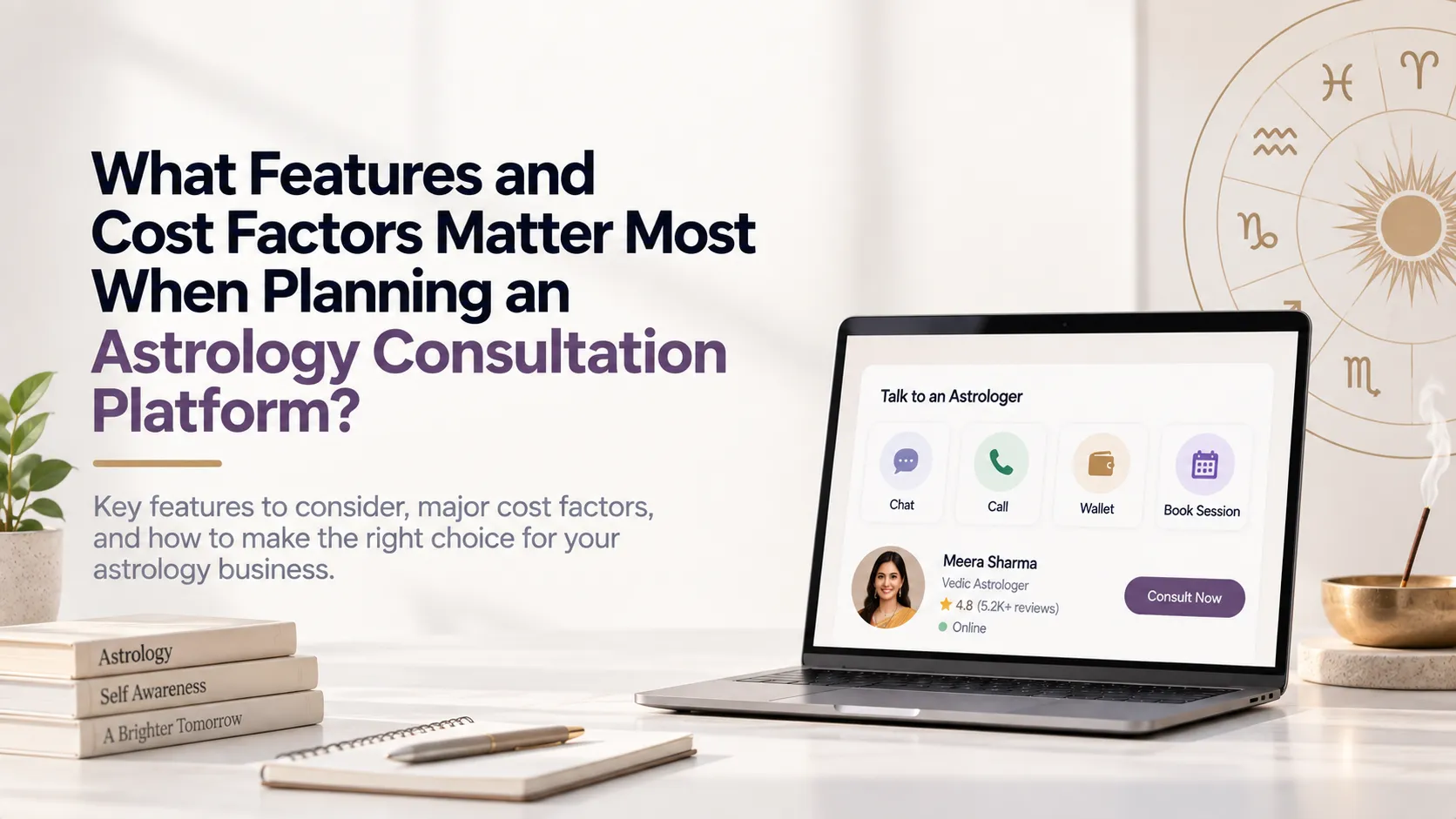
Key Takeaways
- Astrology consultation platform features and cost factors should be planned together because every workflow affects development, trust, and daily operations.
- Core features include astrologer discovery, expert profiles, chat, voice and video calls, wallet recharge, session billing, ratings, and rebooking.
- The platform must connect users, astrologers, payments, consultations, earnings, and administrative controls.
- Development cost depends on consultation channels, wallet complexity, provider management, integrations, security, localization, and admin depth.
- Founders should prioritize features that create paid consultations, protect revenue, and simplify marketplace operations.
Feature and Cost Signals
- Define whether the first release needs chat, voice calls, video consultations, scheduled sessions, live broadcasts, or a focused combination.
- Plan wallet recharges, minimum-balance checks, per-minute deductions, session timers, refunds, bonus credits, and reconciliation.
- Determine the required depth of astrologer verification, availability management, pricing control, earnings visibility, and payout processing.
- Include admin controls for users, astrologers, categories, commissions, payments, disputes, content, reports, and staff permissions.
- Account for regional languages, local payment methods, AI tools, communication providers, hosting, security, deployment, and ongoing support.
Real Insights
- A large feature list has little value when wallet deductions, consultation timers, refunds, or payouts are unreliable.
- Chat may support an initial launch, while voice and video introduce additional infrastructure, testing, and session-management costs.
- A stronger admin dashboard can increase the initial scope but reduce long-term dependence on developers.
- Regional language support and culturally relevant service categories may create more value than advanced visual features.
- Miracuves develops white-label, source-code-owned astrology consultation platforms with connected wallets, sessions, astrologer panels, payments, and admin controls, with six-day delivery where the standard scope applies.
Planning an astrology consultation platform is not only about adding chat, calls, horoscopes, and astrologer profiles. When founders evaluate astrology consultation platform features and cost factors, the real business challenge is understanding how every feature connects into a reliable consultation marketplace where users can discover experts, recharge wallets, start sessions, receive guidance, and return for repeat consultations.
For founders, this is where many early planning mistakes happen. A platform may look complete on the surface but still fail operationally if the wallet logic is weak, astrologer availability is unclear, admin controls are limited, or payout workflows are handled manually.
That is why feature planning and cost planning should happen together. Every major feature affects not only development effort but also trust, monetization, support workload, scalability, and long-term platform control.
This guide explains the most important features and cost factors to consider before building an astrology consultation platform, so you can make smarter product decisions before investing in development.
Why Astrology Consultation Platforms Need More Than Basic App Screens
Many founders start by thinking about visible features: login, astrologer listing, chat, call, horoscope, payment, and profile pages. These are important, but they are only the surface layer.
A serious astrology consultation platform has three connected sides:
- Users who want trusted guidance, quick discovery, secure payments, and smooth consultations.
- Astrologers or consultants who need profile control, availability management, consultation tools, and earnings visibility.
- Platform operators who need admin control over users, experts, payments, refunds, commissions, content, disputes, and performance.
If these three sides do not work together, the platform becomes difficult to operate. For example, chat may work, but if the wallet does not deduct correctly, revenue leaks. Astrologer profiles may exist, but if verification is weak, trust suffers. Payments may be integrated, but if refunds and payouts are not tracked, support pressure increases.
The better planning question is not, “How many features can we add?” It is, “Which features are required to run the business safely, profitably, and repeatedly?”
Read More: AI Astrologer vs Human Astrologer: What Role Should Each Play in a Digital Astrology Platform?
Core User Features That Shape the Consultation Experience
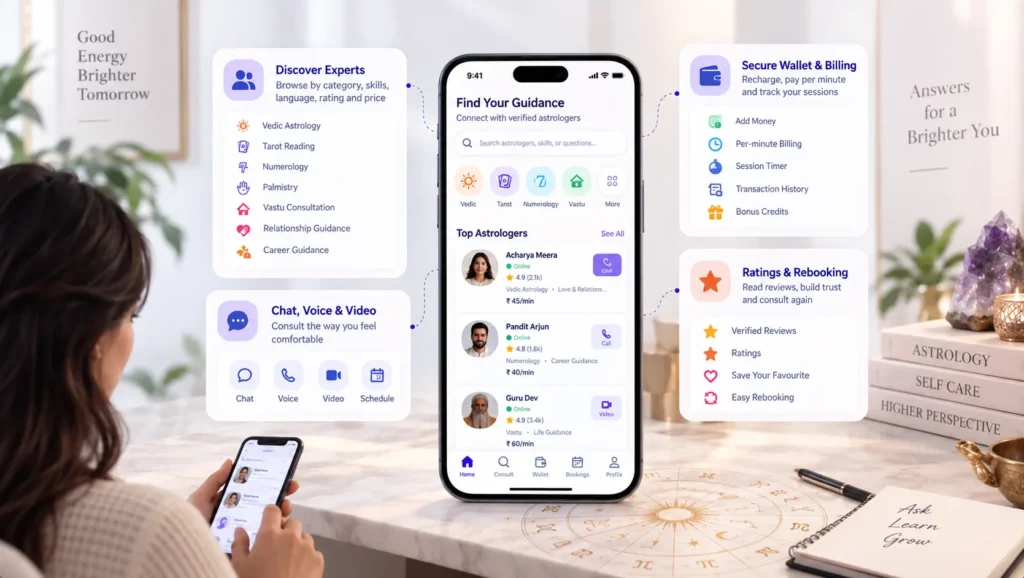
The user side of the platform decides whether visitors convert into paying customers. In astrology, trust and convenience matter because users often share personal questions, birth details, relationship concerns, and financial or career doubts.
Astrologer Discovery and Filtering
Users should be able to browse experts based on categories, skills, language, experience, ratings, consultation price, and availability. A simple list is not enough because users usually arrive with a specific need.
Useful filters may include:
- Vedic astrology
- Tarot reading
- Numerology
- Palmistry
- Vastu consultation
- Relationship astrology
- Career guidance
- Language preference
- Price per minute
- Online or offline status
This feature affects cost because better discovery requires structured profile data, category mapping, search logic, sorting rules, and UI work. A basic listing is cheaper, but a strong discovery experience improves conversion and repeat use.
Chat, Voice, and Video Consultation
Most astrology platforms need more than one consultation mode. Some users prefer chat because it feels private and affordable. Others prefer voice or video when they want a more personal experience.
Each channel has different development and cost implications.
| Consultation Mode | Business Value | Cost Impact |
|---|---|---|
| Chat consultation | Good for quick, private, low-friction guidance | Requires real-time messaging, timers, wallet deduction, and moderation |
| Voice consultation | Better for deeper conversations and higher trust | Requires calling integration, session tracking, and call status logic |
| Video consultation | Useful for premium experts and high-value sessions | Requires video SDK, stronger infrastructure, and better device testing |
| Scheduled consultation | Helps users book preferred experts in advance | Requires calendars, reminders, slots, cancellations, and rescheduling |
A founder does not always need every mode on day one. The right choice depends on the business model, expert supply, launch region, and expected user behavior.
Wallet Recharge and Session Billing
Wallet logic is one of the most important parts of an astrology consultation platform. A wallet-based model allows users to recharge before starting a session and pay per minute during chat, call, or video consultation.
A strong wallet system should support:
- User recharge
- Per-minute deduction
- Minimum balance checks
- Session timers
- Failed payment handling
- Refund logic
- Bonus credits
- Transaction history
- Admin visibility
This is also a major cost factor because wallet billing is not just a payment screen. It requires backend accuracy, ledger logic, session-state tracking, and reconciliation. Weak wallet logic can create disputes, revenue leakage, and customer support problems after launch.
Ratings, Reviews, and Rebooking
Astrology is trust-driven. Users are more likely to start a paid session when they can see reviews, ratings, expertise, and previous user feedback.
Ratings and rebooking features help the platform retain users. If someone has a positive experience with an astrologer, the app should make it easy to follow, save, or consult the same expert again.
These features are not always expensive individually, but they add value because they improve repeat usage and reduce the need to reacquire the same customer again and again.
Astrologer-Side Features That Affect Platform Quality
The expert side of the platform is often underestimated. Founders may focus heavily on users while forgetting that astrologers also need a smooth operational experience.
If astrologers cannot manage availability, view earnings, respond quickly, or update profiles, the platform becomes harder to scale.
Astrologer Registration and Verification
A platform should allow astrologers to register, submit profile details, add skills, upload documents, define language preferences, and apply for verification.
Verification matters because users are trusting the platform with personal questions. Even if final quality control depends on business operations, the software should support document review, approval status, profile completeness, and admin verification.
Availability and Consultation Queue
Availability management helps users know whether an astrologer is online, busy, offline, or accepting scheduled bookings.
This feature can include:
- Online/offline toggle
- Busy status
- Auto-accept or manual accept
- Waiting queue
- Missed request handling
- Session history
- Appointment slots
The more advanced the availability logic, the higher the development complexity. However, this feature directly affects user experience because users do not want to recharge and then wait without clarity.
Earnings Dashboard and Payout Tracking
Astrologers need to understand how much they earned, what commission was deducted, which sessions were completed, and when payouts are expected.
A useful earnings dashboard may include:
- Completed sessions
- Session duration
- Gross earnings
- Platform commission
- Net payable amount
- Withdrawal request status
- Payout history
This feature affects cost because payout logic must connect with consultation records, wallet deductions, commission settings, and admin approval workflows.
Admin Features That Matter More Than Founders Expect
The admin panel is where the platform operator controls the business. A weak admin panel may look acceptable during launch but becomes a bottleneck once users, experts, disputes, payments, and content start increasing.
User and Expert Management
Admin should be able to manage users, astrologers, documents, profile status, categories, blocked accounts, and reported activity.
This matters because astrology consultation platforms involve personal conversations and paid guidance. The operator needs control over who appears publicly, who can accept sessions, and how issues are handled.
Commission and Pricing Control
A platform may need different commission models for different astrologers, categories, or promotional periods.
Common pricing controls include:
- Default platform commission
- Expert-specific commission
- Per-minute pricing
- Free-minute offers
- Promotional credits
- Featured expert pricing
- Subscription or package pricing
These rules affect development cost because they require backend flexibility. A hard-coded pricing model may be cheaper at first but can limit future monetization experiments.
Refunds, Disputes, and Support
Disputes can happen when sessions disconnect, users are dissatisfied, experts miss requests, or payments fail. Admin should have visibility into sessions, transaction history, refund status, user complaints, and expert responses.
A platform without dispute tools may depend on manual support, spreadsheets, or developer intervention. That creates operational drag and increases long-term cost.
Content and Engagement Control
Astrology platforms often use content to attract users before they purchase a consultation. This may include horoscopes, kundli tools, tarot content, numerology insights, spiritual blogs, daily predictions, or festival-specific guidance.
Admin-side content control helps the business publish, update, and organize content without waiting for developers every time.
Feature vs Cost Impact: What Founders Should Prioritize
Not every feature has the same business value or cost impact. Some features are essential for launch, while others can be added after validation.
Astrology Platform Feature and Cost Impact Table
| Feature Area | Business Value | Cost Impact |
|---|---|---|
| Astrologer discovery | Helps users find the right expert faster | Medium, depending on filters, sorting, and profile depth |
| Chat consultation | Creates low-friction paid consultation flow | Medium to high because it needs real-time messaging and billing logic |
| Voice and video consultation | Supports premium, trust-led consultation experiences | High because third-party SDKs, testing, and session handling are required |
| Wallet and per-minute billing | Protects revenue and enables prepaid consultation | High because ledger accuracy and session metering are critical |
| Astrologer verification | Improves marketplace trust and quality control | Medium, depending on document workflows and approval rules |
| Admin dashboard | Gives the operator control over users, experts, payments, and disputes | Medium to high depending on reporting and permission depth |
| Multi-language support | Expands regional reach and improves accessibility | Medium to high depending on content, UI, and support requirements |
| AI astrology tools | Supports instant engagement when human experts are unavailable | Variable, depending on AI provider, prompts, metering, and safeguards |
Main Cost Factors When Building an Astrology Consultation Platform
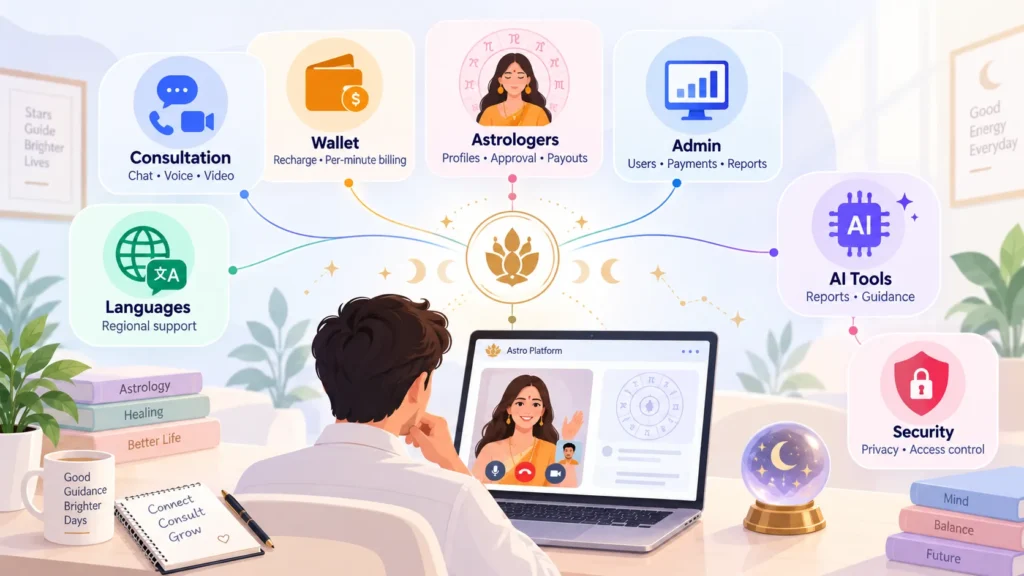
The cost of an astrology consultation platform depends on more than the number of screens. Two apps with similar-looking interfaces can have very different development costs if one includes proper wallet metering, admin controls, expert payouts, call infrastructure, and security workflows.
1. Consultation Channels
Chat is usually simpler than voice and video, but it still needs session tracking and billing logic. Voice and video add more complexity because they require real-time communication providers, call states, permissions, network handling, recording options, and device testing.
A founder should decide whether launch requires all consultation modes or whether the first version can begin with chat and voice before expanding into video.
2. Wallet and Payment Architecture
Payment integration is only one part of the cost. The bigger factor is how money moves inside the platform after recharge.
Important questions include:
- Does the wallet support prepaid consultation?
- Can the system deduct per minute?
- Can users top up during a session?
- Are failed payments handled properly?
- Can admin view wallet history?
- Are refunds and bonus credits recorded clearly?
- Can the platform reconcile transactions later?
The more accurate the money flow needs to be, the more backend planning is required.
3. Astrologer Management Depth
A basic profile form is simple. A full expert management system is more complex.
Cost increases when the platform needs document verification, approval workflows, category mapping, skill tagging, pricing controls, availability scheduling, earnings dashboards, payout requests, and performance analytics.
This investment is important because expert quality directly affects user trust and repeat consultation.
4. Admin Dashboard Complexity
Many founders underestimate admin development. The admin panel may need more work than the user app because it controls the entire business.
Cost depends on whether admin needs:
- User management
- Astrologer approval
- Category management
- Commission control
- Payment tracking
- Refund management
- Dispute handling
- Content management
- Analytics dashboards
- Role-based access
- Support workflows
A stronger admin dashboard can increase initial development scope, but it reduces operational dependency later.
5. Regional Language and Localization
Astrology is highly local and cultural. Users may prefer consultations in Hindi, Tamil, Telugu, Bengali, Marathi, Gujarati, Arabic, Spanish, or other regional languages depending on the launch market.
Localization affects UI, content, astrologer profiles, notifications, support, and sometimes search behavior. Multi-language support can be a major growth advantage, but it should be planned properly instead of added as an afterthought.
6. AI and Automated Astrology Tools
AI features can support engagement, instant answers, tarot-style prompts, numerology explanations, horoscope summaries, or first-level guidance. However, AI should be implemented carefully because astrology users expect relevance, consistency, and trust.
AI tools can affect cost through:
- AI provider integration
- Prompt design
- Usage metering
- Wallet deduction
- Response history
- Safety controls
- PDF or report generation
- Admin-level pricing controls
For many founders, AI is useful as a support layer, not a replacement for trusted human consultations.
7. Security, Privacy, and Data Handling
Users may share birth details, relationship concerns, health worries, financial questions, payment information, and private consultation histories. This makes privacy-conscious platform design important.
Security-related cost factors may include encrypted data transfer, secure payment gateway integration, role-based access control, activity logs, user verification, provider verification, abuse reporting, and admin access controls.
Founders should avoid treating security as a final checklist item. It should be part of the platform foundation from the beginning.
Read More: Cutting AI Astrology Costs by 68%: Benchmarking Precomputed Aspects in Natal Charts
Founder Decision Signals
Speed
If speed matters, prioritize a launch-ready foundation with the core consultation, wallet, expert, and admin flows already connected.
Cost
If budget is tight, avoid building every advanced feature at once. Focus first on the features that create paid consultations and operational control.
Scalability
If you plan to onboard many astrologers, invest early in verification, commission rules, availability management, and payout tracking.
Market Fit
If your target market is regional, language support, local payment methods, and culturally relevant astrology categories may matter more than advanced visuals.
Ready-Made Foundation vs Custom Development: Which Route Fits Better?
There are two common ways to build an astrology consultation platform.
A custom build gives full flexibility but usually requires more time, planning, testing, and budget. It may be suitable when the business model is highly unique or when the founder needs a completely custom workflow from day one.
A ready-made foundation can help founders launch faster because the core marketplace flows are already prepared. This route is useful when the goal is to validate demand quickly, customize branding, and avoid building common modules from zero.
The right choice depends on:
- Launch timeline
- Feature scope
- Budget
- Customization needs
- Team experience
- Required integrations
- Long-term ownership expectations
- Compliance and security review needs
For founders who want to evaluate a launch-ready path, Miracuves offers a ready-made astrology consultation marketplace solution that can be customized around branding, consultation flows, wallet logic, expert management, and admin control.
Hidden Costs Founders Should Not Ignore
The visible app development cost is only one part of the total investment. Founders should also plan for operational and post-launch costs.
Payment Gateway and Communication Provider Costs
Payment gateways, OTP providers, voice/video SDKs, push notification tools, email systems, and AI providers may carry their own usage charges. These costs depend on transaction volume, session duration, regions, and selected providers.
Hosting and Infrastructure
A consultation platform needs reliable hosting because users expect real-time availability. As sessions, messages, reports, calls, and media increase, infrastructure planning becomes more important.
Support and Moderation
Astrology platforms require customer support because users may ask about payments, refunds, expert quality, missed sessions, or technical issues. Moderation tools and support workflows should be planned early.
Marketing and Expert Acquisition
Even the best platform needs users and astrologers. Founders should budget for expert onboarding, content marketing, paid campaigns, referral programs, influencer partnerships, or regional growth strategies.
Maintenance and Feature Improvements
After launch, the platform may need bug fixes, performance improvements, app store updates, new payment methods, additional languages, seasonal campaigns, or new astrology categories.
Mistakes Founders Should Avoid
Choosing Features Without Understanding the Business Model
Adding many features does not automatically create revenue. The platform should first support a clear consultation, payment, commission, and retention model.
Underestimating Wallet and Billing Logic
Wallet errors can create disputes and revenue leakage. Per-minute billing, recharge history, refunds, and session tracking should be planned carefully.
Launching Without Strong Admin Control
Without proper admin tools, the operator may depend on developers for everyday changes like commissions, categories, expert approval, refunds, and content updates.
Treating Astrologer Experience as Secondary
Experts are the supply side of the marketplace. If they cannot manage availability, earnings, and sessions smoothly, platform quality suffers.
Practical Feature Planning Checklist
Before starting development, founders should answer these questions:
- Which consultation types are needed at launch: chat, voice, video, or scheduled sessions?
- Will the platform use wallet-based billing, direct payment, subscriptions, or a hybrid model?
- How will astrologers be verified before they appear publicly?
- Can astrologers manage their availability and pricing?
- How will commissions and payouts be calculated?
- What happens if a session disconnects?
- How will refunds and disputes be handled?
- Which languages are required for the first launch market?
- Will the platform include horoscope, kundli, tarot, numerology, or Vastu tools?
- What admin controls are required for daily operations?
- Which integrations are essential for day one?
- What should be custom now, and what can wait until after validation?
This checklist helps prevent overbuilding while ensuring the platform does not launch with weak business-critical flows.
Final Thoughts: Plan the Platform Around Revenue, Trust, and Control
An astrology consultation platform is not just a spiritual content app. It is a trust-based marketplace where discovery, expert quality, wallet billing, consultation experience, admin control, and payouts must work together.
The strongest platforms are planned around the full business loop: attract users, help them find the right expert, convert them into wallet balance, deliver a smooth consultation, settle expert earnings, and bring users back for another session.
For founders, the smart move is not always to build the largest feature list. It is to build the right foundation: one that supports monetization, protects user trust, gives operators control, and can grow with the business.
FAQs
What features should an astrology consultation platform include?
An astrology consultation platform should include user registration, astrologer discovery, expert profiles, chat consultation, voice or video calls, wallet recharge, per-minute billing, ratings, reviews, astrologer onboarding, admin control, payment tracking, and support workflows.
What affects the cost of building an astrology consultation platform?
The main cost factors include consultation channels, wallet and billing logic, payment gateways, astrologer verification, admin dashboard depth, language support, AI tools, security workflows, hosting, and third-party integrations.
Is chat consultation enough for the first version?
Chat consultation can be enough for an initial launch if the target audience prefers quick and private guidance. However, voice and video consultations may improve trust and allow premium pricing for experienced experts.
Why is wallet-based billing important for astrology apps?
Wallet-based billing helps users recharge before the session and allows the platform to deduct balance based on session duration. This supports per-minute consultation, reduces payment friction, and gives the operator better control over revenue.
Do astrology platforms need an admin dashboard?
Yes. Admin dashboards are essential for managing users, astrologers, payments, refunds, commissions, categories, content, reports, disputes, and platform settings. Without admin control, daily operations become difficult as the platform grows.
Can an astrology consultation platform support multiple services?
Yes. A platform can support Vedic astrology, tarot, numerology, palmistry, Vastu, relationship guidance, career consultation, horoscope reports, kundli tools, and spiritual wellness services if the category structure is planned properly.
Should founders build custom or start with a ready-made foundation?
A custom build is useful when the business needs highly unique workflows. A ready-made foundation is better when founders want faster validation, lower development complexity, and core consultation marketplace modules already connected.
How can founders reduce unnecessary development cost?
Founders can reduce cost by prioritizing core revenue features first: expert discovery, wallet recharge, consultation flow, admin control, payment tracking, and basic retention. Advanced AI, deep analytics, multi-language expansion, and premium content modules can be phased based on demand.
Miracuves is an independent software development company. We are not affiliated with, connected to, sponsored by, or endorsed by any company or product named in this article.
Terms such as “X Clone” are used descriptively. It is how the software industry refers to building a platform with functionality comparable to a known service, and how clients search for it.
The entire design and codebase of our products is built by our own team. Our products contain no code, design, graphics, or content originating from any third-party website or applications.
All third-party names and marks referenced in this article are the property of their respective owners, referenced solely to identify the services discussed.