


Key Takeaways
- A TikTok clone needs optimized video hosting before viral traffic arrives.
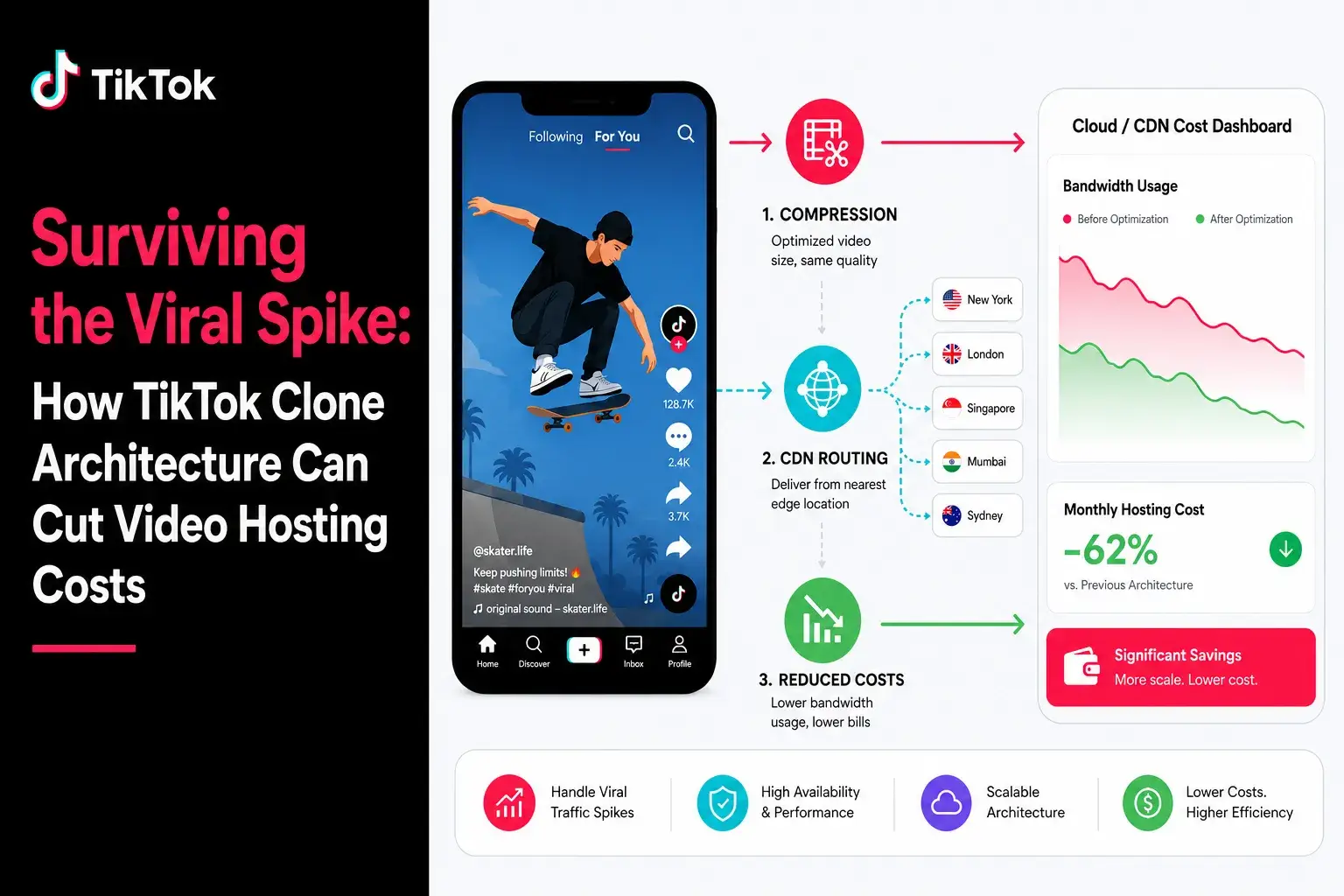
- Compression, CDN routing, and caching directly affect server and bandwidth usage.
- Unoptimized uploads can increase storage, playback, and delivery costs quickly.
- Short-form video platforms need fast playback without overloading the backend.
- A strong architecture helps founders control hosting costs during user growth.
Feature Signals
- Users need smooth video upload, fast feed loading, playback quality, and low buffering.
- Creators need compression, thumbnails, video processing, drafts, and publishing tools.
- Admins need control over storage, bandwidth, moderation, reports, and content delivery.
- CDN routing helps deliver videos from locations closer to the user.
- Analytics help track watch time, video performance, bandwidth usage, and growth patterns.
Real Insights
- Video hosting becomes expensive when every upload is stored and delivered without optimization.
- Weak CDN planning can cause buffering during viral spikes.
- Smart compression protects playback quality while reducing storage pressure.
- Architecture decisions matter more than features when video traffic starts scaling.
- Miracuves builds TikTok Clone apps with optimized video hosting, CDN, and admin workflows.
For most founders, the fear around launching a short video app is simple: “What if nobody uses it?”
For media entrepreneurs and bootstrapped founders, the more dangerous question is often the opposite: what if the app works too well?
A TikTok-style platform does not behave like a normal mobile app. Every swipe triggers video delivery. Every creator upload creates storage, transcoding, thumbnail, moderation, and CDN events. Every viral spike turns into bandwidth demand. If the architecture is generic, the founder does not just pay for users. They pay for every inefficient encoding decision, every cache miss, every oversized video file, and every poorly routed request.
That is why TikTok clone architecture should never be treated as a commodity build. A simple “app like TikTok” script may look fine in a demo, but once real users start uploading and watching videos, infrastructure costs become one of the biggest risks in the business model.
Miracuves helps founders build ready-made and white-label short video platforms with scalable backend workflows, admin control, creator features, and cost-aware video delivery foundations. For short-form video apps, that cost-aware foundation matters because cloud bills can grow faster than revenue if the video pipeline is not designed properly from day one.
The Hidden Bankruptcy Risk Behind Short-Form Video Apps
A short-form video app has a brutal cost equation.
The product may look simple to the user: upload, scroll, like, comment, share. But behind every swipe, the system has to serve video files quickly, from the right region, in the right quality, on the right device, under unpredictable network conditions.
That means a founder is not only paying for app servers. They are paying for:
| Cost Layer | Why It Becomes Expensive |
|---|---|
| Video storage | Every creator upload adds original files, processed files, thumbnails, and metadata. |
| Transcoding | Videos need to be converted into playback-ready formats and resolutions. |
| CDN delivery | Every view consumes bandwidth, and viral videos multiply delivery cost quickly. |
| Origin requests | Poor caching sends repeated requests back to storage, increasing cost and latency. |
| Playback quality | Higher bitrate files improve quality but increase bandwidth if not controlled. |
| Regional routing | Serving users from distant regions can increase latency and delivery inefficiency. |
This is why a viral spike can be financially dangerous. A founder may celebrate a creator’s video crossing 1 million views, only to realize later that the app delivered oversized files to users who never needed that quality.
AWS’ own video-on-demand cost guidance notes that CloudFront and S3 costs vary based on output formats, request volume, viewer count, and the size of outputs being delivered. In practical terms, every extra representation, oversized file, unnecessary request, or poorly cached object can affect monthly spend.
For a bootstrapped founder, this is not a theoretical engineering issue. It is survival math.
Why Generic TikTok Clone Scripts Become Expensive After Launch
Most generic TikTok clone scripts are built to show features quickly. They prove that users can upload videos, scroll a feed, follow creators, like content, and comment.
That is useful for a demo. It is not enough for production.
The problem appears when the script treats video as a normal file-upload feature instead of a high-volume media delivery system. A basic script may upload the original file, store it in one bucket, generate a thumbnail, and serve the same heavy video to every user.
That approach creates three immediate problems.
First, the app delivers more data than necessary. A user watching on a small phone screen over average mobile data does not always need the same high-bitrate file as a user on a strong Wi-Fi connection.
Second, the app depends too heavily on origin storage. If caching is weak, the platform repeatedly pulls video from the origin instead of serving it efficiently from edge locations.
Third, the founder loses control over unit economics. The cost per watch becomes unpredictable because every playback event depends on file size, user region, device type, connection strength, and CDN behavior.
This is where short video app architecture must be designed differently from normal social media architecture. The feed is not the expensive part. The expensive part is the video delivery loop behind the feed.
For founders evaluating a TikTok clone app, the stronger question is not “Does it have TikTok-like features?” It is “Can the architecture keep video delivery costs under control when users start watching at scale?”
Read More: The Backend Architecture Every TikTok Clone Needs to Scale
Dumb Storage vs. Optimized CDN Routing
A common mistake in early short video platforms is what we call dumb storage.
Dumb storage means the platform accepts uploaded videos, saves them, and serves them without enough intelligence around compression, region, bitrate, cache behavior, and playback context.
It usually looks like this:
| Dumb Storage Pattern | Business Risk |
|---|---|
| Store original files without aggressive optimization | Higher storage and delivery cost |
| Serve one large version to all devices | Wasted bandwidth on mobile playback |
| Use one CDN path for all regions | Higher latency and inefficient routing |
| Weak cache headers | More origin hits and unnecessary storage reads |
| No lifecycle rules | Old or low-value videos continue consuming storage |
| No popularity-based routing | Viral content and rarely watched content are treated the same |
Optimized CDN routing takes the opposite approach.
Instead of treating every video request equally, the architecture considers the user’s location, device, connection quality, playback behavior, and content popularity. Frequently watched videos can be pushed closer to users. Less popular videos can remain in lower-cost storage until demand increases. Short preview segments can be cached aggressively. Heavy files can be compressed into efficient representations before they ever become part of the feed.
Modern streaming architecture often relies on adaptive bitrate logic, where a video is encoded into multiple quality levels and the player selects the most suitable stream based on network and device conditions. Adaptive bitrate streaming is designed to reduce buffering and improve playback by switching between encoded versions as conditions change.
For short video apps, adaptive delivery matters because most consumption happens through rapid scrolling. Users may watch only a few seconds before skipping. Serving a heavy file immediately for every feed impression is one of the fastest ways to waste bandwidth.
How Video Compression Changes the Unit Economics of a TikTok-Style App
Compression is not just a technical process. It is a margin strategy.
A short video platform can reduce delivery cost when it avoids sending unnecessary video weight across the network. That does not mean destroying quality. It means choosing the right output for the right playback situation.
A practical video compression pipeline usually includes:
| Pipeline Step | What It Does | Founder Impact |
|---|---|---|
| Upload normalization | Converts unpredictable creator uploads into standard formats | Reduces playback failures and inconsistent file sizes |
| Transcoding | Creates playback-ready video versions | Improves compatibility across devices |
| Bitrate ladder generation | Produces multiple quality levels | Avoids serving oversized files to every user |
| Thumbnail and preview generation | Creates lightweight feed assets | Reduces unnecessary full-video loads |
| Device-aware playback | Serves suitable quality based on screen and connection | Controls bandwidth without hurting experience |
| Compression quality checks | Prevents over-compression and visual damage | Protects user experience and creator trust |
The goal is simple: reduce the average delivered bitrate without making the product feel broken.
Research on adaptive video streaming shows that encoding and bitrate decisions influence storage, transmission, and playback efficiency. Recent work on bitrate ladder prediction also highlights that one-size-fits-all bitrate ladders can be less efficient than content-aware approaches, especially when different videos have different complexity levels.
For founders, the business lesson is clear: two videos with the same length can have very different cost profiles. A fast-moving dance video, a static talking-head clip, and a screen-recorded tutorial do not always need the same encoding treatment.
A cost-aware TikTok clone architecture should not process every file blindly.
The Architecture Miracuves Uses to Control Video Delivery Costs
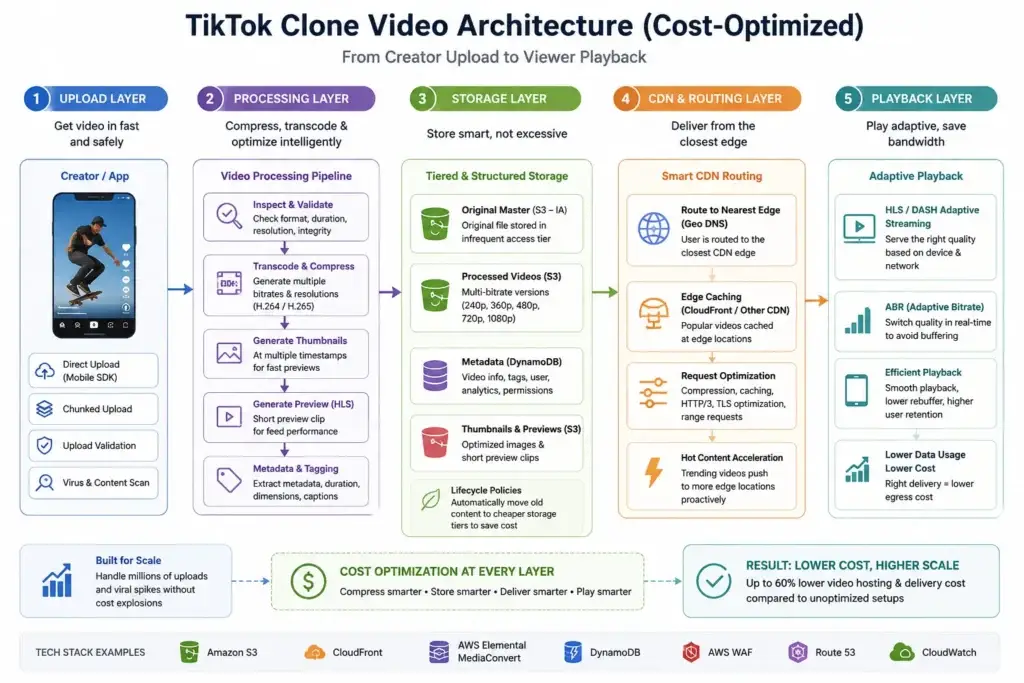
A scalable short video platform needs more than a mobile app and an admin panel. It needs a backend pipeline that controls the full media lifecycle.
For a white-label short video app , Miracuves typically thinks about the platform in five layers:
1. Upload Layer
The upload layer handles creator-submitted videos. It should validate file type, size, duration, resolution, and upload reliability. For creator platforms, this layer also connects to content moderation, abuse reporting, and admin review workflows where relevant.
A weak upload layer creates messy storage. A strong upload layer keeps the pipeline predictable.
2. Processing Layer
The processing layer converts raw uploads into playback-ready assets. This may include compression, transcoding, thumbnail generation, preview generation, metadata extraction, and queue-based background processing.
For short video platforms, background processing matters because upload activity can spike suddenly after creator campaigns or influencer onboarding. Miracuves’ related guide on background processing for creator platforms explains why media-heavy apps need asynchronous workflows instead of forcing everything through the main app server.
3. Storage Layer
The storage layer should separate originals, optimized files, thumbnails, and temporary processing assets. It should also support lifecycle rules so old, failed, duplicate, or low-demand files do not sit in expensive storage forever.
This is where many generic scripts quietly become expensive. They store everything the same way.
4. CDN and Routing Layer
The CDN layer decides how videos reach users. A strong setup uses caching, edge delivery, region-aware routing, signed URLs where needed, and cache-control policies that reduce unnecessary origin hits.
A recent AWS cloud financial management example described a video-hosting platform that reduced S3 costs by 70% by analyzing file lifecycle behavior and fine-tuning its just-in-time video hosting architecture. While every platform’s result depends on its usage pattern, the example reinforces the broader point: video cost optimization depends heavily on lifecycle visibility and architecture tuning.
5. Playback Layer
The playback layer decides what the user actually receives. It should support adaptive quality, quick start, fallback logic, retry handling, and analytics around watch time, buffering, and drop-off.
For founders, playback analytics are not just product metrics. They are cost-control signals. If users skip after two seconds, the app should not consistently deliver heavy files upfront.
Read More: How to Launch a TikTok Clone Startup With the Right Product Strategy
How We Engineered a 60% Hosting Cost Reduction in an Anonymized Project
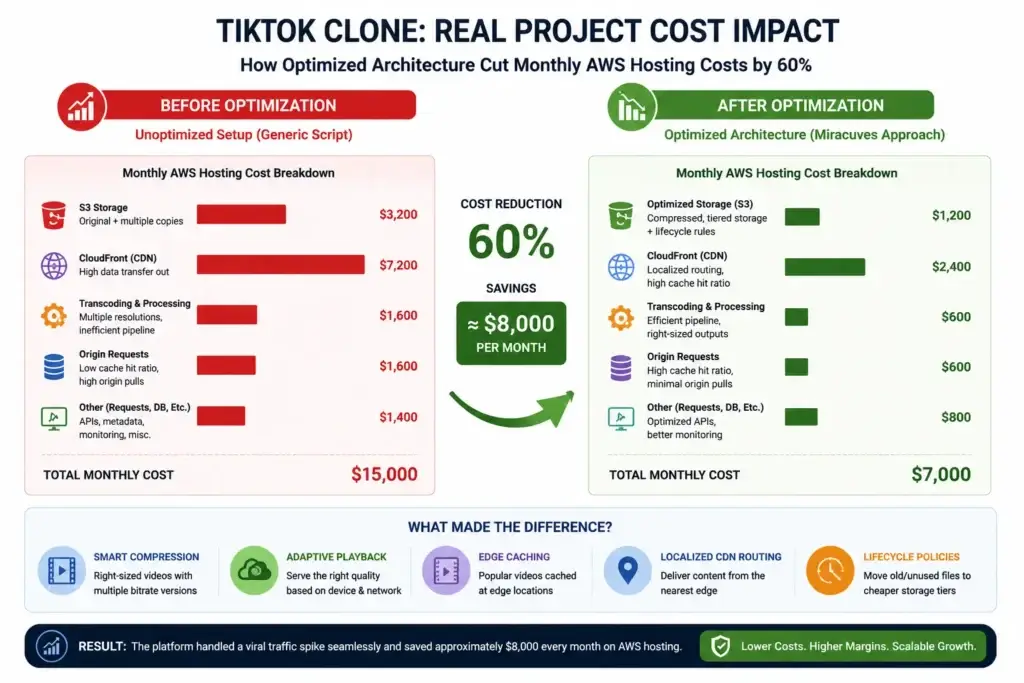
In an anonymized Miracuves project scenario provided for this blog brief, a TikTok-style platform experienced a viral traffic spike that exposed a serious hosting-cost problem.
The app was not failing because users disliked it. It was failing because success made the infrastructure expensive.
The original setup behaved like a generic video script:
| Original Setup | Cost Problem |
|---|---|
| Large video files were being delivered too often | Higher bandwidth cost per view |
| Limited compression logic | Oversized videos reached mobile users |
| Weak region-aware CDN routing | Users were not always served from efficient edge paths |
| Poor distinction between viral and low-demand content | Storage and delivery resources were not prioritized |
| Feed playback loaded more than users actually watched | Bandwidth was wasted during rapid scrolling |
Miracuves approached the problem as a margin engineering exercise, not just a cloud configuration task.
The optimized architecture focused on three changes.
1. Compression Before Distribution
Videos were processed into more efficient playback versions before entering the main feed. Instead of serving large originals, the platform delivered optimized files based on playback context.
This reduced the average data transferred per view.
2. Localized CDN Routing
The delivery path was adjusted so users were served through more efficient regional routes. The goal was to reduce unnecessary origin pulls, improve cache behavior, and keep popular content closer to demand.
This mattered most during the viral spike because a small number of popular videos were responsible for a large share of delivery volume.
3. Feed-Aware Playback Behavior
The playback flow was adjusted for short-form behavior. Since users often scroll quickly, the system reduced waste by avoiding heavy delivery too early in the session.
The result: according to the anonymized project data supplied for this brief, the optimized compression and CDN routing pipeline cut video hosting costs by 60%, saving approximately $8,000/month in AWS hosting bills compared with the unoptimized setup.
That kind of reduction can change the business model. For a bootstrapped founder, $8,000/month is not just an infrastructure line item. It can fund creator acquisition, moderation, support, paid campaigns, or product iteration.
Read More: White-Label TikTok Clone vs Custom Development : Which Saves More Time and Cost?
Founder Decision Signals: When Your Short Video App Needs Cost Optimization
Not every early app needs enterprise-grade media infrastructure on day one. But short video founders should watch for signals that the basic setup is becoming dangerous.
Founder Decision Signals
Speed
If feed loading slows during campaigns or creator pushes, the issue may be video delivery architecture rather than the mobile app itself.
Cost
If hosting bills rise faster than user growth, video size, CDN routing, cache behavior, and origin requests should be reviewed immediately.
Scalability
If one viral video creates unpredictable backend pressure, the platform needs better separation between upload, processing, storage, and delivery layers.
Market Fit
If users are engaging but margins are shrinking, the product may have demand but poor infrastructure economics.
Dumb Storage vs. Optimized CDN Routing: A Founder-Friendly Comparison
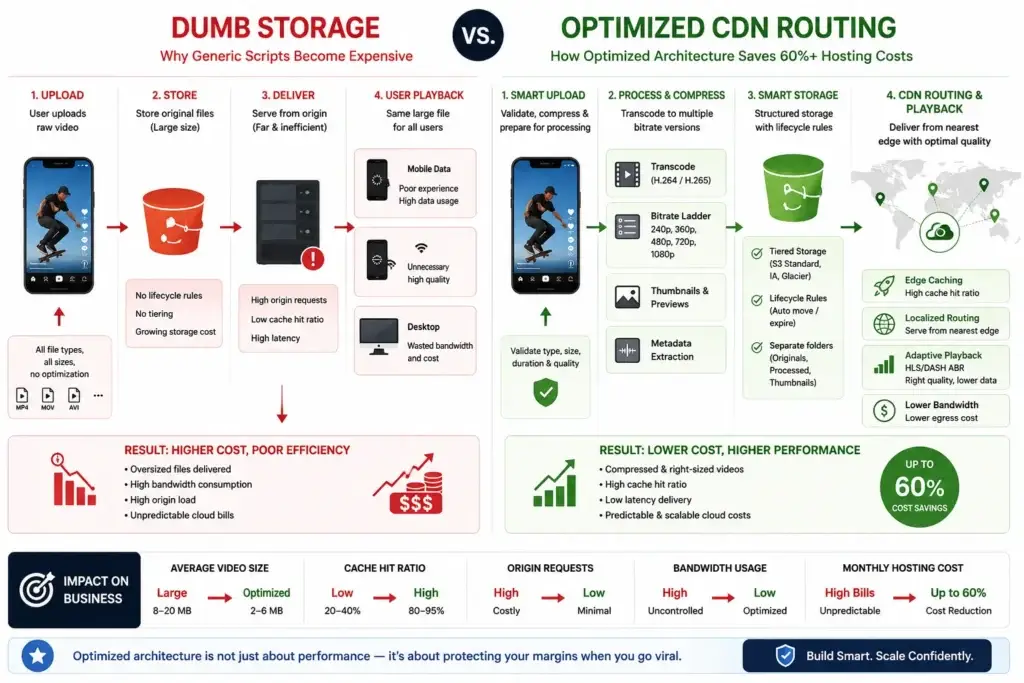
| Decision Area | Generic Script Approach | Optimized TikTok Clone Architecture |
|---|---|---|
| Upload handling | Accept and store files directly | Validate, queue, process, compress, and standardize |
| Video quality | Same or limited versions for most users | Adaptive versions based on device and network |
| CDN delivery | Basic CDN setup | Region-aware routing and cache optimization |
| Viral videos | Treated like all other videos | Prioritized caching and delivery strategy |
| Storage | Originals and processed assets may be mixed | Separated storage classes and lifecycle rules |
| Cost visibility | Monthly bill reviewed after the damage | Cost signals monitored through architecture and analytics |
| Founder outcome | Lower launch effort, higher scaling risk | Better cost control during growth |
A generic script can help a founder get to demo faster. But a production-ready video streaming infrastructure for short video apps needs to account for traffic spikes, caching, compression, processing queues, and cloud delivery cost.
That is especially important for media founders who plan to rely on creator-led growth. The more successful the content becomes, the more pressure the infrastructure faces.
Mistakes That Make Viral Video Apps Expensive
Mistake 1: Serving Original Uploads Too Often
Original files are often larger than what most users need. Serving them directly increases bandwidth and slows playback. A short video app should process files into optimized versions before broad distribution.
Mistake 2: Treating Every Video as Equally Important
A viral clip and a rarely watched upload should not have the same delivery strategy. Popular content deserves stronger cache logic. Low-demand content can be stored and delivered more conservatively.
Mistake 3: Ignoring Regional User Patterns
If most users are in one region but files are delivered inefficiently from another, the app can suffer from higher latency and avoidable delivery cost. Localized CDN routing helps align cost and performance.
Mistake 4: Loading Too Much Video Too Early
Short video feeds are scroll-heavy. Many users skip quickly. If the app aggressively loads large files before intent is clear, it wastes bandwidth.
Mistake 5: Looking Only at Development Cost
Founders often compare TikTok clone development cost but ignore monthly cloud burn. That is risky. For short video apps, the long-term cost is not only the build. It is the cost per upload, cost per view, and cost per viral spike.
Security and Control Still Matter in Video Architecture
Cost optimization should not weaken platform control.
A short video app still needs role-based admin access, content moderation, abuse reporting, creator verification where relevant, activity logs, secure API integration, and permission-based dashboards. For creator and UGC platforms, safety workflows affect retention, advertiser trust, creator trust, and long-term scalability. Miracuves’ internal security language rules position safety as a foundation rather than a marketing add-on, especially for user-generated content products.
That means CDN optimization, compression, and storage decisions should work alongside moderation and admin control. For example, flagged videos may need restricted delivery, review queues, or removal workflows. Deleted or rejected videos should not continue consuming expensive storage.
Where Miracuves Fits Into Short Video App Development
Miracuves’ short video app development approach is built around a practical founder question: how can you launch faster without inheriting fragile infrastructure?
A ready-made solution can help founders move faster, but short video apps still need thoughtful customization around:
- Creator onboarding
- Video upload and processing
- Compression strategy
- CDN delivery
- Feed performance
- Admin dashboard controls
- Monetization workflows
- Moderation and abuse reporting
- Analytics and cost visibility
- Source-code ownership
For founders planning to launch a TikTok-style platform, Miracuves offers a TikTok clone solution that can be customized for brand, market, creator model, monetization, and backend workflow requirements.
A stronger short video platform is not the one with the longest feature list. It is the one that can keep user experience strong while protecting founder margins.
Final Thoughts: Viral Growth Should Not Bankrupt the Backend
The real challenge in short video app development is not building a feed. It is building a feed that can survive success.
A viral spike should create opportunity, not panic. But that only happens when the architecture is designed around video compression, CDN routing, adaptive playback, caching, storage discipline, and backend cost visibility.
For media entrepreneurs and bootstrapped founders, the smartest TikTok clone architecture is not the one that copies the most visible features. It is the one that protects margins when users start watching, uploading, sharing, and scaling faster than expected.
Miracuves helps founders move from idea to launch faster with ready-made, white-label short video app foundations built for branding, admin control, monetization, and source-code ownership.
FAQs
Why are TikTok clone hosting costs so high?
TikTok clone hosting costs are high because short video apps deliver large media files repeatedly. Every upload creates storage and processing cost, while every view creates bandwidth and CDN delivery cost. If videos are not compressed, cached, and routed efficiently, cloud bills can grow quickly during viral traffic spikes.
How can I reduce server costs for a short video app?
You can reduce short video app server costs by compressing uploads, using adaptive bitrate streaming, optimizing CDN routing, improving cache behavior, separating storage layers, applying lifecycle rules, and monitoring cost per view. The goal is to avoid delivering oversized video files when lighter versions will work.
Is CDN necessary for a TikTok-style app?
Yes. A CDN is important for TikTok-style apps because users expect fast playback with minimal buffering. CDN delivery helps serve videos from locations closer to users, reduces origin load, and improves scalability. However, the CDN must be configured carefully or it can still become expensive.
What is the biggest infrastructure mistake in TikTok clone development?
The biggest mistake is treating video as a normal file upload. Short video apps need a media pipeline with compression, transcoding, thumbnails, adaptive playback, CDN routing, and storage lifecycle rules. Without that, hosting costs can rise faster than user growth.
Can a white-label TikTok clone be scalable?
Yes, a white-label TikTok clone can be scalable if the backend is built with proper media processing, CDN delivery, admin controls, creator workflows, and source-code ownership. Founders should check whether the solution is only demo-ready or genuinely designed for production traffic.
How does video compression help short video app margins?
Video compression reduces the amount of data delivered per view. Since short video apps may serve thousands or millions of views, even small reductions in average file size can create meaningful monthly savings. Compression should balance cost savings with visual quality.
What should founders ask before buying a TikTok clone script?
Founders should ask how the script handles video uploads, compression, transcoding, CDN routing, cache rules, adaptive playback, moderation, admin controls, source-code ownership, and scaling. A low-cost script can become expensive if it creates high monthly infrastructure bills.
Does Miracuves offer a TikTok clone solution?
Yes. Miracuves offers a TikTok clone solution that can be customized for short video platforms, creator workflows, admin control, branding, monetization, and scalable backend requirements.