


Key Takeaways
- Owned infrastructure gives delivery startups more control.
- Source code ownership reduces platform dependency risks.
- White-label systems help launch faster with customization.
- Operational flexibility improves long-term scalability.
- Infrastructure ownership supports sustainable business growth.
Infrastructure Signals
- Control customer, restaurant, and driver workflows.
- Manage commissions, pricing, and service zones directly.
- Customize features without waiting for third-party vendors.
- Scale backend systems based on business demand.
- Maintain full visibility over operational data.
Real Insights
- Platform dependency can limit long-term growth options.
- Owned systems provide greater business flexibility.
- Faster deployment helps startups reach market sooner.
- Scalable architecture is critical during traffic spikes.
- Miracuves helps founders launch owned food delivery infrastructure with full source code control.
For a food delivery business, the real infrastructure test does not happen on a quiet Tuesday afternoon.
It happens on Friday night.
Customers are ordering dinner at the same time. Restaurants are accepting and rejecting orders. Delivery partners are receiving assignments. Payment gateways are sending callbacks. Admin teams are watching live dashboards. Push notifications are firing every few seconds. One delayed checkout can become a refund. One failed payment callback can become a support ticket. One platform outage can damage trust across customers, restaurants, and delivery partners.
That is why scaling restaurants and delivery startups eventually face a hard question:
Is a monthly SaaS delivery platform enough, or is it time to move to owned food delivery app infrastructure?
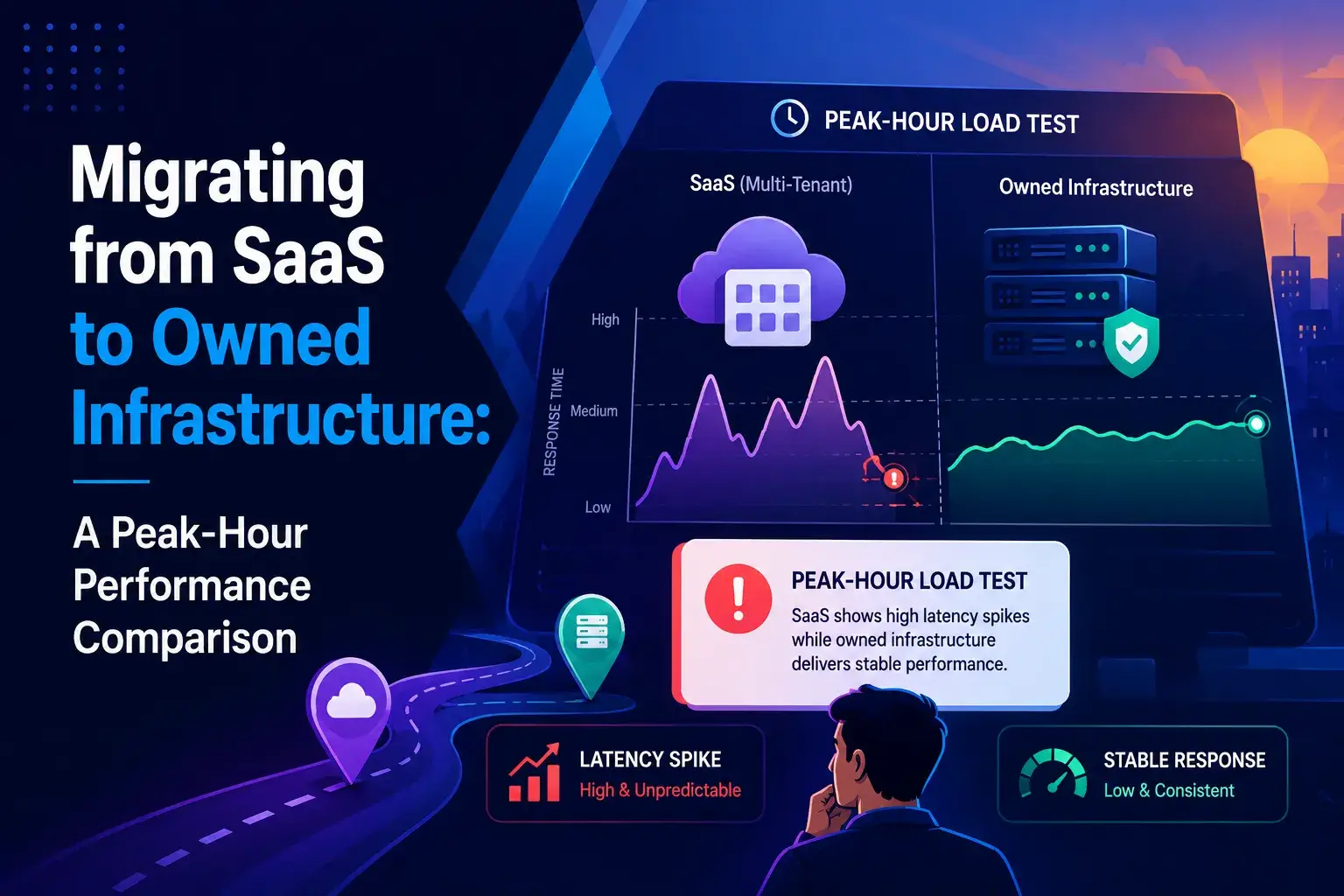
This blog compares shared SaaS platforms with dedicated white-label infrastructure using a peak-hour server load lens. Instead of comparing surface-level features, we will look at what happens when a food delivery platform moves from a shared-server environment that struggles under 2,000 concurrent Friday-night orders to a dedicated Miracuves Laravel engine designed to process 10,000 simultaneous checkout events.
For scaling delivery startups and multi-chain restaurant owners building UberEats Clone or DoorDash Clone delivery marketplaces apps, this is not only a technical decision. It is a revenue protection decision.
Why Peak-Hour Load Is the Real Test of a Food Delivery Platform
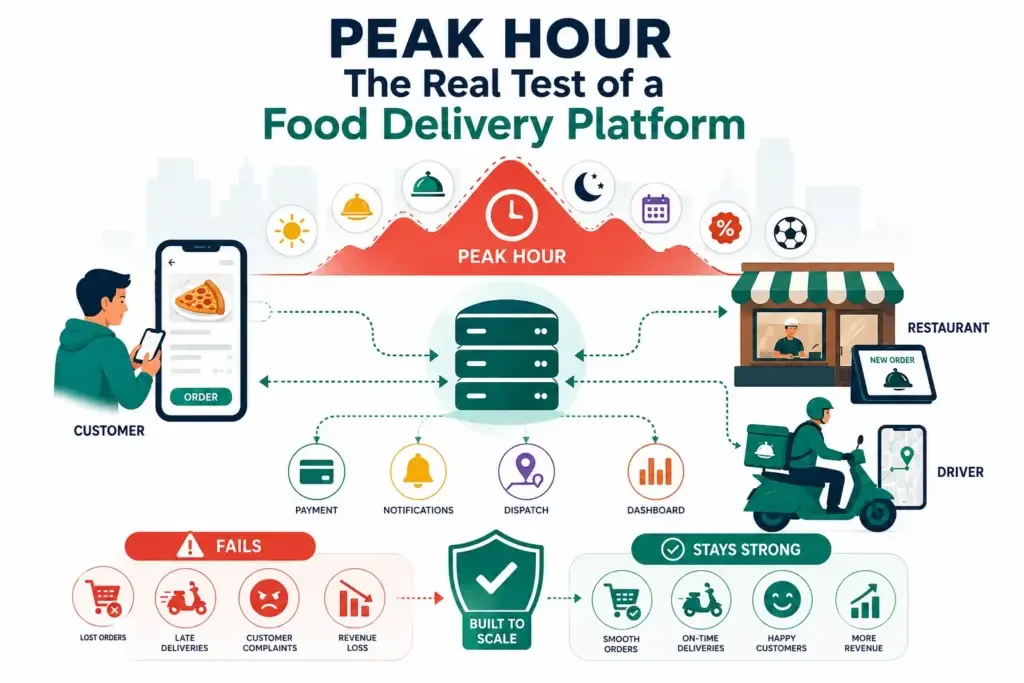
Image Source: AI-generated visual by Miracuves
Most food delivery app comparisons focus on features.
They compare whether the app has restaurant listings, customer profiles, live tracking, discount coupons, driver apps, payment options, and admin dashboards. These features matter, but they do not answer the most important question for a scaling operator:
Can the platform stay stable when thousands of customers try to order at the same time?
Food delivery demand is not evenly distributed. It spikes around lunch, dinner, weekends, festivals, holidays, match days, office breaks, and promotional campaigns. For multi-chain restaurant owners, the pressure is even sharper because one brand campaign can push sudden traffic across multiple branches.
During these windows, the platform must process several workflows at once:
| Peak-Hour Workflow | Backend Pressure Created | Business Risk If It Fails |
|---|---|---|
| Customer checkout | Cart validation, tax, delivery fee, payment initiation | Abandoned orders and lost revenue |
| Restaurant order acceptance | Real-time status updates and kitchen notifications | Delayed preparation and customer complaints |
| Delivery assignment | Driver matching, route logic, ETA updates | Late deliveries and refund requests |
| Payment callbacks | Gateway response handling and order confirmation | Duplicate orders or failed paid orders |
| Push notifications | Customer, restaurant, and driver alerts | Confusion across all users |
| Admin dashboard | Live reporting and operational visibility | No control during demand spikes |
This is why infrastructure ownership matters. The issue is rarely whether a SaaS platform has a coupon module. The deeper issue is whether the platform gives you enough server control, database visibility, queue scaling, and deployment flexibility when demand becomes unpredictable.
Read more: The Evolution of Food Delivery App: What It Takes to Compete With Swiggy and UberEats
The Shared Server Trap: Why SaaS Platforms Crash on Friday Nights
A SaaS food delivery platform usually works on a shared infrastructure model. Multiple businesses use the same application foundation, the same hosting environment, or the same managed backend layer. Each business may have separate branding and configuration, but the underlying resource pool is often shared.
This model has benefits in the beginning. It reduces setup complexity, lowers early operational responsibility, and helps small restaurants go live quickly. For a single outlet or low-volume brand, SaaS can be a practical first step.
The problem starts when your order volume grows faster than the SaaS environment was designed to handle.
During peak-hour traffic, shared SaaS platforms can face four common pressure points.
1. Noisy Neighbor Resource Contention
In shared infrastructure, your food delivery business is not the only platform using server resources. Another restaurant network, grocery platform, or delivery brand may run a campaign at the same time. If their traffic spikes, your performance can slow down even when your own system is not misconfigured.
This is the noisy neighbor problem.
You may see slower checkout pages, delayed order confirmations, dashboard lag, or timeout errors because compute, database, memory, or queue resources are under pressure across the shared environment.
2. Limited Backend Control
SaaS platforms usually restrict backend-level access. You may not be able to tune database indexes, configure queue workers, customize caching rules, separate read/write workloads, or adjust server capacity exactly when your business needs it.
For a growing delivery startup, this creates a dangerous dependency. You are responsible for the customer experience, but you do not fully control the infrastructure that powers it.
3. Generic Scaling Rules
SaaS platforms must serve many businesses with generalized infrastructure policies. That means their scaling logic is built for average usage patterns, not your exact Friday-night traffic behavior.
A multi-chain restaurant with 80 outlets, high coupon redemption, live tracking, and payment-heavy checkout flows has very different infrastructure needs from a small café using online ordering for 30 daily orders.
4. Queue Bottlenecks During Order Surges
Food delivery apps depend heavily on background jobs: notifications, invoice generation, delivery assignment, payment status checks, restaurant alerts, and reporting updates. If queue processing slows down, the app may still appear online, but the operational experience breaks.
Customers do not care whether the database is overloaded or the queue worker is behind. They only see a stuck checkout or a late order confirmation.
Laravel’s official queue system supports multiple queue backends, including Redis, Amazon SQS, and databases, which is useful when a delivery platform needs to separate slow background work from real-time checkout flows.
Architectural Comparison: Shared SaaS Platforms vs. Dedicated Laravel Engines
The difference between SaaS and owned infrastructure becomes clearer when you compare what the operator can control.
Shared SaaS vs. Dedicated Laravel Infrastructure
| Infrastructure Layer | Shared SaaS Platform | Dedicated Laravel White-Label Engine | Founder Impact |
|---|---|---|---|
| Server resources | Shared with other businesses | Dedicated or isolated server environment | More predictable performance during campaigns and dinner rushes |
| Source code | Usually not owned | Source-code-owned foundation | Greater flexibility for customization, migration, and long-term control |
| Database optimization | Limited visibility and tuning access | Indexes, query optimization, backups, and scaling can be configured | Better control over checkout speed and order history performance |
| Queue workers | Managed by SaaS provider | Can be configured by workload type | Order, notification, payment, and dispatch jobs can be separated |
| Customization | Bound by platform roadmap | Custom workflows can be added | Multi-chain rules, branch-level pricing, loyalty, and dispatch logic can evolve |
| Scaling model | Generic scaling across many customers | Scaling strategy based on your traffic and order behavior | Better fit for high-volume delivery operators |
| Operational visibility | Limited logs and diagnostics | Server logs, app logs, monitoring, and alerts can be owned | Faster root-cause analysis when issues happen |
A shared SaaS food delivery app is often a rented operating layer. A dedicated Laravel engine is closer to a controlled product foundation.
That distinction matters when your delivery business moves from early validation to serious operational scale.
Read more: AI in Food Delivery Apps: Features, Benefits & Future
The Peak-Hour Migration Benchmark: From 2,000 Concurrent Orders to 10,000 Simultaneous Checkouts
In the migration scenario supplied for this brief, the old shared-server SaaS platform crashed under approximately 2,000 concurrent Friday-night orders. After migration to a dedicated Miracuves Laravel engine, the new infrastructure processed approximately 10,000 simultaneous checkout events during stress testing.
The important takeaway is not only the numeric jump. The deeper lesson is what changed architecturally.
The SaaS setup had the usual constraints:
- Shared compute resources
- Limited backend tuning access
- Generic checkout flow
- Restricted database optimization
- Limited queue visibility
- Dependence on SaaS provider response time
- Minimal control over server-level diagnostics
The dedicated Miracuves setup changed the operating model:
- Isolated backend resources
- Laravel-based application control
- Dedicated database tuning
- Queue-based background processing
- Configurable cache layer
- Admin-focused order visibility
- Source-code ownership
- Deployment flexibility
For delivery businesses, this kind of migration is not about leaving SaaS because SaaS is always bad. It is about recognizing when the business has outgrown a shared operating model.
A SaaS platform can help you start. Owned infrastructure helps you control what happens when the business becomes serious.
What Actually Breaks During a Dinner Rush?
When a food delivery app crashes during peak demand, founders often blame “server load.” That is directionally correct, but too broad.
Several backend systems can break at once.
Checkout Validation Slows Down
Every checkout request may need to validate the cart, restaurant status, delivery address, serviceability, coupon code, delivery fee, tax, wallet balance, and payment method.
If these checks are not optimized, checkout becomes the first bottleneck. Customers click “Place Order,” wait too long, refresh the app, or abandon the cart.
Payment Callbacks Get Delayed
Payment gateways often send confirmation callbacks after a transaction attempt. If the backend is overloaded, those callbacks may be delayed or mishandled.
This can create dangerous states:
- Customer paid, but order not confirmed
- Order confirmed twice
- Payment pending, but restaurant receives the order
- Refund workflow triggered unnecessarily
- Support team receives duplicate complaints
For a restaurant chain, failed payment-state handling can damage trust quickly.
Restaurant Panels Lag
During peak-hour pressure, restaurant staff need fast order visibility. If the restaurant panel lags, the kitchen may miss incoming orders or accept them too late.
This creates a chain reaction: delayed food preparation, late driver assignment, poor customer experience, refund requests, and lower repeat orders.
Delivery Assignment Queues Back Up
Driver assignment is not just a map feature. It depends on distance, availability, branch location, order preparation time, delivery capacity, and sometimes batching rules.
If assignment jobs sit behind other background tasks, delivery operations slow down even when customers successfully place orders.
Notifications Become Unreliable
Food delivery platforms rely on constant updates:
- Order placed
- Restaurant accepted
- Food being prepared
- Driver assigned
- Driver arrived
- Order picked up
- Order delivered
If notification jobs are delayed, users start opening support chats because they do not know what is happening.
Admin Dashboards Lose Real-Time Value
A dashboard that freezes during a dinner rush is not a dashboard. It is a historical report.
Operators need live order status, branch pressure, driver availability, failed payments, and delayed orders. Without backend stability, the admin team loses control exactly when control matters most.
Why a Dedicated Laravel Engine Gives Scaling Restaurants More Control
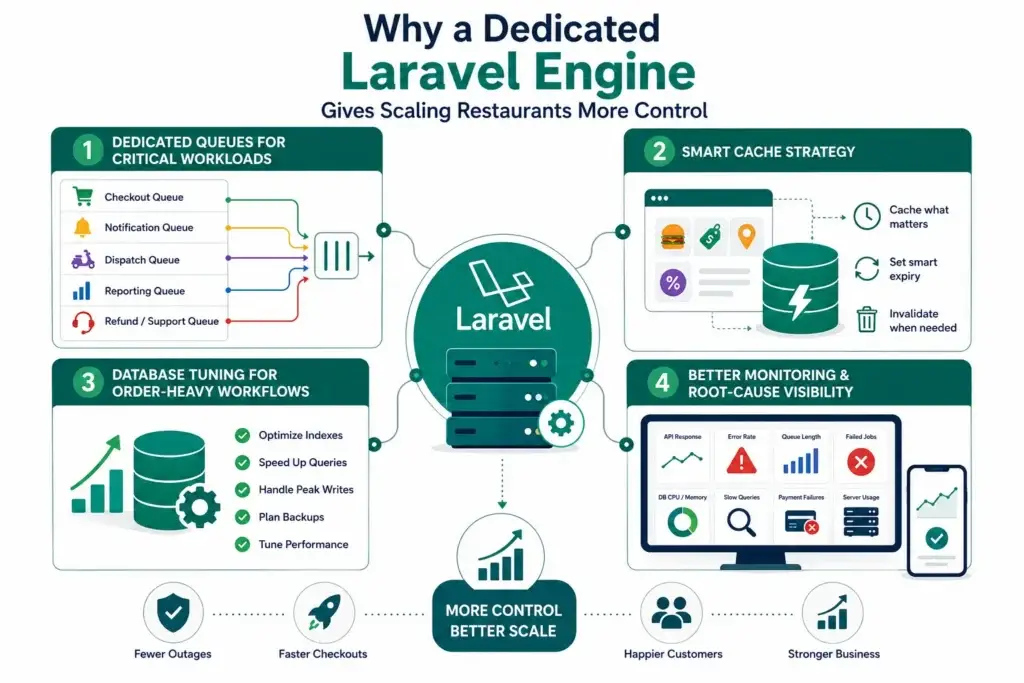
Image Source: AI-generated visual by Miracuves
Laravel is widely used for business applications because it provides a structured backend foundation, routing, authentication, queues, database ORM, caching, and ecosystem support. Laravel’s queue architecture allows slow or background jobs to be moved away from the real-time request path, which is critical for order-heavy systems.
For high-performance Laravel applications, Laravel Octane can keep the application booted in memory and serve requests through high-powered application servers such as FrankenPHP, Open Swoole, Swoole, and RoadRunner. That does not automatically solve every scaling problem, but it shows how Laravel-based systems can be tuned for stronger request-handling performance when the architecture is planned correctly.
For a food delivery platform, the practical value is control.
Dedicated Queues for Critical Workloads
A dedicated Laravel backend can separate jobs by business priority.
For example:
| Queue Type | Example Jobs | Why It Matters |
|---|---|---|
| Checkout queue | Payment confirmation, order creation | Protects revenue-critical flows |
| Notification queue | Push alerts, SMS, email | Prevents communication delays |
| Dispatch queue | Driver matching, ETA updates | Keeps delivery operations moving |
| Reporting queue | Sales reports, branch analytics | Prevents dashboards from slowing checkout |
| Refund/support queue | Failed payment checks, dispute triggers | Helps operations respond faster |
In a shared SaaS environment, these decisions may not be under your control. In an owned backend, they can be designed around your operating model.
Cache Strategy Based on Real Ordering Behavior
Not every request needs to hit the database.
A delivery platform can cache menus, categories, branch availability, restaurant metadata, service zones, promotional banners, and frequently used configuration data. This reduces database pressure during peak traffic.
The key is deciding what should be cached, how long it should stay cached, and when it must be invalidated. A restaurant menu update should reflect quickly. A static category list can remain cached longer. A checkout price calculation should be handled more carefully.
Owned infrastructure gives the operator more flexibility to design these rules.
Database Tuning for Order-Heavy Workflows
Food delivery apps are write-heavy during peak hours. Orders, payment statuses, restaurant actions, driver status updates, and tracking events all create database activity.
A dedicated backend allows technical teams to optimize indexes, separate heavy reporting queries, review slow query logs, plan backups, and tune database configuration.
This is one of the biggest hidden benefits of owning infrastructure. You can optimize for the way your business actually behaves instead of accepting a generic shared configuration.
Better Monitoring and Root-Cause Visibility
When a SaaS app slows down, the operator often sees only the symptom.
With owned infrastructure, teams can monitor:
- API response times
- Error rates
- Queue length
- Failed jobs
- Database CPU and memory
- Slow queries
- Payment callback failures
- Server resource usage
- Checkout conversion drops
- Branch-level order pressure
This makes scaling more predictable because you can diagnose where pressure builds before it becomes a full outage.
Read more: Types of Food Delivery App and the Secret to Their Success
The 10k Order Stress Test: Achieving Zero Downtime
A serious migration from SaaS to owned infrastructure should not rely on hope. It should be validated through stress testing.
In the benchmark supplied for this brief, the dedicated Miracuves Laravel engine processed 10,000 simultaneous checkout events during stress testing. To make that result meaningful, a delivery startup should evaluate more than raw request volume.
A proper stress test should measure:
| Test Metric | Why It Matters |
|---|---|
| Checkout success rate | Shows whether revenue-critical flows are stable |
| Average response time | Shows whether customers can place orders without frustration |
| Payment callback accuracy | Prevents paid-but-unconfirmed order issues |
| Queue processing delay | Shows whether background jobs are keeping up |
| Database write performance | Reveals order creation and status update bottlenecks |
| Failed job count | Shows operational weak points |
| Notification delay | Measures customer and restaurant communication reliability |
| Admin dashboard responsiveness | Confirms operator visibility during peak traffic |
| Recovery behavior | Shows whether the system stabilizes after a spike |
Zero downtime is not achieved by one large server. It comes from architecture discipline.
A stronger delivery infrastructure usually includes:
- Load-balanced application servers
- Optimized Laravel application layer
- Redis or equivalent caching where appropriate
- Queue workers separated by workload type
- Database indexing and slow query monitoring
- Payment callback retry logic
- Cloud storage for media assets
- CDN for static assets where needed
- Error monitoring and alerting
- Backup and rollback planning
- Admin-level operational visibility
For founders, the business value is simple: the platform should not become weakest when order demand is strongest.
Founder Decision Signals: When Should You Migrate from SaaS to Owned Infrastructure?
Not every restaurant brand needs dedicated infrastructure from day one. But certain signals suggest your SaaS platform is becoming a growth risk.
Founder Decision Signals
Speed
If checkout slows down during dinner rushes, promotions, or weekends, your backend may be blocking revenue at the exact moment demand is highest.
Cost
If monthly SaaS fees, transaction limits, add-ons, and dependency costs keep rising, owned infrastructure may become more cost-efficient over the long term.
Scalability
If your platform cannot handle branch expansion, city expansion, or order spikes without provider intervention, your infrastructure is limiting growth.
Market Fit
If customers already trust your brand and order volume is increasing, infrastructure ownership helps protect retention, delivery reliability, and operating control.
You should seriously evaluate migration if you are seeing any of these signs:
- Your SaaS platform slows down during Friday or weekend demand.
- You cannot access meaningful backend logs.
- Checkout failures are increasing during campaigns.
- Your restaurant panel lags during peak hours.
- Your provider cannot customize dispatch or payment workflows.
- Your monthly subscription cost is rising without stronger control.
- You want source-code ownership.
- You are expanding to multiple cities or many branches.
- You need custom loyalty, wallet, offers, or branch-level workflows.
- You want your own deployment, server, database, and scaling roadmap.
The migration decision should not be emotional. It should be based on operational evidence.
If the platform is stable, low-volume, and commercially acceptable, SaaS may still be fine. But if growth is exposing backend limits, staying on shared infrastructure can become more expensive than migration.
Mistakes Founders Should Avoid During SaaS-to-Owned Migration
Mistakes Founders Should Avoid
Migrating Only the Frontend
A new customer app design will not solve backend bottlenecks. The migration must include checkout logic, order management, queue design, database planning, restaurant workflows, driver assignment, and admin control.
Ignoring Payment State Handling
Payment callbacks, failed transactions, retries, refunds, and duplicate order protection must be tested carefully. Food delivery platforms cannot afford unclear payment states during high-volume checkout periods.
Running Load Tests Without Real Order Logic
A homepage traffic test is not enough. Stress testing should simulate cart validation, checkout, payment response, restaurant acceptance, driver assignment, notifications, and admin dashboard load.
Not Planning Data Migration Properly
Customer accounts, restaurant menus, branch data, order history, wallet balances, coupon rules, and delivery zones need careful mapping before migration. Poor data migration can create operational confusion after launch.
How Miracuves Helps Delivery Startups Build Owned, White-Label Infrastructure
Miracuves helps delivery startups and multi-chain restaurant operators move beyond generic SaaS dependency with food delivery app development services built around white-label flexibility, source-code ownership, stronger backend control, branded customer experiences, and scalable order operations.
For scaling food delivery businesses, the goal is not simply to build an app like Swiggy or Zomato. The stronger decision is to own a delivery ecosystem that supports your exact operating model, including checkout flows, restaurant panels, delivery partner workflows, payment gateways, admin dashboards, and peak-hour infrastructure planning.
This approach is especially useful when a business needs:
- Infrastructure ownership instead of SaaS dependency: dedicated deployment control, source-code access, scalable backend planning, and freedom to customize core workflows as the business grows.
- A launch-ready delivery foundation: customer, restaurant, delivery partner, and admin modules already structured for branding, order management, payment integration, and faster market deployment.
Miracuves’ ready-made approach can reduce development time because the foundation already includes essential delivery app flows and admin control. Final pricing depends on selected features, integrations, branding, and customization scope.
Final Thoughts: Own the Infrastructure Before Peak Demand Exposes the Weakness
A food delivery app does not fail because it lacks another feature.
It fails when customers cannot place orders, restaurants cannot see incoming demand, drivers cannot receive assignments, payments do not reconcile, and operators cannot see what is happening during peak-hour pressure.
Shared SaaS platforms can be useful for early-stage restaurants and small delivery brands. But as order volume grows, the same convenience can become a constraint. Limited backend access, shared server resources, generic scaling rules, and restricted customization can put revenue at risk during the moments that matter most.
Owned food delivery app infrastructure gives scaling founders more control. A dedicated Laravel backend, when properly configured, can support stronger checkout handling, queue management, cache strategy, database tuning, monitoring, and long-term customization.
The real migration question is not, “Do we need more features?”
The better question is:
Can our current platform survive our busiest night of the week?
If the answer is uncertain, it may be time to move from rented SaaS dependency to a dedicated, white-label food delivery infrastructure foundation built for scale.
FAQs
Why do SaaS food delivery platforms crash during peak hours?
SaaS food delivery platforms can crash or slow down during peak hours because server resources, database capacity, queue workers, and backend processes may be shared across many businesses. When several platforms experience high traffic at the same time, checkout, payment callbacks, restaurant panels, and notifications can become delayed.
When should a restaurant chain move from SaaS to owned food delivery infrastructure?
A restaurant chain should consider moving from SaaS to owned infrastructure when checkout slows down during dinner rushes, backend customization becomes limited, order volume increases across branches, monthly SaaS costs rise, or the business needs source-code ownership and dedicated deployment control.
Is a dedicated Laravel backend better for food delivery app scalability?
A dedicated Laravel backend can be a strong option for food delivery app scalability when it is properly configured with queue workers, caching, database optimization, monitoring, and dedicated infrastructure. Laravel also supports queue-based background processing, which is useful for separating notifications, payment callbacks, dispatch workflows, and reporting from real-time checkout flows.
What is the difference between shared SaaS and white-label food delivery infrastructure?
Shared SaaS usually means the business rents access to a hosted platform with limited backend control. White-label owned infrastructure gives the business more control over branding, source code, server deployment, database tuning, custom workflows, and long-term scalability.
Can Miracuves help migrate a delivery startup from SaaS to owned infrastructure?
Yes. Miracuves can help delivery startups and restaurant operators move toward white-label, source-code-owned food delivery platforms with customer apps, restaurant workflows, delivery partner modules, admin dashboards, and dedicated backend planning. Final scope depends on the current SaaS setup, data migration needs, integrations, and customization requirements.
What should be tested before migrating from a SaaS delivery platform?
Before migration, a food delivery business should test checkout performance, payment callbacks, order creation, restaurant acceptance, delivery assignment, notifications, admin dashboards, data migration accuracy, failed payment handling, and peak-hour queue processing.
Does owned infrastructure guarantee zero downtime?
No infrastructure model can honestly guarantee zero downtime in every situation. Owned infrastructure gives more control over scaling, monitoring, optimization, and recovery planning, but uptime depends on architecture, hosting setup, DevOps practices, traffic behavior, code quality, and third-party integrations.
Is SaaS still useful for small food delivery businesses?
Yes. SaaS can be useful for small restaurants or early-stage brands that need quick setup and have low order volume. The need for owned infrastructure becomes stronger when the business grows, requires deeper customization, handles frequent traffic spikes, or wants long-term platform ownership.