

Key Takeaways
- A Glovo-like app performs better with pure delivery architecture.
- Ride-hailing bloat can slow food and courier workflows.
- Fast dispatch, tracking, and order updates are core delivery needs.
- Customer, store, courier, and admin flows must stay focused.
- Lean architecture improves speed, reliability, and launch control.
Architecture Signals
- Keep delivery dispatch separate from ride-matching logic.
- Optimize order status updates for real-time visibility.
- Use lightweight flows for cart, checkout, and tracking.
- Avoid unnecessary ride, trip, and vehicle modules.
- Track courier availability, zones, distance, and delivery capacity.
Real Insights
- Delivery apps fail when operations become too heavy.
- Bloated code can increase app load time and support issues.
- Focused delivery logic improves courier assignment accuracy.
- Simple admin tools help teams manage orders faster.
- Miracuves builds Glovo Clone apps with focused delivery workflows.
Food delivery founders often begin with an exciting but risky idea: build a Glovo-style app that can do everything.
Food today. Groceries tomorrow. Courier next week. Taxi booking after that. Maybe even pharmacy, ecommerce, and home services once investors start asking about scale.
On paper, the super-app route looks powerful. In production, especially during food delivery peak hours, it can become a technical liability.
A food delivery app does not fail because it lacks a taxi booking screen. It fails when the order assignment queue slows down, restaurant preparation time is not reflected accurately, delivery partners receive delayed jobs, customers see stale ETAs, and the admin team cannot control dispatch pressure fast enough.
That is why Miracuves approaches a Glovo like app differently for food delivery founders, ghost kitchen operators, and operations-heavy delivery startups. Instead of forcing ride-hailing modules into every Glovo-style build, the better architecture decision is often to isolate the delivery engine and keep the platform focused on food logistics first.
This is the pure delivery advantage.
The Super-App Fallacy: Why Taxi Code Sabotages Food Dispatch Speeds
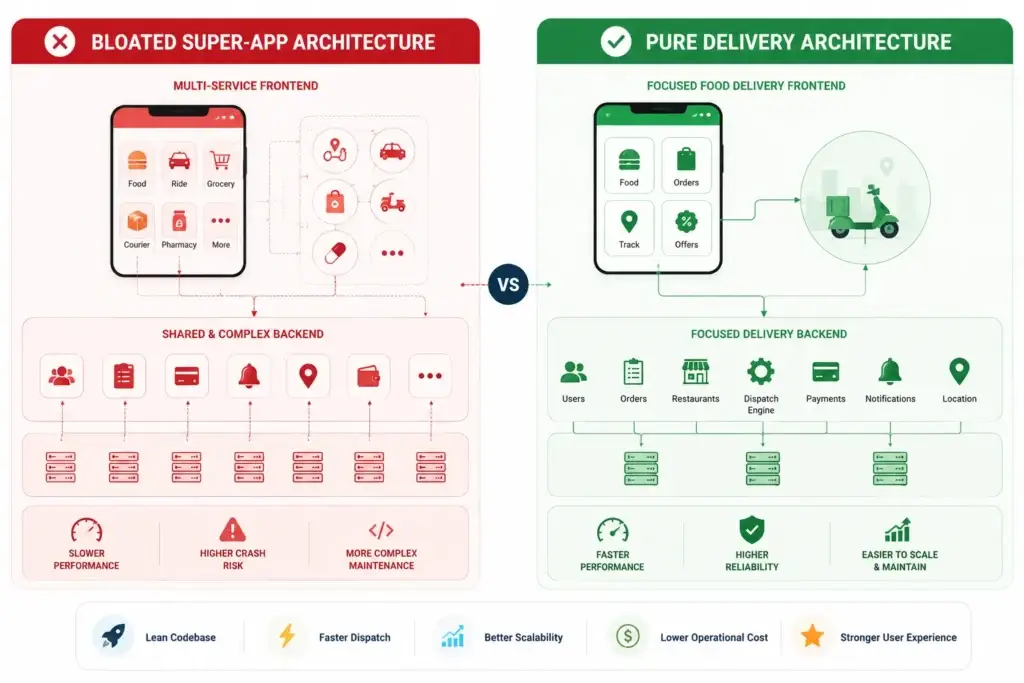
Image Source: AI-generated visual by Miracuves
A super app works when the business has the capital, operational maturity, service density, and backend discipline to support multiple verticals at once. But many food delivery startups do not begin there.
They begin with a narrower problem: get hot food from restaurants or ghost kitchens to customers quickly, predictably, and profitably.
Ride-hailing and food delivery may both use maps, drivers, live location, payments, and notifications, but their operational logic is not the same.
A taxi trip usually starts with a pickup point, destination, driver acceptance, route, fare calculation, and trip completion. Food delivery adds extra pressure points:
- Restaurant preparation time
- Kitchen acceptance delays
- Menu availability
- Item substitutions
- Order batching
- Rider wait time at pickup
- Delivery radius controls
- Multiple order states before pickup
- Refunds, cancellations, and merchant disputes
- Peak meal-hour spikes concentrated into short windows
When ride-hailing modules sit inside the same app foundation, they may bring extra service objects, unused trip states, fare models, driver workflows, map events, and database relationships that food delivery does not need for the first launch.
That bloat matters because food delivery is a concurrency game. At 8:00 p.m. on a Friday, the system does not care how many future verticals the founder dreams about. It cares whether the dispatch engine can process live order volume without delay.
Why Food Delivery Dispatch Needs a Different Architecture Than Ride-Hailing
A food delivery dispatch engine must constantly answer one operational question:
Which available delivery partner should receive this order right now, based on restaurant readiness, distance, rider capacity, delivery promise, and business rules?
That question sounds simple. It is not.
A serious food delivery backend has to coordinate customer orders, restaurant panels, delivery partner apps, admin dashboards, payment status, live tracking, and notification flows. The dispatch service becomes the center of the platform because it connects order readiness with rider availability.
That is why adding unnecessary ride-hailing logic is not a harmless feature decision. It changes the weight of the codebase, increases testing surface, adds more conditions to maintain, and can create avoidable load during periods when the business needs maximum stability.
For ghost kitchens, this problem becomes sharper. A ghost kitchen may run multiple brands from one physical location. Dinner rush can trigger sudden order clusters from nearby neighborhoods. If the platform is carrying unrelated taxi workflows, the technical team is supporting complexity that does not improve kitchen throughput, customer satisfaction, or delivery partner efficiency.
Isolating the Delivery Engine for Maximum Reliability
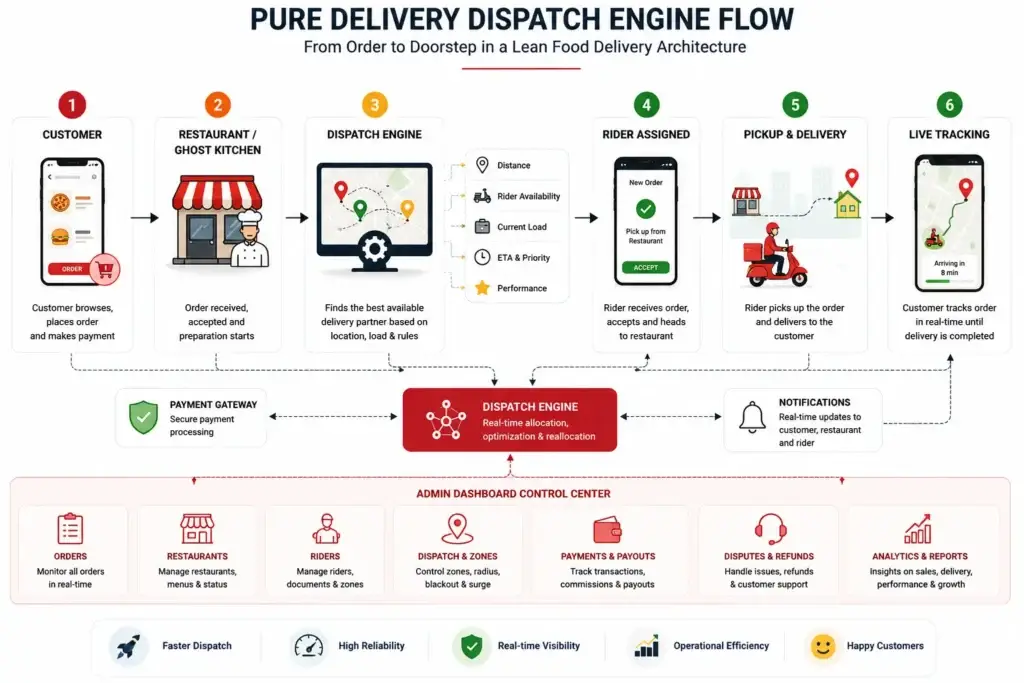
Image Source: AI-generated visual by Miracuves
The strongest Glovo-style food delivery build is not the one with the longest feature list. It is the one with the cleanest logistics path.
A pure delivery architecture focuses on the modules that directly support food ordering and fulfillment:
| Core Module | What It Controls | Why It Matters for Food Delivery |
|---|---|---|
| Customer app | Search, cart, ordering, payment, tracking, ratings | Converts demand into structured orders |
| Restaurant or kitchen panel | Menu, availability, order acceptance, prep status | Keeps kitchen operations connected to dispatch |
| Delivery partner app | Job acceptance, pickup, route, proof of delivery, earnings | Turns orders into completed deliveries |
| Admin dashboard | Users, restaurants, riders, commissions, disputes, reports | Gives the operator control over the marketplace |
| Dispatch engine | Rider allocation, ETA, batching, radius, status updates | Protects delivery speed and reliability |
| Notification layer | Order updates, rider alerts, customer tracking | Reduces support pressure and uncertainty |
| Payment and settlement logic | Customer payment, merchant payout, rider earnings | Supports monetization and trust |
The difference is discipline.
A bloated super-app script asks, “What else can we add?”
A pure delivery architecture asks, “What must stay fast under pressure?”
For food delivery founders, that second question is more valuable.
Read More: Best Glovo Clone Script in 2026: Features & Pricing Compared
What We Removed from the Glovo-Style Food Delivery Build
In this architecture model, ride-hailing modules were deliberately excluded from the food delivery build.
That means no taxi trip lifecycle, no fare bidding workflow, no ride category management, no driver ride availability states, no passenger destination logic, no ride cancellation rules, and no taxi-specific admin workflows.
The result is a cleaner delivery platform with fewer irrelevant states for the backend to evaluate.
This does not mean the platform cannot expand later. It means the first launch is protected from unnecessary complexity. Founders can still plan grocery, pharmacy, courier, or multi-category delivery if those verticals share similar logistics patterns. But ride-hailing should not be bundled into a food-first product unless the business model truly requires it.
Founder Decision Signals Speed
If the first business goal is food delivery, every non-food workflow should be questioned. Faster load, cleaner screens, and simpler order logic help users reach checkout and tracking faster.
Cost
Unnecessary modules increase testing, QA, maintenance, and future debugging. A focused build protects the launch budget by prioritizing revenue-critical workflows.
Scalability
Scaling food delivery means strengthening dispatch, order queues, restaurant coordination, and rider tracking before adding unrelated service categories.
Market Fit
Food founders need proof that customers order repeatedly and kitchens can fulfill reliably. A pure delivery app makes validation clearer because the product is not distracted by unused verticals.
Speed
If the first business goal is food delivery, every non-food workflow should be questioned. Faster load, cleaner screens, and simpler order logic help users reach checkout and tracking faster.
Cost
Unnecessary modules increase testing, QA, maintenance, and future debugging. A focused build protects the launch budget by prioritizing revenue-critical workflows.
Scalability
Scaling food delivery means strengthening dispatch, order queues, restaurant coordination, and rider tracking before adding unrelated service categories.
Market Fit
Food founders need proof that customers order repeatedly and kitchens can fulfill reliably. A pure delivery app makes validation clearer because the product is not distracted by unused verticals.
Benchmarking the Pure Delivery Architecture Under Friday Night Loads
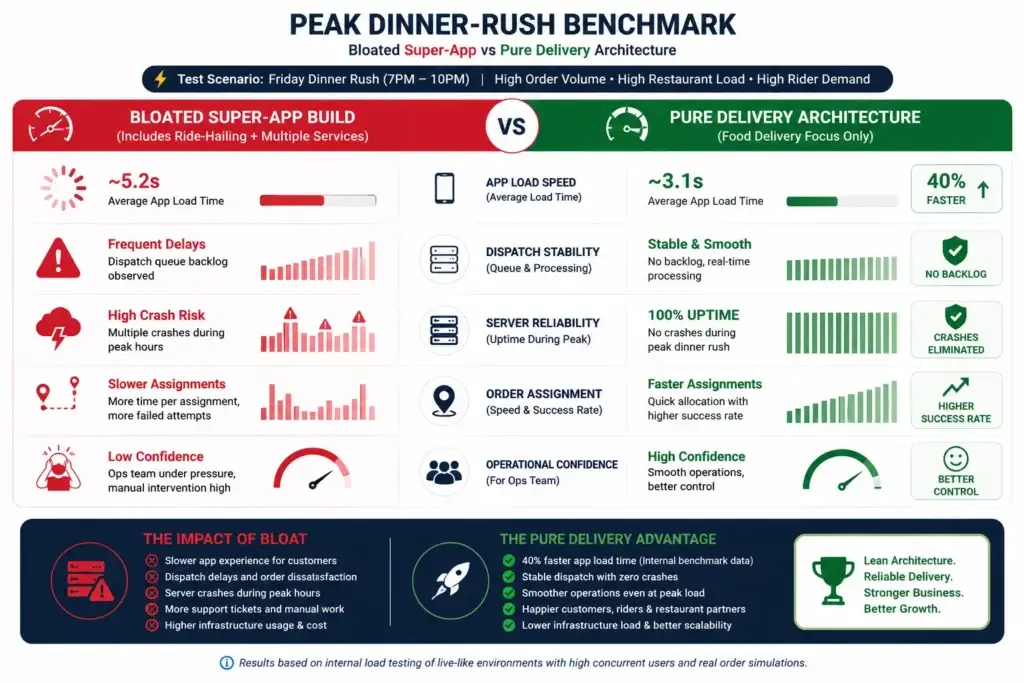
Image Source: AI-generated visual by Miracuves
Peak dinner rush is the real test of a food delivery platform.
A demo can look smooth at noon with five sample orders. The harder question is what happens when multiple restaurants accept orders at the same time, riders are moving across zones, customers are refreshing order tracking, and the admin team is watching delayed pickups.
Based on the provided internal benchmark data, removing ride-hailing bloat from the Glovo-style food delivery build produced two major operational improvements:
| Benchmark Area | Bloated Super-App Build | Pure Delivery Build | Founder Impact |
|---|---|---|---|
| App load behavior | Heavier navigation and service logic | 40% faster app load based on provided internal benchmark data | Customers reach ordering flow faster |
| Dispatch stability | Extra unused service conditions increase backend complexity | Dispatch server crashes eliminated during tested peak dinner-rush scenarios | Fewer failed assignments and less admin firefighting |
| QA scope | Multiple unrelated service workflows require testing | Food delivery workflows remain the main QA focus | Faster release cycles and cleaner updates |
| Admin operations | More service categories create more controls to monitor | Admin panel focuses on restaurants, riders, orders, commissions, and disputes | Operations team gets clearer control |
| Future scaling | Expansion starts from a heavier foundation | Expansion can be planned module-by-module | Founder avoids premature complexity |
The takeaway is not that every super app is bad. The takeaway is that a super app is a later-stage operating model, not always the right first architecture for a food delivery startup.
Why Ghost Kitchens Benefit Most from Pure Delivery Architecture
Ghost kitchens are operationally different from traditional restaurants. They often run multiple brands, tighter menus, faster prep cycles, and delivery-only demand. Their success depends on throughput.
For a ghost kitchen operator, the app does not need taxi booking. It needs:
- Fast menu updates
- Accurate kitchen prep status
- Delivery radius control
- Real-time order acceptance
- Rider assignment visibility
- Peak-hour order throttling
- Cancellation and refund workflows
- Brand-level reporting
- Customer reorder flows
When the codebase is focused on food logistics, the platform can support kitchen operations more directly. The admin team can see where the bottleneck is: kitchen delay, rider shortage, payment issue, or customer cancellation.
That clarity matters more than having a long list of unused modules.
Pure Delivery vs Super-App Script: Which Should Founders Choose?
| Decision Factor | Pure Delivery Architecture | Bloated Super-App Script |
|---|---|---|
| Best for | Food delivery startups, ghost kitchens, restaurant aggregators, local delivery operators | Large businesses planning multiple service verticals from day one |
| First launch complexity | Lower | Higher |
| Dispatch focus | Strong | Often shared across multiple service types |
| App performance | Easier to optimize | Heavier due to broader module set |
| Operational clarity | High | Can become complex for small teams |
| Expansion path | Add relevant delivery categories later | Multiple services available upfront |
| Founder risk | Lower technical distraction | Higher maintenance and QA surface |
For most food delivery founders, the smarter path is not “build everything now.” It is “build the right thing first.”
A pure Glovo clone for food delivery gives founders a focused product foundation: customer ordering, restaurant control, delivery partner workflows, admin management, payments, tracking, and monetization.
That is enough to validate demand. More importantly, it is enough to learn what the market actually wants before adding more verticals.
The Admin Control Layer Matters More Than Extra Modules
Many founders judge clone apps by frontend screens. Operations leads judge them by admin control.
A strong food delivery admin dashboard should help the platform operator manage:
- Customer accounts
- Restaurant or kitchen partners
- Delivery partners
- Active and completed orders
- Delivery zones and radius rules
- Commissions and delivery fees
- Coupons and promotions
- Refunds and disputes
- Payouts and settlement records
- Reports and operational analytics
This is where a focused architecture becomes valuable. When the admin layer is not crowded with ride-hailing objects, taxi fare rules, and irrelevant service categories, the operations team can focus on what actually drives food delivery performance.
Miracuves’ white-label food delivery approach helps founders start from a launch-ready foundation while keeping business-critical controls visible and manageable. For a food-first Glovo clone, that means the product is shaped around ordering, kitchen coordination, courier workflows, and marketplace monetization rather than unnecessary super-app baggage.
Monetization Works Better When Operations Are Stable
A food delivery app can monetize through multiple streams:
| Revenue Stream | How It Works | Why Reliability Matters |
|---|---|---|
| Restaurant commission | Platform earns a percentage from each order | Delayed dispatch can reduce restaurant trust |
| Delivery fee | Customer pays based on distance, urgency, or order value | ETA accuracy affects willingness to pay |
| Featured listings | Restaurants pay for better visibility | Only valuable if customers keep ordering |
| Subscription plans | Users pay for free delivery or benefits | Retention depends on consistent service quality |
| Advertising | Brands or restaurants promote offers | Advertisers need active, engaged users |
| Cloud kitchen partnerships | Platform supports delivery-only brands | Kitchen throughput depends on dispatch reliability |
Founders often think monetization starts with pricing. In food delivery, monetization starts with operational trust.
If orders arrive late, customers churn. If riders wait too long, they leave. If restaurants receive poor coordination, they push users elsewhere. A lean delivery engine protects the foundation that monetization depends on.
Read More: Glovo vs Blinkit: Business Model Comparison for Startup Success
Mistakes Founders Should Avoid When Building a Glovo Like App
Mistakes Founders Should Avoid
Adding ride-hailing just because the script supports it
Unused modules still create design, QA, backend, and admin complexity. If ride-hailing is not part of the first business model, it should not control the architecture.
Ignoring peak dinner-rush load during testing
A food delivery app must be tested around order spikes, restaurant delays, rider shortages, and repeated tracking requests. Normal demo testing is not enough.
Building for investor slides instead of operational reality
A super-app roadmap may sound impressive, but the first version must prove that customers order, kitchens fulfill, riders deliver, and admins can manage exceptions.
Underestimating the dispatch engine
Dispatch is not just assigning a rider. It connects preparation time, location, rider availability, delivery promises, and customer experience.
Where Miracuves Fits Into the Pure Delivery Architecture
Miracuves helps founders launch ready-made and white-label app solutions with source-code ownership, branded design, admin control, and faster deployment.
For a Glovo-style food delivery app, the value is not simply cloning a famous interface. The value is starting with a proven delivery foundation and shaping it around the founder’s actual operating model.
That may mean a food-only platform for a city launch. It may mean ghost kitchen delivery with multiple brands. It may mean restaurant marketplace ordering with courier tracking. It may mean grocery or pharmacy expansion later.
The key is architectural discipline.
A ready-made solution should reduce time to launch, not force founders into irrelevant modules. Miracuves’ food delivery app development approach keeps the focus on customer ordering, kitchen coordination, courier assignment, admin control, and monetization-ready delivery workflows
Final Thoughts: Food Delivery Does Not Need Super-App Bloat to Scale
The strongest food delivery platforms are not always the ones with the most modules. They are the ones with the clearest operating logic.
For food delivery startups, ghost kitchens, and operations-heavy delivery teams, the first priority should be reliable ordering, fast dispatch, accurate tracking, restaurant coordination, courier visibility, and admin control.
Ride-hailing can be a valid business vertical. But it should not be bundled into a Glovo clone unless the business actually needs it.
The pure delivery advantage is simple: fewer distractions, cleaner logistics, faster app behavior, stronger dispatch reliability, and a product foundation built around the real job food delivery customers expect the app to perform.
Miracuves helps founders build that kind of launch-ready foundation without starting from zero.
FAQs
What is a pure delivery Glovo clone?
A pure delivery Glovo clone is a Glovo-style app focused on food ordering, restaurant management, courier dispatch, real-time tracking, payments, and admin control without unrelated modules such as ride-hailing.
Why remove ride-hailing modules from a food delivery app?
Ride-hailing modules add workflows, trip states, fare logic, and admin complexity that may not support food delivery operations. Removing them keeps the codebase focused on dispatch speed, restaurant coordination, and courier reliability.
Is a super app bad for food delivery startups?
Not always. A super app can work for larger businesses with multiple active verticals. But for a food-first startup, launching with too many modules can increase complexity before the core delivery model is validated.
Can I add grocery or pharmacy delivery later?
Yes. Grocery and pharmacy delivery may be added later if they fit the same delivery logistics model. The key is to expand intentionally instead of bundling every possible service into the first launch.
What matters most in food delivery app architecture?
The most important layers are order management, restaurant or kitchen coordination, dispatch logic, rider tracking, payment flow, notifications, and admin control. The dispatch engine is especially important because it affects delivery speed and customer trust.
Is a ready-made Glovo clone suitable for ghost kitchens?
Yes, if it supports fast menu control, kitchen order management, delivery partner assignment, real-time tracking, and admin reporting. Ghost kitchens benefit from lean food-first systems because they depend heavily on throughput and operational visibility.
Does Miracuves provide source code with food delivery apps?
Miracuves positions its ready-made app solutions around white-label branding, admin control, faster deployment, and source-code ownership where applicable. Final scope should be confirmed with the Miracuves team before launch.
How fast can Miracuves launch a food delivery app?
For ready-made Miracuves solutions, a 6-day launch can be relevant when the scope fits an existing foundation. Custom features, integrations, major UI changes, or complex operational requirements may extend the timeline.
Miracuves is an independent software development company. We are not affiliated with, connected to, sponsored by, or endorsed by any company or product named in this article.
Terms such as “X Clone” are used descriptively. It is how the software industry refers to building a platform with functionality comparable to a known service, and how clients search for it.
The entire design and codebase of our products is built by our own team. Our products contain no code, design, graphics, or content originating from any third-party website or applications.
All third-party names and marks referenced in this article are the property of their respective owners, referenced solely to identify the services discussed.