



Key Takeaways
- Rental marketplace accounting is more than basic bookkeeping.
- Escrow, deposits, and split payouts require dedicated accounting logic.
- Automated reconciliation reduces payment errors.
- Accurate ledgers improve financial transparency.
- Scalable accounting supports marketplace growth.
Accounting Signals
- Track escrow, refunds, and security deposits separately.
- Automate host commissions and split payouts.
- Maintain audit logs for every financial transaction.
- Generate tax and revenue reports automatically.
- Monitor payment reconciliation in real time.
Real Insights
- Poor accounting workflows create costly financial disputes.
- Manual reconciliation becomes difficult as bookings increase.
- Integrated accounting improves operational efficiency.
- Financial accuracy builds trust with hosts and guests.
- Miracuves builds rental marketplaces with enterprise-grade accounting and payout workflows.
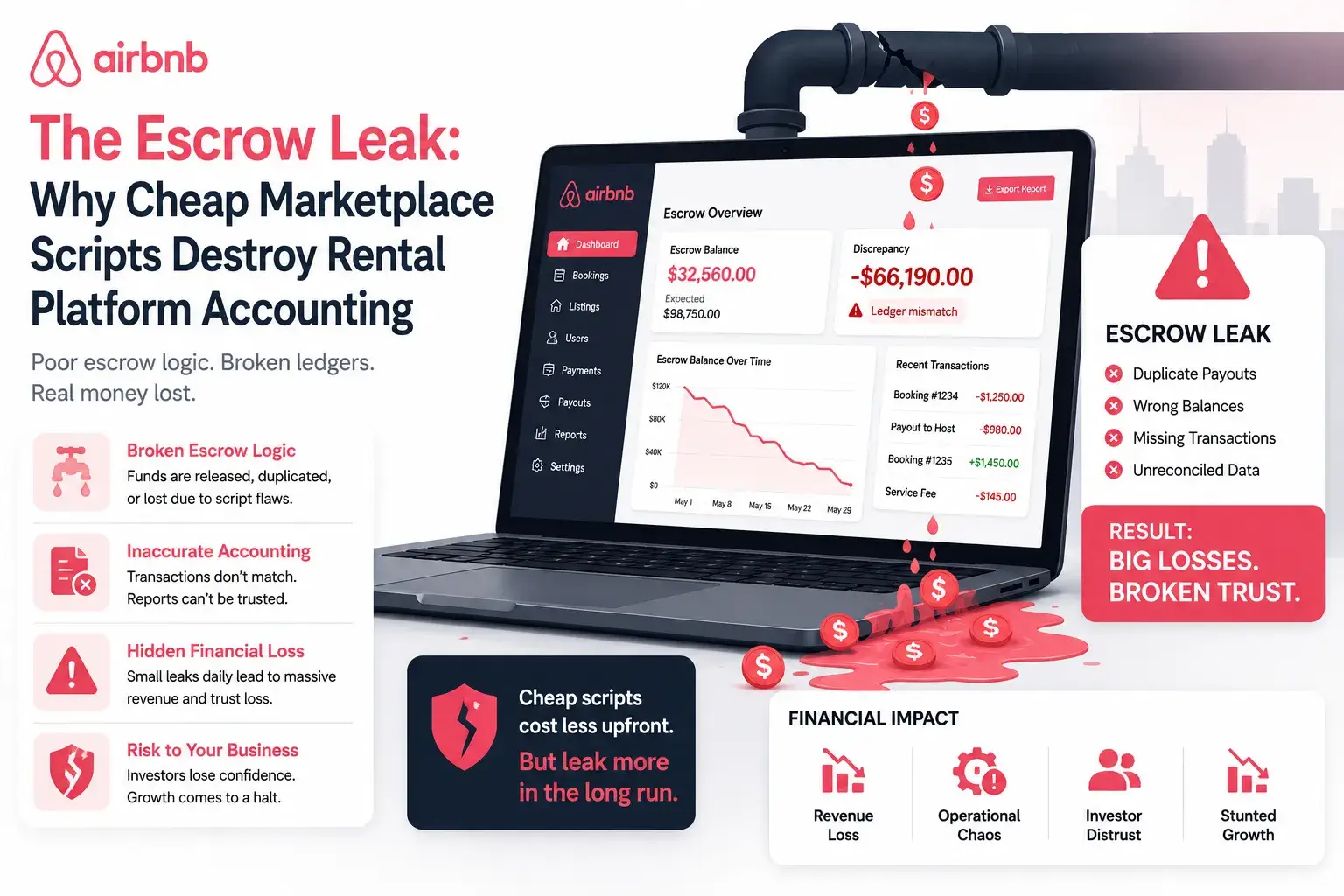
Cheap marketplace scripts rarely look dangerous on the demo page.
The homepage works. Listings appear. A guest can book a property. A host can log in. The admin dashboard shows bookings. The vendor promises a payment gateway. Everything looks ready until the first real transaction cycle begins.
Then the accounting leak starts. A guest pays for a booking. The platform takes a commission. The host expects the remaining payout. A security deposit must be held. A cleaning fee may be added. Taxes may need to be separated. The guest cancels. A partial refund applies. The host disputes the refund. The deposit is released later. The platform owner now has to explain why the payment gateway amount, admin dashboard amount, host statement, and accounting spreadsheet do not match.
That is where many cheap vacation rental scripts break down.
For a multi-vendor rental marketplace, payments are not just a checkout feature. They are the financial operating system of the business. If the split-payout escrow logic is weak, the founder does not merely face a technical bug. The founder inherits manual reconciliation, payout disputes, tax confusion, reporting gaps, and operational margin loss.
Miracuves helps founders build ready-made and white-label rental marketplace Accounting software platforms with booking workflows, secure payment integration, host management, admin control, and revenue tracking. Its Airbnb Clone page highlights secure payments, host verification, revenue and commission tracking, booking monitoring, complete white-labeling, source code, and 6-day launch readiness.
The Split-Payment Trap: Commissions, Refunds, and Security Deposits
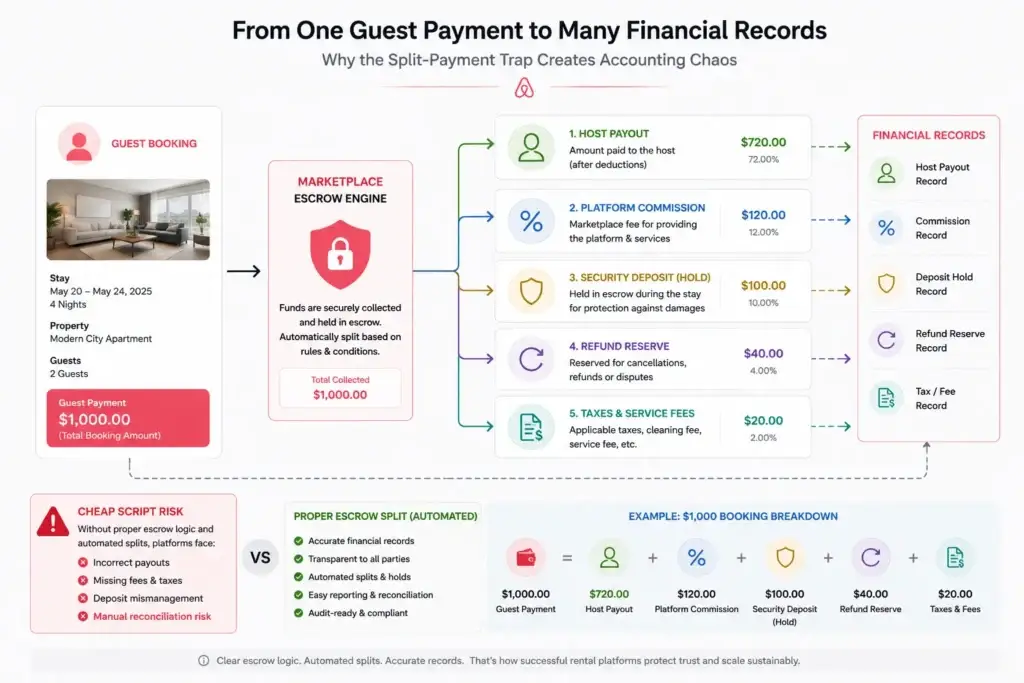
A normal ecommerce checkout is simple compared with a rental marketplace transaction.
In a basic ecommerce flow, one buyer pays one seller. The platform records the order, confirms payment, and triggers fulfilment. Even if there is a refund, the transaction path is usually linear.
A vacation rental marketplace is different.
One booking can involve:
| Transaction Layer | What Happens | Why It Matters |
|---|---|---|
| Guest payment | Guest pays booking amount | The platform must record gross transaction value correctly |
| Platform commission | Marketplace deducts its fee | Commission must be separated from host payout |
| Host payout | Host receives net payable amount | Payout timing and payout status must be traceable |
| Security deposit | Amount may be held, released, or partially deducted | Deposit logic must not mix with platform revenue |
| Cleaning/service fees | Extra fee may go to host, platform, or service partner | Fee ownership must be clear |
| Taxes | Tax may apply depending on geography and operating model | Tax balances must not be manually guessed later |
| Refunds and cancellations | Full, partial, or policy-based refund may apply | Reversal logic must update every affected ledger |
| Disputes | Guest or host challenges the charge | Admin needs transaction history, not scattered notes |
This is the “split-payment trap.”
A cheap script may advertise “commission management” or “payment gateway integration,” but that does not automatically mean it can manage escrow-like holding logic, multi-party payouts, refund reversals, deposit releases, and owner statements at scale. Several rental script pages in the market promote commissions, provider earnings, payment gateway integration, and admin revenue reports as features, but feature presence alone does not prove deep transaction architecture.
For founders, this difference matters because payment acceptance is not the same as payment orchestration.
Payment acceptance means the platform can collect money.
A $200 marketplace script may handle a successful booking. The problem is that rental platforms do not live on perfect bookings. They live on exceptions.
The guest changes dates. The host cancels. The platform applies a cancellation fee. The deposit must be held for inspection. A partial refund is approved. The payout batch fails. The host asks why the statement does not match the bank credit.
That is where weak architecture becomes a financial liability.
Read more : Best Airbnb Clone Script in 2026: Features, Pricing & Cost
Why Manual Reconciliation Kills Your Operational Margin
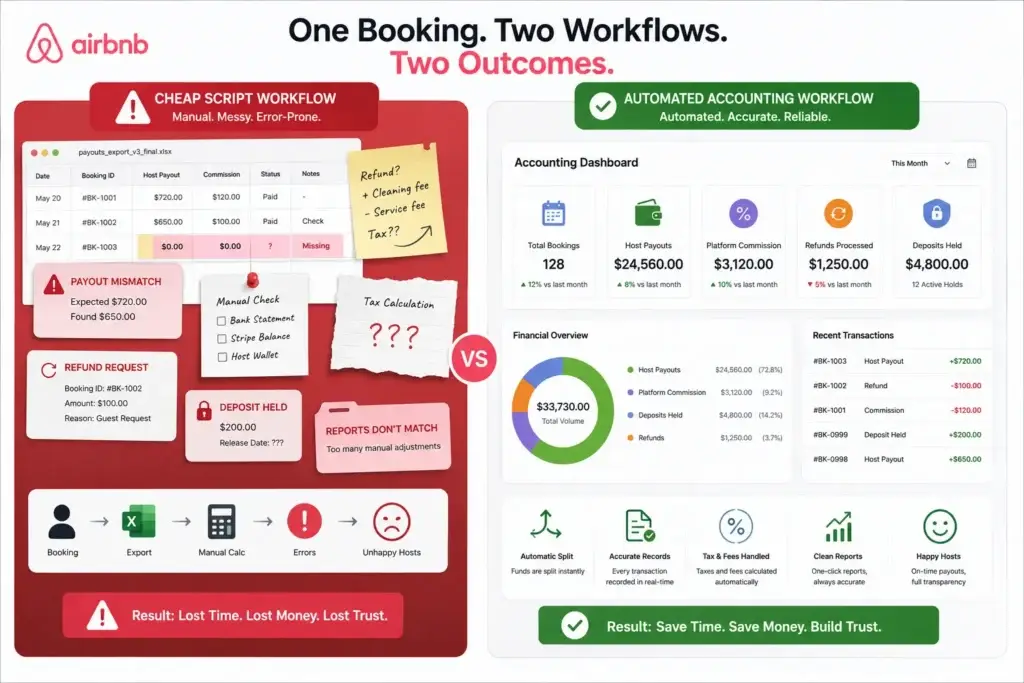
Manual reconciliation begins quietly.
At first, the founder says, “We will handle it manually until volume increases.”
That sounds practical when there are five bookings a week. But as the marketplace grows, every exception creates hidden labor. Operations managers start downloading payment gateway reports, comparing them with booking exports, checking host balances, adjusting spreadsheet formulas, and manually calculating platform commissions.
The platform may be earning commission, but the team is spending that margin on reconciliation.
This is dangerous because manual reconciliation creates four types of business damage.
1. Payout disputes become support tickets
When a host asks, “Why did I receive this amount?” the admin team needs an answer immediately.
A weak marketplace script may show the booking amount and commission percentage, but not the full transaction story. The admin may need to check the payment gateway, booking table, cancellation notes, deposit status, refund record, and spreadsheet calculation separately.
That turns a simple host question into an operations investigation.
A proper rental marketplace engine should allow the admin to see:- gross booking amount,
- platform commission,
- host payable amount,
- deposit held,
- refund amount,
- payout status,
- gateway reference,
- and adjustment history.
Without that, every payout dispute becomes manual work.
2. Refunds break commission logic
Refunds are where many cheap scripts expose their weakness.
A platform may correctly calculate commission on the original booking, but what happens when the booking is partially refunded?
Does the platform reverse its commission proportionally?
Does the host payout update automatically?
Does the refund reduce platform revenue?
Does the admin dashboard show the revised commission?
Does the host statement reflect the refund?
Does the deposit remain separate?
If the answer is unclear, the accounting engine is not ready.
Refund logic must be connected to the original booking, commission record, host ledger, guest wallet or payment record, and admin reporting layer. Otherwise, the platform owner is forced to manually adjust balances after the fact.
3. Security deposits get mixed with revenue
Security deposits are one of the most underestimated problems in vacation rental marketplaces.
A security deposit is not ordinary platform revenue. It may need to be held, released, partially deducted, or disputed. If a cheap script treats every collected amount as simple booking income, the owner may lose visibility into what is earned, what is payable, and what is temporarily held.
That creates confusion during:- deposit release,
- damage claims,
- guest disputes,
- host payout calculation,
- tax reporting,
- and month-end accounting.
A strong platform should separate booking revenue, commission revenue, host payable balance, deposit hold, deposit release, and deposit deduction logic. This does not replace legal or accounting review, but it gives the founder cleaner operational control.
4. Tax balances become guesswork
Marketplace accounting becomes especially risky when the admin team cannot separate gross transaction value from platform commission, host earnings, taxes, service fees, and deposits.
If reports only show “total bookings,” the founder may not know what portion belongs to the platform, what portion belongs to hosts, and what portion is held temporarily.
That creates weak month-end reporting.
It also makes investor discussions, accountant reviews, and operational planning harder because the platform cannot clearly show how money moves through the system.
Vacation rental accounting specialists often emphasize the need for structured accounts, owner statements, reconciliation workflows, and property-level profitability tracking, which reinforces why rental marketplaces need accounting-aware transaction design rather than basic checkout logic.
Read more : Reasons startups choose our Airbnb clone over custom development
True Automation: Secure Escrow and Split Routing from Day 1
True automation does not mean removing humans from every financial decision.
It means the platform has a controlled transaction engine where every booking movement is recorded, routed, and visible.
For a rental marketplace, the transaction engine should support:
| Automation Layer | What It Should Control | Founder Benefit |
|---|---|---|
| Escrow-style holding logic | Hold funds until booking rules are satisfied | Reduces premature payout risk |
| Split payout routing | Separate host payout from platform commission | Reduces manual commission calculation |
| Deposit handling | Hold, release, deduct, or dispute deposits | Prevents deposits from being treated as revenue |
| Refund adjustment | Update booking, payout, and commission records | Reduces spreadsheet correction work |
| Admin transaction logs | Track status changes and payment references | Improves dispute resolution |
| Host statements | Show booking earnings, deductions, and payouts | Builds host trust |
| Revenue reports | Separate gross value, commission, fees, and refunds | Improves accounting clarity |
A marketplace platform should not bolt on payment complexity after launch. The payment engine should be part of the product foundation from day one.
Miracuves’ rental marketplace positioning already includes secure payments, booking management, host verification, revenue and commission tracking, admin dashboards, complete rebranding, source code, and 6-day launch readiness for its Airbnb Clone solution.
That matters because founders need more than a marketplace that looks like Airbnb on the surface. They need a platform that supports the operational reality behind bookings.The founder should not need to rebuild this logic after the marketplace starts getting traction.
By the time real booking volume arrives, the operational team should already know how every rupee or dollar moves through the platform.
Founder Decision Signals
Speed
A cheap script may launch quickly, but if payout logic is weak, the team loses speed during every refund, deposit release, and host payout dispute.
Cost
The visible software price is only one cost. Manual reconciliation, accounting cleanup, support tickets, and redevelopment can turn a low-cost script into an expensive operating burden.
Scalability
A rental marketplace cannot scale if every transaction exception needs manual spreadsheet correction. Scalable platforms need automated split routing and admin-level transaction visibility.
Market Fit
Hosts stay when payouts are transparent. Guests trust the platform when refunds and deposits are handled clearly. Payment clarity directly affects marketplace trust.
The Financial Liabilities Hidden Inside Cheap Marketplace Scripts
The dangerous part of a cheap marketplace script is not always bad design. Many look polished enough to impress a non-technical founder.
The problem is usually hidden deeper.
Weak ledger separation
A serious rental platform should not treat all payment records as one flat transaction table.
It should separate:- guest paid amount,
- platform commission,
- host net amount,
- cleaning fee,
- service fee,
- tax amount,
- security deposit,
- refund amount,
- gateway fee,
- and manual adjustment.
If the platform cannot separate these cleanly, reports become unreliable.
No payout event logic
Host payout should usually depend on a configured event.
For example:
- after guest check-in,
- after check-out,
- after cancellation window closes,
- after admin approval,
- or after dispute resolution.
No exception handling
The real test of a marketplace engine is not the perfect transaction. It is the exception.
Can the platform handle:- partial cancellations,
- split stays,
- date changes,
- host penalties,
- guest refunds,
- deposit deductions,
- failed payouts,
- chargeback notes,
- and admin overrides?
If not, the founder is buying a demo, not a finance-ready marketplace foundation.
Poor admin auditability
When money moves, the admin panel must tell the story.
A strong admin dashboard should show transaction logs, payout status, refund records, commission records, host statements, and booking history. Miracuves’ Airbnb Clone page specifically lists admin-side booking monitoring and revenue and commission tracking, which are key operational controls for rental marketplace owners.
Without auditability, founders cannot confidently answer host questions, accountant questions, or internal operations questions.
Read more : How Airbnb Makes Money: The Complete Business Model Behind the Short-Term Rental Giant
Why “Payment Gateway Integration” Is Not Enough
One of the most misleading phrases in marketplace software is “payment gateway integrated.”
A payment gateway helps collect or move money. It does not automatically solve the platform’s business logic.
A rental marketplace still needs to decide:- who receives the money,
- when they receive it,
- how commission is deducted,
- how refunds affect commissions,
- how deposits are held,
- how taxes are separated,
- how payout failures are handled,
- and how the admin reconciles records.
Some marketplace payment guides explain that split payments involve dividing customer payments between providers and platform owners, often using providers such as Stripe, MANGOPAY, or Braintree, but the gateway is only part of the solution.
The marketplace application must still hold the rules.
That means the booking engine, payment engine, commission module, refund workflow, host dashboard, and admin reporting system must work together.
If these pieces are not designed together, the platform owner becomes the integration layer.
And that is exactly what destroys operational margin.
Cheap Script vs Accounting-Ready Rental Marketplace Engine
Cheap Vacation Rental Script vs Accounting-Ready Marketplace Engine
| Decision Area | Cheap Marketplace Script Risk | Accounting-Ready Marketplace Engine |
|---|---|---|
| Payment handling | Accepts payment but may not manage ownership of funds clearly. | Maps payments into booking amount, commission, payout, deposit, refund, and fee categories. |
| Host payouts | Requires manual payout calculation or spreadsheet review. | Supports host payable tracking and payout status visibility. |
| Platform commission | Calculates simple commission but may fail during refunds or cancellations. | Connects commission logic to booking status, cancellation policy, and refund adjustments. |
| Security deposits | May treat deposits as normal payment records. | Separates deposit holds, releases, deductions, and disputes from revenue. |
| Admin reporting | Shows basic booking or revenue totals. | Gives transaction-level visibility across payouts, commissions, refunds, and adjustments. |
| Operational margin | Looks cheaper upfront but increases support and reconciliation workload. | Reduces manual work by building financial control into the platform foundation. |
Mistakes Founders Should Avoid With Rental Marketplace Payments
Choosing a script only because it accepts online payments
Payment acceptance is not enough for a rental marketplace. Founders need split payout logic, deposit separation, refund handling, host statements, and admin transaction visibility.
Assuming commission tracking means reconciliation is solved
A script may calculate commission on successful bookings, but still fail when cancellations, partial refunds, payout failures, or deposit deductions occur.
Treating security deposits as a simple extra fee
Security deposits require separate handling because they may be held, released, deducted, or disputed. Mixing deposits with platform revenue creates accounting confusion.
Waiting until scale to fix financial architecture
Rebuilding payout logic after launch can be more expensive than starting with a stronger transaction foundation. Payment workflows should be designed before booking volume grows.
What Founders Should Ask Before Buying a Vacation Rental Script
Before buying a rental marketplace script, founders should ask sharper questions than “Does it have payments?”
Ask:
- Can the platform separate guest payment, platform commission, host payout, fees, taxes, and security deposits?
- Can host payouts be delayed until check-in, check-out, or admin approval?
- What happens to commission when a booking is partially refunded?
- Can the admin see payout status and payment gateway references?
- Can the system generate host-side earning records?
- Are deposits held separately from revenue?
- Can refund rules be connected to cancellation policies?
- Does the admin dashboard show transaction adjustments?
- Can the platform support future payment gateway changes?
- Does the founder receive source code for long-term control?
These questions reveal whether the software is a listing script or a real marketplace engine.
For founders who want a faster launch without losing control of core workflows, Miracuves offers ready-made, white-label, source-code-owned app foundations across marketplace categories. The Miracuves solutions hub lists rental, travel, ecommerce, job, and marketplace categories under Listings, while also positioning ready-made solutions for faster deployment.
Miracuves Perspective: Build the Transaction Engine Before the Marketplace Scales
A rental marketplace does not become valuable only because it has listings.
It becomes valuable when guests trust bookings, hosts trust payouts, and the platform owner can manage revenue without financial chaos.
That requires a product foundation where:
- booking workflows are connected to payment workflows,
- commission rules are connected to payout rules,
- security deposits are separated from revenue,
- refunds update financial records automatically,
- admin users can audit transaction history,
- and founders retain long-term control through source-code ownership.
Miracuves helps founders launch rental marketplace platforms with white-label branding, admin control, secure payment integration, host and booking workflows, and source-code ownership. For rental founders, the goal is not to copy Airbnb blindly. The goal is to build a marketplace engine that can support bookings, payouts, disputes, deposits, and monetization without forcing the operations team into spreadsheets.
Final Thoughts: The Cheapest Script Can Become the Most Expensive Accounting Problem
The biggest risk in cheap marketplace software is not always visible on the front end.
A founder can replace a theme. A founder can improve search filters. A founder can redesign property cards. But broken financial architecture is harder to fix after launch because it touches every booking, payout, commission, refund, and host relationship.
The real cost of a cheap vacation rental script appears when the founder has to manually reconcile tax balances, explain payout mismatches, correct deposit records, and rebuild payment logic while the marketplace is already operating.
For rental marketplace founders, the stronger decision is to treat escrow, split payouts, commission routing, security deposits, and reconciliation as core product architecture from day one.
Miracuves helps founders move faster with ready-made, white-label rental marketplace solutions built for branding, admin control, monetization workflows, and source-code ownership. If the goal is to launch a marketplace that can grow beyond the demo stage, the transaction engine deserves as much attention as the booking experience.
FAQs
1. Why do cheap vacation rental scripts fail during split payouts?
Cheap vacation rental scripts often handle basic payment collection but may not properly separate platform commission, host payout, security deposits, refunds, gateway fees, and tax records. The script may work for a simple booking but fail when cancellations, partial refunds, or payout exceptions occur.
2. What is split-payout escrow in a rental marketplace?
Split-payout escrow refers to a transaction flow where guest payments are collected, held according to booking rules, and then routed between the host and the platform after commissions, fees, refunds, or deposits are considered. The exact legal and payment setup depends on the payment gateway, operating model, and jurisdiction.
3. Why are security deposits difficult in Airbnb clone accounting?
Security deposits are difficult because they are not ordinary revenue. They may need to be held, released, deducted, or disputed after the stay. If a platform mixes deposits with booking revenue, the admin team may struggle to reconcile host payouts and guest refunds accurately.
4. Is payment gateway integration enough for a rental marketplace?
No. Payment gateway integration only helps process payments. The marketplace still needs business logic for commissions, payout timing, refund adjustments, deposit handling, host statements, and admin reporting.
5. How does manual reconciliation hurt rental marketplace margins?
Manual reconciliation consumes operations time. Teams must compare booking records, payment gateway reports, host payouts, refunds, and spreadsheet calculations. As booking volume grows, this hidden labor can reduce the margin earned from platform commissions.
6. What should founders check before buying an Airbnb clone script?
Founders should check whether the platform supports commission tracking, host payout records, refund handling, security deposit separation, admin transaction logs, secure payment integration, booking monitoring, and source-code ownership.
7. Does Miracuves offer a rental marketplace solution?
Yes. Miracuves offers an Airbnb Clone solution positioned for vacation rental marketplace use cases, including booking management, secure payments, host verification, revenue and commission tracking, white-labeling, source code, and 6-day launch readiness.
8. Can accounting integrity be guaranteed by software alone?
No. Software can improve transaction control, visibility, and reconciliation workflows, but final accounting integrity also depends on payment gateway setup, tax rules, operating model, accountant review, jurisdiction, and internal financial processes.