



Key Takeaways
- An internal dev team can create a heavy monthly burn rate before the app starts generating revenue.
- Founders must budget for salaries, benefits, tools, hiring time, management, QA, DevOps, and ongoing support.
- A team of developers needs direction, documentation, sprint planning, code reviews, testing, and production ownership.
- Team cost risk depends on feature scope, developer seniority, project timeline, infrastructure, and management overhead.
- A fixed-cost app foundation can help founders preserve runway while launching with professional architecture.
Cost Signals
- Founders need to compare monthly payroll, recruitment cost, project delay, support load, and launch capital remaining.
- Developers need product requirements, backend architecture, mobile apps, admin panels, deployment systems, and QA workflows.
- Managers need to coordinate priorities, timelines, bug reports, releases, technical debt, and cross-functional decisions.
- Hidden costs appear when teams need extra specialists for UI/UX, security, DevOps, testing, and post-launch maintenance.
- Ready-made platforms reduce burn pressure by replacing long discovery cycles with proven modules and faster execution.
Real Insights
- Hiring developers is not only a salary decision; it is a long-term operational and management commitment.
- A full-time team can drain runway quickly if product-market validation, monetization, and customer acquisition are still uncertain.
- Fixed-cost app development can help founders control spending before investing in a permanent engineering department.
- Founders should build an internal team when the product has traction, roadmap clarity, and enough revenue to support payroll.
- Miracuves builds ready-made clone apps and custom platforms with source-code ownership, scalable architecture, deployment support, maintenance-friendly workflows, and admin control.
Founders often ask a simple question: how much does it cost to pay someone to develop an app?
Most answers give a project estimate. A basic app may cost one amount, a marketplace another, and a complex platform much more. That is useful, but it misses the bigger financial question.
The real question is not only, “What will the app cost?”
The better question is, “What monthly burn rate am I creating before the product has proven demand?”
That distinction matters because hiring a full-time development team is not the same as buying development output. You are taking on recurring salaries, benefits, recruiting cost, management overhead, tools, infrastructure, QA needs, product direction, and delivery risk.
For early-stage founders, that can quietly turn an app idea into a runway problem.
A ready-made white-label app system from Miracuves changes the cost structure. Instead of building every workflow from zero, founders can explore ready-made clone solutions, customize the platform for their market, and move toward launch with a fixed, more predictable foundation.
The Burn Rate Mirage: Calculating the True Cost of Full-Time Engineers
Hiring developers feels like control.
You can assign tasks daily, change priorities, review code, and build the product exactly the way you imagine it. But that control has a financial shape. It is called burn rate.
According to the U.S. Bureau of Labor Statistics, the median annual wage for software developers was $133,080 in May 2024. The broader category of software developers, QA analysts, and testers had a 2024 median pay of $131,450, with projected employment growth of 15% from 2024 to 2034. That means experienced software talent remains expensive and in demand.
Now imagine a founder hiring a small internal team:
| Role | Base Salary Assumption | Why It Matters |
|---|---|---|
| Backend developer | $133,080 | Builds server logic, APIs, database, admin workflows |
| Mobile developer | $133,080 | Builds iOS/Android or cross-platform app experience |
| Frontend/full-stack developer | $133,080 | Builds web dashboard, user flows, integrations |
| Base payroll only | $399,240/year | Before benefits, recruiting, tools, QA, management, and delays |
This is only the visible payroll number.
It does not include benefits. It does not include recruiter fees or hiring time. It does not include the founder’s time spent managing sprints. It does not include QA, UI/UX, DevOps, cloud setup, app store publishing, support, or bug fixing.
The Bureau of Labor Statistics reported that private-industry benefit costs averaged $13.58 per hour worked in June 2025, while total private-industry compensation averaged $45.65 per hour worked. If we use that wage-to-benefit relationship as an illustrative burden model, one $133,080 developer can represent roughly $189,000 in annual total compensation exposure, and a three-developer team can represent roughly $568,000 per year before other startup operating costs.
That is the staffing trap.
The founder thinks they are buying code. In reality, they are funding a department.
Read More: Designing a Peer-to-Peer Rental Engine: Solving the Availability Challenge
Financial Breakdown: Salaries, Overhead, and Management Debt vs. Platform Assets
A full-time engineering team does not become productive the day employment contracts are signed. A founder still has to hire, onboard, explain the product, manage priorities, review output, and correct direction. For founders who need frontend, backend, APIs, dashboards, and deployment handled under one delivery model, Miracuves’ Full Stack App Development Company page is a useful next step.
SHRM has reported average cost-per-hire at nearly $4,700, while noting that hard-to-fill roles can cost significantly more. For a three-person engineering team, even a basic recruiting assumption adds around $14,100 before anyone ships a feature.
Here is a simple CFO-style model.
| Cost Layer | Internal Dev Team Estimate | Why Founders Underestimate It |
| Base salary for 3 developers | $399,240/year | This is the number most founders notice first |
| Benefits and compensation burden | Included in approx. $568,000 burdened compensation model | Benefits, payroll taxes, leave, insurance, and related costs are often ignored early |
| Recruiting cost | $14,100+ | Based on three hires at roughly $4,700 each |
| Management overhead | $59,886/year | 15% of base payroll as an illustrative founder/PM management allocation |
| Tools, cloud, testing, collaboration | $18,000/year | Assumes $1,500/month for basic operating stack |
| Illustrative first-year burn | Approx. $660,000 | Before marketing, sales, legal, customer support, or unexpected rebuilds |
This model is not saying every app team costs exactly $660,000. It is showing the hidden financial structure behind “let’s hire developers and build it ourselves.”
The monthly burn can become more important than the total build cost. An internal team costing around $47,000 per month in burdened compensation can consume runway quickly if the product is still in discovery, design, backend setup, and QA.
That is why many founders should separate two questions:
- Do we need a custom engineering department today?
- Or do we need a reliable app foundation that lets us validate the business first?
Those are not the same decision.
Read More: FinTech Architecture: Evaluating Development Paths for Your Digital Wallet
The Problem With “Hourly Rate × Development Hours”
Many app cost guides use a formula such as:
Development Hours × Hourly Rate = Total App Development Cost
That formula is not wrong. Appinventiv uses this logic in its app development cost guide and shows how project cost changes based on complexity, features, team size, and development time.
But for founders deciding between hiring and buying, that formula is incomplete.
It prices production effort. It does not price organizational drag.
An internal app team creates recurring cost even when:
- The product scope changes.
- The backend architecture needs refactoring.
- One developer leaves.
- A senior engineer is needed for code review.
- A third-party API changes.
- The app fails testing.
- The founder realizes the market needs a different workflow.
This is where software development becomes financially dangerous for early-stage companies. You are not only paying for the app. You are paying for the learning curve of building the app.
A fixed-cost platform approach gives the founder a different financial profile. The core system already exists. The user panels, admin dashboard, core workflows, and deployment structure are already built. The founder’s money goes toward branding, configuration, customization, integrations, launch preparation, and market entry.
Why Full-Time Engineering Burn Hurts Startup Runway
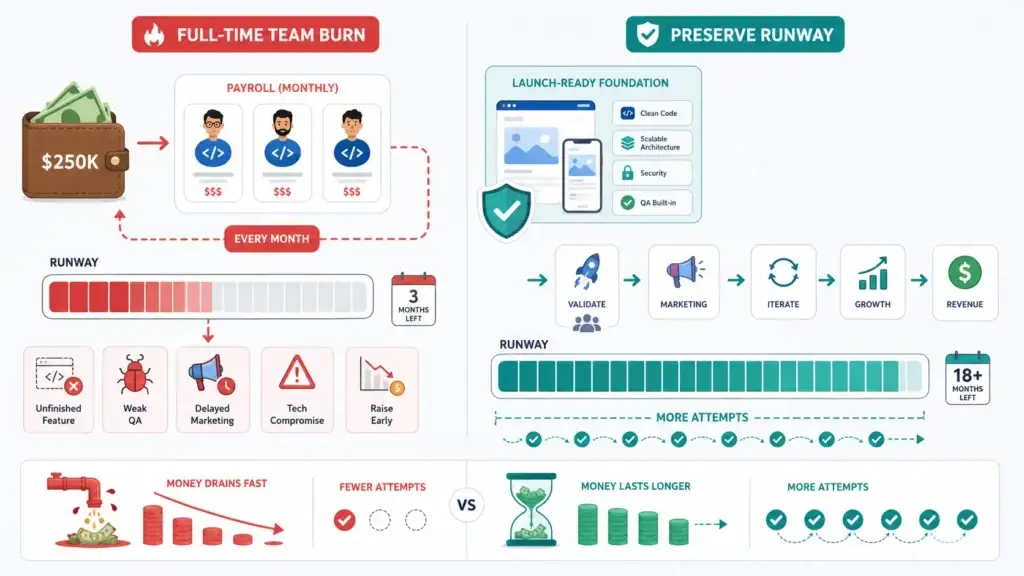
Runway is not just how much cash you have. It is how many strategic attempts your startup can afford before cash runs out.
If a founder raises or saves $250,000 for launch, hiring three full-time developers can consume that budget before the first serious market test. Even with a smaller or offshore team, ongoing monthly payroll changes the psychology of decision-making.
Founders under payroll pressure often make rushed choices:
- They launch unfinished features because the team is expensive.
- They cut QA because salaries already consumed the budget.
- They delay marketing because development took longer than expected.
- They accept technical compromises because replacing the team is painful.
- They raise money too early because the product is not generating revenue yet.
This is why the internal team decision should be treated like a finance decision, not only a product decision.
A founder does not need to own a full engineering department before proving the business model. In many cases, the smarter move is to own a launch-ready product foundation first.
Read More: Passing the Enterprise IT Review: The Architecture Choice for B2B SaaS
Pre-Built Platform vs. Internal Dev Team: What Are You Really Buying?
A founder hiring developers is buying capacity.
A founder working with a Clone App Development Company is not just buying developer hours. They are buying a working product foundation that can be branded, configured, and launched faster than a blank-codebase build.
That difference matters.
| Decision | What You Buy | Cost Behavior | Founder Risk |
| Hire internal developers | Engineering capacity | Recurring payroll burn | High if market demand is unproven |
| Hire freelancers | Task completion | Variable cost and coordination risk | Medium to high depending on quality |
| Custom agency build | Project delivery | Large scoped investment | Medium if scope is stable |
| White-label clone platform | Existing product foundation | Fixed and predictable starting point | Lower for early validation |
A ready-made app platform does not remove every cost. Founders still need branding, cloud hosting, third-party services, payment gateway setup, marketing, customer support, and future iterations.
But it reduces the most dangerous early cost: paying a team to recreate standard product architecture from scratch.
Miracuves positions its ready-made clone solutions around faster deployment, white-label branding, source-code ownership, admin control, and launch-ready workflows. Its current site describes 90+ readymade clone solutions deployed in 6 days starting at $2,799, while final pricing still depends on app type, features, customization, and integrations.
That fixed-cost starting point can protect runway because the founder is not funding months of blank-page development before seeing a working product.
Read More: Beyond the Code: The DevOps Guide to Launching Production Architecture
Preserving Runway: Launching with Fixed-Cost Professional Architecture
A fixed-cost white-label platform works best when the founder is not trying to invent an entirely new technology category.
It is especially useful when the business model already follows a proven app pattern:
- Ride-hailing
- Food delivery
- Grocery delivery
- Short video
- Rental marketplace
- Service marketplace
- Fintech wallet or remittance flow
- Ecommerce marketplace
- Online learning
- Social networking
In these cases, the first challenge is not usually whether the app pattern can technically exist. It already exists in the market. The real challenge is whether the founder can localize the model, differentiate the brand, acquire users, build trust, and monetize.
That is where a pre-built platform creates leverage. Miracuves’ rapid app development process explains how a ready-made foundation can move through scope confirmation, branding, QA, deployment preparation, and handover without rebuilding every standard module from zero.
Instead of spending six months building login, profiles, listings, bookings, payments, notifications, admin roles, dashboards, and basic mobile flows, the founder can start closer to launch. The budget can shift from engineering payroll to market validation.
That is a better use of early capital.
Founder Decision Signals
Choose an internal team when
You are building proprietary technology, own deep technical IP, have long runway, and need full-time engineering control from day one.
Choose a white-label platform when
You need to validate a proven app model quickly, preserve cash, customize branding, and avoid rebuilding standard workflows from zero.
Watch your burn rate when
Your monthly development payroll is growing faster than user traction, revenue, or investor milestones.
Protect runway by
Spending first on launch, user learning, operations, and monetization instead of carrying unnecessary engineering overhead too early.
The Real Cost Is Delay
The biggest hidden cost of hiring an internal team is not salary.
It is delay.
Every month spent hiring, planning, building, testing, fixing, and rebuilding is a month without real customer behavior. The app may become technically better, but the business remains unvalidated.
That is why “paying someone to develop an app” should not be framed as a one-time expense. It should be framed as a runway allocation decision.
If the app requires deep custom IP, hiring may be justified. But if the business is based on a proven platform pattern, paying full-time engineers to rebuild standard architecture can be financially inefficient.
A white-label app platform gives founders a faster route to the real test: Will users sign up? Will vendors onboard? Will creators publish? Will drivers accept jobs? Will customers pay? For a deeper view of this validation logic, read how clone app development helps founders validate demand faster.
Those answers are more valuable than a large custom codebase that has not met the market yet.
How Miracuves Helps Founders Avoid the Staffing Trap
Miracuves helps founders launch ready-made and white-label app solutions with source-code ownership, branded design, admin dashboards, and launch-ready workflows.
This does not mean every founder should avoid custom development. A custom mobile app development company is valuable when the product requires unique logic, unusual workflows, proprietary algorithms, or long-term technical differentiation.
But many founders do not need to start there.
For a clone app, marketplace, delivery platform, fintech-style flow, service app, or creator platform, a ready-made foundation can reduce the financial risk of starting from zero. The founder can launch faster, test the market, collect feedback, and then decide where deeper custom development is worth the investment.
That is a more disciplined startup finance strategy.
Final Thoughts: Do Not Hire a Department When You Need a Launch Asset
The question “how much does it cost to pay someone to develop an app?” is usually too narrow.
A better founder question is:
“How much runway will I burn before the app reaches real users?”
Hiring an internal development team can make sense when the company has enough capital, strong technical leadership, and a product that truly requires proprietary engineering. But for many founders, hiring three developers too early creates a heavy recurring cost before the market has validated the idea.
The smarter path is often to buy speed, structure, and predictability first.
A Miracuves white-label app platform can give founders a launch-ready product foundation without the immediate financial weight of a full-time engineering department. That means more runway for marketing, operations, customer feedback, and revenue experiments — the things that decide whether the app becomes a business.
FAQs
How much does it cost to pay someone to develop an app?
The cost depends on app complexity, platforms, integrations, team location, and whether you hire freelancers, an agency, or full-time developers. The bigger issue is whether you are paying for a fixed project or creating recurring payroll burn.
Is hiring developers cheaper than buying a white-label app?
Not always. Hiring developers may seem flexible, but full-time salaries, benefits, recruiting, management, QA, tools, and delays can make it expensive. A white-label app can be more predictable when the business model follows a proven app pattern.
How much does a three-person app development team cost?
Using U.S. software developer salary data as a rough model, three developers can exceed $399,000 in base annual payroll before benefits and overhead. With benefits, recruiting, management, and tools, the first-year burn can become much higher.
What hidden costs do founders forget when hiring developers?
Common hidden costs include benefits, payroll taxes, recruiting, onboarding, management time, QA, DevOps, cloud hosting, design, documentation, bug fixing, third-party APIs, and post-launch maintenance.
When should a startup hire an internal dev team?
A startup should consider hiring internally when the product depends on proprietary technology, unusual workflows, long-term technical IP, or continuous engineering innovation. If the goal is to validate a proven business model quickly, a ready-made platform may be more efficient.
Why does a white-label clone app protect startup runway?
A white-label clone app reduces the need to build standard workflows from scratch. Founders can spend less time funding backend, mobile, and admin architecture and more time testing customers, operations, and monetization.
Does Miracuves provide source code with white-label apps?
Miracuves positions its ready-made solutions around white-label branding, source-code ownership, admin dashboards, and faster launch. Final scope depends on the selected solution, customization, and integrations.
Is a pre-built app platform the same as a no-code app builder?
No. A pre-built white-label app platform is usually a production-ready software foundation with mobile apps, backend workflows, and admin controls. A no-code builder is typically a tool for creating simpler workflows and interfaces with more platform dependency.