


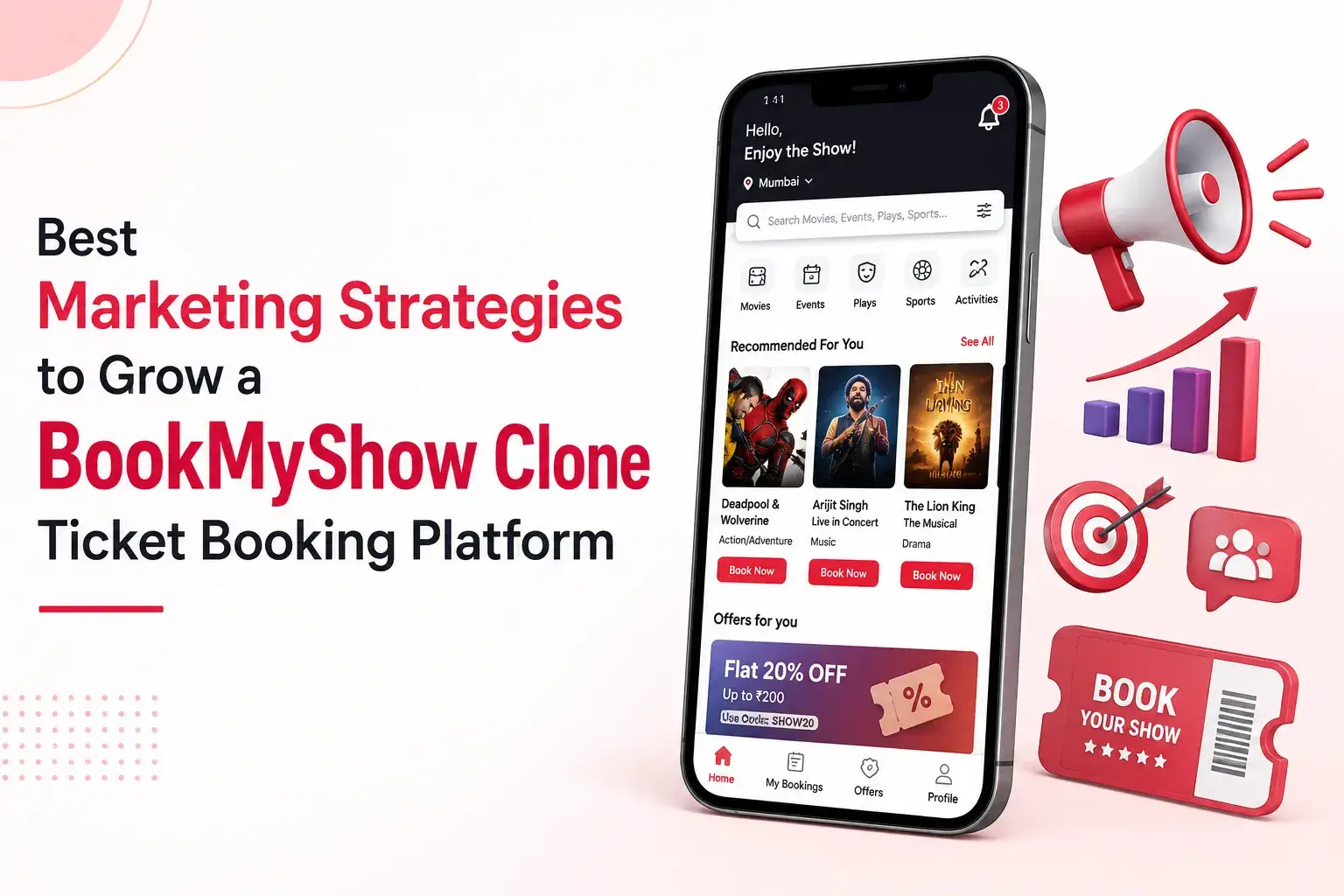
Launching a BookMyShow clone is only the first step. The real challenge begins after the platform goes live.
A ticket booking platform does not grow like a normal ecommerce app. It depends on two connected sides: people who want tickets and venues, cinemas, artists, event organizers, sports operators, clubs, comedy shows, colleges, and promoters who need an audience. If one side is weak, the other side suffers.
That is why marketing a BookMyShow Clone Marketing Strategies requires more than paid ads. You need local supply, strong event discovery, trust, booking convenience, repeat engagement, organizer partnerships, CRM automation, and retention loops that bring users back before every movie release, concert, festival, match, comedy night, or local event.
The opportunity is strong. India’s live events sector has been reported as a ₹13,000 crore market, and Zomato’s acquisition of Paytm’s movie and events ticketing businesses shows how serious the competition around entertainment commerce has become. For startups, this means one thing clearly: a BookMyShow-style platform needs a sharp marketing strategy from day one.
Miracuves helps founders launch ready-made and white-label app solutions with source code, custom branding, admin control, and faster deployment. But even the strongest platform needs the right go-to-market strategy to attract users, onboard event partners, and create repeat bookings.
Key Takeaways
- A BookMyShow clone grows when founders build both ticket supply and user demand together.
- Hyperlocal marketing is critical because most entertainment discovery starts city by city.
- Event organizer onboarding, venue partnerships, SEO landing pages, referrals, influencer campaigns, and CRM automation should work together.
- The strongest ticket booking platforms reduce booking friction with fast checkout, secure payments, QR tickets, reminders, and easy refunds.
- Miracuves helps founders move from idea to launch faster with ready-made and white-label app solutions.
What Makes Marketing a BookMyShow Clone Different?
A ticket booking platform is a marketplace. It has two audiences.
The first audience is the ticket buyer. They want discovery, convenience, seat selection, secure payments, offers, reminders, and a smooth entry experience.
The second audience is the supply partner. This includes cinemas, event organizers, artists, venues, sports clubs, comedy promoters, colleges, and local entertainment brands. They want visibility, ticket sales, payment control, audience data, check-in tools, and lower operational friction.
A normal app marketing campaign focuses mostly on user installs. A BookMyShow clone marketing campaign must focus on both:
- Getting enough events, shows, and venues listed
- Getting enough users to search, book, and return
This is where many startups fail. They spend money on app installs before they have strong local inventory. Users open the app, see limited events, and leave. Then organizers do not see traction and stop listing. The marketplace weakens from both sides.
The better strategy is to launch with a city-focused growth plan.
Read more- Why Startups Choose a BookMyShow Clone Over Building a Ticket Booking Platform From Scratch
Start With a City-by-City Launch Strategy
A BookMyShow clone should not try to become a national ticketing platform on day one. The smarter move is to win one city, category, or audience segment first.
Start with a clear launch wedge:
- Movie tickets in one metro city
- Comedy events in one region
- College festivals in one state
- Local theatre and stage shows
- Sports turf and tournament tickets
- Music gigs and nightlife events
- Religious, cultural, or community events
- Corporate and conference ticketing
- Kids’ activities and weekend events
A focused launch helps you solve supply, marketing, and operations at a manageable scale. It also makes your campaigns sharper. Instead of saying “Book events online,” your platform can say “Discover every live comedy show in Pune this weekend” or “Book the best college fest passes in Bangalore.”
This level of positioning is easier to rank, easier to promote, and easier for users to remember.
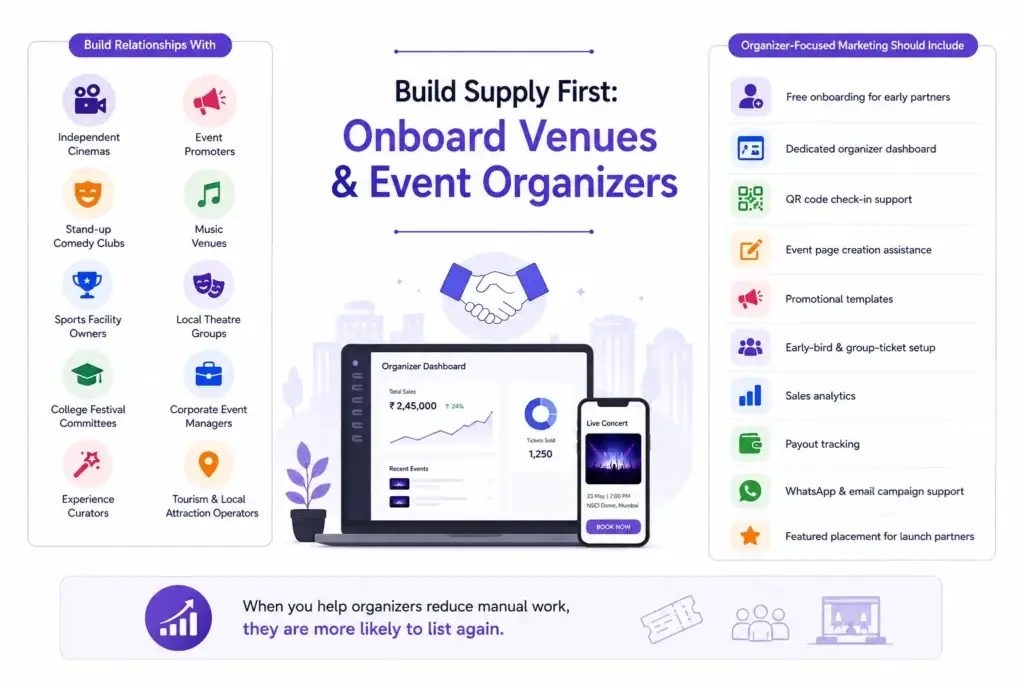
Build Supply First: Onboard Venues and Event Organizers
Ticketing platforms grow when they have exclusive, useful, or hard-to-find inventory.
Before spending heavily on consumer ads, founders should build relationships with:
- Independent cinemas
- Event promoters
- Stand-up comedy clubs
- Music venues
- Sports facility owners
- Local theatre groups
- College festival committees
- Corporate event managers
- Experience curators
- Tourism and local attraction operators
Your pitch to organizers should not only be “list your event.” It should be “we help you sell more tickets, manage entry better, collect payments securely, and understand your audience.”
Organizer-focused marketing should include:
- Free onboarding for early partners
- Dedicated organizer dashboard
- QR code check-in support
- Event page creation assistance
- Promotional templates
- Early-bird and group-ticket setup
- Sales analytics
- Payout tracking
- WhatsApp and email campaign support
- Featured placement for launch partners
If your platform helps organizers reduce manual work, they are more likely to list again.
Create High-Converting Event Landing Pages
Every event should have a landing page that can rank, convert, and be shared.
A strong event page should include:
- Clear event title
- Date, time, and venue
- Ticket categories
- Seat or slot availability
- Artist, cast, speaker, or performer details
- Event description
- High-quality images or trailer
- FAQs
- Venue map
- Refund policy
- Age restrictions if relevant
- Social sharing buttons
- Urgency indicators such as “limited seats”
- Trust signals such as secure payment and QR ticket entry
Event marketing guides consistently emphasize the importance of clear event pages, pricing, promotion, mobile-friendly checkout, and audience follow-up.
For a BookMyShow clone, the event page is not just a listing. It is the conversion engine.
Use Local SEO to Capture High-Intent Searches
Ticket buyers often search with location and timing.
Examples:
- “movies near me”
- “events in Mumbai this weekend”
- “standup comedy in Bangalore”
- “concert tickets in Delhi”
- “movie tickets Pune”
- “kids activities near me”
- “Navratri events Ahmedabad”
- “New Year party tickets Goa”
Your BookMyShow clone should create SEO-friendly pages for:
- City pages
- Event category pages
- Venue pages
- Artist pages
- Movie pages
- Festival pages
- Weekend event pages
- “Near me” discovery pages
- Seasonal campaign pages
Example SEO structure:
| Page Type | Example Page | Purpose |
|---|---|---|
| City Page | Events in Mumbai | Rank for city-level discovery searches |
| Category Page | Comedy Shows in Bangalore | Capture niche entertainment demand |
| Venue Page | Events at Phoenix Marketcity | Build venue-based search visibility |
| Artist Page | Zakir Khan Tickets | Capture performer-led demand |
| Movie Page | Book Movie Tickets in Pune | Capture movie ticket booking intent |
| Seasonal Page | New Year Events in Delhi | Capture high-demand seasonal traffic |
SEO is especially useful because ticketing intent is recurring. A user may search for weekend events every week, movies every month, or festival tickets every season.
Run Hyperlocal Paid Ads Instead of Broad Campaigns
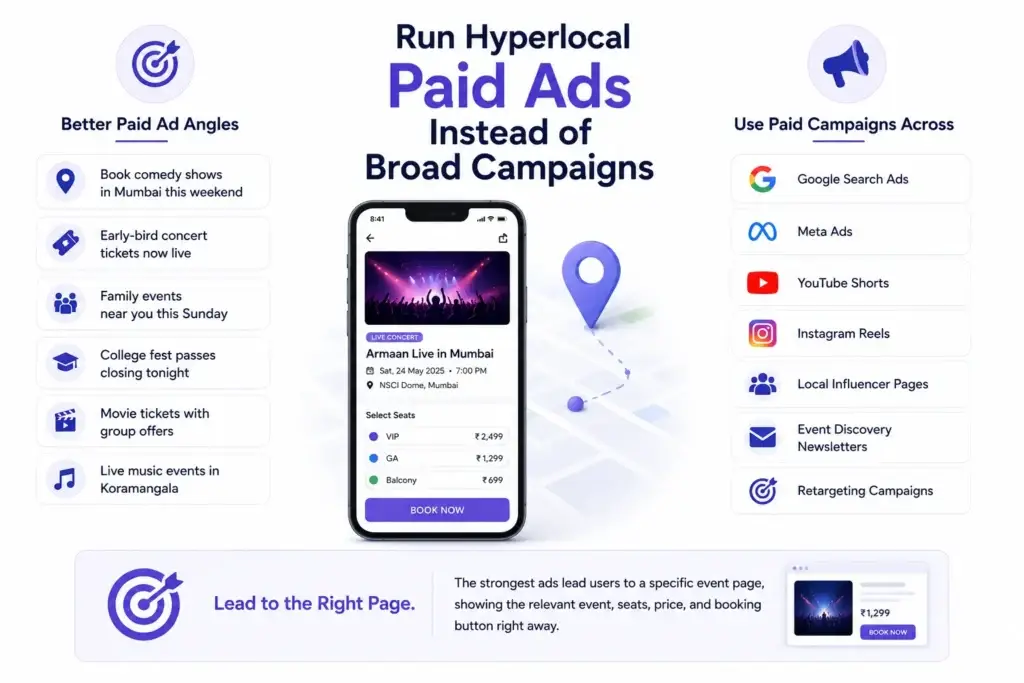
Paid ads can work well for a ticket booking app, but only when the targeting is narrow.
Instead of running broad “download our ticket booking app” campaigns, promote specific events, cities, or categories.
Better paid ad angles include:
- “Book comedy shows in Mumbai this weekend”
- “Early-bird concert tickets now live”
- “Family events near you this Sunday”
- “College fest passes closing tonight”
- “Movie tickets with group offers”
- “Live music events in Koramangala”
Use paid campaigns across:
- Google Search Ads
- Meta Ads
- YouTube Shorts
- Instagram Reels
- Local influencer pages
- Event discovery newsletters
- Retargeting campaigns
The strongest ads lead users to a specific event page, not only the app homepage. When users click an ad, they should immediately see the relevant show, seat options, price, and booking button.
Build Referral Loops Around Group Bookings
Entertainment is social. People rarely attend events alone.
This makes referrals and group booking one of the most powerful growth levers for a BookMyShow clone.
Useful referral campaigns include:
- Invite friends and earn credits
- Group booking discounts
- Split payment options
- Share ticket with friends
- Refer an organizer
- Bring three friends and unlock a cashback
- College ambassador referral codes
- Creator-specific promo codes
- Venue partner referral links
A group booking workflow can also reduce drop-offs. If one user selects an event but needs friends to confirm, the app should make sharing, payment splitting, and reminders easy.
BookMyShow itself has historically added social features such as split costs and split tickets, showing how important group behavior is in ticketing experiences.
Use Influencer and Creator Partnerships
For event platforms, creators are not just marketing channels. They are demand generators.
A BookMyShow clone can partner with:
- Local food and lifestyle influencers
- Comedy creators
- Music creators
- College influencers
- City guide pages
- Sports creators
- Movie reviewers
- Theatre bloggers
- Parenting communities
- Travel and weekend experience creators
The key is to avoid generic influencer promotions. Instead, give creators trackable links, exclusive ticket codes, early access, giveaways, and co-branded event pages.
Example campaigns:
- “Top 10 weekend events curated by [Creator Name]”
- “Creator-only early access concert tickets”
- “Comedy night giveaway with QR ticket redemption”
- “Influencer-curated date night events”
- “College creator passes for campus festivals”
This turns influencers into discovery partners, not just ad publishers.
Turn WhatsApp, Email, SMS, and Push Notifications Into a CRM Engine
Ticket booking is time-sensitive. People need reminders before events sell out, before prices increase, and before the weekend begins.
A strong CRM strategy should include:
- Welcome sequence after signup
- City preference capture
- Category preference capture
- Abandoned booking reminders
- Price drop alerts
- “Selling fast” notifications
- Upcoming weekend recommendations
- Artist-follow alerts
- Venue-follow alerts
- Event reminder before showtime
- Post-event feedback requests
- Rebooking recommendations
- Organizer follow-up campaigns
The goal is not to spam users. The goal is to send relevant, timely, preference-based messages.
Example segments:
| User Segment | Marketing Message |
| Movie fans | “New releases near you this Friday” |
| Comedy fans | “3 stand-up shows in your city this weekend” |
| College students | “Student passes closing tonight” |
| Family users | “Kids’ events near you this Sunday” |
| Concert users | “Early-bird music festival tickets now live” |
| Abandoned checkout users | “Your selected seats may expire soon” |
A ticket booking platform becomes more valuable when it remembers what users like.
Improve App Store Optimization for Ticket Booking Searches
Many founders focus on website SEO but ignore app store discovery.
For a BookMyShow clone, the app listing should target keywords such as:
- ticket booking app
- movie ticket booking
- event booking app
- concert tickets
- events near me
- comedy show tickets
- sports ticket booking
- online ticket booking
App store assets should include:
- Clear app name and subtitle
- City and category-focused screenshots
- Event discovery screenshots
- Seat booking screenshots
- QR ticket screenshots
- Offer and referral screenshots
- Trust-focused payment screenshots
- Regular review generation campaigns
- Fast response to negative reviews
App reviews matter because ticketing involves payments, timing, and trust. Users want confidence that tickets, refunds, and check-ins will work smoothly.
Use Offers Carefully Without Training Users to Wait for Discounts
Discounts can help early growth, but they can also damage revenue quality if overused.
Better offer strategies include:
- First booking credit
- Category-specific cashback
- Weekend bundles
- Student discounts
- Group booking offers
- Early-bird pricing
- Last-minute fill-rate offers
- Loyalty points
- Venue-specific promo codes
- Partner bank offers
Avoid making every campaign discount-led. Ticketing platforms should also market convenience, exclusive access, better discovery, and trusted entry.
A useful rule: use discounts to trigger trial, but use experience to drive retention.
Build B2B Partnerships That Reduce Customer Acquisition Cost
A BookMyShow clone can grow faster by partnering with organizations that already have audiences.
Potential partners include:
- Colleges and universities
- Coworking spaces
- Corporate HR teams
- Residential communities
- Cafes and restaurants
- Gyms and sports clubs
- Tourism boards
- Local media pages
- Radio stations
- Shopping malls
- Cinema chains
- Creator agencies
Partnership campaigns can include:
- Corporate event passes
- Student entertainment cards
- Weekend activity bundles
- Mall event calendars
- Restaurant + event combos
- Hotel + event packages
- Sports tournament booking
- Community festival ticketing
Partnerships work because they turn ticket sales into ecosystem distribution.
Use Retargeting to Recover High-Intent Users
Many users browse events but do not book immediately. They may compare prices, ask friends, wait for salary day, or forget.
Retargeting helps recover this demand.
Build retargeting audiences for:
- Event page viewers
- Seat selection abandoners
- Payment abandoners
- Category page visitors
- City page visitors
- Past buyers
- App installers who did not book
- Users who booked one event but never returned
Retargeting messages should be specific:
- “Still thinking about the concert?”
- “Your comedy show tickets are selling fast”
- “Weekend events near you”
- “New shows added in your city”
- “Book before early-bird pricing ends”
Generic retargeting rarely works. Event-specific retargeting works better because it matches urgency.
Create Category-Led Content Marketing
A BookMyShow clone can use content to become a local entertainment guide.
Strong content formats include:
- Best events this weekend
- Top comedy shows in [City]
- Upcoming concerts in [City]
- Best family activities near you
- Festival ticket guide
- Date night event ideas
- College events calendar
- Artist interviews
- Venue spotlights
- Local movie release guides
- Sports tournament calendars
This supports SEO, social media, newsletters, and push campaigns.
Example blog topics:
- Best Comedy Shows in Mumbai This Weekend
- How to Choose the Right Concert Seats
- Top Family Events in Delhi This Month
- Best New Year Events in Bangalore
- How QR Ticketing Makes Event Entry Faster
- Movie Ticket Booking Trends in Tier 2 Cities
Content should not only attract traffic. It should send users to bookable event pages.
Give Organizers Their Own Growth Dashboard
The organizer side needs marketing too.
If organizers can see their ticket sales, page views, conversion rate, referral sources, audience demographics, and campaign performance, they are more likely to trust the platform.
Organizer dashboards should show:
- Tickets sold
- Revenue generated
- Page views
- Conversion rate
- Top traffic sources
- Discount code usage
- Check-in count
- Refund requests
- Buyer city
- Repeat buyer percentage
- Campaign performance
This turns the platform from a listing tool into a growth partner.
Miracuves’ ready-made and white-label app approach can support founders with admin control, branded workflows, booking modules, and scalable product foundations. Founders can explore the broader Miracuves solutions hub or the entertainment solutions development category to understand how digital entertainment platforms can be structured for launch and growth.
Track the Right Growth Metrics
A BookMyShow clone should not measure growth only by app installs.
Track metrics across the full funnel:
| Funnel Stage | Metrics to Track | Why It Matters |
| Supply | Number of events, venues, organizers, categories | Shows whether users have enough inventory to browse |
| Discovery | SEO traffic, ad clicks, app opens, event page views | Shows whether marketing is creating demand |
| Conversion | Seat selection rate, checkout completion, payment success | Shows whether users can book smoothly |
| Retention | Repeat bookings, category follows, push engagement | Shows whether users return |
| Organizer Success | Tickets sold per organizer, repeat listings, payout satisfaction | Shows whether supply partners stay active |
| Revenue | Commission, convenience fee, ads, featured listings | Shows monetization health |
The most important early-stage question is simple: are users coming back because the platform helps them discover something worth attending?
90-Day Marketing Plan for a BookMyShow Clone
90-Day Growth Plan for a BookMyShow Clone
| Phase | Marketing Focus | Founder Action | Success Signal |
|---|---|---|---|
| Days 1–30 | Supply acquisition | Onboard cinemas, venues, local organizers, and event partners in one city or category. | Enough listings to make the app useful for early users. |
| Days 31–60 | Demand generation | Run local SEO, influencer campaigns, paid ads, referrals, and event-specific social campaigns. | Growing event page views, first bookings, and repeat visits. |
| Days 61–90 | Retention and optimization | Launch CRM flows, remarketing, loyalty rewards, organizer dashboards, and category-based recommendations. | Repeat bookings, lower acquisition cost, and active organizers. |
Founder Decision Signals
Supply
If your city has limited event listings, focus on organizer onboarding before user acquisition.
Discovery
If users cannot find relevant shows quickly, improve SEO pages, filters, categories, and personalization.
Conversion
If users browse but do not book, simplify checkout, reduce payment friction, and improve trust signals.
Retention
If users book once and disappear, build reminders, preference-based alerts, loyalty credits, and category follows.
How Miracuves Helps Founders Launch Ticket Booking Platforms Faster
A BookMyShow clone needs more than a frontend event listing page. It needs booking flows, secure payments, ticket generation, organizer controls, admin dashboards, offers, notifications, QR-based entry, reporting, and scalable backend workflows.
Miracuves helps founders build ready-made and white-label app solutions with source-code ownership where applicable, custom branding, admin control, and faster deployment. For founders planning to launch a ticket booking or entertainment platform, Miracuves can help create a product foundation that supports faster validation and future customization.
Relevant Miracuves pages to explore include:
- Entertainment solutions development
- On-demand services app development
- Custom mobile app development services
- Full-stack app development services
- Ready-made app solutions
Mistakes to Avoid While Marketing a BookMyShow Clone
Running Ads Before Building Supply
If users open the app and find limited events, they may not return. Build enough relevant listings before scaling acquisition.
Competing Only on Discounts
Discounts can trigger first bookings, but long-term growth comes from convenience, exclusive inventory, trust, and better discovery.
Ignoring Organizers After Onboarding
Event partners need visibility, sales support, analytics, check-in tools, and timely payouts. Without organizer success, supply dries up.
Not Tracking Checkout Drop-Offs
Ticketing is urgent. Slow checkout, failed payments, unclear fees, or poor refund communication can hurt conversion quickly.
Final Thoughts: Growth Comes From Inventory, Discovery, and Repeat Bookings
The best marketing strategy for a BookMyShow clone is not one campaign. It is a connected growth system.
You need organizers to list events, users to discover them, payments to work smoothly, reminders to bring people back, and analytics to improve every campaign. You also need trust because users are paying for time-sensitive experiences.
Founders who treat marketing as an afterthought will struggle even with a strong app. Founders who build marketing into the product foundation can grow faster: city pages for SEO, organizer dashboards for supply retention, referral links for group bookings, CRM alerts for repeat demand, and data-led campaigns for better conversion.
A BookMyShow clone can give startups a faster product foundation. The marketing strategy decides whether that foundation becomes a real ticket booking business.
Disclaimer: BookMyShow is a trademark of its respective owner. This article uses the term “BookMyShow clone” only to describe a ticket booking app model for educational and comparison purposes. Miracuves is not affiliated with, endorsed by, or connected to BookMyShow.
FAQs
1. What is a BookMyShow clone?
A BookMyShow clone is a ticket booking platform inspired by BookMyShow’s core model. It can include movie ticket booking, event listings, seat selection, secure payments, QR tickets, organizer dashboards, admin controls, offers, and user notifications.
2. How do I market a BookMyShow clone app?
Start with city-level supply acquisition, onboard cinemas and event organizers, create SEO-friendly event pages, run hyperlocal ads, use influencer partnerships, launch referral campaigns, and build CRM flows through push notifications, WhatsApp, SMS, and email.
3. What is the best first marketing channel for a ticket booking platform?
The best first channel depends on your launch wedge. For local events, city-level SEO, influencer partnerships, and organizer networks work well. For movies, cinema partnerships and search ads may be stronger. For college events, campus ambassadors and referral codes can perform better.
4. How can a BookMyShow clone attract event organizers?
Offer organizers easy event listing, QR ticketing, secure payments, promotional support, analytics, payout tracking, featured placement, and audience insights. The platform should make ticket selling easier than manual or fragmented tools.
5. Should a BookMyShow clone offer discounts?
Yes, but carefully. Discounts can help with first bookings, group bookings, student campaigns, and early-bird sales. However, the platform should not depend only on discounts. Long-term growth needs strong discovery, trust, inventory, and user experience.
6. How can a ticket booking platform improve repeat bookings?
Use category preferences, city-based recommendations, artist alerts, venue follows, abandoned booking reminders, event reminders, loyalty points, and post-event suggestions. Repeat booking depends on relevance and timing.
7. What metrics should a BookMyShow clone track?
Track event supply, active organizers, event page views, seat selection rate, checkout completion, payment success rate, repeat bookings, referral usage, campaign conversion, refund requests, and organizer retention.
8. How does Miracuves help with BookMyShow clone development?
Miracuves helps founders launch ready-made and white-label ticket booking and entertainment app solutions with branding, admin control, booking workflows, secure payment integration, and source-code ownership where applicable.