
Key Takeaways
- Pre-built ticketing platform vs custom software is mainly a trade-off between faster implementation with existing modules and deeper control through ground-up development.
- A pre-built foundation can include event listings, seat booking, payments, digital tickets, QR validation, organizer dashboards, refunds, promotions, and admin operations.
- The right approach depends on budget, customization requirements, technical resources, source-code access, integration complexity, scalability needs, and how differentiated the ticketing model must be.
Cost & Control Signals
- Pre-built software can reduce repeated engineering across authentication, event management, inventory, checkout, payment workflows, ticket generation, notifications, and administrative tools.
- Custom development provides greater freedom over architecture, booking logic, seat maps, pricing rules, organizer workflows, integrations, user experience, and specialized event operations.
- Founders should compare initial development cost with long-term expenses for hosting, maintenance, upgrades, integrations, security testing, technical support, and future feature expansion.
Launch Risk Insights
- Building from scratch introduces more development and testing dependencies across seat inventory, concurrent bookings, payment failures, refunds, ticket issuance, and entry validation.
- A customizable pre-built foundation can reduce implementation risk, but founders should still test scalability, source-code quality, security, customization limits, data ownership, and third-party dependencies.
- Miracuves develops customizable ticketing platforms with event discovery, seat booking, payments, digital tickets, organizer management, entry validation, analytics, scalability, and admin controls.
Choosing between a pre-built ticketing platform and custom software is not only a technical decision. For founders, event companies, cinema operators, venue owners, and entertainment startups, it affects launch speed, budget control, product ownership, operational risk, and how quickly the business can start learning from real ticket buyers.
A ticketing platform may look simple from the outside. Users search for events, select tickets, pay online, and receive a QR code. But behind that experience are seat maps, ticket inventory, payment confirmations, refund rules, organizer dashboards, check-in workflows, admin controls, campaign tools, and reporting systems. Readers who are still exploring the basics of an online ticket booking platform can first understand how the user, organizer, and admin workflows connect before comparing development routes.
That is why the real question is not, “Can we build a ticketing platform?” The better question is, “Which development route gives us the right balance of speed, control, cost, and launch confidence?”
This guide breaks down the difference between pre-built ticketing platforms and custom ticketing software so founders can make a smarter product decision before committing budget.
What Is a Pre-Built Ticketing Platform?
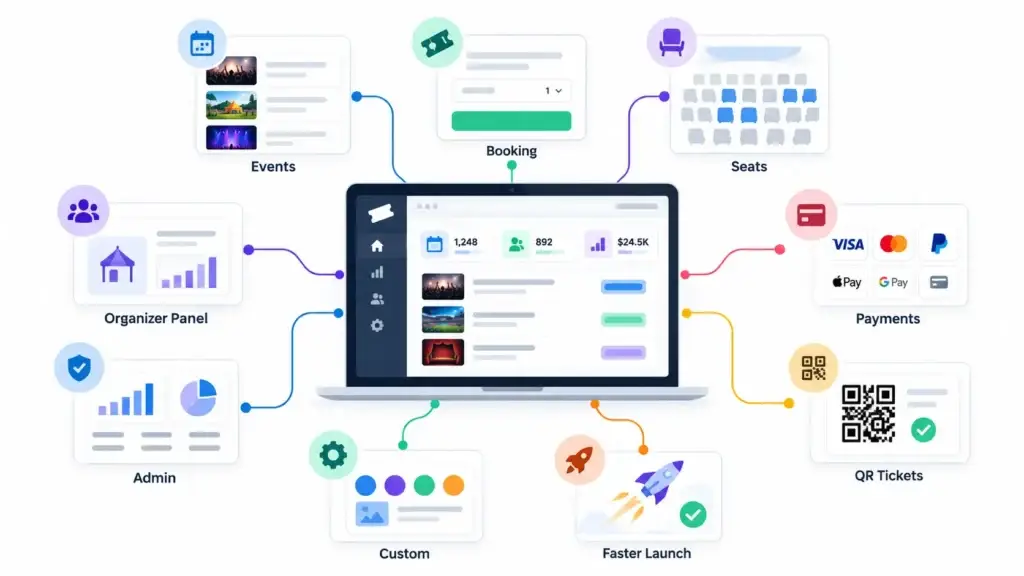
A pre-built ticketing platform is a ready-made software foundation that already includes the core workflows needed to run an online ticket booking business. Instead of starting with a blank development roadmap, the founder begins with existing modules such as event listing, ticket booking, seat selection, payment integration, QR ticket generation, vendor panels, and admin dashboards.
This does not mean every business launches with the same product. A good pre-built platform should still support branding, configuration, feature customization, payment setup, and operational changes. The main difference is that the basic ticketing engine is already available, so the project moves faster.
For a founder, this matters because the first version of a ticketing business is usually about market validation. You need to know whether organizers will list events, whether buyers will trust your checkout, whether venues can manage entry, and whether your team can operate bookings without chaos.
A pre-built ticketing platform is useful when speed, cost-efficiency, and reduced development uncertainty are more important than building every workflow from a blank file.
What Is Custom Ticketing Software?
Custom ticketing software is built specifically for one business from the ground up. The development team defines the product architecture, database structure, user flows, payment logic, event rules, admin controls, and integrations based on the founder’s exact requirements.
This route gives more flexibility, especially when the business model is unusual. For example, a platform may need complex membership passes, venue-specific access control integrations, offline counter sales, multi-brand event operations, unique settlement logic, loyalty rules, or deep enterprise reporting.
The tradeoff is that custom software requires more discovery, more testing, more quality assurance, more stakeholder alignment, and more launch risk. Every module has to be planned, built, reviewed, debugged, and improved before the platform can handle real users.
Custom development can be the right path, but founders should choose it because the business model truly needs it, not because “custom” sounds more premium.
The Real Difference Is Not Design. It Is Risk.
Many founders compare ticketing platforms by looking at screens. They check whether the homepage looks modern, whether the event cards look attractive, and whether the checkout flow feels smooth.
Those things matter, but they are not the hardest parts of ticketing.
The real pressure appears when multiple users try to book the same seat, when a payment succeeds but the ticket confirmation fails, when a buyer requests a refund, when a vendor wants settlement visibility, when the QR scanner faces poor network conditions, or when the admin team needs to pause a listing quickly.
A ticketing platform is not just a storefront. It is an operations system.
That is why the stronger comparison is not “pre-built vs custom design.” It is:
- Which option protects launch speed?
- Which option reduces technical uncertainty?
- Which option gives the founder enough control?
- Which option makes future scaling easier?
- Which option keeps cost predictable?
- Which option supports real event operations?
Pre-Built Ticketing Platform vs Custom Software: Quick Comparison
| Decision Area | Pre-Built Ticketing Platform | Custom Ticketing Software |
|---|---|---|
| Launch Speed | Faster because core modules already exist | Slower because modules are built from scratch |
| Upfront Cost | Usually more cost-efficient | Usually higher due to discovery, design, development, QA, and testing |
| Product Control | Strong if source code and admin control are included | High, but depends on technical ownership and documentation |
| Customization | Suitable for branding, workflows, integrations, and feature adjustments | Suitable for highly specific or unusual business logic |
| Launch Risk | Lower when the foundation is already tested | Higher because every module must be validated before launch |
| Scalability | Depends on architecture, database, APIs, and infrastructure setup | Can be deeply optimized if planned properly |
| Maintenance | Easier when documentation and source code are provided | Requires long-term development and technical management |
| Best For | Founders who want faster validation and practical control | Businesses with complex workflows that cannot fit a reusable foundation |
How Cost Changes Between Both Options
Cost changes because the two options use different starting points.
With custom software, the team has to create the product foundation from zero. That includes requirement planning, UX design, backend development, frontend development, mobile app development, admin panel setup, database architecture, payment gateway integration, event inventory logic, testing, deployment, and post-launch improvements.
With a pre-built ticketing platform, many of these modules already exist. The budget is then focused more on branding, configuration, customization, deployment, payment setup, feature refinement, and launch preparation.
This is why founders should not compare only the invoice amount. They should compare the full cost of reaching a usable launch.
A lower development estimate can become expensive if the team later discovers missing modules, poor seat-locking logic, weak admin controls, broken refund flows, or limited reporting. In ticketing, hidden cost often appears after the platform is exposed to real transactions. Founders can review the main ticketing platform cost drivers before deciding whether a pre-built foundation or custom build makes better financial sense.
Cost Factors Founders Should Evaluate
| Cost Factor | Why It Matters |
|---|---|
| Seat map complexity | Reserved seating requires accurate inventory states and clear buyer experience |
| Payment gateway setup | Failed or delayed payment confirmation can damage buyer trust |
| QR ticket validation | Entry workflows must be fast enough for real venues |
| Organizer dashboard | Event partners need visibility into bookings, revenue, and ticket status |
| Admin control | Operators need tools to manage listings, users, refunds, disputes, and reports |
| Custom branding | The platform should build trust under your own business identity |
| Integrations | CRM, marketing tools, accounting, SMS, email, and analytics can affect cost |
| Scalability planning | Launch-day spikes require stronger backend and infrastructure decisions |
The founder’s goal should be to avoid paying repeatedly for the same basic ticketing modules and instead invest in the parts that create market differentiation.
How Control Changes Between Both Options
Control is one of the most misunderstood parts of this decision.
Some founders assume custom software always gives more control. That is not always true. A custom project can still create dependency if the code is poorly documented, if deployment access is unclear, if the vendor controls the repository, or if the business cannot maintain the platform without the original development team.
On the other side, a pre-built ticketing platform can offer strong control when it includes source-code ownership, admin access, deployment documentation, and the ability to customize the product.
For founders, control should mean practical operating power:
- Can you manage events without asking developers?
- Can you onboard organizers and venues?
- Can you configure commissions, fees, and categories?
- Can you access booking reports?
- Can you manage refunds and cancellations?
- Can your technical team modify the code later?
- Can you change the platform as your business grows?
A ready-made solution from Miracuves is useful in this area because founders can start with a white-label ticketing foundation while still keeping ownership and admin control. For teams evaluating a faster route, the ready-made event ticketing solution from Miracuves gives a practical next step without turning this blog into a product page.
How Launch Risk Changes Between Both Options
Launch risk is the risk that your platform is technically built but not operationally ready.
In ticketing, launch risk is high because errors are visible immediately. A failed checkout, double-booked seat, delayed confirmation, or broken QR scan creates frustration for buyers and organizers at the exact moment trust matters most.
Custom software carries launch risk because every workflow is new. Even a skilled team needs time to test seat holds, payment states, refund scenarios, admin actions, ticket scanning, email/SMS notifications, and peak traffic behavior.
A pre-built platform reduces some of that risk because core workflows are already structured. However, the founder still needs to test business-specific settings such as payment gateway choice, event categories, organizer onboarding, refund policy, pricing rules, and infrastructure readiness.
The safest approach is not simply choosing the fastest option. It is choosing the option where the important risks are already understood before launch.
Why Ticketing Platforms Need Strong Admin Control
The admin dashboard is where the platform operator runs the business. A beautiful customer-facing app is not enough if the backend is weak.
For a ticketing business, the admin panel should help manage:
- Users and buyer accounts
- Event organizers and venue partners
- Event categories and listings
- Ticket types and pricing
- Seat inventory and booking status
- Payments and refunds
- Commission rules
- Coupons and promotions
- QR validation records
- Reports and analytics
- Disputes and support requests
A deeper breakdown of ticketing platform features and modules can help founders understand which workflows should be available before launch and which modules can be customized later based on market response.
This control layer matters because ticketing is time-sensitive. If a showtime changes, a listing needs review, or a refund issue appears, the operator cannot wait for development support every time.
A strong admin dashboard turns the platform from a simple booking interface into a manageable business system.
When a Pre-Built Ticketing Platform Makes More Sense
A pre-built platform makes more sense when the founder wants to launch faster, validate demand, and avoid unnecessary technical risk.
It is usually a practical choice when:
- The business model follows standard ticket booking workflows
- The founder wants to start with movies, events, plays, activities, or venue-based bookings
- The team wants white-label branding
- The platform needs customer, organizer, and admin workflows
- The founder wants source-code ownership instead of platform dependency
- The launch goal is measured in days or weeks, not long custom cycles
- The business needs a working foundation before investing in deeper custom features
This approach is especially useful when the founder already understands the market opportunity but does not want to spend months building basic ticketing infrastructure.
Miracuves supports this route with a 6-day delivery approach for ready-made solutions, helping founders move from planning to market validation faster.
When Custom Ticketing Software Makes More Sense
Custom software makes more sense when the product logic cannot fit a reusable foundation.
This may happen when the business needs advanced venue hardware integrations, unusual ticketing rules, complex enterprise workflows, multi-region compliance logic, custom loyalty engines, deep data pipelines, or highly specialized access control systems.
Custom development may also be useful when the ticketing platform itself is the company’s core intellectual property and the founder wants to design a unique technical architecture from the beginning.
However, custom software should be selected with realistic expectations. It requires detailed scope planning, stronger technical management, longer QA cycles, budget flexibility, and post-launch maintenance planning.
A founder should choose custom development when the business requirement justifies the added time and complexity.
Founder Decision Signals
Speed
If your goal is to test organizer demand and buyer conversion quickly, a launch-ready foundation can reduce the time spent building standard ticketing flows.
Cost
If your budget should go toward market validation, branding, partnerships, and growth, avoid spending too much on modules that already exist in a pre-built foundation.
Control
Choose an option that gives admin access, source-code ownership, clear documentation, and room for future customization.
Launch Risk
Ticketing platforms must handle booking states, payments, refunds, and entry validation correctly before real users arrive.
What Founders Often Underestimate in Ticketing Software
Ticketing businesses have operational details that are easy to miss during planning.
1. Seat Inventory Is a Business-Critical System
Seat inventory must stay accurate when multiple buyers act at the same time. If two users can book the same seat, the issue becomes a customer support problem, a venue problem, and a brand trust problem.
Seat inventory must stay accurate when multiple buyers act at the same time. If two users can book the same seat, the issue becomes a customer support problem, a venue problem, and a brand trust problem. For a deeper technical view, founders can study seat inventory management in event ticketing platforms before finalizing their development scope.
2. Payment Status Must Match Ticket Status
A ticketing platform must clearly handle successful payments, failed payments, pending confirmations, expired holds, refunds, and cancellations. Weak payment logic creates confusion for buyers and admin teams.
3. Organizers Need More Than Listings
Event organizers need dashboards, booking data, sales visibility, payout information, attendee lists, and communication support. Without these tools, the platform becomes harder to scale.
4. Entry Validation Has to Work Under Pressure
QR validation must be fast and reliable because entry happens in a crowded, time-sensitive environment. A slow check-in process can damage the event experience even if the booking flow worked well. The complete ticket booking journey from seat hold to check-in is worth reviewing because every step affects buyer trust, venue operations, and platform reliability.
5. Marketing Depends on Platform Readiness
Promotions, referral campaigns, coupons, featured listings, and loyalty programs are only useful when the platform can support them operationally. Marketing cannot fix weak booking infrastructure. Once the booking engine, payment flow, organizer dashboard, and reporting layer are stable, founders can start planning ticketing platform marketing strategies around events, venues, offers, and repeat buyers.
Cost vs Control vs Risk: The Practical Founder Matrix
| Founder Priority | Better-Fit Option | Why |
|---|---|---|
| Fast launch | Pre-built ticketing platform | Core booking workflows are already available |
| Lowest uncertainty | Pre-built ticketing platform | Fewer modules need to be created from zero |
| Highly unique workflows | Custom software | Better for unusual product logic |
| Full product differentiation | Custom software | More room for original architecture and custom features |
| Market validation | Pre-built ticketing platform | Faster route to test buyers, organizers, and operations |
| Long-term technical ownership | Depends on source code | Ownership matters more than whether the build is pre-built or custom |
| Complex enterprise integrations | Custom software | More suitable when deep system integration is required |
| Branded launch with admin control | Pre-built platform with customization | Balances speed, ownership, and operational readiness |
The build decision should also connect with the ticketing platform business model, because commission logic, organizer payouts, booking fees, featured listings, coupons, and subscription options affect how the platform earns after launch.
How to Choose the Right Route
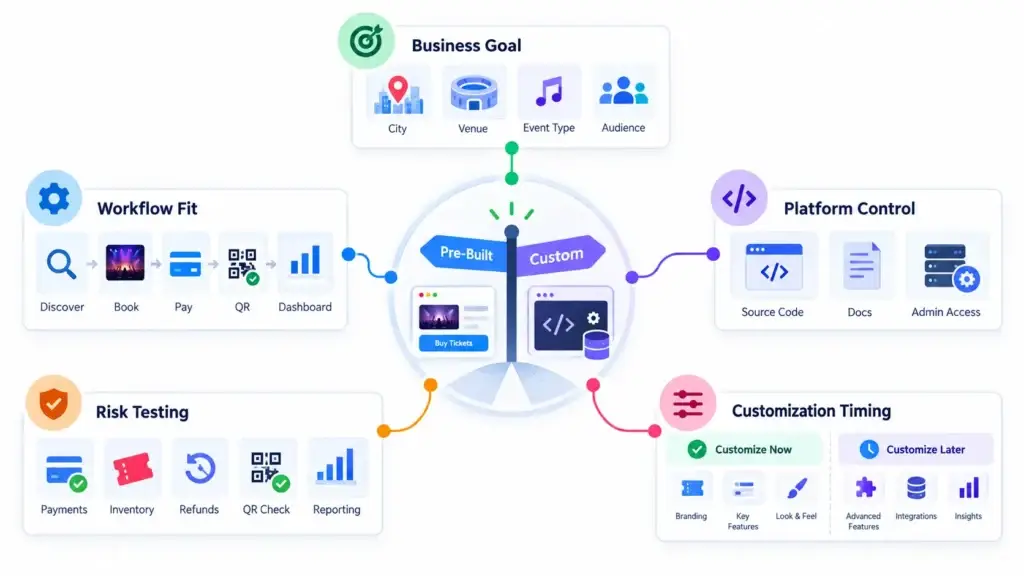
Before choosing between a pre-built ticketing platform and custom software, founders should answer five questions.
First, what is the immediate business goal? If the goal is to validate a city, venue network, event category, or audience segment, speed matters. A pre-built foundation may be enough to begin.
Second, how different is the required workflow? If the platform needs standard discovery, booking, payments, QR tickets, organizer dashboards, and admin control, custom development may not be necessary at the start.
Third, who will maintain the platform after launch? Source code, documentation, and admin access matter because the founder should not become dependent on one team for every operational change. This is also where choosing the right ticketing platform development partner becomes important, because handover quality, QA, documentation, and technical support directly affect long-term control.
Fourth, what risks must be tested before real events? Payment confirmation, ticket inventory, refunds, QR validation, and partner reporting should be tested early.
Fifth, what should be customized now versus later? Many founders delay launch by trying to perfect every feature before learning what the market actually needs.
How Miracuves Fits Into This Decision
Miracuves helps founders who want a faster, more controlled route to launching an online ticketing platform. Instead of building every module from zero, founders can start with a white-label, source-code-owned foundation and customize it around their brand, event model, organizer workflows, and growth strategy.
This is useful when the founder wants the advantages of a pre-built product without giving up control over branding, admin operations, or future customization.
For teams comparing both routes, the Miracuves ticket booking platform foundation can be used as the commercial next step after understanding the cost, control, and launch-risk tradeoffs explained in this guide.
Mistakes Founders Should Avoid
Choosing Custom Development Without a Clear Reason
Custom development is useful when the business model requires it. But choosing custom software only because it feels more advanced can increase cost and delay market learning.
Ignoring Source-Code Ownership
A founder should understand who owns the source code, who controls deployment, and whether the platform can be modified later. Ownership affects long-term flexibility.
Treating Ticketing as a Simple Checkout Flow
Ticketing is not just payment collection. It includes ticket states, entry validation, organizer dashboards, refunds, capacity rules, and admin governance.
Launching Without Operational Testing
Before launch, the team should test booking, payment, ticket confirmation, cancellation, refund, organizer reporting, and QR validation flows.
Overbuilding Before Market Validation
A founder does not need every advanced feature on day one. The stronger approach is to launch with the right foundation, learn from users, and then expand based on real demand.
Final Thoughts
The choice between a pre-built ticketing platform and custom software depends on what the founder needs most right now.
If the business needs highly specialized workflows, deep integrations, or original product architecture, custom software may be the better long-term route. But if the goal is to launch faster, reduce development uncertainty, control cost, and validate demand, a pre-built ticketing platform can be a more practical starting point.
The strongest decision is not always the longest build. It is the build that gets the right product into the market with enough control, enough stability, and enough room to grow.
For founders planning to launch an event booking business, Miracuves offers a faster route through a branded, source-code-owned ticketing platform foundation that can be customized around the business model.
FAQs
What is the difference between a pre-built ticketing platform and custom ticketing software?
A pre-built ticketing platform starts from an existing software foundation with core modules such as event listings, ticket booking, payments, QR tickets, organizer panels, and admin controls. Custom ticketing software is built from scratch around specific business requirements.
Is a pre-built ticketing platform suitable for startups?
Yes, it can be suitable for startups that want to launch faster, test event categories, onboard organizers, and validate buyer demand without spending months building every module from zero.
Does custom ticketing software give more control?
Custom software can give strong control, but only when source code, documentation, deployment access, and maintenance planning are handled properly. A pre-built platform can also offer strong control if source-code ownership and admin access are included.
What increases the cost of ticket booking platform development?
Cost usually increases with advanced seat maps, multiple payment gateways, QR validation logic, organizer dashboards, refund workflows, loyalty features, infrastructure needs, reporting, and third-party integrations.
Which option is faster to launch?
A pre-built ticketing platform is usually faster because the core ticketing workflows already exist. Miracuves highlights 6-day delivery for ready-made solutions where the launch scope matches the available product foundation.
When should a founder choose custom ticketing software?
Custom software makes sense when the business requires unusual ticketing rules, complex enterprise integrations, custom access-control systems, or a product architecture that cannot fit a reusable platform foundation.
How does this blog support the money page?
This blog targets comparison and decision-stage queries around cost, control, and launch risk. It does not repeatedly target the money page’s primary terms. Instead, it guides readers toward the money page through contextual internal links when they are ready to evaluate the Miracuves solution.
Miracuves is an independent software development company. We are not affiliated with, connected to, sponsored by, or endorsed by any company or product named in this article.
Terms such as “X Clone” are used descriptively. It is how the software industry refers to building a platform with functionality comparable to a known service, and how clients search for it.
The entire design and codebase of our products is built by our own team. Our products contain no code, design, graphics, or content originating from any third-party website or applications.
All third-party names and marks referenced in this article are the property of their respective owners, referenced solely to identify the services discussed.