


Key Takeaways
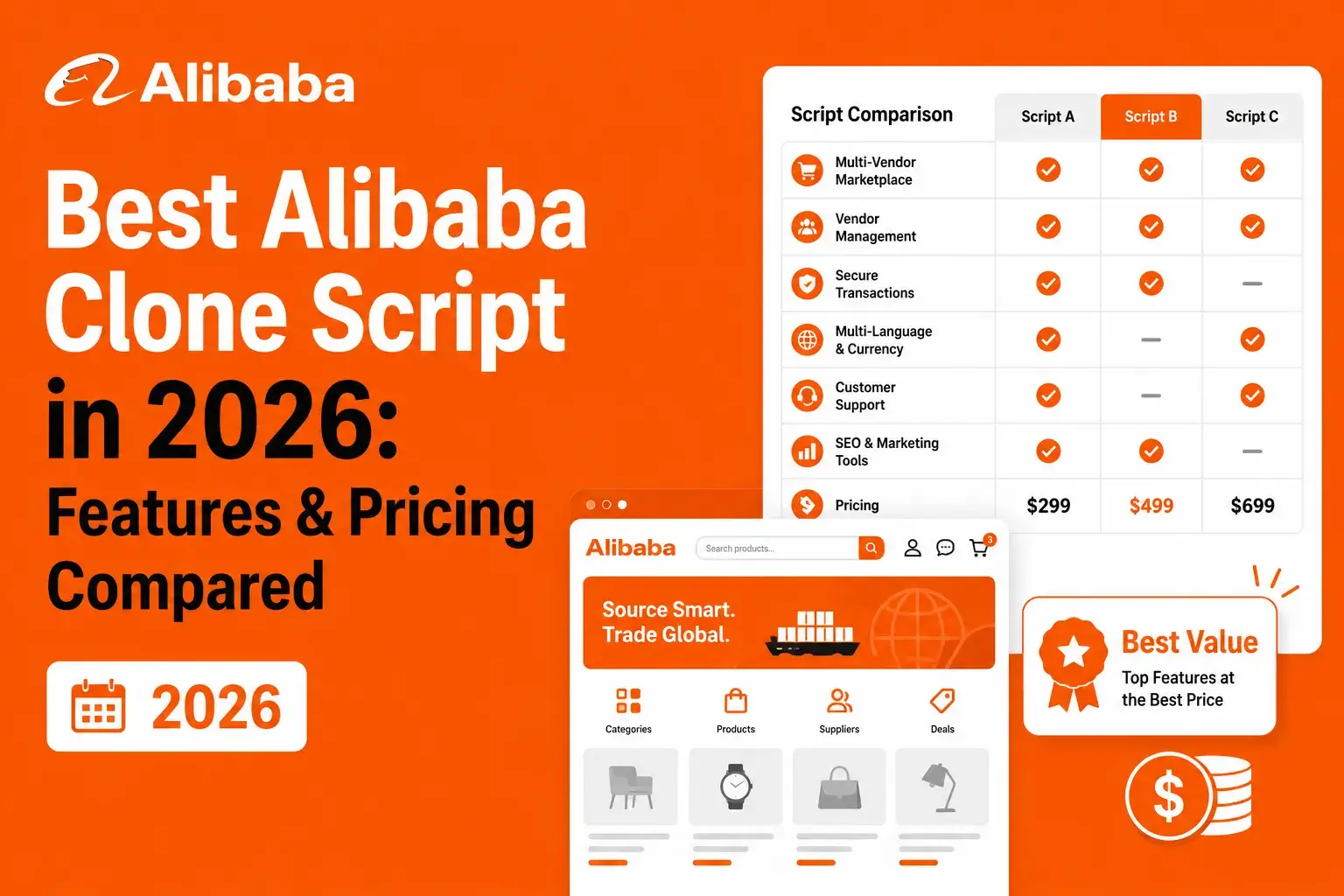
- An Alibaba clone script helps founders launch a B2B marketplace with buyer, supplier, product, RFQ, order, payment, and admin management features.
- The best Alibaba clone solution should support bulk orders, supplier profiles, MOQ pricing, quote requests, product catalogs, and buyer-supplier communication.
- Pricing depends on features, mobile apps, payment gateways, customization, source code access, hosting setup, and post-launch support.
- Founders should compare Alibaba clone scripts by real marketplace operations, not only by design, demo screens, or low upfront cost.
- A scalable B2B marketplace needs supplier verification, admin control, inventory logic, secure payments, analytics, and flexible monetization options.
Alibaba Clone Feature Signals
- Buyer features should include product search, supplier discovery, RFQ submission, order tracking, wishlist, chat, and secure checkout.
- Supplier features should include product listing, bulk pricing, MOQ setup, quote management, inventory updates, order handling, and business profile control.
- Admin features should manage vendors, buyers, commissions, categories, products, payments, disputes, reports, approvals, and platform settings.
- A strong RFQ system allows buyers to request custom pricing while suppliers respond with quotes based on quantity, location, and fulfillment terms.
- Marketplace performance depends on search filters, product categorization, vendor approval flows, payment security, mobile usability, and scalable backend architecture.
Real Insights
- An Alibaba clone is not just an ecommerce website; it is a supplier-driven B2B marketplace built for wholesale trade, negotiation, and repeat buying.
- Low-cost scripts may look attractive, but missing RFQ, vendor control, source code, or support can increase long-term development costs.
- Founders should choose a script that matches their business model, whether they need B2B-only, B2B plus B2C, regional wholesale, or niche supplier marketplace operations.
- Revenue can come from supplier subscriptions, commissions, featured listings, RFQ access, verified badges, advertising, and premium vendor plans.
- Miracuves offers an Alibaba Clone solution starting at $2,899 with PHP technology and a 6-day launch timeline for founders who want faster marketplace deployment.
Launching a B2B marketplace like Alibaba is no longer limited to large enterprises with massive development budgets. Today, founders, wholesalers, manufacturers, exporters, distributors, and niche marketplace startups can use a ready-made Alibaba clone script to launch a supplier-buyer marketplace faster and at a lower starting cost.
An Alibaba clone script helps businesses build a multi-vendor B2B marketplace where buyers can discover suppliers, send inquiries, request quotations, compare products, negotiate prices, place bulk orders, and manage trade transactions from one platform.
But choosing the right Alibaba clone script is not only about buying software. Founders must check whether the platform supports real B2B workflows such as RFQ, MOQ, bulk pricing, supplier verification, custom invoices, admin control, payment management, dispute handling, and source-code ownership.
In this guide, we will explain the key features, pricing factors, RFQ workflow, revenue models, security needs, and selection checklist founders should review before choosing an Alibaba clone script in 2026.
What Is an Alibaba Clone Script and How Does It Work?
An Alibaba clone script is a ready-made B2B marketplace software solution that allows founders to launch an online wholesale marketplace similar to Alibaba. It usually includes buyer panels, supplier dashboards, admin controls, product catalog management, inquiry systems, payment integration, order tracking, and vendor management features.
Instead of building every marketplace module from scratch, founders can use a ready-made Alibaba Clone solution to reduce development time, control cost, and launch faster.
A typical Alibaba clone script works through three main user roles:
- Buyers search products, view supplier profiles, send inquiries, request quotes, compare pricing, and place orders.
- Suppliers list products, manage catalogs, respond to RFQs, handle orders, and track leads.
- Admins manage vendors, buyers, categories, payments, commissions, disputes, approvals, and marketplace performance.
This structure makes the platform useful for many B2B business models, including wholesale product marketplaces, manufacturer-to-buyer platforms, export-import marketplaces, supplier discovery platforms, industrial product marketplaces, and niche B2B trade portals.
For founders who want faster market entry, the Miracuves Alibaba Clone solution provides a ready-made foundation to launch and customize an Alibaba-style B2B marketplace.
Why Founders Are Choosing Alibaba-Like B2B Marketplaces in 2026
B2B buying has changed. Businesses no longer want to depend only on trade shows, offline supplier contacts, WhatsApp groups, phone calls, and manual quotation systems. Buyers now expect digital supplier discovery, product comparison, verified seller profiles, quick communication, bulk pricing, and secure order workflows.
This shift creates strong opportunities for founders who want to build niche Alibaba-like marketplaces.
Instead of competing directly with Alibaba at a global level, founders can focus on a specific category, region, buyer group, or supplier segment. For example, a founder can launch a B2B marketplace for:
- Industrial tools
- Apparel and textile suppliers
- Food and grocery wholesalers
- Furniture manufacturers
- Auto parts suppliers
- Electronics components
- Construction materials
- Beauty and cosmetic manufacturers
- Medical equipment suppliers
- Packaging material suppliers
- Agricultural product suppliers
A focused B2B marketplace can perform better than a broad marketplace because it solves a specific trade problem. Buyers get relevant suppliers, and sellers receive more qualified business leads.
That is why an Alibaba clone script is useful for founders who want to launch a marketplace quickly, validate demand, onboard suppliers, and build a category-focused B2B platform.
Read More: How to Build a Multi-Vendor Inventory Management Database for B2B Apps
Core Alibaba Clone Features That Help Buyers, Suppliers, and Admins Manage B2B Trade
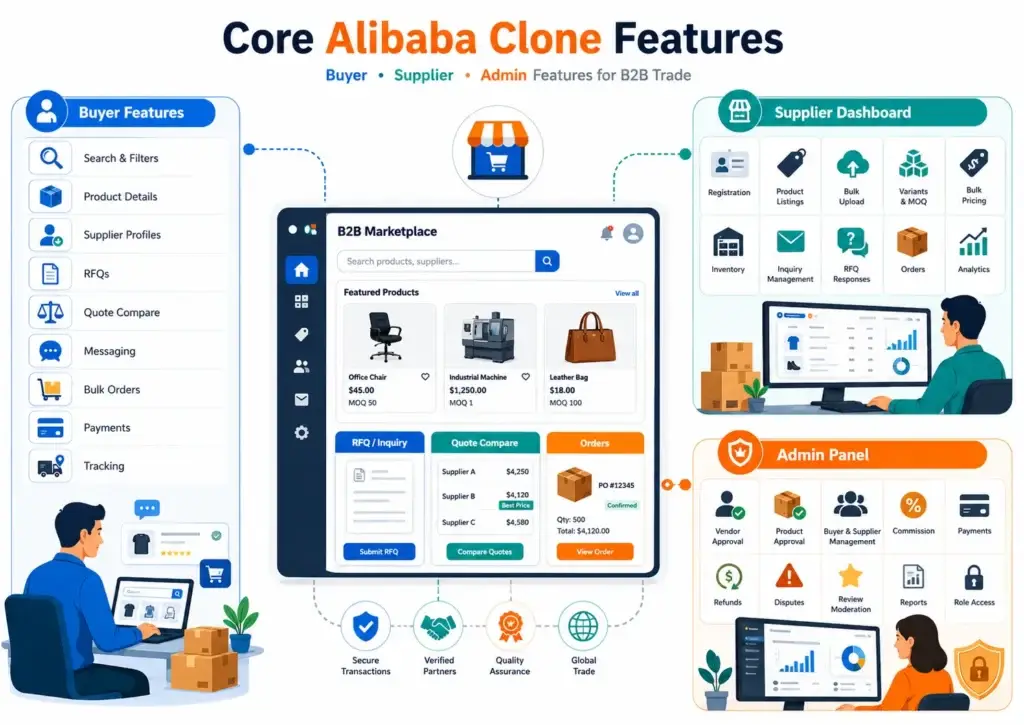
An Alibaba-like marketplace needs more than basic product listings. It must support the complete B2B trade journey, from supplier discovery and buyer inquiries to quotation requests, bulk orders, payments, admin approvals, and marketplace governance.
A strong Alibaba clone script should give buyers a smooth way to find and compare suppliers, help suppliers manage products and leads, and give admins enough control to maintain trust across the marketplace.
Buyer-Side Features for Product Discovery, RFQs, and Bulk Orders
The buyer side should make it easy for business buyers to search products, compare suppliers, ask questions, and request pricing before placing an order. In B2B trade, buyers rarely behave like retail customers. They usually review product specifications, check supplier profiles, compare minimum order quantities, discuss pricing, and confirm terms before payment.
Key buyer-side features include:
- Product search, category browsing, advanced filters, supplier profiles, and product detail pages.
- RFQ submission, inquiry forms, quote comparison, buyer-supplier messaging, and bulk order requests.
- Order placement, payment options, order tracking, invoice downloads, reviews, ratings, and a buyer dashboard.
The important point is that an Alibaba clone script should not force every buyer into a simple “add to cart and checkout” flow. B2B buyers need quotation-based buying, custom pricing, supplier discussion, and order confirmation before they commit to larger purchases.
Supplier Dashboard Features for Products, Quotes, Orders, and Leads
Suppliers are the foundation of a B2B marketplace. If the supplier dashboard is weak, vendors will struggle to upload products, respond to leads, manage pricing, update inventory, and process orders efficiently.
Key supplier-side features include:
- Business profile setup, product listing management, bulk product upload, product images, videos, variants, and inventory control.
- MOQ setup, bulk pricing, inquiry management, RFQ response panel, quote management, and order management.
- Invoice management, payment history, shipping status updates, product approval status, supplier analytics, and customer review management.
This dashboard should help suppliers run their marketplace operations without depending on the admin for every small update. Suppliers should be able to add products, respond to buyer inquiries, adjust pricing, manage orders, and track business performance from one place.
Admin Panel Features for Vendor Approval, Product Control, Payments, and Reports
The admin panel gives the marketplace owner control over platform quality, supplier trust, payment flow, disputes, and overall marketplace performance. For a B2B marketplace, this control layer is critical because fake listings, poor supplier quality, delayed payments, or unresolved disputes can quickly damage buyer confidence.
Key admin-side features include:
- Buyer management, supplier management, seller approval, product approval, and category management.
- Commission management, inquiry monitoring, order monitoring, payment management, refund handling, and dispute management.
- Banner management, content control, review moderation, notifications, CMS pages, reports, analytics, and role-based admin access.
With the right admin controls, founders can manage marketplace quality, reduce fake listings, approve verified suppliers, monitor revenue, resolve disputes, and maintain trust between buyers and sellers as the platform grows.
B2B Marketplace Features That Make an Alibaba Clone Different from a Normal Ecommerce App
A normal ecommerce app focuses on fixed-price products, carts, checkout, and customer orders. An Alibaba-like marketplace is different because B2B buyers often need custom pricing, bulk quantities, supplier negotiation, invoices, purchase terms, and trust verification.
That is why a strong Alibaba clone script must include B2B-specific features, not only regular multi-vendor ecommerce features.
RFQ Workflow for Custom Price Requests and Supplier Negotiation
RFQ stands for Request for Quotation. It is one of the most important features in an Alibaba-style marketplace.
A typical RFQ workflow works like this:
- Buyer selects a product or category
- Buyer submits quantity, requirements, delivery location, and expected timeline
- Suppliers receive the RFQ
- Suppliers respond with pricing and terms
- Buyer compares quotations
- Buyer negotiates with selected suppliers
- Buyer confirms the order
This workflow is important because many B2B products do not have one fixed price. Pricing may depend on order quantity, customization, packaging, delivery location, production time, and supplier availability.
Without RFQ, an Alibaba clone becomes only a normal product listing website. With RFQ, it becomes a real B2B trade platform.
MOQ and Bulk Pricing Logic for Wholesale Buyers
MOQ means Minimum Order Quantity. It defines the minimum number of units a buyer must purchase from a supplier.
For example:
- Minimum order: 100 pieces
- Price for 100–499 units: $5 per unit
- Price for 500–999 units: $4.50 per unit
- Price for 1,000+ units: $4 per unit
This type of bulk pricing is common in B2B trade. Buyers expect better pricing when they order larger quantities.
A strong Alibaba clone script should allow suppliers to set MOQ and quantity-based pricing. This helps vendors manage wholesale pricing more clearly and helps buyers understand cost differences before sending inquiries.
Hide Pricing and Inquiry-Based Buying for B2B Products
In many B2B categories, suppliers do not want to show fixed prices publicly. Pricing may depend on buyer type, country, order volume, customization, raw material cost, and delivery terms.
That is why hide pricing and inquiry-based buying are useful features.
Instead of showing a fixed price, the product page can show options like:
- Request price
- Send inquiry
- Get quote
- Contact supplier
- Ask for bulk pricing
This makes the platform more suitable for wholesale products, manufacturing orders, export deals, and high-value B2B transactions.
Custom Invoices, Purchase Orders, and Downloadable Trade Documents
B2B transactions often need more documentation than regular ecommerce orders. Buyers may need invoices, purchase orders, supplier documents, product specifications, tax details, and payment records.
An Alibaba clone script should support:
- Custom invoices
- Purchase order records
- Downloadable order documents
- Supplier documents
- Product specification files
- Payment receipts
- Tax details
- Business verification files
These features are important for businesses because B2B purchases often involve accounting, internal approvals, procurement teams, and compliance checks.
Part Payment and Escrow-Style Payment Flow for High-Value Orders
B2B transactions may involve large order values. In many cases, buyers do not pay the full amount upfront. Suppliers may ask for advance payment, milestone payment, or partial payment before production starts.
An Alibaba-like marketplace can support payment models such as:
- Full payment
- Advance payment
- Part payment
- Milestone-based payment
- Escrow-style payment flow
- Payment after order confirmation
Escrow-style logic can help build trust between buyers and suppliers. The platform can hold or track payment status until order conditions are met, depending on the business model and payment setup.
Read More:Alibaba Features Explained: A Guide for Startup Founders
Global Cost of Development for an Alibaba Clone App
Alibaba-Like B2B Marketplace Development — Market Price by Tech Stack
PHP/Laravel is often the most practical choice for launching an Alibaba clone quickly and affordably. Node.js/Python fits better when heavier marketplace activity, real-time workflows, and data-rich commerce logic become more important, while Go microservices are better suited for enterprise-scale B2B ecommerce platforms with higher concurrency and more complex infrastructure needs.
The tech stack affects the speed, scalability, vendor management, product catalog, and order processing of an Alibaba-like B2B marketplace. PHP/Laravel works well for cost-effective marketplace launches, Node.js/React.js supports real-time inventory, advanced search, and buyer-seller communication, while Go microservices suit large B2B platforms with high traffic, multi-vendor operations, and complex commerce workflows.
These values reflect global development cost estimates. Final pricing varies based on vendor onboarding, product listings, bulk orders, RFQ flow, payments, commission setup, shipping, dispute management, admin controls, and platform complexity.
Miracuves Alibaba-Like Platform Solution Cost and Tech Stack
Miracuves Pricing for a Alibaba like B2B Wholesale Marketplace developed in PHP/Laravel with Flutter Apps For $2,499 USD (One-Time Price) in just 6 days
Get a fully developed, deployment-ready B2B marketplace platform modeled after Alibaba. Built on a stable PHP foundation, this complete package includes everything you need to launch and scale:
- Core Workflows: Seller onboarding, buyer registration, product listing, category management, bulk ordering, RFQ flow, cart checkout, order management, and shipment tracking.
- Built-in Revenue Logic: Seller commissions, listing fees, featured product placements, subscription plans, transaction fees, service charges, advertising options, and bulk order monetization.
- Management Hub: Centralized admin dashboard, seller management, buyer management, product approval, order tracking, payment records, refund handling, dispute management, and marketplace analytics.
- Launch-Ready: Fully prepared for your custom branding, configuration, payment gateway setup, seller onboarding, product category setup, and immediate market entry.
Why Is Alibaba-Like Marketplace Development More Affordable?
Most B2B marketplace platforms become expensive when businesses choose fully custom development from scratch. Building seller panels, buyer workflows, product catalog systems, bulk order logic, RFQ modules, payment flows, order management, shipping logic, and admin controls separately can increase cost, timeline, and technical complexity.
We took a smarter, more practical approach:
- You Aren’t Paying for Ground-Up Development: Our B2B marketplace engine is already developed, tested, and ready to deploy. You skip the inflated cost and long waiting period usually required for building an Alibaba-style platform from scratch.
- The Power of PHP: We built this solution on a reliable and cost-effective PHP architecture. This keeps the upfront price affordable while supporting essential marketplace workflows, seller management, product listings, buyer orders, payment operations, and admin control.
You get a launch-ready Alibaba-like marketplace platform with practical B2B commerce features, source code access, and faster deployment without the high custom development price tag.
Note: This cost is for the solution, re-branding, deployment, and source code only.
Explore the full Alibaba Clone solution here: https://miracuves.com/alibaba-clone/
Alibaba Clone Script vs Custom B2B Marketplace Development
Before starting, founders usually compare two options: buying a ready-made Alibaba clone script or building a custom B2B marketplace from scratch.
A ready-made script is better for founders who want faster launch, lower starting cost, and pre-built marketplace modules. Custom development is better when the business has complex enterprise workflows or unique technical requirements that cannot be handled by a ready-made system.
| Factor | Ready-Made Alibaba Clone Script | Custom B2B Marketplace Development |
|---|---|---|
| Launch Time | Faster launch | Longer development timeline |
| Cost | More predictable | Usually higher |
| Features | Pre-built marketplace modules | Built from scratch |
| Risk | Lower if source code and support are included | Higher if planning is weak |
| Customization | Good with source code access | Fully flexible |
| Best For | Faster market entry and validation | Complex enterprise workflows |
| Support Needs | Provider can assist after launch | Requires dedicated development team |
| Market Testing | Easier to test quickly | Slower to validate |
For most early-stage and growth-stage founders, a ready-made Alibaba clone script is a practical starting point. It helps them launch, onboard suppliers, test demand, generate leads, and improve the platform based on real market feedback.
Revenue Models for an Alibaba-Like B2B Marketplace
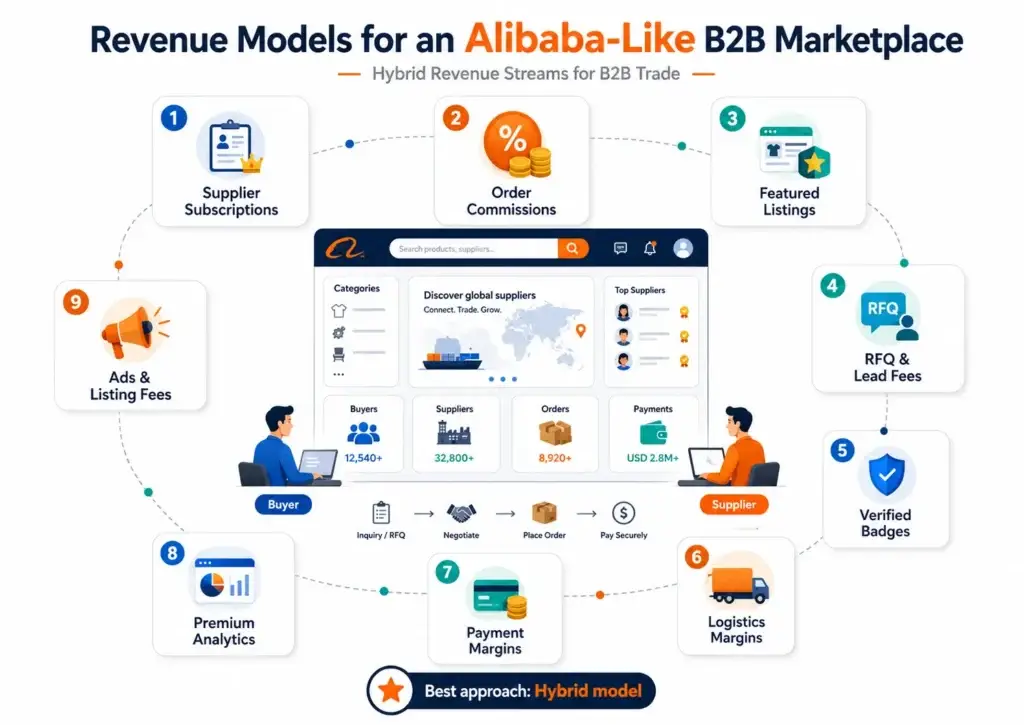
An Alibaba clone marketplace can generate revenue in several ways. The best model depends on the product category, supplier base, buyer behavior, transaction value, and market size.
A strong revenue model should not depend on only one income stream. Many B2B marketplaces use a hybrid model that combines subscriptions, commissions, lead fees, and premium visibility.
Seller Subscription Plans
Suppliers can pay monthly, quarterly, or yearly fees to sell on the platform. Higher plans can include more product listings, better visibility, lead access, analytics, and verified badges.
Commission on Successful Orders
The marketplace can charge a percentage commission on successful transactions. This model works well when the platform controls order flow and payment processing.
Featured Supplier and Product Listings
Suppliers can pay to promote their products or business profiles. Featured listings help vendors get more visibility in search results, category pages, and homepage sections.
RFQ Access and Lead Fees
The platform can charge suppliers for accessing buyer inquiries or premium RFQs. This model works well when buyers submit high-intent requirements and suppliers compete to win the order.
Verified Supplier Badge Fees
Suppliers can pay for verification, document checks, and trust badges. This helps serious suppliers stand out and gives buyers more confidence.
Logistics, Payment, and Value-Added Service Margins
The marketplace can also earn from logistics support, payment processing, inspection services, trade assurance, advertising, and premium business tools.
Common revenue streams include:
- Supplier subscriptions
- Order commissions
- Featured listings
- RFQ access fees
- Lead generation fees
- Verified supplier badges
- Banner advertising
- Logistics margins
- Payment processing margins
- Premium analytics
- Category-based listing fees
Read More:Business Model of Alibaba : Revenue Streams & Strategy
Security and Trust Features Needed in an Alibaba Clone Script
Trust is one of the biggest challenges in a B2B marketplace. Buyers need confidence before sending inquiries, sharing business details, or placing bulk orders. Suppliers also need protection from fake buyers and unserious leads.
A strong Alibaba clone script should include security and trust features from the beginning.
Supplier Verification and Business Document Checks
Supplier verification helps reduce fake sellers and low-quality listings. The platform can verify business details, registration documents, tax IDs, contact details, warehouse details, or other relevant records depending on the market.
This builds buyer confidence and improves marketplace quality.
Secure Payment Gateway Integration
Payment security is important because B2B transactions can involve higher order values. The platform should support secure payment gateways, payment status tracking, refund records, and transaction history.
A clear payment flow helps reduce confusion between buyers, suppliers, and admins.
Role-Based Admin Access and Audit Logs
As the marketplace grows, multiple team members may manage operations. Role-based access helps the owner control what each admin user can view or edit.
Audit logs help track important actions such as product approvals, payment updates, refund changes, and dispute decisions.
Dispute Management for Buyers and Suppliers
Disputes can happen due to late delivery, product quality issues, payment confusion, wrong specifications, or order cancellation. The admin panel should allow the marketplace team to review complaints, track conversations, check order records, and resolve disputes properly.
This is especially important for high-value B2B transactions.
Common Mistakes Founders Make When Choosing an Alibaba Clone Script
Many founders make the mistake of choosing an Alibaba clone script only based on price. But a cheap script without proper B2B workflows, source code, support, or customization can create bigger problems later.
Here are common mistakes to avoid:
- Choosing only the cheapest script
- Ignoring source code ownership
- Not checking RFQ workflow
- Ignoring supplier dashboard quality
- Not checking MOQ and bulk pricing features
- Not reviewing admin panel control
- Ignoring payment and dispute management
- Not planning category structure
- Launching too many categories at once
- Not checking post-launch support
- Ignoring mobile responsiveness
- Not verifying customization options
A good Alibaba clone script should support your business model, not just look similar to Alibaba on the surface.
How to Choose the Best Alibaba Clone Script for Your Business Model
Before selecting an Alibaba clone script, founders should check whether the solution supports real business operations, not just product listings. The best script is the one that fits your category, supplier strategy, buyer behavior, pricing flow, and monetization plan.
Start by checking your marketplace model. Decide whether you want a B2B-only marketplace or a hybrid B2B plus B2C platform. This matters because wholesale buyers need different workflows from retail customers. A B2B buyer may need RFQs, MOQ, quote comparison, supplier messaging, bulk pricing, and invoice downloads before placing an order.
Next, review the operational features. A strong Alibaba clone script should support:
- Fixed pricing, RFQ pricing, MOQ, bulk pricing, buyer-supplier messaging, and supplier verification.
- Multi-currency payments, mobile apps, white-label branding, design customization, and source code ownership.
- Vendor control, product approval, deployment support, post-launch technical support, and scalability as suppliers and products grow.
Founders should also check whether the provider understands marketplace operations. B2B marketplaces are not only about software. They need supplier onboarding, trust systems, buyer flow, lead management, payment logic, dispute control, and admin governance.
The right Alibaba clone script should help you launch faster, but it should also give you enough control to manage suppliers, customize workflows, build buyer trust, and scale the marketplace over time.
Why Miracuves Is a Practical Choice for Alibaba Clone Development
Miracuves helps founders launch ready-made and customizable marketplace platforms with faster deployment and source-code ownership.
For Alibaba clone development, Miracuves focuses on practical B2B marketplace needs such as supplier onboarding, product catalog management, inquiry workflows, admin control, payment integration, white-label branding, and scalable marketplace operations.
The Miracuves Alibaba Clone solution is suitable for founders who want to:
- Launch an Alibaba-like B2B marketplace
- Start a wholesale marketplace
- Build a supplier discovery platform
- Create a niche B2B marketplace
- Offer vendor storefronts
- Support inquiry-based buying
- Manage vendors from an admin panel
- Reduce development time and cost
- Own source code for future customization
- Launch faster with a ready-made solution
Want to launch your own Alibaba-style B2B marketplace? Explore the Miracuves Alibaba Clone solution .
Final Thoughts: Choose an Alibaba Clone Script That Supports Real B2B Trade
Choosing the best Alibaba clone script in 2026 depends on your business model, target category, supplier strategy, budget, and customization needs.
Do not choose a script only because it has a low price or looks similar to Alibaba. A serious B2B marketplace needs RFQ workflows, supplier dashboards, admin control, MOQ pricing, bulk order logic, payment management, dispute handling, source code access, and post-launch support.
A ready-made Alibaba clone script can help founders launch faster, validate demand, onboard suppliers, and build a B2B marketplace without the heavy cost and long timeline of full custom development.
For founders who want expert guidance before starting, scheduling a consultation can help clarify the right feature set, revenue model, supplier workflow, and launch plan for an Alibaba-like marketplace. Miracuves helps businesses plan and launch ready-made Alibaba Clone solutions designed for real B2B trade.
FAQs
Still have questions about launching an Alibaba clone? Let’s clear them up.
What is an Alibaba clone script?
An Alibaba clone script is a ready-made B2B marketplace software solution that helps founders launch an online wholesale marketplace similar to Alibaba. It includes buyer, supplier, admin, product, inquiry, order, payment, and marketplace management features.
How much does an Alibaba clone script cost?
The cost depends on features, customization, mobile apps, payment integration, source code access, and support. Miracuves offers an Alibaba Clone solution starting at $2,499 .
How long does it take to launch an Alibaba clone app?
With a ready-made solution, the launch timeline can be much shorter than custom development. Miracuves can help launch an Alibaba Clone solution in 6 days, depending on branding, deployment, and customization requirements.
Can I customize an Alibaba clone script?
Yes. A good Alibaba clone script should allow design changes, feature customization, payment gateway setup, vendor workflow changes, and future scalability. Source code access makes customization easier.
Is an Alibaba clone script suitable for B2B marketplaces?
Yes. An Alibaba clone script is mainly designed for B2B marketplace models such as wholesale trade, supplier discovery, manufacturer platforms, exporter marketplaces, and bulk product selling.
What features should an Alibaba clone app include?
An Alibaba clone app should include buyer registration, supplier dashboard, product catalog, RFQ, inquiry management, bulk pricing, MOQ, order tracking, payment integration, admin panel, review system, and vendor management.
Why is RFQ important in an Alibaba clone script?
RFQ is important because many B2B buyers need custom quotes instead of fixed pricing. It allows buyers to send requirements and suppliers to respond with pricing, quantity, delivery, and order terms.
What is MOQ in an Alibaba clone marketplace?
MOQ means Minimum Order Quantity. It defines the minimum number of units a buyer must purchase from a supplier. MOQ is important for wholesale and bulk trade marketplaces.
Is source code important for an Alibaba clone script?
Yes. Source code ownership gives founders more control over customization, scaling, security updates, future features, and long-term business growth.
Why choose Miracuves for Alibaba clone development?
Miracuves provides a ready-made Alibaba Clone solution with white-label branding, source-code access, buyer and supplier panels, admin control, payment integration, customization support, and a 6-day launch timeline.
Related Articles