


Key Takeaways
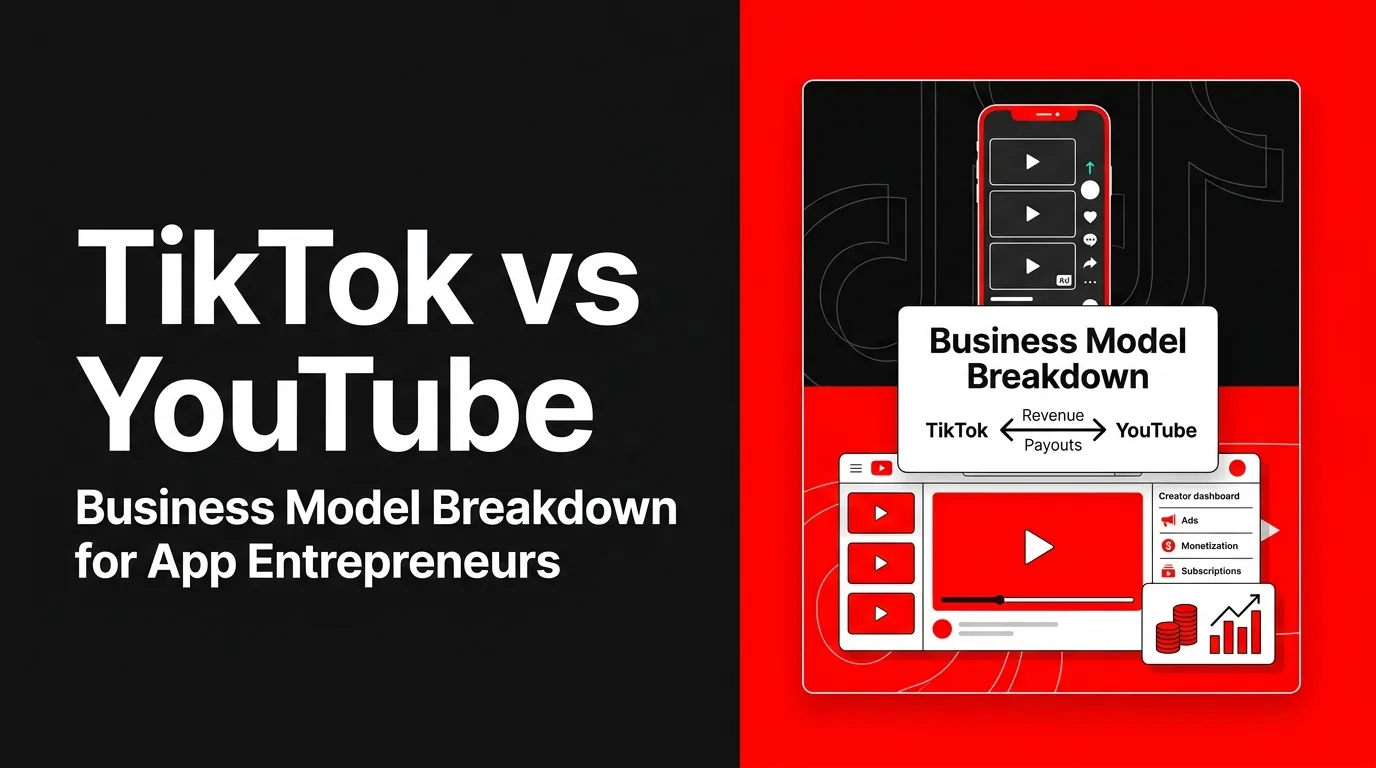
- TikTok and YouTube use different business models to attract viewers, creators, advertisers, and commerce partners.
- TikTok focuses on short-form discovery, viral engagement, live gifts, advertising, and social commerce.
- YouTube combines short-form and long-form video with advertising, subscriptions, memberships, and creator revenue sharing.
- The right model depends on content format, audience behaviour, creator strategy, and monetization goals.
- A startup can also combine TikTok-style discovery with YouTube-style creator monetization.
Business Model Signals
- TikTok-style platforms need personalized feeds, short-video creation, live streaming, virtual gifts, and shopping integrations.
- YouTube-style platforms need creator channels, subscriptions, advertising, memberships, search, and long-form video support.
- Creators need content uploads, audience analytics, monetization tools, earnings reports, and community features.
- Admins need control over users, content, advertisements, subscriptions, payments, moderation, and platform analytics.
- Recommendation systems and notifications help improve content discovery, viewing sessions, and creator engagement.
Real Insights
- TikTok’s model suits trend-driven platforms where rapid discovery and short viewing sessions drive growth.
- YouTube’s model suits content-rich platforms that need deeper creator relationships and multiple revenue channels.
- Short-form virality can accelerate user acquisition, but content churn and moderation costs can also increase.
- Long-form content, subscriptions, memberships, and search visibility can create more stable creator monetization.
- Miracuves builds TikTok-like and YouTube-style video platforms with creator tools, monetization, streaming, analytics, and admin control.
TikTok and YouTube have both built powerful video ecosystems, but they create engagement and revenue in very different ways. TikTok prioritizes rapid discovery, short-form viewing, trends, live interactions, and social commerce. YouTube combines search-led discovery, long-form viewing, Shorts, advertising, subscriptions, and a more established creator revenue ecosystem.
For founders, this is not simply a comparison of which platform is more popular. The more useful question is which operating model fits the product you want to launch, the creators you want to attract, and the revenue streams your business can realistically support.
A TikTok-style model requires a fast vertical feed, frictionless video creation, personalized discovery, community engagement, moderation, creator rewards, and mobile-first performance. A YouTube-style model usually requires deeper content libraries, search, channel management, long-form delivery, subscriptions, advertising workflows, and more complex creator analytics.
Founders planning to turn the short-form model into an owned product can explore Miracuves’ white-label short-video platform to understand how creator tools, user experiences, monetization modules, admin control, and platform operations fit together.
This guide compares the TikTok and YouTube business models while translating their differences into practical startup decisions around features, monetization, cost, security, administration, customization, and launch strategy.
What is TikTok?
TikTok is a mobile-first short-video platform built around algorithmic discovery. Instead of requiring users to search for specific creators or subscribe before seeing relevant content, its feed continuously recommends videos based on viewing behaviour, engagement signals, interests, and content performance.
Its business model combines advertising, creator-brand partnerships, virtual rewards, live interactions, commerce, and creator incentive programs. For a startup founder, TikTok’s most important lesson is not the video format alone. It is the way content discovery, creation tools, creator participation, and monetization reinforce one another.
Key Highlights:
- Personalized feed powered by AI (the “For You Page”)
- Viral trends, music syncing, and filters
- Integrated monetization tools for creators
- In-app shopping, TikTok Live, and branded content
As of 2026, YouTube remains a content powerhouse with a massive creator economy and enterprise-grade monetization opportunities.
Read More: What is TikTok App and How Does It Work?
What is YouTube?
YouTube is a multi-format video ecosystem that supports long-form videos, Shorts, live streaming, music, television content, subscriptions, advertising, and creator communities.
Its business model combines search-led discovery, recommendations, advertising revenue sharing, premium subscriptions, memberships, fan payments, shopping integrations, and other creator monetization tools. For founders, YouTube demonstrates how a large video library, strong search behaviour, creator channels, and multiple content formats can produce long-term audience and revenue value.
- YouTube Shorts (TikTok-style)
- YouTube Premium (ad-free + music)
- YouTube TV (live streaming)
- YouTube Music
As of 2026, YouTube remains a content powerhouse with a massive creator economy and enterprise-grade monetization opportunities.
Read More: What is the YouTube App and How Does It Work?
Business Model of TikTok
1. Revenue Streams
- Advertising (Main Driver):
- In-feed ads
- Branded hashtag challenges
- TopView ads
- Spark Ads (boosting organic content)
- TikTok Creator Marketplace
- Brands partner directly with influencers
- TikTok Shop & Live Shopping
- Affiliate commissions, product sales
- TikTok Coins
- In-app purchases for tipping creators
- Sponsorship & Brand Deals
- Cross-promotion of products/services
2. Cost Structure
- AI R&D for recommendation algorithms
- Content moderation (manual + AI)
- Creator fund payouts and live stream commissions
- Marketing and expansion into new markets
- Infrastructure (cloud storage, CDN bandwidth)
3. Key Partners
- Brands and advertisers
- Influencers and creators
- E-commerce platforms (Shopify, Amazon)
- Music labels (licensing content)
- Payment gateways
4. Growth Strategy
- Localized content & regional creator support
- AI-powered personalization
- Social commerce integrations (TikTok Shop)
- Global expansion with tailored content
- Acquisition of AI, AR, and video editing startups
Learn More: Business Model of TikTok: How the App Makes Billions
Business Model of YouTube
1. Revenue Streams
- AdSense Advertising (Primary Source)
- Pre-roll, mid-roll, and display ads
- Ads on Shorts (2023 revenue share model introduced)
- YouTube Premium
- Subscription-based (ad-free experience)
- YouTube Music
- Streaming subscriptions
- Super Chat, Stickers, Channel Memberships
- Fan support & tipping model
- Partner Program Revenue Split
- 55% creators, 45% YouTube
- YouTube Shopping
- Product integrations & affiliate links
- YouTube TV
- Live channels with ads/subscriptions
2. Cost Structure
- Video hosting and global CDN infrastructure
- Licensing fees (music and third-party content)
- Creator payouts and Super Chat commissions
- Engineering and product development
- Content moderation, AI/ML model training
3. Key Partners
- Google AdSense Network
- Creators and MCNs (multi-channel networks)
- Music labels and publishers
- Brands and advertisers
- Telecom and smart TV manufacturers
4. Growth Strategy
- Expansion of Shorts to rival TikTok
- Enhancing creator tools and analytics
- Global penetration via local language content
- Integration with Google services (Search, Android)
- Pushing Premium + TV subscriptions
Learn More: Business Model of YouTube: Revenue Strategy & Key Insights
TikTok vs YouTube Business Model Comparison
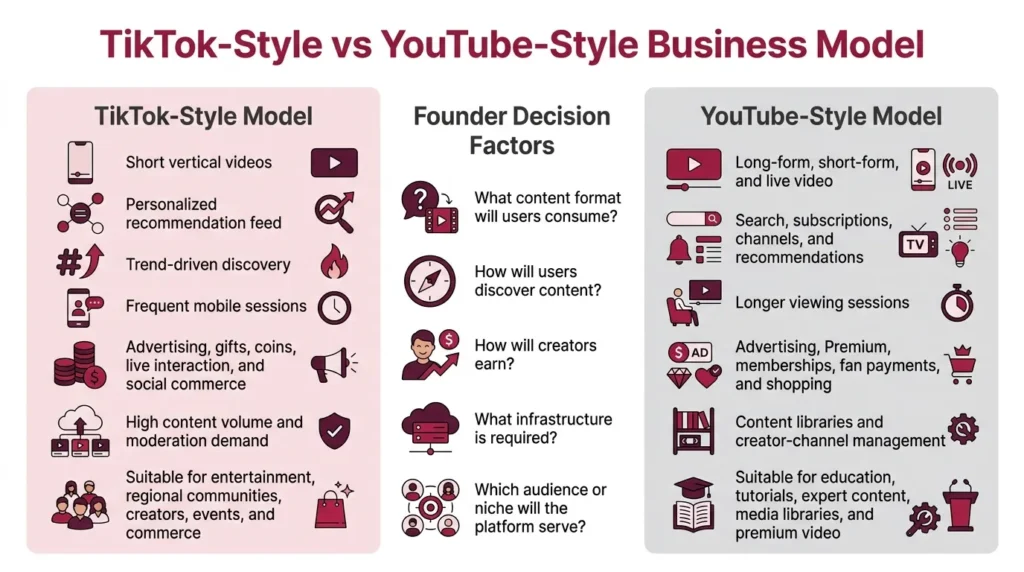
| Business factor | TikTok-style model | YouTube-style model | Founder implication |
|---|---|---|---|
| Core content experience | Short, vertical, fast-consumption videos | Long-form, short-form, live, music, and premium content | Choose based on how frequently users should create and consume content |
| Primary discovery system | Personalized recommendation feed | Search, subscriptions, recommendations, and channel discovery | TikTok-style products depend more heavily on feed quality and rapid content testing |
| Creator entry barrier | Relatively low because short content can be produced quickly | Often higher for long-form, specialist, or high-production content | Short-form platforms may onboard creators faster but must manage higher content volume |
| Main monetization options | Advertising, gifts, coins, paid promotion, commerce, brand campaigns, subscriptions | Advertising, Premium, memberships, fan payments, shopping, and subscriptions | Select revenue modules that match creator behaviour and user purchasing intent |
| Engagement pattern | Frequent sessions, rapid scrolling, trends, comments, sharing, and live interaction | Longer watch sessions, search intent, subscriptions, playlists, and repeat channel viewing | Product analytics should reflect the engagement loop you are trying to build |
| Infrastructure pressure | High upload volume, transcoding, feed delivery, storage, and repeated playback | Long-video storage, adaptive streaming, search indexing, and multi-device delivery | Video infrastructure costs should be modelled before user growth accelerates |
| Moderation requirement | High-frequency review of videos, comments, live streams, spam, and abuse reports | Review across videos, live content, comments, copyright reports, and community activity | Moderation is an operating system, not a feature that can be added after launch |
| Admin requirements | Feed controls, creator management, content reports, gifts, wallets, campaigns, and trend controls | Channel controls, copyright workflows, advertising, subscriptions, reports, and content libraries | The admin panel should reflect the chosen revenue and content model |
| Strongest startup fit | Regional communities, entertainment, social commerce, music, events, education snippets, and creator-led niches | Education libraries, specialist content, media archives, premium video, tutorials, and long-term creator channels | The strongest opportunity is usually a focused vertical, not a general-purpose copy |
| Product launch strategy | Launch focused, test creator supply, and improve recommendations using real engagement data | Build content depth, search structure, creator tools, and repeat viewing behaviour | Start with a clear audience and content loop before expanding the feature set |
What This Comparison Means for Founders Building a Video Platform
The business model determines more than the content format. It influences the app architecture, creator incentives, moderation workload, operating costs, admin controls, and the time required to reach useful market feedback.
A regional entertainment startup may benefit from a TikTok-style model because creators can publish frequently and users can discover content without already knowing whom to follow. An education or expert-content platform may prefer YouTube-style channels, playlists, search, and longer videos. A commerce-led platform could combine short-video discovery with product links, live shopping, creator commissions, and brand campaigns.
Founders should therefore make four decisions before selecting the feature set:
- What type of creator will publish consistently?
- What user action should drive repeat sessions?
- Which monetization method fits the audience?
- What operational controls will the business need as content volume grows?
The objective should not be to reproduce every feature of a major platform. It should be to identify the discovery, creation, engagement, and revenue loops that support a specific audience or market.
Core Product Layers Behind a TikTok-Style Business Model
A short-form business model only works when the user experience, creator tools, monetization, administration, and infrastructure operate as one system. Founders evaluating short-video app features should connect every feature to a measurable business purpose.
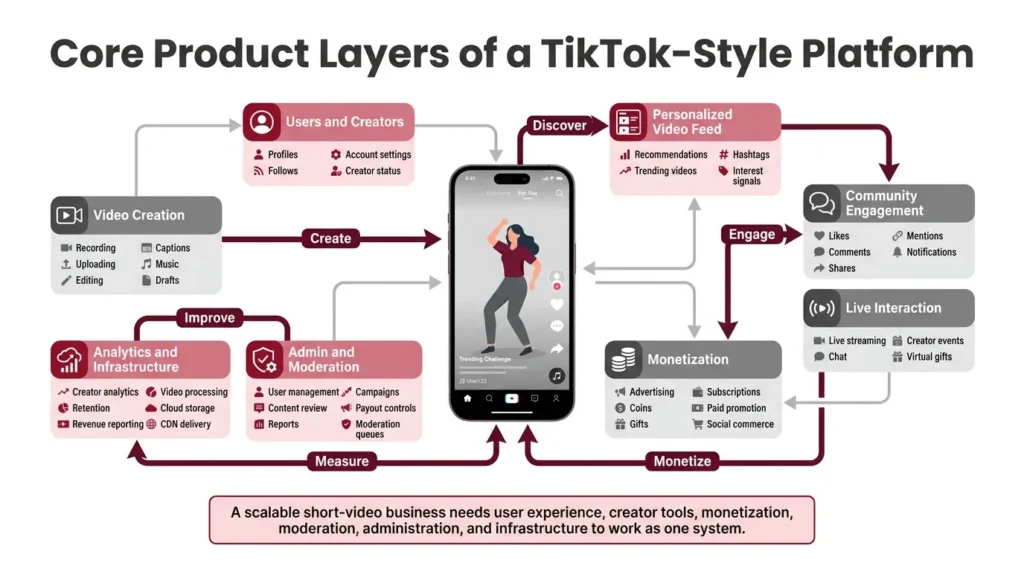
| Product layer | Typical capabilities | Business value |
| User and creator accounts | Profiles, follows, account settings, creator status, saved content, and notifications | Creates identity, creator relationships, and repeat engagement |
| Personalized video feed | Vertical playback, recommendations, trending content, hashtags, and interest signals | Improves content discovery and session depth |
| Video creation workflow | Recording, uploads, trimming, filters, captions, music, drafts, and publishing controls | Reduces creator friction and increases content supply |
| Community engagement | Likes, comments, shares, follows, mentions, reporting, and notifications | Builds interaction and improves recommendation signals |
| Live and creator interaction | Live streaming, chat, creator events, gifts, and audience participation | Creates stronger creator-fan relationships and additional revenue options |
| Monetization system | Advertising, coins, gifts, subscriptions, paid boosts, commissions, and social commerce | Gives the platform and creators multiple earning paths |
| Admin dashboard | User management, content review, reports, payments, analytics, campaigns, and configuration | Lets the operator manage the business without relying on developers for routine changes |
| Moderation and safety | Reporting, review queues, warnings, restrictions, age controls, and audit records | Protects users, creators, advertisers, and platform reputation |
| Analytics | Content performance, creator activity, retention, revenue, reports, and campaign results | Helps founders improve the product using real behaviour and commercial data |
The most important launch features are those that help users discover content, creators publish consistently, and administrators operate the platform safely. Advanced filters, AI tools, commerce, and live monetization should be introduced according to market demand rather than added simply to make the feature list longer.
Monetization, Cost, and Launch Decisions
How a Short-Video Platform Can Generate Revenue
A startup should avoid depending on a single revenue stream before it understands user behaviour. Advertising can work when the platform has sufficient attention and audience segmentation, while gifts, coins, subscriptions, paid creator tools, sponsored campaigns, affiliate commerce, and paid promotion can support more focused communities.
The right mix depends on who creates the content, who pays, and what value the platform controls. A creator-led entertainment platform may prioritize gifts and brand campaigns. A specialist community may be better suited to subscriptions or premium access. A commerce-focused platform may use creator commissions, product discovery, and sponsored placement.
Review these creator monetization models before deciding which modules belong in the first release.
What Drives Short-Video Platform Cost?
Development cost is influenced by more than the number of screens. Important cost drivers include:
- Android, iOS, web, and admin-platform requirements
- Video recording, editing, compression, transcoding, and storage
- CDN delivery and adaptive playback
- Recommendation and feed logic
- Live-streaming requirements
- Creator wallets, gifts, subscriptions, and payout workflows
- Content moderation and abuse-reporting systems
- Third-party payment, analytics, messaging, or commerce integrations
- Branding, user-experience changes, and custom workflows
- Security, privacy, access control, and regional requirements
- Expected traffic, content volume, and infrastructure scale
Video delivery can become a significant operating expense when uploads and viewing grow. Founders should therefore model video hosting and architecture costs before selecting infrastructure.
Ready-Made Foundation or Custom Development?
Custom development gives a business greater freedom over architecture and workflows, but it requires more product planning, development, testing, and infrastructure preparation.
A ready-made foundation can shorten the path to market because core user, creator, video, engagement, monetization, and admin flows already exist. The business can then focus its budget on branding, market-specific workflows, integrations, creator onboarding, and product differentiation.
The right route depends on product uniqueness, available budget, technical ownership, launch urgency, and the level of customization required. Founders still comparing these routes should review the differences between white-label and custom development.
Why Admin Control and Platform Safety Affect the Business Model
A video platform is not commercially useful if the business cannot control what happens behind the user interface.
The admin dashboard should allow authorized teams to manage users, creators, videos, comments, reports, campaigns, revenue settings, gifts, wallets, payouts, platform categories, notifications, analytics, and configuration. Role-based permissions are also important when moderation, finance, marketing, and platform-management teams require different levels of access.
Safety workflows should include content reporting, moderation queues, account warnings, restrictions, spam controls, abuse management, age-related controls where relevant, and records of sensitive administrative actions. Live streams, creator payouts, user-generated content, and virtual rewards may require additional monitoring.
Security should be treated as part of the product foundation. Secure API communication, protected administrative access, permission-based dashboards, audit-friendly activity records, account controls, and privacy-conscious data handling reduce operational risk.
Final legal and compliance requirements depend on the target country, audience, content category, payment model, integrations, and operating structure. A technical platform can support compliance workflows, but it does not replace jurisdiction-specific legal review.
Read More: How Short-Form Video Algorithms Work: Building a Custom TikTok Feed
Which Video Business Model Fits Your Startup?
Choose a TikTok-Style Model When
A short-form model is more suitable when:
- Frequent content creation is central to the product
- Users should discover content before following creators
- Trends, challenges, music, events, or communities drive participation
- Mobile-first viewing is the primary experience
- Gifts, live interaction, social commerce, or paid promotion fit the business
- The startup is targeting a regional, language-based, industry-specific, or creator-led niche
Choose a YouTube-Style Model When
A multi-format or long-form model is more suitable when:
- Search and content libraries are important
- Creators publish tutorials, shows, courses, reviews, interviews, or specialist content
- Users are expected to subscribe to channels and return to established creators
- Advertising, premium access, memberships, or long-form sponsorships fit the audience
- The platform needs playlists, structured channels, and deeper content archives
Read More: Business Model of YouTube: Revenue Strategy & Key Insights
Consider a Hybrid Model When
A hybrid platform may work when short videos are used for discovery while long-form videos, live sessions, subscriptions, courses, or premium content create deeper value.
However, launching every format at once can increase product complexity and infrastructure cost. A stronger approach is to identify the primary content loop first and introduce additional formats after creator and user behaviour has been validated.
The right decision is not based on which major platform has more users. It is based on which model gives your startup a defensible audience, reliable content supply, manageable operating requirements, and realistic monetization opportunities.
Final Thoughts: Choose the Business Model Before Building the Feature List
TikTok and YouTube demonstrate two different ways to build a creator-led video business.
TikTok’s model is built around rapid discovery, frequent short-form content, mobile engagement, trends, live interaction, and commerce. YouTube’s model creates value through search, subscriptions, content depth, multiple formats, advertising, and long-term creator relationships.
For founders, the strongest opportunity is rarely a broad copy of either platform. It is a focused product for a specific community, language, industry, content category, or commercial use case.
Before development begins, define the creator, the audience, the discovery loop, the revenue model, the moderation workflow, and the level of administrative control the business requires. These decisions will shape the features, infrastructure, budget, and launch route.
Miracuves helps founders turn these decisions into branded short-video platform using a ready-made foundation or a customized development path aligned with the intended audience and business model.
FAQs
What is the main difference between TikTok and YouTube’s business models?
TikTok focuses on short-form discovery, rapid engagement, live interactions, advertising, virtual gifts, and social commerce. YouTube combines short-form and long-form content with search, advertising, subscriptions, memberships, Premium revenue, and creator monetization.
Which business model is better for a video startup?
A TikTok-style model is better suited to mobile-first, trend-driven, regional, entertainment, or social-commerce platforms. A YouTube-style model may be more suitable for education, tutorials, premium content, specialist creators, and searchable video libraries. The right choice depends on the target audience, content format, creator strategy, and revenue model.
How does TikTok generate revenue?
TikTok generates revenue through advertising, promoted content, brand campaigns, virtual coins, live gifts, social commerce, creator partnerships, and other platform-based monetization tools.
How does YouTube generate revenue?
YouTube earns revenue through video advertising, YouTube Premium, channel memberships, fan payments, shopping integrations, television subscriptions, and revenue-sharing programs for eligible creators.
Can a startup combine TikTok-style and YouTube-style features?
Yes. A platform can use short videos for discovery while offering long-form videos, live sessions, subscriptions, courses, or premium creator content. However, launching every format at once can increase development, moderation, and infrastructure costs.
What features does an app like TikTok need?
A TikTok-style app usually needs user and creator profiles, video recording and uploads, a personalized vertical feed, likes, comments, sharing, follows, notifications, search, hashtags, reporting, moderation, analytics, monetization tools, and an admin dashboard.
How can a short-video platform make money?
A short-video platform can earn through advertising, subscriptions, virtual gifts, coins, paid promotions, creator commissions, sponsored campaigns, affiliate commerce, premium content, and brand partnerships. The right mix depends on the platform’s audience and creator ecosystem.
What affects the cost of building a short-video platform?
Cost depends on the number of platforms, video processing requirements, storage, CDN delivery, recommendation logic, live streaming, monetization, payment integrations, moderation tools, security, custom branding, third-party services, and expected traffic.
What should the admin panel of a video platform include?
The admin panel should allow the business to manage users, creators, videos, comments, reports, advertising, gifts, wallets, payouts, subscriptions, moderation, notifications, analytics, and platform settings.
Is a ready-made video platform better than custom development?
A ready-made platform can reduce launch time because the core user, creator, video, monetization, and admin modules already exist. Custom development offers more architectural flexibility but usually requires more planning, testing, development time, and budget.