

Key Takeaways
- Flipkart follows a consumer-focused hybrid model that combines direct retail, third-party sellers, private labels, and logistics.
- Alibaba operates a broader marketplace ecosystem serving B2B, B2C, and C2C transactions across multiple regions.
- Flipkart earns through product sales, seller commissions, advertising, private labels, and fulfillment services.
- Alibaba combines marketplace fees, supplier memberships, advertising, cloud services, logistics, and financial services.
- The right model depends on whether a founder is targeting domestic consumers, global suppliers, wholesale buyers, or multiple commerce segments.
Business Model Comparison Signals
- Choose a retail-led model when customer experience, product control, local delivery, and direct sales are major priorities.
- Consider a marketplace-first model when connecting manufacturers, wholesalers, exporters, retailers, and buyers at scale.
- Define whether the platform will manage inventory directly, rely on sellers, or combine both approaches.
- Plan commissions, seller memberships, advertisements, fulfillment fees, payments, and value-added services before development.
- Evaluate seller onboarding, catalog complexity, logistics responsibility, regional expansion, and admin-control requirements.
Real Insights
- Inventory control can improve product availability but increases warehousing, fulfillment, and working-capital requirements.
- An asset-light marketplace can scale its catalog faster but needs strong seller verification and quality controls.
- Domestic retail and cross-border wholesale require different search, pricing, payment, shipping, and negotiation workflows.
- Founders should adapt proven marketplace principles to their audience instead of copying one company’s complete model.
- Miracuves develops configurable ecommerce marketplaces with B2C, B2B, multi-vendor, payment, logistics, seller, and admin workflows.
Choosing the right marketplace model is one of the earliest decisions that can shape your startup’s product, revenue, operations, and growth strategy.
Many founders look at large ecommerce platforms and assume the only question is, “Which successful company should I model?” But a better question is this:
Should your marketplace serve everyday shoppers or business buyers?
That difference matters more than most founders realise. An online retail marketplace and a B2B marketplace may both connect buyers and sellers, but they behave very differently behind the scenes. They require different user journeys, pricing logic, vendor onboarding, catalogue structures, payment workflows, fulfilment rules, and monetization strategies.
For startups, the right choice depends on your target customer, capital, market timing, supplier access, and operational strength. This guide breaks down both models clearly so you can decide which one fits your startup better.
What Is an Online Retail Marketplace?
An online retail marketplace is a digital platform where customers buy products from multiple sellers, brands, or merchants. The platform operator does not always own the inventory. Instead, it provides the technology, catalogue experience, payment flow, order management, and seller ecosystem that allow transactions to happen.
This model is common in ecommerce sectors such as fashion, electronics, groceries, beauty, home products, accessories, local retail, and general merchandise.
For a startup, the online retail marketplace model works best when the goal is to serve a large number of individual shoppers with a smooth buying experience. The focus is usually on convenience, trust, pricing, delivery, product variety, and repeat purchases.
A retail marketplace typically includes:
- Customer app or storefront
- Seller or vendor panel
- Product catalogue management
- Cart and checkout
- Offers, coupons, and promotions
- Payment gateway integration
- Order tracking
- Delivery management
- Ratings and reviews
- Admin dashboard
- Refund and dispute workflows
The startup challenge is not only building the ecommerce interface. It is building a system where sellers can list products easily, customers can buy confidently, and the operator can manage orders, payouts, inventory signals, and support issues from one control layer.
What Is a B2B Marketplace?
A B2B marketplace connects businesses with other businesses. Instead of selling single products to individual shoppers, it usually helps manufacturers, wholesalers, distributors, retailers, exporters, importers, or service providers trade with each other.
The buying behaviour is different. B2B buyers rarely make instant emotional purchases. They compare suppliers, request quotations, negotiate pricing, check minimum order quantities, evaluate shipping terms, and often need internal approval before placing an order.
A B2B marketplace may include:
- Supplier profiles
- Buyer accounts
- Bulk product catalogues
- Minimum order quantity rules
- Request-for-quote workflows
- Custom pricing
- Negotiation tools
- Purchase order management
- Credit or invoice-based payment options
- Supplier verification
- Logistics coordination
- Business document uploads
- Admin approval workflows
For startups, B2B marketplaces can be powerful because a smaller number of business customers may generate higher transaction value. However, they usually take longer to activate because trust, supplier quality, and relationship management matter deeply.
Online Retail Marketplace vs B2B Marketplace: Core Difference
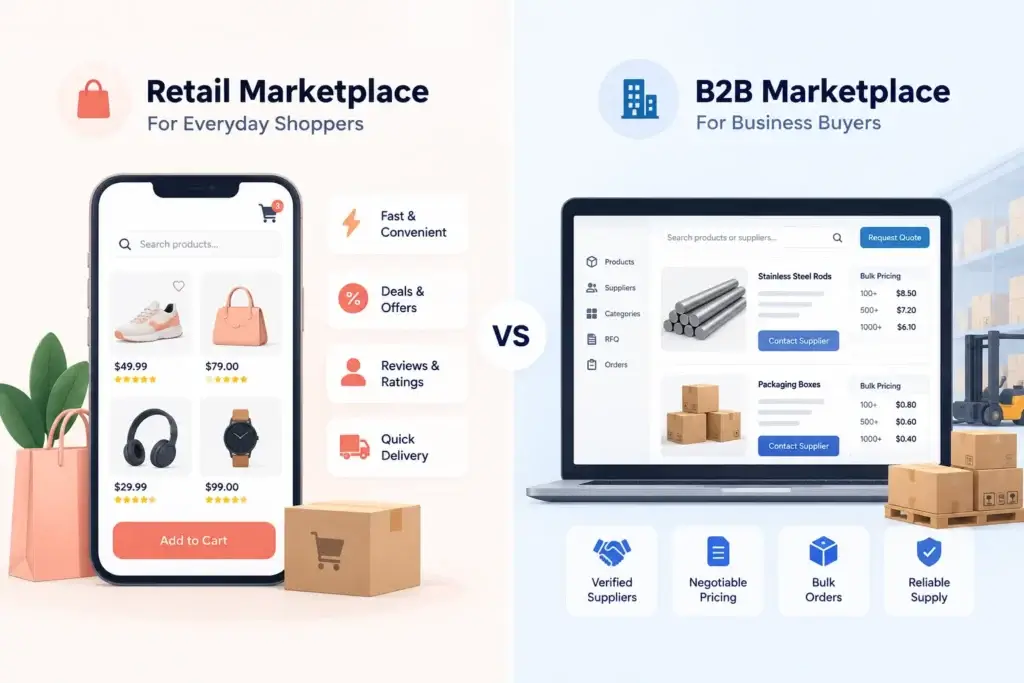
Image Source: AI-generated visual by Miracuves
The biggest difference is not the technology. It is the buyer mindset.
Retail customers usually want speed, convenience, discounts, reviews, and simple checkout. Business buyers want reliability, pricing flexibility, supplier credibility, stock availability, and long-term purchasing confidence.
| Comparison Area | Online Retail Marketplace | B2B Marketplace |
|---|---|---|
| Primary buyer | Individual consumer | Business buyer |
| Purchase style | Fast, frequent, convenience-led | Planned, negotiated, volume-led |
| Average order value | Usually lower | Usually higher |
| Sales cycle | Short | Medium to long |
| Catalogue style | Product discovery focused | Specification and supplier focused |
| Pricing | Fixed or promotional | Tiered, negotiable, quote-based |
| Trust signals | Reviews, ratings, return policy | Supplier verification, documents, trade history |
| Marketing focus | Ads, SEO, social, offers, referrals | Industry outreach, account-based selling, partnerships |
| Fulfilment need | Fast delivery and tracking | Bulk shipping, logistics coordination, order terms |
| Startup complexity | Operationally intense at scale | Trust and supply-chain intense from day one |
Both models can work. But they require different execution muscles.
When an Online Retail Marketplace Fits Startups Better
An online retail marketplace is usually a better fit when your startup wants to target a defined consumer segment and build demand through product variety, convenience, pricing, and delivery experience.
This model works well when:
- You are targeting a city, region, niche category, or consumer community.
- Your products are easy to browse, compare, and buy online.
- Sellers are ready to list inventory digitally.
- Customers expect app-based ordering and tracking.
- You can manage delivery, returns, and support workflows.
- Promotions, loyalty, and repeat orders can drive growth.
For example, a founder may want to launch a marketplace for regional fashion brands, home essentials, local grocery stores, electronics sellers, beauty products, or speciality retail categories. In these cases, the buyer journey is relatively direct: search, compare, add to cart, pay, track, receive, review.
The opportunity is strong when the startup can make discovery and fulfilment easier than offline buying or fragmented seller channels.
When a B2B Marketplace Fits Startups Better
A B2B marketplace is a better fit when your startup has access to suppliers, manufacturers, wholesalers, distributors, or business buyers in a specific industry.
This model works well when:
- The market is fragmented and buyers struggle to find reliable suppliers.
- Businesses still depend on offline calls, brokers, spreadsheets, or manual procurement.
- Order value is high enough to justify longer sales cycles.
- Supplier verification creates a strong trust advantage.
- Buyers need quotes, bulk pricing, and repeat procurement.
- The startup can build relationships with both supply and demand sides.
For example, a founder may build a B2B marketplace for construction materials, textile suppliers, restaurant supplies, wholesale electronics, packaging products, industrial parts, agricultural goods, or medical equipment sourcing.
In this model, the platform does not win only because it has many listings. It wins because it reduces procurement friction, improves supplier trust, and makes repeat ordering easier for business customers.
Revenue Models: How Each Marketplace Makes Money
Revenue strategy should influence the model you choose. Retail marketplaces often monetize through transaction-led and promotion-led models. B2B marketplaces may monetize through subscriptions, supplier visibility, lead generation, transaction fees, or value-added services.
| Revenue Stream | Online Retail Marketplace | B2B Marketplace |
|---|---|---|
| Sales commission | Common on every order | Common but may vary by category |
| Seller subscription | Optional for premium sellers | Strong fit for verified suppliers |
| Featured listings | Useful for product visibility | Useful for supplier visibility |
| Advertising | Strong for consumer discovery | Strong in niche industries |
| Delivery fees | Common | Depends on logistics model |
| Membership plans | Useful for loyalty programs | Useful for buyer/supplier access |
| Lead fees | Less common | Strong fit for RFQ-based models |
| Value-added services | Packaging, fulfilment, marketing | Verification, logistics, finance, documentation |
Retail marketplaces often need high transaction volume to grow revenue. B2B marketplaces may generate meaningful revenue with fewer transactions if order values are larger and suppliers are willing to pay for qualified leads or visibility.
Product Architecture: What Founders Need to Build
A common mistake is assuming both models need the same ecommerce engine. They share some common modules, but the product architecture should match the buyer journey.
Core Architecture for an Online Retail Marketplace
A retail marketplace needs a smooth frontend and strong backend control. The customer experience must reduce friction from discovery to delivery.
Important modules include:
- Product listing and category management
- Seller dashboard
- Customer app or responsive storefront
- Cart and checkout
- Coupon and promotional engine
- Payment gateway integration
- Delivery tracking
- Order and return management
- Ratings and reviews
- Vendor payout management
- Admin reporting dashboard
This is where a launch-ready retail marketplace foundation from Miracuves can support founders who want to validate demand faster without building every module from zero.
Core Architecture for a B2B Marketplace
A B2B marketplace needs stronger account, supplier, and negotiation workflows. The buying journey is less about impulse and more about confidence.
Important modules include:
- Supplier onboarding and verification
- Buyer company profiles
- Bulk catalogue uploads
- Request-for-quote system
- Custom pricing and negotiation workflows
- Minimum order quantity management
- Purchase order and invoice support
- Document uploads
- Logistics coordination
- Admin approval workflows
- Lead and inquiry management
This model often needs more workflow customization because every industry has different buying terms, delivery logic, supplier documentation, and negotiation patterns.
Founder Decision Signals
Speed
Choose retail if you want to launch a customer-facing marketplace quickly with standard ecommerce flows. Choose B2B if your launch depends more on supplier onboarding and procurement workflows.
Capital
Retail may require more spending on marketing, discounts, delivery, and support. B2B may need more investment in relationship-building, verification, and sales operations.
Market Access
If you already know sellers and consumer demand, retail may move faster. If you have strong supplier or industry access, B2B may create a stronger defensible position.
Monetization
Retail usually depends on order volume. B2B can monetize through commissions, supplier subscriptions, qualified leads, and high-value transactions.
Which Model Is Easier for Startups to Launch?
An online retail marketplace is usually easier to understand, design, and test because the customer journey is familiar. Most users already know how to search, add products to cart, pay, and track an order.
However, “easier to understand” does not always mean easier to scale. Retail marketplaces can become operationally demanding because customer acquisition, seller quality, delivery performance, cancellations, refunds, and support expectations increase quickly.
A B2B marketplace may be harder to launch because supplier trust and buyer relationships take time. But once trust is established, repeat business can be stronger. Business buyers often return when the platform solves a real procurement pain point.
So the better startup model depends on your unfair advantage:
- If your advantage is consumer demand, local retail access, or category branding, choose online retail.
- If your advantage is supplier relationships, industry knowledge, or procurement inefficiency, choose B2B.
Which Model Has Better Scalability?
Retail marketplaces scale through traffic, product variety, seller growth, faster checkout, delivery coverage, promotions, and customer retention. The platform must support high browsing volume, real-time inventory signals, product search, payment reliability, and order tracking.
B2B marketplaces scale through supplier depth, buyer trust, industry coverage, RFQ volume, repeat procurement, and account relationships. The platform must support complex catalogues, negotiated pricing, document handling, and business workflows.
Scalability is not only about servers. It is about whether the operating model can handle more users, more sellers, more orders, more disputes, more payment flows, and more support cases without breaking.
For founders, this means the admin dashboard is not a secondary feature. It is the control centre of the marketplace.
Marketplace Trust: Different Buyers Need Different Proof
Trust works differently in both models.
Retail shoppers trust a platform when they see:
- Clear product images
- Verified reviews
- Easy returns
- Reliable delivery
- Secure payment options
- Customer support
- Familiar checkout flow
Business buyers trust a platform when they see:
- Verified suppliers
- Company details
- Product specifications
- Bulk pricing clarity
- Trade documents
- Response history
- Delivery terms
- Negotiation records
If you build the wrong trust layer, your marketplace may attract traffic but fail to convert. A retail marketplace without review and return flows feels risky. A B2B marketplace without verification and quotation workflows feels incomplete.
Cost Logic: What Actually Affects Development Scope?
The cost of building either marketplace depends on the modules, integrations, user roles, design depth, backend complexity, and launch scope.
Retail marketplace cost is usually shaped by:
- Customer app or web storefront
- Seller panel
- Admin dashboard
- Product catalogue complexity
- Payment and wallet flows
- Delivery partner workflows
- Return and refund logic
- Promotion engine
- Analytics and reporting
B2B marketplace cost is usually shaped by:
- Supplier verification workflows
- RFQ and negotiation tools
- Bulk product uploads
- Custom pricing
- Buyer approval flows
- Invoice or purchase order logic
- Document management
- Industry-specific catalogue fields
- Lead management
- Logistics integrations
A ready-made foundation can reduce development effort when your business model matches established marketplace flows. A custom build may be better when your procurement logic, pricing rules, supplier workflows, or integrations are highly unique.
Mistakes Founders Should Avoid
Choosing a model only because a large company used it
A startup should not copy a large platform blindly. The better approach is to understand the operating logic behind the model and adapt it to your target market, budget, and launch stage.
Building features before validating buyer behaviour
Retail buyers and business buyers make decisions differently. If the product journey does not match how your users actually buy, more features will not solve the core adoption problem.
Ignoring admin control
Marketplace growth creates operational pressure. Founders need backend control over sellers, products, orders, payments, disputes, payouts, and reports from the beginning.
Treating fulfilment as an afterthought
Retail marketplaces need fast and trackable delivery. B2B marketplaces need reliable bulk logistics, delivery terms, and order coordination. Fulfilment must match the model.
Startup Fit Matrix: Which Model Should You Choose?
| Startup Situation | Better-Fit Model | Why |
|---|---|---|
| You want to serve local shoppers | Online retail marketplace | Consumer discovery and delivery convenience matter most |
| You already have access to wholesalers | B2B marketplace | Supplier depth can become your advantage |
| You want faster app-based validation | Online retail marketplace | Standard ecommerce flows are easier to test |
| Your buyers need quotations | B2B marketplace | RFQ and negotiation workflows are essential |
| Your category depends on repeat consumer orders | Online retail marketplace | Loyalty, offers, and convenience can drive retention |
| Your industry has fragmented procurement | B2B marketplace | The platform can organize suppliers and reduce buying friction |
| You want high transaction frequency | Online retail marketplace | Retail categories can create frequent buying behaviour |
| You want larger order values | B2B marketplace | Business purchases often involve bulk or recurring orders |
Read More: Online Retail Marketplace Launch Mistakes: What Startups Should Avoid Before Going Live
How Miracuves Supports Marketplace Startups Without Forcing One Model
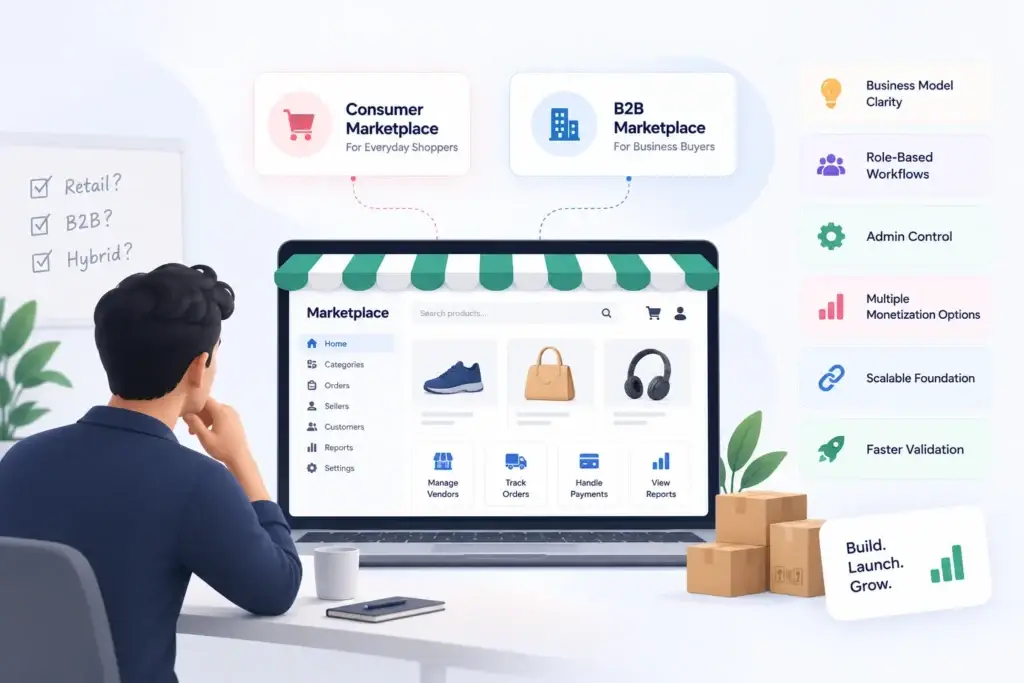
Image Source: AI-generated visual by Miracuves
Miracuves supports founders by helping them build marketplace platforms around the business model they want to validate, instead of pushing every startup into the same product structure. A retail marketplace and a B2B marketplace may share common foundations, but their workflows, buyer behaviour, monetization logic, and admin requirements are very different.
For a consumer-facing retail marketplace, the focus is usually on product discovery, vendor management, smooth checkout, delivery tracking, offers, refunds, and repeat purchases. For a B2B marketplace, the product may need supplier onboarding, bulk catalogue uploads, request-for-quote flows, negotiated pricing, business accounts, documentation, and approval-based purchasing.
The goal is not to copy another platform’s surface-level layout. The stronger approach is to build a marketplace foundation that matches your audience, operating model, revenue strategy, and launch stage.
Miracuves can support marketplace startups with:
- Business model clarity: Understanding whether retail, B2B, or a hybrid marketplace structure fits the startup’s target users.
- Role-based platform workflows: Building the right flows for customers, sellers, suppliers, delivery partners, and admins.
- Admin control: Helping founders manage users, listings, orders, payments, commissions, disputes, payouts, and reports from one backend.
- Monetization-ready setup: Supporting commission, subscription, featured listing, delivery fee, lead fee, or advertising-based revenue models.
- Scalable marketplace foundation: Creating a product structure that can grow with more categories, vendors, buyers, orders, and integrations.
- Faster validation: Giving startups a practical foundation to test demand without building every marketplace module from zero.
If you are planning a consumer-facing retail platform, you can explore Miracuves’ white-label retail marketplace solution as a practical starting point for understanding the modules needed for catalogues, vendors, orders, payouts, delivery, and admin control.
For founders still comparing marketplace models, the better decision is to define the business logic first and choose the software foundation second. Once the model is clear, the platform can be shaped around the real workflows your buyers, sellers, suppliers, and operations team actually need.
Final Recommendation: Retail Marketplace or B2B Marketplace?
Choose an online retail marketplace if your startup is focused on consumer demand, product discovery, category branding, fast checkout, and repeat shopping behaviour. This model is easier for users to understand and can be validated faster when you have access to sellers and a clear consumer niche.
Choose a B2B marketplace if your startup is focused on procurement, supplier networks, bulk ordering, quotation workflows, and long-term business relationships. This model may take more effort to activate but can become powerful when it solves a specific industry pain point.
The real question is not which marketplace model is more popular. The real question is which model matches your access, audience, capital, and execution strength.
A startup does not win by copying a large platform. It wins by choosing the right model, building the right workflows, and launching with enough control to learn from the market.
FAQs
What is the main difference between an online retail marketplace and a B2B marketplace?
An online retail marketplace sells products to individual consumers, while a B2B marketplace connects businesses with suppliers, wholesalers, manufacturers, or service providers. Retail marketplaces focus on fast checkout and product discovery. B2B marketplaces focus on trust, bulk buying, quotations, and supplier relationships.
Which marketplace model is better for startups?
The better model depends on your target market. If you understand consumer demand and have access to sellers, an online retail marketplace may be a better fit. If you have supplier relationships or industry procurement knowledge, a B2B marketplace may offer stronger long-term value.
Is a retail marketplace easier to launch than a B2B marketplace?
In many cases, yes. Retail marketplace flows are easier for customers to understand because users are familiar with browsing, cart, checkout, and delivery tracking. B2B marketplaces often need more trust-building, supplier verification, quotation workflows, and sales support.
How do online retail marketplaces make money?
Online retail marketplaces can earn through seller commissions, delivery fees, featured listings, advertising, subscriptions, payment-related fees, and value-added seller services. The most suitable revenue model depends on the category, order value, seller base, and customer behaviour.
How do B2B marketplaces make money?
B2B marketplaces can earn through supplier subscriptions, transaction commissions, lead fees, featured supplier placements, RFQ access, verification services, logistics support, and industry-specific value-added services.
Can one marketplace support both retail and B2B buyers?
Yes, but startups should avoid launching both models too early unless they have clear workflows for each audience. Retail buyers and business buyers need different pricing, onboarding, checkout, trust, and support systems. It is usually better to validate one model first and expand later.
What features are essential for a retail marketplace app?
Essential features include product catalogues, seller panels, customer accounts, cart and checkout, payment integration, order tracking, delivery management, offers, ratings, reviews, refunds, vendor payouts, and admin controls.
What features are essential for a B2B marketplace?
Essential B2B marketplace features include supplier verification, business buyer accounts, bulk catalogue uploads, minimum order quantity rules, request-for-quote workflows, custom pricing, negotiation tools, purchase orders, invoice support, document uploads, and lead management.
Miracuves is an independent software development company. We are not affiliated with, connected to, sponsored by, or endorsed by any company or product named in this article.
Terms such as “X Clone” are used descriptively. It is how the software industry refers to building a platform with functionality comparable to a known service, and how clients search for it.
The entire design and codebase of our products is built by our own team. Our products contain no code, design, graphics, or content originating from any third-party website or applications.
All third-party names and marks referenced in this article are the property of their respective owners, referenced solely to identify the services discussed.