


Key Takeaways
- An online retail marketplace growth strategy should balance seller acquisition, product supply, buyer demand, conversion, fulfillment quality, and repeat purchases instead of focusing on traffic alone.
- Marketplace growth becomes stronger when sellers receive useful tools for catalog management, promotions, order handling, payouts, and performance tracking while buyers get relevant products, competitive pricing, and reliable delivery.
- Long-term growth depends on creating a healthy marketplace loop where better seller supply improves buyer choice, stronger demand attracts more sellers, and positive purchase experiences encourage repeat transactions.
Seller & Buyer Growth Signals
- Seller acquisition can use category-focused outreach, simplified onboarding, commission incentives, promotional support, catalog migration, referral programs, and clear earning opportunities.
- Buyer demand can grow through SEO, product discovery, personalized recommendations, seasonal campaigns, coupons, paid acquisition, social proof, competitive offers, and dependable checkout experiences.
- Track active sellers, product assortment, listing quality, buyer acquisition cost, search-to-product views, add-to-cart rate, checkout conversion, fulfilled orders, and seller response performance.
Repeat Purchase Insights
- Personalized recommendations, wishlists, saved carts, loyalty benefits, reorder options, targeted offers, and timely notifications can encourage customers to return after their first purchase.
- Accurate listings, reliable inventory, transparent pricing, fast fulfillment, easy returns, responsive support, and consistent seller quality are critical for improving repeat purchase behavior.
- Miracuves develops customizable online retail marketplaces with seller onboarding, product discovery, promotions, order management, payments, delivery workflows, loyalty features, analytics, and admin controls.
Building an online retail marketplace is not only about launching an app or website. The real challenge begins when the platform needs to attract quality sellers, create buyer demand, generate trust, and encourage repeat purchases.
Many founders focus heavily on product features in the beginning. Features matter, but marketplace growth depends on something deeper: whether sellers see enough demand to stay active, whether buyers find enough relevant products to return, and whether the platform operator has enough control to manage pricing, promotions, logistics, commissions, catalog quality, and customer experience.
An online retail marketplace growth strategy helps founders think beyond launch. It connects seller acquisition, buyer acquisition, merchandising, retention, monetization, and operational control into one clear growth system.
For founders exploring broader retail and ecommerce industry solutions, the real growth opportunity is not only launching a marketplace but building a system where seller quality, buyer trust, product discovery, and repeat purchases work together.
For founders planning to enter ecommerce faster, Miracuves helps build launch-ready ecommerce marketplace platforms with branded design, admin control, source code, and a 6-day solution delivery model for ready-made solutions. But even with a strong product foundation, growth depends on how well the marketplace balances supply, demand, and repeat transactions.
Why Online Retail Marketplaces Need a Growth Strategy Before Scaling
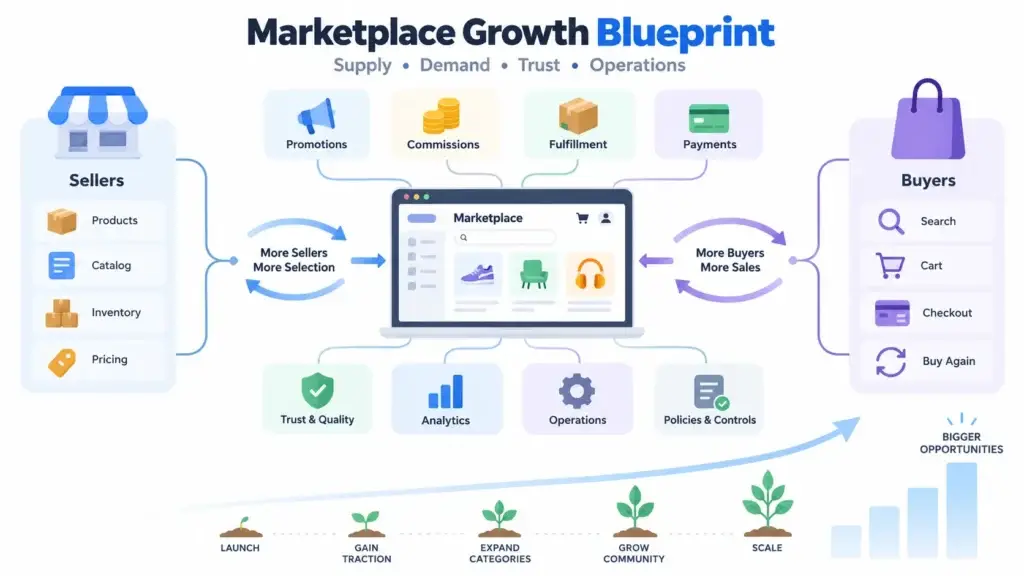
A marketplace grows differently from a single-brand ecommerce store.
In a normal ecommerce business, the company controls inventory, pricing, fulfillment, product pages, and customer experience. In a marketplace model, the platform operator manages an ecosystem. Sellers bring inventory. Buyers create demand. The platform connects both sides while maintaining trust, quality, payments, search, promotions, and operations.
This creates a chicken-and-egg problem.
Sellers will not stay if there are no buyers. Buyers will not return if there are not enough products, sellers, offers, and reliable fulfillment. The marketplace operator must solve both sides together.
A strong growth strategy helps answer questions such as:
- Which seller categories should be onboarded first?
- What product categories can create early buyer demand?
- How should commissions, discounts, and promotions be structured?
- What repeat purchase loops should be built into the platform?
- Which marketplace metrics show real traction?
- What operational controls are needed before scaling?
This is why marketplace growth is not just a marketing problem. It is a product, supply, demand, trust, and operations problem.
The Three-Sided Growth Engine of an Online Retail Marketplace
Most founders think of marketplace growth as two-sided: sellers and buyers. In reality, an online retail marketplace has three connected growth layers.
The first layer is seller supply. The platform needs enough quality sellers, active catalogs, competitive pricing, stock availability, and reliable fulfillment.
The second layer is buyer demand. The platform needs traffic, search visibility, paid acquisition, organic discovery, product trust, offers, and smooth checkout.
The third layer is repeat purchase behavior. A marketplace becomes stronger when customers come back without needing heavy discounts every time.
| Growth Layer | What It Means | Founder Priority |
|---|---|---|
| Seller Supply | Attracting vendors, products, catalogs, and reliable fulfillment capacity. | Build category depth before trying to sell everything. |
| Buyer Demand | Creating traffic, product discovery, trust, and purchase intent. | Focus on high-intent buyers and strong product categories. |
| Repeat Purchases | Encouraging users to return through value, convenience, loyalty, and experience. | Reduce dependence on paid acquisition over time. |
The mistake many marketplace founders make is trying to scale all three layers too quickly. A better approach is to start with a narrow category, build liquidity, learn buyer behavior, then expand.
Seller Acquisition Strategy: How to Attract the Right Marketplace Sellers
Seller acquisition is not about adding as many vendors as possible. It is about attracting sellers who can improve product availability, pricing depth, category trust, and buyer experience.
A marketplace with 100 weak sellers can perform worse than a marketplace with 20 active, reliable sellers. The goal is not seller count. The goal is seller quality, catalog relevance, fulfillment consistency, and long-term activity.
Start With Category-Led Seller Targeting
Founders should avoid launching with too many unrelated categories. A marketplace becomes easier to grow when it begins with a clear category focus.
For example, instead of trying to sell electronics, fashion, home goods, beauty, groceries, and accessories from day one, the platform can start with two or three categories where demand is easier to prove.
Good starting categories usually have:
- Frequent purchase behavior
- Enough local or regional sellers
- Clear price comparison value
- Repeat order potential
- Product variety
- Strong search demand
- Manageable fulfillment requirements
A category-led seller acquisition strategy helps the platform create depth instead of shallow variety.
Give Sellers a Clear Reason to Join
Sellers do not join a marketplace just because the platform exists. They join when they believe the platform can help them grow revenue, reach new customers, manage orders easily, or reduce dependence on one sales channel.
A strong seller pitch should communicate:
- Access to new buyer demand
- Simple onboarding and product upload
- Transparent commission structure
- Seller dashboard access
- Promotion and discount tools
- Order and inventory management
- Payout visibility
- Ratings and review benefits
- Support for branded storefronts where relevant
For early-stage marketplaces, the first seller pitch should not sound too technical. It should focus on business value: more visibility, easier selling, and better control.
Reduce Seller Onboarding Friction
Seller acquisition fails when onboarding is slow or confusing. If vendors need too many calls, documents, spreadsheets, or manual approvals before going live, many will drop off.
A scalable seller onboarding workflow should include:
- Seller registration
- Business profile setup
- Document or identity verification where needed
- Product catalog upload
- Inventory setup
- Pricing and discount configuration
- Shipping or delivery preferences
- Payout details
- Admin approval
- Seller training or onboarding guide
For marketplace operators, the admin dashboard is critical here. It should allow the business owner to approve sellers, review documents, manage categories, control commissions, monitor products, and resolve disputes without depending on developers for every operational change.
This is where a launch-ready ecommerce marketplace foundation can support faster execution, because the core seller, buyer, and admin workflows do not need to be built from zero.
Buyer Demand Strategy: How to Bring the Right Customers Into the Marketplace
Buyer acquisition is not just traffic generation. A marketplace needs relevant buyers who are likely to search, compare, trust, purchase, and return.
Early buyer demand should be built around a specific value promise. That could be better pricing, wider selection, faster delivery, local seller discovery, niche product depth, verified sellers, or exclusive offers.
Build Demand Around High-Intent Product Categories
A new marketplace should not spend heavily on broad awareness before it knows which categories convert. It should first identify product categories where buyers already have strong intent.
High-intent categories usually include products that people actively search for, compare, and buy within a short decision window.
Examples include:
- Mobile accessories
- Beauty and personal care
- Home essentials
- Fashion basics
- Regional products
- Electronics accessories
- Gift items
- Daily-use products
- Local specialty goods
The goal is to create early demand where buyer intent already exists instead of forcing demand in categories that need heavy education.
Use Search, Content, and Category Pages Together
Marketplace SEO works best when the platform has strong category pages, product pages, seller pages, and supporting content.
A founder should think of SEO in layers:
- Homepage for broad marketplace positioning
- Category pages for commercial search intent
- Product pages for purchase-ready search intent
- Seller/store pages for brand and local discovery
- Blog content for informational and comparison queries
- Buying guides for decision-stage users
For example, a marketplace selling electronics accessories can create category pages for phone cases, chargers, earbuds, cables, and power banks. Supporting content can explain buying criteria, product comparisons, care tips, and seasonal buying guides.
The blog should not compete with product or solution pages. It should support them by answering questions that help users move closer to a buying decision.
Improve Product Discovery Inside the Marketplace
Traffic alone does not create sales. Buyers need to find the right products quickly.
Strong product discovery depends on:
- Search filters
- Category navigation
- Product sorting
- Personalized recommendations
- Trending products
- Recently viewed products
- Related items
- Seller ratings
- Product reviews
- Delivery estimates
- Price and discount visibility
If buyers cannot find relevant products within a few clicks, they leave. For marketplace founders, discovery is not a design detail. It directly affects conversion rate, average order value, and repeat purchases.
Repeat Purchase Strategy: How to Make Buyers Come Back
Repeat purchases are where marketplace economics become healthier.
A platform that depends only on new customer acquisition will need continuous ad spending. A marketplace that increases repeat purchases can improve customer lifetime value, seller confidence, and organic growth.
Repeat purchases happen when buyers trust the platform enough to return without needing to compare every alternative.
Create Post-Purchase Loops
The customer journey should not end after checkout. A strong marketplace creates post-purchase loops that bring buyers back.
Useful post-purchase loops include:
- Order updates
- Delivery notifications
- Review requests
- Reorder reminders
- Personalized recommendations
- Loyalty points
- Wallet credits
- Seasonal offers
- Category-specific campaigns
- Abandoned cart recovery
- Wishlist reminders
For example, if a buyer purchases skincare products, the platform can send replenishment reminders after a reasonable usage period. If a buyer purchases mobile accessories, the platform can recommend related products such as chargers, cases, and screen protectors.
The more relevant the follow-up, the stronger the repeat purchase potential.
Build Loyalty Without Over-Discounting
Discounts can create early traction, but they can also train users to buy only when prices drop. A stronger repeat purchase strategy combines value, convenience, trust, and loyalty.
Marketplace loyalty can include:
- Points on every purchase
- Early access to sales
- Member-only shipping offers
- Category-specific coupons
- Referral credits
- Seller-specific offers
- Wallet rewards
- Subscription benefits where relevant
The key is to reward repeat behavior without destroying margins.
Improve Trust Signals Across the Buyer Journey
Buyers return when they feel safe. Trust signals matter across the full journey, from product discovery to post-purchase support.
Important trust signals include:
- Verified sellers
- Transparent ratings
- Product reviews
- Clear return policies
- Secure payments
- Order tracking
- Customer support
- Refund and dispute workflows
- Accurate product descriptions
- Reliable delivery communication
Marketplace trust is operational, not just visual. A polished interface may bring users in, but fulfillment quality, refunds, support, and seller reliability decide whether they come back.
Founders should also consider marketplace app security considerations such as secure payments, seller verification, refund workflows, role-based access, and dispute management because trust directly affects buyer retention.
Marketplace Liquidity: The Real Growth Metric Founders Should Watch
Marketplace liquidity means buyers can find what they want, and sellers can receive enough demand to stay active.
Without liquidity, both sides weaken. Sellers stop uploading products because sales are low. Buyers stop visiting because selection is poor. The marketplace loses momentum.
Founders should track liquidity through practical metrics such as:
- Active sellers by category
- Active product listings
- Product search-to-purchase rate
- Add-to-cart rate
- Checkout conversion rate
- Repeat purchase rate
- Seller order acceptance rate
- Fulfillment success rate
- Return and refund rate
- Average order value
- Customer acquisition cost
- Customer lifetime value
- Seller retention rate
These metrics help the operator understand whether the marketplace is growing structurally or only generating temporary traffic.
Founder Decision Signals
Speed
If the business needs to test marketplace demand quickly, starting with a launch-ready product foundation can reduce the time spent building standard seller, buyer, and admin flows.
Cost
Growth spending becomes risky when the platform lacks strong conversion, retention, and seller management workflows. Build the control layer before scaling acquisition.
Scalability
A marketplace needs scalable catalog management, order workflows, payment handling, seller dashboards, and admin controls before expanding categories aggressively.
Market Fit
Early traction should be measured by repeat orders, seller activity, category depth, and buyer satisfaction, not only downloads or website visits.
Revenue Models That Support Marketplace Growth
A retail marketplace should not depend on one revenue stream too early. Different revenue models can support different stages of growth.
In the beginning, the platform may use lower commissions or free onboarding to attract sellers. Once demand improves, it can introduce paid promotions, featured listings, subscriptions, or category-based commission rules.
| Revenue Model | How It Works | Best Use Case |
|---|---|---|
| Commission on Orders | The platform earns a percentage from each successful order. | Core marketplace monetization once transactions start growing. |
| Featured Listings | Sellers pay for better product visibility inside category or search pages. | Useful when sellers want more exposure in competitive categories. |
| Seller Subscription | Sellers pay a recurring fee for advanced tools, visibility, or storefront features. | Works when the platform offers consistent seller value. |
| Advertising | Brands or sellers pay to promote products, banners, or campaigns. | Best after the marketplace has meaningful traffic. |
| Delivery or Convenience Fees | The platform charges buyers for delivery, faster shipping, or convenience. | Relevant when logistics or fulfillment is controlled by the platform. |
| Membership or Loyalty Program | Buyers pay for benefits such as special offers, priority support, or shipping perks. | Works when repeat purchase behavior is already strong. |
The right revenue model depends on marketplace maturity. Charging too much too early can discourage sellers. Discounting too heavily for buyers can hurt margins. The platform operator needs flexibility to adjust monetization based on real traction.
Founders who want to go deeper into commissions, seller subscriptions, paid listings, advertising, delivery fees, and loyalty-based monetization can explore how a retail marketplace business model is structured before finalizing their own revenue plan.
Operational Controls Every Growing Retail Marketplace Needs
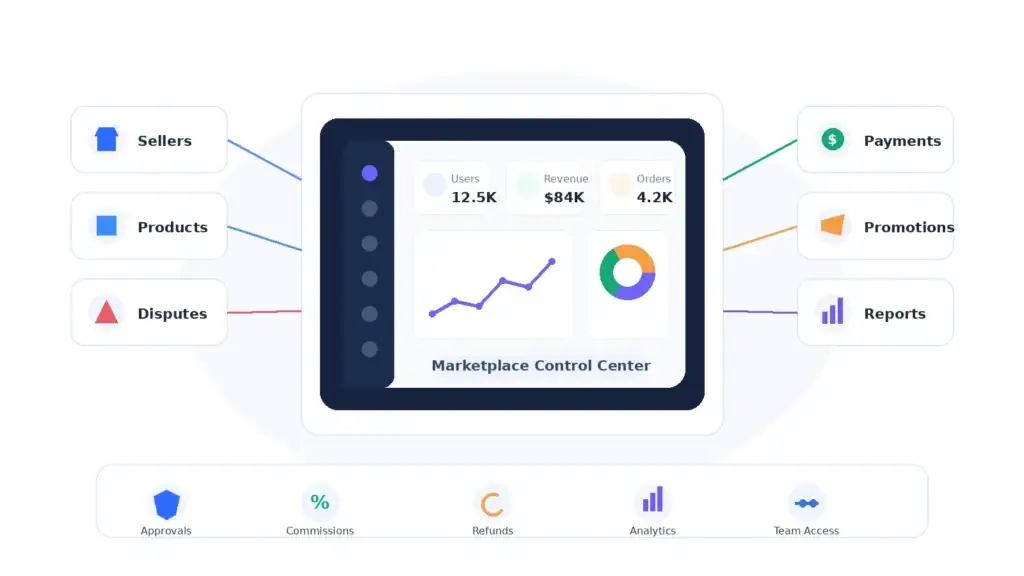
Growth becomes difficult when the admin layer is weak.
A marketplace operator needs control over sellers, products, orders, payments, promotions, disputes, categories, commissions, refunds, reports, and content. Without this backend control, every small operational change becomes slow.
Important admin controls include:
- Seller approval and verification
- Category and subcategory management
- Product approval workflows
- Commission management
- Coupon and promotion controls
- Order status monitoring
- Refund and return management
- Dispute handling
- Buyer and seller communication oversight
- Payment and payout visibility
- Analytics and reporting
- Role-based team access
- Review and rating moderation
These controls matter because marketplace growth creates complexity. More sellers mean more listings. More buyers mean more support tickets. More orders mean more payment, delivery, refund, and dispute workflows.
Many of these workflows connect directly to essential ecommerce marketplace features, especially seller approval, product catalog management, order tracking, promotions, refunds, ratings, and admin analytics.
A scalable admin dashboard gives the founder visibility and control before the business becomes operationally heavy.
Technology Layers That Influence Marketplace Growth
Technology does not replace strategy, but it can limit or support growth. Before investing heavily in seller acquisition or buyer demand campaigns, founders should also understand ecommerce marketplace development cost factors such as features, integrations, branding, platform complexity, admin controls, and customization scope.
If the platform is slow, search is weak, checkout fails, or seller dashboards are difficult to use, marketing will not solve the problem. The product foundation must support buyer experience and seller operations together.
This is why founders often evaluate ecommerce app development services before scaling acquisition campaigns, because growth becomes easier when the platform already supports catalog management, checkout, payments, seller tools, and admin control.
Key technology layers include:
- Mobile app and web storefront
- Seller dashboard
- Admin dashboard
- Product catalog system
- Search and filtering
- Cart and checkout
- Payment gateway integration
- Order management
- Notification system
- Review and rating system
- Promotion engine
- Analytics dashboard
- Inventory control
- Return and refund workflows
- API integrations
- Security and access controls
Miracuves supports founders with ready-made and white-label ecommerce marketplace development that includes core marketplace workflows, custom branding, source-code ownership, and 6-day solution delivery for ready-made deployments. This allows founders to focus more energy on seller acquisition, demand generation, and repeat purchase strategy instead of spending months building every standard module from scratch.
Seller Acquisition vs Buyer Acquisition: What Should Come First?
The answer depends on the category.
In some categories, seller supply must come first because buyers need enough selection before they purchase. In other cases, buyer waitlists, content campaigns, or pre-launch demand can help convince sellers to join.
A practical approach is to build both sides in controlled stages.
| Stage | Seller Focus | Buyer Focus | Main Goal |
|---|---|---|---|
| Pre-Launch | Onboard early sellers in selected categories. | Build interest through content, waitlists, and local campaigns. | Prepare supply and validate demand signals. |
| Early Launch | Improve catalog depth and seller reliability. | Drive targeted traffic to high-intent categories. | Create first transactions and learn conversion behavior. |
| Growth Stage | Add seller tools, promotions, and performance dashboards. | Use retargeting, loyalty, referrals, and personalization. | Increase repeat purchases and seller activity. |
| Scale Stage | Expand categories and introduce seller monetization. | Build brand recall, app engagement, and lifecycle campaigns. | Improve marketplace liquidity and profitability. |
The strongest marketplaces do not treat sellers and buyers as separate campaigns. They connect both sides through category strategy, pricing, trust, fulfillment, and retention.
A staged pre-launch and post-launch marketplace marketing plan can help founders build seller supply, test buyer demand, and improve campaign timing without rushing into broad acquisition too early.
Common Growth Mistakes Online Marketplace Founders Should Avoid
Trying to Launch Too Many Categories at Once
A broad catalog may look impressive, but shallow supply weakens buyer trust. Start with focused categories where seller availability and buyer demand can be built together.
Spending on Ads Before Fixing Conversion
Paid campaigns can bring traffic, but they cannot fix poor product discovery, weak pricing, slow checkout, or unclear return policies. Conversion readiness should come before aggressive acquisition.
Ignoring Seller Experience
Sellers need simple onboarding, product management, order visibility, and payout clarity. If the seller dashboard is difficult to use, seller activity drops.
Depending Only on Discounts
Discounts may create short-term orders, but repeat purchases need trust, convenience, personalization, loyalty, and reliable fulfillment.
How Miracuves Helps Founders Launch and Grow Retail Marketplaces Faster
A strong marketplace growth strategy needs the right product foundation. Founders need buyer apps, seller panels, product catalog systems, order workflows, payment integrations, admin dashboards, promotion tools, and analytics before they can scale seller acquisition and buyer demand confidently.
Miracuves helps founders launch ecommerce marketplace platforms faster with ready-made, white-label solutions that can be customised around branding, workflows, monetization, and marketplace operations. Founders comparing different models can also explore Miracuves’ ecommerce marketplace solution options for seller-driven, catalog-based, and multi-vendor retail businesses.
For founders who do not want to build every module from zero, a multi-vendor commerce platform foundation can reduce launch complexity and help the business move faster from planning to market validation.
The goal is not to copy another platform blindly. The smarter approach is to use a proven marketplace structure, customize it for a specific audience, and build growth around seller quality, buyer trust, and repeat purchases.
Final Thoughts: Marketplace Growth Comes From Balance, Not Just Traffic
An online retail marketplace grows when sellers, buyers, and repeat purchase loops strengthen together.
Seller acquisition brings supply. Buyer demand creates transactions. Repeat purchases build long-term value. But none of these work well without a strong marketplace foundation, clear category strategy, trusted operations, and admin control.
For founders, the best growth strategy is not to launch everything at once. It is to start with focused categories, onboard reliable sellers, attract high-intent buyers, improve product discovery, and build retention from the first order.
Miracuves helps founders move faster with ready-made ecommerce marketplace solutions designed for branding, source-code ownership, admin control, and 6-day delivery where applicable. With the right foundation and growth strategy, founders can focus less on starting from zero and more on building a marketplace that sellers and buyers actually want to use.
FAQs
What is an online retail marketplace growth strategy?
An online retail marketplace growth strategy is a plan for attracting sellers, generating buyer demand, increasing transactions, and encouraging repeat purchases. It includes seller onboarding, product discovery, pricing, promotions, retention, trust-building, and marketplace operations.
How do online marketplaces attract sellers?
Marketplaces attract sellers by offering access to buyer demand, simple onboarding, transparent commissions, seller dashboards, product promotion tools, payout visibility, and operational support. Early-stage marketplaces should focus on quality sellers in specific categories instead of trying to onboard everyone.
How can a marketplace increase buyer demand?
A marketplace can increase buyer demand through SEO, category pages, paid campaigns, referral programs, product discovery, competitive pricing, trust signals, reviews, offers, and smooth checkout. Demand generation works best when focused on high-intent product categories.
Why are repeat purchases important for ecommerce marketplaces?
Repeat purchases reduce dependence on paid acquisition and improve customer lifetime value. When buyers return frequently, sellers receive more orders, platform liquidity improves, and the marketplace becomes easier to scale.
What features help improve marketplace retention?
Retention improves with wishlists, reorder reminders, personalized recommendations, loyalty rewards, wallet credits, review requests, fast checkout, order tracking, and reliable customer support. Trust and convenience are as important as discounts.
Should a new marketplace focus on sellers or buyers first?
A new marketplace should usually build both sides in stages. It needs enough seller supply to make the platform useful and enough buyer demand to keep sellers active. The best starting point is often a focused category where supply and demand can be matched quickly.
What metrics should marketplace founders track?
Important marketplace metrics include active sellers, active listings, conversion rate, repeat purchase rate, seller retention, average order value, order fulfillment rate, return rate, customer acquisition cost, and customer lifetime value.
How can Miracuves help with ecommerce marketplace launch?
Miracuves helps founders build ready-made and white-label ecommerce marketplace platforms with source code, branding, seller workflows, buyer experience, admin dashboards, and faster deployment. Ready-made solutions can support a 6-day launch depending on customization scope.
Miracuves is an independent software development company. We are not affiliated with, connected to, sponsored by, or endorsed by any company or product named in this article.
Terms such as “X Clone” are used descriptively. It is how the software industry refers to building a platform with functionality comparable to a known service, and how clients search for it.
The entire design and codebase of our products is built by our own team. Our products contain no code, design, graphics, or content originating from any third-party website or applications.
All third-party names and marks referenced in this article are the property of their respective owners, referenced solely to identify the services discussed.