


Key Takeaways
- Real-time microblogging platforms can generate revenue through advertising, subscriptions, creator tools, and data services.
- Advertising becomes more effective after the platform develops active users, measurable engagement, and brand-safe content.
- Premium subscriptions can create recurring income through analytics, advanced posting tools, identity features, and reduced advertising.
- Creator subscriptions, tips, paid communities, and sponsored content can improve creator retention and platform activity.
- A diversified revenue model is more sustainable than depending completely on feed advertising.
Revenue Model Signals
- Use lightweight subscriptions, business profiles, and creator tips to test willingness to pay during the early launch stage.
- Introduce promoted posts, sponsored topics, and targeted campaigns after community activity and moderation become stable.
- Connect creator monetization with subscription records, payout workflows, refunds, transaction history, and abuse controls.
- Monetize APIs and public conversation insights through authenticated plans, rate limits, permission rules, and usage monitoring.
- Give administrators control over campaigns, subscription plans, creator payouts, API access, payments, reports, and revenue analytics.
Real Insights
- A new platform should not copy the revenue mix of a mature network before developing sufficient audience activity and trust.
- Premium features generate stronger subscription demand when they solve visibility, productivity, analytics, or community-management problems.
- Data services can create long-term value, but privacy controls and access governance must be established before commercial API access begins.
- Moderation directly affects revenue because advertisers, creators, subscribers, and developers require a reliable and trustworthy environment.
- Miracuves develops white-label microblogging platforms with advertising controls, subscriptions, creator monetization, API access, admin workflows, source-code ownership, and six-day delivery where the ready-made scope applies.
Real-time microblogging platforms are built around fast public conversations. Users post short updates, react to breaking moments, follow creators, join discussions, and discover content through timelines, hashtags, replies, and recommendations.
For founders, the revenue opportunity is not limited to showing ads in a feed. A strong microblogging platform can generate income from multiple sides of the ecosystem: advertisers, premium users, creators, developers, brands, media teams, communities, and data-driven businesses.
This guide explains how real-time microblogging platforms make money through advertising, subscriptions, creator tools, and data services. It also shows how founders can think about monetization without weakening user trust, creator activity, or platform safety.
Why Microblogging Platforms Need More Than One Revenue Stream
A real-time social platform depends on activity. If users stop posting, replying, sharing, and discovering content, the business model becomes weak no matter how many monetization features exist.
This is why depending only on advertising can be risky for new platforms. Ads usually need scale, advertiser confidence, repeat traffic, and brand-safe content. A young platform may have strong community engagement before it has enough inventory to attract serious advertisers.
A stronger revenue model combines short-term and long-term monetization layers. Subscriptions can start early. Creator tools can attract power users. Sponsored placements can work for niche communities. Data and API services can become valuable once the platform has structured public activity and developer demand.
Founder insight: The monetization question is not “Which revenue stream is the biggest?” The better question is “Which revenue stream fits the platform’s current stage, audience behavior, and trust level?”
The Four Core Revenue Pillars of Real-Time Microblogging Platforms
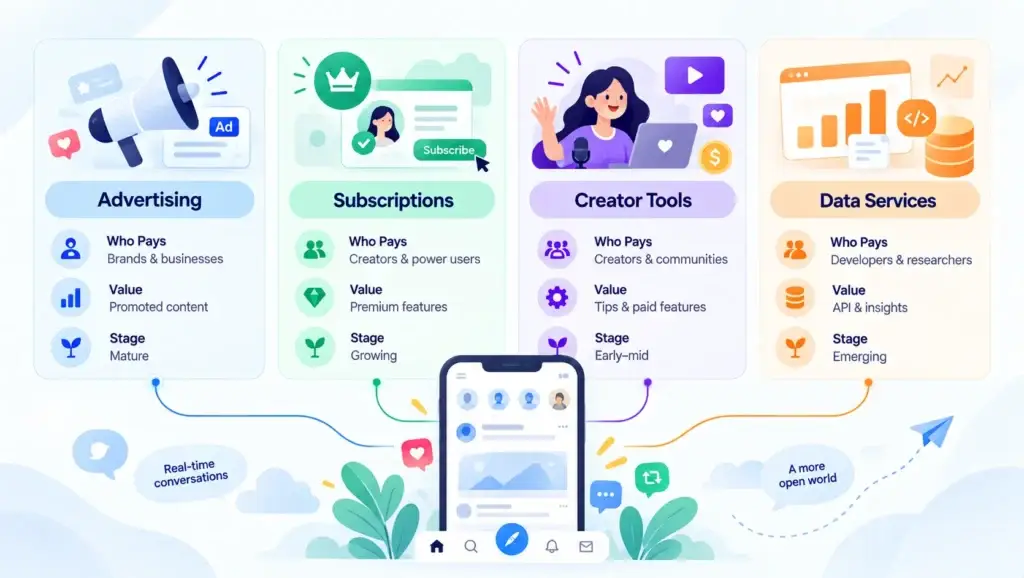
Most real-time microblogging platforms can be monetized through four core pillars: ads, subscriptions, creator tools, and data services. Each pillar works differently and depends on a different side of the platform ecosystem.
| Revenue Pillar | Who Pays? | What They Pay For | Best Stage to Introduce |
|---|---|---|---|
| Advertising | Brands, businesses, agencies, campaign managers | Promoted posts, sponsored trends, display placements, video ads, targeted campaigns | After audience activity and moderation systems are stable |
| Subscriptions | Power users, creators, professionals, communities | Premium visibility, advanced posting tools, analytics, identity features, fewer ads | Early to mid-stage |
| Creator Tools | Creators, followers, subscribers, supporters | Paid communities, tips, exclusive posts, creator subscriptions, revenue share models | Once creators see audience value |
| Data Services | Developers, researchers, brands, media teams, businesses | API access, trend data, sentiment signals, public conversation analytics, reporting tools | After meaningful data volume and governance systems exist |
Advertising Revenue: Turning Attention Into Campaign Inventory
Advertising is the most familiar revenue stream for microblogging platforms because the feed naturally creates attention. Users scroll through posts, replies, topics, hashtags, profiles, search results, and trending discussions. Each of these surfaces can become ad inventory.
However, ad monetization works only when the platform can protect user experience. Too many ads reduce trust. Poor targeting lowers advertiser performance. Weak moderation creates brand-safety concerns. A platform operator needs control over ad placement, campaign quality, budget limits, targeting logic, and reporting.
Common Ad Formats for Microblogging Platforms
- Promoted posts: Sponsored posts inserted into the feed while matching the format of native content.
- Sponsored topics: Paid visibility around hashtags, categories, or trending conversations.
- Profile promotions: Paid discovery for creators, brands, experts, or community leaders.
- Video ads: Monetization for short clips, embedded media, and high-engagement content.
- Banner placements: Display-style ad units in sidebars, search pages, or community pages.
- Local promotions: Geo-targeted campaigns for regional businesses or niche communities.
What Founders Should Control in the Ad System
An ad system is not just an ad slot. It should include campaign creation, advertiser approval, targeting settings, daily budgets, spend tracking, impressions, clicks, reporting, and moderation controls.
For founders, this matters because the ad desk becomes a business operations layer. Without it, every campaign requires manual handling. With it, the platform can serve advertisers more professionally and scale monetization without depending on developers for every campaign change.
Read More: What Is a Real-Time Microblogging Platform and How Do Feeds, Trends, Posts, and Conversations Work?
Subscription Revenue: Building Predictable Income From Power Users
Subscriptions help microblogging platforms create recurring revenue without depending completely on ad demand. Instead of charging every user, platforms can offer premium features to users who need more reach, control, identity, or analytics.
This model works especially well when the platform attracts creators, professionals, journalists, analysts, educators, community leaders, or niche experts. These users often care about audience growth, credibility, post performance, and content management.
Subscription Features That Users May Pay For
- Advanced profile customization
- Post editing and scheduling
- Longer posts or richer media uploads
- Reduced ads or ad-free browsing
- Creator analytics and audience insights
- Priority visibility in replies or search
- Professional identity badges
- Bookmark folders and productivity tools
- Early access to new platform features
The strongest subscription features are not cosmetic. They solve a real user problem. A creator may pay for analytics. A professional may pay for visibility. A community operator may pay for moderation tools. A business account may pay for campaign and profile controls.
Creator Monetization: Giving High-Value Users a Reason to Stay
Creator tools help microblogging platforms move beyond passive content consumption. When creators can earn inside the platform, they have a stronger reason to publish consistently, bring followers, and build community relationships.
For a platform operator, creator monetization can support retention and engagement. For creators, it turns attention into income. For users, it creates more reasons to follow, subscribe, support, and participate.
Creator Revenue Tools That Can Work in a Microblogging Platform
- Paid creator subscriptions: Followers pay for exclusive posts, private updates, premium discussions, or subscriber-only spaces.
- Tips and one-time support: Users send direct support to creators for valuable posts, threads, analysis, or community work.
- Paid communities: Creators or experts run gated groups around niche interests.
- Sponsored creator posts: Brands collaborate with creators through platform-managed campaigns.
- Revenue sharing: The platform shares eligible ad or subscription revenue with creators based on engagement rules.
- Digital products: Creators sell reports, guides, access, templates, event passes, or premium resources.
The platform should not treat creator monetization as a simple payment button. It needs subscription records, payout workflows, refund logic, creator dashboards, transaction history, abuse controls, and admin visibility. These operational details decide whether creator monetization can scale safely.
Founder Decision Signals
Audience Quality
If users visit for real-time updates, niche expertise, or professional conversations, subscription and creator tools may work earlier than broad advertising.
Advertiser Readiness
If the platform has clear communities, safe content, and measurable engagement, promoted posts and sponsored topics become easier to sell.
Creator Supply
If creators already bring an audience, paid subscriptions, tips, and exclusive content can become an early monetization layer.
Data Value
If conversations reveal market trends, audience sentiment, or niche signals, API and data services may become a long-term revenue opportunity.
Data Services and API Revenue: Monetizing Public Conversation Signals
Real-time microblogging platforms generate valuable public signals. These signals may include trending topics, sentiment shifts, breaking discussions, audience reactions, creator influence, hashtag activity, and content velocity.
When organized responsibly, this data can support developers, researchers, media teams, brands, analytics teams, and community operators. The platform can monetize this through API access, dashboards, export tools, trend reports, monitoring products, and developer plans.
Possible Data and API Products
- Public post search API
- Trend discovery dashboard
- Hashtag analytics
- Creator performance insights
- Sentiment and topic monitoring
- Brand mention alerts
- Developer API plans
- Rate-limited data access tiers
- Research and reporting exports
This revenue stream requires careful governance. API access should include authentication, rate limits, permission rules, audit logs, pricing tiers, usage monitoring, and privacy-conscious handling. Founders should not open data access without knowing what data is available, who can access it, and how misuse will be prevented.
Commerce, Payments, and Business Tools as Extra Revenue Layers
Ads, subscriptions, creator tools, and data services are the primary monetization pillars. But microblogging platforms can also add commerce and business tools when the audience behavior supports them.
For example, a creator-focused platform may allow paid events, digital downloads, premium communities, or direct bookings. A professional network may sell business profiles, hiring visibility, lead forms, or sponsored newsletters. A regional community platform may support local business promotions, classifieds, paid announcements, or verified organization accounts.
Additional Revenue Options
- Paid business accounts
- Verified organization profiles
- Lead generation forms
- Event promotions
- Paid communities
- Digital product sales
- Sponsored newsletters
- Premium analytics dashboards
- Local business promotions
The right add-on depends on the platform’s niche. A general audience platform may prioritize ads and subscriptions. A professional platform may prioritize analytics and business accounts. A creator-first platform may prioritize subscriptions, tips, and exclusive content.
Revenue Model Sequencing: What to Launch First
Founders often make the mistake of activating every revenue stream at once. A better approach is to sequence monetization based on platform maturity.
| Platform Stage | Primary Goal | Best Revenue Focus | Why It Works |
|---|---|---|---|
| Early launch | Build activity and trust | Light subscriptions, business profiles, creator tips | These do not require massive traffic and can validate willingness to pay. |
| Community growth | Increase retention | Creator subscriptions, premium tools, sponsored posts | Active creators and niche communities can support direct monetization. |
| Advertiser readiness | Monetize attention | Promoted posts, sponsored topics, targeted campaigns | Advertisers need measurable audiences and safe content environments. |
| Platform maturity | Expand business value | API plans, data dashboards, trend reports, business intelligence tools | Structured activity data becomes more useful once the platform has volume and governance. |
This staged approach protects the product experience. Users should not feel that monetization is being forced before the platform gives them enough value.
Why Moderation and Trust Directly Affect Revenue

Monetization depends on trust. Advertisers want safe placement. Creators want fair payouts. Subscribers want reliable features. Developers want stable API rules. Users want useful conversations without abuse, spam, or manipulation.
This means moderation is not only a safety feature. It is part of the revenue foundation. If the platform cannot manage reports, remove harmful content, track admin actions, and control abusive behavior, monetization becomes harder.
Trust Features That Support Monetization
- Content moderation queues
- Abuse reporting
- Spam detection workflows
- Creator verification
- Advertiser approval controls
- Role-based admin access
- Audit logs for operator actions
- Payment and payout monitoring
- Community guideline enforcement
- Dispute and refund workflows
Founders should think of monetization and moderation together. A platform that monetizes attention without protecting trust may grow revenue temporarily but weaken long-term retention.
Admin Control: The Hidden Layer Behind Every Revenue Stream
Every revenue model needs an admin layer. Ads need campaign review. Subscriptions need plan control. Creator tools need payout tracking. API access needs usage limits. Business accounts need approval workflows. Reports need action history.
Without admin control, the founder becomes dependent on developers for routine business decisions. With the right operator console, the platform owner can update monetization rules, manage users, review content, approve campaigns, track payments, and adjust platform policies faster.
This is where a launch-ready public conversation platform can support faster validation. Instead of building every monetization and control layer from zero, founders can start with a working foundation and customize the model around their audience.
Mistakes Founders Should Avoid When Monetizing a Microblogging Platform
Launching Ads Before User Trust Exists
Advertising works only when users find the platform valuable. If ads appear before the community has strong engagement, they can feel intrusive and reduce retention.
Copying a Large Platform’s Revenue Mix Too Early
Large platforms monetize mature traffic. A new microblogging platform should choose revenue streams based on its audience stage, creator supply, and community behavior.
Ignoring Creator Economics
If creators do not see a path to audience growth or earnings, they may not publish consistently. Creator tools should be part of the platform strategy, not an afterthought.
Offering API Access Without Governance
Data services can create revenue, but they need rate limits, access rules, usage tracking, and privacy-conscious data handling.
Treating Monetization as a Plugin
Revenue features need to connect with user roles, payments, analytics, moderation, reporting, and admin workflows. A disconnected payment button is not a complete monetization system.
How Miracuves Helps Founders Build Monetization-Ready Microblogging Platforms
Miracuves helps founders move faster with ready-made and white-label app solutions that include the product foundation needed to launch, test, and refine a real-time social platform.
For microblogging platform founders, the goal is not just to publish posts. The platform needs feeds, user profiles, messaging, moderation, ad controls, subscription logic, creator monetization, API access, admin workflows, and source-code ownership so the business can evolve after launch.
With Miracuves’ 6-day solution delivery for ready-made platforms, founders can reduce the time spent building basic infrastructure and focus more energy on audience strategy, creator acquisition, monetization testing, and market validation.
Final Thoughts: Monetization Starts With the Right Platform Foundation
Real-time microblogging platforms generate revenue by turning conversations, attention, creators, communities, and data into business value. But the strongest platforms do not depend on one income stream alone.
Ads can monetize attention. Subscriptions can create recurring revenue. Creator tools can improve retention. Data services can support developers and business users. Commerce and business tools can add extra earning layers when the audience is ready.
For founders, the practical decision is to build monetization in stages. Start with the revenue streams that match your audience today, keep admin control at the center, and use moderation as a trust layer that protects long-term growth.
If you are planning a real-time social product, Miracuves can help you move from revenue strategy to execution with a source-code-owned, white-label platform foundation built for faster launch and future customization.
FAQs
How do real-time microblogging platforms make money?
Real-time microblogging platforms make money through promoted posts, sponsored topics, premium subscriptions, creator tools, API access, data services, business accounts, and commerce features.
Is advertising enough for a new microblogging platform?
Advertising alone is usually not enough for a new platform because ads need traffic, trust, targeting, and brand-safe content. Early platforms often benefit from subscriptions, creator tools, and business features before scaling ad revenue.
What subscription features can a microblogging platform offer?
A microblogging platform can offer premium profiles, post editing, scheduled posts, analytics, reduced ads, advanced bookmarks, identity badges, longer posts, and creator-focused tools as part of paid subscription plans.
How do creator tools generate revenue for microblogging platforms?
Creator tools generate revenue through paid subscriptions, tips, paid communities, exclusive posts, digital products, sponsored creator campaigns, and platform revenue-share models.
Can microblogging platforms monetize data and API access?
Yes. Platforms can monetize API access, trend dashboards, hashtag analytics, public conversation insights, brand monitoring, and research exports. This requires clear access rules, rate limits, authentication, and privacy-conscious data handling.
What should founders monetize first in a microblogging platform?
Founders should usually start with revenue streams that match their early audience, such as premium tools, creator subscriptions, tips, business profiles, or light sponsored placements. Larger ad and data models work better after the platform has stronger activity and trust.
Miracuves is an independent software development company. We are not affiliated with, connected to, sponsored by, or endorsed by any company or product named in this article.
Terms such as “X Clone” are used descriptively. It is how the software industry refers to building a platform with functionality comparable to a known service, and how clients search for it.
The entire design and codebase of our products is built by our own team. Our products contain no code, design, graphics, or content originating from any third-party website or applications.
All third-party names and marks referenced in this article are the property of their respective owners, referenced solely to identify the services discussed.