


A professional networking platform can attract thousands of members and still struggle to build a sustainable business. The reason is simple: having an active network and having a monetizable network are not the same thing.
The strongest professional-network revenue models do not charge every user for the same product. They identify different forms of professional intent inside the network and monetize each one differently. An individual may pay for better visibility or search. A recruiter may pay for candidate discovery and hiring workflows. A sales professional may pay for prospect intelligence. A business may pay for multiple seats. Certain high-value actions can also be controlled through usage credits.
This distinction matters for founders because professional networking is fundamentally a multi-sided business. Members create the identity graph and activity that make the network useful, while recruiters, sales teams, employers, and other professional users may have a much higher willingness to pay for access to specialized workflows built on top of that network.
The familiar LinkedIn revenue-model pattern helped make these distinctions visible, but the broader lesson applies well beyond one network. A niche industry community, alumni ecosystem, professional association, recruiting network, expert marketplace, or private B2B community can apply similar monetization principles without trying to reproduce a mass-market social network.
Key Takeaways
- Professional networking platform revenue works best when different users are charged according to the business value they receive.
- Memberships monetize individual professional advantage, while recruiter and sales seats monetize specialized business workflows.
- Credits are useful for metering valuable actions such as direct outreach without placing every capability behind a more expensive subscription.
- A healthy free layer is important because the members who never pay can still create the network density that makes paid products valuable.
- Founders should design entitlements, permissions, billing logic, and usage limits together rather than adding payment buttons after the product has been built.
- Niche professional networks do not necessarily need advertising-scale audiences if they create enough value for recruiters, sellers, employers, associations, or other professional buyers.
Why Professional Networking Platforms Monetize Differently From Ordinary Social Networks
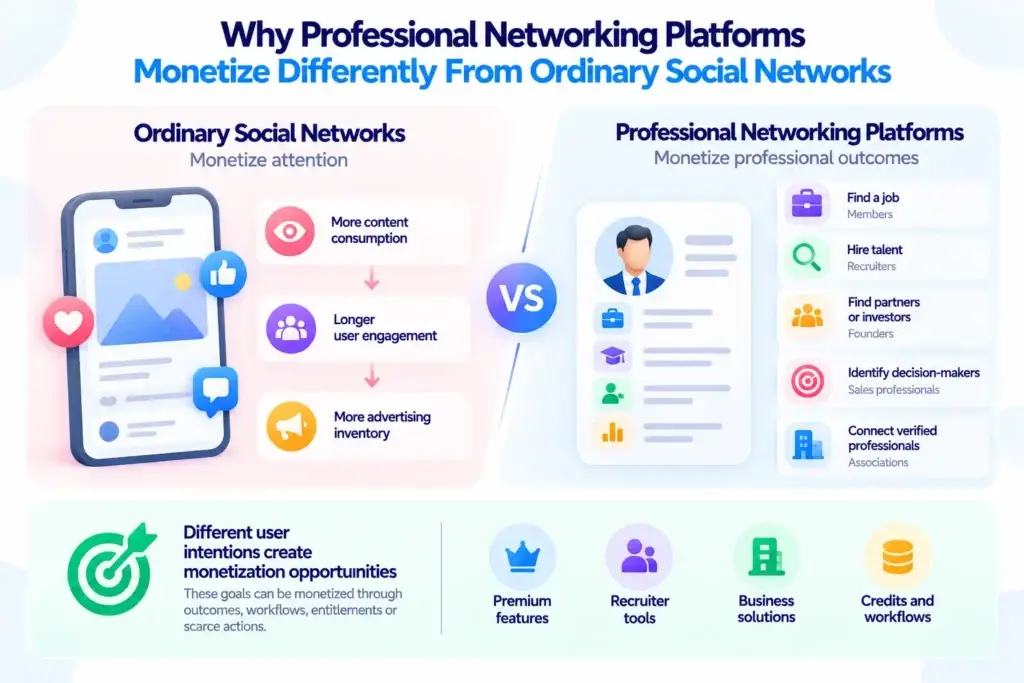
Most consumer social platforms primarily monetize attention. The more content people consume and the longer they remain active, the more advertising inventory the platform may eventually create.
Professional networks can operate differently because user activity often has an identifiable economic objective behind it. A member may be searching for a job. A recruiter may be trying to fill an open role. A founder may be looking for investors or partners. A salesperson may be identifying a decision-maker. An association may need to connect verified professionals in one industry.
Those intentions create monetization opportunities long before a platform has the audience scale required for a significant advertising business.
That is why the most useful question is not simply, “How many users can we monetize?” A better question is, “What economically valuable outcome is each type of user trying to achieve?”
Once that is clear, pricing can be attached to the outcome, workflow, entitlement, or scarce action involved.
The Four Core Revenue Engines: Memberships, Recruiter Seats, Sales Tools, and Credits
These four models may exist inside the same platform, but they monetize fundamentally different units of value. Treating them as interchangeable pricing plans usually produces confusing packaging.
How Each Revenue Layer Creates Value
| Revenue Layer | Typical Buyer | What the Buyer Is Paying For | Natural Billing Logic |
|---|---|---|---|
| Premium membership | Individual professional | Greater visibility, discovery, insights, search, or career advantage | Monthly or annual subscription |
| Recruiter seat | Recruiter, hiring team, staffing organization | Candidate discovery, workflow, collaboration, outreach, and hiring efficiency | Per seat or organizational contract |
| Sales tools | Salesperson or revenue team | Lead discovery, account intelligence, prioritization, lists, and prospecting workflows | Per-user subscription or team contract |
| Credits | Members, recruiters, sellers, or businesses | Controlled consumption of scarce, valuable actions | Included allowance, refill, package, or metered usage |
1. Premium Memberships Monetize Individual Professional Advantage
A premium membership should give an individual a meaningful advantage without making the free experience unusable.
That advantage can come from deeper search, extended visibility, profile analytics, saved searches, additional messaging privileges, applicant insights, stronger discovery controls, or other capabilities connected to a professional goal.
The important distinction is that a membership usually monetizes the member’s own professional outcome. The person is paying because the platform helps them discover more opportunities, understand their visibility, reach people more effectively, or manage their professional presence more intelligently.
This is different from charging simply because someone uses the platform frequently. High usage alone does not establish willingness to pay. A professional may visit every day yet see basic networking as something that should remain free.
The strongest premium boundaries therefore tend to sit around incremental advantage rather than basic participation.
2. Recruiter Seats Monetize Hiring Workflow and Access
A recruiter is not simply another member with more features. The recruiter has an entirely different job to perform.
Recruiters may need advanced candidate search, saved talent pools, hiring projects, notes, pipeline stages, team collaboration, candidate recommendations, direct outreach, reporting, and connections with external hiring systems. These capabilities collectively create an operational product rather than a simple premium profile.
That changes the monetization unit from “premium member” to “professional seat.”
Seat-based pricing is powerful because it can expand with the customer. A company may begin with one recruiter and later add additional users as hiring volume increases. Revenue therefore has an opportunity to grow inside an existing business account rather than depending entirely on acquiring another organization.
Recruiter monetization is especially relevant to niche networks. A platform focused on healthcare professionals, engineers, creative specialists, executives, tradespeople, academics, or another defined community may not need hundreds of millions of members if its audience is sufficiently valuable to organizations hiring within that category.
Founders designing the hiring layer should also consider how advanced job-search and discovery workflows affect perceived recruiter value. Search quality is not merely a feature decision; it can directly influence whether a hiring tool is worth paying for.
3. Sales Tools Monetize Commercial Discovery and Prioritization
The sales side of a professional network has a similar structure but a different objective. Recruiters search for candidates. Sales teams search for accounts, buyers, decision-makers, partners, or commercial opportunities.
A sales product may therefore monetize capabilities such as advanced people and company search, lead lists, account lists, saved prospects, change alerts, relationship signals, collaboration, activity tracking, and integrations with external customer-management workflows.
Again, the buyer is not paying merely for access to profiles. The real product is reduced prospecting friction.
If a professional network can help a salesperson move from a broad universe of people to a prioritized set of commercially relevant contacts, the platform has converted its identity graph into a decision-support product.
This distinction is strategically important. A free user experiences the network as a place to connect. A sales subscriber experiences the same underlying network as a prospecting database, relationship map, alerting engine, and workflow tool.
4. Credits Monetize Scarce or High-Value Actions
Credits solve a different pricing problem.
Some actions are too valuable to make unlimited, but too granular to justify forcing a customer into an entirely different subscription. Direct outreach to someone outside an existing network is a good example.
A credit system places a measurable unit around that action. A user may receive an allowance as part of a plan and consume one unit each time the restricted action is performed.
This creates several advantages. It establishes scarcity, discourages indiscriminate use, gives the platform a usage metric, and allows different subscriptions to include different levels of consumption.
Credits can also make pricing more flexible. The platform does not need to decide that every customer who wants additional outreach should suddenly become an enterprise buyer. Instead, subscription access and usage intensity can be managed separately.
However, credits work only when the customer understands what one credit represents. A complicated wallet with unclear expiry rules, invisible deductions, or inconsistent restrictions can create frustration rather than monetization.
Why the Free Layer Is Part of the Revenue Model, Not the Opposite of It
A common monetization mistake is to place too many fundamental networking functions behind a paywall.
That can reduce the very activity that makes premium products valuable.
A recruiter benefits from having a deep candidate pool. A seller benefits from a rich company and professional graph. A premium member benefits when there are enough relevant people to discover and contact. Employers benefit when their opportunities can reach qualified professionals.
The free layer therefore performs an economic function: it supplies network density.
This does not mean everything should be free. It means founders should separate participation features from advantage features.
Creating a profile, connecting, participating in discussions, maintaining a basic professional identity, and discovering part of the network may help strengthen participation. Premium analytics, expanded search, deeper outreach, workflow tools, organizational controls, or specialized intelligence can then sit above that foundation.
Membership Revenue and Seat Revenue Should Not Be Designed as the Same Product
It is tempting to create “Basic, Pro, and Business” plans and simply add more features at each level. Professional networks often require a more deliberate model because a member subscription and an organizational seat solve different jobs.
An individual professional typically evaluates a subscription based on personal utility: Will this help me find opportunities, understand who is discovering me, communicate more effectively, or improve my visibility?
A company evaluates a recruiter or sales seat using team economics: Will this help employees complete an important workflow faster or with better information?
That difference affects onboarding, permissions, reporting, billing, administration, analytics, and renewal logic.
For founders, the consequence is important: account architecture needs to distinguish between the person using the software and the organization paying for multiple users.
The Real Monetization Engine Is the Entitlement Layer
Payment processing is the easy part. The difficult part is consistently enforcing what each subscription, seat, role, and credit balance is allowed to do.
Suppose an individual membership includes extended search while a recruiter seat includes candidate projects and a sales seat includes account lists. The system needs to know which user owns which entitlement, whether the entitlement belongs to the individual or an organization, when it renews, what happens after cancellation, and which usage limits apply.
The same logic applies to credits. A platform needs a clear ledger showing the available balance, consumption event, renewal behavior, refund logic if applicable, administrative adjustments, and what happens when access ends.
This is why monetization architecture should be designed alongside product architecture. Miracuves’ dedicated guide to membership, seat, and credit monetization logic goes deeper into how these controls can be structured at the product level.
Founders evaluating implementation should similarly examine the entitlement-based feature structure behind the user experience rather than treating pricing as a separate checkout-page decision.
How the Revenue Layers Reinforce Each Other
The strongest professional-network monetization models are interconnected.
Free members create profiles, relationships, activity, expertise signals, and professional context. That makes discovery more useful. Better discovery creates more value for premium individuals. The same identity graph can also make candidate search useful for recruiters and account discovery valuable for sales teams.
Recruiters and sales professionals may then consume additional outreach capacity or other metered resources. Organizations with multiple users can expand through additional seats.
This creates a monetization ladder rather than a single paywall:
- Free participation increases network density.
- Individual premium plans monetize personal advantage.
- Recruiter and sales products monetize professional workflows.
- Seat expansion monetizes growing organizational adoption.
- Credits monetize valuable usage inside those workflows.
- Additional business services can be layered on only when they fit the network’s specific audience.
The advantage of this structure is diversification. Revenue does not depend entirely on convincing every ordinary member to subscribe.
What the LinkedIn Revenue-Model Pattern Teaches Platform Founders
The enduring strategic lesson from LinkedIn’s monetization model is not that every new platform should reproduce every product it offers.
The more useful lesson is that one professional identity graph can support several different economic use cases.
The same profile can matter to the person who owns it, the recruiter searching for relevant talent, the salesperson identifying a potential decision-maker, and the organization building its professional presence.
Each party receives different value. Therefore, each party can justify a different product surface and pricing structure.
Founders should copy the logic, not the scale. A focused network for one profession or industry may only require two monetization layers at launch. For example, free professional membership plus paid recruiter access may be stronger than launching memberships, advertising, sales intelligence, courses, credits, company upgrades, and every other possible revenue stream simultaneously.
Niche Professional Networks Can Monetize Before They Reach Mass-Market Scale
This is one reason vertical professional networks can be economically interesting.
A general-purpose network requires enormous breadth. A niche network can create value through relevance and concentration.
Imagine a professional community focused exclusively on licensed healthcare practitioners, experienced cybersecurity specialists, renewable-energy engineers, film-production professionals, franchise operators, university alumni, or verified independent consultants.
In those environments, a smaller member base may still be attractive to recruiters, associations, specialist vendors, training organizations, and employers because the audience has already been filtered by professional relevance.
This makes the strategy behind a focused or walled-garden professional network particularly relevant. The objective is not to recreate the broadest network possible. It is to build enough trusted density inside a specific category that valuable transactions and professional workflows can occur.
Choosing Which Revenue Model to Launch First
More monetization options do not automatically produce a stronger business. Early-stage founders should prioritize the revenue mechanism closest to the platform’s primary user outcome.
Founder Decision Signals
Members repeatedly seek personal career advantage
Test premium membership around visibility, analytics, discovery, saved activity, or other individual professional advantages.
Employers urgently need access to your audience
Recruiter subscriptions or seats may be more valuable than trying to convert ordinary members first.
Your network contains valuable buyer or company intelligence
A sales-oriented subscription may work when the platform can reduce the cost of identifying and prioritizing commercial prospects.
A specific action needs scarcity
Credits can meter outreach, introductions, unlocks, boosts, or another valuable action without redesigning the entire subscription structure.
Why Credits Can Protect Both Revenue and Network Quality
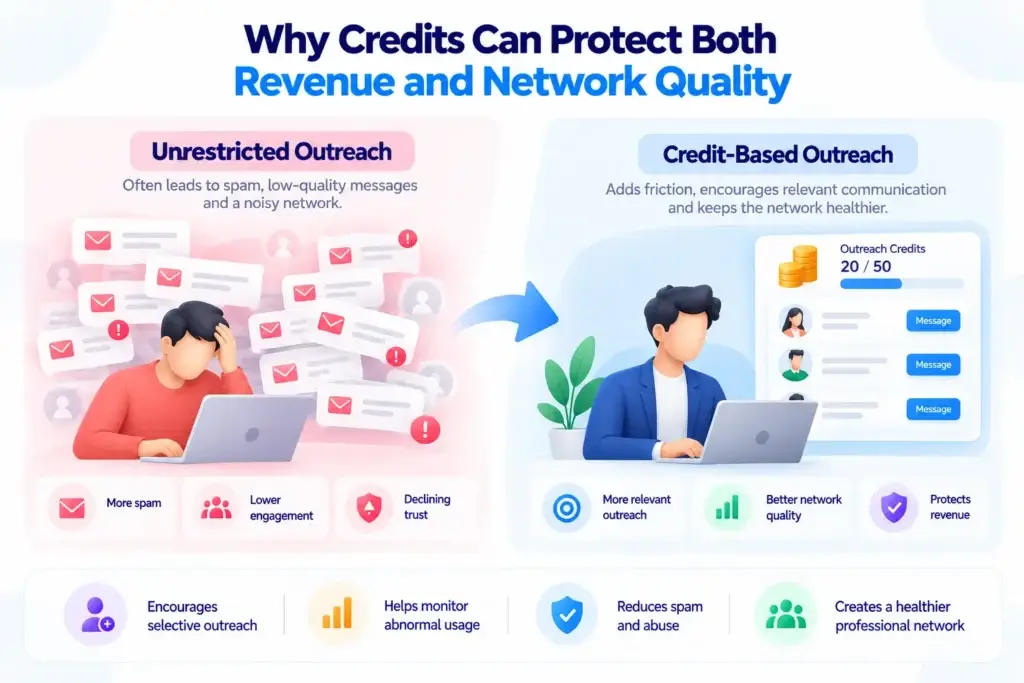
Usage limits are sometimes viewed purely as a monetization mechanism, but they can also protect product quality.
Consider unrestricted cold outreach. If every user can message an unlimited number of strangers, the platform risks becoming noisy. Recipients receive lower-quality communication, spam increases, trust declines, and users become less willing to engage.
A controlled outreach system introduces friction. That friction encourages users to be more selective about whom they contact and gives the operator a clearer mechanism for monitoring abnormal usage.
Therefore, a credit should not automatically be interpreted as a fee imposed on the customer. In the right context it is a governance mechanism that also has monetization value.
Trust and Professional Identity Directly Affect Willingness to Pay
A professional network is valuable because users believe the identities, companies, jobs, credentials, opportunities, and conversations inside it are sufficiently credible to influence real decisions.
That makes trust an economic issue rather than merely a moderation issue.
A recruiter is less likely to pay for candidate search if profiles are low quality. A seller is less likely to value prospect intelligence if company information is unreliable. Members are less likely to pay for visibility if the audience itself is weak. Organizations will hesitate to adopt team tools if permissions, reporting, or account administration feel unreliable.
Founders should therefore consider verification, reporting, moderation, role-based controls, privacy, abuse prevention, and auditability as part of the monetization foundation. The broader professional-network safety and governance considerations are relevant because monetization depends on trust in the underlying network.
Important Metrics for a Professional Networking Revenue Model
Revenue alone does not tell founders whether the monetization structure is healthy. Each layer needs its own operating metrics.
Free-to-Paid Conversion
This measures how effectively the free experience creates demand for individual premium capabilities. A weak conversion rate may indicate that premium benefits are unclear, unnecessary, incorrectly timed, or poorly matched to user intent.
Paid Member Retention
Conversion can look healthy while recurring revenue remains weak if subscribers cancel quickly. Retention shows whether premium value continues after the initial trigger that caused someone to subscribe.
Seat Utilization
A company may purchase multiple recruiter or sales seats but use only a fraction of them. Low utilization can become a renewal problem. High utilization can indicate potential for account expansion.
Expansion Revenue
Track whether organizations add users, upgrade packages, or adopt additional paid workflows over time. In a B2B networking product, account expansion can be as important as new customer acquisition.
Credit Consumption
Credit balances reveal whether metered capabilities are genuinely valuable. If users consistently finish their allowance, additional capacity may have value. If balances remain untouched, the product may be bundling an entitlement customers do not need.
Outcome Metrics
The strongest measurement connects monetization to the outcome each buyer cares about: relevant candidates discovered, qualified conversations started, hiring projects progressed, prospects saved, introductions accepted, or another business result appropriate to the network.
Common Monetization Mistakes Founders Should Avoid
Mistakes Founders Should Avoid
Charging for basic network participation too early
If basic access is over-restricted before network density exists, the platform may weaken the free participation that creates value for higher-paying users.
Treating every buyer as the same customer
A job seeker, recruiter, seller, company administrator, and association manager can use the same network for completely different objectives. Their paid products should reflect those differences.
Creating too many plans before validating willingness to pay
Complex tier tables can hide weak product-market alignment. Start with the revenue layer closest to the strongest business outcome and expand after usage validates the next opportunity.
Adding billing before designing entitlements
A subscription is not complete until permissions, usage limits, seat ownership, downgrades, cancellations, and administrative controls behave consistently throughout the product.
Using credits without transparent rules
Customers should understand what consumes a credit, how balances change, whether unused allowances carry forward, and what happens when a subscription changes.
Copying a large network’s full revenue stack
A focused professional community may need only one or two strong revenue products initially. Complexity should follow validated demand rather than precede it.
How Founders Can Build the Revenue Architecture Into the Product From Day One
A monetization-ready professional network needs more than a payment gateway. The product foundation should understand user identity, organizational ownership, roles, entitlements, usage limits, recurring billing states, credits, administrative adjustments, and analytics.
Founders should decide early which capabilities belong to everyone, which belong to individuals, which belong to organizational seats, and which should be consumption-based. That decision influences database design, middleware permissions, dashboards, checkout flows, analytics events, cancellation behavior, and administrative tooling.
For teams that do not want to engineer every networking, hiring, sales, permissions, and administration workflow from zero, Miracuves offers a launch-ready professional networking platform solution that can be branded and configured around the operator’s business model.
The commercial implementation should still be based on the founder’s actual market. A specialist recruiting community may prioritize recruiter seats. An alumni network may emphasize member subscriptions and organizational access. A B2B community may derive greater value from sales tools. The software should support the strategy rather than dictate it.
Final Thoughts: Monetize Professional Intent, Not Just Network Activity
The strongest professional networking revenue models do not simply place a price on access. They identify which users receive meaningful economic advantage from the network and then build paid products around those outcomes.
Memberships can monetize individual professional advantage. Recruiter seats can monetize talent discovery and hiring workflows. Sales products can monetize commercial intelligence and prospecting efficiency. Credits can place controlled economics around scarce actions such as direct outreach.
The free network remains essential because it creates the professional graph, activity, identities, and relationships that make all those paid products useful.
For founders, that leads to a practical principle: do not begin by asking how many revenue streams the platform can support. Begin by identifying the strongest professional outcome, the user who receives that value, and the cleanest unit to charge for it. Add additional monetization layers only when the underlying behavior proves that they belong.
FAQs
How do professional networking platforms make money?
Professional networking platforms can generate revenue through premium memberships, recruiter subscriptions or seats, sales prospecting tools, employer services, usage credits, paid visibility, job-related products, and other specialized B2B services. The strongest mix depends on which professional outcomes the network enables.
Why do recruiter seats work well for professional networks?
Recruiter seats monetize a business workflow rather than ordinary networking. Employers and recruiters may pay for deeper candidate search, saved talent pools, hiring projects, collaboration, outreach, and workflow management because those capabilities support a measurable hiring objective.
What is the difference between a premium membership and a recruiter seat?
A premium membership usually provides additional value to an individual professional, while a recruiter seat is designed around hiring workflows for a recruiter or organization. The buyer, permissions, administration, reporting, and pricing logic can therefore be different.
How do sales tools generate revenue on a professional networking platform?
Sales tools can be sold as individual or team subscriptions that provide advanced prospect search, company discovery, lead lists, account intelligence, alerts, collaboration, and other workflows that reduce prospecting effort for revenue teams.
What are credits in a professional networking revenue model?
Credits are units used to control consumption of specific high-value actions. A platform may include a defined allowance in a subscription and deduct credits when a user performs a metered action such as contacting someone outside their existing network.
Should a professional networking platform charge all members?
Not necessarily. A useful free layer can increase participation and network density, which may make recruiter, sales, and premium products more valuable. Founders should usually distinguish between basic participation and paid professional advantage.
Can a niche professional network generate revenue without a massive user base?
Yes. A focused professional network may create substantial value with a smaller but highly relevant audience, particularly when employers, recruiters, associations, or B2B teams need reliable access to people in that specific profession or industry.
Which professional networking revenue model should a startup launch first?
The first revenue model should usually match the strongest validated user outcome. Platforms centered on hiring may prioritize recruiter products, while career-focused communities may begin with premium memberships and B2B networks may find sales-oriented tools more relevant.
Miracuves is an independent software development company. We are not affiliated with, connected to, sponsored by, or endorsed by any company or product named in this article.
Terms such as “X Clone” are used descriptively. It is how the software industry refers to building a platform with functionality comparable to a known service, and how clients search for it.
The entire design and codebase of our products is built by our own team. Our products contain no code, design, graphics, or content originating from any third-party website or applications.
All third-party names and marks referenced in this article are the property of their respective owners, referenced solely to identify the services discussed.



