


Key Takeaways
- A real-time microblogging platform connects users, creators, advertisers, businesses, and developers within one multi-sided ecosystem.
- Users create attention, creators supply engaging content, and advertisers pay to reach relevant and active audiences.
- Revenue can come from advertising, memberships, creator payments, business tools, sponsored communities, and API access.
- The right monetization mix depends on audience quality, posting frequency, creator activity, trust, and platform maturity.
- Moderation, analytics, payment workflows, campaign controls, and administration form the operational foundation of the business model.
Business Model Signals
- Start with a defined niche, regional audience, professional community, or creator segment that has a reason to participate regularly.
- Use premium features, creator subscriptions, tips, and business tools before depending heavily on advertising revenue.
- Give advertisers campaign creation, audience targeting, budget management, approval workflows, reporting, and brand-safety controls.
- Support developers and businesses through authenticated APIs, rate limits, access tiers, documentation, analytics, and usage monitoring.
- Provide administrators with control over users, content, subscriptions, campaigns, payouts, reports, APIs, policies, and audit logs.
Real Insights
- A smaller but highly engaged niche audience can create more commercial value than a large and unfocused user base.
- Advertising requires meaningful activity and trust, while subscriptions and creator tools can generate revenue at an earlier stage.
- The feed is a commercial surface because its ranking, freshness, safety, and sponsored placements affect retention and revenue.
- Creator incentives and effective moderation protect the content supply, audience loyalty, and advertiser confidence that monetization depends on.
- Miracuves develops source-code-owned microblogging platforms with creator tools, advertising, subscriptions, API access, moderation, admin controls, and six-day delivery where the ready-made scope applies.
Real-time microblogging platforms are built around one simple behavior: people want to share, react, follow, discover, and discuss what is happening now.
But the business model behind these platforms is not simple.
A successful microblogging platform does not earn only because users post short updates. It earns because multiple sides of the ecosystem create value for each other. Users create attention. Creators bring influence. Advertisers pay to reach relevant audiences. Developers and businesses may pay for platform access, data workflows, automation, or API-based services. The platform operator connects these sides through feed design, moderation, monetization controls, analytics, subscriptions, and trust systems.
That is why the business model of Twitter-style platforms has become an important reference point for founders. The lesson is not to copy a large social network feature by feature. The smarter lesson is to understand how real-time content, creator participation, advertiser demand, and platform services work together to form a monetization-ready social product.
For founders planning a niche public conversation network, creator-led community, professional discussion app, regional social platform, or media-driven engagement product, this model offers a useful blueprint.
What Is a Real-Time Microblogging Platform?
A real-time microblogging platform is a social app where users publish short-form updates, follow accounts, react to posts, join conversations, discover trending topics, and consume live public discussions through personalized feeds.
Unlike long-form publishing platforms, microblogging depends on speed, frequency, and visibility. The core product experience is built around:
- Short posts and updates
- Public conversations
- Replies and quote posts
- Reposts or reshares
- Hashtags and trending topics
- Creator and brand profiles
- Real-time notifications
- Direct messages
- Personalized feeds
- Search and discovery
- Content moderation
- Advertising or promoted content tools
The business value comes from the interaction between these layers. A post creates conversation. Conversation creates attention. Attention attracts creators and advertisers. Creators bring repeat audiences. Advertisers fund reach. Premium tools, subscriptions, and platform services create additional monetization.
This is why founders should treat microblogging as an ecosystem business, not just a posting app.
Why Microblogging Platforms Become Multi-Sided Businesses
A real-time microblogging platform usually connects four major participant groups.
| Participant Group | What They Contribute | What They Expect | How the Platform Can Monetize |
|---|---|---|---|
| Users | Attention, conversations, reactions, sharing behavior | Relevant content, community, discovery, expression | Premium features, ads, memberships |
| Creators | Influence, content supply, audience loyalty | Reach, monetization, analytics, audience ownership | Creator subscriptions, tips, revenue share, paid tools |
| Advertisers | Marketing budgets and campaign demand | Targeted reach, measurable attention, brand safety | Promoted posts, sponsored trends, ad campaigns |
| Platform service users | Developer, brand, research, or business use cases | API access, analytics, automation, data workflows | API plans, dashboards, enterprise access, integrations |
The stronger the connection between these groups, the stronger the business model becomes. If users are active but creators cannot monetize, creators may leave. If advertisers can buy reach but brand safety is weak, campaigns may slow down. If developers want access but API rules are unclear, platform-service revenue stays limited.
The operator’s job is to keep value flowing between all sides.
Read More: Why Startups Choose a Ready-Made Real-Time Microblogging Platform Over Custom Development
The Core Revenue Streams Behind a Microblogging Platform

A microblogging platform can monetize in several ways. The right mix depends on the audience, market, community type, and maturity of the platform.
1. Advertising Revenue From Attention
Advertising is usually the most visible revenue stream for real-time social platforms. Advertisers pay to promote posts, trends, profiles, products, campaigns, or messages inside the user experience.
This model works because microblogging platforms generate high-frequency attention. Users check feeds for updates, breaking conversations, niche discussions, creator opinions, and brand announcements. That creates repeated ad inventory.
Common advertising formats include:
- Promoted posts
- Sponsored trends
- Banner placements
- Sponsored profile recommendations
- Video or media ads
- Campaign-based targeting
- Topic or interest-based ads
- Brand takeover placements
For founders, the important lesson is that advertising should not be treated as a simple banner slot. A serious ad model needs campaign creation, targeting controls, daily budgets, spend tracking, approval workflows, reporting, and moderation rules.
Without these controls, advertisers may not trust the platform enough to spend consistently.
2. Premium Memberships and Paid User Features
Premium memberships allow users to pay for enhanced platform access. This may include advanced posting options, longer content formats, profile customization, priority visibility, analytics, saved searches, or reduced ads.
This model is useful because it does not require every user to pay. Free users help build network activity, while power users pay for tools that make the platform more useful.
Premium features can work well for:
- Professionals who use the platform for visibility
- Creators who need audience tools
- Brands managing public communication
- Community leaders who want better control
- Researchers or analysts tracking conversations
- Users who want a cleaner or more advanced experience
The mistake many founders make is placing basic social actions behind a paywall too early. In most microblogging platforms, free participation should remain easy because user activity creates the attention layer that powers the rest of the model.
3. Creator Subscriptions and Fan Payments
Creator monetization turns a microblogging platform into more than a public posting app. It gives influential users a reason to stay, publish consistently, and bring their audience into the platform.
Common creator revenue options include:
- Paid creator subscriptions
- Exclusive posts
- Subscriber-only replies
- Tips or donations
- Paid live sessions
- Premium communities
- Creator analytics
- Profile monetization tools
From a business model perspective, creator monetization gives the platform a transaction-based revenue stream. The platform may charge a commission, processing fee, platform fee, or subscription-management fee depending on the operating model.
For founders, the key decision is whether creators are central to the platform’s identity. A news discussion app, professional network, investor community, local city platform, sports fan network, or entertainment-focused community may all benefit from creator-led monetization.
4. Business and Brand Tools
Brands use real-time conversation platforms for visibility, announcements, customer support, reputation monitoring, and campaign engagement. That creates an opportunity to monetize business accounts separately from normal users.
Business tools may include:
- Brand dashboards
- Multi-account management
- Scheduled posts
- Campaign analytics
- Customer support inboxes
- Team access roles
- Content approval workflows
- Lead tracking
- Brand monitoring
- Advanced search and listening tools
This revenue stream is especially useful for niche microblogging platforms. For example, a platform focused on finance professionals, healthcare discussions, local businesses, gaming communities, or regional news may attract companies that want more targeted access than broad social media can provide.
The platform does not need massive global scale to make business tools useful. It needs a clearly defined audience that businesses care about reaching.
5. API Access and Platform Services
API access can turn a microblogging platform into infrastructure. Developers, media companies, analytics firms, automation tools, and business intelligence teams may want structured access to public posts, trends, user activity, search data, or integration workflows.
Platform services may include:
- Developer API access
- Rate-limited data access
- OAuth-based app connections
- Webhooks
- Search endpoints
- Analytics exports
- Social listening tools
- Data dashboards
- Brand monitoring services
- Enterprise integrations
This model is usually more advanced than advertising or subscriptions, but it can become highly valuable when the platform has unique content, professional discussions, regional conversations, or niche market data.
For founders, API monetization should be planned carefully. It needs rate limits, access tiers, documentation, authentication, data permissions, and clear usage rules. Poorly controlled API access can create privacy, scraping, spam, or infrastructure-cost problems.
6. Sponsored Communities and Topic Spaces
Microblogging platforms often organize conversations around topics, groups, lists, spaces, events, or communities. These areas can become monetization units when brands, creators, or organizations sponsor them.
Examples include:
- Sponsored topic hubs
- Branded community spaces
- Paid event conversations
- Sponsored live discussions
- Expert AMAs
- Partner-led content rooms
- Professional discussion groups
This model works best when the platform has a clear niche. A broad platform may need scale, but a niche platform can monetize relevance.
For example, a microblogging platform for startup founders could monetize investor AMAs, SaaS tool sponsorships, founder communities, and premium business content. A regional news conversation app could monetize local business campaigns, civic discussions, and event-based promotions.
How Users, Creators, Advertisers, and Platform Services Connect
The business model becomes stronger when every participant group supports another.
| Ecosystem Link | Business Logic |
|---|---|
| Users follow creators | Creators generate repeat attention and community loyalty |
| Creators publish consistently | The platform gains fresh content and engagement |
| Advertisers follow attention | Active feeds create ad inventory and campaign demand |
| Businesses need visibility | Paid tools, dashboards, and promoted posts become valuable |
| Developers need access | API plans and platform services create advanced revenue |
| Moderation protects trust | Users, creators, and advertisers feel safer participating |
This is the real engine behind microblogging monetization. The platform does not simply “sell ads.” It creates a live attention marketplace with social behavior, creator incentives, business demand, and technology services connected through one product.
Founder Decision Signals
Audience First
If your platform does not have a clear audience, monetization will feel forced. Start with a niche, community, region, industry, or creator segment that has a reason to post and return.
Revenue Sequencing
Ads usually need attention before they work. Premium tools, creator subscriptions, tips, and business features may become earlier revenue opportunities for niche platforms.
Operator Control
A microblogging business needs admin control over users, reports, campaigns, payouts, subscriptions, API access, and policy enforcement.
Trust and Safety
Moderation, abuse reporting, spam controls, account protection, and audit logs directly affect user retention, advertiser confidence, and creator trust.
Real-Time Microblogging Platform Business Model Canvas for Founders
A founder should not evaluate this model only by listing features. The stronger approach is to map the full business logic.
| Business Model Area | What It Means for a Microblogging Platform |
|---|---|
| Value proposition | Real-time public conversation, niche discovery, creator visibility, brand reach, and community engagement |
| Customer segments | Users, creators, advertisers, brands, developers, agencies, publishers, and niche community operators |
| Core activity | Feed engagement, content creation, moderation, ad delivery, creator monetization, data access, and community growth |
| Revenue streams | Ads, subscriptions, creator commissions, tips, premium tools, business dashboards, API access, sponsored communities |
| Cost structure | Hosting, media storage, moderation, engineering, payment processing, security, support, marketing, compliance workflows |
| Key assets | User graph, content graph, recommendation logic, creator base, advertiser tools, admin dashboard, moderation systems |
| Trust layer | Reporting tools, content policies, account controls, audit logs, user verification, payment safety, API governance |
This canvas helps founders avoid a common mistake: launching with social features but no operating model. A microblogging platform becomes a business only when the platform can manage content, users, monetization, trust, and growth from the backend.
What Drives Revenue in a Microblogging Platform?
Revenue depends on more than user count. A smaller platform with a valuable niche can sometimes monetize better than a broad platform with passive users.
The most important revenue drivers are:
Audience Quality
Advertisers and creators care about who the audience is. A professional, regional, interest-based, or high-intent community may be more valuable than a large but unfocused user base.
Posting Frequency
Microblogging depends on fresh content. If users and creators do not post often, the feed becomes stale. Stale feeds reduce session frequency, ad inventory, and subscription value.
Engagement Depth
Replies, reposts, bookmarks, profile visits, DMs, and follows show that users are not just scrolling. They are participating. Deeper engagement improves monetization potential.
Creator Retention
Creators bring audiences and content supply. If creators can grow, earn, and understand their analytics, they are more likely to keep publishing.
Advertiser Confidence
Advertisers need targeting, reporting, brand safety, campaign controls, and predictable inventory. Without these, ad revenue may remain inconsistent.
Platform Service Value
Developers, agencies, and business users will pay for API access or analytics only when the platform has useful data, clear documentation, and reliable access controls.
Cost Structure of a Real-Time Microblogging Platform
A microblogging platform has a cost structure that founders should understand before choosing a build route.
| Cost Area | Why It Matters |
|---|---|
| Infrastructure and hosting | Feeds, media uploads, notifications, search, and real-time updates create continuous load |
| Media storage and delivery | Images, videos, GIFs, and audio increase storage and bandwidth requirements |
| Engineering and maintenance | Feed ranking, performance, security, APIs, and mobile updates need ongoing care |
| Moderation and safety | User-generated content requires report queues, policy controls, spam detection, and admin workflows |
| Payment processing | Subscriptions, tips, creator payouts, and business plans need secure payment flows |
| Customer support | Account issues, payment disputes, advertiser questions, and creator support need operational handling |
| Compliance workflows | Privacy, data access, payments, and content rules may vary by market and business model |
| Marketing and community growth | The platform needs creator onboarding, audience building, partnerships, and retention campaigns |
This is why founders should not evaluate a microblogging platform only by frontend features. The backend operating layer decides whether the business can actually run.
Monetization Readiness: What Features Must Exist Before Revenue Works?
A platform does not become monetization-ready just because it has users. Each revenue line needs supporting product infrastructure.
Revenue Stream vs. Required Platform Capability
| Revenue Stream | Required Platform Capability | Founder Impact |
|---|---|---|
| Advertising | Campaign dashboard, targeting, budgets, approval flow, reporting, brand safety controls | Lets the operator sell attention professionally instead of manually placing promotions |
| Premium memberships | Plan management, entitlement checks, payment gateway, upgrade prompts, user settings | Creates recurring revenue without charging every user |
| Creator subscriptions | Creator profiles, paid content access, subscriber management, payout tracking | Gives creators a reason to build their audience inside the platform |
| Tips and fan payments | Secure payments, transaction records, creator wallet or payout logic, dispute records | Adds low-friction monetization before users commit to subscriptions |
| API access | Developer authentication, rate limits, API keys, documentation, usage tiers | Turns the platform into a service layer for developers and businesses |
| Business tools | Brand dashboards, analytics, scheduled posts, team roles, monitoring tools | Creates higher-value revenue from brands and professional users |
Why Trust and Safety Directly Affect Monetization
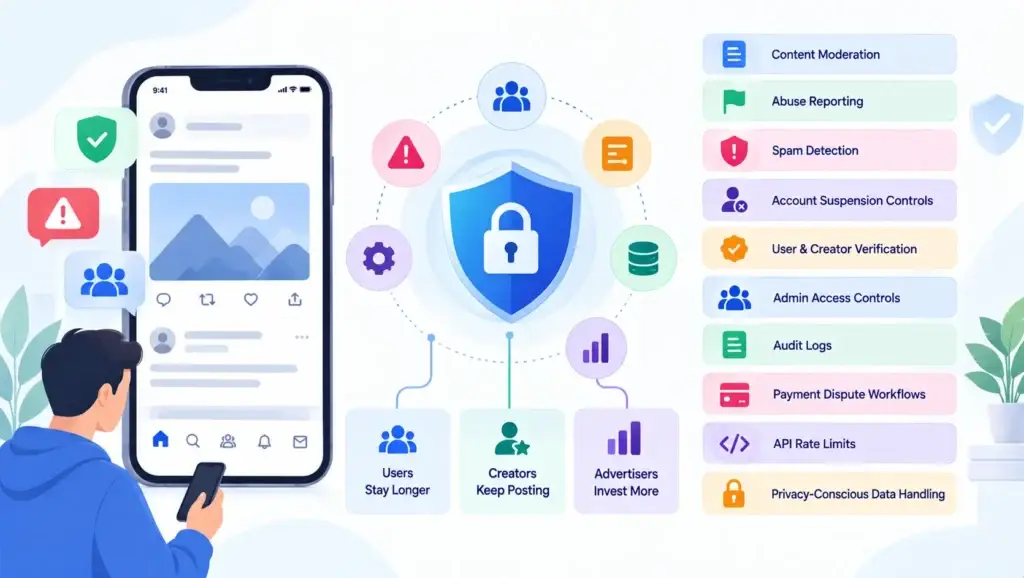
Trust and safety are not just policy concerns. They directly affect revenue.
Users will not stay on a platform filled with spam, abuse, impersonation, or low-quality content. Creators will not invest time if their audience can be attacked or copied without control. Advertisers will avoid placements if brand safety is weak. Business users will hesitate to pay for tools if the platform cannot manage disputes, account risk, or content quality.
Important trust and safety layers include:
- Content moderation workflows
- Abuse reporting
- Spam detection
- Account suspension controls
- User verification where relevant
- Creator verification where relevant
- Admin access controls
- Audit logs
- Payment dispute workflows
- API rate limits
- Privacy-conscious data handling
A founder should treat moderation and security as part of the business model. They protect the revenue engine by keeping participation safe enough for users, creators, and advertisers to keep investing attention and money.
Real-Time Feed Design and Its Business Impact
The feed is where the business model comes alive.
A real-time microblogging feed needs to balance freshness, relevance, safety, and monetization. If the feed is too random, users leave. If it is too restrictive, discovery weakens. If ads interrupt too aggressively, retention drops. If creator content is buried, creators lose motivation.
Important feed decisions include:
- Following feed vs. recommended feed
- Trending topics and discovery logic
- Hashtag-based exploration
- Creator priority signals
- Sponsored placement frequency
- Content freshness rules
- Engagement-based ranking
- Moderation visibility controls
- Bookmarking and saved searches
- Notification triggers
For founders, this means the feed is not only a product feature. It is a commercial surface. It affects session time, creator reach, ad inventory, subscription upgrades, and user retention.
Common Mistakes Founders Should Avoid
Building Only the Posting Feature
A composer and feed are not enough. The business needs moderation, admin controls, monetization tools, analytics, reporting, and user management to operate beyond the first launch.
Depending Only on Advertising
Ads usually need meaningful attention before they generate serious revenue. Early-stage platforms should also evaluate subscriptions, creator tools, paid communities, tips, business features, and platform services.
Ignoring Creator Incentives
Creators are often the supply engine. If they cannot grow, monetize, or understand their audience, they may shift their effort to platforms that reward them better.
Treating Moderation as a Later Problem
Trust issues appear early in user-generated content platforms. Reporting tools, abuse controls, and admin review workflows should be part of the launch foundation.
Ready-Made vs. Custom Development for Microblogging Business Models
Founders usually have two broad paths: build from zero or start with a ready-made foundation.
| Build Route | Strength | Risk | Best Fit |
|---|---|---|---|
| Custom development from zero | Maximum product flexibility | Longer timelines, higher planning risk, more upfront architecture decisions | Funded teams with unique technical requirements and enough time for discovery |
| Ready-made foundation | Faster launch, existing app flows, admin control, monetization modules, lower starting complexity | Customization still needs clear scope and business priorities | Founders who want to validate a niche, region, creator community, or social product faster |
| Hybrid approach | Start ready-made, then customize based on market response | Requires strong product roadmap discipline | Teams that want speed now and deeper differentiation after launch |
For many founders, the strongest first decision is not to build every module from scratch. It is to launch with the right foundation, test audience behavior, and invest custom development where differentiation actually matters.
Miracuves supports this approach with ready-made, white-label app foundations that can be customized around brand, monetization, admin control, and platform workflows. For relevant ready-made solutions, Miracuves can support a 6-day launch path depending on selected scope and deployment requirements.
How Miracuves Helps Founders Launch Faster
A microblogging business model needs more than screens. It needs the operating system behind the community: user flows, creator tools, campaign controls, moderation, admin dashboards, payment logic, and source-code ownership.
Miracuves helps founders launch faster by providing a ready-made platform foundation that can be adapted for niche communities, creator-led platforms, regional discussion apps, professional networks, brand communities, and public conversation products.
For founders exploring a twitter clone as a starting point, the better strategy is not to copy another platform blindly. The better strategy is to understand the revenue model, choose the right audience, define the monetization sequence, and customize the platform around a specific market opportunity.
Final Thoughts
The business model of a real-time microblogging platform is not built on posts alone. It is built on the relationship between attention, creators, advertisers, business users, developers, and platform trust.
Users bring activity. Creators bring content supply and loyalty. Advertisers pay for relevant attention. Businesses pay for tools. Developers may pay for access. The platform earns when these groups are connected through strong product design, monetization controls, safety workflows, and admin visibility.
For founders, the real opportunity is not to recreate a famous platform feature by feature. The opportunity is to build a focused public conversation product for a specific audience, then monetize through the revenue streams that fit that audience best.
FAQs
How do real-time microblogging platforms make money?
Real-time microblogging platforms usually make money through advertising, premium memberships, creator subscriptions, tips, business tools, sponsored communities, and API or platform-service access. The right mix depends on audience size, engagement quality, creator activity, and advertiser demand.
Is advertising the main revenue source for a microblogging platform?
Advertising can become a major revenue source when the platform has active users, strong targeting signals, and brand-safe content controls. However, early-stage platforms should not depend only on ads. Premium tools, creator monetization, paid communities, and business features may create earlier revenue opportunities.
Why are creators important in a microblogging business model?
Creators help generate repeat content, bring audiences, start conversations, and build community loyalty. If creators can monetize through subscriptions, tips, exclusive content, or analytics tools, they have more reason to keep publishing on the platform.
What features are needed to monetize a microblogging platform?
A monetization-ready platform usually needs user profiles, real-time feeds, creator tools, ad campaign controls, payment workflows, subscription management, analytics, moderation tools, admin dashboards, and secure platform access controls.
Can a niche microblogging platform make money?
Yes, a niche platform can monetize if it serves a clearly defined audience that users, creators, and advertisers care about. A smaller but highly engaged professional, regional, creator, or interest-based audience can support premium tools, sponsorships, subscriptions, and business services.
Why is moderation important for microblogging monetization?
Moderation protects user trust, creator safety, advertiser confidence, and platform reputation. Without reporting tools, admin controls, spam protection, and policy enforcement, the platform may struggle to retain users or attract paying business customers.
What is API monetization in a social platform?
API monetization means charging developers, businesses, analytics tools, or enterprise users for structured access to platform data or functionality. This can include rate-limited API plans, OAuth apps, data dashboards, search access, and integration workflows.
Should founders build a microblogging platform from scratch?
Building from scratch can work for teams with deep funding, unique technical requirements, and longer timelines. Many founders choose a ready-made foundation first because it helps them validate the audience, monetization model, and operating workflows faster before investing in deeper customization.
Miracuves is an independent software development company. We are not affiliated with, connected to, sponsored by, or endorsed by any company or product named in this article.
Terms such as “X Clone” are used descriptively. It is how the software industry refers to building a platform with functionality comparable to a known service, and how clients search for it.
The entire design and codebase of our products is built by our own team. Our products contain no code, design, graphics, or content originating from any third-party website or applications.
All third-party names and marks referenced in this article are the property of their respective owners, referenced solely to identify the services discussed.



