Key Takeaways
- A successful real-time microblogging platform connects publishing, discovery, conversation, engagement, safety, and administration.
- The core activity loop begins with a fast post composer and continues through feeds, replies, reposts, search, and notifications.
- Hashtags, topics, trends, and recommendations help new users discover value before building a large following network.
- Moderation, reporting, privacy controls, analytics, and admin workflows are essential for sustainable platform growth.
- Founders should prioritize features according to audience needs instead of launching every advanced function immediately.
Feature Priority Signals
- Start with profiles, follows, post creation, feeds, replies, reposts, hashtags, search, and relevant notifications.
- Add direct messaging, communities, lists, scheduling, richer media, and advanced discovery when the audience requires them.
- Plan early for feed performance, pagination, caching, media storage, moderation queues, and growing traffic.
- Give users practical controls for messages, mentions, blocking, muting, notification preferences, and content reporting.
- Track active users, posting frequency, engagement, retention, reported content, community activity, and monetization performance.
Real Insights
- A visually polished feed cannot support growth when search, notifications, moderation, and operator controls are weak.
- Engagement buttons are not decorative because likes, replies, reposts, bookmarks, and follows shape content distribution.
- Notifications improve retention only when they return users to meaningful activity without creating unnecessary noise.
- The best monetization model depends on the audience and may include subscriptions, promoted posts, advertising, creator tips, or API access.
- Miracuves develops source-code-owned microblogging platforms with feeds, discovery, messaging, moderation, monetization, admin controls, and six-day delivery where the ready-made scope applies.
Real-time microblogging platforms succeed because they make it easy for people to share quick thoughts, discover active conversations, react instantly, and return when something relevant happens. The visible features may look simple: posts, replies, reposts, likes, hashtags, trends, messages, and notifications. But behind those features is a product system designed to keep discovery, conversation, and engagement moving together.
That is why founders should not evaluate microblogging features as a checklist alone. A post composer is useful only when the feed can surface the right content. Hashtags are valuable only when search and discovery are structured well. Replies matter only when conversation threads remain readable. Notifications drive retention only when they feel timely rather than noisy.
This guide breaks down the features that matter most in a real-time microblogging platform and explains why each one matters from a product, user experience, and business perspective.
Why Feature Priority Matters in a Real-Time Microblogging Platform
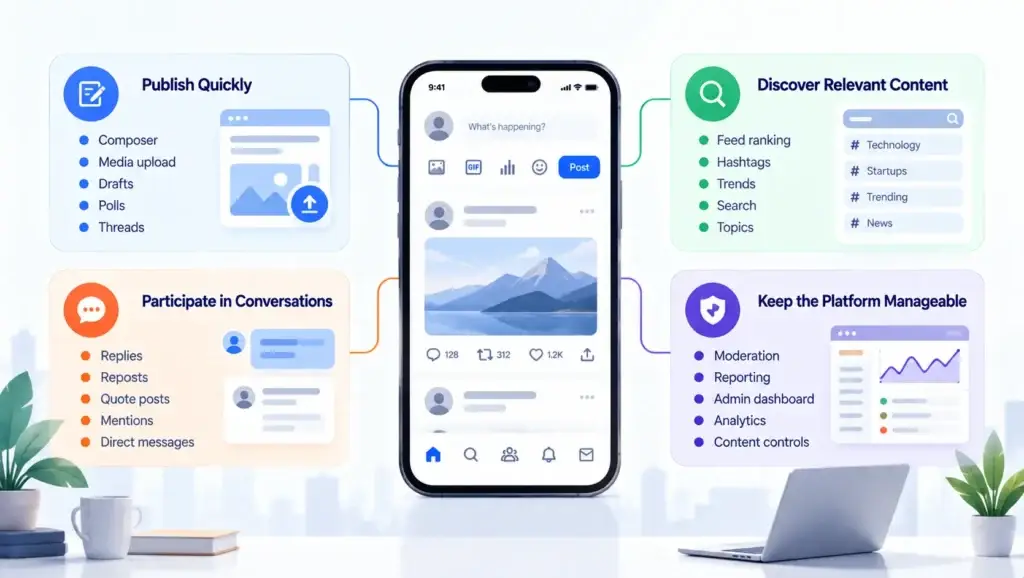
A microblogging platform is built around speed. Users open the app to see what is happening now, add their own perspective, follow people or topics, and return when the conversation changes.
This means every feature should answer one of four product questions:
| Product Question | Feature Layer That Supports It |
|---|---|
| How do users publish quickly? | Composer, media upload, drafts, polls, threads |
| How do users discover relevant content? | Feed ranking, hashtags, trends, search, topics |
| How do users participate in conversations? | Replies, reposts, quote posts, mentions, DMs |
| How does the platform stay manageable? | Moderation, reporting, admin dashboard, analytics |
Founders often focus first on visible social features. That is understandable because users judge the platform through the interface. But the features that protect long-term growth are often less visible: content controls, notification logic, abuse reporting, analytics, and admin workflows.
For founders reviewing a Twitter like real-time microblogging platform as a build path, the real question is not whether the interface looks familiar, but whether the platform can support discovery, conversation, engagement, safety, and monetization from the start.
Read Mire: Why Startups Choose a Ready-Made Real-Time Microblogging Platform Over Custom Development
1. A Fast Post Composer That Reduces Publishing Friction
The post composer is the entry point of a microblogging platform. It should help users publish quickly without making the experience feel heavy.
A strong composer usually supports:
- Short-form text posts
- Images, GIFs, videos, and audio where relevant
- Polls for lightweight interaction
- Mentions for user participation
- Hashtags for content discovery
- Drafts and scheduled posts
- Content warnings or visibility settings when required
The business value of the composer is simple: more posting activity creates more content inventory. More content inventory gives the feed, search, trends, and notifications more useful signals to work with.
For a founder, the key decision is whether the composer should stay simple or support richer media from the first release. Text-first communities may need speed and clarity. Creator-led networks may need media support early. Professional or niche communities may need drafts, scheduling, and thread support because users are sharing more structured ideas.
2. Real-Time Feed Design That Helps Users Discover What Matters
The feed is the heart of a real-time microblogging platform. It is where users decide whether the platform feels active, relevant, and worth revisiting.
A strong feed should not feel like one endless stream of random posts. It should give users different ways to consume content, such as:
- A following feed for accounts they already trust
- A discovery feed for relevant content beyond their network
- Bookmarked or saved content for later reading
- Topic-based or hashtag-based feeds
- List-based feeds for curated groups of users
The feed also needs a strong technical foundation. As the platform grows, feed performance, pagination, caching, ranking signals, and media loading affect user experience directly. A slow feed makes the product feel inactive even when users are posting.
From a business perspective, feed quality affects retention. If users see relevant conversations within a few seconds, they are more likely to stay, react, follow, and return. If the feed feels empty, repetitive, or chaotic, growth becomes harder.
3. Hashtags, Topics, and Search for Better Discovery
Discovery features help new users find value before they have built a large following list. This is especially important for new microblogging platforms because early users may not know whom to follow yet.
Useful discovery features include:
- Hashtag pages
- Topic pages
- Search suggestions
- Saved searches
- Trending conversations
- Location or community-based discovery
- Recommended accounts
- Search filters for posts, people, media, or recent discussions
Hashtags and trends should not exist only as clickable labels. They should help users move from one post into a wider conversation. Search should help users find people, posts, topics, and active discussions without feeling buried.
For founders, discovery is also a growth tool. When users can find relevant conversations quickly, they are more likely to follow accounts, engage with posts, and invite others into the platform.
4. Replies, Mentions, and Conversation Threads
Microblogging is not only about broadcasting. The strongest platforms turn short posts into layered conversations.
The core conversation features include:
- Replies
- Mentions
- Nested or structured discussion views
- Threaded posts
- Quote posts
- Reposts
- Reply notifications
- Conversation muting
- Blocking and reporting controls
Replies create participation. Mentions pull users into discussions. Threads allow deeper storytelling or explanation without forcing long-form publishing. Quote posts add commentary and help content spread with context.
The important product question is readability. As conversations grow, users need to understand who is replying to whom, what the original post said, and where the most relevant discussion is happening. Poor conversation structure can make the platform feel noisy instead of active.
5. Reposts, Quote Posts, and Likes as Engagement Signals
Engagement features help content move through the network. Likes show quick approval. Reposts distribute content. Quote posts add interpretation. Replies create conversation depth.
Each interaction produces a different signal:
| Engagement Feature | User Purpose | Platform Value |
|---|---|---|
| Like | Quick reaction | Lightweight engagement signal |
| Repost | Share with followers | Content distribution |
| Quote post | Add commentary | Conversation expansion |
| Reply | Participate directly | Discussion depth |
| Bookmark | Save privately | Content utility |
| Follow | Build feed relevance | Long-term personalization |
Founders should avoid treating engagement buttons as decorative UI. These signals influence what users see, how content spreads, and which accounts gain attention. They also help the admin dashboard understand activity patterns across the platform.
6. Notifications That Bring Users Back Without Creating Noise
Notifications are powerful because they create return moments. But notification overload can damage trust.
A useful notification system should support:
- Replies to user posts
- Mentions
- Reposts and quote posts
- Likes or reactions
- New followers
- Direct messages
- Community updates
- Topic or hashtag alerts
- Moderation or account alerts where needed
The best notification systems are relevant, timely, and controllable. Users should be able to manage what they receive. A founder should also consider notification priority: a direct message may need a stronger alert than a generic like, while a moderation warning should be clear and actionable.
From a retention perspective, notifications should bring users back to meaningful activity, not just create temporary clicks.
7. Direct Messaging for Private Conversation
Public conversations help the platform grow, but private messaging helps users build stronger relationships. Direct messaging is especially useful for creators, communities, professional groups, media brands, and niche networks.
Important messaging features may include:
- One-to-one messages
- Group conversations
- Media sharing
- Audio messages
- Reactions
- Read receipts
- Typing indicators
- Message requests
- Blocking and reporting
- Admin-level abuse handling where required
Messaging should be designed with privacy and safety in mind. Users need control over who can contact them, and the platform operator needs workflows to respond to abuse reports without overexposing private user data.
For a real-time platform, messaging also helps keep users inside the ecosystem instead of moving conversations to another app.
8. Profiles, Follows, Lists, and Identity Signals
A user profile is more than a bio page. It is a trust signal, discovery surface, and personal hub.
Strong profile features may include:
- Display name and handle
- Profile image and banner
- Bio and links
- Follower and following counts
- User posts and replies
- Pinned posts
- Verification or role labels where relevant
- Lists or curated feeds
- Account privacy settings
Follows help users shape their feed. Lists help them organize attention. Profile quality affects whether users trust an account enough to follow, reply, subscribe, or message.
For niche platforms, identity features matter even more. A community for doctors, investors, creators, local citizens, sports fans, or educators may need different profile signals than a general social network.
9. Communities and Interest Groups for Retention
Communities help users find a smaller space inside a larger platform. This is useful when a platform is built around niches, professions, regions, creators, or interest-based groups.
Community features may include:
- Group pages
- Member rules
- Topic-based posting
- Moderator roles
- Join requests
- Group notifications
- Community-specific feeds
- Pinned discussions
- Reporting workflows
Communities support retention because users feel they belong somewhere specific. Instead of relying only on broad public feeds, the platform can create smaller conversation loops where members return for familiar people and focused topics.
For founders, communities are also useful for phased launches. A platform can begin with one strong niche community before expanding into broader categories.
10. Moderation, Reporting, and Safety Controls
Content safety is not optional in a real-time microblogging product. Fast conversations can grow quickly, and platform operators need tools to handle abuse, spam, impersonation, misinformation concerns, harassment, and policy violations.
Important moderation features include:
- Post reporting
- Account reporting
- Comment and reply controls
- Hide, delete, suspend, or ban actions
- Admin notes
- Audit logs
- Spam detection signals
- Keyword or content filters
- User blocking and muting
- Appeal or review workflows where needed
Safety features protect users, but they also protect the business. Advertisers, creators, brands, and community operators are more likely to trust a platform that has clear control systems behind the feed.
A founder should ask: Can the admin team resolve problems without engineering help every time? If not, the platform may become difficult to operate once real users arrive.
11. Admin Dashboard and Analytics for Platform Operators
A real-time microblogging platform needs more than a user-facing app. The operator needs a control center.
A practical admin dashboard should help manage:
- Users and account status
- Posts and reported content
- Hashtags and trends
- Communities
- Notifications
- Ads or promoted content
- Subscriptions or paid features
- Creator activity where relevant
- Platform analytics
- Audit logs and admin roles
Analytics should not only show vanity numbers. Founders need decision-making data such as active users, posting frequency, engagement rate, reported content volume, top communities, popular topics, and monetization performance.
The admin layer becomes more important as the platform grows. Without it, the founder depends too heavily on developers for everyday operational decisions.
12. Monetization Features That Can Grow With the Platform
Not every microblogging platform should monetize the same way. The right model depends on the audience, content type, community structure, and market positioning.
Common monetization features include:
| Monetization Feature | Best Fit | Founder Consideration |
|---|---|---|
| Paid subscriptions | Creator or professional communities | Works when users see clear premium value |
| Promoted posts | Media, brand, or niche networks | Needs active content inventory |
| Display ads | Larger audience platforms | Requires traffic quality and advertiser controls |
| Creator tips | Creator-led communities | Needs payout and trust workflows |
| Premium accounts | Power users or professionals | Should offer meaningful utility |
| API access | Developer or data-driven ecosystems | Requires rate limits and documentation |
Founders should avoid turning on every revenue feature at once. A cleaner approach is to launch with the monetization model that fits the first audience, then expand once engagement patterns are clear.
13. Developer API and Integrations for Long-Term Flexibility
Some microblogging platforms remain standalone apps. Others become part of a wider ecosystem through integrations, APIs, automation, or partner tools.
A developer API can support:
- Third-party integrations
- Content publishing tools
- Analytics dashboards
- Brand management tools
- Community moderation tools
- External login or identity workflows
- Automation for publishers or creators
This does not need to be the first priority for every launch. But if the founder’s long-term vision involves partners, enterprise use cases, publisher workflows, or data-driven products, API planning should be considered early.
14. Mobile Experience and Cross-Platform Consistency
Users expect real-time platforms to work smoothly across mobile and web. The experience should remain consistent whether someone is posting from a phone, checking a thread on desktop, or responding to a message from a notification.
Important cross-platform considerations include:
- Consistent feed behavior
- Fast media loading
- Push notifications
- Mobile-friendly composer
- Smooth profile navigation
- Reliable messaging
- Shared backend logic
- Consistent moderation actions across surfaces
For founders, cross-platform consistency reduces operational friction. When web, mobile, and admin systems are aligned, product changes are easier to manage and users get a more reliable experience.
Founder Decision Signals: Which Features Should Come First?
Speed
Prioritize the composer, feed, profiles, follows, replies, reposts, hashtags, search, and notifications first. These create the core activity loop.
Cost
Avoid building every advanced feature immediately. Match feature depth to the first audience, then expand based on usage data.
Scalability
Plan early for feed performance, media handling, pagination, moderation workflows, and admin controls because these become harder to fix later.
Market Fit
Choose features based on the community you want to serve. A creator network, professional network, regional platform, and private community do not need identical priorities.
Feature Priority Table for a Real-Time Microblogging Platform
| Feature Layer | Business Value | Founder Impact |
|---|---|---|
| Composer and media posts | Creates content supply | Helps users publish quickly and keeps the platform active |
| Feed and timelines | Improves content discovery | Determines whether users find value immediately |
| Hashtags and search | Connects users to live topics | Supports discovery before users build a strong follow graph |
| Replies and quote posts | Creates conversation depth | Turns short posts into ongoing discussions |
| Notifications | Drives return visits | Improves retention when alerts are relevant and controllable |
| Direct messaging | Builds private user relationships | Keeps deeper conversations inside the platform |
| Moderation and reporting | Protects trust and safety | Helps operators manage growth without constant developer support |
| Admin analytics | Improves operational decisions | Shows what content, users, and communities are driving activity |
Common Mistakes Founders Should Avoid
Building only the visible feed
A feed may look impressive in a demo, but the platform becomes difficult to operate without reporting, moderation, analytics, user controls, and admin workflows.
Adding too many features before proving the core loop
Advanced monetization, communities, audio, or API access should support the audience strategy. They should not distract from posting, discovery, conversation, and retention.
Ignoring safety until after launch
Real-time platforms can attract spam and abuse quickly. Reporting, blocking, muting, admin review, and audit controls should be part of the foundation.
Treating notifications as growth hacks
Notifications should return users to meaningful activity. Too many low-value alerts can make users mute the app or leave entirely.
How Miracuves Helps Founders Launch Real-Time Social Platforms Faster

Miracuves helps founders move from feature planning to launch with ready-made, white-label social networking solutions built for faster deployment, branded user experience, admin control, and source-code ownership.
For a real-time microblogging product, this means founders do not have to start every core module from zero. They can begin with a launch-ready foundation that already supports the essential user, engagement, and platform management workflows.
With Miracuves’ 6-day solution delivery for ready-made products, founders can test their idea sooner and focus more on audience growth, positioning, community engagement, and monetization.
Key advantages include:
- Faster launch: Start with a ready-made product foundation instead of spending months building common social platform modules.
- Brand control: Customize the platform with your own design, identity, content style, and market positioning.
- Admin dashboard: Manage users, posts, reports, moderation actions, monetization settings, and platform activity from one control layer.
- Engagement-ready features: Support important social workflows such as feeds, replies, reposts, messaging, notifications, discovery, and user profiles.
- Monetization support: Prepare the platform for revenue models such as promoted content, subscriptions, premium accounts, and ads.
- Source-code ownership: Keep long-term flexibility to customize features, add integrations, improve workflows, and scale the product as the audience grows.
This approach gives founders a practical way to validate their platform idea without delaying launch for every technical layer. Instead of spending early months only on development, they can start testing real user behavior, content activity, and engagement patterns sooner.
As the platform grows, the same foundation can be customized around new workflows, monetization models, and community needs. That makes Miracuves useful not just for faster launch, but also for long-term product evolution.
Final Thoughts: The Best Features Are the Ones That Strengthen the User Loop
The strongest real-time microblogging platforms are not built from isolated features. They are built from connected loops.
A user posts something. Others discover it. Someone replies. The original user receives a notification. More people join the conversation. The platform learns which topics, people, and communities are creating activity. The operator monitors safety, growth, and monetization from the admin layer.
That is the real purpose of microblogging features: not just to make the platform look familiar, but to help discovery, conversation, engagement, and trust reinforce each other.
For founders, the smarter decision is to prioritize the features that create activity first, support safety from day one, and keep enough flexibility to adapt the platform around the audience that actually shows up.
FAQs
What are the most important features in a real-time microblogging platform?
The most important features are a fast post composer, real-time feed, replies, reposts, quote posts, hashtags, search, notifications, profiles, direct messaging, moderation tools, and an admin dashboard. These features work together to support publishing, discovery, conversation, engagement, and platform control.
Why is the feed so important in a microblogging app?
The feed determines what users see first. A well-designed feed helps users discover relevant posts, active conversations, trending topics, and accounts worth following. If the feed feels slow, empty, or irrelevant, users are less likely to return.
How do hashtags and trends improve content discovery?
Hashtags and trends group conversations around shared topics. They help users discover discussions beyond the accounts they already follow, which is especially useful for new users who have not built a strong network yet.
Should a microblogging platform include direct messaging?
Direct messaging is valuable when the platform needs private communication, creator-to-fan interaction, professional networking, customer conversations, or community relationship-building. It helps keep deeper conversations inside the platform.
What role does moderation play in a real-time social platform?
Moderation protects user trust. Reporting, blocking, muting, admin review, account controls, and audit logs help platform operators respond to spam, abuse, impersonation, and harmful behavior before it damages the community.
Which monetization features should founders consider?
Founders can consider subscriptions, promoted posts, ads, creator tips, premium accounts, and API access. The right monetization model depends on the audience, content type, platform maturity, and business goals.
Is it better to launch with every feature or start with a focused feature set?
A focused feature set is usually better for early validation. The first version should support posting, discovery, conversation, notifications, safety, and admin control. Advanced features can be added once user behavior shows what matters most.
How can Miracuves help with real-time microblogging platform development?
Miracuves helps founders launch ready-made and white-label social networking platforms with source-code ownership, branded design, admin control, and faster deployment. This gives founders a stronger foundation for testing their audience and business model without starting from zero.
Miracuves is an independent software development company. We are not affiliated with, connected to, sponsored by, or endorsed by any company or product named in this article.
Terms such as “X Clone” are used descriptively. It is how the software industry refers to building a platform with functionality comparable to a known service, and how clients search for it.
The entire design and codebase of our products is built by our own team. Our products contain no code, design, graphics, or content originating from any third-party website or applications.
All third-party names and marks referenced in this article are the property of their respective owners, referenced solely to identify the services discussed.