

Key Takeaways
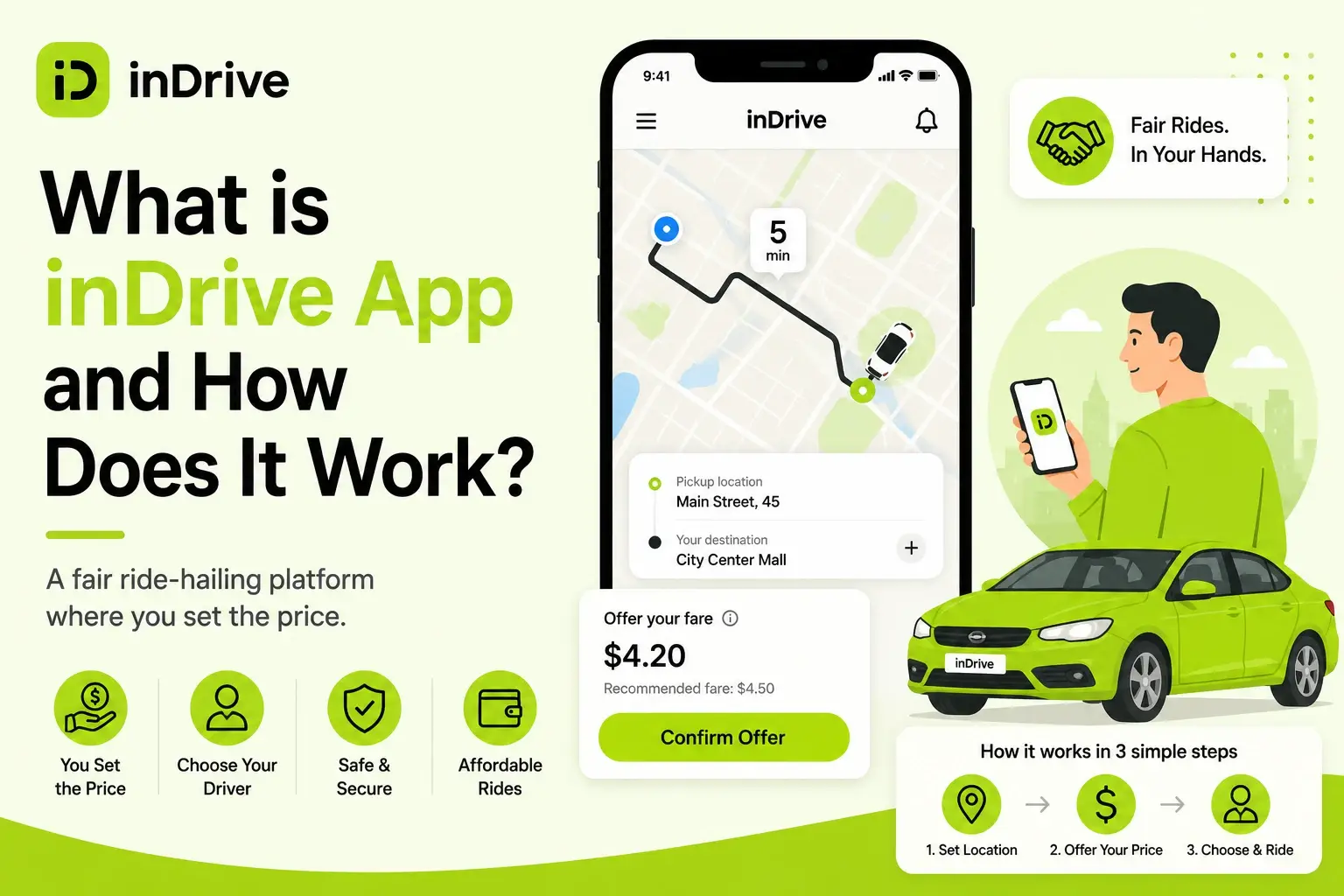
- InDrive lets riders propose their own fare.
- Drivers can accept or negotiate ride prices.
- The app focuses on transparency and flexibility.
- Cash and digital payments are supported.
- InDrive operates in hundreds of cities worldwide.
How It Works
- Riders enter pickup and destination details.
- Passengers suggest a fare for the trip.
- Drivers review and respond to ride requests.
- Both parties agree before the trip starts.
- Ratings help maintain trust and safety.
Real Insights
- The model gives users more pricing control.
- It works especially well in price-sensitive markets.
- Driver flexibility improves ride acceptance.
- No surge pricing attracts many riders.
- An InDrive clone can replicate this negotiation model.
Remember those awkward taxi rides where you had no clue how much you’d pay until the meter stopped ticking? Yep, those days are (thankfully) fading fast. InDrive is one of the rebels rewriting the rules of ride-hailing — not just in how you get from A to B, but how much control you get in the process. If you’re an entrepreneur or digital creator with a dream of launching your own app that actually puts users in the driver’s seat (pun intended), then keep reading.
See, startups today aren’t just about tech — they’re about trust. And InDrive, born from a social movement rather than Silicon Valley boardrooms, nailed that sweet spot. It’s not just another Uber or Lyft clone — it’s a conversation. Rider suggests a fare. Driver accepts or counters. It’s bartering, 2.0 — and people are loving it.
So if you’ve ever thought, “Hey, I could build something like that… maybe even better,” you’re in the right place. Because at Miracuves, we specialize in turning bold mobility ideas into powerful, scalable apps. With an InDrive clone, startups can launch a ride-hailing platform built around fare negotiation, passenger price control, driver flexibility, real-time booking, and local market needs — helping your app ride the waves of innovation instead of simply following them.
What is InDrive?
InDrive (short for Independent Drivers) is a peer-to-peer ride-hailing app that flips the typical on-demand transport model on its head.
Instead of automatically generating fare estimates based on distance and demand, InDrive lets passengers suggest their own price. Drivers then choose whether to accept, reject, or negotiate.
Born in Yakutsk, Russia — one of the coldest cities on Earth — InDrive was started in 2013 by a group of locals tired of being overcharged during blizzards. It quickly went viral and expanded globally. Today, it operates in 700+ cities across 45+ countries, with over 150 million downloads.
Related entities:
- Uber, Bolt, Lyft (as antonyms in pricing model)
- Ola, Careem (comparative competitors)
- Apps like BlaBlaCar (ride-sharing vs. point-to-point)
How Does InDrive Work?
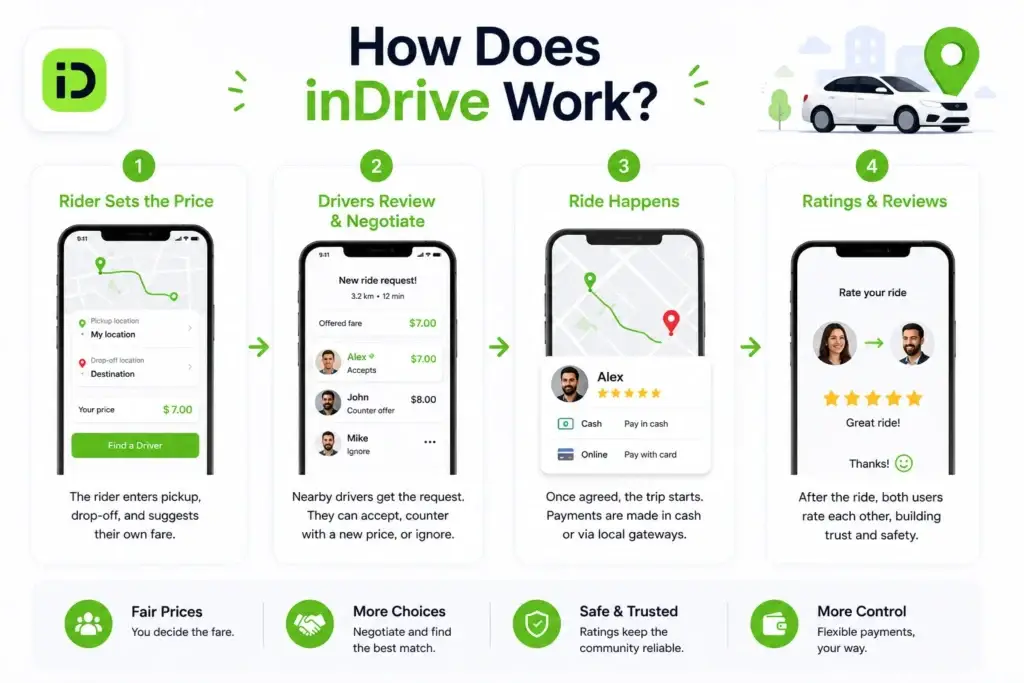
Step 1: The Rider Sets the Price
Unlike Uber where prices are algorithm-generated, here the passenger enters their pickup, drop-off, and suggested fare.
Step 2: Drivers Review & Negotiate
Nearby drivers get a ping. They can:
- Accept the offer
- Counter with a new price
- Ignore it
This restores price flexibility and gives both parties bargaining power.
Step 3: Ride Happens
Once agreed, the trip starts — with no app-based metering. Payments are often handled in cash or through local payment gateways, depending on the country.
Step 4: Ratings & Reviews
After the ride, both users can rate each other, promoting safety and community trust.
Why It Works: The Psychology Behind It
Humans love choice and control. That’s why InDrive’s model clicks emotionally. Unlike Uber, where prices surge during rain or peak hours, InDrive users can feel empowered by proposing what feels fair.
For many users in emerging markets, this also bypasses payment challenges. No credit card? No problem. InDrive’s cash-centric and flexible approach is designed for smartphones without premium banking access.
See how our InDriver clone solution turns bids into bookings — with built-in retention strategies and revenue-focused features to maximize long-term returns.
InDrive by the Numbers
| Metric | Value |
|---|---|
| Global Cities | 700+ |
| Downloads | 150M+ |
| Active Countries | 45+ |
| App Store Rating | 4.7/5 |
| Revenue (2024 est.) | $200M+ |
Core Features of InDrive App
1. User-Driven Pricing
Letting riders offer their own fare — revolutionary, right?
2. Driver Freedom
Drivers can view all ride requests and choose based on price, distance, or user rating.
3. No Surge Pricing
A major advantage in price-sensitive markets.
4. Multiple Ride Categories
From passenger cars to courier deliveries, InDrive is expanding its marketplace.
5. Safety Toolkit
Including ride tracking, emergency SOS button, and driver-passenger verification.
Explore the key features of the InDrive app — from driver bidding to transparent pricing, see how these unique capabilities make it stand out in the ride-hailing market.
Monetization Model: How InDrive Makes Money
Despite offering lower fares, InDrive earns by charging a small commission from the driver (typically 5-8%) — far less than Uber’s 20-30%.
They’re also introducing premium tiers, in-app ads, and are experimenting with parcel delivery and intercity rides as secondary revenue channels.
Want to Build an InDrive-Like App?
Alright, so here’s the million-dollar idea: launch your own driver-passenger negotiation ride app tailored to your region. Whether it’s for logistics, tuk-tuks, bike taxis, or eco-friendly EV fleets — the possibilities are endless.
With Miracuves, you don’t need to reinvent the wheel. Our InDrive Clone App solutions are:
- Fast to deploy
- Secure and scalable
- Monetization-ready
- Fully customizable
✅ Want to integrate UPI for Indian users?
✅ Need multi-language support for LATAM?
✅ Dreaming of adding AI-based route suggestions?
Learn how to build an app like InDrive — follow our full-stack developer’s guide covering architecture, features, tech stack, and step-by-step development to launch your own competitive ride-hailing platform.
InDrive vs Competitors: Quick View
| Comparison Factor | InDrive | Uber | Lyft |
|---|---|---|---|
| Passenger-Led Fare Control | Available | Not Available | Not Available |
| Cash Payment Support | Supported | Limited by Region | Mostly Not Supported |
| Surge Pricing Model | No Surge-Based Pricing | Uses Surge Pricing | Uses Surge Pricing |
| Driver Ride Acceptance Flexibility | High Flexibility | Limited Flexibility | Limited Flexibility |
| Fare Negotiation Option | Available | Not Available | Not Available |
The Road Ahead: What’s Next?
With decentralization trends, ride-hailing platforms like InDrive are setting the stage for peer-governed models. Think blockchain-based identity or driver-owned platforms. We’re seeing early signs in Africa, Southeast Asia, and LATAM.
As super-apps become the norm, don’t be surprised if InDrive’s DNA starts showing up in food delivery, parcel services, and even community security patrol apps.
Global Cost of Development for an Indrive Clone App
InDrive-Like Ride-Hailing App Development — Market Price by Tech Stack
These values reflect global development cost estimates. Final pricing varies based on feature scope, team location, and platform complexity.
These values reflect the global development cost of building an InDrive-like ride-hailing platform using different backend architectures. The final cost usually depends on fare negotiation logic, real-time trip handling, geo-location systems, wallet setup, payment integrations, scalability goals, and the operational coverage of the platform.
Miracuves Grab-Like App Solution Cost and Tech Stack
Miracuves Pricing for an inDrive-Like Super App developed in PHP/Laravel with Flutter Apps for $3,099 USD (One-Time Price) in just 6 days
Get a fully developed, deployment-ready platform modeled after inDrive. Built on a rock-solid PHP/Laravel foundation, this complete package includes everything you need to launch and scale:
Core Workflows: Ride-hailing with fare negotiation, on-demand delivery, and multi-service categories.
Built-in Finance: In-app wallet logic, pricing operations, and payout setups.
Management Hub: Comprehensive provider management and a centralized admin backend.
Launch-Ready: Fully prepped for your custom branding, configuration, and immediate market entry.
Why Miracuves’s Indrive Like App is so affordable?
Most complex super apps force you into expensive architectures like Node.js or Go. Building from scratch with those frameworks requires highly specialized, expensive engineering teams, which drives the cost into the tens or hundreds of thousands of dollars.
We took a smarter, more practical approach:
You Aren’t Paying for Ground-Up Development: Our multi-service engine is already developed, battle-tested, and ready to deploy. You skip the inflated costs and months of waiting associated with building from scratch.
The Power of PHP / Laravel: We built this on one of the most reliable, globally adopted frameworks in the world. Not only does this keep our upfront costs down, but it also protects your future budget. PHP has a massive global talent pool, making it incredibly easy and cost-effective for you to find developers for future scaling or customizations.
You get an enterprise-capable, heavy-duty foundation without the inflated Silicon Valley price tag.
Note: This cost is for the solution, re-branding, deployment and source code only.
Delivery Timeline for an InDrive Clone with Miracuves
Miracuves development timeline including setup, configuration, admin deployments, API integrations, and platform handover in 6 Days, depending on customization and additional functional layers requested. This ensures a stable, market-ready system with predictable delivery and no hidden engineering delays.
Tech Stack
This solution is built with robust frameworks — Web using PHP, MySQL & Apps using Flutter, optimized for performance, stability, and easy maintenance. Other tech stacks can be discussed upon request — Contact us.
Compare the best InDrive clone scripts in 2026 — explore their features, pricing, and scalability, and get our complete InDriver-style app cost guide covering everything from MVP development to a full-scale build so you can launch smarter and budget with confidence.
Conclusion
InDrive isn’t just a ride-hailing app — it’s a bold rethink of how digital platforms can empower real people. With transparency, negotiation, and control at its core, it’s changing the game — especially in markets left behind by traditional tech giants.
At Miracuves, we help innovators launch high-performance app clones that are fast, scalable, and monetization-ready. Ready to turn your idea into reality? Let’s build together.
FAQs
What makes InDrive different from Uber?
InDrive lets riders set their own fare and negotiate with drivers — unlike Uber’s fixed, surge-based pricing.
Does InDrive operate everywhere?
Nope. While it’s in 700+ cities, it’s more common in Asia, LATAM, and parts of Africa — especially in areas underserved by Uber/Bolt.
Is InDrive safe for users?
Yes! The app includes safety features like trip tracking, SOS buttons, and mutual rating systems to ensure safety.
Can I pay in cash on InDrive?
Absolutely. One of InDrive’s biggest appeals is that it works great even without credit cards.
How does InDrive make money?
It charges a smaller commission to drivers (usually around 5-8%), making it more appealing than competitors with higher cuts.
Can I build an app like InDrive?
Yes! With Miracuves, you can get a ready-made InDrive Clone App with full customizations and rapid launch options.
Related Articles :-
Miracuves is an independent software development company. We are not affiliated with, connected to, sponsored by, or endorsed by any company or product named in this article.
Terms such as “X Clone” are used descriptively. It is how the software industry refers to building a platform with functionality comparable to a known service, and how clients search for it.
The entire design and codebase of our products is built by our own team. Our products contain no code, design, graphics, or content originating from any third-party website or applications.
All third-party names and marks referenced in this article are the property of their respective owners, referenced solely to identify the services discussed.