


Key Takeaways
- The Inbound Flip turns cold pitches into warm B2B partnership conversations.
- Instead of ignoring cold sellers, businesses can invite them into their owned networking ecosystem.
- Profile verification, messaging, lead routing, and white-label offers are core workflow drivers.
- Success depends on positioning, fast response, clear partnership value, and smart follow-up logic.
- A B2B networking platform can help agencies monetize outreach instead of treating every pitch as spam.
Growth Signals
- Agencies need a system to capture cold leads, qualify sellers, and route conversations into useful offers.
- Sales teams need profile data, message history, lead intent, follow-ups, and partnership tracking.
- Admins need control over users, pitches, communities, moderation, analytics, and campaign performance.
- Owned-network workflows help convert random cold emails into structured B2B opportunities.
- Notifications keep founders, sales teams, and partners updated on replies, leads, and deal movement.
Real Insights
- Cold outreach becomes more useful when the seller is moved from inbox noise into a controlled business environment.
- Weak qualification can waste time on low-fit vendors, fake leads, and unstructured conversations.
- Clear onboarding, profile context, and partnership offers help turn outreach into revenue opportunities.
- A strong B2B network gives agencies more control over lead capture, relationship building, and monetization.
- Miracuves builds B2B networking apps with lead workflows, messaging, profiles, partnership tools, and admin control.
Cold emails are usually treated as noise.
A founder opens the inbox, sees another “quick question,” “partnership opportunity,” or “we help companies like yours” message, and deletes it before the second sentence. Agency owners do the same. B2B sales leaders do the same. The instinct is understandable because most cold pitches are poorly researched, badly timed, and written as if the sender has never seen your business before.
But a LinkedIn-like platform changes the way these conversations can be handled. Instead of letting cold outreach die in the inbox, businesses can move sellers, partners, and prospects into a controlled professional network where profiles, credibility, shared interests, and relationship context shape the next step.
But after years of building, selling, and operating in B2B software, I learned something most teams miss:
A cold pitch is not just an interruption. It is a signal.
Someone took the time, however clumsily, to approach your business. That person may be a freelancer, agency owner, consultant, SaaS seller, lead-generation operator, or regional service provider. They may not be your buyer today, but they are commercially active. They understand outreach. They are trying to sell. They are looking for revenue.
That makes them valuable.
The mistake is responding inside the same frame they created.
They pitch. You object. They follow up. You ignore. The conversation dies.
The better move is what I call the Inbound Flip.
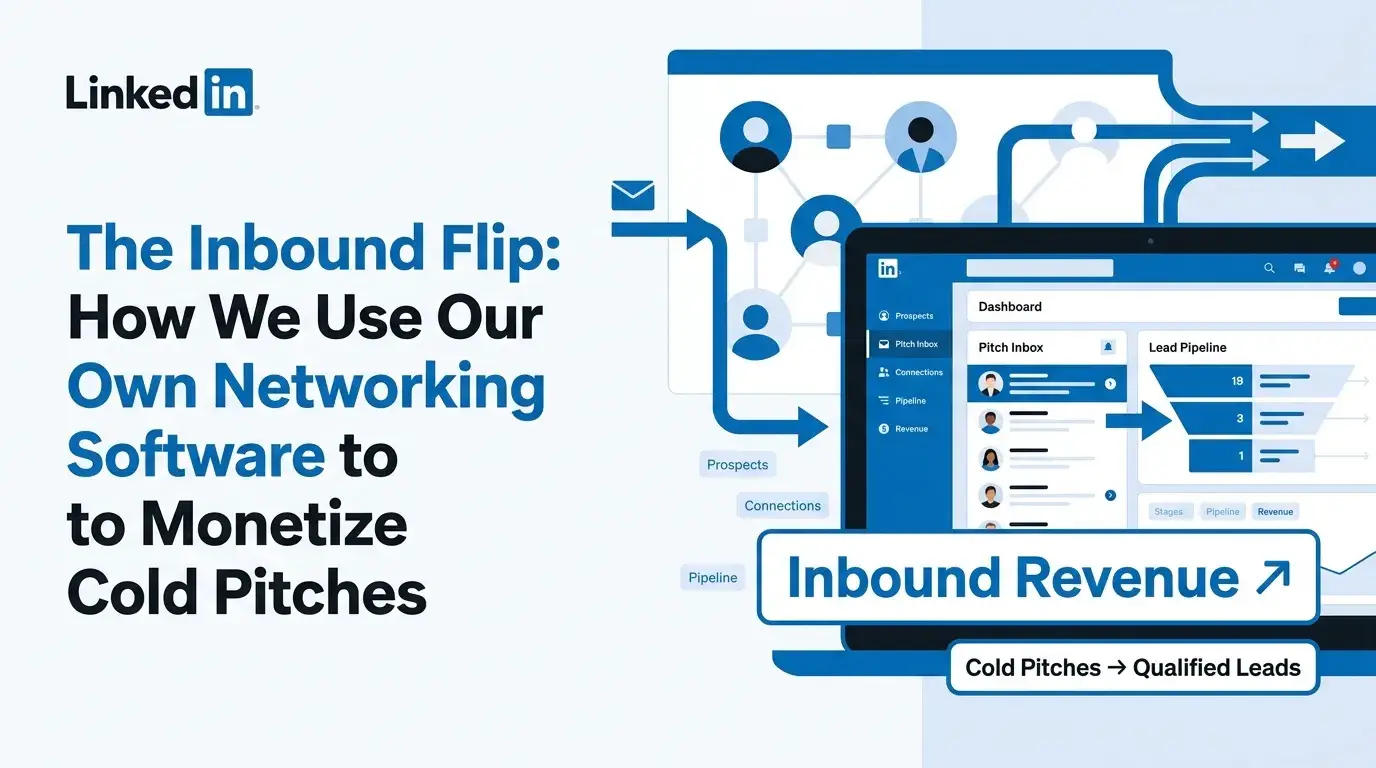
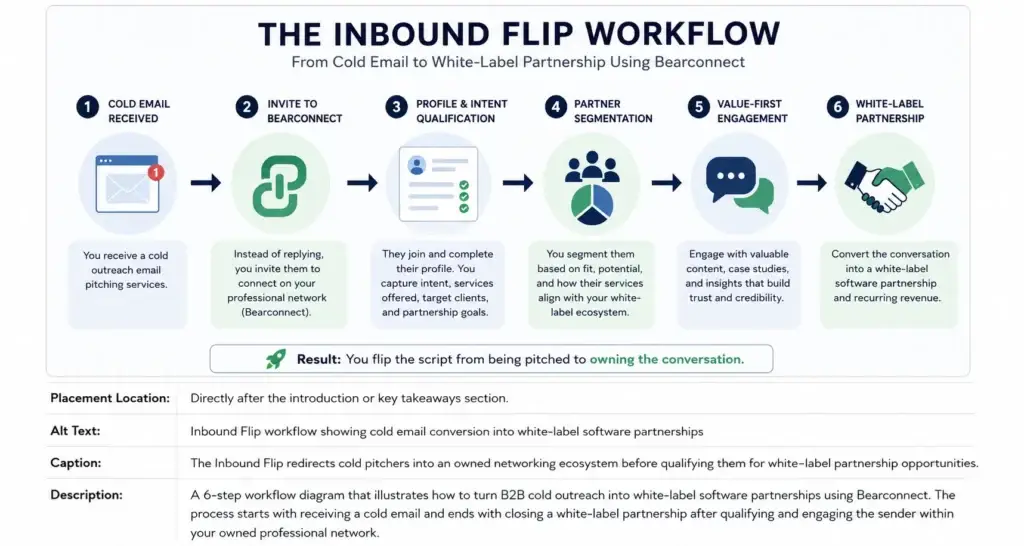
Instead of letting the cold pitcher own the conversation, you bring them into your owned ecosystem. In our case, that ecosystem can be a proprietary professional networking tool such as Bearconnect. The goal is not to argue with cold emails. The goal is to redirect them into a platform where you control the context, qualify their intent, observe their behavior, and reposition the conversation around white-label software partnerships.
This is not a generic networking tactic. It is a B2B growth playbook for agency owners, founders, and sales executives who want to turn inbound noise into partnership revenue.
The B2B Cold Outreach Epidemic
Most B2B inboxes are flooded because the tools for outbound selling have become easier to access.
Today, a salesperson can scrape lists, enrich contacts, generate AI-assisted copy, automate follow-ups, rotate inboxes, and push hundreds of messages with minimal manual effort. Modern outreach platforms now package lead databases, verification, deliverability tools, CRM workflows, and AI sales features into one system.
That convenience created a predictable side effect: buyers receive more messages, but most messages feel less personal.
For agency owners and sales executives, this creates three problems.
First, attention gets diluted. The useful partnership email and the lazy mass blast sit in the same inbox. Your team spends energy filtering noise instead of identifying hidden opportunities.
Second, the sender controls the first frame. Their message defines the problem, the offer, the urgency, and the next step. Even when you reply, you are usually responding inside their sales process.
Third, most companies treat cold outreach as binary. Either the sender is a qualified vendor, or the message gets deleted. That misses the larger opportunity. A sender can be unqualified as a vendor but highly qualified as a potential channel partner.
That distinction matters.
A cold email from a freelancer offering SEO services may not be useful if you already have SEO covered. But that same freelancer may serve five clients who need apps, automation, dashboards, marketplaces, or white-label platforms. A cold pitch from a small agency may not convince you to buy their service, but that agency may be looking for a software partner to expand its offer stack.
The Inbound Flip starts here:
Do not evaluate cold pitchers only as vendors. Evaluate them as distribution.
Read More: What is LinkedIn App and How Does It Work?
Why Cold Pitchers Are Often Better Partner Prospects Than Cold Leads
A traditional cold lead has to be educated into action. They may not know they have a problem. They may not have budget. They may not be looking for partnerships.
Cold pitchers are different.
They are already in motion. They are prospecting. They understand selling. They are trying to grow revenue. They are comfortable initiating business conversations. That does not make them automatically valuable, but it makes them commercially alert.
For digital agency owners, this is important because many white-label software partnerships start with one simple pain:
The agency has client demand but cannot fulfill the technical product.
They can sell branding, ads, SEO, content, automation, or consulting. But when a client asks for a marketplace app, SaaS dashboard, delivery platform, fintech wallet, AI assistant, booking system, or social network, the agency needs technical infrastructure.
That is where a company like Miracuves can become relevant. Miracuves’ solution ecosystem includes ready-made app categories across super apps, ride-sharing, delivery, on-demand services, finance, networks, listings, entertainment, education, blockchain, and more. The solutions page also positions ready-made scripts and apps as rebrandable and deployable in minimal time, which directly supports white-label and agency partnership use cases.
So instead of thinking, “This person is trying to sell me something,” the stronger question is:
Can this person sell what we already know how to deliver?
That question changes the entire conversation.
Read More: How the World’s Largest Professional Network Makes Money
Flipping the Script: Bringing Sellers into Your Owned Ecosystem
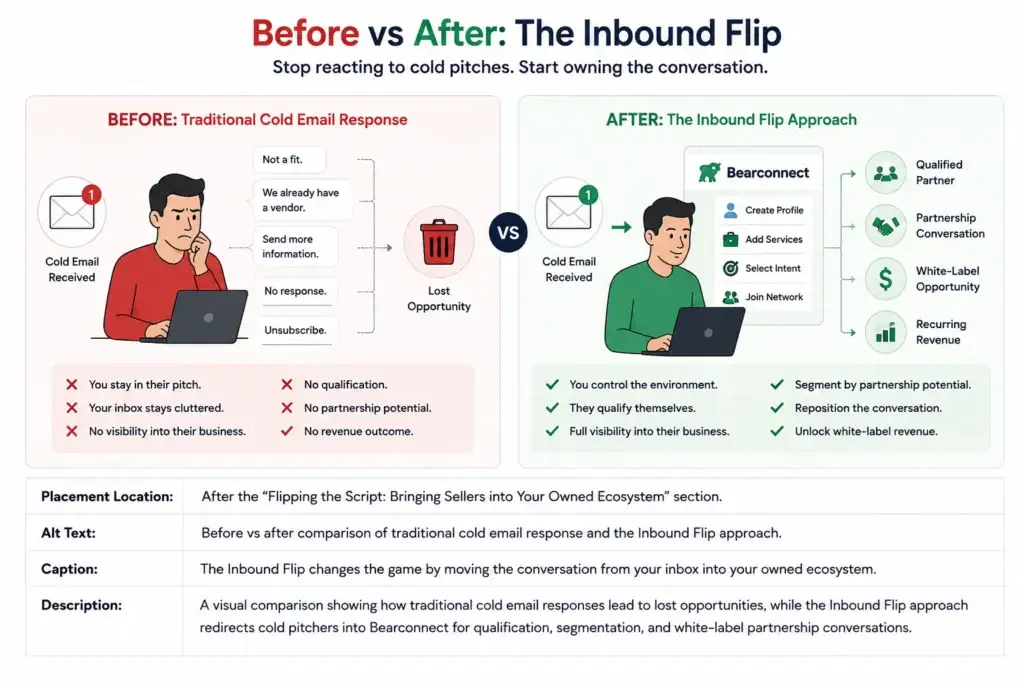
The Inbound Flip works because it changes the environment.
When you reply to a cold email inside the inbox, you are just another recipient. The sender remains in pitch mode. They try to handle objections, push for a meeting, or send another follow-up.
When you invite them into your owned professional network, the psychology changes.
They are no longer pitching into your inbox. They are entering your ecosystem.
That ecosystem can include a profile, business category, service tags, portfolio details, founder introductions, partner channels, product showcases, and curated discussions. A proprietary network such as Bearconnect can become more than a directory. It becomes a controlled qualification layer.
The message shifts from:
“Tell me why I should buy from you.”
To:
“Join our network, show us what you do, and let’s see whether there is partnership alignment.”
This is powerful because it reduces friction without giving away your time.
You are not saying yes to a meeting. You are not rejecting them. You are creating a new step that benefits you either way.
If they refuse to join, they were likely just blasting emails.
If they join but do nothing, they self-disqualify.
If they join, complete their profile, engage, ask smart questions, and explore collaboration, they become a real prospect.
That is the filter.
Read More: White-label LinkedIn App Safety: Complete Security Analysis 2026
The Exact Inbound Flip Response Framework
The first response should be short, respectful, and controlling.
Here is the structure:
- Acknowledge the pitch without encouraging a long vendor conversation.
- Reframe the relationship around partnership potential.
- Move them into your owned network.
- Ask for a specific action inside the platform.
- Keep the next meeting conditional.
Example:
Thanks for reaching out. We usually route new B2B partnership conversations through Bearconnect so we can understand the company, offer, market, and collaboration fit before scheduling calls.
Create your profile, add your core services, and mention whether you work with clients who need software, apps, automation, or white-label platforms. If there is alignment, our team can explore a partnership conversation from there.
This response does three things.
It protects your calendar.
It gives the sender a low-friction next step.
It quietly introduces your real offer: software, apps, automation, and white-label platforms.
The strongest part is that you have not pitched yet. You have repositioned.
The Bearconnect Playbook: Turning Spam into White-Label Revenue
Bearconnect, in this content angle, should be framed as a proprietary professional networking tool that helps organize commercially active contacts into a controlled B2B ecosystem.
The playbook has five stages.
Stage 1: Capture the Cold Pitch Without Rewarding Bad Outreach
Not every cold email deserves a call. But many deserve a lightweight redirect.
The first rule is simple:
Never give your calendar as the first conversion point.
Your calendar is expensive. A network invite is cheap.
Instead of booking calls with every sender, create a standard response that sends them into Bearconnect. This creates a behavioral test. Serious operators will follow instructions. Low-quality spammers will disappear.
The goal is not to punish outreach. The goal is to make the sender prove intent before consuming sales time.
Stage 2: Convert the Sender into a Profile, Not a Thread
Email threads are weak databases.
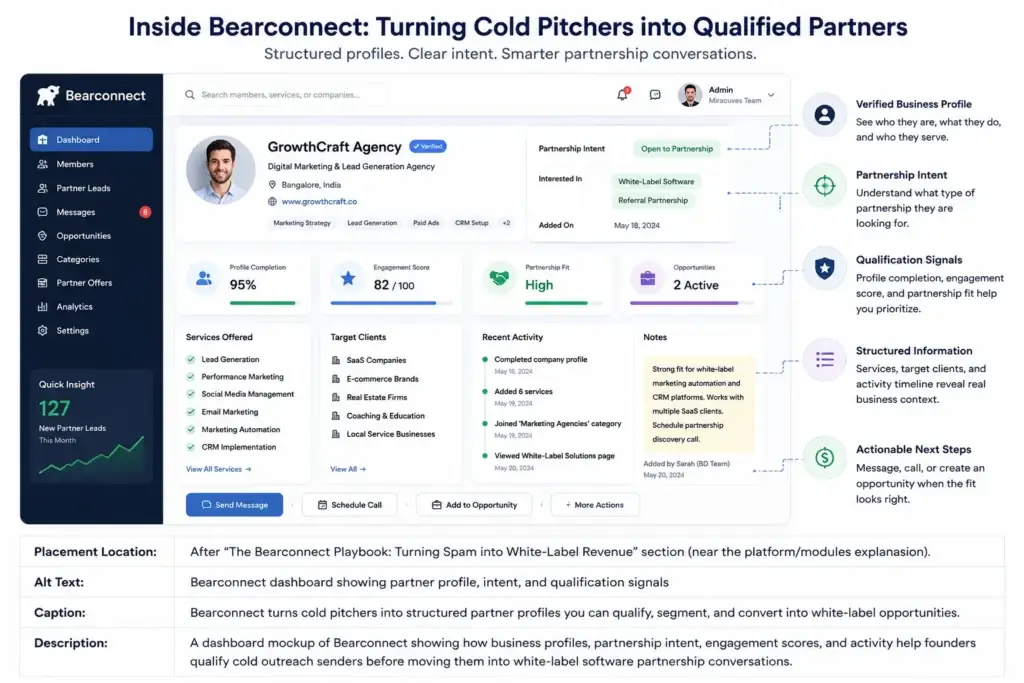
They hide context, fragment conversations, and make it difficult to see patterns across hundreds of inbound pitches. A professional networking platform solves this by turning the sender into a structured record.
Inside Bearconnect, the profile should capture:
- Company name
- Services offered
- Target clients
- Industry focus
- Geography
- Monthly client volume
- Current software needs
- Partnership interest
- White-label service potential
- Decision-maker role
- Portfolio or proof links
This is where the technical product matters. A professional network is not valuable because it has profiles. It is valuable because those profiles produce qualification signals.
For a founder planning to build this kind of owned ecosystem, Miracuves’ broader solution categories around networks, social platforms, communication tools, AI, automation, and website/web app development can provide useful internal pathways for product planning. The Miracuves solutions page lists Networks as a category covering social networks, communication, AI, file sharing, and website builder solutions.
Stage 3: Segment Sellers by Partnership Potential
Once cold pitchers enter the ecosystem, they should not all be treated the same.
Segment them into practical groups:
| Segment | What They Usually Want | Hidden Opportunity | Best Next Step |
|---|---|---|---|
| Freelancers | Project work | May refer app/software clients | Invite to referral partner track |
| Small agencies | More retainers | May need white-label fulfillment | Offer software partnership call |
| Lead-gen sellers | Campaign clients | May resell white-label tools | Discuss reseller model |
| Consultants | Strategic projects | May influence buyer decisions | Add to expert network |
| SaaS vendors | Integration or partnership | May need custom modules | Explore technical collaboration |
| Regional operators | Local client demand | May need branded platforms | Offer white-label launch model |
This is where most businesses fail. They treat every sender as either “vendor” or “spam.”
The Inbound Flip adds more categories. More categories create more revenue paths.
Stage 4: Introduce the White-Label Software Bridge
The white-label bridge should not happen too early.
If you pitch white-label software immediately, you become just another seller. The power of the Inbound Flip is that the cold pitcher first enters your world, identifies themselves, and reveals what kind of business they operate.
Then you can bridge.
For example:
“Based on your profile, it looks like your agency works with local service businesses. Do your clients ever ask for booking apps, marketplace platforms, delivery systems, or automation dashboards? We help partners launch white-label software products under their own brand without building from zero.”
That message lands differently because it is contextual.
You are no longer interrupting them. You are responding to their business model.
White-label positioning is already common in agency software markets. Many white-label SaaS platforms now promote features such as custom agency branding, custom domains, branded reporting, client access controls, and role-based dashboards. Industry guides also show that agencies often look for white-label SaaS across CRM, email marketing, analytics, reporting, SEO, and dashboard categories, because these tools help them deliver services under their own brand without building every system from scratch.
The Miracuves opportunity is to connect that white-label mindset to broader software categories: marketplaces, delivery apps, fintech tools, social platforms, AI automation, ecommerce systems, and custom web apps.
Stage 5: Turn Qualified Sellers into Repeat Distribution
The final goal is not one deal.
The final goal is distribution.
A qualified agency partner can bring multiple client opportunities over time. A consultant can introduce you to funded founders. A regional operator can sell branded software into a niche market. A lead-gen team can package your solution into a campaign.
That is why the Inbound Flip should be measured differently from normal lead generation.
Do not only track booked calls. Track:
- Cold pitchers redirected into Bearconnect
- Profile completion rate
- Qualified partner rate
- White-label conversations started
- Partner referrals generated
- Repeat opportunities from the same partner
- Revenue influenced by redirected cold outreach
The real metric is not reply rate. The real metric is ecosystem conversion.
Read More: How a LinkedIn Clone App Can Improve Recruiter and Job Seeker Engagement With Advanced Search
The Psychology Behind the Inbound Flip
The tactic works because it uses four psychological shifts.
1. Status Reversal
In the original cold email, the sender acts as the seller and you are the prospect.
When you invite them into your platform, you become the ecosystem owner. They are now applying for relevance.
That is a status reversal.
You do not need to be rude. You simply change the frame.
2. Effort Qualification
A spammer wants the easiest possible path. A real partner will take a reasonable next step.
Profile completion, category selection, and business description are micro-commitments. They reveal seriousness.
3. Context Expansion
Email is narrow. It usually contains one pitch.
A professional network expands context. You can see what they offer, who they serve, what markets they understand, and whether they are a potential software reseller.
4. Offer Repositioning
If you pitch white-label software inside an email reply, it may feel random.
If you pitch after reviewing their Bearconnect profile, it feels consultative.
That is the difference between selling and diagnosing.
Founder Decision Signals
Speed
If your inbox already receives cold pitches, the Inbound Flip lets you create a partner pipeline without launching a completely new outbound campaign.
Cost
The tactic reduces wasted sales calls by using profile completion and network behavior as a qualification layer before human time is spent.
Scalability
An owned professional network can turn scattered email threads into structured partner records, making follow-up, segmentation, and reporting easier.
Market Fit
Cold pitchers reveal what services, markets, and client needs are active around your brand, helping you identify white-label demand patterns faster.
Why Owned Networking Software Beats a Spreadsheet
Some teams may ask: why not just tag these people in a CRM?
A CRM is useful, but it is not the same as an owned network.
A CRM is internal. The prospect does not experience it. A networking platform is external. The prospect participates in it.
That participation matters.
When a cold pitcher creates a profile, joins a category, responds to prompts, and interacts with your ecosystem, they are doing more than becoming a record. They are entering a relationship environment.
For B2B sales, that creates leverage.
| System | What It Does | Limitation | Inbound Flip Advantage |
|---|---|---|---|
| Email inbox | Receives cold pitches | Messy, reactive, hard to segment | Use only as the capture point |
| Spreadsheet | Stores sender details | Manual, static, no user participation | Good for backup, weak for engagement |
| CRM | Tracks pipeline | Sales-team focused, not community-driven | Useful after qualification |
| Owned network | Structures identity and interaction | Requires product setup and moderation | Best for ecosystem control and partner discovery |
The owned network is where the flip becomes visible.
The sender sees your categories, your partner language, your product ecosystem, and your credibility. They understand that they are not just emailing a company. They are entering a commercial network.
The Technical Layer Behind the Strategy
A Bearconnect-style platform needs more than basic profiles.
To support this playbook, the platform should include practical B2B modules:
Core Platform Modules for the Inbound Flip
| Feature | Business Value | Founder Impact |
|---|---|---|
| Business profiles | Turns anonymous cold pitchers into structured company records. | Helps founders qualify partners without manual research for every sender. |
| Service categories | Groups sellers by what they offer and who they serve. | Makes it easier to identify agency, freelancer, reseller, and consultant segments. |
| Partner intent fields | Captures whether the user wants referrals, fulfillment, software, or collaboration. | Prevents wasting sales calls on unclear intent. |
| Admin dashboard | Gives the platform owner control over users, categories, approvals, and engagement. | Allows the business to manage the ecosystem without depending on developers for every change. |
| Private messaging | Moves conversations from inbox chaos into a controlled relationship layer. | Improves follow-up discipline and keeps partner conversations attached to profiles. |
| White-label offer pages | Shows relevant software opportunities to specific partner types. | Helps agencies discover products they can resell or package under their own brand. |
| Analytics and activity logs | Tracks signups, engagement, profile completion, and partner conversion. | Shows whether cold-pitch monetization is becoming a real channel. |
Security and control also matter. A B2B networking tool should include role-based access control, admin approval workflows, abuse reporting, activity logs, permission-based dashboards, and privacy-conscious data handling, especially if users can message each other or share business information. These are core trust layers for marketplace, networking, and user-generated platforms.
The White-Label Revenue Conversation
Once the sender is qualified, the white-label conversation becomes much easier.
The script should not start with:
- Do you want to buy our software?
It should start with:
- Do your clients ask for software products you currently cannot deliver in-house?
That question is powerful because it exposes a business gap.
Many agencies are strong at selling demand-generation services but weak at software fulfillment. Many consultants identify product opportunities but do not have development capacity. Many lead-gen operators can book meetings but do not own a high-ticket offer behind the campaign.
A white-label app or software solution solves that problem.
Miracuves’ positioning is relevant here because the company offers ready-made, white-label, source-code-owned clone app solutions and custom app development services for founders, startups, agencies, and businesses. Miracuves’ internal linking rules also prioritize connecting blogs to primary solution pages, supporting blogs, industry pages, and the contact/demo path when relevant.
For agency owners, the message is simple:
You do not need to build every technical product from zero to sell higher-value software outcomes.
You need the right partner, the right product foundation, and the right market.
Practical Outreach-to-Partnership Flow
Here is the complete Inbound Flip workflow.
Step 1: Identify Cold Pitches Worth Redirecting
Do not redirect every message.
Ignore messages that are clearly irrelevant, deceptive, spammy, or unrelated to business services. Focus on senders who appear to operate in B2B, marketing, consulting, SaaS, lead generation, software, design, automation, or regional business services.
Step 2: Send the Bearconnect Redirect
Use a polite template:
Appreciate the message. We review new B2B collaboration requests through Bearconnect so we can understand the company, service category, and partnership fit before scheduling calls.
Please create your profile, add your services, and select whether you are interested in referrals, white-label software, or collaboration. If there is alignment, our team can continue the conversation there.
Step 3: Score the Profile
Create a simple scoring model.
| Signal | Score |
|---|---|
| Complete business profile | +2 |
| Clear target audience | +2 |
| Works with business clients | +2 |
| Has software/app demand | +3 |
| Offers complementary services | +2 |
| Engages after signup | +1 |
| Sends generic follow-up without joining | -3 |
| Refuses to provide business context | -5 |
Step 4: Start the Partnership Conversation
Once a sender reaches the qualification threshold, send a direct message:
Thanks for completing your profile. Based on your agency focus, there may be a white-label opportunity. Do your clients ever ask for apps, dashboards, marketplaces, automation platforms, or software products that your team does not build internally?
Step 5: Match Them to a Relevant Software Category
Do not pitch everything.
If they serve restaurants, talk about delivery, booking, loyalty, or marketplace tools.
If they serve fintech clients, talk about wallet, remittance, KYC workflows, and compliance-ready foundations.
If they serve creators, talk about short video, subscriptions, content moderation, and creator monetization.
If they serve local service businesses, talk about booking, provider dashboards, payments, reviews, and admin control.
Step 6: Move Serious Partners to a Call
The call should happen only after three things are clear:
- They serve clients who may need software.
- They understand white-label or partner delivery.
- They can influence buying decisions.
Now the call is not exploratory noise. It is a qualified partnership discussion.
Mistakes Founders Should Avoid
Mistakes Founders Should Avoid
Giving every cold pitcher a sales call
This rewards weak outreach and drains leadership time. Use the network profile as a qualification step before offering calendar access.
Pitching white-label software too early
If you pitch before understanding the sender’s business, you become another cold seller. Let the profile reveal whether the partnership angle is relevant.
Building a passive directory instead of an active ecosystem
A list of users is not enough. The platform needs prompts, categories, messaging, admin workflows, and partner-specific calls to action.
Ignoring trust and moderation
A professional network can quickly lose value if low-quality users, spam, or irrelevant promotions are not controlled through admin approval and reporting workflows.
Where Miracuves Fits into the Inbound Flip
The Inbound Flip is not just a sales tactic. It is a product strategy.
To run it properly, you need an owned platform that can capture users, structure profiles, qualify intent, manage partner conversations, and introduce relevant software offers. For some companies, that may be a private professional network. For others, it may be a branded partner portal, agency marketplace, reseller community, or B2B collaboration platform.
Miracuves helps founders and agencies build white-label and custom app foundations that support these kinds of ecosystems. The broader Miracuves solution hub includes network, communication, AI, website builder, marketplace, delivery, fintech, entertainment, and custom development pathways, giving teams multiple ways to connect a B2B network to monetization-ready software categories.
For a Bearconnect-style model, the strongest product direction would include:
- Professional profiles
- Business category discovery
- Partner intent tagging
- Admin dashboard
- Messaging and approval workflows
- White-label offer pages
- Referral tracking
- Partner onboarding
- Analytics
- Abuse reporting and moderation
Final Thoughts: Stop Deleting Signals
Most businesses treat cold pitches as inbox pollution.
Some of them are.
But hidden inside that noise are freelancers, consultants, agencies, SaaS sellers, and operators who already understand one thing many leads do not: they want revenue.
The Inbound Flip gives you a way to capture that energy without surrendering your calendar. Bring sellers into your owned ecosystem. Let them qualify themselves. Watch their behavior. Segment their intent. Then, when the fit is real, reposition the conversation around white-label software partnerships.
For founders and agencies building a controlled B2B network, a LinkedIn clone app can become more than a professional networking tool. It can act as an owned relationship layer where outreach, credibility, partner discovery, and sales conversations happen inside one structured platform. At Miracuves, this approach is often seen as a smarter way to turn cold inbound activity into qualified partnership opportunities.
The strategic shift is simple:
Do not just defend your inbox.
Build an ecosystem that turns inbound noise into partner-side revenue. Let’s build together.
FAQs
What is the Inbound Flip in B2B sales?
The Inbound Flip is a sales strategy where you redirect cold pitchers into your owned platform or professional network instead of responding inside their email thread. This changes the frame from “they are selling to you” to “they are entering your ecosystem for potential partnership qualification.”
How can agency owners monetize cold emails?
Agency owners can monetize cold emails by identifying senders who serve business clients, redirecting them into a partner network, qualifying their services, and offering relevant white-label software or fulfillment partnerships when there is fit.
Why use a professional networking platform instead of just replying by email?
Email keeps the conversation reactive and unstructured. A professional networking platform lets you capture profiles, segment users, track engagement, manage partner intent, and create a controlled environment for white-label partnership discovery.
What kind of cold pitchers are most valuable for this strategy?
The best prospects are freelancers, digital agencies, consultants, lead-generation providers, SaaS sellers, and regional business operators who already work with clients that may need software, apps, automation, marketplaces, or digital platforms.
How does Bearconnect fit into the Inbound Flip?
Bearconnect can be positioned as the owned professional networking ecosystem where cold pitchers create profiles, identify their services, show partnership intent, and enter a structured business environment before any sales call happens.
Is this strategy only for software companies?
No. The Inbound Flip can work for agencies, consultants, SaaS companies, IT service providers, and B2B founders. It is especially useful when your business has partner, reseller, affiliate, white-label, or referral opportunities.
What features should a B2B networking platform include?
A strong B2B networking platform should include business profiles, service categories, partner intent fields, admin controls, messaging, approval workflows, analytics, activity logs, moderation, and offer pages for relevant partnership paths.
Can Miracuves help build a Bearconnect-style platform?
Yes. Miracuves can help founders and agencies build custom or white-label professional networking, partner portal, marketplace, and software ecosystem platforms with branded design, admin control, source-code ownership, and scalable product workflows.