A professional networking platform is a digital ecosystem where people build career-focused identities, connect with relevant professionals, discover opportunities, share expertise, follow organizations, and communicate around work, hiring, business, learning, and reputation.
At first glance, a professional networking platform may look similar to a social network. Users may have profiles, feeds, comments, messages, notifications, followers, and groups. The difference is the purpose behind those interactions. A professional network is not built primarily for entertainment or casual social activity. It is built around credibility, career growth, expertise, hiring, industry relationships, business development, and opportunity discovery.
The most important part is not any one feature. It is how the features connect. A profile gives the user a professional identity. Connections turn that identity into a relationship graph. Search and feeds help people discover relevant professionals, companies, content, and jobs. Messaging turns discovery into direct conversations. Trust and moderation keep the network useful as it grows.
For founders, product teams, associations, recruiters, agencies, and business communities, understanding this interaction model is more useful than copying a long feature checklist. A professional networking platform becomes valuable when identity, discovery, relationships, opportunities, communication, and trust reinforce one another.
Key Takeaways
- A professional networking platform connects career identity, professional relationships, job discovery, business opportunities, and communication in one ecosystem.
- Profiles are not simple user bios. They act as structured professional identities that support search, recommendations, credibility, hiring, and trust.
- Connections, follows, groups, and company pages create a professional graph that improves discovery and relevance.
- Jobs become more useful when profile data, skills, experience, preferences, and relationships contribute to matching.
- Messaging should be designed with permission rules, spam controls, reporting, and privacy so that communication remains useful rather than noisy.
- Founders should define the target professional community before planning features, because a niche network often needs different workflows than a broad public network.
What Is a Professional Networking Platform?
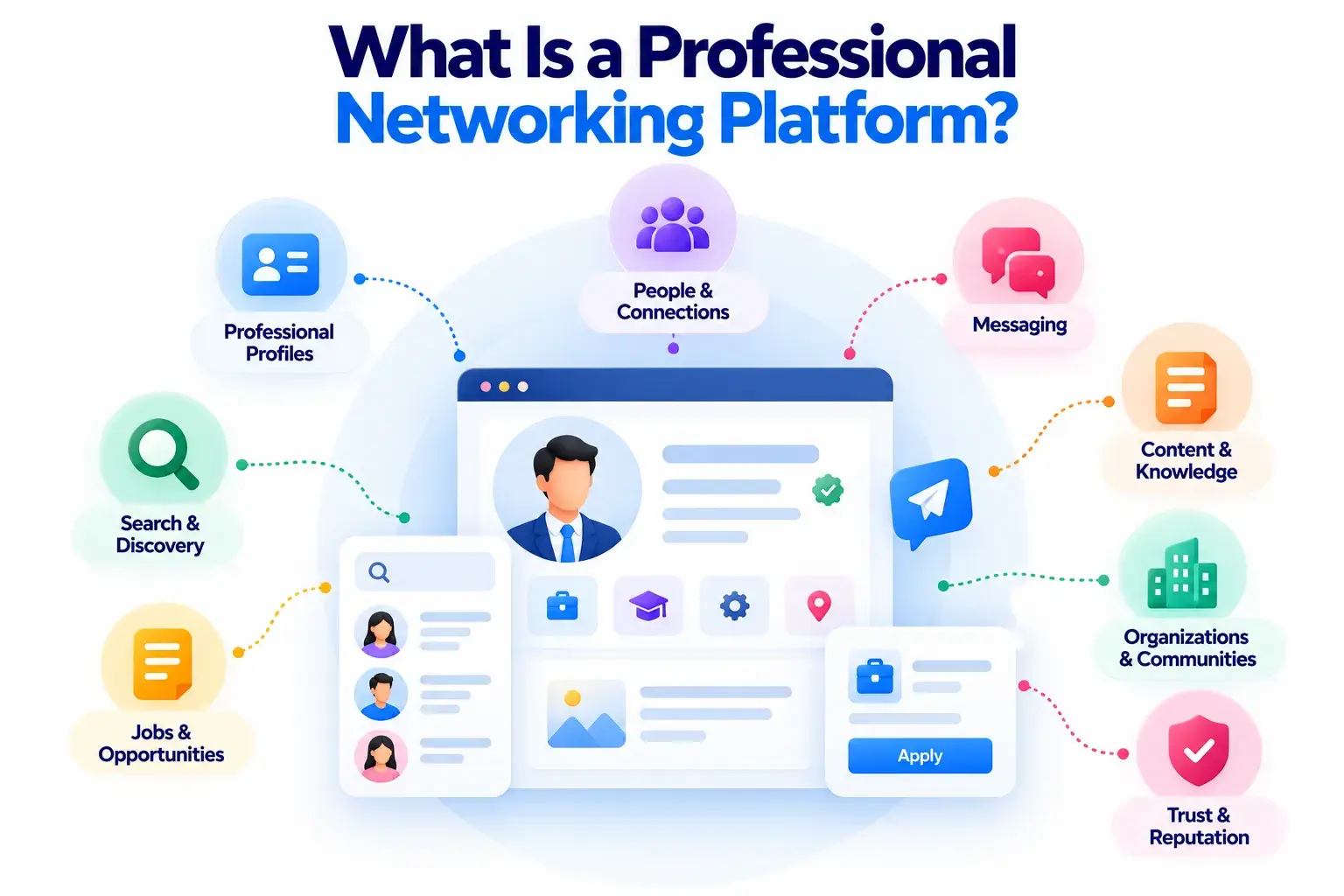
A professional networking platform is an online system that helps people represent who they are professionally and interact with others around careers, expertise, hiring, projects, learning, business relationships, and industry communities.
Instead of answering only “Who do you know?”, a professional networking platform can help answer more useful questions: What does this person do? What skills do they have? Which companies have they worked with? What credentials can they show? Are they open to opportunities? Are they hiring? Which organizations are they connected to? What have they published? Can I contact them safely and appropriately?
This is why the profile layer matters so much. A strong profile gives structure to professional identity. That structure can then support search, job matching, connection suggestions, recruiter workflows, content relevance, and trust signals.
A basic directory can list people. A professional networking platform does more. It connects people, organizations, opportunities, communication, and reputation in a way that helps members create professional outcomes.
How Is a Professional Networking Platform Different From a General Social Network?
The visible interface may look familiar, but the user intent is different. A general social network usually optimizes for social interaction, entertainment, personal updates, content consumption, or creator discovery. A professional networking platform should optimize for credibility, expertise, opportunity, recruiting, business development, and professional trust.
Professional Network vs General Social Network
| Layer | General Social Network | Professional Networking Platform |
|---|---|---|
| Identity | Personal interests, lifestyle, friends, entertainment, creators, and social activity. | Experience, skills, credentials, work history, expertise, professional interests, and reputation. |
| Relationships | Friends, followers, fans, groups, and casual communities. | Colleagues, recruiters, candidates, clients, founders, mentors, employers, industry peers, and business contacts. |
| Discovery | People, entertainment, trending content, hobbies, and social interests. | Professionals, companies, expertise, jobs, projects, services, opportunities, and industry knowledge. |
| Content | Broad social posts, entertainment, creator updates, opinions, and personal sharing. | Career updates, hiring posts, professional insights, company activity, industry discussions, and thought leadership. |
| Messaging | General communication between friends, followers, or communities. | Networking, recruiting, partnerships, referrals, business development, mentoring, and career conversations. |
| Business Outcome | Engagement, audience growth, entertainment, and social interaction. | Professional relationships, hiring, visibility, credibility, career mobility, and opportunity creation. |
This difference matters because a professional network should not be designed only to maximize clicks, posts, or random activity. Activity is useful only when it improves professional discovery, trust, relationships, or opportunity creation.
How Does a Professional Networking Platform Work?
A professional networking platform works through connected product loops. Each loop improves the value of the next one.
- A user joins the platform and creates an account.
- The user builds a professional profile with structured information.
- The platform uses that identity to improve search, recommendations, and discovery.
- The user connects with people, follows organizations, joins communities, or engages with content.
- Those relationships improve feed relevance, job discovery, and opportunity matching.
- Recruiters, companies, professionals, founders, or communities interact around jobs, posts, messages, and introductions.
- Messaging moves the interaction from discovery to direct conversation.
- Trust, moderation, notifications, and admin controls keep the platform useful as activity increases.
The value comes from flow. Sparse profiles weaken search. Weak search reduces useful connections. Poor connections make feeds less relevant. Irrelevant feeds reduce engagement. Open messaging without safeguards creates spam. Weak moderation damages credibility. For founders, this means each module should be planned as part of a system, not as an isolated feature.
1. Professional Profiles Create the Identity Layer
The professional profile is the foundation of the platform. It turns a user account into a credible professional identity that can participate in discovery, hiring, networking, content, and messaging.
A useful profile may include name, headline, location, industry, experience, education, skills, certifications, portfolio links, projects, publications, languages, achievements, professional interests, recommendations, and availability preferences.
The right fields depend on the community. A healthcare professional network may need licences, specialties, practice areas, and verification. An alumni network may care about graduation year, university, location, mentoring interests, and employer history. A founder network may prioritize company stage, sector, fundraising status, collaboration interests, and expertise. A creative professional community may place more weight on portfolios, case studies, media, and project credits.
Why Profile Completeness Matters
Profile completeness affects more than visual polish. Structured profile data powers the wider platform. Skills support search. Experience improves candidate discovery. Location supports local networking. Education can power alumni connections. Job preferences can improve opportunity matching. Portfolio items help others assess work quality. Organization links create relationships between people and companies.
Every meaningful profile field can strengthen another product layer. This is why founders should avoid treating profiles as basic “about me” pages. In a professional networking platform, the profile is the data foundation for discovery, trust, hiring, and communication.
A Profile Is Also a Trust Surface
Before users connect, reply, hire, collaborate, or start a business conversation, they often ask a simple question: “Is this person relevant and credible enough for the next interaction?”
A strong profile helps answer that question. Employment history, credentials, mutual relationships, activity, recommendations, verification signals, and professional context can all help users make better decisions. Without these trust signals, the network can quickly become noisy, generic, or difficult to use.
2. Connections Turn Profiles Into a Professional Graph
A directory contains profiles. A network begins when relationships between profiles are represented.
Connections can represent colleagues, classmates, clients, recruiters, candidates, founders, investors, mentors, collaborators, association members, industry peers, or business contacts. Once those relationships exist as structured data, the platform can use them to improve discovery.
A connection graph can support direct connections, mutual contacts, second-degree discovery, shared employers, shared education, common industries, overlapping interests, group membership, and organization-based relationships.
Connections and Follows Serve Different Purposes
Many professional communities benefit from separating mutual connections from one-way follows.
A connection usually represents a stronger two-way relationship. A follow allows a user to receive updates from another person, company, school, publication, or organization without requiring mutual acceptance. This gives the platform more flexibility. Users can build trusted professional graphs while still discovering experts, employers, companies, and communities outside their immediate network.
Why Relevance Matters More Than Raw Connection Counts
A professional network does not automatically become more valuable because users collect thousands of contacts. The quality of relevance matters more than the size of the list.
For founders, this creates an important product question: should the platform encourage broad connection growth, curated professional relationships, closed community access, one-way following, verified memberships, or a hybrid model?
A broad public network may need wide discovery. A niche professional community may create more value with a smaller but highly relevant member base. A recruitment-focused network may optimize for candidate search and employer access. An alumni community may focus on mentoring, referrals, and career support.
3. Search and Discovery Help Users Navigate the Network
As a professional community grows, manual browsing becomes ineffective. Search and discovery systems become the navigation layer between user intent and network data.
A user may want to find a marketing leader in a specific city, an engineer with a particular skill, a recruiter hiring for a role, alumni from a university, professionals from a company, consultants in a niche, investors in a sector, or founders building in a specific market.
Useful discovery depends on structured identity. Location, skills, job titles, employers, experience, education, certifications, connections, interests, posts, groups, and activity can all become signals for search or recommendations.
This is why profile design cannot be separated from search design. Better profile structure gives the discovery system better information to work with. Weak profiles force users to rely on generic keywords. Strong structured profiles allow more precise filtering, matching, and recommendations.
4. The Professional Feed Creates an Ongoing Discovery Loop
Profiles explain who people are. A professional feed shows what those people and organizations are doing now.
Users may share industry observations, career milestones, hiring announcements, company news, project updates, questions, event information, research, learning content, and practical expertise. Reactions, comments, reposts, saves, and mentions then create lightweight interactions that can turn into stronger professional relationships over time.
The feed also works as an indirect discovery engine. Users do not need to search manually for every useful professional or company. Relevant content can introduce them to experts, employers, recruiters, founders, organizations, opportunities, and discussions they may not have found through search alone.
A Professional Feed Needs Different Relevance Signals
A platform designed around professional value should be careful about optimizing only for clicks or reactions. Popularity and professional usefulness are not always the same thing.
Relationship strength, subject relevance, followed organizations, professional interests, recency, content quality, user feedback, prior engagement, and community rules can all influence what appears in the feed. The exact weighting depends on the product and audience, but the objective should be useful professional discovery rather than uncontrolled attention.
5. Jobs Connect Professional Identity With Opportunity
Jobs are powerful inside a professional networking platform because users do not arrive as anonymous applicants. Their profiles already contain professional context.
A jobs layer can allow organizations, recruiters, communities, or companies to publish roles while members search, filter, save, and apply. The platform can connect job discovery with skills, experience, location, industry, education, certifications, career preferences, availability, and relationship signals.
How Job Matching Can Work
At a basic level, job discovery may use keywords, categories, titles, locations, and experience filters. A more advanced professional network can combine several structured signals to improve relevance.
For example, someone searching for a product management role may benefit from results filtered by role type, experience level, industry, location, work arrangement, skills, company stage, and professional interests. Recruiters may similarly need to discover candidates through combinations of expertise, experience, certification, location, availability, and past roles rather than a single keyword.
This is where professional networking platforms can become stronger than standalone job boards. The job layer can use the wider professional identity and relationship graph to improve relevance.
Why Jobs Strengthen the Wider Network
Jobs create more than a separate job board. They give members a reason to keep profiles updated. Updated profiles improve search and matching. Better matching attracts recruiters and organizations. More hiring activity creates more platform value. More companies and recruiters create more reasons for professionals to return.
For a founder, this is a useful product loop. A job module should not be planned only as a listing page. It should connect to profiles, search, notifications, applications, recruiter tools, messaging, and admin controls.
6. Messaging Converts Discovery Into Professional Interaction
Discovery has limited value if users cannot act on it. Messaging provides the bridge between finding someone and starting a real professional conversation.
A user might message a former colleague, ask an expert a question, contact a potential business partner, approach a candidate, follow up after an event, discuss a job opportunity, ask for mentorship, or continue a conversation that began in a public discussion.
Because professional communication often involves people who do not already know each other, messaging rules require careful design. A completely open inbox can encourage spam, cold outreach, impersonation, or low-quality messages. A highly restricted inbox can make discovery frustrating because users find relevant people but cannot communicate with them.
Useful Messaging Controls
- Connection-based messaging permissions
- Message requests for people outside the immediate network
- Blocking and reporting controls
- Conversation notifications
- Spam and abuse safeguards
- Attachments or links where appropriate
- Searchable conversation history
- Admin moderation pathways for reported conversations
- Permission rules for recruiters, company accounts, and premium users
The goal is not simply to enable more messages. The goal is to support useful professional conversations while protecting inbox quality, user safety, and platform credibility.
7. Company and Organization Profiles Add Institutional Identity
Professional ecosystems include organizations as well as individuals. Company, school, association, community, or institution profiles create an organizational layer inside the network.
An organization may use its presence to describe its work, publish updates, post jobs, attract followers, showcase culture, manage recruiters, promote events, support alumni, or provide context for employees and members who list the organization in their profiles.
This creates another valuable relationship. Users can connect not only with people but also with the institutions, employers, sectors, education providers, associations, and communities shaping their professional lives.
8. Notifications Bring Users Back at the Right Moments
A professional networking platform creates many moments that may matter to a user: connection requests, profile views, messages, comments, mentions, job matches, application updates, company posts, event reminders, recruiter outreach, group activity, and recommendation alerts.
Notifications help surface these moments, but volume matters. Too many alerts can become noise. Too few alerts can cause users to miss valuable interactions.
Effective notification systems should prioritize relevance, urgency, user preferences, and frequency. The objective should be to bring users back when something professionally useful has happened, not to interrupt them for every small event.
9. Trust and Safety Keep Professional Interactions Credible
Professional networking platforms depend heavily on trust because users may make decisions involving careers, hiring, reputation, partnerships, business development, or paid opportunities.
That makes safety part of the product foundation, not a feature to add after growth. A network may attract spam, fake profiles, low-quality outreach, impersonation, misleading credentials, harassment, or irrelevant promotions if trust controls are weak.
Useful trust mechanisms can include user reporting, moderation queues, admin access controls, activity logs, identity verification where appropriate, credential verification, privacy settings, spam detection, profile visibility controls, blocked-user lists, and clear enforcement workflows.
Professional information can also be sensitive. A thoughtful platform should support privacy-conscious data handling, secure access controls, and clear settings around who can view profiles, send messages, discover users, or contact members.
How the Main Professional Networking Modules Reinforce One Another
A professional networking platform works best when each module strengthens the others. Profiles, connections, search, jobs, messaging, feeds, notifications, and trust controls should not feel like separate products stitched together. They should support one connected member journey.
Professional Networking Platform Interaction Map
| Platform Layer | Primary User Value | What It Strengthens |
|---|---|---|
| Professional Profile | Represents expertise, experience, credentials, and professional identity. | Search, matching, connections, trust, applications, and reputation. |
| Connections | Build relevant professional relationships between members. | Discovery, feed relevance, messaging, referrals, and network trust. |
| Search | Helps users find people, companies, expertise, jobs, and communities. | Networking, recruiting, business discovery, and opportunity matching. |
| Feed | Shows updates, insights, hiring posts, and professional activity. | Engagement, visibility, content discovery, and relationship building. |
| Jobs | Connects people with career and hiring opportunities. | Profile freshness, recruiter activity, company participation, and return usage. |
| Messaging | Turns discovery into direct professional conversations. | Hiring, networking, business development, mentoring, and collaboration. |
| Company Profiles | Creates organizational identity and employer visibility. | Recruiting, content, credibility, company discovery, and job posting. |
| Trust Controls | Reduces abuse and improves credibility. | Every interaction layer across the platform. |
Why Network Effects Matter in Professional Platforms
Professional networking products can become more useful as relevant participation increases. More professionals create more potential relationships. More complete profiles improve search. More companies create more jobs and organization updates. More credible experts create better content and discussions. More recruiters create more opportunity.
However, network effects are not only about total user count. A smaller network can be highly valuable if the members share a meaningful professional context. A specialized community for one industry, role type, city, association, school, or business niche may solve a more focused problem than a broad public network.
For founders, this changes the early product question. Instead of asking, “How do we get millions of users?”, the better question is, “Which professional group needs a stronger way to discover, trust, and communicate with each other?”
Why Niche Professional Networks Can Work Before They Become Huge
A new professional network faces a cold-start problem. Users expect value from the network, but the network needs users before that value grows.
One way to reduce this challenge is to provide standalone value before large-scale network effects develop. A structured member directory can make people discoverable. A professional profile can act as a portable identity inside the community. A jobs board can provide immediate opportunity. Industry content can make the platform useful even with a smaller membership base. Events, mentoring, credentials, resources, or community spaces can create additional reasons to return.
This is especially important for vertical professional communities. Instead of recreating a generic network for everyone, founders can build around a concentrated group with a specific reason to participate.
How Professional Networks Create Business Value for Different Users
The same professional networking platform can create different types of value for different participant groups. This multi-sided value is one reason the category can become strategically important for communities, hiring ecosystems, associations, education brands, and business networks.
User Value Across a Professional Networking Platform
| User Type | Primary Need | Potential Platform Value |
|---|---|---|
| Professionals | Visibility, reputation, learning, relationships, and opportunity. | Professional profile, networking, content sharing, discovery, and communication. |
| Job Seekers | Relevant career opportunities and recruiter visibility. | Job search, profile-based recommendations, saved roles, applications, and recruiter contact. |
| Recruiters | Access to relevant candidates and outreach tools. | Professional search, candidate filtering, job posting, messaging, and hiring workflow support. |
| Companies | Employer visibility, hiring, and professional audience building. | Company pages, jobs, updates, followers, recruiter access, and brand presence. |
| Founders and Sales Teams | Business relationships, credibility, partnerships, and market access. | Professional discovery, content visibility, direct communication, and relationship building. |
| Associations | Member engagement, directory access, and professional community building. | Member profiles, groups, credentials, jobs, events, mentoring, and communication. |
| Educational Communities | Alumni engagement, career support, and mentorship. | Alumni profiles, mentoring workflows, job sharing, employer connections, and institutional identity. |
Common Monetization Models for Professional Networking Platforms
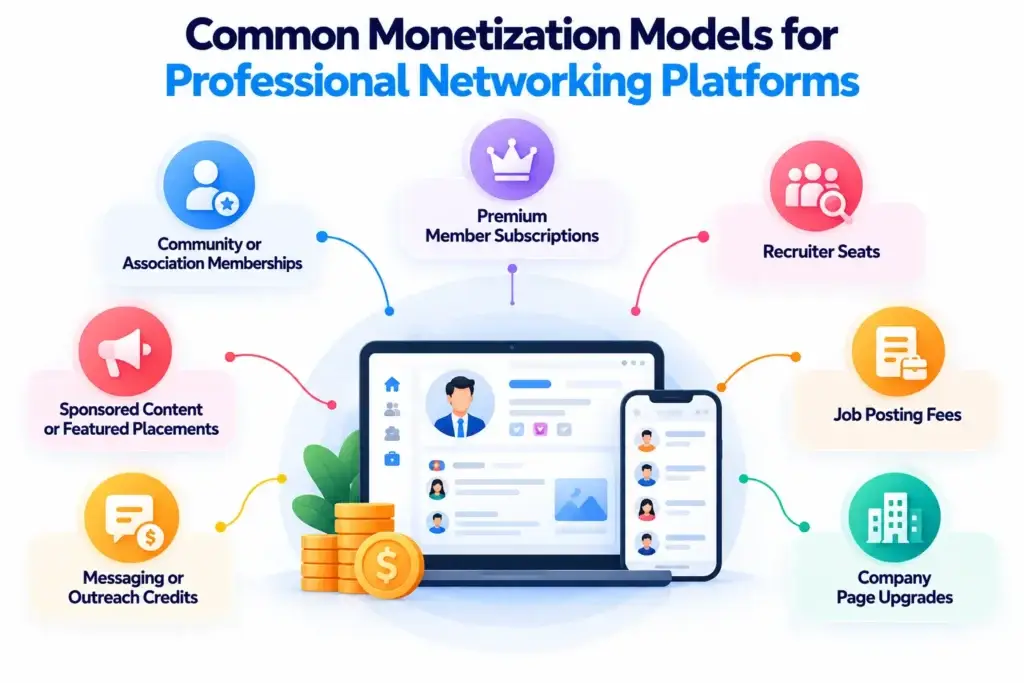
A professional networking platform can create value for users and generate revenue in several ways. The right monetization model depends on the audience, the strength of the network, the role of recruiters, and the type of professional outcome the platform supports.
Founders should be careful not to add monetization too early in a way that damages trust. A professional network should first prove that it can create useful relationships, discovery, and opportunity. Once that value is clear, monetization can be aligned with the users who benefit most.
- Premium member subscriptions: Members pay for advanced visibility, profile insights, additional discovery tools, or expanded communication options.
- Recruiter seats: Recruiters or hiring teams pay for candidate search, outreach, applicant management, and talent pipeline workflows.
- Job posting fees: Companies pay to publish opportunities, promote listings, or access relevant candidates.
- Company page upgrades: Organizations pay for enhanced branding, analytics, hiring tools, or featured visibility.
- Messaging or outreach credits: Certain types of outreach can be metered to reduce spam and support monetization.
- Sponsored content or featured placements: Professional content, events, jobs, or organizations can receive paid visibility when clearly labeled and controlled.
- Community or association memberships: A niche network may monetize through paid access, member dues, training access, or professional resources.
The strongest monetization strategy usually follows the value flow of the platform. If recruiters gain the most direct business value, recruiter tools may be the primary monetization layer. If the network is built for a paid professional community, subscriptions or memberships may matter more. If it is employer-led, company pages and job posting packages may become more important.
What Founders Should Understand Before Planning a Professional Networking Platform
The most important decisions are usually not cosmetic. They concern identity, interaction, trust, incentives, and network structure.
Founder Decision Signals
Identity
Decide which professional information makes a profile genuinely valuable in your market. A healthcare community, alumni network, founder community, and recruiter network should not all use the same profile structure.
Network Density
Identify the smallest professional group that can create useful relationships and opportunities for one another. Relevance often matters more than raw member count in the early stage.
Core Outcome
Clarify whether members mainly come to find jobs, recruit talent, gain visibility, exchange expertise, build business relationships, access mentoring, or join a trusted professional community.
Trust
Plan moderation, reporting, privacy, identity quality, admin controls, and messaging rules early. Professional value declines quickly when spam or low-quality outreach damages credibility.
Read more: Why Niche Professional Networking Platforms Can Create More Value Than Broad Social Networks
Common Mistakes When Building a Professional Networking Product
Mistakes Founders Should Avoid
Treating the Product as a Feature Checklist
Profiles, feeds, connections, jobs, and messages are easy to list. The harder question is whether they create a coherent user journey. A strong network should let professional identity improve discovery, discovery create relationships, relationships improve relevance, and communication create outcomes.
Building for “All Professionals” Too Early
A professional network becomes difficult to differentiate when the audience is too broad. A defined profession, association, geography, alumni group, industry, or business community can create a clearer reason to join and participate.
Prioritizing Engagement Before Trust
High activity does not help if users are overwhelmed by irrelevant requests, spam, questionable profiles, or low-quality outreach. Trust and relevance should grow alongside engagement.
Separating Jobs From Professional Identity
When job discovery operates independently from user profiles and professional relationships, the platform loses much of its contextual advantage. Jobs become more valuable when the broader identity and discovery system contributes to relevance.
Making Messaging Either Completely Open or Completely Closed
Open messaging can create spam. Highly restrictive messaging can block useful interactions. Permission levels, connection rules, message requests, reporting tools, and outreach limits can create a healthier balance.
When Does a Business Need Its Own Professional Networking Platform?
Not every business needs to operate a professional network. The category becomes relevant when an organization already has, or can realistically build, a community whose members benefit from discovering one another.
Examples include industry associations, specialist talent communities, alumni networks, professional education communities, recruitment ecosystems, membership organizations, internal enterprise networks, sector-specific communities, regional business groups, and expert communities.
The strongest signal is not simply that a business wants social features. It is that professional identity and relationships are valuable assets inside the community.
If members need to maintain profiles, find peers, identify expertise, discover opportunities, communicate directly, access jobs, or participate in career-focused activity, a dedicated professional networking product can provide a stronger structure than disconnected spreadsheets, directories, forums, job boards, and messaging tools.
From Understanding the Model to Planning a Platform
Once the interaction model is clear, founders can decide what their own community actually requires. A specialist network may not need every possible professional-networking feature at launch. It does need the features that make its core member-to-member or member-to-opportunity interaction work.
If you are evaluating the category beyond user experience, Miracuves provides a ready-made professional networking platform that can be adapted for branded professional communities. The solution page covers implementation, ownership, deployment, and product capability separately, so this guide can stay focused on explaining how the platform model works.
You can also explore the professional networking platform feature breakdown if you want to compare core modules such as profiles, jobs, messaging, recruiter tools, company pages, and admin controls in more detail.
Final Thoughts: Professional Networks Work When Identity Leads to Opportunity
A professional networking platform is much more than a collection of profiles and a social feed. Its real value comes from connecting professional identity with relevant relationships, information, jobs, organizations, communication, and trust.
Profiles provide context. Connections build the relationship graph. Search and feeds make the network navigable. Jobs connect people with career opportunities. Messaging turns discovery into conversations. Company profiles add organizational identity. Trust and moderation protect the credibility that makes every other interaction useful.
For founders, the strongest starting question is not “Which features should we copy?” It is “Which professional interaction should our community make easier?” Once that is clear, the right profile structure, connection model, discovery system, job workflow, messaging permissions, and trust controls become much easier to define.
Frequently Asked Questions
What is a professional networking platform?
A professional networking platform is a digital system where people create career-focused profiles, connect with professional contacts, discover jobs or business opportunities, share expertise, follow organizations, and communicate with other members.
How does a professional networking platform work?
It connects several layers of professional activity. Users create profiles, build connections, discover people or organizations, engage with professional content, search for opportunities, and communicate through messaging. Data from each layer can improve discovery and relevance elsewhere in the platform.
What information belongs in a professional profile?
A professional profile can include work experience, education, skills, certifications, projects, portfolio items, publications, professional interests, location, recommendations, and other credentials relevant to the community. The right fields depend on the platform’s audience and purpose.
How do connections work on a professional networking platform?
Connections represent professional relationships between users. Platforms may support mutual connections, one-way follows, mutual-contact discovery, organization relationships, and suggested connections based on shared employers, education, industries, interests, or other relevant signals.
How do jobs work on professional networking platforms?
Organizations or recruiters can publish opportunities while professionals search, filter, save, or apply for suitable roles. A networking platform can use structured profile information such as skills, experience, location, preferences, and relationships to make job discovery more relevant.
How does messaging work on a professional network?
Messaging allows professionals, recruiters, organizations, and other members to move from discovery to direct conversation. Platforms may use connection-based permissions, message requests, blocking, reporting, spam controls, and notification settings to balance communication with user safety.
What is the difference between a professional networking platform and a social network?
Both may contain profiles, feeds, followers, messages, and content, but professional networking platforms organize those interactions around careers, expertise, hiring, reputation, industry relationships, and business opportunities rather than primarily personal or entertainment-focused activity.
Can a professional networking platform focus on one industry or community?
Yes. A professional network can be designed for an industry, association, alumni group, profession, company, geographic market, recruitment community, or other focused audience. A specialized network can create strong value when members have a clear reason to discover and interact with one another.
Miracuves is an independent software development company. We are not affiliated with, connected to, sponsored by, or endorsed by any company or product named in this article.
Terms such as “X Clone” are used descriptively. It is how the software industry refers to building a platform with functionality comparable to a known service, and how clients search for it.
The entire design and codebase of our products is built by our own team. Our products contain no code, design, graphics, or content originating from any third-party website or applications.
All third-party names and marks referenced in this article are the property of their respective owners, referenced solely to identify the services discussed.