



Key Takeaways
- A Threads clone app growth strategy should focus on niche communities, creator onboarding, and fast user engagement.
- Users, creators, moderators, admins, brands, and community managers need connected social networking workflows.
- Feeds, posts, replies, reposts, follows, notifications, moderation, and analytics are core growth features.
- Growth depends on strong positioning, early community activity, content quality, retention loops, and trust-building features.
- A focused Threads-like platform can help startups build engaged communities without competing directly with broad social networks.
Growth Signals
- Users need easy onboarding, profile setup, relevant feeds, follow suggestions, replies, reposts, and real-time notifications.
- Creators need posting tools, audience insights, engagement tracking, visibility controls, and community-building features.
- Admins need control over users, posts, reports, moderation, trends, analytics, and platform safety settings.
- Referral campaigns, invite systems, niche content prompts, and creator partnerships help improve early acquisition.
- Notifications keep users active with replies, mentions, follows, reposts, trending conversations, and community updates.
Real Insights
- A Threads clone grows faster when it serves a clear audience instead of trying to copy every mainstream social feature.
- Weak onboarding can reduce first-post activity, follow connections, and early user retention.
- Strong moderation, reporting, privacy controls, and content rules help protect community trust as activity grows.
- Founders should measure activation, repeat posting, reply rates, creator retention, and referral growth from launch.
- Miracuves builds Threads Clone apps with social feeds, posting workflows, creator tools, moderation, analytics, and admin control.
Launching a Threads clone app is only the first step. The real challenge begins after launch, when your platform needs users, conversations, creators, repeat engagement, and reasons for people to return every day.
A Threads-style platform is different from a normal utility app. One user cannot experience full value alone. A microblogging app becomes useful when people post, reply, follow, quote, discover, and participate in live conversations. That means growth cannot be treated as a separate marketing task after development. It must be planned into the product, community, and launch strategy from the beginning.
Threads has shown how powerful public conversation platforms can become. Meta announced in June 2026 that Threads reached 500 million monthly active users, supported by communities, personalization, and user feedback-driven product improvements.
For founders, the lesson is clear: a Threads clone app does not grow because it looks like Threads. It grows because it gives users a focused community, a useful feed, and a reason to participate repeatedly.
If you are planning to launch a Threads-style platform, a ready-made microblogging foundation such as Miracuves’ X Clone or Microblogging Clone can help you move faster with white-label branding, source-code ownership, admin control, and launch-ready app workflows.
Why a Threads Clone App Needs a Growth Strategy Before Launch
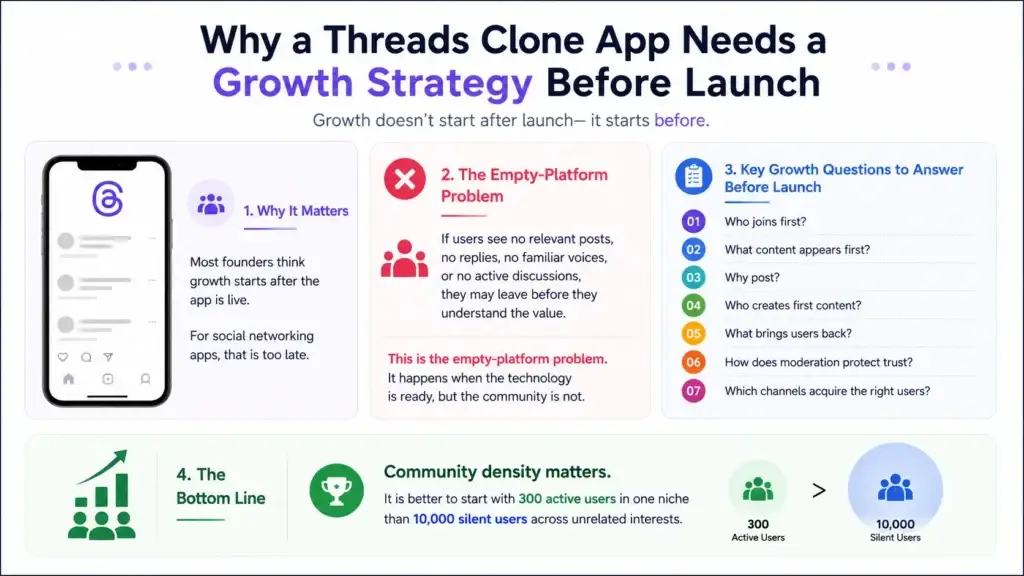
Many founders think app growth starts after the app is live. For social networking Solutions, that is too late.
A Threads clone app needs a growth strategy before launch because the product depends on network activity. If new users open the app and see no relevant posts, no replies, no familiar voices, and no active discussions, they may leave before they understand the value.
This is called the empty-platform problem. It happens when the technology is ready, but the community is not.
A strong growth strategy solves this by answering key questions before launch:
- Who should join first?
- What conversations should they see first?
- Why would they post instead of only browsing?
- Who will create the first wave of content?
- What will bring users back tomorrow?
- How will moderation protect trust?
- Which acquisition channels match the target community?
For a Threads-style app, launch success depends on community density. It is better to start with 300 active users in one niche than 10,000 silent users across unrelated interests.
What Threads’ Growth Teaches Founders About Social Platforms
Threads’ growth is not only about Meta’s distribution power. It also shows that people still want public conversation spaces when the experience feels simple, fast, and community-driven.
A Threads-style platform works because it reduces friction. Users can quickly post thoughts, reply to discussions, follow people, and discover trending topics. The product does not need complicated content creation tools to create engagement. It needs a fast conversation loop.
For founders, the main lesson is this: your Threads clone app should not try to be everything for everyone on day one. It should start with a clear community angle.
That angle could be:
- A professional discussion app for founders
- A local city-based conversation platform
- A creator-led fan discussion app
- A private community microblogging platform
- A niche industry networking app
- A student or campus-based discussion platform
- A regional language social app
- A brand-owned community platform
The narrower the first community, the easier it is to create repeated conversations.
Read more: Best Threads Clone Script in 2026: Features & Pricing Compared
Pre-Launch Growth Foundation for a Threads Clone App
Before launching your Threads clone app, build a pre-launch foundation that prepares users, creators, and content themes.
The pre-launch phase should focus on three things: audience clarity, waitlist building, and content seeding.
Audience clarity means knowing exactly who the platform is for. “People who use social media” is too broad. “Startup founders in India discussing product launches and funding” is much stronger because it gives the platform a clear identity.
Waitlist building helps you avoid launching to silence. Use landing pages, LinkedIn posts, niche communities, email campaigns, and founder networks to collect early interest before the app is live.
Content seeding means planning the first set of posts, discussions, prompts, and creator profiles users will see when they join. A social app should not feel empty on day one.
Founder Decision Signals
Speed
If speed matters, a ready-made Threads clone app can help you launch faster than building every social feature from zero.
Community Fit
If your target users already gather around strong topics, a microblogging platform can turn those conversations into a branded community.
Retention
If users need daily reasons to return, focus on notifications, trending discussions, creator replies, and personalized feeds.
Control
If you need moderation, analytics, user management, and monetization control, the admin dashboard becomes a core growth layer.
How to Get the First 100 Users for a Microblogging App
The first 100 users decide whether your Threads clone app feels alive or empty.
Do not start with mass advertising. Start with handpicked users who care about the same topic. These users should be invited personally, onboarded carefully, and encouraged to post early.
A practical first-user plan could look like this:
- Identify one niche community.
- Invite 25 people who already create content.
- Invite 50 people who actively comment or discuss.
- Invite 25 people who can bring credibility, such as founders, experts, creators, or community leaders.
- Seed 30 to 50 starter posts before public launch.
- Ask every early user to follow at least 10 relevant profiles.
- Create daily prompts for the first 30 days.
The first 100 users should not be treated as random signups. They should be treated as founding members of the platform.
User Acquisition Channels That Work for Threads-Style Apps
A Threads clone app can use multiple acquisition channels, but not every channel should be used at once. Early-stage founders should focus on channels where conversation already exists.
User Acquisition Channels for a Threads Clone App
| Channel | Best Use Case | Founder Action |
|---|---|---|
| Niche communities | Finding early users with shared interests | Invite users from Reddit, Discord, Slack groups, LinkedIn groups, or industry forums. |
| Creator partnerships | Building trust and content supply | Onboard micro-creators who can host conversations and bring their audience. |
| LinkedIn and X | Founder-led launch visibility | Share build-in-public updates, community prompts, and launch stories. |
| Referral campaigns | Encouraging users to invite similar people | Reward users for bringing active members, not only signups. |
| SEO landing pages | Capturing long-term discovery | Create niche landing pages around community topics, creator categories, or local interest groups. |
| Paid ads | Scaling proven positioning | Use ads only after onboarding, activation, and retention signals are visible. |
Product Features That Turn Acquisition Into Retention
User acquisition brings people into the app. Product design decides whether they stay.
A Threads clone app needs features that create fast activation. The user should understand what to do within the first few minutes.
Important retention-focused features include:
- Simple onboarding
- Interest selection
- Suggested profiles to follow
- Trending conversations
- Personalized feed
- Thread creation
- Replies and reposts
- Mentions and notifications
- Bookmarks
- Community sections
- Topic-based discovery
- Creator profiles
- Moderation and reporting
- Admin analytics
Miracuves’ X Clone includes microblogging features such as posting, replying, direct messaging, profile customization, thread management, trending topics, notifications, analytics, content moderation, report handling, and admin controls.
For founders, the business value is simple. The app should not only allow users to post. It should guide users toward conversations where they are likely to respond.
Community Seeding Strategy for a Threads Clone App
Community seeding is the process of creating enough early activity so new users feel the platform is alive.
For a Threads-style app, this can include:
- Daily discussion prompts
- Founder-led posts
- Expert Q&A threads
- Trending topic starters
- Creator introductions
- Community challenges
- Polls and opinion threads
- Weekly recap posts
- Featured member highlights
The goal is not to fake activity. The goal is to reduce cold-start friction by giving early users something useful to react to.
A good community seeding plan should cover the first 30 days after launch. Each day should have planned conversation triggers, featured users, and engagement actions.
Creator and Influencer Onboarding Strategy
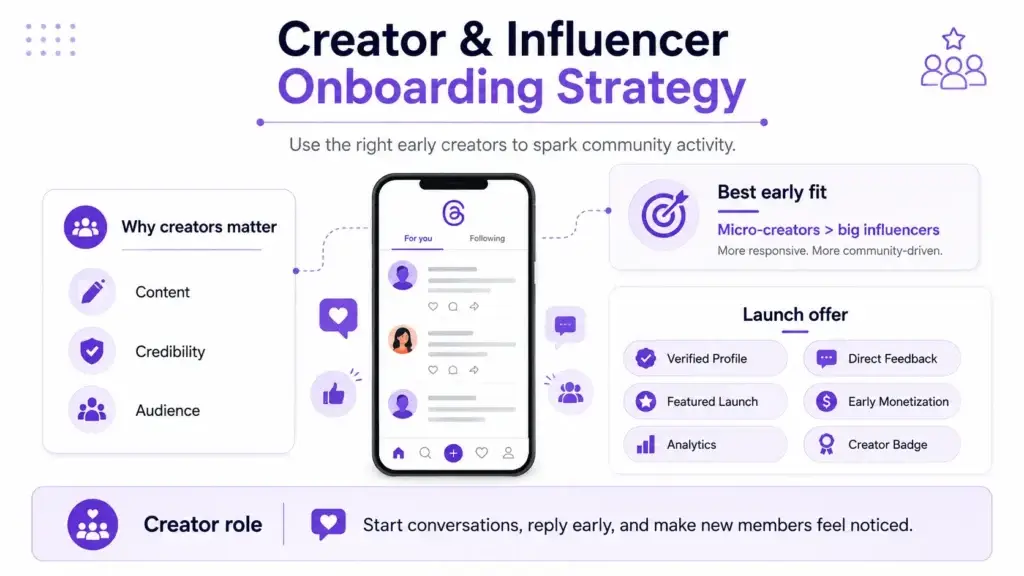
Creators can accelerate the growth of a Threads clone app because they bring content, credibility, and audience movement.
However, the best early creators are not always large influencers. Micro-creators often perform better because they respond more, care more about community, and are easier to onboard personally.
A founder should create a simple creator onboarding offer:
- Early verified profile
- Featured placement during launch
- Community host status
- Analytics access
- Direct feedback channel with the founding team
- Monetization access when revenue features go live
- Invite-only creator badge
The creator’s job is not only to post. Their job is to start conversations, reply to users, and make new members feel noticed.
Read more: Reasons startup choose our Threads clone over custom development
Referral Loops and Viral Mechanics for a Threads Clone App
Referral growth works when users have a reason to invite others.
For a Threads clone app, referral loops should be connected to identity, status, access, and community value.
Useful referral mechanics include:
- Invite-only launch access
- Founding member badges
- Creator invite codes
- Community leaderboard
- Rewards for active invitees
- Shareable thread links
- External post previews
- “Join this conversation” CTA links
- Topic-based invite pages
The mistake many founders make is rewarding users only for signups. A better approach is to reward users for bringing people who complete meaningful actions, such as posting, following, replying, or joining a community.
Retention Metrics Founders Should Track After Launch
A Threads clone app should not be judged only by downloads. Downloads can look good, but they do not prove community health.
Founders should track activation, engagement, and retention metrics from the first week.
Key Growth Metrics for a Threads Clone App
| Metric | What It Shows | Why It Matters |
|---|---|---|
| Activation rate | How many users complete key first actions | Shows whether onboarding is helping users understand the app quickly. |
| Post creation rate | How many users publish content | Reveals whether users feel confident enough to participate. |
| Reply rate | How often users respond to posts | Indicates conversation quality and community engagement. |
| Follow rate | How many users build their social graph | Shows whether users are finding relevant people and topics. |
| Day 1 retention | How many users return after the first day | Measures whether the first experience creates enough value. |
| Day 7 retention | How many users return after one week | Shows whether the app is becoming part of a repeat habit. |
| Invite conversion | How many invited users become active | Helps measure referral quality instead of vanity signups. |
Monetization Timing for a Threads Clone App
Monetization should not be rushed before the community has enough activity.
A Threads clone app can support multiple revenue models, but the timing matters. If founders introduce too many paid features too early, users may feel blocked before they experience value.
Potential monetization models include:
- Sponsored posts
- Premium creator profiles
- Brand communities
- Subscription-based private communities
- Promoted trends
- In-app ads
- Creator monetization tools
- Paid verification
- Business profile upgrades
- Data and analytics packages for brands
The right monetization model depends on the target audience. A professional microblogging app may monetize through premium profiles and brand communities. A creator-led app may monetize through subscriptions, tips, and exclusive access. A local community app may monetize through sponsored listings and promoted posts.
The stronger approach is to grow engagement first, then introduce monetization where users already see value.
Security and Moderation as Growth Layers
For a Threads clone app, moderation is not just a safety feature. It directly affects growth.
If users see spam, abuse, fake profiles, or irrelevant content, they may stop posting. If creators feel unsafe, they may not bring their audience. If brands see poor moderation, they may avoid advertising or partnerships.
A growth-ready Threads clone app should include:
- Content moderation
- Abuse reporting
- User blocking
- Comment controls
- Profile verification
- Admin review queues
- Spam detection
- Activity logs
- Role-based admin access
- Privacy-conscious data handling
Final compliance and privacy requirements depend on the target region, operating model, app policies, and legal review. The product should support compliance-ready workflows, but founders should avoid assuming that software alone guarantees legal compliance.
Mistakes Founders Should Avoid
Mistakes Founders Should Avoid
Launching without a core community
A Threads clone app needs conversation density. Launching to a broad audience without a focused group often creates an empty-feed problem.
Spending on ads before fixing retention
Paid acquisition can bring users, but it cannot fix unclear onboarding, weak feed quality, or poor conversation flow.
Ignoring creator onboarding
Creators supply content and social proof. Without creator participation, the platform may struggle to build early momentum.
Treating moderation as optional
Social platforms depend on trust. Weak moderation can damage retention, advertiser interest, and community reputation.
How Miracuves Helps Founders Launch Faster
A Threads clone app requires more than user profiles and posting features. It needs a strong product foundation with feed logic, user flows, admin control, moderation tools, analytics, notifications, and monetization flexibility.
Miracuves helps founders launch ready-made and white-label social networking apps with source-code ownership, branded design, admin dashboard, and faster deployment. For founders who want to validate a microblogging platform without building every module from zero, Miracuves’ X Clone and Microblogging Clone can provide a launch-ready foundation.
The advantage is not just speed. It is control.
With the right foundation, founders can focus more energy on community growth, creator onboarding, positioning, partnerships, and retention instead of spending months only building the first version.
Final Thoughts
A Threads clone app is not successful just because it has posting, replies, profiles, and a feed. Those features are only the foundation.
The real growth comes from community clarity, creator participation, useful conversations, smart onboarding, referral loops, retention tracking, and strong admin control. Founders who treat growth as part of the product strategy have a better chance of building a social platform that people actually return to.
The strongest decision is not always to build everything from zero. For many founders, a ready-made and white-label app foundation can reduce launch delay, support faster validation, and leave more time for what truly matters after launch: acquiring users, activating communities, and building repeat engagement.
FAQs
What is a Threads clone app growth strategy?
A Threads clone app growth strategy is a launch and user acquisition plan designed to help a microblogging app attract early users, seed conversations, onboard creators, improve retention, and build a repeat engagement loop after launch.
How do I get the first users for a Threads clone app?
Start with a focused niche community instead of a broad audience. Invite creators, active commenters, experts, and early supporters who care about the same topic. Seed discussions before launch so the app does not feel empty.
Should I use paid ads to grow a Threads clone app?
Paid ads can help after you understand your audience, onboarding flow, and retention signals. In the early stage, community seeding, creator partnerships, referral loops, and founder-led outreach are usually more practical than spending heavily on ads.
What features help a Threads clone app retain users?
Retention-focused features include personalized feeds, suggested follows, trending topics, notifications, replies, reposts, bookmarks, creator profiles, community sections, moderation tools, and admin analytics.
How can creators help grow a Threads-style app?
Creators help by posting regularly, starting discussions, inviting followers, replying to users, and giving the platform social proof. Micro-creators can be especially useful in the early stage because they are more likely to engage directly with the community.
When should a Threads clone app start monetizing?
Monetization should begin after the platform has active users, consistent conversations, and visible retention. Revenue models can include sponsored posts, premium profiles, brand communities, subscriptions, promoted trends, ads, and creator monetization.
Why choose a ready-made Threads clone app instead of custom development?
A ready-made Threads clone app can reduce development time because core social networking workflows are already built. Founders can focus more on branding, positioning, user acquisition, community growth, and monetization instead of building every module from zero.
Can Miracuves help launch a Threads-style microblogging app?
Yes. Miracuves helps founders launch white-label and source-code-owned social networking apps with branded design, admin dashboard, moderation support, and faster deployment for market validation.