


Key Takeaways
- Revolut’s marketing strategy turns digital banking into a modern, relatable, and shareable brand experience.
- Its growth came from solving clear user problems such as costly transfers, hidden fees, and complicated money management.
- Referral programs, waitlists, social content, product-led growth, and community engagement are core acquisition drivers.
- Strong fintech marketing depends on trust, clear positioning, useful features, and a consistent brand voice.
- A Revolut-like app can grow faster when product experience and marketing strategy are designed together.
Growth Signals
- Users need simple onboarding, transparent fees, fast transfers, spending insights, rewards, and clear financial benefits.
- Marketing teams need referral links, waitlist campaigns, social content, influencer access, and conversion tracking.
- Admins need control over referral rewards, promotions, user segments, notifications, campaigns, and growth analytics.
- Gamified savings, progress tracking, premium tiers, and personalized insights help improve engagement and retention.
- Behavior-based notifications keep users engaged with spending updates, rewards, budgets, transfers, and account activity.
Real Insights
- Fintech brands grow more effectively when they communicate like modern consumer products instead of traditional banks.
- Promoting a few high-value solutions is usually more effective than marketing a long list of disconnected features.
- Referral loops work best when invitations are simple, rewards are clear, and users already value the product.
- Paid advertising cannot compensate for weak onboarding, confusing fees, poor usability, or low customer trust.
- Miracuves builds Revolut Clone apps with digital banking workflows, referral systems, gamified experiences, payments, analytics, and admin control.
Revolut’s marketing strategy offers an important lesson for fintech founders: growth does not come from advertising alone. It comes from aligning a clear customer problem, differentiated positioning, useful financial features and a product experience people are willing to recommend.
The company’s growth playbook combined pain-point messaging, referral mechanics, digital-first communication, partnerships and product-led retention. Founders can learn from this model without copying Revolut’s brand, campaigns or exact feature set. The more valuable approach is to understand why each tactic worked and adapt it to a specific market, customer segment and financial use case.
Product readiness matters just as much as campaign execution. A referral offer cannot scale if onboarding is confusing. A multi-currency message will not build trust if pricing is unclear. A security promise will not support retention unless users receive transparent transaction information and meaningful account controls.
For founders evaluating how these ideas could translate into an owned product, Miracuves provides a launch-ready Revolut-style banking platform with product, admin, branding, monetization and deployment information. This guide remains focused on marketing strategy, while the solution page covers the commercial product scope.
Below, we break down the positioning, acquisition, partnership and retention lessons founders can use to build a more credible fintech brand.
Why Revolut’s Marketing Strategy Works

Revolut did not position itself as another traditional financial institution with a mobile application. It presented an alternative way to manage money digitally.
That distinction matters. Traditional financial marketing often begins with the institution: its history, network, products and credentials. Digital-first fintech marketing usually begins with the user: what frustrates them, what slows them down and what they want to control from their phone.
Revolut’s marketing became effective because its messaging, interface and features supported the same central idea: financial services could be simpler, more transparent and more user-controlled.
Speak Like a Challenger, Not a Traditional Bank
Many financial brands use formal language about empowerment, security and innovation. Those themes are important, but they become forgettable when every provider uses the same wording.
Revolut developed a more direct and conversational identity. Its messaging frequently focused on everyday money frustrations instead of abstract banking terminology.
The lesson for founders is not to make every message humorous or provocative. It is to create a voice that is recognizably different and appropriate for the intended market.
A youth-focused spending product may use informal, energetic communication. A business banking platform may require a more precise and operational tone. A remittance product may lead with clarity, trust and transparent transfer information.
The brand voice should reflect four things:
- The customer segment
- The seriousness of the financial action
- The customer’s level of financial knowledge
- The trust required to complete the transaction
A useful fintech brand sounds human without becoming careless. It can be direct without making promises the product cannot verify.
Target Financial Pain Points With Product Proof
Revolut’s positioning focused on financial frustrations users could immediately recognize:
- Unclear foreign-exchange costs became a message about transparent conversion and greater control.
- Complex international transfers became a message about simpler cross-border money movement.
- Limited visibility into spending became a message about budgeting insights and real-time notifications.
- Slow card-management processes became a message about in-app controls and faster account actions.
- Fragmented financial tools became a message about managing more activities through one digital experience.
The lesson is not to promote every feature equally. Choose the customer problem your product can solve most convincingly, then connect the marketing promise to a visible product experience.
A new fintech product may have dozens of modules, but the launch campaign should usually lead with one primary value proposition and a small number of supporting benefits.
For example:
- An international freelancer product may lead with receiving, holding and managing multiple currencies.
- A family finance application may lead with budgeting, allowances and spending visibility.
- A small-business product may lead with expense approvals, team cards and financial reporting.
- A remittance platform may lead with transparent transfer status and recipient convenience.
- A regional neobank may lead with mobile onboarding and access to locally relevant financial services.
The strongest positioning comes from deciding what the product should be known for before choosing advertising channels.
Build a Recognizable Identity Without Sacrificing Trust
Fintech brands need to balance familiarity and credibility.
A brand that sounds too institutional may struggle to connect with mobile-first users. A brand that sounds too casual may weaken confidence around payments, identity verification or account security.
Founders should therefore separate tone from trust.
The marketing tone can be modern, simple and relatable. The trust layer should remain clear and precise. Pricing, transaction status, support processes, data handling and important terms should never be hidden behind playful language.
A distinctive fintech identity can be built through:
- A consistent visual system
- Recognizable language and message patterns
- Clear explanations of financial features
- Transparent fees and limitations
- Helpful onboarding content
- Responsive support communication
- Consistent transaction and security notifications
Brand recognition may help users remember the product, but operational clarity helps them trust it.
Read More: What is a Revolut App and How Does It Work?
Why Product Readiness Is Part of Fintech Marketing
A fintech campaign creates expectations before a user completes registration. Every promise made in an advertisement, landing page, referral message or influencer campaign must be supported by the product.
For example:
- Multi-currency accounts support positioning around international money management.
- Clear onboarding and verification workflows reduce friction between interest and activation.
- Card controls and transaction notifications support messages about visibility and user control.
- Budgeting tools, spending insights and savings features create reasons to return.
- Responsive support and dispute workflows strengthen trust after a transaction problem.
- Business finance tools allow the brand to serve freelancers, teams and small companies rather than only individual users.
These are not merely feature-list items. They shape acquisition, activation, retention and customer confidence.
Founders can review the Revolut app features that support user trust and retention before deciding which benefits should lead their campaign.
The strategic question is simple:
Can the product prove the promise being used to acquire the user?
When the answer is yes, marketing becomes more credible. When the answer is no, the campaign may produce registrations without producing long-term users.
Read More: Best Revolut Clone Script in 2026: Features & Pricing Compared
Revolut’s Acquisition Strategy: Build Growth Loops, Not Just Campaigns
Paid advertising can create reach, but a growth loop creates a reason for one user action to produce another.
In fintech, effective growth loops may include referrals, payment interactions, shared expenses, business invitations, recipient onboarding or rewards linked to verified activity.
The important distinction is that a growth loop lives inside the product journey. It is not simply an advertisement asking users to share a link.
Create a Referral Engine With Measurable Business Logic
A typical referral flow looks simple:
Existing user invites a contact → the contact registers → the contact completes a qualifying action → the reward is approved.
The operational logic behind that flow is more complex. The product and admin system may need to track:
- Who sent the invitation
- Which link or campaign produced the registration
- Whether identity verification was completed
- Whether the qualifying transaction occurred
- Whether the reward conditions were met
- Whether suspicious or duplicate activity was detected
- Whether the incentive was issued
- Whether referred users remained active
This is why referral marketing should not be planned separately from product development.
Founders should define the business purpose of the referral campaign before choosing the reward. The objective may be to increase registrations, verified accounts, first transactions, deposits, card orders or paid-plan upgrades.
The qualifying action should reflect genuine product value. Rewarding registrations alone may create volume without creating meaningful activation.
Keep the Referral Journey Friction-Conscious
Every additional step between invitation and activation creates drop-off.
A practical referral flow should make it easy for the recipient to:
- Understand what the product offers
- Review the reward terms
- Register through the correct referral path
- Complete identity or account requirements
- Perform the qualifying action
- See the reward status
The interface should also explain why a reward is pending, rejected or completed. Lack of clarity can turn an acquisition program into a support problem.
Scarcity and limited-time rewards can increase urgency, but the conditions should remain transparent. Financial brands should avoid manipulative countdowns, unclear eligibility rules or incentives that encourage risky behavior.
Use Waitlists to Validate Demand, Not Manufacture Vanity
A waitlist can help founders measure interest before a wider launch. It can also support phased onboarding when operations, support capacity or financial integrations need to be tested gradually.
A useful waitlist may collect:
- Target customer type
- Country or region
- Intended use case
- Expected transaction behavior
- Business or personal account interest
- Most important requested feature
- Referral source
This information helps the founder understand who is interested and why.
An invite-based launch can also be used to:
- Give selected users early access
- Test onboarding and support workflows
- Identify product friction
- Collect structured feedback
- Build educational launch content
- Improve messaging before paid acquisition
The platform should give the operating team visibility into invitation sources, successful referrals, reward status, onboarding completion and suspicious activity so the growth loop can be measured and controlled.
Segment Acquisition by Customer Problem
A fintech platform may serve several audiences, but the same advertisement should not be used for all of them.
Consider separate campaigns for:
- International travelers
- Freelancers receiving cross-border payments
- Small businesses managing team expenses
- Consumers seeking budgeting tools
- Migrants sending money to family
- Digital-first customers seeking mobile account control
Each segment has a different motivation, trust concern and activation event.
A campaign for travelers may focus on currency management and card control. A campaign for small businesses may focus on approvals, expenses and reporting. A campaign for freelancers may focus on getting paid and managing multiple currencies.
Segment-specific positioning improves relevance and also helps the product team understand which user groups create the strongest retention and revenue potential.
Read More: Why Choose a White-Label Revolut like app Instead of Building from Scratch?
Content, Social Media and Community: Build Understanding Before Promotion
Financial products often require more education than ordinary consumer applications.
A user may need to understand account eligibility, verification, fees, exchange rates, transfer status, card controls, chargebacks or security settings before feeling confident enough to transact.
Content marketing is therefore not just a traffic channel. It can reduce uncertainty across the customer journey.
Use Content Formats Native to Each Channel
A common mistake is publishing the same asset across every platform without adapting it.
Different channels support different behaviors:
- Short-form video can explain one financial concept or feature quickly.
- Search content can answer detailed questions and capture high-intent demand.
- Email can support onboarding and feature adoption.
- Professional networks can reach founders, finance leaders and business users.
- Community channels can gather feedback and answer recurring questions.
- In-app education can guide users at the moment a feature becomes relevant.
The subject may be the same, but the format and call to action should match the platform.
A search article about multi-currency accounts may provide a detailed comparison. A short video may explain one common conversion-fee mistake. An onboarding email may show the user how to add a currency account.
Use Education to Improve Activation and Retention
Users rarely adopt every feature immediately. They need guidance based on their stage and behavior.
A useful education system may include:
- Onboarding checklists
- Contextual tooltips
- Transaction explanations
- Security reminders
- Short feature tutorials
- Fee and limit information
- Help-center content
- Lifecycle email sequences
- Behavior-based notifications
Educational content should connect to specific onboarding steps, feature-adoption goals and support questions so it improves activation rather than generating awareness alone.
For example, a customer who has completed verification but has not added money may need a funding guide. A user who has received an international payment may need information about holding or converting currencies. A business administrator may need guidance on inviting employees and setting permissions.
Turn Support Questions Into Marketing Intelligence
Customer questions reveal where positioning or onboarding is unclear.
If users repeatedly ask whether a transfer is instant, the marketing may be overgeneralizing. If users cannot find pricing information, the fee presentation may need improvement. If customers do not understand why verification is required, onboarding education may be insufficient.
Founders should regularly review:
- Search queries
- Support tickets
- Chat transcripts
- App-store reviews
- Onboarding drop-off
- Feature usage
- Cancellation reasons
- Social comments
- Sales objections
These signals can improve product copy, campaign messaging and the roadmap.
Read More: How Safe Is a White-Label Revolut app? Security Guide 2026
B2B Partnerships Can Expand Distribution and Product Value
Partnerships can help a fintech product reach users through ecosystems they already trust.
The right partner does more than provide exposure. It can make the financial product more useful.
Potential partner categories include:
- Banking-as-a-Service providers
- Identity-verification services
- Payment gateways
- Card-issuing partners
- Accounting platforms
- Payroll systems
- Travel companies
- Coworking networks
- Freelance platforms
- Ecommerce ecosystems
- Business software providers
A partner should be assessed using three questions:
- Does the partnership improve the product?
- Does it provide access to a relevant customer segment?
- Can the partnership be managed operationally and commercially?
A recognizable partner logo may create short-term credibility, but a useful integration creates long-term customer value.
Use Partnerships to Reach Specific Audiences
A fintech startup targeting freelancers could work with invoicing, contracting or accounting platforms. A business expense product could integrate with payroll and bookkeeping tools. A travel finance product could collaborate with travel communities, booking platforms or remote-work networks.
The strongest partnerships begin with overlapping customer needs.
Instead of asking, “Which well-known brand can promote us?” ask, “Which product does our target customer already use before or after using ours?”
That question creates more practical integration and co-marketing opportunities.
Expand Into Business Finance Carefully
Business customers can create higher-value and longer-term relationships, but their requirements are more operational.
They may need:
- Team accounts
- Employee cards
- Approval workflows
- Spending limits
- Expense categorization
- Receipt management
- Invoicing
- Accounting integrations
- Role-based access
- Reporting and audit history
The marketing should therefore emphasize control, visibility and reduced administrative work rather than consumer-style convenience alone.
Turn Growth Tactics Into a Repeatable Fintech Business Model
Acquisition is only valuable when the business has a clear way to retain customers and generate sustainable revenue.
Before scaling a campaign, founders should decide which customer actions create business value and which features justify paid plans or transaction-based income.
Possible monetization paths include:
- Monthly or annual subscriptions for premium account features
- Transaction or transfer service fees
- Foreign-exchange fees or margins
- Card-related and payment revenue where supported by the operating model
- Business-account subscriptions
- Paid expense-management or reporting tools
- Premium support or account-management services
- Partner revenue from integrated services
- Usage-based pricing for embedded-finance or business customers
The right model depends on the target market, financial partners, regulatory requirements, operating costs and customer expectations.
A product should not introduce fees simply because another fintech uses them. The pricing model must reflect a clear customer benefit.
For a deeper breakdown, review the Revolut business model and revenue streams.
Use that information to decide which revenue paths fit the product before committing heavily to paid acquisition.
A founder should be able to answer four questions before scaling:
- Which customer segment is most likely to activate?
- Which product action indicates long-term value?
- Which revenue stream can grow without damaging trust?
- Which acquisition channel brings users who are likely to retain?
When those answers are connected, marketing becomes part of a repeatable business system rather than a collection of campaigns.
Read More: Understanding the Revolut vs Wise Business Model for Fintech Startups
Retention Marketing: Make the Product Useful After Sign-Up
Acquisition may bring users into the application, but retention determines whether marketing spend creates lasting value.
Fintech retention is not created by sending more notifications. It is created by helping users complete recurring financial tasks with greater clarity or control.
Connect Retention to Meaningful Financial Progress
Progress can be represented through:
- Spending summaries
- Budget tracking
- Savings goals
- Recurring-payment visibility
- Subscription management
- Cash-flow insights
- Business expense reports
- Transfer history
- Account health indicators
These features help users understand what has happened and what they should do next.
Gamification can support engagement, but it should not trivialize important financial decisions. Progress indicators, milestones and educational prompts are usually more appropriate than mechanics that encourage unnecessary spending or risky activity.
Use Behavior-Based Notifications
Generic notifications are easy to ignore. Behavioral messages are triggered by a relevant user action, account event or financial pattern.
Examples include:
- Confirmation that a transfer has been completed
- Notification that verification requires additional information
- Warning that a card or spending limit is approaching
- Reminder about an incomplete onboarding step
- Update on a disputed transaction
- Notice about a recurring payment
- Explanation of an unusual account event
- Prompt to review a monthly spending summary
The message should answer three questions:
- What happened?
- Why does it matter?
- What should the user do next?
Avoid using sensitive transaction details on lock screens unless the user has opted into that level of visibility.
Build Lifecycle Campaigns Around User Stages
A new registrant and a long-term business customer should not receive the same communication.
Useful lifecycle stages may include:
- Registered but not verified
- Verified but not funded
- Funded but not transacting
- Completed first transaction
- Active personal user
- Active business user
- Eligible for premium features
- At risk of becoming inactive
- Contacted support
- Experienced a failed transaction
- Cancelled or downgraded
Each stage requires a different message and outcome.
For example, a verified but unfunded user may need guidance on adding money. An active traveler may need information about currency management. A business customer may need help setting employee permissions.
Retention improves when communication reflects the user’s real relationship with the product.
Read More: Exploring the Revenue Model Behind Revolut
What Must Be Ready Before Scaling Fintech Acquisition
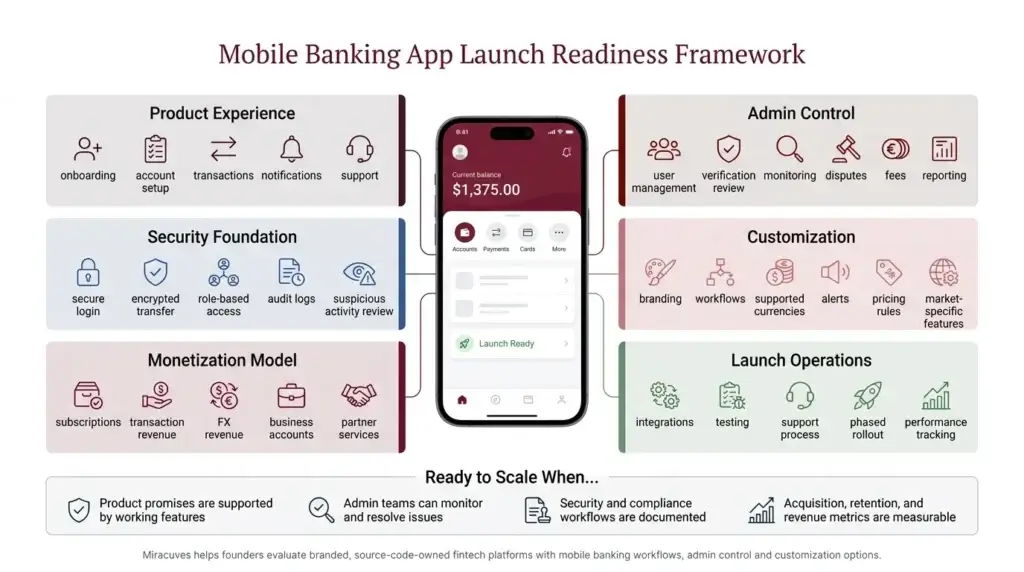
Marketing can increase sign-ups quickly, but growth also exposes weaknesses in onboarding, operations, security and support.
Founders should confirm that the product and operating team can manage increased activity before investing heavily in acquisition.
Admin Control and Operational Visibility
The admin dashboard should help the operating team review:
- Users and account status
- Verification progress
- Transactions and transfers
- Card status and controls
- Referral activity
- Fees and commissions
- Support requests
- Disputes
- Provider performance
- Suspicious activity
- Audit history
- Platform alerts
Without this control layer, a company may attract users faster than it can support them.
Admin access should also be permission-based. Customer-support staff, compliance reviewers, finance teams and senior administrators do not require identical access to sensitive information or high-impact actions.
The dashboard is not merely a technical feature. It directly affects customer experience because it determines how quickly the team can investigate problems, correct errors and respond to user requests.
Security and Compliance Workflows
Security should be part of the product foundation rather than a marketing statement added immediately before launch.
Important security and operational layers can include:
- Encrypted data transfer
- Secure authentication
- Role-based access control
- Audit logs
- User identity checks
- Transaction monitoring
- Suspicious-activity review
- Secure API integration
- Session and device controls
- Dispute-management workflows
- Incident-response procedures
- Permission-based administration
A platform can support compliance-ready workflows, but final obligations depend on the jurisdiction, business model, financial partners, integrations and legal review.
Founders should avoid universal claims such as “fully compliant everywhere.” A safer and more accurate approach is to explain which controls exist and how the product can be configured for the intended market.
Read more about building trust into a Revolut-style financial product.
Customization Should Support Market Positioning
Customization is more than changing a logo and color palette.
The product may need to be aligned across:
- Onboarding language
- Account structure
- Supported currencies
- Fee presentation
- Notification logic
- Verification flow
- Help content
- Financial partners
- Payment methods
- Business rules
- Customer-support process
- Feature priorities
A platform serving international freelancers may emphasize multi-currency access, invoicing and payment visibility.
A regional consumer finance product may focus on local payment methods, budgeting and mobile account management.
A business finance platform may lead with expense controls, employee permissions, approvals and reporting.
Customization becomes commercially important when it enables the product experience to support the brand promise.
Understand What Affects Cost
The cost of launching a digital banking product depends on more than the number of screens.
Important cost factors include:
- User and business account modules
- Admin workflows
- Mobile, web and API requirements
- Branding and interface changes
- Multi-currency and foreign-exchange scope
- Card or payment integrations
- Banking-as-a-Service provider integrations
- Verification providers
- Security requirements
- Infrastructure and deployment
- Testing
- Documentation
- Post-launch support
- Market-specific compliance workflows
A ready-made foundation can reduce the amount of product logic that must be created from zero. However, deeper integrations, market-specific requirements and substantial workflow changes can increase scope.
Founders should compare development options using the same criteria:
- What is already included?
- Which modules require customization?
- Is source-code ownership included?
- Who manages deployment?
- Which integrations are included?
- What testing will be completed?
- What happens after launch?
- How easily can the platform be extended?
The dedicated solution page should remain the primary location for current pricing, product scope and deployment information.
Follow a Structured Launch Process
A practical launch process may include the following stages.
1. Define the target segment
Choose the first customer group, geography, financial use case and value proposition.
2. Confirm the operating model
Identify financial partners, verification requirements, payment flows, account structure and revenue model.
3. Select the product scope
Decide which user, business, admin and reporting workflows are necessary for the first market release.
4. Configure branding and workflows
Align the interface, onboarding, notifications, pricing and customer-support journey with the chosen audience.
5. Complete integrations and testing
Test payment, provider, verification, transaction, security and administrative workflows.
6. Prepare operations and support
Document escalation paths, dispute handling, compliance reviews, customer support and incident response.
7. Launch to a controlled user group
Use phased onboarding or a limited rollout to identify friction before increasing acquisition spend.
8. Measure activation and retention
Track verified accounts, first-value actions, repeat usage, revenue, support volume and customer loss.
For broader development and integration capabilities, explore Miracuves’ fintech product and technology services.
Mistakes Founders Should Avoid When Adapting Revolut’s Marketing Strategy
Copying the Brand Instead of Learning From the Strategy
Reproducing another company’s language, design or identity does not create differentiation. Use proven strategic patterns, but build original positioning around your own customer and market.
Promoting Too Many Features
A long feature list can weaken the primary value proposition. Lead with the customer problem that creates the strongest demand and use other features as supporting evidence.
Scaling Acquisition Before Fixing Onboarding
Paid traffic cannot repair a confusing registration, verification or funding experience. Fix high-impact drop-off before increasing acquisition spend.
Treating Referrals as a Simple Discount
Referral systems require attribution, eligibility rules, reward controls, fraud monitoring and performance measurement. The incentive should be connected to a meaningful activation event.
Making Security Claims Without Product Proof
Words such as secure, protected and compliant should be supported by specific controls, processes and documentation.
Copying Another Fintech’s Revenue Model
A monetization method that works in one region or for one customer segment may not fit another. Revenue must be aligned with customer value, financial partners, regulations and operating costs.
Ignoring the Admin Experience
An attractive customer interface cannot compensate for weak operational control. The team needs visibility into users, transactions, referrals, disputes, fees and system events.
Using the Same Message for Every Audience
Travelers, freelancers, consumers and businesses have different financial priorities. Segment the message, landing page and onboarding journey.
Expecting Marketing to Create Trust Alone
Trust is built through consistent product behavior, transparent pricing, responsive support, reliable transaction information and clear problem resolution.
How to Adapt the Strategy for Your Own Fintech Brand
Founders can apply the lessons from Revolut’s marketing through a practical sequence.
Step 1: Select a Narrow Initial Audience
Choose the first customer group based on a meaningful financial need rather than the size of the general banking market.
Step 2: Define the Primary Problem
Decide which problem the product should solve most convincingly.
Step 3: Connect the Problem to Product Evidence
Identify the exact feature, workflow or service that proves the marketing promise.
Step 4: Choose the Activation Event
Define the action that demonstrates the user has received value. This may be completing verification, funding an account, issuing a card, completing a transfer or inviting a team member.
Step 5: Design the Acquisition Loop
Choose whether the initial growth engine will be search, partnerships, communities, referrals, content, sales outreach or a combination.
Step 6: Prepare the Retention Journey
Plan onboarding education, notifications, support, feature adoption and lifecycle communication.
Step 7: Confirm Monetization Logic
Determine how revenue will be connected to customer value without damaging trust.
Step 8: Measure the Full Funnel
Track more than registrations. Useful metrics may include:
- Registration-to-verification rate
- Verification-to-first-value rate
- Referral conversion
- Cost per activated user
- Repeat transaction rate
- Feature adoption
- Support requests per active user
- Revenue per active user
- Retention by acquisition channel
- Cancellation or inactivity reasons
The objective is not to reproduce Revolut’s growth. It is to build a marketing and product system appropriate for your own market.
Final Thoughts: The Product Must Deliver the Marketing Promise
Revolut’s marketing strategy is valuable because it demonstrates how positioning, referral loops, partnerships, education and retention can work together as one connected growth system.
The central lesson is not to copy a bold brand voice or reproduce another company’s campaign. It is to identify a meaningful financial problem, communicate it clearly and support that promise with a mobile banking app experience users can trust.
For founders, the most important work happens at the intersection of marketing and product execution.
Referral campaigns need measurable reward logic. Retention campaigns need genuinely useful features. Security messaging needs verifiable operational controls. Monetization needs to create value without weakening customer confidence.
A fintech brand becomes easier to market when the underlying product is clear, differentiated and ready to support the users its campaigns attract. Miracuves helps founders build branded, launch-ready fintech platforms with the product, admin and customization layers needed to turn marketing strategy into a practical business opportunity.
FAQs
What is the main idea behind Revolut’s marketing strategy?
Revolut’s strategy connects recognizable customer pain points with differentiated positioning, referral-led acquisition, product education, partnerships and feature-driven retention. Its main lesson is that marketing performs better when the product experience supports the promise made in the campaign.
How can a fintech startup adapt Revolut’s strategy without copying it?
Start by selecting a specific audience and a small number of financial problems to solve. Build messaging around those problems, choose acquisition channels that reach the audience and ensure the product visibly delivers the promised benefit. Adapt the strategic principles rather than copying Revolut’s branding, copy or protected assets.
Which product features are most useful for fintech marketing?
The strongest features depend on the intended customer. Multi-currency accounts may matter to international workers, while budgeting tools may appeal to consumers and expense controls may appeal to businesses. Features should be promoted according to the customer outcome they create.
How do referral loops support fintech user acquisition?
A referral loop encourages existing users to invite new users through a trackable reward or benefit. The product should support invitation links, referral attribution, reward status, onboarding completion and fraud controls. The program becomes more valuable when the business can measure whether referred users activate and remain engaged.
Why does an admin dashboard matter to marketing performance?
Marketing can increase registrations, transactions and support requests quickly. The admin dashboard helps the operating team monitor onboarding, verification, transactions, referrals, disputes, fees and platform alerts. Without operational visibility, acquisition may grow faster than the team’s ability to manage users.
How can a Revolut-style financial platform generate revenue?
Potential revenue paths include premium subscriptions, transaction services, foreign-exchange services, business accounts, payment-related income and partner services. The appropriate model depends on customer value, financial partners, operating expenses and market regulations.
What security areas should founders consider before marketing a financial product?
Founders should consider secure authentication, encrypted data transfer, role-based access, transaction monitoring, audit logs, user verification, fraud review and incident-management workflows. Final compliance depends on the target jurisdiction, legal review, financial partners, integrations and operating model.
What affects the cost and launch timeline of a Revolut-style platform?
Cost and timeline depend on the required user journeys, admin workflows, branding, financial integrations, verification providers, infrastructure, security work, testing and support scope. A ready-made foundation can reduce the development required, while custom integrations and market-specific requirements may extend implementation.
Can Miracuves customize the platform for a specific fintech market?
Miracuves can align branding, user journeys, modules, admin workflows and integrations with the intended operating model and customer segment. The final scope should be confirmed against the target market, financial partners, compliance requirements and launch priorities.