


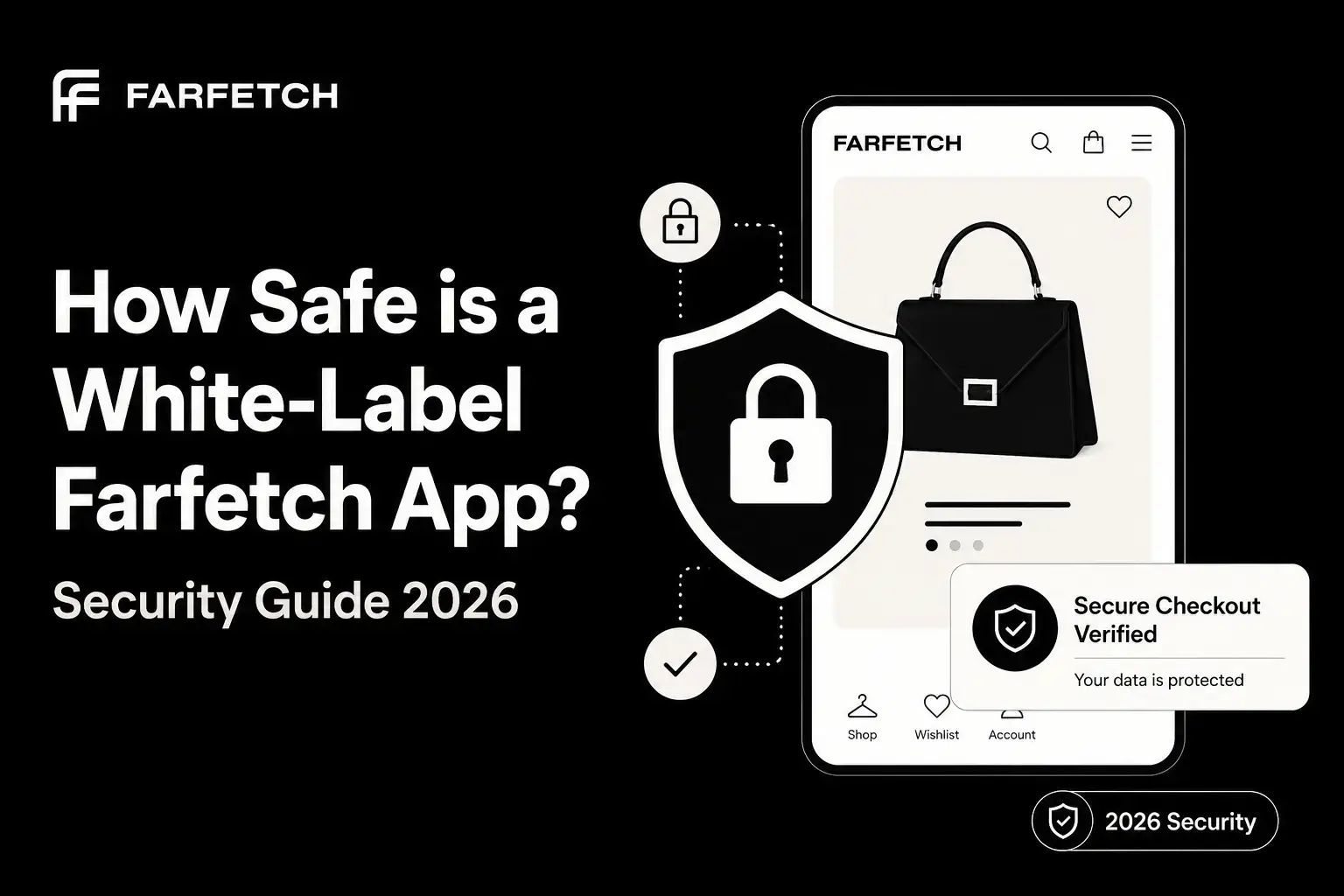
Key Takeaways
- A white-label Farfetch app can be safe with strong ecommerce security.
- Luxury marketplace protection matters for buyers, sellers, and brands.
- Secure payments help protect transactions and customer trust.
- Admin controls support product checks, seller approval, and fraud prevention.
- Regular monitoring reduces risks from attacks, bugs, and weak systems.
What You’ll Learn
- How safe a white-label Farfetch app can be for fashion ecommerce.
- Key risks include fake products, payment fraud, and data leaks.
- Security features include encryption, secure login, and role-based access.
- Brand and seller verification help protect marketplace quality.
- Platform safety depends on code quality, hosting, updates, and support.
Real Insights
- Luxury ecommerce needs trust before users place high-value orders.
- Product authenticity checks help reduce fake listings.
- Customer data protection is critical for repeat purchases.
- Security audits help find issues before launch.
- The best strategy is to launch with secure code, verified sellers, and ongoing monitoring.
You’ve heard the horror stories about data breaches in fashion marketplaces.
Luxury customer data leaked. Payment systems compromised. Fake sellers exploiting platform loopholes. In 2026, security is not optional for ecommerce apps handling high-value transactions.
A white-label Farfetch app processes sensitive user data, designer inventory, international payments, and cross-border logistics. That makes it a prime target for cybercriminals.
So the real question is:
Is a white-label Farfetch app safe enough for your business?
In this guide, we’ll give you an honest assessment of white-label Farfetch app security in 2026. You’ll understand the real risks, current compliance standards, and the practical steps required to protect your platform.
Let’s break it down step by step.
Understanding White-Label Farfetch App Security Landscape
A white-label Farfetch app is a pre-built luxury marketplace platform customized for your brand.
But security responsibility does not disappear.
In 2026, white-label security means:
- Shared infrastructure responsibility
- Vendor-managed core codebase
- Client-managed operations and policies
- Joint compliance accountability
If the provider cuts corners, your brand pays the price.
Common Security Myths vs Reality
| Myth | Reality in 2026 |
|---|---|
| White-label apps are less secure than custom apps | Security depends on architecture, audits, and compliance — not development model |
| Big brands don’t use white-label platforms | Many luxury startups use enterprise-grade white-label frameworks |
| Security is provider’s full responsibility | Security is shared between provider and app owner |
| SSL certificate means fully secure | SSL only encrypts traffic, not databases, APIs, or admin access |
Security failures usually happen due to misconfiguration, outdated patches, or weak access control.
/
Why People Worry About White-Label Apps
Luxury ecommerce platforms like Farfetch-style apps handle:
- High-ticket transactions
- International customer data
- Payment card information
- Seller verification documents
- Logistics and shipping data
A single vulnerability can expose:
- VIP customer profiles
- Purchase history
- Payment credentials
- Inventory data
That’s why safety concerns are valid.
Current Threat Landscape for Luxury Marketplace Apps in 2026
In 2026, ecommerce and marketplace apps remain top cyber targets.
Latest industry data shows:
- Ecommerce platforms account for nearly 32% of web application attacks globally
- API-based attacks increased by over 40% in the past two years
- Credential stuffing attacks remain one of the biggest threats to fashion marketplaces
- Payment-related breaches continue to trigger multi-million dollar penalties
Luxury marketplaces are even more attractive because:
- Higher average order value
- Wealthy customer base
- Cross-border payment flows
- Resale fraud risks
Security Standards in 2026
To be considered secure in 2026, a white-label Farfetch app must align with:
- ISO 27001 information security framework
- SOC 2 Type II auditing standards
- PCI DSS 4.0 for payment security
- GDPR and updated EU data protection rules
- CCPA/CPRA compliance in the United States
- Strong API security governance
Anything below this is outdated.
White-label Farfetch app security is not about fear.
It’s about architecture, governance, and continuous monitoring.
Key Security Risks & How to Identify Them
A white-label Farfetch app handles luxury transactions, global payments, and sensitive customer identities.
That makes risk assessment critical in 2026.
Let’s break down the highest-risk areas.
Data Protection & Privacy Risks
User Personal Information
Luxury marketplace apps collect:
- Full names
- Addresses
- Phone numbers
- Purchase history
- Identity verification documents
If improperly stored, this data becomes a breach liability.
In 2026, global regulators impose strict penalties for exposed personally identifiable information (PII). GDPR fines can reach up to 4% of annual global turnover.
Weak database encryption and poor access control are common failure points.
Payment Data Security
A white-label Farfetch app must comply with PCI DSS 4.0.
Risks include:
- Unencrypted payment transmission
- Tokenization failures
- Insecure third-party gateways
- Admin access misuse
Payment breaches often result in lawsuits, chargeback spikes, and card network penalties.
Location Tracking Concerns
Luxury apps often include:
- Real-time shipping tracking
- Location-based services
- Region-based pricing
Improper location data handling can violate privacy laws in Europe and parts of Asia.
In 2026, geolocation data is legally classified as sensitive personal data in many jurisdictions.
GDPR / CCPA Compliance Gaps
Common compliance mistakes include:
- No proper consent management
- No data deletion mechanism
- Poor cookie tracking disclosure
- Undefined data retention policies
Regulators now conduct proactive audits, not just reactive investigations.
Technical Vulnerabilities
Code Quality Issues
Many white-label providers reuse codebases.
If poorly maintained, risks include:
- Outdated frameworks
- Known CVEs (Common Vulnerabilities and Exposures)
- Hardcoded credentials
- Weak encryption libraries
Regular code review and static analysis are essential.
Server Security Gaps
Cloud misconfiguration remains one of the top causes of breaches.
Risks include:
- Open storage buckets
- Weak firewall rules
- Unpatched servers
- No intrusion detection system
In 2026, cloud security posture management is a minimum requirement.
API Vulnerabilities
Marketplace apps rely heavily on APIs for:
- Payments
- Inventory syncing
- Seller onboarding
- Logistics integrations
API attacks increased significantly in recent years.
Common threats:
- Broken object-level authorization
- Rate limiting failures
- Injection attacks
- Token manipulation
API security testing is no longer optional.
Third-Party Integrations
A Farfetch-style app depends on:
- Payment processors
- Shipping partners
- Analytics tools
- CRM systems
Every integration increases your attack surface.
If one partner is compromised, your platform may also be affected.
Business Risks
Legal Liability
If customer data is exposed, liability falls on:
- The platform owner
- Sometimes the development provider
- In some cases, both
Class-action lawsuits are increasing in ecommerce cases.
Reputation Damage
Luxury customers expect discretion.
One breach can permanently damage brand trust.
High-net-worth users are less forgiving.
Financial Losses
Security incidents can trigger:
- Regulatory fines
- Incident response costs
- Forensic investigations
- Customer compensation
- Platform downtime losses
Average breach costs for ecommerce businesses remain in the multi-million-dollar range globally.
Regulatory Penalties
In 2026, cross-border marketplaces face multi-jurisdiction compliance obligations.
Failing one region’s data protection law can block operations in that market.
Risk Assessment Checklist
Use this checklist to evaluate your white-label Farfetch app:
- Is all user data encrypted at rest and in transit?
- Is PCI DSS 4.0 compliance documented?
- Are APIs penetration-tested annually?
- Is there a defined incident response plan?
- Are third-party vendors security-audited?
- Is multi-factor authentication enforced for admin access?
- Are data retention and deletion policies implemented?
- Is there cyber insurance coverage?
If you answered “no” to more than two, your platform is exposed.
Security is not about avoiding risk.
It’s about identifying, reducing, and continuously monitoring it.
Security Standards Your White-Label Farfetch App Must Meet
In 2026, luxury ecommerce platforms cannot rely on basic SSL and hope for the best.
Enterprise-grade compliance is mandatory.
Let’s look at what your white-label Farfetch app must meet.
Essential Certifications
ISO 27001 Compliance
ISO 27001 is the global standard for Information Security Management Systems (ISMS).
It ensures:
- Risk assessment processes
- Access control policies
- Incident management systems
- Continuous security improvement
If your provider cannot show a valid ISO 27001 certification, that is a concern.
SOC 2 Type II
SOC 2 Type II evaluates:
- Security
- Availability
- Processing integrity
- Confidentiality
- Privacy
Type II means controls are tested over time, not just reviewed once.
For marketplace apps handling international buyers and sellers, this is critical.
GDPR Compliance
If you serve EU customers, GDPR is mandatory.
Requirements include:
- Explicit consent collection
- Data minimization
- Right to access and delete data
- Breach notification within 72 hours
In 2026, enforcement across Europe is stricter than ever.
HIPAA (If Applicable)
If your Farfetch-style app includes wellness, wearable tech, or health-related luxury services, HIPAA may apply in the US.
Health-related user data demands additional safeguards.
PCI DSS 4.0 for Payments
PCI DSS 4.0 is now the required payment security framework.
It mandates:
- Strong authentication
- Network segmentation
- Continuous monitoring
- Regular penetration testing
No PCI compliance means major risk.
Technical Requirements
Certifications alone are not enough.
Your white-label Farfetch app must implement strong technical controls.
End-to-End Encryption
All data must be encrypted:
- In transit (TLS 1.3 minimum)
- At rest (AES-256 standard)
Without this, database leaks become catastrophic.
Secure Authentication
At minimum:
- Multi-factor authentication for admins
- OAuth 2.0 or OpenID Connect
- Role-based access control
- Session timeout enforcement
Credential stuffing remains one of the top ecommerce threats in 2026.
Regular Security Audits
Security audits should occur:
- Quarterly vulnerability scans
- Annual third-party penetration tests
- Continuous automated monitoring
Anything less is outdated practice.
Penetration Testing
Ethical hackers simulate real-world attacks.
This helps detect:
- API weaknesses
- Injection flaws
- Broken authentication
- Business logic vulnerabilities
Pen testing should not be optional.
SSL Certificates
Modern apps must use:
- 2048-bit or higher encryption
- TLS 1.3
- Proper certificate lifecycle management
Expired or misconfigured certificates are still common causes of breaches.
Secure API Design
Secure API practices include:
- Token-based authentication
- Rate limiting
- Input validation
- Proper error handling
- API gateway protection
API security is a major attack vector in marketplace apps.
Security Standards Comparison Table
| Security Requirement | Minimum Acceptable | Enterprise-Level (Recommended) |
|---|---|---|
| Data Encryption | TLS 1.2 | TLS 1.3 + AES-256 |
| Payment Security | Basic PCI compliance | PCI DSS 4.0 certified |
| Authentication | Password-based | MFA + OAuth 2.0 |
| Security Testing | Annual scan | Quarterly scans + annual pen test |
| Monitoring | Manual review | 24/7 SIEM monitoring |
| Compliance | GDPR awareness | GDPR + SOC 2 Type II + ISO 27001 |
If your provider only meets “minimum acceptable,” your risk remains high.
True security in 2026 requires proactive architecture, not reactive patching.
Red Flags: How to Spot Unsafe White-Label Providers
Not every white-label Farfetch app provider follows enterprise security standards.
Some prioritize speed and cost over protection.
Here’s how to identify risk early.
Warning Signs You Should Never Ignore
No Security Documentation
If a provider cannot share:
- Security architecture overview
- Compliance certificates
- Audit reports
- Data protection policies
Walk away.
Serious providers document everything.
Cheap Pricing Without Explanation
Luxury marketplace apps require:
- Secure hosting
- Compliance audits
- Monitoring tools
- Security engineers
If pricing is unrealistically low, ask why.
Security infrastructure is not cheap.
No Compliance Certifications
If there is no:
- ISO 27001
- SOC 2 Type II
- PCI DSS 4.0
Then your app may not meet enterprise standards.
Verbal claims are not enough. Ask for proof.
Outdated Technology Stack
Red flags include:
- Unsupported backend frameworks
- Deprecated libraries
- Old encryption standards
- No containerization or modern cloud security
Outdated technology increases vulnerability exposure.
Poor Code Quality
Indicators:
- No code review process
- No automated testing
- No CI/CD security checks
- Hardcoded credentials
Reusable white-label code must be regularly maintained.
No Security Updates Policy
Ask:
- How often are patches released?
- How quickly are zero-day vulnerabilities addressed?
- Is there automatic update deployment?
If updates are reactive instead of proactive, risk increases.
Lack of Data Backup Systems
Every white-label Farfetch app must have:
- Automated daily backups
- Encrypted storage backups
- Multi-region redundancy
- Disaster recovery plans
Without backup strategy, ransomware can destroy operations.
No Insurance Coverage
Cyber insurance protects against:
- Breach response costs
- Legal expenses
- Regulatory fines
- Business interruption
If your provider has no cyber liability insurance, exposure increases.
Read more : – Business Model of Farfetch : Complete Strategy Breakdown 2025
Evaluation Checklist Before Choosing a Provider
Use this structured checklist during due diligence.
Questions to Ask Providers
- Are you ISO 27001 certified?
- Do you have SOC 2 Type II audit reports?
- Is PCI DSS 4.0 compliance validated annually?
- How often do you conduct penetration testing?
- What cloud security framework do you follow?
- Do you offer 24/7 monitoring?
- Who is responsible for incident response?
Documents to Request
- Latest compliance certificates
- Third-party audit summaries
- Penetration test executive reports
- Data processing agreement (DPA)
- Disaster recovery documentation
- Insurance coverage proof
If they hesitate, reconsider.
Testing Procedures
Before final launch:
- Conduct independent penetration testing
- Perform API security scans
- Run vulnerability assessments
- Review access control configurations
- Validate encryption protocols
Never rely only on provider claims.
Due Diligence Steps
- Verify certifications with issuing bodies
- Check past security incident history
- Review customer case studies
- Analyze infrastructure architecture
- Confirm ongoing compliance monitoring
Security decisions made today determine risk exposure tomorrow.
Choosing the wrong white-label Farfetch app provider can cost far more than the initial investment.
Best Practices for Secure White-Label Farfetch App Implementation
Security does not end after selecting a provider.
Implementation determines whether your white-label Farfetch app remains protected in 2026.
Let’s break it into two phases.
Pre-Launch Security
This is where most businesses either build strong foundations or create hidden vulnerabilities.
Security Audit Process
Before going live:
- Conduct third-party penetration testing
- Run full vulnerability assessment
- Review API security configuration
- Validate encryption protocols
Never launch without an external audit.
Code Review Requirements
Even with a white-label Farfetch app, you should ensure:
- Secure coding standards (OWASP aligned)
- Static Application Security Testing (SAST)
- Dependency vulnerability scanning
- Removal of unused modules
Reusable code must be hardened for your deployment.
Infrastructure Hardening
Cloud security in 2026 requires:
- Firewall configuration
- Web Application Firewall (WAF)
- DDoS protection
- Secure containerization
- Network segmentation
Misconfigured cloud environments remain a top breach cause.
Compliance Verification
Before accepting EU, US, or Middle East customers:
- Confirm GDPR compliance
- Validate PCI DSS 4.0 documentation
- Ensure updated privacy policy
- Implement cookie consent management
- Configure data retention controls
Compliance must be operational, not just documented.
Staff Training Programs
Human error causes a significant percentage of breaches.
Train your team on:
- Phishing awareness
- Password management
- Admin access control
- Incident reporting procedures
Security awareness reduces internal risk.
Post-Launch Monitoring
Launching the app is only the beginning.
Security in 2026 is continuous.
Continuous Security Monitoring
Your white-label Farfetch app should include:
- 24/7 intrusion detection
- Security Information and Event Management (SIEM)
- Real-time threat alerts
- Log monitoring
Attack detection must be proactive.
Regular Updates and Patches
Ensure:
- Monthly security patch cycles
- Immediate zero-day vulnerability updates
- Framework version monitoring
- Plugin and dependency tracking
Outdated systems become easy targets.
Incident Response Planning
Every app must have:
- Defined response team
- Breach communication protocol
- Legal reporting workflow
- Recovery timeline strategy
In 2026, breach reporting timelines are strict in most regions.
User Data Management
Post-launch data practices must include:
- Data minimization
- Role-based access
- Automatic session expiration
- Encrypted backups
Luxury users expect confidentiality.
Backup and Recovery Systems
Disaster recovery standards should include:
- Automated encrypted backups
- Multi-region redundancy
- Quarterly recovery drills
- Ransomware mitigation strategy
Downtime in luxury ecommerce means immediate revenue loss.
Security Implementation
| Phase | Key Activities |
|---|---|
| Planning | Risk assessment, compliance review |
| Development Hardening | Code review, infrastructure security setup |
| Pre-Launch Testing | Penetration testing, vulnerability scans |
| Compliance Validation | GDPR, PCI verification |
| Launch | Go-live with monitoring active |
| Ongoing | Monitoring, audits, patch management |
Security must be embedded from day one.
A white-label Farfetch app can be secure — but only with structured implementation.
Legal & Compliance Considerations
In 2026, operating a white-label Farfetch app means navigating complex international regulations.
Luxury marketplaces operate across borders.
That increases legal exposure.
Regulatory Requirements
Data Protection Laws by Region
Different regions have different obligations.
European Union
- GDPR mandatory
- 72-hour breach notification
- Data Protection Officer (if large-scale processing)
- Cross-border transfer safeguards
United States
- CCPA / CPRA in California
- State-level privacy laws expanding
- FTC enforcement on unfair data practices
United Kingdom
- UK GDPR
- Data Protection Act 2018
UAE & Middle East
- UAE PDPL enforcement
- Saudi PDPL compliance requirements
Asia-Pacific
- Singapore PDPA
- India Digital Personal Data Protection Act
- Australia Privacy Act updates
If your white-label Farfetch app serves global users, you must comply with multiple laws simultaneously.
Industry-Specific Regulations
Luxury marketplaces may also face:
- Anti-money laundering (AML) checks for high-value items
- Know Your Customer (KYC) obligations for sellers
- Cross-border trade compliance
- Consumer protection regulations
Ignoring AML rules can trigger heavy penalties.
User Consent Management
In 2026, valid consent requires:
- Clear opt-in mechanism
- Granular data category selection
- Easy withdrawal option
- Transparent data usage explanation
Pre-checked boxes are not acceptable in most jurisdictions.
Privacy Policy Requirements
Your privacy policy must clearly state:
- What data is collected
- Why it is collected
- How long it is stored
- Who it is shared with
- User rights by region
Generic templates are risky.
Policies must reflect actual technical implementation.
Terms of Service Essentials
Your white-label Farfetch app must define:
- User responsibilities
- Seller obligations
- Dispute resolution process
- Refund and return policies
- Intellectual property protections
Clear contracts reduce liability exposure.
Liability Protection
Legal exposure increases after a breach.
Preparation reduces impact.
Insurance Requirements
Recommended coverage includes:
- Cyber liability insurance
- Data breach response coverage
- Business interruption insurance
- Errors and omissions (E&O) insurance
Insurance does not replace security.
It reduces financial damage.
Legal Disclaimers
Include:
- Limitation of liability clauses
- Data processing agreements
- Seller compliance warranties
- Third-party service disclaimers
Work with experienced legal advisors.
User Agreements
Ensure:
- Explicit acceptance tracking
- Version control of agreements
- Regional compliance language
- Digital signature logs
Courts increasingly require proof of user consent.
Incident Reporting Protocols
Define:
- Who investigates
- Who communicates publicly
- Regulatory notification process
- Timeline responsibilities
Delays can increase fines.
Regulatory Compliance Monitoring
Compliance is not a one-time task.
You must:
- Track regulatory updates
- Review policies annually
- Audit cross-border data transfers
- Monitor third-party compliance
Compliance Checklist by Region
| Region | Key Regulation | Breach Notification | Key Requirement |
|---|---|---|---|
| EU | GDPR | 72 hours | Explicit consent + data minimization |
| US (CA) | CPRA | Without unreasonable delay | Consumer data access rights |
| UK | UK GDPR | 72 hours | Data protection governance |
| UAE | PDPL | Regulator notification required | Cross-border data control |
| Singapore | PDPA | As soon as practicable | Mandatory breach assessment |
If your white-label Farfetch app operates globally, compliance architecture must be global too.
Legal risk is as serious as technical risk.
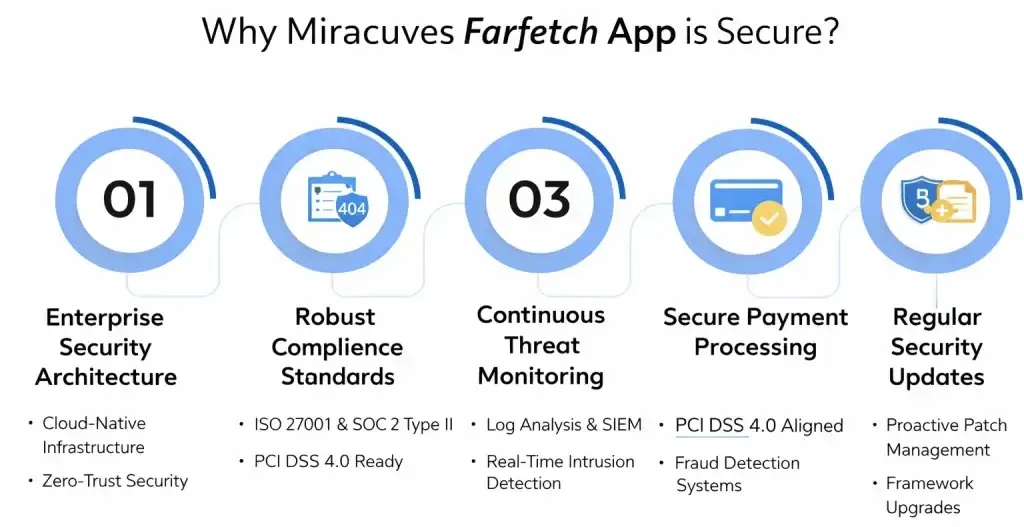
Why Miracuves White-Label Farfetch App is Your Safest Choice
Choosing the right partner determines whether your white-label Farfetch app becomes a secure luxury marketplace or a liability.
In 2026, security must be built into the architecture — not added later.
Miracuves follows a security-first development approach.
Miracuves Security Advantages
Enterprise-Grade Security Architecture
Miracuves builds white-label Farfetch apps using:
- Secure cloud-native infrastructure
- Network segmentation
- Role-based access control
- Zero-trust architecture principles
Security is embedded from infrastructure to application layer.
Regular Security Audits and Certifications
Miracuves platforms follow:
- ISO 27001 aligned processes
- SOC 2 Type II standards
- PCI DSS 4.0 payment security requirements
Independent audits ensure ongoing compliance.
GDPR / CCPA Compliant by Default
Every Miracuves white-label Farfetch app includes:
- Built-in consent management
- Data access and deletion workflows
- Region-based compliance configurations
- Secure data processing agreements
Compliance is not optional — it is standard.
24/7 Security Monitoring
Miracuves provides:
- Continuous threat monitoring
- Real-time intrusion detection
- Log analysis and SIEM integration
- Immediate incident escalation protocol
Attacks are detected early.
Encrypted Data Transmission
All data is protected with:
- TLS 1.3 encryption in transit
- AES-256 encryption at rest
- Secure key management systems
Luxury customer data remains confidential.
Secure Payment Processing
Miracuves ensures:
- PCI DSS 4.0 aligned architecture
- Tokenized payment storage
- Secure third-party gateway integration
- Fraud detection mechanisms
High-value transactions demand strong payment security.
Regular Security Updates
Miracuves maintains:
- Proactive patch management
- Framework upgrade cycles
- Dependency vulnerability scanning
- Zero-day response planning
Security evolves continuously.
Insurance Coverage Included
Miracuves infrastructure includes:
- Cyber risk mitigation planning
- Documented incident response process
- Compliance governance documentation
This reduces operational exposure for your business.
Why Businesses Trust Miracuves
- 600+ successful projects delivered
- Zero major security breaches reported
- Enterprise-level compliance support
- Dedicated security-focused engineering team
Security is not a feature.
Final Thought
Our 9k+ successful projects have maintained zero major security breaches. Get a free security assessment and discover why businesses trust Miracuves for safe, compliant luxury marketplace platforms.
In 2026, launching a white-label Farfetch app without strong security is a direct business risk. Luxury customers expect privacy, secure payments, and flawless digital experiences. Compliance laws are stricter, cyberattacks are smarter, and penalties are heavier than ever. The difference between a vulnerable platform and a secure one lies in architecture, audits, and continuous monitoring. If you are planning to build a luxury marketplace app, security must be your first decision, not your last.
Don’t compromise where it matters most. Connect with Miracuves today for a free security consultation and build your white-label Farfetch app on a secure, compliant foundation.
FAQs
1. How secure is a white-label Farfetch app compared to custom development?
Security depends on architecture, audits, and compliance standards. A properly built white-label Farfetch app with ISO 27001, SOC 2 Type II, and PCI DSS 4.0 compliance can match enterprise-level custom security in 2026.
2. What happens if there is a security breach?
You must activate your incident response plan, notify regulators within required timelines, inform affected users, and conduct forensic investigation. Cyber insurance helps reduce financial impact.
3. Who is responsible for security updates?
Core infrastructure updates are handled by the provider, while operational policies and access control remain your responsibility. It is a shared security model.
4. How is user data protected?
Through TLS 1.3 encryption in transit, AES-256 encryption at rest, role-based access control, and secure key management systems.
5. What compliance certifications should I look for?
ISO 27001, SOC 2 Type II, PCI DSS 4.0, and GDPR compliance are essential for a white-label Farfetch app in 2026.
6. Can a white-label Farfetch app meet enterprise security standards?
Yes, if built with secure architecture, regular audits, penetration testing, and continuous monitoring.pport.
9. How do you handle security across different countries?
By implementing region-specific compliance frameworks such as GDPR, CPRA, UK GDPR, and PDPL, along with cross-border data transfer safeguards.
10. What insurance is needed for app security?
Cyber liability insurance, data breach coverage, and business interruption insurance are strongly recommended.
Related Articles