


Key Takeaways
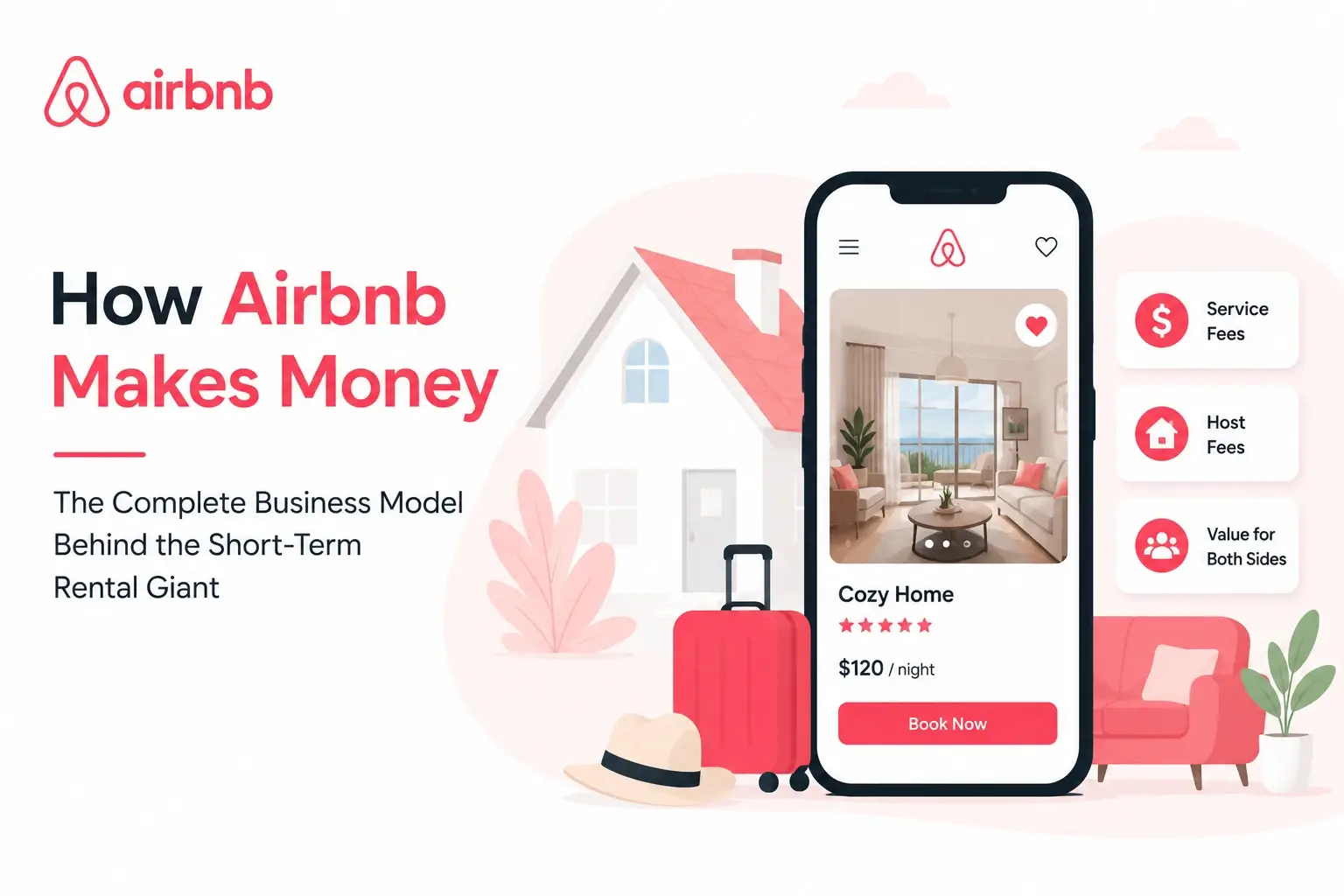
- Airbnb makes money through marketplace fees charged on guest bookings and host payouts.
- The platform does not own properties; it connects hosts and guests through a trusted rental marketplace.
- Trust features matter through reviews, profiles, secure payments, and support systems.
- Marketplace liquidity drives growth when more hosts attract more guests and more bookings.
- The model depends on supply, demand, booking volume, pricing, trust, and platform experience.
What You’ll Learn
- How Airbnb makes money from short-term rental bookings.
- Guest and host fees create revenue from every completed reservation.
- Search, booking, payments, and reviews make the marketplace work smoothly.
- Host supply and guest demand create the flywheel behind Airbnb’s growth.
- Growth depends on trust, inventory, user experience, pricing, and repeat bookings.
Real Insights
- Airbnb’s biggest strength is building trust between strangers at scale.
- More listings improve choice, which can increase bookings and attract more hosts.
- Secure payments reduce friction for both guests and property owners.
- Reviews improve confidence before users book or accept stays.
- The best insight is that Airbnb earns by turning property access into a scalable marketplace business.
Airbnb is one of the clearest examples of how a marketplace business can scale without owning the inventory it sells. The company does not need to buy hotels, build apartments, or manage every property directly. Instead, Airbnb connects people who have spaces to rent with people who need short-term or flexible accommodation.
That is the core of the Airbnb business model.
Airbnb’s real strength is not just that it lists homes. Its strength is that it controls the digital layer of the transaction. Guests search, compare, book, pay, message hosts, and leave reviews through Airbnb. Hosts list properties, manage calendars, accept bookings, receive payouts, and build reputation through the same platform.
This model creates value for all sides. Guests get more stay options. Hosts get a way to earn from unused or underused spaces. Airbnb earns revenue from the service fees attached to successful transactions.
For founders, Airbnb is not only a travel success story. It is a practical blueprint for building a rental marketplace. The same marketplace logic can be used for vacation homes, villas, apartments, co-living spaces, boats, event spaces, farm stays, corporate housing, or niche travel experiences.
This is why many startups study Airbnb’s model before investing in an Airbnb clone app. The goal is not to copy Airbnb’s brand. The goal is to understand how a proven rental marketplace works and then customize that structure for a specific market, region, or audience.
Why Airbnb’s Asset-Light Marketplace Model Became So Powerful
Airbnb works because it separates ownership from access. Traditional hospitality businesses usually need to own, lease, or operate physical rooms. Airbnb does not need to own most of the properties listed on its platform. Hosts bring the inventory, and Airbnb provides the marketplace infrastructure.
This asset-light structure gives Airbnb a major scaling advantage. The company can expand supply by onboarding more hosts instead of buying more real estate. A new city, destination, or travel category can grow when enough hosts list properties and enough guests begin booking.
The model becomes powerful because Airbnb focuses on the parts of the transaction that create trust and convenience:
- Property discovery
- Listing presentation
- Booking flow
- Guest-host communication
- Online payments
- Reviews and ratings
- Cancellation policies
- Customer support
- Trust and safety workflows
However, asset-light does not mean simple. Airbnb may not own every property, but it still owns the user experience. If a listing is misleading, a payment fails, a host does not respond, or a guest has a poor stay, the platform’s trust is affected.
That distinction matters for founders. A rental marketplace is not just a property listing website. It is a transaction system where strangers need to trust each other.
A founder building an Airbnb clone solution should think the same way. The product should not only show listings. It should help users search confidently, book safely, pay securely, communicate clearly, and resolve issues when something goes wrong.
Read more: What is Airbnb App and How Does It Work?
Airbnb Business Model Canvas: How the Platform Creates Value for Hosts, Guests, and Itself
The Airbnb business model canvas explains how the company creates, delivers, and captures value across the marketplace. It is useful because Airbnb’s success does not come from one revenue stream alone. It comes from the alignment of users, supply, demand, technology, trust, and monetization.
| Business Model Element | How Airbnb Uses It | What Founders Should Learn |
|---|---|---|
| Customer Segments | Guests, hosts, property managers, experience providers, and service providers | A marketplace must clearly define every user group it serves. |
| Value Proposition | Flexible stays, unique properties, local experiences, and income opportunities for hosts | The platform must solve a real problem for both supply and demand. |
| Channels | Website, mobile apps, search engines, referrals, app stores, and brand campaigns | Growth depends on how easily both hosts and guests discover the platform. |
| Customer Relationships | Reviews, messaging, support, cancellation policies, host profiles, and guest trust signals | Trust keeps users transacting inside the platform instead of moving outside it. |
| Revenue Streams | Host fees, guest fees, host-only fees, experiences, services, and premium offerings | Marketplace revenue can come from multiple transaction layers. |
| Key Resources | Platform technology, brand, listings, host network, data, payment systems, and trust infrastructure | The strongest marketplace asset is liquidity, not only software. |
| Key Activities | Host acquisition, guest acquisition, payment processing, support, product development, and safety operations | Technology and operations must work together for the marketplace to scale. |
| Key Partners | Hosts, payment gateways, property managers, local service providers, and regulatory bodies | Partnerships help improve supply, compliance, and service coverage. |
| Cost Structure | Product development, cloud infrastructure, customer support, marketing, legal operations, and trust systems | Asset-light businesses still need serious operational investment. |
The most important lesson from Airbnb’s business model canvas is that the platform does not simply sell accommodation. It coordinates a marketplace. Every part of the business supports the transaction between host and guest.
For founders, this means the product must be designed around the full transaction journey. A rental marketplace needs listing tools, search filters, booking logic, payment workflows, reviews, cancellation rules, host payouts, and admin control.
Without these layers, the marketplace may look complete on the front end but fail during real operations.
How Airbnb’s Marketplace Flywheel Turns More Hosts Into More Bookings
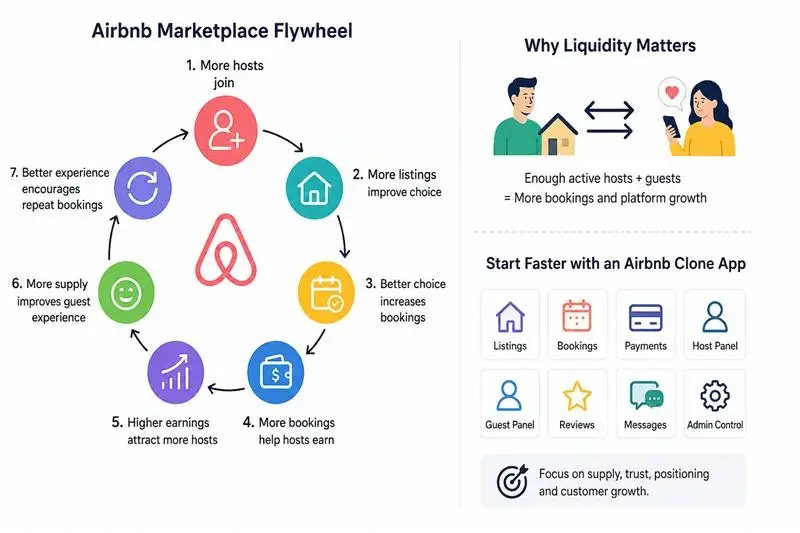
Airbnb’s growth is powered by a marketplace flywheel, where each side of the platform strengthens the other. More hosts create more listings, more listings give guests better choices, more guest activity creates more bookings, and more bookings encourage more hosts to join.
This is why Airbnb’s model became powerful. The platform becomes more useful as supply and demand grow together.
How the Airbnb Flywheel Works
The Airbnb flywheel follows a simple growth cycle:
- More hosts join the platform.
- More listings improve guest choice.
- Better choice increases booking conversion.
- More bookings help hosts earn.
- Higher host earnings attract more hosts.
- More supply improves the guest experience.
- Better guest experience encourages repeat bookings.
This cycle becomes stronger when users trust the platform enough to keep booking and listing.
Why Marketplace Liquidity Matters
The flywheel works only when the marketplace has liquidity. Liquidity means there are enough active hosts and guests for bookings to happen regularly.
Without liquidity, guests may not find suitable stays, and hosts may stop using the platform because they do not receive bookings. This is why new rental marketplaces should not try to launch everywhere at once.
A focused launch is usually stronger. For example, founders can begin with:
- Luxury villas in one region
- Student rentals in one city
- Farm stays for weekend travelers
- Pet-friendly vacation homes
- Corporate short-term rentals
- Boat rentals
How an Airbnb Clone App Helps Founders Start Faster
A ready-made Airbnb clone app can help founders begin with the core marketplace workflows already in place, such as listings, bookings, payments, host panels, guest panels, reviews, and admin control.
This allows founders to focus more on supply acquisition, trust-building, local positioning, and customer growth instead of building every module from zero.
Airbnb Revenue Model: How Airbnb Makes Money From Every Successful Booking
Airbnb makes money primarily through service fees charged when bookings happen through the platform. The company earns from the transaction layer rather than from property ownership.
When a guest books a stay, Airbnb processes the transaction, manages the booking flow, collects payment, supports communication, and enables reviews. In exchange, Airbnb charges service fees to hosts, guests, or in some cases through a host-only fee structure.
The strength of this revenue model is that Airbnb earns when the marketplace works. More bookings mean more revenue. Better supply increases booking potential. Stronger trust increases conversion. Better user experience improves repeat usage.
Airbnb’s revenue model includes several layers:
| Revenue Stream | How It Works | Why It Matters |
|---|---|---|
| Host fees | Airbnb deducts a fee from the host payout after a confirmed booking | Helps monetize supply-side transactions |
| Guest fees | Guests may pay a service fee during checkout | Helps monetize demand-side activity |
| Host-only fees | Some professional hosts pay the entire service fee | Makes pricing simpler for some guest-facing experiences |
| Experiences | Airbnb earns from local experiences and activities | Expands revenue beyond accommodation |
| Services | Airbnb can monetize trip-related services around the stay | Increases value per user journey |
| Premium offerings | Curated stays, premium visibility, and advanced host tools can create additional revenue | Gives the platform room to expand monetization |
For founders, the important lesson is that marketplace revenue should be flexible. An airbnb clone app should not lock the business into only one commission model. The platform should allow the operator to test host fees, guest fees, host-only fees, subscriptions, featured listings, cancellation fees, and service add-ons.
How Host Fees Help Airbnb Monetize the Supply Side
Host fees allow Airbnb to earn from the supply side of the marketplace. When a host receives a booking, Airbnb deducts a service fee from the payout.
This fee is accepted because Airbnb gives hosts access to demand they may not generate independently. A host can list a property, receive booking requests, manage availability, communicate with guests, and receive payments through one platform.
The host benefits from:
- Guest visibility
- Listing tools
- Booking management
- Calendar control
- Payment collection
- Guest messaging
- Reviews and ratings
- Platform trust
For founders, this is a practical reminder that hosts will only accept platform fees when the marketplace creates real value. A rental marketplace must help hosts earn, reduce manual effort, manage bookings, and build credibility.
A weak marketplace cannot simply charge commission because it has an app. It must justify that commission through bookings, tools, automation, and trust.
How Guest Fees Monetize Demand Without Damaging Trust
Guest fees allow Airbnb to earn from the demand side of the marketplace. These fees are usually shown during checkout and become part of the total booking amount.
This part of the model must be handled carefully. Guests are sensitive to price changes at checkout. If the final price looks much higher than the listing price, users may abandon the booking.
A strong rental marketplace should make pricing transparent. Guests should clearly understand:
- Nightly rate
- Cleaning fee where applicable
- Service fee
- Taxes where applicable
- Discounts
- Coupon reductions
- Cancellation policy
- Refund rules
- Final payable amount
For founders building an airbnb clone, pricing clarity is not only a design issue. It directly affects conversion and trust.
The admin dashboard should also allow the platform owner to manage guest fees, host commissions, taxes, refunds, coupons, and cancellation deductions. Without this flexibility, the business becomes harder to operate after launch.
How Experiences Help Airbnb Expand Beyond Stays
Airbnb Experiences allow users to book local activities, tours, workshops, and events. This turns Airbnb from a stay-booking platform into a broader travel marketplace.
Experiences matter because they increase the value of each customer relationship. A guest may come to Airbnb to book accommodation but later use the platform to book activities during the same trip.
Examples of experience-based revenue include:
- City tours
- Food experiences
- Cultural workshops
- Wellness sessions
- Outdoor adventures
- Local events
- Guided activities
For founders, the lesson is important. A rental marketplace does not have to stop at property bookings. Once users trust the platform, the business can add related services such as airport pickup, local guides, cleaning services, chef bookings, equipment rentals, event planning, or concierge support.
A flexible airbnb clone script should allow future service expansion instead of limiting the marketplace only to property listings.
Why Host-Only Fees Work Better for Professional Hosts and Property Managers
The host-only fee model places the full service fee on the host side. This structure is often useful for professional hosts, hotels, or property managers who use connected software and prefer cleaner guest-facing pricing.
For smaller hosts, a split-fee model may feel easier. For professional operators, host-only fees can fit better with structured pricing and external property management workflows.
This matters for founders because different host segments need different monetization rules. A homeowner with one spare room does not operate like a property manager with 200 units.
A professional host may need:
- Bulk listing tools
- Team access
- Payout reporting
- Calendar sync
- Advanced pricing rules
- Host-only commission settings
- Tax settings
- Property management integration
A strong airbnb clone app should support this difference through flexible commission settings and scalable host tools.
How Premium and Future Revenue Streams Can Make the Marketplace More Valuable
Airbnb’s long-term revenue opportunity is not limited to accommodation. Once a platform owns the travel relationship, it can expand into related transactions.
Premium and future revenue streams may include:
- Curated luxury stays
- Boutique hotel listings
- Promoted listings
- Premium host tools
- Airport transfers
- Luggage storage
- Grocery delivery partnerships
- Travel insurance
- Local transportation
- AI-powered trip planning
- Business travel
- Long-term stays
For founders, this shows why marketplace architecture matters. A founder may begin with vacation rentals but later want to add experiences, services, featured listings, subscriptions, or local partnerships.
The platform should be built with expansion in mind. A rigid product may work for the first launch but become expensive to modify later.
This is one reason startups choose a customizable Airbnb clone solution instead of a narrow listing script. The stronger foundation is one that supports bookings today and business model expansion tomorrow.
How Airbnb Attracts Hosts and Guests by Balancing Supply, Demand, and Trust
Airbnb grows because it gives both hosts and guests a clear reason to use the platform. Guests come for choice, convenience, pricing transparency, reviews, and a smoother booking experience. Hosts join because Airbnb gives them earning potential, listing tools, payment handling, and access to travelers they may not reach on their own.
The model works only when both sides stay active. A marketplace with many guests but poor listings will not convert. A marketplace with many listings but no bookings will lose hosts. Airbnb’s growth depends on balancing supply, demand, and trust at the same time.
How Airbnb Attracts Guests With Choice and Booking Confidence
Guests use Airbnb because it gives them more options than a traditional hotel search. They can compare apartments, villas, private rooms, cabins, farm stays, and unique properties in one place.
Airbnb improves guest confidence through:
- Search filters by location, price, dates, amenities, and property type
- Property photos and detailed listing descriptions
- Reviews and ratings from previous guests
- Clear pricing and booking details
- Host communication before and after booking
- Cancellation policies
- Secure online payments
These features reduce uncertainty. A guest is more likely to book when they can understand the property, compare options, check reviews, and feel protected during payment.
How Airbnb Attracts Hosts With Income Potential and Easy Management
Hosts join Airbnb because the platform helps them turn unused or underused spaces into income. Instead of building their own website, running ads, collecting payments manually, and managing every booking separately, hosts can use Airbnb’s existing marketplace.
Airbnb supports hosts with:
- Listing creation tools
- Availability calendar
- Pricing controls
- Guest messaging
- Booking management
- Payout handling
- Reviews and reputation building
- Platform support
For hosts, the main value is access to demand. Airbnb gives them visibility in front of travelers who are already searching for stays. That makes the platform attractive even after service fees are deducted.
Why Trust Connects Both Sides of the Marketplace
Trust is the layer that keeps hosts and guests transacting inside Airbnb. Guests need to trust that listings are real, hosts are responsive, payments are secure, and reviews are reliable. Hosts need to trust that guests are genuine, payments will be processed, and the platform can help if problems happen.
Airbnb builds this trust through reviews, ratings, booking history, cancellation rules, secure payment flows, messaging, and support workflows. These systems reduce the fear of booking with strangers or hosting unknown guests.
For founders building an Airbnb clone app, this is a key lesson. The app should not only connect users. It should create enough trust for users to complete transactions.
What Founders Should Learn About Early Marketplace Growth
For a new rental marketplace, host acquisition is often the hardest early challenge. Guests will not book if the platform lacks quality supply. Hosts will not stay active if they do not receive bookings.
That is why a focused niche is usually stronger than a broad launch. It is easier to onboard villa owners in one region than to convince every type of property owner in every city.
A founder can begin with a focused category such as:
- Luxury villas in one destination
- Student housing in one city
- Pet-friendly vacation rentals
- Corporate short-term stays
- Farm stays or weekend retreats
- Boat rentals or event spaces
This focused approach helps the marketplace build supply, attract the right guests, create trust, and prove demand before expanding into broader rental categories.
What It Really Costs to Run an Airbnb-Style Marketplace After Launch
Airbnb’s model is asset-light, but it is not cost-free. The company does not need to buy every property, but it still needs to operate a complex digital marketplace.
The major cost areas include:
| Cost Area | Why It Matters |
|---|---|
| Technology development | Supports web, mobile, backend, search, payments, messaging, reviews, and booking systems |
| Cloud infrastructure | Keeps the platform fast, secure, and available at scale |
| Customer support | Helps guests and hosts with cancellations, refunds, disputes, and account issues |
| Trust and safety | Protects the marketplace from fraud, fake listings, abuse, and unsafe behavior |
| Payment processing | Handles transactions, payouts, refunds, and multi-currency flows |
| Marketing | Drives guest demand and host acquisition |
| Legal operations | Supports local rules, taxes, rental policies, and compliance workflows |
| Product localization | Supports different languages, currencies, taxes, and regional expectations |
For founders, this is one of the most overlooked parts of the Airbnb business model. Many people think the main cost is app development. In reality, marketplace costs continue after launch.
A rental marketplace needs ongoing investment in:
- Host onboarding
- Guest acquisition
- Listing moderation
- Payment monitoring
- Refund handling
- Review management
- Fraud prevention
- Dispute resolution
- Platform updates
- Marketing campaigns
This is why the admin panel is so important.
A founder needs backend control to manage users, hosts, listings, bookings, commissions, payments, refunds, reviews, disputes, categories, locations, promotions, and reports. Without admin control, daily operations become slow and developer-dependent.
Miracuves helps founders build source-code-owned rental marketplace platforms with admin dashboards, branded design, and customisation support, so the business owner has more control after launch.
Technology Behind Airbnb’s Marketplace Model: The Systems That Make Bookings Work
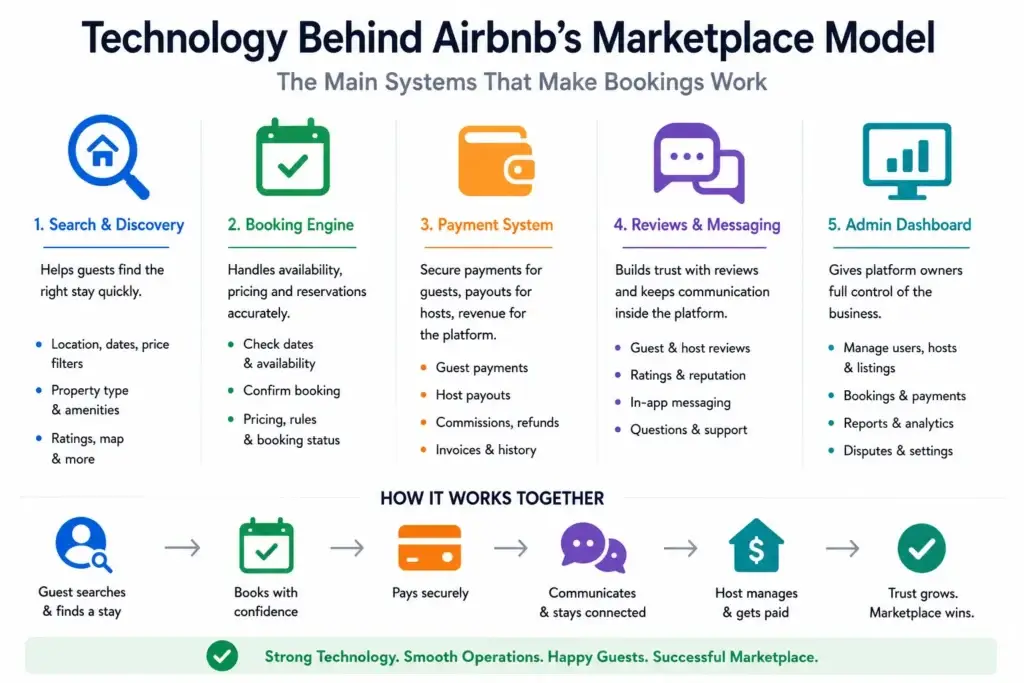
Airbnb’s marketplace works because the technology behind it makes complex rental transactions feel simple. A guest can search, compare, book, pay, message a host, and leave a review in one flow. A host can list a property, manage availability, accept bookings, receive payouts, and track guest communication from the same platform.
For founders, this is an important lesson. A rental marketplace is not only a website or mobile app. It is an operating system for bookings, payments, trust, and marketplace control.
Search and Discovery Help Guests Find the Right Stay
Search is one of the most important systems in Airbnb’s marketplace model. Guests need to find relevant stays quickly based on their travel needs.
A strong rental marketplace search system should support:
- Location-based search
- Date and availability filters
- Price range filters
- Guest count
- Property type
- Amenities
- Ratings and reviews
- Map-based discovery
- Instant booking filters
If search is weak, users may leave even when good listings exist. The platform must help guests move from browsing to confident decision-making.
Booking Engine Keeps Availability, Pricing, and Reservations Accurate
The booking engine is the core transaction system. It manages date selection, availability, booking confirmation, pricing, service fees, taxes, cancellation rules, refunds, and booking status.
This system matters because booking errors can damage trust quickly. Double bookings, wrong prices, unclear cancellation rules, or delayed confirmations can create disputes between hosts and guests.
A strong booking engine should make every reservation clear for the guest, the host, and the admin.
Payment System Builds Trust Between Guests, Hosts, and the Platform
Payments are one of the most sensitive parts of any rental marketplace. Guests need secure checkout. Hosts need reliable payouts. The platform owner needs clear commission tracking.
A marketplace payment system should manage:
- Guest payments
- Host payouts
- Admin commissions
- Refunds
- Cancellation deductions
- Tax and fee calculation
- Invoices
- Transaction history
- Secure payment gateway integration
Transparent payment flows reduce confusion and help the platform handle disputes more effectively.
Reviews, Ratings, and Messaging Strengthen Marketplace Trust
Reviews and ratings help guests evaluate hosts and properties before booking. They also help hosts understand guest behavior and build reputation over time.
Messaging keeps communication inside the platform. Guests can ask questions, hosts can share instructions, and the platform can review communication if disputes happen later.
Together, reviews and messaging make the marketplace safer and more reliable.
Admin Dashboard Gives the Platform Owner Business Control
The admin dashboard is where the platform operator manages the business. Without a strong admin panel, even a well-designed marketplace becomes difficult to run after launch.
The admin dashboard should control:
- Users
- Hosts
- Listings
- Bookings
- Commissions
- Payments
- Reviews
- Disputes
- Locations
- Categories
- Reports
- Verification workflows
A founder planning to launch an Airbnb-like rental app should treat technology as the business control layer, not just the visible app interface. The stronger the backend systems, the easier it becomes to manage growth, trust, revenue, and marketplace operations.
Why Airbnb Succeeded While Many Other Rental Platforms Struggled
Airbnb succeeded because it solved trust, liquidity, and usability together. Many rental platforms fail because they focus too heavily on listings and not enough on the complete marketplace experience.
Listings alone do not create a business. A marketplace needs enough quality supply, enough guest demand, reliable payments, user confidence, strong search, good support, and fair dispute handling.
Airbnb built a system where hosts had a reason to list and guests had a reason to book. Reviews helped reduce uncertainty. Payments stayed inside the platform. Messaging supported pre-booking questions. Search helped users find relevant options. Brand trust improved conversion.
Other rental platforms often struggled because one part of the marketplace was weak:
- Some had inventory but not enough demand.
- Some had traffic but low trust.
- Some had good technology but weak operations.
- Some had pricing issues that reduced conversion.
- Some failed to create enough network effects.
The founder lesson is clear. An airbnb clone app should not simply copy visible screens. It must recreate the business logic behind the marketplace.
That means the platform must support supply growth, demand generation, trust-building, payment safety, booking reliability, and admin control.
The strongest rental marketplace is not always the one with the most features. It is the one that gives users the most confidence at the moment of booking.
Challenges in Airbnb’s Business Model That Startups Must Plan For
Airbnb’s marketplace model is powerful, but it also comes with serious challenges. Founders should understand these challenges before launching a similar platform.
Regulation is one of the biggest issues. Short-term rental rules vary by city, region, and country. Some areas require host registration, tax collection, rental-day limits, permits, or zoning compliance. A marketplace that ignores local rules can face operational problems later.
Trust and safety are also major challenges. Rental platforms deal with real homes, real guests, real payments, and real risks.
Common risks include:
- Fake listings
- Misleading photos
- Property damage
- Guest misconduct
- Host fraud
- Payment disputes
- Review manipulation
- Unsafe stays
Quality control is another challenge. Airbnb does not own most listings, so guest experience depends heavily on host behavior. A bad stay can affect the platform’s reputation even if the property is owned by an independent host.
Platform leakage can also reduce revenue. Hosts and guests may try to move transactions outside the app to avoid fees. This weakens payment safety, reduces revenue, and makes dispute handling harder.
Market saturation is another issue. Airbnb, Vrbo, Booking.com, Expedia, and local platforms already compete in many destinations. New founders need a sharper positioning strategy.
A startup can compete by focusing on:
- Verified listings
- Niche categories
- Better local support
- Curated inventory
- Lower booking friction
- Specialized rental types
- Stronger host onboarding
- Better dispute handling
Read more: Best Airbnb Clone Script in 2026: Features & Pricing Compared
Airbnb vs Vrbo vs Booking.com: What Founders Can Learn From Different Travel Marketplace Models
Airbnb, Vrbo, and Booking.com all operate in travel and accommodation, but their models are not identical.
| Platform | Core Model | Main Strength | Founder Lesson |
|---|---|---|---|
| Airbnb | Peer-to-peer and professional rental marketplace | Unique stays, host network, reviews, experiences, and trust | Community-driven marketplaces can scale when trust and supply grow together. |
| Vrbo | Vacation rental marketplace | Entire-home rentals for families and groups | A focused category can create strong positioning. |
| Booking.com | Online travel agency and accommodation marketplace | Hotels, apartments, and broad travel inventory | Convenience and broad inventory can dominate high-intent travel demand. |
| Expedia | Travel marketplace ecosystem | Hotels, flights, cars, packages, and travel bundles | Bundled services can increase transaction value. |
| Niche rental apps | Specialized marketplace | Local or category-specific inventory | Startups can win by solving a narrower problem better. |
The comparison shows that founders do not need to build a global Airbnb competitor immediately. A focused marketplace can be more realistic and more defensible.
A founder can build:
- Airbnb for luxury villas
- Airbnb for student housing
- Airbnb for corporate rentals
- Airbnb for farm stays
- Airbnb for pet-friendly stays
- Airbnb for religious tourism
- Airbnb for boats
- Airbnb for event spaces
A focused rental marketplace can create stronger relevance than a broad platform with no clear audience.
How Founders Can Build an Airbnb-Like Rental Marketplace With the Right Product Foundation
Building an Airbnb-like marketplace requires more than a front-end website. The platform needs guest workflows, host workflows, admin workflows, booking logic, payment systems, reviews, messaging, and operational controls.
The user panel should help guests search, compare, book, pay, review, and manage trips. The host panel should help property owners list spaces, manage availability, set prices, accept bookings, message guests, and track payouts. The admin panel should help the platform operator manage the entire business.
A strong marketplace foundation should include:
- Guest search and booking flow
- Host listing and availability tools
- Admin dashboard
- Booking engine
- Secure payment gateway
- Commission management
- Reviews and ratings
- Messaging
- Calendar sync
- Cancellation and refund workflows
- Reports and analytics
The product should also be flexible enough to support different rental categories. A villa marketplace may need different filters than a student housing platform. A boat rental marketplace may need different availability rules than an apartment rental app.
This is where a customizable Airbnb clone foundation becomes useful. It gives founders core marketplace workflows while allowing branding, features, revenue rules, and user journeys to be adapted for the target market.
User Panel: What Guests Need to Search, Compare, Book, and Trust Listings
The user panel is where guests interact with the marketplace. It should make discovery and booking simple, clear, and trustworthy.
Important user panel features include:
- Signup and login
- Guest profile
- Location-based search
- Date selection
- Guest count
- Filters
- Map view
- Property detail pages
- Photo gallery
- Amenities
- Wishlist
- Booking request
- Instant booking
- Online payment
- Booking history
- Messaging
- Cancellation request
- Ratings and reviews
- Support access
The guest panel should reduce uncertainty. Every screen should help the user understand the property, price, availability, host reputation, cancellation terms, and final booking value.
Host Panel: What Property Owners Need to List, Manage, and Earn
The host panel helps property owners manage their listings and income. A good host panel should make it easy to create listings, manage availability, communicate with guests, and track payouts.
Important host panel features include:
- Host registration
- Profile verification
- Property listing creation
- Photo upload
- Amenity selection
- Pricing setup
- Availability calendar
- Booking approval
- Guest messaging
- Payout tracking
- Review management
- Cancellation handling
- Performance dashboard
Host experience affects supply quality. If hosts cannot easily manage listings and bookings, the marketplace will struggle to keep inventory active.
A strong host panel also helps reduce support workload because hosts can manage many tasks themselves.
Admin Panel: Why Backend Control Matters for Marketplace Operators
The admin panel is the business control center. It gives the platform operator control over users, listings, bookings, payments, commissions, disputes, and reports.
Important admin panel features include:
- User management
- Host management
- Listing approval
- Booking management
- Commission settings
- Payment tracking
- Payout management
- Refund control
- Review moderation
- Dispute handling
- Category management
- Location management
- Promotion management
- Reports and analytics
- Notification management
- Verification controls
For a founder, admin control is not optional. It decides whether the platform can manage real-world operations after launch.
Without a strong admin panel, every small operational change becomes difficult. With a strong admin panel, the founder can adjust commissions, approve listings, resolve disputes, manage refunds, and review performance from one place.
Booking Engine: The System That Protects Availability and Revenue
The booking engine controls date selection, pricing, availability, confirmation, cancellation, and refund logic.
A strong booking engine should support:
- Instant booking
- Request-to-book
- Host approval
- Blocked dates
- Booking status
- Cancellation policies
- Refund logic
- Seasonal pricing
- Long-stay discounts
- Calendar sync
A weak booking engine creates double bookings, pricing errors, disputes, and support problems.
For founders, this is one of the most important parts of an airbnb clone app. If booking logic fails, user trust falls quickly.
Payment Gateway: How Marketplaces Manage Commissions and Payouts
Payments are central to trust. Guests need safe checkout. Hosts need reliable payouts. Admins need commission control.
A rental marketplace payment system should support:
- Guest payments
- Host payouts
- Admin commission deduction
- Refunds
- Cancellation charges
- Tax and fee calculation
- Transaction history
- Payment status
- Invoice records
- Secure payment gateway integration
A marketplace without clear payment logic will struggle with disputes and trust.
The payment system should also give the admin clear records. This helps with refund requests, payout tracking, dispute resolution, and revenue reporting.
Reviews, Messaging, Calendar Sync, and Dynamic Pricing: Features That Improve Retention
Retention depends on trust and convenience.
Reviews help users make decisions. Messaging keeps communication inside the platform. Calendar sync helps hosts avoid double bookings. Dynamic pricing helps hosts adjust rates based on demand.
These features improve conversion, host satisfaction, and repeat usage.
A strong airbnb clone script should support:
- Verified booking reviews
- Guest ratings
- Host ratings
- In-app messaging
- Push notifications
- Availability calendar
- External calendar sync
- Weekend pricing
- Seasonal pricing
- Long-stay discounts
- Featured listings
- Host performance analytics
These are not just feature add-ons. They directly affect marketplace reliability and user confidence.
Replicating the Model: Why Startups Invest in a Custom Airbnb Clone App
Startups invest in a custom airbnb clone app because Airbnb’s marketplace logic has already been tested at scale. The goal is not to create a copy of Airbnb. The goal is to use the same proven structure: listings, search, booking, payments, reviews, messaging, host tools, and admin control.
A custom airbnb clone app can help founders launch faster because the foundation already includes many of the workflows needed for a rental marketplace. Instead of building every module from zero, the founder can customize the product for a specific niche, region, and revenue model.
This matters because speed is often important in marketplace validation. A founder may want to test whether hosts are willing to list, whether guests are willing to book, and whether the business can earn from commissions or service fees. Waiting too long to launch can delay market learning.
An airbnb clone script can provide the initial structure, but the real value comes from customization. A generic script may not be enough if the business needs niche filters, local payment gateways, unique commission rules, verification workflows, or specialized booking logic.
A custom airbnb clone can be adapted for different use cases:
- Luxury villa rentals
- Student housing
- Corporate housing
- Farm stays
- Boat rentals
- Event space rentals
- Pet-friendly stays
- Religious tourism accommodation
- Medical travel stays
- Co-living rentals
For example, a luxury villa marketplace may need deposit handling, concierge add-ons, and premium listing controls. A student housing marketplace may need longer booking durations, document verification, and roommate preferences. A boat rental marketplace may need hourly booking, equipment details, and safety requirements.
This is why founders should not evaluate an airbnb clone app only by screens. They should evaluate the product foundation, admin control, customization flexibility, source-code ownership, payment readiness, and ability to support future monetization.
A strong airbnb clone script should include guest, host, and admin modules. It should support listing management, availability calendars, booking workflows, secure payment gateway integration, commission settings, reviews, messaging, refunds, disputes, and reports.
The best use of an airbnb clone is not imitation. It is faster execution with a proven marketplace pattern.
Miracuves helps founders build white-label, source-code-owned Airbnb clone apps with branded design, admin dashboards, booking workflows, payment integration, and customization support. For founders who want to validate a rental marketplace faster, a ready-made airbnb clone app can reduce avoidable development effort while still allowing market-specific customization.
Explore the Miracuves Airbnb Clone Solution to see how the marketplace foundation can be adapted for vacation rentals, villas, apartments, homestays, boats, event spaces, and niche travel platforms.
Why Entrepreneurs Build Airbnb Clone Apps for Niche Rental Marketplaces
Entrepreneurs build Airbnb clone apps because the marketplace structure can be applied to many rental categories. The same core system that powers vacation rentals can be adapted for property rentals, co-living spaces, boats, vehicles, event spaces, office spaces, and travel experiences.
The main advantage is that founders do not have to start from a blank product architecture. A ready-made airbnb clone app can already include the major flows needed to connect hosts and guests.
However, the app alone does not guarantee marketplace success. Founders still need host acquisition, guest acquisition, brand positioning, support operations, marketing, quality control, and trust-building.
The strongest approach is to combine a proven app foundation with a focused market strategy.
A founder should answer these questions before launch:
- Which rental niche will the platform serve first?
- Who are the first hosts?
- Why will guests choose this platform instead of existing alternatives?
- How will listings be verified?
- How will payments and payouts work?
- What commission model will the platform use?
- How will cancellations and refunds be handled?
- What makes the marketplace different?
An airbnb clone script becomes valuable when it supports these decisions instead of forcing the founder into a fixed model.
For many startups, the opportunity is not to become another generic travel platform. The opportunity is to own a specific rental category better than larger platforms do.
Read more: Revenue Model of Airbnb: How the World’s Largest Home-Sharing Platform Makes Money
Conclusion
Airbnb’s business model works because it connects supply and demand through a trusted digital marketplace. The company does not need to own most properties because it controls the systems that make bookings possible: discovery, trust, payments, communication, reviews, support, and marketplace operations.
Airbnb makes money through service fees, but the deeper lesson is about marketplace design. Revenue is created when guests trust the platform enough to book and hosts trust the platform enough to list.
For founders, the real opportunity is not to copy Airbnb’s interface. The opportunity is to understand the business logic and apply it to a focused rental market.
A successful rental marketplace needs quality supply, real demand, transparent pricing, secure payments, reliable booking workflows, host tools, guest confidence, admin control, and dispute management.
An airbnb clone app can help founders launch faster when it is used as a customizable product foundation. The stronger strategy is to start with a proven marketplace structure, adapt it to a specific niche, and build trust between hosts and guests from the beginning.
Miracuves helps founders create white-label, source-code-owned Airbnb clone apps with booking workflows, host panels, guest panels, admin dashboards, payment integration, and custom branding.
To launch your own rental marketplace, explore the Airbnb Clone Solution or connect with Miracuves experts for product planning.
FAQs
What is Airbnb’s business model?
Airbnb uses a marketplace business model. It connects hosts who list properties with guests who want to book stays. Airbnb earns revenue by charging service fees on bookings and related marketplace transactions.
How does Airbnb make money?
Airbnb makes money mainly through host fees, guest fees, host-only fees, experiences, services, and future travel-related offerings. Its core revenue comes from successful transactions completed through the platform.
Why does Airbnb not need to own properties?
Airbnb does not need to own most properties because hosts provide the inventory. Airbnb focuses on the digital infrastructure for search, booking, payments, reviews, messaging, trust, and support.
What is an Airbnb clone app?
An Airbnb clone app is a rental marketplace platform inspired by Airbnb’s business model. It usually includes guest search, host listings, booking calendars, payments, reviews, messaging, and admin control.
What is an Airbnb clone script?
An airbnb clone script is a ready-made software foundation for building a rental marketplace. It can be customized for vacation rentals, villas, apartments, boats, event spaces, co-living spaces, or other rental categories.
Why do startups invest in Airbnb clone apps?
Startups invest in Airbnb clone apps because they want to use a proven marketplace structure and launch faster. A ready-made foundation can reduce development effort while still allowing customization for niche markets.
Can an Airbnb clone app be customized?
Yes. A custom airbnb clone app can be customized for branding, listing categories, booking rules, payment gateways, commission models, verification workflows, host tools, and admin controls.
How can Miracuves help with Airbnb clone app development?
Miracuves helps founders build white-label, source-code-owned Airbnb clone apps with guest panels, host panels, admin dashboards, booking workflows, secure payment integration, and customization support.
Related Articles: