
Key Takeaways
- A vacation rental marketplace connects hosts and guests without owning the properties listed on the platform.
- Booking commissions and service fees usually form the foundation of the revenue model.
- Subscriptions, promoted listings, premium stays, local experiences, and partner services can diversify revenue.
- Revenue grows when the platform increases completed bookings, average booking value, and repeat usage.
- Trust, transparent pricing, reliable payments, and accurate availability are essential for sustainable profitability.
Revenue Model Signals
- Decide whether the platform will charge hosts, guests, or both sides of each booking.
- Define commission rates, service charges, cancellation fees, taxes, refunds, and payout deductions.
- Add recurring revenue through host subscriptions, premium tools, and paid listing visibility.
- Track booking value, platform earnings, host payouts, cancellations, repeat bookings, and occupancy.
- Give administrators control over fees, discounts, payout rules, subscriptions, and revenue reports.
Real Insights
- An asset-light business model still requires strong control over listings, bookings, payments, and disputes.
- Higher platform fees can reduce conversion when guests or hosts do not understand the value provided.
- Revenue improves when pricing rules are transparent and the complete booking cost appears before checkout.
- Repeat bookings and reliable host supply create stronger long-term value than excessive transaction charges.
- Miracuves develops vacation rental marketplaces with configurable commissions, booking workflows, host payouts, and admin controls.
A vacation rental platform does not earn money only by helping guests find places to stay. Its real business model is built around trust, supply, booking convenience, payment control, host participation, and repeat guest demand.
For founders, this matters because the revenue model decides how the platform grows. A booking marketplace can charge hosts, guests, or both. It can also generate income through subscriptions, premium listings, payment processing, local experiences, insurance-style protection, cancellation fees, and partner services.
But the strongest platforms do not add fees randomly. They design monetization around the value each side receives. Hosts want more bookings, better visibility, smooth payouts, and fewer operational headaches. Guests want transparent pricing, safe payments, verified stays, reviews, and support when something goes wrong.
That is why a vacation rental marketplace revenue model should be planned before the platform is built. The fee logic, payout rules, booking flow, admin dashboard, cancellation policies, and monetization settings all need to work together from day one.
Why Vacation Rental Marketplace Revenue Models Matter for Founders
A vacation rental platform is a two-sided marketplace. One side brings supply through property owners, hosts, or property managers. The other side brings demand through travellers, families, remote workers, business guests, and local staycation users.
The platform earns revenue by connecting both sides and reducing friction in the transaction. That friction can include discovery, trust, booking confirmation, payments, cancellations, refunds, reviews, support, and payout handling.
For founders, the revenue model matters because it answers five business questions:
- Who pays the platform?
- When does the platform earn revenue?
- What value justifies the fee?
- How does the platform protect host and guest trust?
- Which monetization model can scale without hurting bookings?
A high platform fee may increase short-term revenue but reduce host participation or guest conversion. A low fee may attract users but weaken profitability. The strongest model balances revenue with liquidity, trust, and repeat usage.
What Is a Vacation Rental Marketplace Revenue Model?
A vacation rental marketplace revenue model explains how a booking platform earns money from rental transactions and related services.
At the simplest level, the platform connects people who have properties with people who need short-term stays. The platform may not own the properties itself. Instead, it creates the digital infrastructure for search, listings, booking, payment, communication, reviews, and support.
The platform can earn from:
- A percentage of every completed booking
- A fee charged to guests during checkout
- A fee deducted from host payouts
- Paid listing visibility
- Monthly or annual host subscriptions
- Add-on services such as cleaning, insurance, local experiences, or transport
- Payment processing or currency-related charges
- Cancellation, rescheduling, or service handling fees
The business model becomes stronger when revenue is connected to real platform value. If hosts receive more bookings, they can justify commissions. If guests receive secure checkout, support, and verified listings, they can accept service fees more easily.
Core Revenue Streams That Power Rental Booking Platforms
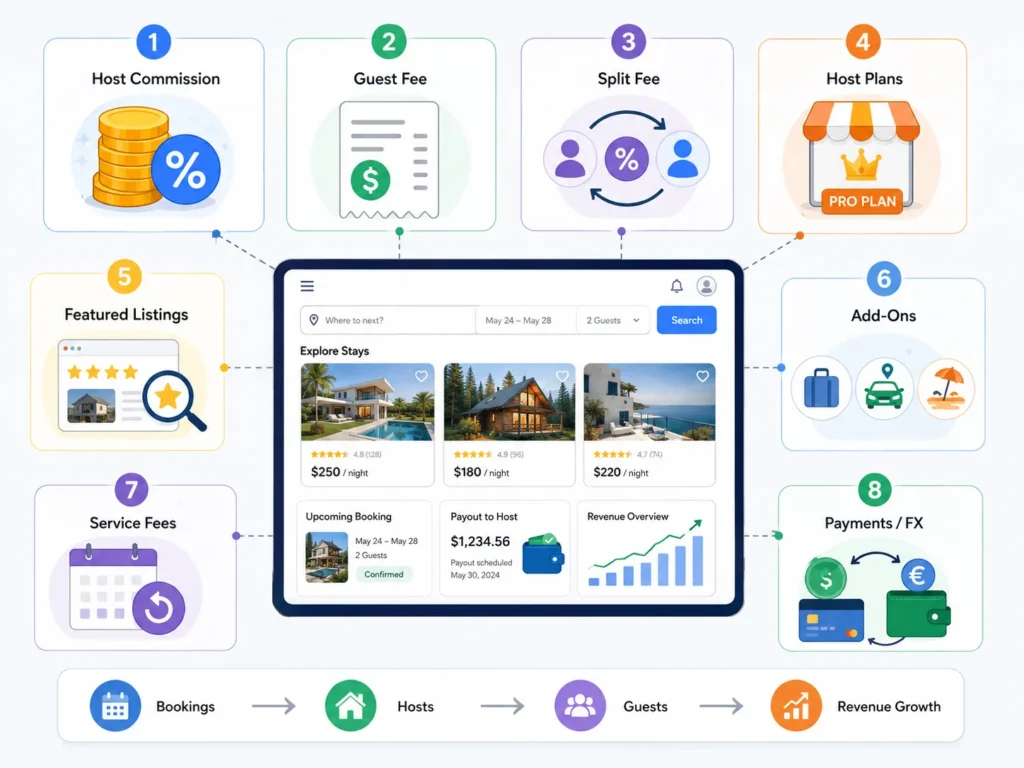
Image Source: AI-generated visual by Miracuves
A vacation rental marketplace can combine multiple revenue streams instead of depending on only one. This creates flexibility for different markets, property types, and user segments.
1. Host Commission on Every Booking
Host commission is one of the most common monetization models. The platform deducts a percentage from the host’s payout after a successful booking.
For example, if a guest books a stay and the host earns a payout, the platform may deduct a commission before releasing funds. This model works well when the platform consistently brings qualified demand to hosts.
The founder advantage is simple: revenue grows as booking volume grows. The risk is that hosts may resist high commissions if they feel the platform does not deliver enough value.
2. Guest Service Fee at Checkout
A guest service fee is charged to the traveller during booking. This fee usually supports platform operations such as secure payments, customer support, booking management, and trust systems.
Guest-side fees work best when the platform provides convenience, selection, protection, and a smooth booking experience. However, fee visibility matters. If guests discover unexpected charges too late in checkout, conversion can drop.
For founders, the lesson is clear: guest fees should be transparent, explainable, and aligned with the value delivered.
3. Split Fee Model
A split fee model charges both hosts and guests. The host pays a smaller commission, while the guest pays a service fee during checkout.
This approach distributes monetization across both sides of the marketplace. It can improve host adoption because the host-side deduction feels lighter. But it can also make guest checkout more expensive if not managed carefully.
A split model is useful when the platform wants to grow supply quickly while still earning meaningful revenue from each transaction.
4. Host Subscription Plans
Some rental platforms offer monthly or annual subscription plans for hosts, property owners, or professional managers.
A subscription plan may include:
- More active listings
- Better dashboard tools
- Lower commission rates
- Featured placement
- Analytics and booking insights
- Faster support
- Calendar sync tools
- Access to promotional campaigns
This model works especially well for professional hosts managing multiple properties. It gives the platform recurring revenue and gives serious hosts more control.
5. Premium Listings and Featured Placement
Premium listings allow hosts to pay for more visibility. This may include homepage placement, boosted search ranking, category highlights, destination pages, or seasonal campaign visibility.
This revenue stream is attractive because it monetizes host demand for bookings without directly increasing guest fees.
However, founders must use it carefully. If paid visibility weakens listing quality or makes search results feel unfair, guest trust can decline. A balanced platform should combine paid promotion with relevance, reviews, availability, pricing, and quality signals.
6. Add-On Services and Local Experiences
Vacation rental platforms can increase revenue by offering add-ons beyond the stay itself.
Examples include:
- Airport pickup
- Local tours
- Cleaning services
- Early check-in
- Late checkout
- Travel insurance-style protection
- Pet stay add-ons
- Equipment rental
- Concierge services
- Meal packages
- Work-from-stay amenities
Add-ons increase average booking value. They also help the platform become more than a listing marketplace. For founders, this is useful because add-ons can improve margin without changing the core booking fee.
7. Cancellation, Rescheduling, and Service Fees
Booking changes create operational work. Some platforms charge service fees for cancellations, modifications, or special handling, depending on the policy.
This revenue stream should be handled with care. If the fee feels punitive, guests may lose trust. If the policy is clear and fair, it can protect the platform from operational losses.
The best approach is to create transparent cancellation tiers and allow hosts to choose policy options inside the dashboard.
8. Payment Processing and Currency-Related Margins
Payment processing is a critical layer in rental marketplace monetization. A platform may collect payment from the guest, deduct its fees, and release the remaining payout to the host according to platform rules.
In cross-border or multi-currency markets, currency conversion, payment gateway charges, and payout methods can create additional cost or revenue logic.
Founders should not treat payments as a minor feature. Payment flow affects trust, cash movement, refunds, chargebacks, payout timing, and accounting visibility.
Read More: Vacation Rental Marketplace Features and Pricing: What Founders Should Evaluate Before Launch
Host-Side Monetization: Commission, Subscriptions, and Listing Visibility
Host-side monetization works when hosts believe the platform helps them earn more than they could alone.
A host may accept platform fees when the marketplace provides:
- Consistent guest demand
- Easy listing management
- Secure payment collection
- Availability calendar control
- Review and rating systems
- Payout tracking
- Dispute handling
- Promotional visibility
- Support for booking changes
- Better occupancy during seasonal demand
The key founder decision is whether to charge hosts per booking, through a subscription, or through optional visibility upgrades.
A new marketplace may start with lower host fees to build supply. A mature platform may introduce paid tools, premium placement, or professional host plans once hosts already receive value.
Guest-Side Monetization: Service Fees, Add-Ons, and Booking Convenience
Guest-side monetization depends on perceived convenience and trust.
Guests may accept a service fee if the platform gives them:
- Verified property listings
- Transparent prices
- Secure checkout
- Real reviews
- Easy booking confirmation
- Support during issues
- Clear cancellation policies
- Safe communication with hosts
- Refund or dispute workflows
The risk is checkout shock. If the listed price looks affordable but the final price jumps because of service fees, cleaning charges, taxes, or platform charges, guests may abandon the booking.
For founders, fee design should be visible early in the booking journey. A transparent pricing experience often builds more trust than a low advertised price with late-stage charges.
How Payment Flow and Payout Timing Affect Profitability
Payment flow is one of the most important parts of the vacation rental marketplace revenue model.
A typical booking flow includes:
- Guest selects dates and property.
- Platform calculates rental price, taxes, service fees, and add-ons.
- Guest pays through a secure checkout.
- Platform records the booking and confirms availability.
- Platform deducts applicable fees.
- Host payout is scheduled based on policy.
- Refunds, cancellations, and disputes are handled through admin rules.
Payout timing can affect both trust and cash flow. Hosts want fast and predictable payouts. Platforms need enough control to manage cancellations, disputes, refunds, and fraud risk.
This is why a booking marketplace should include admin controls for payout status, refund approval, cancellation logic, tax handling, and transaction history.
Revenue Streams and Founder Impact
| Revenue Stream | How It Works | Founder Impact |
|---|---|---|
| Host Commission | The platform deducts a percentage from the host payout after successful bookings. | Creates scalable transaction-based revenue as booking volume grows. |
| Guest Service Fee | The guest pays a service charge during checkout for platform convenience and support. | Improves revenue per booking but requires transparent pricing to protect conversion. |
| Subscription Plans | Hosts pay monthly or annual fees for enhanced tools, lower commissions, or more visibility. | Adds recurring revenue and works well for professional property managers. |
| Premium Listings | Hosts pay to promote listings in search, categories, or destination pages. | Monetizes host demand for visibility without increasing guest checkout costs. |
| Add-On Services | The platform earns from extra services such as cleaning, transport, tours, or early check-in. | Increases average booking value and creates more monetization depth. |
| Cancellation or Service Fees | Fees apply when booking changes, cancellations, or special handling create operational work. | Protects operational cost but must be communicated clearly to avoid trust issues. |
Revenue Model Comparison: Which Approach Fits Your Marketplace?
Not every founder should start with the same monetization model. The right choice depends on market maturity, host supply, guest demand, property type, and platform positioning.
| Monetization Model | Best For | Advantage | Risk |
|---|---|---|---|
| Host commission | Marketplaces with strong guest demand | Simple to understand and scales with bookings | Hosts may resist if commission feels high |
| Guest service fee | Platforms with strong convenience and trust value | Improves revenue per booking | Can hurt checkout conversion if poorly explained |
| Split fee | Balanced host and guest marketplaces | Distributes fees across both sides | Requires careful price display |
| Host subscription | Professional hosts and property managers | Builds recurring revenue | Harder to sell before hosts see value |
| Premium listings | Competitive destinations with many hosts | Monetizes visibility demand | Can weaken search trust if overused |
| Add-on services | Travel, local experiences, and premium stays | Increases average order value | Requires operational partners or service control |
For most early-stage founders, a hybrid model works better than depending on one fee. The platform can start with a simple commission and later add subscriptions, premium visibility, and add-on services once supply and demand become stronger.
Founder Decision Signals
Speed
If the goal is faster launch, choose a platform foundation where booking, listing, payment, and admin workflows are already structured.
Cost
Revenue settings should be flexible from the beginning, because changing fee logic later can create payment, accounting, and user-experience issues.
Scalability
A scalable marketplace needs host dashboards, guest booking flows, payout rules, review systems, and admin controls that can support more listings and transactions.
Market Fit
Start with the fee model your target market can accept. Luxury stays, budget rentals, managed properties, and local homestays may need different monetization logic.
What Founders Should Decide Before Building the Platform
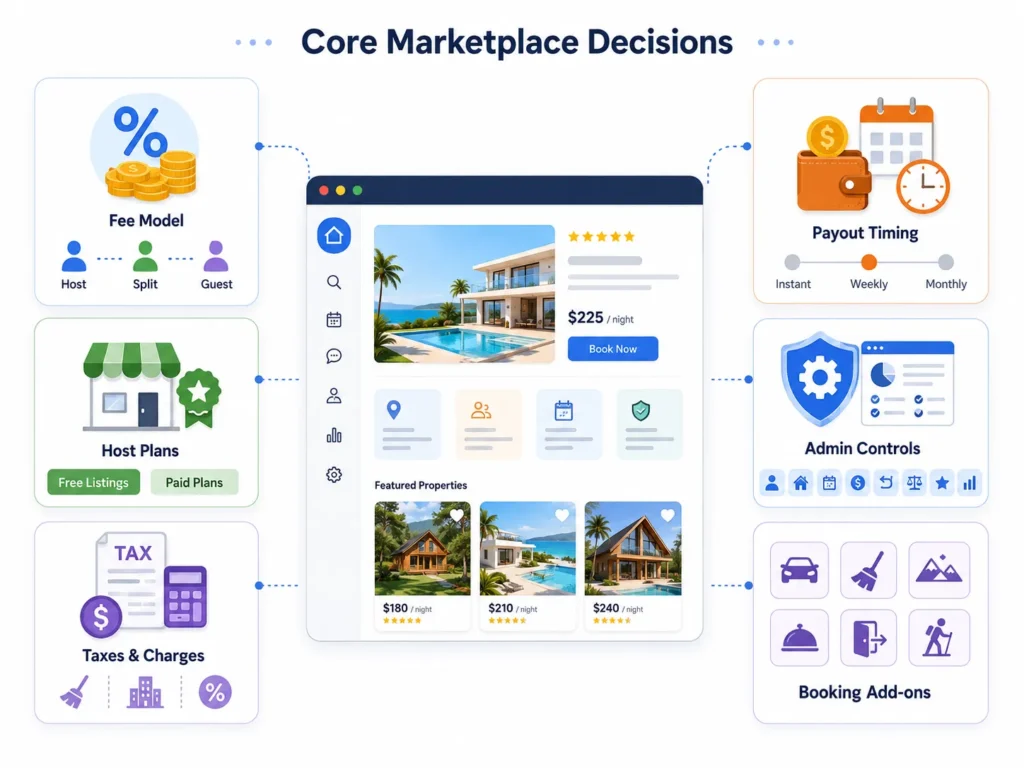
Image Source: AI-generated visual by Miracuves
A vacation rental marketplace should not be built only around property listings. The business model must be built into the product logic.
Before development, founders should decide:
Who Will Pay the Main Platform Fee?
Some markets are host-friendly. Some are guest-friendly. Some can support a split model. The decision affects pricing, checkout design, payout rules, and platform positioning.
Will Hosts Need Free Listings or Paid Plans?
Free listings help build supply faster. Paid host plans work better when the platform already has demand or serves professional property managers.
How Will the Platform Handle Taxes and Local Charges?
Taxes, cleaning fees, local charges, and service fees should be displayed clearly. Poor price transparency can damage guest trust.
When Will Hosts Receive Payouts?
Payout timing should balance host expectations with refund, cancellation, and dispute risk.
What Admin Controls Are Required?
The admin panel should allow the platform operator to manage users, listings, bookings, commissions, payouts, refunds, disputes, reviews, and reports without depending on developers for every operational change.
Which Add-Ons Can Increase Booking Value?
Add-ons should match the travel context. Airport pickup, cleaning, guided tours, meals, late checkout, or local experiences can increase revenue when they are relevant to the guest journey.
Read More: What Is a Vacation Rental Booking App? How Search, Listings, Calendars, and Payouts Work
Mistakes Founders Should Avoid When Designing Rental Marketplace Monetization
Adding too many fees at checkout
Extra charges may increase revenue per booking, but they can also reduce trust if guests feel surprised at the final step.
Ignoring host payout experience
Hosts care about predictable payouts. If payout rules are unclear, supply growth can become harder.
Building listings before revenue logic
A booking marketplace needs commission rules, payment flows, cancellation policies, and admin controls from the start.
Using one fee model for every market
Urban stays, luxury villas, budget rooms, managed rentals, and homestays may require different monetization strategies.
Read More: How to Launch a Niche Vacation Rental Marketplace Without Building Every Module From Scratch
How Miracuves Helps Founders Build Monetization-Ready Rental Platforms
Understanding the revenue model is only the first step. The next step is turning that model into a working platform where hosts can list properties, guests can book stays, payments can be processed, and the admin can control business rules.
Miracuves helps founders build ready-made and white-label rental marketplace platforms with source-code ownership, branded design, admin control, and faster launch workflows.
A monetization-ready rental booking platform should include:
- Host listing management
- Guest search and booking flow
- Availability calendar
- Secure payment integration
- Commission and fee settings
- Host payout management
- Review and rating system
- Cancellation and refund controls
- Admin dashboard
- Reports and transaction history
- User verification and listing moderation
- Dispute management workflows
For founders who want to move from revenue-model research to execution, a launch-ready rental marketplace foundation can reduce avoidable development risk and help validate demand faster.
Related reading: rental platform revenue model breakdown.
Final Thoughts: Profit Comes From Trust, Not Just Fees
A vacation rental marketplace becomes profitable when it creates enough trust and convenience for both sides of the transaction.
Hosts need demand, visibility, payout clarity, and operational support. Guests need verified listings, transparent prices, secure payments, and confidence that the platform will help if something goes wrong.
The strongest revenue model is not always the one with the highest fee. It is the one that balances monetization with marketplace liquidity, user trust, and repeat bookings.
For founders, the better decision is to design the business model before development begins. When commission rules, guest fees, host payouts, subscriptions, and admin controls are built into the platform foundation, the marketplace becomes easier to launch, manage, and scale.
FAQs
What is a vacation rental marketplace revenue model?
A vacation rental marketplace revenue model explains how a booking platform earns money by connecting property hosts with guests. Common revenue streams include host commissions, guest service fees, premium listings, subscriptions, add-ons, cancellation fees, and payment-related charges.
How do vacation rental booking platforms make money?
Vacation rental booking platforms usually make money by charging a percentage of completed bookings, adding guest service fees, offering paid host visibility, selling subscription plans, and monetizing travel-related add-ons such as cleaning, transport, local experiences, or premium support.
What is the difference between host commission and guest service fee?
Host commission is deducted from the host’s payout after a booking. A guest service fee is charged to the traveller during checkout. Some platforms use one model, while others use a split-fee structure where both sides contribute.
Is a subscription model useful for rental marketplaces?
Yes, but it works best when hosts already see value from the platform. Professional hosts and property managers may pay for subscriptions if they receive better tools, lower commissions, more visibility, analytics, or priority support.
Why is payout timing important in a rental marketplace?
Payout timing affects host trust and platform risk. Hosts want predictable payments, while the platform needs enough control to handle cancellations, disputes, refunds, and fraud checks. A clear payout policy helps both sides.
Can a vacation rental platform earn beyond booking fees?
Yes. It can earn from add-on services, local experiences, premium listings, host subscriptions, cleaning partnerships, insurance-style protection, payment processing, cancellation handling, and destination-based promotions.
What should founders decide before launching a rental booking platform?
Founders should decide who pays the platform fee, how commissions work, when hosts receive payouts, how cancellations are handled, what admin controls are needed, and which add-ons can increase booking value.
How can Miracuves help with rental marketplace development?
Miracuves helps founders launch ready-made and white-label rental marketplace platforms with source-code ownership, branded design, admin dashboards, booking workflows, payment integration, and monetization-ready controls.
Miracuves is an independent software development company. We are not affiliated with, connected to, sponsored by, or endorsed by any company or product named in this article.
Terms such as “X Clone” are used descriptively. It is how the software industry refers to building a platform with functionality comparable to a known service, and how clients search for it.
The entire design and codebase of our products is built by our own team. Our products contain no code, design, graphics, or content originating from any third-party website or applications.
All third-party names and marks referenced in this article are the property of their respective owners, referenced solely to identify the services discussed.