
Key Takeaways
- A ready-made online retail marketplace provides prebuilt buyer, seller, catalog, order, payment, inventory, delivery, and admin workflows instead of developing every module from scratch.
- Startups can focus more on seller acquisition, product assortment, buyer demand, marketplace positioning, and customer experience while using an existing ecommerce technology foundation.
- Source-code ownership, customization flexibility, integrations, scalability, security, and operational control determine how well a ready-made marketplace can support long-term growth.
Ready-Made Marketplace Signals
- Prebuilt modules can cover seller onboarding, product listings, search and filters, carts, checkout, payments, commissions, order management, delivery tracking, returns, and payouts.
- Founders can customize branding, product categories, seller rules, commission structures, payment gateways, shipping workflows, promotions, loyalty features, and marketplace policies.
- Modular architecture can make it easier to add recommendations, multi-vendor inventory, advanced analytics, warehouse integrations, automation, subscriptions, and new fulfillment options as the marketplace scales.
Startup Decision Insights
- Startups should compare development effort, customization depth, source-code access, integration needs, scalability, maintenance, security, and total ownership requirements before choosing an approach.
- Custom development may suit highly specialized commerce models, while a customizable ready-made marketplace can be practical when standard multi-vendor workflows already match most business requirements.
- Miracuves develops customizable online retail marketplaces with buyer journeys, seller management, product catalogs, payments, commissions, inventory, delivery workflows, analytics, and admin controls.
Why This Topic Matters for Marketplace Startups
Launching an online retail marketplace is different from launching a simple ecommerce store.
A single-brand ecommerce store mainly needs product pages, checkout, payment, inventory, and fulfillment. A marketplace needs much more. It has to manage sellers, buyers, product catalogs, orders, commissions, delivery workflows, refunds, promotions, disputes, and performance visibility across multiple user groups. This is why founders exploring retail and ecommerce platform development need to think beyond storefront design and evaluate the full operating system behind the marketplace.
This is why many startups hesitate between two choices: build everything from scratch or start with a ready-made online retail marketplace foundation.
Custom development sounds attractive because it promises complete control. But for a startup, control only becomes useful after the business model is validated. Before that, the bigger challenge is speed, cost discipline, seller onboarding, buyer trust, and real transaction testing.
A ready-made marketplace helps founders avoid spending months building basic workflows that already follow a proven structure. Instead, they can focus on positioning, seller acquisition, pricing strategy, product categories, local fulfillment, and customer retention.
For founders planning a marketplace launch, Miracuves offers a launch-ready retail marketplace system that supports branded deployment, admin control, source-code ownership, and faster market entry.
Ready-Made Marketplace vs Custom Development: The Core Difference
A ready-made marketplace is not just a shortcut. It is a pre-built product foundation with core modules already structured for marketplace operations.
Custom development starts from planning, wireframes, UI design, backend architecture, user flows, database structure, integrations, testing, and deployment. That route can work well when a business has a highly unique model, a longer timeline, and a larger product budget. For businesses that need a fully bespoke build, Miracuves’ ecommerce app development services can support custom planning, marketplace architecture, integrations, and long-term product scalability.
A ready-made platform works better when the startup wants to validate demand quickly and avoid rebuilding standard marketplace features from zero.
| Decision Area | Ready-Made Online Retail Marketplace | Custom Development |
|---|---|---|
| Launch speed | Faster because core modules already exist | Slower because everything is planned and built from scratch |
| Startup risk | Lower early execution risk | Higher risk before validation |
| Budget control | More predictable for initial launch | Can expand as requirements change |
| Feature foundation | Buyer, seller, admin, catalog, order, and payment flows can be available early | Depends on planning, team, scope, and timeline |
| Customization | Branding, modules, workflows, and integrations can be adjusted | Highly flexible but slower |
| Best for | Startups testing a marketplace model faster | Businesses with complex, unique operational requirements |
For most startups, the real question is not “Which option is more advanced?” The better question is “Which option helps us reach the market, learn faster, and avoid unnecessary development drag?”
Why Startups Prefer Ready-Made Marketplace Platforms
Startups usually do not fail because they lacked one advanced feature. They fail because they spent too much time building before testing demand.
A marketplace needs both supply and demand. Sellers need a reason to list products. Buyers need enough variety, price confidence, delivery reliability, and trust signals to place orders. The platform operator needs admin control to manage both sides without depending on developers for every small change.
A ready-made online retail marketplace gives founders a faster base to start this process.
The core reasons startups choose this route include:
- They want to launch before market conditions change.
- They want to test seller and buyer behavior with a working product.
- They need admin visibility from the beginning.
- They want to reduce avoidable build complexity.
- They prefer spending more effort on growth, categories, and operations instead of rebuilding standard commerce flows.
This does not mean custom development is wrong. It means startups should not use custom development for features that are already standard unless those features create a real competitive advantage.
Speed Becomes a Strategic Advantage
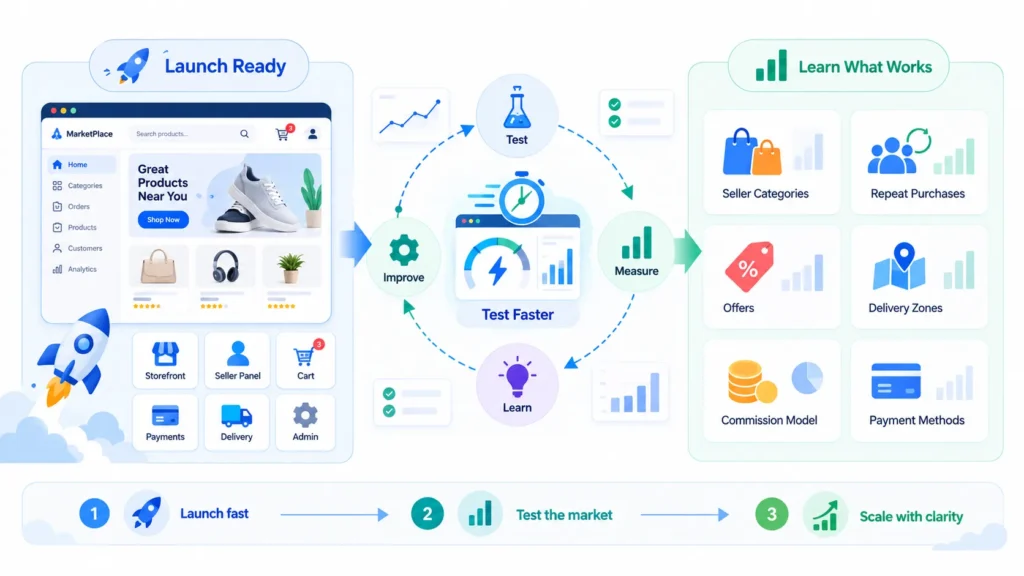
In marketplace businesses, speed is not only about going live quickly. It is about learning quickly.
A startup can spend months perfecting screens, flows, and backend logic, only to discover that sellers are not interested, buyers do not trust the catalog, or delivery operations need a different structure. A ready-made platform helps founders reach those answers earlier.
With a launch-ready foundation, founders can test important questions such as:
- Which seller categories generate the strongest supply?
- Which products create repeat purchases?
- Which offers improve first-order conversion?
- Which delivery zones are realistic to serve?
- Which commission model works for sellers?
- Which payment methods do buyers prefer?
- Which admin controls are needed before scaling?
Miracuves’ ready-made approach is useful here because the focus shifts from building every basic module to configuring, branding, and preparing the platform for launch. Where applicable, Miracuves highlights 6-day solution delivery for ready-made marketplace products, helping startups reduce the time between idea and real market testing.
A Marketplace Needs More Than a Customer App
Many founders initially think about the customer-facing app first. That is understandable because buyers see the storefront, product pages, cart, checkout, offers, and order tracking.
But the real strength of a retail marketplace sits behind the scenes.
A scalable online retail marketplace needs:
- A seller panel for catalog uploads, stock updates, order management, and payouts.
- A customer app or storefront for browsing, checkout, payment, and order tracking.
- An admin dashboard for users, sellers, commissions, promotions, disputes, and reports.
- Delivery or fulfillment workflows for order movement and serviceability.
- Payment and payout logic for transactions, commissions, refunds, and settlements.
- Marketing tools for coupons, deals, banners, featured listings, and notifications.
When startups build custom from zero, these workflows have to be planned, developed, tested, and connected. A ready-made marketplace already gives the business a working structure that can be adapted to the launch model.
That is why a white-label ecommerce app option can be a better first step for startups that want a practical operating base instead of a long technical discovery phase.
Founder Decision Signals
Speed
Choose a ready-made marketplace when your priority is to launch, onboard sellers, test buyer demand, and collect real marketplace feedback faster.
Cost
Choose ready-made when you want better cost control for the first market version instead of spending heavily before validation.
Scalability
Choose a platform foundation that includes admin control, seller workflows, catalog logic, order tracking, and payment flows from the beginning.
Market Fit
Choose ready-made when the business model follows a familiar marketplace pattern but needs branding, category strategy, and operational customization.
Cost Control Matters Before Marketplace Validation
Custom development can become expensive because marketplace products have many connected parts. Every user role creates more workflows. Every workflow creates more backend logic. Every backend decision affects testing, deployment, security, and long-term maintenance. A practical way to evaluate the budget is to understand the major marketplace development cost factors, including feature scope, integrations, customization, admin controls, technology stack, and launch requirements.
For example, a marketplace does not simply need “seller management.” It needs seller registration, approval, profile control, product uploads, SKU management, order alerts, payout visibility, cancellation logic, return handling, and performance reporting.
Similarly, an admin dashboard is not just a login screen. It is the control center for commissions, sellers, buyers, catalog quality, delivery zones, promotional campaigns, reports, disputes, refunds, and platform configuration.
A ready-made marketplace reduces the need to pay repeatedly for standard foundation work. Startups can invest more intelligently in the areas that actually differentiate the business:
- Category selection
- Seller acquisition
- Local fulfillment strategy
- Pricing and commission model
- Brand experience
- Promotions and loyalty
- Payment preferences
- Customer support workflows
- Regional market customization
This is why the ready-made route often fits founders who need a cost-efficient launch path without losing control over branding and operations.
Custom Development Still Has a Place
A balanced decision does not treat ready-made and custom development as enemies.
Custom development is useful when the marketplace has unusual workflows, complex enterprise integrations, deeply specialized logistics, unique pricing engines, or regulatory requirements that cannot be handled through configuration or modular customization.
But many retail marketplace startups do not need that level of complexity on day one.
They need a working product that can support real sellers, real buyers, real orders, and real admin decisions. Once the business validates demand, the founder can decide what deeper customizations are worth building.
A practical path is:
- Start with a ready-made marketplace foundation.
- Brand and configure it for the target market.
- Launch with the right seller and buyer workflows.
- Track marketplace behavior.
- Customize based on real data instead of assumptions.
This approach helps founders avoid overbuilding too early.
What Features Matter Most in a Ready-Made Retail Marketplace?
Not every ready-made platform is equally useful. A startup should evaluate whether the system gives enough control to operate the marketplace, not just display products.
Important modules include:
| Module | Why It Matters | Startup Impact |
|---|---|---|
| Customer storefront | Helps buyers browse, search, compare, and purchase products | Improves buyer experience and conversion |
| Seller panel | Allows sellers to manage catalogs, orders, stock, and basic business activity | Makes seller onboarding easier |
| Admin dashboard | Gives the platform owner control over users, sellers, commissions, content, and reports | Reduces operational dependency |
| Catalog management | Supports product listings, categories, variants, pricing, and stock | Keeps marketplace inventory structured |
| Order management | Tracks order status, cancellations, returns, and fulfillment progress | Improves buyer trust |
| Payment and payout flow | Supports transaction handling, commission logic, refunds, and seller settlements | Protects marketplace financial control |
| Promotions and offers | Supports coupons, banners, featured listings, and campaigns | Helps drive demand and repeat purchases |
| Reports and analytics | Shows sales, orders, sellers, users, and operational performance | Helps founders make better decisions |
Before choosing a platform, founders should review the core marketplace feature modules that support buyers, sellers, admins, catalog management, payments, promotions, delivery workflows, and order operations.
The stronger the admin and operations layer, the easier it becomes for a startup to scale beyond the first version.
Why Admin Control Is a Major Reason Startups Avoid Starting From Zero
Founders often underestimate the admin dashboard.
Without strong admin control, the marketplace operator cannot easily answer basic operational questions:
- Which sellers are active?
- Which sellers are creating order issues?
- Which products are selling fastest?
- Which categories need more supply?
- Which orders are delayed?
- Which refunds or disputes need attention?
- Which promotions are working?
- Which commission settings need adjustment?
Custom development teams may build a beautiful customer interface first, while admin control gets delayed. That creates problems after launch because the founder cannot manage real marketplace behavior properly.
A ready-made online retail marketplace should include a practical control layer from the beginning. That control layer helps the startup operate, test, adjust, and scale the business with fewer internal bottlenecks.
Marketplace Growth Depends on Supply, Demand, and Operations
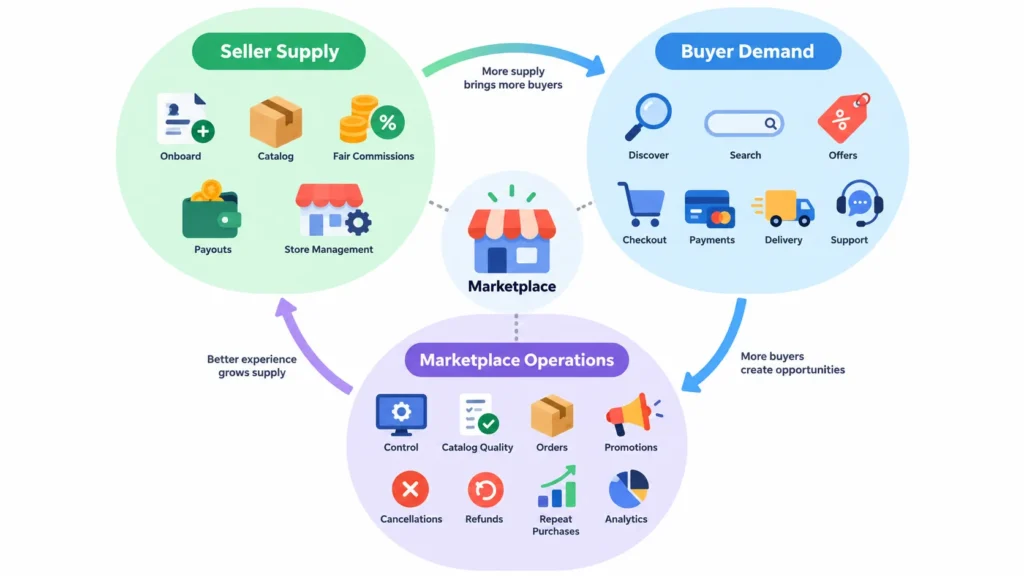
A ready-made marketplace does not automatically create growth. But it gives founders a faster base to run growth experiments.
Before scaling, founders also need a clear marketplace revenue model that balances seller commissions, featured listings, advertising, subscriptions, delivery fees, and buyer retention.
Marketplace growth usually depends on three connected layers:
- The first layer is seller supply. Sellers need easy onboarding, catalog tools, visibility, fair commissions, and reliable payouts.
- The second layer is buyer demand. Buyers need relevant products, strong search, offers, smooth checkout, payment options, delivery confidence, and customer support.
- The third layer is marketplace operations. The platform owner needs visibility into sellers, orders, catalog quality, promotions, cancellations, refunds, and repeat purchases.
When these three layers work together, the startup has a better chance of building marketplace momentum. If one layer is weak, growth slows down. Because marketplaces handle seller onboarding, payments, refunds, disputes, and buyer data, founders should also think about online retail marketplace security before scaling operations.
This is why founders should not think of ready-made platforms only as technology. The right foundation becomes a business operating system for seller growth, buyer trust, and marketplace control.
When a Ready-Made Marketplace Is the Better Choice
A ready-made platform is usually the better fit when:
- The startup wants to launch quickly.
- The business model follows a familiar online retail marketplace pattern.
- The founder needs seller, buyer, admin, catalog, order, and payment workflows early.
- The startup wants to test categories before investing in deeper custom development.
- The team wants source-code ownership and branding control.
- The business needs a cost-efficient route to market.
- The founder wants to spend more time on growth and operations than base product development.
For startups entering ecommerce, the early advantage often comes from choosing the right market, the right sellers, and the right operating model. A ready-made foundation helps accelerate that process.
Founders exploring broader retail and ecommerce platform development can use this approach to evaluate whether their idea needs a ready-made launch path, a custom build, or a hybrid roadmap.
Mistakes Startups Should Avoid
Building too much before testing demand
A marketplace becomes valuable only when sellers and buyers interact. Spending too long on advanced features before validation can delay the real learning process.
Choosing design over operational control
A polished interface is useful, but the founder also needs admin tools for sellers, orders, commissions, payouts, promotions, and disputes.
Ignoring seller experience
If sellers cannot manage catalogs, stock, orders, and payouts easily, they may not stay active on the platform.
Assuming custom development is always safer
Custom development can be powerful, but it also adds time, cost, testing, and coordination risk when used too early.
Why Miracuves Fits Startups Choosing a Faster Marketplace Launch
Miracuves helps founders launch marketplace platforms with ready-made, white-label foundations that can be branded and configured for the target business model. For founders who want to move faster, Miracuves provides a launch-ready retail marketplace solution with white-label branding, source-code ownership, admin control, and 6-day delivery where applicable.
For a startup, this matters because the first version of a marketplace should not only look functional. It should help the founder manage sellers, products, orders, payments, delivery logic, and marketplace controls from the beginning.
A ready-made Miracuves solution can support faster validation by reducing the time spent rebuilding standard marketplace modules. Where applicable, Miracuves’ 6-day solution delivery gives startups a faster route to launch while still allowing branding, configuration, and source-code ownership.
This makes the approach especially useful for founders who already understand the marketplace opportunity but do not want to spend months before testing seller and buyer behavior.
Final Thoughts
Startups choose ready-made online retail marketplaces because speed, control, and validation matter more in the early stage than building every feature from zero.
Custom development is valuable when the business model truly requires unique workflows. But many marketplace startups first need a strong foundation for sellers, buyers, catalogs, payments, orders, promotions, and admin control. Once the model proves traction, deeper customization becomes easier to justify.
The smarter decision is not always the longest build. It is the build that helps the founder reach the market, learn from real users, and improve with clarity.
Miracuves helps startups take that practical path with ready-made marketplace solutions built for faster launch, white-label branding, source-code ownership, and operational control.
FAQs
What is a ready-made online retail marketplace?
A ready-made online retail marketplace is a pre-built ecommerce marketplace platform that includes core buyer, seller, catalog, order, payment, and admin workflows. It helps startups launch faster without building every standard marketplace module from scratch.
Why do startups choose ready-made marketplace software over custom development?
Startups choose ready-made marketplace software because it reduces launch time, controls early development risk, and helps founders validate seller and buyer demand faster. Custom development can be useful later when deeper business-specific workflows are needed.
Is a ready-made marketplace suitable for a new ecommerce startup?
Yes, a ready-made marketplace can be suitable when the startup wants to test a retail marketplace model quickly. It is especially useful when the business needs seller onboarding, product listings, order management, payments, promotions, and admin control from the beginning.
Can a ready-made marketplace be customized?
Yes. A ready-made marketplace can usually be customized for branding, categories, design, workflows, payment integrations, delivery logic, language, currency, and admin settings. The final scope depends on the selected modules and business requirements.
What should founders check before choosing a ready-made marketplace?
Founders should check whether the platform includes seller tools, customer experience, admin dashboard, catalog management, order tracking, payment workflows, payout logic, reports, and source-code ownership. These areas decide whether the marketplace can be operated properly after launch.
Is custom development better than ready-made marketplace development?
Custom development is better when the business needs highly unique workflows or complex integrations. A ready-made marketplace is better when the founder wants to launch faster, reduce early build risk, and validate the marketplace model before investing in deeper custom development.
How does a ready-made marketplace help with faster validation?
It helps founders test real seller onboarding, buyer demand, category performance, pricing, promotions, delivery zones, and repeat purchases sooner. This gives the startup practical feedback before spending heavily on advanced custom features.
Does Miracuves provide ready-made marketplace solutions?
Yes. Miracuves provides ready-made and white-label marketplace solutions with branding, admin control, source-code ownership, and faster deployment options, including 6-day delivery where applicable.
Miracuves is an independent software development company. We are not affiliated with, connected to, sponsored by, or endorsed by any company or product named in this article.
Terms such as “X Clone” are used descriptively. It is how the software industry refers to building a platform with functionality comparable to a known service, and how clients search for it.
The entire design and codebase of our products is built by our own team. Our products contain no code, design, graphics, or content originating from any third-party website or applications.
All third-party names and marks referenced in this article are the property of their respective owners, referenced solely to identify the services discussed.