Key Takeaways
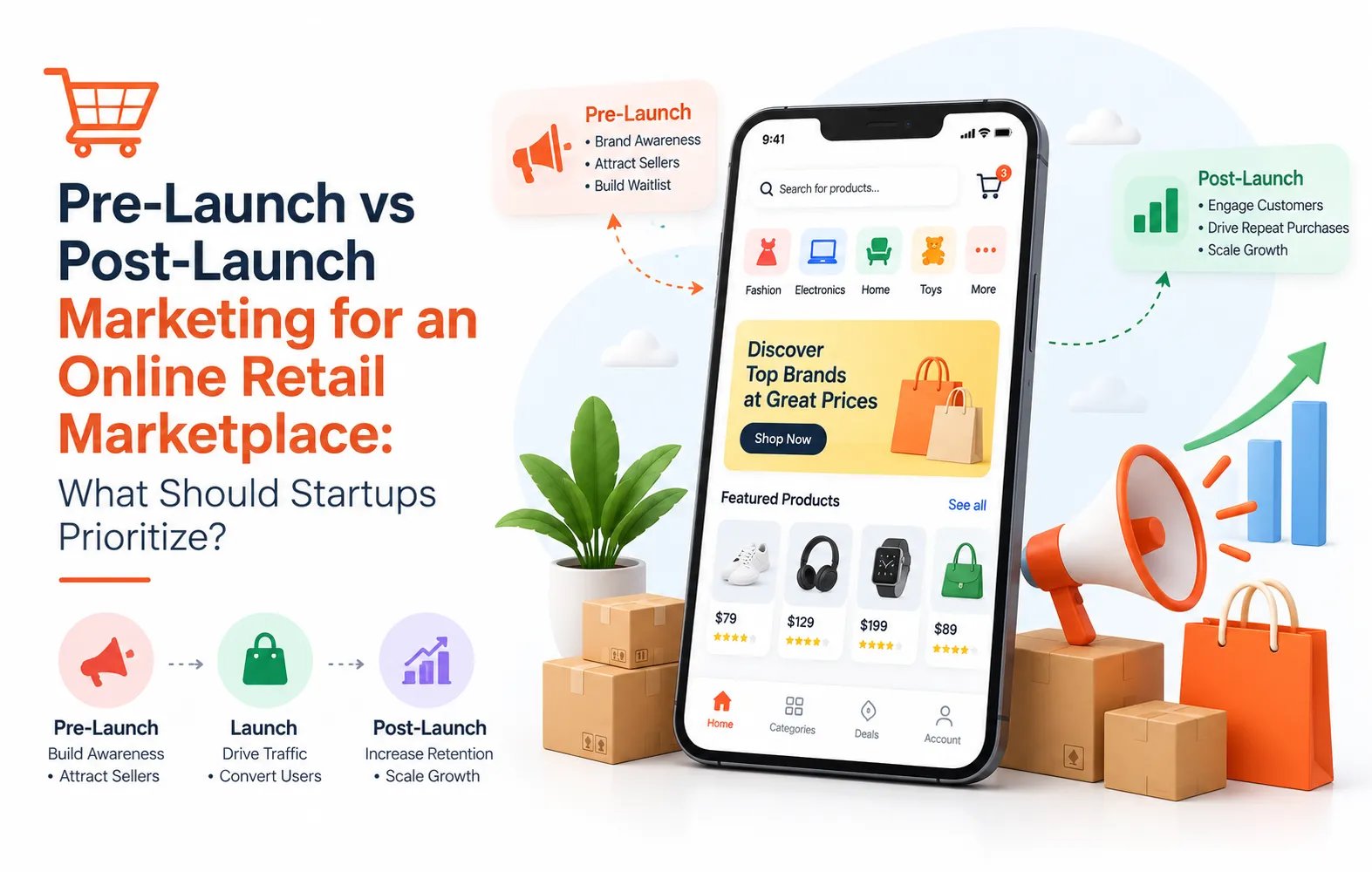
- An online retail marketplace marketing strategy should begin before launch by building seller supply, validating buyer demand, creating category visibility, and preparing acquisition channels.
- Pre-launch marketing focuses on awareness, waitlists, seller onboarding, partnerships, content, and demand validation, while post-launch marketing shifts toward conversion, retention, repeat purchases, and marketplace liquidity.
- Startups should treat both phases as connected because strong early supply and audience interest make post-launch campaigns more efficient and easier to scale.
Pre-Launch Marketing Signals
- Seller outreach, category partnerships, early-access programs, landing pages, waitlists, referral campaigns, and product teasers can help build marketplace supply and initial demand before launch.
- SEO content, social media, email capture, community building, influencer partnerships, and paid testing can reveal which customer segments, product categories, and messages generate interest.
- Track seller signups, approved listings, waitlist growth, cost per lead, referral activity, category interest, landing-page conversion, and pre-launch engagement to measure readiness.
Post-Launch Growth Insights
- After launch, marketing should focus on buyer acquisition, seller activation, product discovery, checkout conversion, fulfilled orders, reviews, referrals, and repeat purchases.
- Retargeting, personalized recommendations, loyalty programs, abandoned-cart campaigns, promotions, lifecycle messaging, and seller campaigns can strengthen retention and transaction frequency.
- Miracuves develops customizable online retail marketplaces with seller onboarding, product discovery, promotions, order management, payments, delivery workflows, loyalty features, analytics, and admin controls.
Launching an online retail marketplace is not just a product decision. It is a timing decision, a demand decision, and an operations decision.
Many founders focus heavily on the app build and assume marketing begins only after the platform goes live. That is where early marketplace launches often lose momentum. A retail marketplace needs two audiences at the same time: sellers who bring inventory and buyers who create demand. If either side is missing, the platform feels empty.
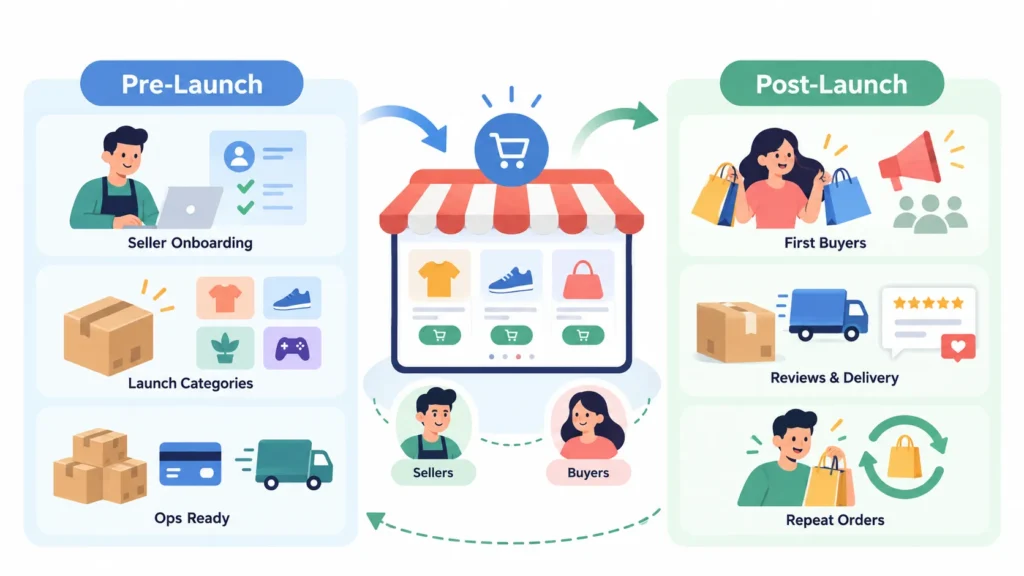
That is why founders need to understand the difference between pre-launch and post-launch marketing. Pre-launch marketing creates awareness, validates demand, recruits sellers, and builds early trust before the first transaction happens. Post-launch marketing turns that initial interest into orders, repeat purchases, seller activity, and measurable growth.
For startups planning to enter ecommerce with a ready-made multi-vendor commerce platform, the smarter question is not “Which phase matters more?” The better question is: “What should we prioritize before launch, and what should only begin once the marketplace is live?” Founders exploring retail and ecommerce platform development should treat marketing timing as part of the business model, not a separate activity after the product is ready.
Why Marketing Timing Matters in an Online Retail Marketplace
A single-vendor ecommerce store can usually launch with a smaller catalog, a focused product line, and a direct brand story. A marketplace is different. It depends on supply, demand, trust, fulfilment, payments, reviews, seller quality, and customer support working together.
That makes marketing timing more complex.
If you attract buyers too early but have weak inventory, they leave and may not return. If you recruit sellers but do not bring buyers quickly enough, sellers lose confidence. If discounts drive orders but delivery operations are not ready, the launch creates complaints instead of traction.
A good marketplace marketing strategy should therefore answer four questions:
- Who are the first sellers we want on the platform?
- Which product categories will create the strongest launch identity?
- Which buyer segment is most likely to try a new marketplace first?
- What retention system will bring users back after the first order?
Pre-launch marketing gives you the foundation. Post-launch marketing gives you the growth loop.
Pre-Launch Marketing: What Startups Should Prioritize Before Going Live
Pre-launch marketing is not only about hype. For an online retail marketplace, it is mainly about reducing launch risk. This is especially important for founders evaluating white-label ecommerce marketplace solutions, because the marketing plan should match the platform’s seller, buyer, catalog, payment, and admin workflows from the beginning.
Before the platform goes live, founders should use marketing to test demand, understand seller interest, define the category mix, and build early credibility. This phase is especially important if the startup is targeting regional commerce, niche categories, local sellers, or cash-led buying behavior.
1. Validate the Marketplace Positioning Before Spending on Acquisition
A marketplace should not launch as “everything for everyone.” That positioning is too broad for most startups. Pre-launch is the right time to define the first wedge.
For example, the marketplace may start with:
- Regional fashion sellers
- Home and lifestyle products
- Electronics accessories
- Grocery and daily essentials
- Beauty and personal care
- Local artisan products
- B2B retail supply categories
The goal is to make the platform memorable before it becomes large. A focused marketplace is easier to explain, easier to market, and easier to fill with relevant sellers.
2. Build a Seller Pipeline Before Launch Day
In a multi-vendor marketplace, sellers are not just suppliers. They are part of the product experience. Their product quality, pricing, images, stock accuracy, shipping speed, and support behavior directly affect buyer trust.
Pre-launch marketing should therefore include seller acquisition campaigns. This can include landing pages, category-specific outreach, seller webinars, onboarding calls, early commission offers, and educational content explaining why sellers should join early.
The strongest early seller pitch is usually not “join another marketplace.” It is:
“Reach buyers through your own branded marketplace channel, with structured catalog, orders, payouts, and visibility support.”
This is also where founders can naturally evaluate whether a ready-made multi-vendor commerce solution gives them the seller, customer, delivery, and admin workflows needed to start faster.
3. Create a Buyer Waitlist With a Clear Launch Promise
A buyer waitlist should not be vague. “Coming soon” is not enough.
The waitlist needs a reason to join. That reason could be early access, launch credits, category-specific offers, local seller discovery, free delivery for first orders, invite-only deals, or priority access to limited inventory.
Good waitlist messaging should answer:
- What kind of products will buyers find?
- Why should they try this platform instead of their usual shopping channel?
- What launch benefit do early users receive?
- When will they be notified?
- How will trust, delivery, refunds, and support work?
The waitlist is not only a lead list. It is a demand signal. If the waitlist grows but users show interest in different categories than expected, the founder can adjust the launch catalog before spending heavily on ads. Trust also matters at this stage, so marketplace trust and security planning should be part of the launch message before buyers start placing orders.
4. Prepare Category Pages and SEO Foundations Early
SEO should start before launch, not months later. Even if the marketplace is not fully open, the startup can prepare category pages, seller pages, product content guidelines, blog content, help pages, and structured metadata.
Pre-launch SEO helps search engines understand the platform’s topical direction. It also helps founders avoid a rushed launch where every category page has thin content, missing metadata, or duplicate product descriptions. Before scaling campaigns, founders should also review marketplace feature readiness across product listings, seller panels, checkout, delivery workflows, offers, reviews, and admin controls.
Important pre-launch SEO assets include:
- Homepage positioning
- Category landing pages
- Seller onboarding page
- Return and refund policy page
- Delivery and serviceability page
- Buyer help center content
- Launch announcement blog
- Product listing content standards
For marketplaces, SEO is not only about rankings. It is also about trust. Buyers are more likely to purchase when policies, product details, shipping information, and seller credibility are clear.
5. Build Social Proof Before You Have Large Order Volume
Startups often think social proof only comes after scale. That is not true.
Before launch, social proof can come from seller stories, founder videos, behind-the-scenes setup, product category previews, early seller interviews, packaging previews, fulfilment readiness, and transparent launch updates.
The point is not to fake traction. The point is to show preparation.
Avoid exaggerated claims such as huge order numbers, unrealistic revenue projections, or unsupported demand statements. Instead, show real readiness signals: seller onboarding, catalog preparation, payment setup, customer support planning, delivery coverage, and app walkthroughs.
Post-Launch Marketing: What Startups Should Prioritize After Going Live
Post-launch marketing begins when real behavior replaces assumptions. At this stage, the founder can see what users click, search, add to cart, abandon, buy, review, return, and repeat. From there, a deeper online retail marketplace growth strategy can be built around conversion, retention, category performance, seller activity, and repeat purchase behavior.
The focus should shift from “creating interest” to “improving marketplace activity.”
1. Convert the Waitlist Into First Orders
The first post-launch priority is to activate the warmest audience. These are the users who joined the waitlist, followed the launch updates, interacted with social content, or asked about seller access.
Do not send them a generic launch message. Segment them based on interest.
For example:
- Buyers interested in fashion should receive fashion-led launch collections.
- Buyers interested in home products should see curated home deals.
- Sellers should receive onboarding reminders and catalog completion prompts.
- Inactive signups should receive a simple reason to return.
Early conversion matters because it gives the marketplace its first behavioral data. Founders can then see which categories attract orders and which ones only attract clicks.
2. Use Retargeting Carefully Instead of Spending Blindly
Post-launch advertising should not simply chase traffic. It should use marketplace behavior.
Retarget users who:
- Visited product pages but did not add to cart
- Added products but abandoned checkout
- Searched for unavailable items
- Bought once but did not return
- Viewed seller pages without purchasing
- Installed the app but did not complete onboarding
The message should match the behavior. A cart abandoner needs a checkout nudge. A category browser needs a better product collection. A first-time buyer needs reassurance. A repeat buyer needs loyalty and convenience.
3. Build Retention Around Repeat Purchase Categories
Not all categories create the same retention. Daily essentials, beauty products, consumables, accessories, grocery, wellness, and household items can create repeat behavior faster than occasional high-ticket products.
Post-launch marketing should identify repeat-purchase categories early and build campaigns around them.
Retention campaigns may include:
- Reorder reminders
- Wishlist alerts
- Back-in-stock notifications
- Category-based coupons
- Loyalty credits
- Subscription-style product reminders
- Personalized product recommendations
- Seller-specific promotions
This is where the marketplace starts becoming more than a launch campaign. It becomes a habit-building commerce system.
4. Turn Sellers Into Growth Partners
After launch, seller marketing should not stop. Sellers need visibility, guidance, and performance feedback.
Founders should create seller growth loops such as:
- Featured seller campaigns
- Seller education emails
- Catalog quality scoring
- Promotion calendars
- Seasonal sale participation
- Review improvement guidance
- Stock update reminders
- Performance dashboards
An online retail marketplace grows faster when sellers understand how to succeed inside the platform. Better sellers improve selection, pricing, fulfilment, and buyer confidence.
5. Use Reviews, Refunds, and Support Data as Marketing Inputs
Post-launch marketing is not only about campaigns. It is also about learning from friction.
Refund reasons, support tickets, delivery complaints, failed payments, out-of-stock searches, and low-rated products can reveal what is blocking growth. Founders should review this data weekly.
If buyers complain about delivery delays, pushing more ads may increase the problem. If sellers upload weak product images, buyer conversion may stay low despite traffic. If users abandon checkout because payment choices are limited, campaign spending cannot fix the core issue.
Marketing and operations should work together after launch. Growth comes from removing friction, not just increasing reach.
Pre-Launch vs Post-Launch Marketing: What Changes?
| Area | Pre-Launch Priority | Post-Launch Priority |
|---|---|---|
| Primary Goal | Build readiness, awareness, and early demand | Convert, retain, and grow marketplace activity |
| Seller Focus | Recruit sellers and prepare catalogs | Improve seller performance and repeat participation |
| Buyer Focus | Build waitlist and category interest | Drive first orders and repeat purchases |
| Content Focus | Launch story, category education, seller onboarding | Product collections, reviews, offers, retention campaigns |
| Metrics | Waitlist signups, seller leads, catalog readiness | Conversion rate, repeat orders, AOV, retention, reviews |
| Main Risk | Launching without enough supply or trust | Spending on traffic before fixing friction |
What Should Startups Prioritize First?
The right priority depends on launch readiness.
If the marketplace has weak seller supply, prioritize seller acquisition before buyer campaigns. If the catalog is ready but awareness is low, prioritize waitlist and launch storytelling. If the platform is live but users are not completing checkout, prioritize conversion and support fixes before scaling ad spend.
A practical order looks like this:
- Define the first marketplace category or niche.
- Recruit sellers and prepare catalog quality standards.
- Build a buyer waitlist with a clear launch offer.
- Prepare SEO, social, email, and launch content assets.
- Launch with a controlled audience before scaling spend.
- Measure first-order conversion, fulfilment, reviews, and support issues.
- Use retention campaigns once product-market behavior becomes visible.
This sequence prevents one of the biggest online retail marketplace launch mistakes: spending heavily on demand before the platform is operationally ready to serve it.
Founder Decision Signals
Speed
If your platform foundation is already ready, your marketing can begin earlier. Miracuves’ ready-made marketplace approach supports faster deployment, helping founders focus more energy on sellers, buyers, and launch execution.
Supply
If sellers are not prepared, buyer acquisition should wait. Inventory depth, catalog quality, and seller responsiveness decide whether launch traffic turns into orders.
Retention
If users buy once and disappear, post-launch marketing should focus on repeat categories, reorder reminders, loyalty offers, and better product discovery.
Market Fit
If one category gets stronger engagement than others, the marketplace should sharpen positioning around that category before expanding too broadly.
Common Marketing Mistakes Online Retail Marketplace Founders Should Avoid
Running buyer ads before seller supply is ready
Traffic does not help if users land on thin categories, weak product pages, or unavailable inventory. Build enough supply before pushing demand aggressively.
Treating launch day as the finish line
Launch day only starts the feedback loop. Post-launch marketing must improve conversion, retention, seller performance, and customer trust continuously.
Using discounts without a retention plan
Introductory offers can create first orders, but they do not automatically create loyalty. Pair offers with reorder reminders, category personalization, and better service quality.
Ignoring seller education
Sellers need guidance on catalog quality, stock updates, pricing, fulfilment, and promotions. Poor seller behavior can weaken buyer trust even if the platform itself works well.
How a Faster Marketplace Launch Changes the Marketing Plan
When the product foundation takes months to build, founders often delay marketing until the platform is close to completion. That creates a gap: the app may be ready, but the audience is not.
A faster launch-ready solution changes that planning rhythm. If the core marketplace system can be deployed quickly, founders can spend more time on category strategy, seller onboarding, launch content, and post-launch growth loops.
Founders who need custom workflows, third-party integrations, regional payment methods, or market-specific commerce logic can also explore ecommerce app development support before finalizing their launch roadmap.
Miracuves supports founders with ready-made, white-label ecommerce marketplace solutions designed for faster deployment, admin control, source-code ownership, seller workflows, customer journeys, and marketplace operations. For founders who want to validate demand without waiting through a long build cycle, this can create a practical advantage.
The important point is this: 6-day solution delivery can accelerate platform readiness, but the go-to-market work still needs serious planning. Sellers need to be onboarded. Buyers need a reason to trust the platform. Campaigns need testing. Fulfilment needs monitoring. Support needs to be ready.
It also helps founders think more clearly about marketplace development cost planning, because budget should cover not only platform setup but also seller onboarding, launch campaigns, retention, and post-launch optimization.
That balance is what creates a stronger launch.
Final Thoughts: Prioritize Readiness Before Reach
Pre-launch and post-launch marketing are not competing priorities. They solve different problems.
Pre-launch marketing helps founders prepare the marketplace before traffic arrives. It builds seller supply, buyer curiosity, launch positioning, trust assets, SEO foundations, and early demand signals.
Post-launch marketing helps founders improve what happens after the first click. It focuses on conversion, retention, reviews, repeat purchases, seller quality, and marketplace activity.
For online retail marketplace startups, the strongest approach is not to spend aggressively from day one. It is to launch with enough supply, activate the right buyers, study real behavior, and then scale the campaigns that are supported by actual marketplace performance.
Miracuves helps founders move faster with a ready-made marketplace foundation, but the real growth advantage comes when faster deployment is paired with smart launch marketing, strong seller onboarding, and disciplined post-launch optimization.
FAQs
What is the difference between pre-launch and post-launch marketing for an online retail marketplace?
Pre-launch marketing focuses on building awareness, recruiting sellers, preparing the catalog, growing a buyer waitlist, and validating demand before launch. Post-launch marketing focuses on converting users, improving retention, collecting reviews, supporting sellers, and increasing repeat purchases after the marketplace is live.
Should marketplace startups focus on sellers or buyers first?
Most online retail marketplace startups should focus on sellers first because buyers need enough product variety to trust the platform. Once the catalog and seller workflows are ready, buyer campaigns can begin with stronger conversion potential.
How early should pre-launch marketing start?
Pre-launch marketing should begin as soon as the marketplace positioning, target category, and seller profile are clear. Even before the platform is fully live, founders can build landing pages, seller interest forms, waitlists, social content, and SEO foundations.
What are the best pre-launch marketing channels for a retail marketplace?
Useful pre-launch channels include SEO landing pages, seller outreach, email waitlists, social media teasers, category-led content, referral campaigns, early-access offers, and founder-led community building.
What should startups measure after launching an online retail marketplace?
Important post-launch metrics include first-order conversion, repeat purchase rate, cart abandonment, average order value, seller activity, product availability, refund reasons, review quality, support tickets, and retention by category.
Is paid advertising better before or after launch?
Paid advertising is usually more effective after the marketplace has enough seller supply, product depth, checkout readiness, and support workflows. Before launch, smaller test campaigns can help validate demand, but heavy spending should wait until the platform can convert and fulfil orders reliably.
How does faster platform deployment affect marketplace marketing?
Faster deployment gives founders more time to focus on seller onboarding, launch campaigns, buyer education, and post-launch optimization. It does not replace marketing work, but it can reduce the delay between idea, platform readiness, and market validation.
Can Miracuves help startups launch an online retail marketplace faster?
Yes. Miracuves offers ready-made and white-label marketplace solutions with source-code ownership, admin control, branded app experiences, and faster deployment support. This helps founders avoid building every core marketplace module from scratch.
Miracuves is an independent software development company. We are not affiliated with, connected to, sponsored by, or endorsed by any company or product named in this article.
Terms such as “X Clone” are used descriptively. It is how the software industry refers to building a platform with functionality comparable to a known service, and how clients search for it.
The entire design and codebase of our products is built by our own team. Our products contain no code, design, graphics, or content originating from any third-party website or applications.
All third-party names and marks referenced in this article are the property of their respective owners, referenced solely to identify the services discussed.