Key Takeaways
- The pay button does not move money: it places a hold, and holding rather than taking is what keeps a cancelled order from becoming a refund.
- The restaurant’s accept is a commitment rather than a confirmation, because it fixes the price and starts a clock that a rider is scheduled against.
- Most lateness is created at the counter, in minutes nobody records unless the rider can mark arrival.
- One card payment is at least five obligations owed to different parties on four different schedules, and the delivery fee is not what pays the rider.
- A refund does not reverse one transaction: the customer is made whole, the rider is still paid, the restaurant may or may not be charged, and the platform absorbs the difference.
Follow the Money
- Separate authorization from capture before you write a single refund flow.
- Record a rider arrival timestamp at every outlet, then price the waiting time against it.
- Store the commission rate on the order, not in a settings page that changes.
- Ship the restaurant statement in the same release as the first payout run.
- Give every refund a recorded liability decision with a reason attached.
Real Insights
- The order lifecycle is only explainable if every transition carries a name and a timestamp, because a complaint cannot be arbitrated from a status field.
- Restaurants rarely churn loudly; they stop pressing accept on a Friday, and an unreconcilable statement is the most common reason.
- Cash markets invert the model entirely: the rider holds your money for a shift, so a running balance and a settlement ceiling are launch requirements.
- Refund cost is an operating line rather than an exception, and a platform that has not modelled it will look profitable until the first payout run lands.
- Miracuves ships the dispatch, settlement and statement layers as one working platform, white-labelled and deployed on an eligible ready-made scope in 6 days of build time, with payment gateway onboarding and store review sitting outside that window.
At 7:42 on a Tuesday evening, a customer two kilometres from a small curry house taps a button that says Pay. Two curries, a naan, a bottle of water, 24.60 plus a delivery fee and a tip.
Nothing has been paid. No currency has moved to anyone, the restaurant has not seen the order, and no rider knows it exists.
This article follows that one order to the day each of the four parties is genuinely paid. Not the browsing before it, but the part after the commitment and past the doorstep into the settlement nobody explains. If you are building or buying a food delivery dispatch app, this order contains almost every hard problem you will meet.
Grubhub moves money between four parties on a single order, and almost none of it moves when the customer taps pay.
The Checkout Tap That Moves No Money in Delivery Dispatch
The tap a customer makes on Grubhub authorizes money. It does not actually move any.
The pay button asks her bank a question rather than making a demand. Roughly: if I came back for 24.60 in the next few days, would you honour it, and will you fence that amount off now.
The yes that returns in two seconds is an authorization, and an authorization is a reservation rather than a transfer. Almost every payment support ticket you will receive is somebody confusing those two states.
You hold rather than take because you do not yet know what the order is worth. Taking money for food nobody has cooked creates a refund obligation on every order that goes wrong, and refunds are slower and more visible than never having taken it.
What her bank actually shows her
Her app shows a pending line for 24.60, usually carrying your platform’s name rather than the restaurant’s. It will not say which dish she ordered, and it will not disappear when the food arrives.
Cancel the order and that pending line does not vanish, because releasing a hold is an instruction the bank applies on its own schedule. Change the total after acceptance and some issuers show the hold and the final charge together, which looks exactly like a double bill.
Why a hold can expire before the order closes
Authorizations lapse. Depending on scheme and acquirer the window runs to days, after which the reservation is released.
That matters when an order is disputed, or delivered but never marked complete because a phone died in a stairwell. An order stuck past its window is money you can no longer collect without asking the customer to pay twice, so close every order within a fixed number of hours whether or not a human remembered.
The Restaurant’s Moment of Acceptance
Four seconds later a tablet above the pass makes a noise. Somebody with flour on their hands reads two lines and presses Accept, and that press is the most consequential action in the order.
Before it, the order is an offer. After it, the kitchen owes a meal, the platform owes a rider, and a clock starts that every later complaint is measured against.
What the outlet can still change
A good accept flow offers one adjustable field and nothing else: how long this will take. That number is not a customer estimate, it is a promise about when a rider should be standing at the counter.
The outlet also needs to say that one item is unavailable; if the only route to that is refusing the whole order, whole orders get refused. Item availability that is genuinely current is how cheap systems poison restaurant relationships, as The Out-of-Stock Trap: Why Cheap Delivery Scripts Ruin Restaurant Relationships sets out.
What the accept commits the kitchen to
Once accepted, the price is fixed. The kitchen cannot decide the portion is worth more tonight, cannot substitute a dish without the customer agreeing, and cannot quietly extend the time.
An outlet that accepts at twenty five minutes and hands over at fifty has held a rider for twenty five minutes, a cost paid by a third party who never agreed to it. Treat the accept as a soft signal and every estimate you produce downstream is decorative.
Dispatch Assignment and the Counter Where Lateness Is Made
The order now needs a rider. The system estimates when the food will be ready, works out which riders could be at that counter by then, and offers the job with a short window to accept. Offers, timeouts, re-offers, claims and batching are covered in How to Build an App Like Grubhub: Inside the Food Delivery Dispatch Engine. Here the only thing that matters is that within ninety seconds a specific human has agreed to carry this bag.
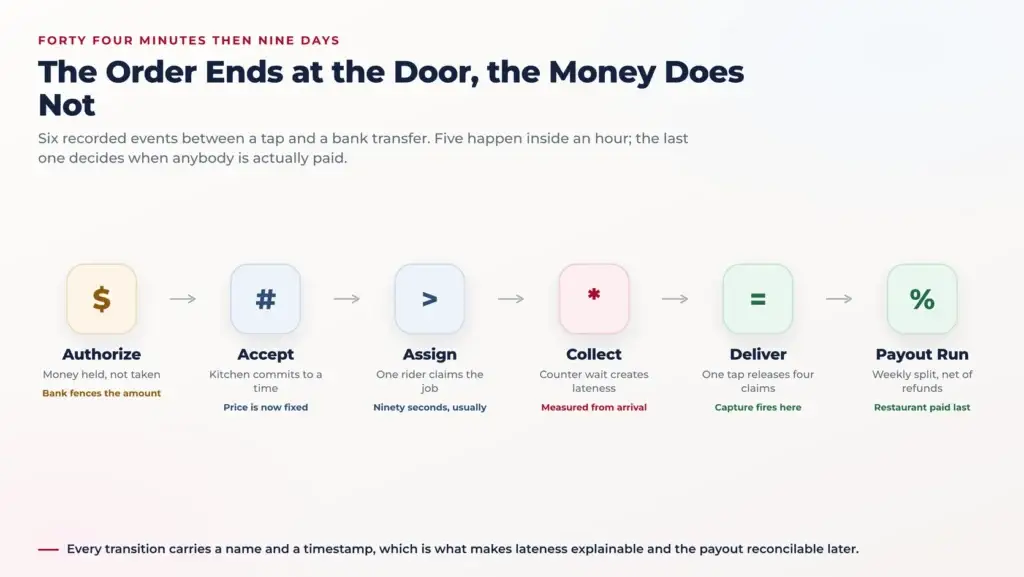
Image Source: AI-generated visual by Miracuves
The order starts collecting names and times
From assignment onward the order is not a status. It is a list of events, each with a name and a timestamp: authorized, accepted, assigned, arrived at outlet, collected, delivered.
That list is the only instrument for splitting blame fairly. A late order where the rider waited nineteen minutes at the counter is a kitchen problem; the same delay where he was assigned eleven minutes late is yours.
The counter is a queue, not a handover
The rider reaches the curry house at 8:04. The food was promised for 8:02 and is not ready, so he waits beside a counter that is also serving walk-in customers, and leaves at 8:11.
Those seven minutes appear in no complaint and nowhere in the customer’s model of what went wrong, yet across a zone at peak they are usually the largest single contributor to late orders.
Waiting is a cost, and it lands on somebody
Those seven minutes were not paid for by anyone unless you decide they were. Absorb the cost and your cost per delivery rises; charge the outlet and it is defensible but unpopular; pass it to the rider, the default if you do nothing, and you lose the riders who know your zone.
Most operators settle on an allowance: the first few minutes free, then a per minute amount accruing to the rider and recorded against the outlet. It sits directly upstream of Grubhub Revenue Model: Dispatch Cost Per Delivery Beats a Higher Fee.
The Dispatch Journey Between a Moving Dot and an Estimate
At 8:11 the rider marks the order collected and her screen becomes a map with an icon crawling along a road. She watches for ninety seconds, then stops.
The tracking map is the most photographed feature in delivery and the most misunderstood. It is an anxiety reducer, not an information source, and it does not tell her when the food will arrive.
What the moving dot really tells her
The dot is a position from a phone in a pocket, smoothed and sent at an interval. It lags, it jumps when signal returns after a tunnel, and on a batched run it shows a route that makes no sense to her.
How fresh that position can be without melting your infrastructure at peak is worked through in Sub-2 Second Tracking: Load-Testing GPS Delivery Updates on Flutter and Laravel. The product rule is narrower: never let the map be the only thing you say, because an icon with no words invites her to invent her own estimate.
What to say when the estimate is going to be wrong
Your system knows an order will be late several minutes before the customer does, because the collection timestamp came in nine minutes after the promise. That gap is the only window in which a late order becomes an acceptable one.
The honest pattern is a revised time with a reason, sent once and early. Customers forgive a late order with an explanation far more readily than a countdown that slides by a minute every ninety seconds for twenty minutes.
The Doorstep, and Why Delivery Dispatch Has Paid Nobody Yet
At 8:26 the rider arrives and the bag changes hands. What the platform records then, and can prove three days later when she says the order never came, has real depth to it: the evidence ladder, photographs and contactless drops are covered in Grubhub App Security Risks: Delivery Dispatch, Proof and Rider Safety. What concerns us is narrower: the delivered event is a financial trigger, not a status update.
Completion is the event the money waits for
Until the order is marked delivered, the rider has no earning, the restaurant has nothing to invoice, the platform has nothing to commission, and her money is still parked at her own bank. One tap on a doorstep in the rain releases all four.
That makes the reliability of the tap a treasury concern rather than a UX detail. An order physically delivered but never marked delivered is four parties waiting on a row that will never be written.
Capture, and what it is not
It is 8:27. The customer is eating, the restaurant has sold two curries, and financially almost nothing has happened.
Capture is the instruction that turns the reservation into a transfer, usually firing on the delivered event. It can be for less than the authorization but not more, which is why a tip added afterwards is a second charge rather than an edit to the first.
Capture does not put money in your account that evening either. The acquirer settles on its own cycle, commonly a few working days later, so even after capture the money is real but somewhere else.
Merchant of record, the question founders skip
There are two structures and they produce different businesses. The platform can collect the whole 24.60 in its own name and pay the restaurant its share, or the payment provider can split at capture and route the restaurant’s share straight to its account.
The first gives control and float, and makes you responsible for tax treatment, chargebacks and holding other people’s money. Software provides the controls for either; whether a structure is permitted where you operate is a question for your own advisors, settled before architecture rather than after.
One Payment, Five Destinations
The customer paid one number, and that number is not one thing. It is at least five obligations collected together, each owed to a different party on a different schedule.
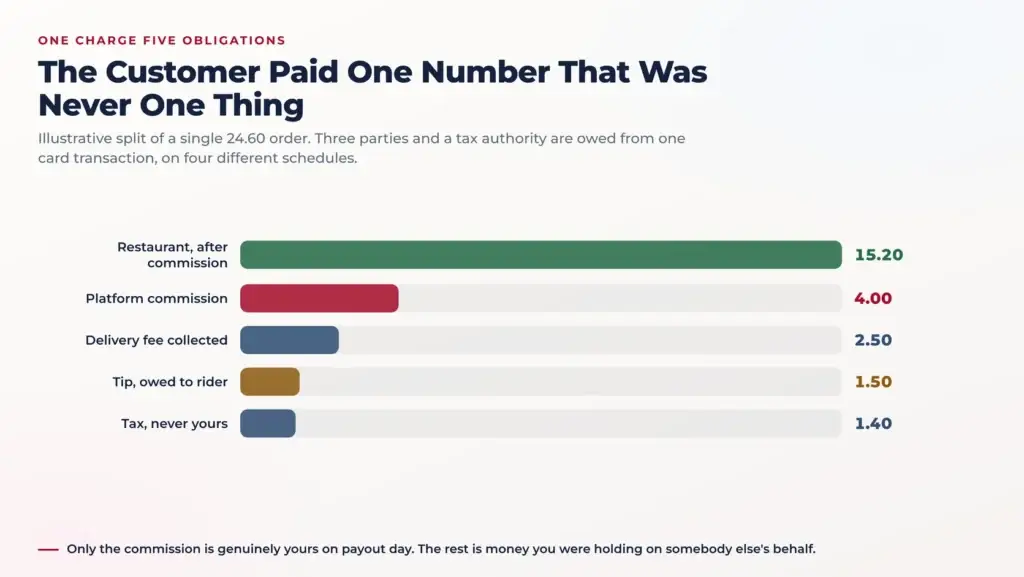
Image Source: AI-generated visual by Miracuves
The food subtotal belongs to the restaurant, less its agreed commission. The delivery fee belongs to the platform, which has separately agreed to pay a rider. The tip belongs to the rider and is never yours, and tax belongs to a government and was never yours at any point.
The restaurant share is not the menu price
The kitchen sold at its menu price and will be paid that less commission. If the outlet joined a promotion a further deduction applies, and an outlet that cannot see which orders carried one reads every deduction as a rate increase.
Commission is rarely one number in a mature operation. It varies by who delivered, by category and by whether the order came from a paid placement, which is a reconciliation problem unless the rate applied to an order is stored on it. The lines this creates are laid out on the business model page.
The delivery fee does not pay the rider
This is the most common misreading of the model. The customer paid a delivery fee of, say, 2.50, and the rider may earn more than that or less: the fee is what a customer tolerates, the rider payment is what gets a job accepted at 8pm in the rain.
On a long drop, or during a surge, the platform pays out more than it collected and takes that loss deliberately. How you manufacture the supply that sets that price is the subject of Grubhub Business Model: Dispatch Depends on an Hourly Rider Flow.
When Each Party Is Actually Paid
Three parties are owed money from one order and none are paid at the same time. The customer is charged within hours, the rider is paid next, and the restaurant is paid last by some distance.
The rider is paid on the shortest cycle
Riders are usually paid weekly, increasingly with an option to draw earnings sooner for a small fee. The cycle is short because somebody deciding at 5pm whether to work tonight is deciding partly on when the money lands.
A rider’s week is not one figure. It is base amounts per job, distance, waiting allowances, incentives and tips attached to specific orders, and a rider who cannot reconstruct his own week assumes he was shorted.
The restaurant is paid on a cycle, not per order
The curry house will not receive 24.60 less commission on Tuesday night. It receives one transfer covering a period, typically a week, arriving days after that period closes, so food sold on Tuesday can be money in the bank the following Wednesday.
Kitchens find this genuinely painful, because they buy ingredients with cash and pay staff on short cycles. It is also the most common reason an outlet quietly stops accepting orders.
Founder Decision Signals
Speed
Authorization at checkout and capture on the delivered event are table stakes. If your platform cannot separate the two, every cancellation becomes a refund and your support load triples in month one.
Cost
Waiting time at the counter is the cheapest lateness to fix and the most expensive to ignore. Measure it from a rider arrival timestamp before you spend anything on routing.
Scalability
A payout run handled by hand for forty restaurants will not survive four hundred. Build the statement and the adjustment ledger before you need them, not during your first disputed week.
Market Fit
In cash-heavy markets the money flows backwards and the rider carries your float. If that is your market, cash reconciliation is a launch requirement rather than a later feature.
What a Payout Run Actually Is
A payout run is a scheduled job that takes every order completed in a window, works out what each party is owed net of everything that has happened since, produces a statement, and issues one transfer per party.
Net is doing the heavy lifting. Between Tuesday’s order and Friday’s run, that order may have been partly refunded, disputed, adjusted for a missing item, or credited because the kitchen accepted responsibility.
Why it runs weekly rather than continuously
You could pay a restaurant the moment each order settles, and almost nobody does. Every transfer carries a cost, disputes arrive after delivery so paying instantly means clawing back later, and four hundred tiny credits are harder to reconcile than one credit with a statement behind it.
There is a fourth reason nobody says out loud, which is float. Money held between capture and payout is working capital, so be honest early about whether your cycle length is operationally justified or financially motivated.
A failed payout is a support ticket in waiting
Transfers fail. Details get mistyped, a bank rejects a name mismatch, an account closes when a restaurant changes hands. Treat a failed transfer as a first class event with an owner and a retry path, and treat a change of payout bank details as a security-sensitive action rather than a profile edit.
What the Restaurant’s Statement Has to Show
A statement is reconcilable when the restaurant’s own bookkeeper can start from the transfer that hit the bank and work backwards to individual orders without asking you a question. That is a high bar and most platforms fail it in their first year.
What Each Party Must Be Able To Verify Alone
| Party | What they check without asking you | What goes wrong without it |
|---|---|---|
| Customer | One pending line, one final charge, the tip shown separately, any refund traceable to an order | Duplicate charge complaints and card disputes you lose on paperwork |
| Restaurant | Every order, the commission rate applied to it, promotion deductions, adjustments and the resulting transfer | Silent deactivation: the outlet stops accepting rather than arguing |
| Rider | Per job base, distance, waiting allowance, incentive progress and the tip attached to each drop | Zone-wide distrust, spreading rider to rider faster than you can answer |
| Operator | Gross collected, amounts owed out, float held, and the contribution left per delivered order | A business that looks profitable until the payout run lands |
Order level lines, then adjustments
The statement needs two sections that are never mixed. First, one line per order: date, the reference the outlet sees on its tablet, gross food value, commission rate and amount, net. Second, everything that is not an order: refunds, promotion contributions, waiting recoveries, corrections.
Adjustments are where trust dies. Without a reason, a date and a reference, restaurants build their own spreadsheet from tablet screenshots, and the day it disagrees with yours the relationship turns adversarial.
The reconciliation test
Take a real week for one outlet, sum the order lines, apply the adjustments, and compare the result to the transfer that actually left your account, to the cent. Then hand it to somebody who was not involved and ask them to do the same unaided.
If it does not reconcile, you have a defect compounding silently every week. If it reconciles but nobody else can follow it, you have a support cost that grows with every restaurant you sign, which is why the features page treats statements and payouts as core rather than as reporting.
Cash Orders Run the Money Backwards
Run the same order again with one change. The customer chooses cash, and at the doorstep, instead of a tap releasing money you already control, the rider is handed 24.60 in notes.
The platform collected nothing, the restaurant is still owed its share, and the money for both is in a bag on a motorbike. In several large markets this is the majority of orders, which is why cash reconciliation belongs in the core rather than as a regional add-on.
The rider is briefly your debtor
From the moment the notes change hands, the rider owes the platform its portion of them, and the platform owes him his earnings for the shift. The two net off, and a rider carrying cash may end a shift owing you money.
Two controls make that workable and neither is optional: a running cash balance visible to the rider at all times, and a ceiling above which no further cash jobs are offered until he settles. Without the ceiling, your exposure to one rider grows all evening with nothing stopping it.
Float, exposure and the settlement moment
Settlement is the moment cash is handed over, at a hub or through a deposit matched against the balance. It produces a reconciliation: the balance the system says, the amount actually received, and a difference that is either zero or a conversation.
Small differences are normal and patterns are not. The system’s job is to make the pattern visible without anyone having to look, which is much of what separates a food delivery platform built for real markets from a demo that assumes everyone pays by card.
What a Refund Does to All Four Parties
Three hours later the customer reports that one curry was missing. This is the clearest test of whether the model is understood, because a refund is not one transaction reversed. It is four separate consequences and they do not cancel out.
The customer is made whole first
Whatever else is unresolved, she gets the value of the missing curry back and quickly, because the cost of a dish is almost always lower than the cost of the dispute and the lost account. A refund to the original card is clean but slow; credit on the platform is instant and cheaper for you, but it is not her money back.
The restaurant may or may not be charged back
A missing item is a kitchen error, so the value of the dish is deducted from that outlet’s next payout and appears on the statement with the order reference attached. That is the straightforward case, and most cases are not straightforward.
If the order arrived late and cold, that may be a dispatch failure and charging the restaurant is indefensible. If the same customer has reported a missing item on five of her last seven orders, the problem is none of the kitchens. Record a liability decision per refund, with a reason.
The rider is still paid, and somebody absorbs the rest
The rider collected the bag, carried it and handed it over, so his earning stands. Deducting from riders for kitchen errors is the fastest way to lose the riders who care.
That leaves arithmetic. The customer got money back, the rider was paid in full, and the restaurant was charged for the dish but not for the commission or the delivery, so somebody is short and that somebody is the platform.
Treating authorization and capture as one step
Charging in full at checkout turns every cancellation into a refund, every refund into days of customer anxiety, and every adjusted order into a visible double charge. Separating them is a day of work at the start and unrecoverable later.
Assuming the delivery fee pays the rider
They are two independent prices set by two different markets. Modelling them as one produces a plan that looks profitable at high density and quietly loses money on every long drop.
Shipping payouts before statements
A transfer with no reconcilable statement behind it creates a restaurant that cannot check you. It will not argue. It will stop accepting orders, and you will read about it in a churn report.
Recording adjustments without reasons
A deduction carrying only an amount is indistinguishable from an error. Every adjustment needs a reason, a date and a reference to the order or agreement it came from.
Deducting refunds from riders
Kitchen errors are not rider errors. Charging a rider for a sealed bag he never opened costs you the riders who know your zone, and those are the ones no incentive replaces.
Leaving cash reconciliation until later
In a cash-heavy market the rider holds your money for an entire shift. Without a running balance and a settlement ceiling, your exposure grows all evening with nothing to stop it.
The Four Parties, and What This Platform Is Not
Having followed one order through, the four parties look different from how they look in a pitch deck. None are buying software, and each leaves when the one thing it is buying stops arriving.
What each party is actually buying
The customer is buying the absence of a decision she has to manage, so anything that makes her chase or explain is a failure even when the food arrives on time. The rider is buying earnings per hour, not per job, and a well-paid job with a nineteen minute counter wait pays badly in the only unit he counts.
The restaurant is buying incremental orders at a predictable cost on a schedule it can plan around; it will never complain about your payout cycle, it will simply stop pressing accept on a Friday. The operator is buying a margin that survives refunds, waiting time and surge payments, which is what Which Features Does a Food Delivery Dispatch App Need for Order Assignment, Rider Tracking, and Fleet Control? assembles in one product.
Against a direct ordering page
A restaurant’s own ordering page has two parties, not four. The customer pays the restaurant, the restaurant is the merchant of record, and there is no commission to calculate and no payout run at all.
What it cannot do is deliver. The moment it needs a rider it has to acquire one, price the job, assign it, track it and pay it, which is why such pages either stay collection-only or rent dispatch from somebody else.
Against a discovery-led listings site
A listings site solves the half of the journey this article deliberately skipped. It helps the customer decide, hands the order to the restaurant and steps back: no rider, no assignment, no cash float, no payout run.
That is a real business and a lighter one. Choose which half you want to own; the delivery half is where a white label food delivery app saves the most time, and Ready-Made Delivery Food delivery dispatch app vs Custom Development: What Should Food Delivery Startups Choose? is worth reading before you commit.
Final Thoughts: One Order Contains the Whole Business
What Grubhub operates is a settlement pipeline with a map on the front of it.
Forty four minutes passed between a tap on a sofa and a bag changing hands at a door. In that time money was reserved but not taken, a kitchen made a commitment it could not revise, and seven minutes of invisible lateness were created at a counter. Nine days later, a restaurant received a transfer that had to explain itself.
If you can follow that sequence and say who holds the money at each step, you can explain this business without notes. Most people working in delivery cannot, because the front half is visible and the back half, where margin is decided, is not.
None of the pieces are exotic: authorization and capture, named timestamps, a waiting rule, a liability decision per refund, a reconcilable statement, a cash ceiling. They are rarely built together, which is why a purpose-built delivery dispatch app exists rather than a checkout bolted onto a menu. Our delivery scope and timelines separate what is ready-made from what is not, and you can book a working session to map your own version of these forty four minutes.
FAQs
What is the Grubhub app and how does delivery dispatch work?
Nothing moves yet. The platform asks your bank to authorize the amount, which fences it off in your account so it cannot be spent twice, without transferring it. Your app shows a pending line. The actual transfer, called capture, usually fires when the order is marked delivered. That is why a cancelled order rarely needs a refund: there was nothing to give back.
Why does a cancelled delivery order stay pending on my card?
Releasing a hold is an instruction the platform sends to your bank, and your bank applies it on its own schedule rather than instantly. The pending line can sit there for several working days even though the platform released it immediately. If the order total changed after the restaurant accepted, some issuers briefly display the original hold and the final charge side by side, which looks like a double bill.
What can a restaurant change after it accepts an order?
Very little, and that is deliberate. It can set how long the food will take, which is a promise about when a rider should be at the counter, and it can mark an item unavailable. It cannot change the price, substitute a dish without the customer agreeing, or quietly extend the time, because a rider has already been scheduled against the original commitment.
Why do dispatch orders arrive late when the rider does nothing wrong?
Most lateness is created at the counter. A rider who arrives on time and waits seven minutes for a bag that is not ready loses those minutes silently, because nothing records them unless the platform lets him mark arrival. Across a zone at peak, counter waiting is usually the single largest contributor to late orders, ahead of traffic or distance.
Does the delivery fee in a dispatch app go to the rider?
Not directly, and often not in the same amount. The fee is priced at what a customer in that zone will tolerate. The rider payment is priced at whatever it takes to get somebody to accept that job at that hour. On a short dense drop the fee covers the rider with something left over; on a long drop or during a surge the platform pays out more than it collected.
Why is the restaurant paid weekly instead of after each order?
Three practical reasons and one commercial one. Every bank transfer costs money, so hundreds of small ones cost far more than one. Disputes arrive after delivery, so paying instantly means clawing money back later, which is much harder than deducting it. And one credit with a statement behind it is easier to reconcile than four hundred tiny ones. The commercial reason is float.
What has to be on a restaurant statement for it to be checkable?
One line per order showing the date, the reference the outlet sees on its own tablet, the gross food value, the commission rate applied and the net. Then a separate section for everything that is not an order: refunds, promotion contributions, waiting recoveries and corrections. Each adjustment needs a reason, a date and a reference, otherwise it is indistinguishable from a mistake.
Who pays when a customer reports a missing item?
All four parties are affected differently. The customer is refunded quickly, usually before any investigation. The rider keeps his earning, because a sealed bag he never opened is not his error. The restaurant may be charged for the dish if the kitchen packed it wrong, with the deduction shown on its statement. The platform absorbs the commission and delivery it can no longer recover.
Miracuves is an independent software development company. We are not affiliated with, connected to, sponsored by, or endorsed by any company or product named in this article.
Terms such as “X Clone” are used descriptively. It is how the software industry refers to building a platform with functionality comparable to a known service, and how clients search for it.
The entire design and codebase of our products is built by our own team. Our products contain no code, design, graphics, or content originating from any third-party website or applications.
All third-party names and marks referenced in this article are the property of their respective owners, referenced solely to identify the services discussed.