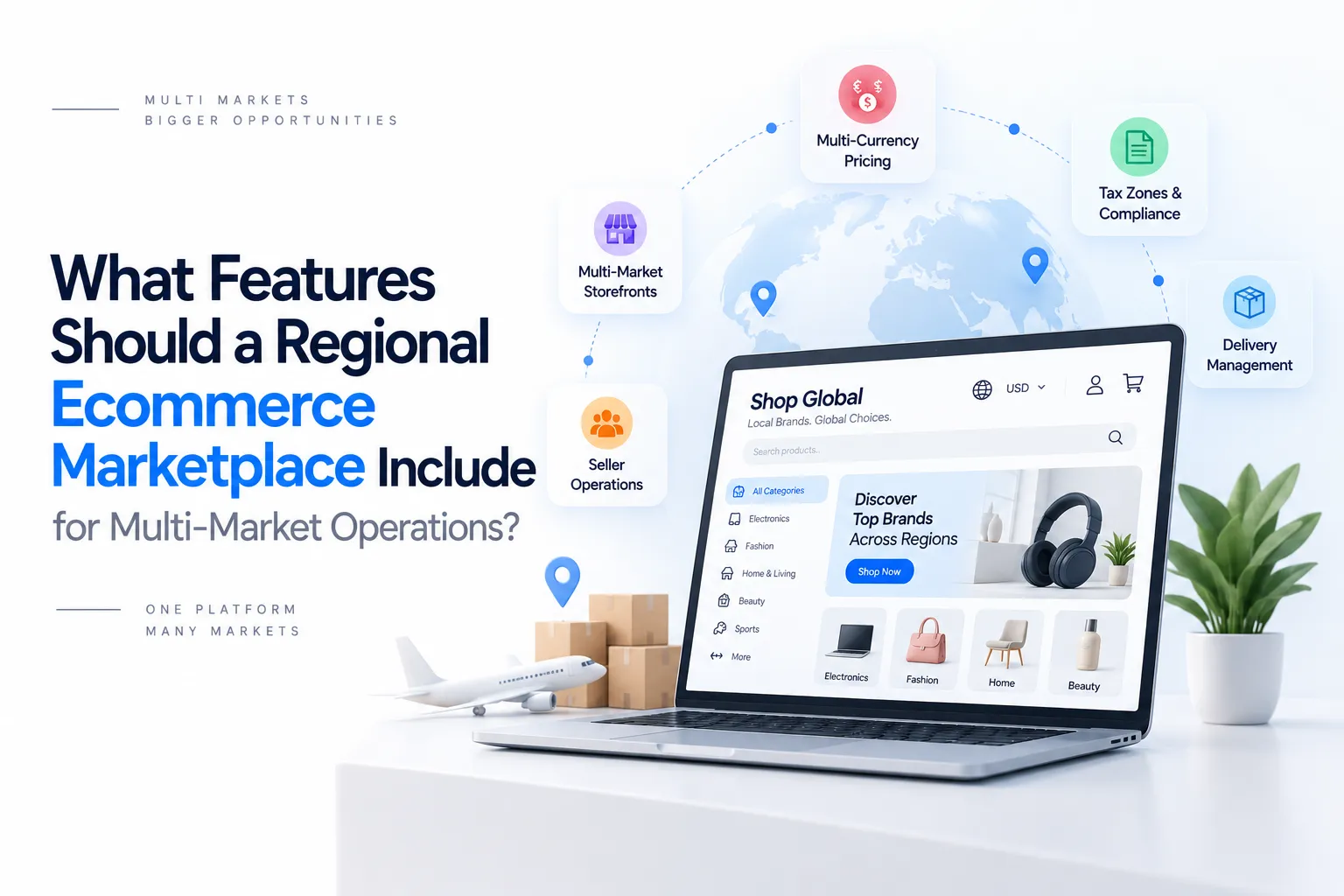
Regional ecommerce marketplaces are not just online stores with more sellers. They are operational systems that must handle different markets, buyer habits, currencies, delivery promises, seller rules, tax structures, payment preferences, and language expectations without breaking the customer experience.
That is why founders planning a regional marketplace need to think beyond a simple product catalog and checkout flow. The real question is not, “What ecommerce features should we add?” The better question is, “Which features help us operate across multiple markets without creating manual chaos?”
A marketplace serving one city can survive with basic catalog, cart, and payments. A marketplace serving multiple regions needs stronger control layers: vendor onboarding, local pricing, delivery zones, tax configuration, cash handling, refunds, payouts, analytics, moderation, and role-based admin workflows.
This guide breaks down the features a regional ecommerce marketplace should include if you want to support multi-market operations, reduce operational risk, and build a launch-ready foundation that can scale.
Key Takeaways
- Regional ecommerce marketplace features should support multiple markets, sellers, currencies, delivery rules, and payment preferences from one controlled backend.
- A multi-market marketplace needs more than a catalog and checkout. It needs vendor management, localized storefronts, tax logic, order workflows, and settlement controls.
- The admin dashboard is the operating center of the business because it controls sellers, products, orders, commissions, refunds, payouts, promotions, and reporting.
- Founders should prioritize features that reduce manual work, protect trust, and make market expansion easier.
- Miracuves helps founders launch ready-made and white-label ecommerce marketplace platforms with source code, branded design, admin control, and 6-day deployment where the ready-made scope fits.
Why Regional Ecommerce Marketplaces Need a Different Feature Strategy
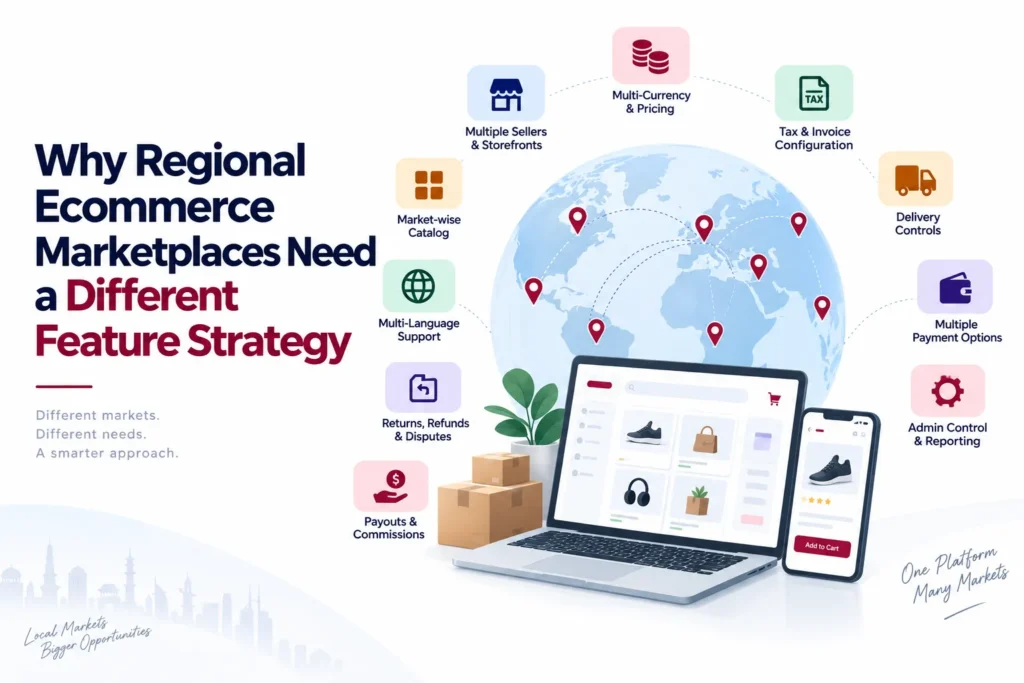
A single-market ecommerce business can usually start with a straightforward setup: one currency, one tax rule, one delivery model, one seller policy, and one language. Regional ecommerce is different.
The same product may need different pricing in different markets. Delivery may be fast in one city and slower across borders. Some buyers may prefer cards, while others expect cash on delivery. A category may be legal or serviceable in one location but restricted in another. Sellers may need separate commission plans, payout cycles, approval rules, and inventory workflows.
For founders, this creates a product risk: if the platform is not built for regional operations, every new market becomes a workaround.
A strong regional ecommerce marketplace should therefore support:
- Multiple seller accounts and storefronts
- Market-wise catalog visibility
- Local currencies and pricing rules
- Tax and invoice configuration by zone
- Delivery country, city, and zip-code controls
- Cash, wallet, card, and gateway-based payments
- Vendor payout and commission workflows
- Multi-language storefront content
- Refund, return, and dispute management
- Admin approval, reporting, and moderation controls
This is also where a ready-made foundation becomes valuable. Instead of building every operational module from zero, founders can start with a marketplace system that already includes the core flows and then customize it for the target region.
For founders comparing build options, Miracuves’ regional marketplace launch foundation is a useful next step when the goal is to understand how a multi-vendor commerce platform can support multi-market selling, vendor workflows, local delivery, and admin control.
Core Customer Features for a Regional Ecommerce Marketplace
The customer app or storefront is where trust is won or lost. In a regional marketplace, the buyer experience must feel local even if the platform is operating across several markets in the background.
Localized Homepage Experience
A regional marketplace should not show the same homepage to every user. The homepage should adjust based on location, language, delivery availability, category demand, and promotional strategy.
Important homepage features include:
- Location-based product visibility
- Market-specific banners and offers
- Featured sellers by region
- Local language support
- Category blocks based on buyer demand
- Recently viewed and recommended products
- Delivery promise visibility before checkout
This matters because buyers do not think in terms of platform architecture. They only care whether the product is available, priced clearly, deliverable to them, and easy to purchase.
Smart Search and Filter System
Search is one of the most important revenue features in a marketplace. If users cannot find what they want quickly, they leave.
A regional ecommerce marketplace should include:
- Keyword search
- Category and subcategory filters
- Brand filters
- Price range filters
- Rating filters
- Delivery speed filters
- Seller filters
- Availability by location
- Search suggestions
- Recently searched terms
For multi-market operations, search should also respect serviceability. A buyer should not discover a product that cannot be delivered to their city unless the platform clearly explains the limitation.
Product Detail Pages Built for Trust
A strong product page should help buyers make decisions without needing support. This is especially important in regional markets where new users may still be building trust with the platform.
Useful product page features include:
- Product images and videos
- Variant selection such as size, color, or model
- Market-specific price display
- Delivery estimate by location
- Seller information
- Stock availability
- Ratings and reviews
- Product Q&A
- Return policy
- Warranty or service information where relevant
- Related products and bundles
The product page should not only sell the item. It should reduce uncertainty.
Vendor and Seller Features That Keep Supply Under Control
In a regional marketplace, sellers are not just users. They are the supply engine of the business. Poor seller onboarding creates poor product quality, delayed orders, refund pressure, and customer trust issues.
Seller Registration and Verification
A marketplace should allow sellers to register, submit business details, upload documents, and wait for platform approval before listing products.
Useful seller onboarding features include:
- Seller profile creation
- Business information collection
- Document upload
- Bank or payout detail submission
- Category access request
- Approval and rejection workflow
- Seller status management
- Internal notes for admin teams
This helps the platform operator control who can sell, which categories they can access, and whether they meet marketplace standards.
Seller Dashboard for Catalog and Orders
Every seller needs a clear dashboard to manage products, stock, pricing, orders, returns, and payouts.
A practical seller dashboard should include:
- Product creation and editing
- Bulk product import
- Inventory management
- Variant-level stock control
- Order queue
- Packing and shipping status updates
- Return and refund responses
- Seller wallet
- Withdrawal requests
- Performance analytics
- Customer message access where enabled
For founders, the seller dashboard is not just a convenience feature. It reduces dependency on the internal operations team. The more sellers can manage safely on their own, the more scalable the marketplace becomes.
Product Approval and Listing Moderation
Not every product submitted by a seller should go live immediately. Regional marketplaces need product moderation to control quality, prohibited items, duplicate listings, incorrect descriptions, and misleading pricing.
Recommended moderation features include:
- Product approval queue
- Category-level moderation rules
- Image review
- Price review
- Restricted product flagging
- Seller warning system
- Listing suspension
- Admin edit history
This is especially important for marketplaces selling electronics, wellness products, grocery, fashion, cosmetics, or other categories where inaccurate listings can create disputes.
Read more: Regional Ecommerce Marketplace vs Global Marketplace: Which Business Model Fits Startups Better?
Marketplace Operations Features for Multi-Market Control
The admin dashboard is where the platform becomes a real business. Without strong admin control, founders may launch a nice-looking app but struggle with orders, sellers, payments, tax, refunds, and customer support.
Multi-Market Configuration
Multi-market configuration allows the operator to define how each region behaves.
This should include:
- Market creation and management
- Country, city, and zone setup
- Currency assignment
- Tax class assignment
- Delivery availability rules
- Language settings
- Local payment method activation
- Market-wise promotional rules
This is one of the most important features for regional ecommerce. It allows founders to expand without creating a separate platform for every geography.
Currency and Local Pricing Rules
If your marketplace operates across countries or regions, pricing cannot be treated as a single universal number. The platform should support currency rules and pricing displays that make sense for each market.
Useful capabilities include:
- Default currency per market
- Product pricing by currency
- Exchange-rate configuration where needed
- Refunds in the buyer’s payment currency
- Seller payout currency settings
- Market-wise discount rules
The goal is not just to display different symbols. The goal is to keep checkout, refunds, seller earnings, and accounting aligned.
Tax and Invoice Configuration
Tax rules can differ by region, product category, seller type, and buyer location. A marketplace should allow admins to configure tax logic clearly instead of depending on manual calculations.
Important tax-related features include:
- Tax zones
- Category-wise tax rules
- Product-level tax overrides
- Inclusive or exclusive tax display
- Tax breakdown at checkout
- Invoice generation
- Refund tax reversal logic
- Admin tax reports
Founders should treat tax configuration as a platform feature, not a spreadsheet task.
Regional Marketplace Feature Priorities
| Feature | Business Value | Founder Impact |
|---|---|---|
| Multi-market configuration | Lets each region have its own delivery, language, currency, and tax settings. | Supports expansion without creating separate platforms for every market. |
| Vendor approval workflow | Protects product quality and marketplace trust. | Reduces risk from low-quality sellers and unmanaged listings. |
| Currency and pricing controls | Keeps pricing, refunds, and payouts aligned across regions. | Prevents accounting confusion as new markets are added. |
| Delivery zone management | Controls where products can actually be delivered. | Reduces failed orders and customer complaints. |
| Cash and online payment support | Matches local buyer payment habits. | Improves conversion in markets where prepaid checkout is not always preferred. |
| Admin reporting | Shows sales, sellers, orders, refunds, payouts, and market performance. | Helps founders make expansion decisions based on operational data. |
Checkout, Payments, and Cash Handling Features
Checkout is where marketplace complexity becomes visible. A single-vendor checkout is simple. A multi-vendor, multi-region checkout has to manage product availability, seller-wise shipping, taxes, discounts, wallet credits, payment methods, and order splitting.
10. Multi-Vendor Cart and Checkout
A buyer may add products from different sellers in one cart. The platform should be able to calculate each seller’s shipping, tax, availability, and fulfilment status properly.
A strong checkout flow should include:
- Multi-seller cart
- Guest cart with login merge
- Address management
- Delivery estimate before payment
- Seller-wise shipping calculation
- Coupon and wallet application
- Tax calculation
- Payment method selection
- Order confirmation
- Failed payment handling
- Duplicate order protection
The checkout should feel simple for the buyer even if the backend is managing many moving parts.
Local Payment Method Support
Regional marketplaces should support the payment methods buyers actually use in the target market. This may include card payments, wallets, bank transfers, local gateways, and cash on delivery.
Key payment features include:
- Payment gateway integration
- Wallet support
- Cash on delivery
- Refund processing
- Payment status tracking
- Failed payment recovery
- Seller settlement tracking
- Payment logs
Local payment flexibility can improve conversion because buyer trust varies by market.
Cash on Delivery Reconciliation
In many regional markets, cash is still part of ecommerce behavior. But cash on delivery is not just a payment option. It is an operational workflow.
A marketplace with cash handling should include:
- Cash order tagging
- Delivery agent collection tracking
- OTP or code-based handover
- Agent cash balance
- Cash settlement status
- Admin reconciliation dashboard
- Handling fee configuration
- Cash refund workflow where needed
Without reconciliation, cash orders quickly become an accounting problem.
Delivery and Fulfilment Features for Regional Operations
Delivery is one of the hardest parts of regional ecommerce because the promise changes by location. A dense metro route, a remote town, and a cross-border shipment cannot be managed with the same delivery logic.
Delivery Zone and Serviceability Controls
A marketplace should let admins define where the platform can deliver and which products are available in which area.
Important delivery controls include:
- Country, city, and zip-code serviceability
- Zone-wise delivery fees
- Category-wise shipping overrides
- Seller-wise delivery rules
- Minimum order rules
- Free shipping rules
- Restricted area settings
Serviceability control protects the customer experience. It prevents buyers from placing orders the business cannot fulfil profitably.
Delivery Agent App or Logistics Workflow
If the marketplace manages its own delivery network, a delivery agent app becomes essential.
Useful delivery features include:
- Delivery agent onboarding
- Agent approval
- Order assignment feed
- Accept or reject delivery tasks
- Pickup status
- Live location tracking
- Navigation support
- OTP proof of delivery
- Cash collected tracking
- Earnings and payout requests
Even if the business uses third-party logistics initially, having delivery workflow logic in the platform helps operators manage future expansion.
Order Status and Tracking
Customers want clarity after purchase. Sellers need clarity after order placement. Admins need clarity when something goes wrong.
A strong order system should include:
- Order placed
- Payment pending or confirmed
- Seller accepted
- Packed
- Picked up
- Out for delivery
- Delivered
- Cancelled
- Returned
- Failed delivery
- Refund initiated or completed
Each status should have timestamps and actor history so the operations team can resolve disputes faster.
Founder Decision Signals
Speed
If your launch depends on months of custom engineering, your competitors may spend that time onboarding sellers and building demand. A ready-made foundation can help validate faster when the core marketplace flows already exist.
Cost
The expensive part of regional ecommerce is not only development. It is rework. Missing payout, tax, delivery, or admin logic early can create costly fixes after launch.
Scalability
A scalable marketplace should let you add regions, sellers, categories, and delivery rules through configuration instead of rebuilding the platform each time.
Market Fit
Local buyer behavior matters. Payment preferences, language, delivery expectations, and category demand should shape the first launch version.
Monetization Features Every Regional Marketplace Should Include
A marketplace should be built around revenue logic from the start. Monetization should not be added as an afterthought because it affects seller plans, commissions, payouts, checkout, invoices, promotions, and reporting.
Commission Management
Commission is the core revenue model for many ecommerce marketplaces. The platform should allow flexible commission rules based on seller, category, market, or product type.
Commission features may include:
- Category-wise commission
- Seller-wise commission
- Market-wise commission
- Fixed or percentage fees
- Commission deduction on completed orders
- Refund reversal logic
- Commission reports
This helps founders adjust monetization without needing developer support for every commercial change.
Seller Subscription Plans
Some marketplaces charge sellers for access, visibility, or premium tools. Subscription plans can be useful when the platform has seller demand and a clear value proposition.
Useful seller plan features include:
- Free and paid seller tiers
- Product listing limits
- Featured seller access
- Trial periods
- Grace periods
- Renewal reminders
- Plan-wise commission differences
This allows the marketplace to monetize both transactions and seller participation.
Promotions, Ads, and Featured Listings
Regional marketplaces often need seller-funded visibility. Promotions can help sellers increase reach while creating an additional revenue stream for the platform.
Promotion features include:
- Featured product placements
- Sponsored category slots
- Banner management
- Coupon campaigns
- Flash deals
- Market-wise promotional campaigns
- Seller-funded discounts
- Campaign performance reports
The key is admin control. Promotions should be measurable, configurable, and aligned with marketplace economics.
Security, Trust, and Compliance-Ready Workflows
Trust is central to any marketplace. Buyers need safe payments. Sellers need transparent settlements. Operators need audit trails. Support teams need clear records.
A regional ecommerce marketplace should include security and control features such as:
- Encrypted data transfer
- Secure payment gateway integration
- Role-based access control
- Admin activity logs
- Seller verification
- Customer account protection
- Refund and dispute records
- Product moderation
- Abuse reporting
- Order and payout history
- Permission-based dashboards
For regulated or sensitive categories, the platform should support compliance-ready workflows. Final compliance depends on the target jurisdiction, legal review, payment integrations, operating model, and category-specific requirements.
Marketplace trust is not built by one feature. It is built by consistent records, controlled access, transparent policies, and reliable dispute resolution.
Analytics and Admin Reporting Features

Founders cannot scale what they cannot measure. A regional marketplace needs analytics that show both overall performance and market-level performance.
Useful reporting features include:
- Gross sales
- Net revenue
- Commission earned
- Seller performance
- Product performance
- Market-wise order volume
- Refund and return rate
- Delivery performance
- Payment method usage
- COD exposure
- Customer retention
- Coupon usage
- Inventory movement
- Support and dispute trends
The strongest reports help founders answer practical questions:
- Which market is growing fastest?
- Which sellers create the most refunds?
- Which categories have the best margin?
- Which delivery zones are unprofitable?
- Which payment methods convert better?
- Which promotions create repeat orders?
Analytics should turn operations into decisions.
Ready-Made vs Custom Build: Which Route Fits a Regional Marketplace?
Founders usually have two build paths: start from a ready-made marketplace foundation or build everything custom from zero.
A custom build may fit if the business model is highly unusual, heavily integrated with legacy systems, or requires category-specific workflows that cannot be adapted from an existing foundation.
A ready-made marketplace foundation is often better when the business needs standard but complex ecommerce flows such as sellers, catalog, checkout, delivery, payouts, commissions, refunds, and admin control.
| Build Route | Best For | Strength | Watch-Out |
|---|---|---|---|
| Ready-made marketplace foundation | Founders who need faster launch and proven marketplace flows | Faster deployment, lower rework risk, pre-built admin and seller modules | Must confirm the base platform supports your required markets, payments, and delivery rules |
| Fully custom build | Businesses with highly unique workflows or deep enterprise integrations | Maximum flexibility from the beginning | Higher cost, longer timeline, and more discovery effort |
| Plugin-based ecommerce setup | Small catalogs or simple single-vendor stores | Quick setup for basic commerce | Often weak for multi-vendor, multi-market, payout, and delivery complexity |
For founders who want to launch faster, Miracuves can help with a white-label, source-code-owned marketplace foundation that can be branded, configured, and deployed quickly. When the ready-made scope matches the business requirements, Miracuves’ 6-day solution delivery can help reduce the time between planning and market validation.
Mistakes Founders Should Avoid
Building Only for One Market
If the platform is hardcoded for one currency, one tax rule, or one delivery model, every future expansion becomes expensive. Multi-market thinking should be part of the foundation.
Ignoring Seller Operations
A marketplace without strong seller onboarding, product approval, inventory control, and payout workflows will struggle as supply grows.
Treating Cash on Delivery as a Simple Payment Option
Cash orders need agent tracking, proof of delivery, collected cash records, and settlement workflows. Without this, finance teams end up fixing platform gaps manually.
Leaving Admin Controls Too Basic
The admin dashboard should manage markets, sellers, orders, payments, refunds, commissions, promotions, and reports. A weak admin panel creates dependence on developers for everyday operations.
A Practical Feature Checklist for Multi-Market Ecommerce Launches
Before choosing a technology partner or marketplace platform, founders should check whether the system supports the operational depth required for regional commerce.
Customer Features
- Localized homepage
- Search and filters
- Product pages with variants
- Wishlist
- Cart and checkout
- Multiple payment options
- Order tracking
- Reviews and ratings
- Refund and return requests
- Notifications
Seller Features
- Seller onboarding
- Document verification
- Seller dashboard
- Product management
- Bulk import
- Inventory control
- Order management
- Return responses
- Wallet and payouts
- Seller analytics
Admin Features
- Market configuration
- Currency controls
- Tax zones
- Delivery zones
- Seller approval
- Product moderation
- Commission setup
- Coupon management
- Refund management
- Payout processing
- Staff permissions
- Reports and analytics
Delivery Features
- Delivery zone rules
- Shipping fee configuration
- Delivery agent app
- Pickup and drop status
- Live tracking
- Proof of delivery
- COD collection tracking
- Delivery performance reports
Trust and Security Features
- Secure login
- Encrypted data handling
- Role-based access
- Payment gateway security
- Activity logs
- Dispute management
- Abuse reporting
- Seller verification
- Product moderation
If most of these are missing, the platform may look ready on the frontend but create operational problems after launch.
How Miracuves Helps Founders Launch Regional Ecommerce Marketplaces Faster
Miracuves helps founders, startups, agencies, and businesses launch ecommerce marketplace platforms with ready-made and white-label app foundations. Instead of starting from a blank development plan, founders can begin with core marketplace modules such as buyer experience, seller management, admin control, product catalog, checkout, delivery workflows, payments, commissions, and reporting.
The key advantage is speed with control. A launch-ready foundation helps founders validate demand faster, while source-code ownership gives the business more flexibility after launch. For ready-made marketplace solutions where the selected scope fits, Miracuves offers 6-day deployment so founders can move from planning to a working branded product faster.
For a deeper look at a marketplace system built around regional commerce logic, explore this multi-market marketplace solution from Miracuves. You can also review broader white-label ecommerce app solutions or the retail and ecommerce development expertise behind marketplace builds.
Final Thoughts: Build for Regional Operations, Not Just Online Sales
A regional ecommerce marketplace succeeds when the platform reflects the reality of the market. That means local pricing, seller control, delivery serviceability, payment flexibility, tax configuration, refund workflows, and admin visibility must work together.
Founders should not treat features as a checklist of screens. Every feature should solve an operational problem: helping buyers trust the platform, helping sellers manage supply, helping delivery teams complete orders, and helping admins control the business.
The stronger decision is not always the longest build. It is the build that gives your marketplace enough control to launch, learn, and expand without rebuilding the foundation each time.
FAQs
What features are most important for a regional ecommerce marketplace?
The most important features are multi-vendor catalog management, market-wise pricing, local currency support, delivery zone control, tax configuration, seller onboarding, checkout, payment options, refunds, payouts, admin analytics, and security workflows.
Why does a regional marketplace need multi-market configuration?
Multi-market configuration helps the platform manage different regions from one backend. Each market may need different currencies, delivery rules, languages, taxes, payment methods, promotions, and seller policies.
Should a regional ecommerce marketplace support cash on delivery?
Yes, if the target market still has strong cash payment behavior. Cash on delivery should include collection tracking, delivery agent settlement, proof of delivery, and admin reconciliation so finance teams can manage it properly.
What admin features should a multi-vendor ecommerce platform include?
The admin dashboard should include seller approval, product moderation, category management, order tracking, market configuration, commission setup, tax rules, refund handling, payout processing, staff permissions, analytics, and reports.
How do seller features affect marketplace growth?
Seller features directly affect product supply and operational quality. Strong seller onboarding, catalog tools, inventory control, order management, and payout visibility help sellers operate independently and reduce support load.
Is a ready-made marketplace platform better than custom development?
A ready-made marketplace platform can be better when founders need faster launch, tested core flows, admin control, and lower rework risk. Custom development may be better for highly unique workflows, complex enterprise integrations, or unusual business models.
How does localization improve ecommerce marketplace conversion?
Localization improves conversion by showing users relevant language, currency, delivery options, promotions, and product availability. Buyers are more likely to complete purchases when the platform feels built for their region.
How can Miracuves help with regional ecommerce marketplace development?
Miracuves helps founders launch ready-made and white-label ecommerce marketplace platforms with source code, branded design, admin dashboards, seller workflows, delivery logic, and faster deployment. When the ready-made scope fits, Miracuves can support 6-day solution delivery.
Miracuves is an independent software development company. We are not affiliated with, connected to, sponsored by, or endorsed by any company or product named in this article.
Terms such as “X Clone” are used descriptively. It is how the software industry refers to building a platform with functionality comparable to a known service, and how clients search for it.
The entire design and codebase of our products is built by our own team. Our products contain no code, design, graphics, or content originating from any third-party website or applications.
All third-party names and marks referenced in this article are the property of their respective owners, referenced solely to identify the services discussed.