




















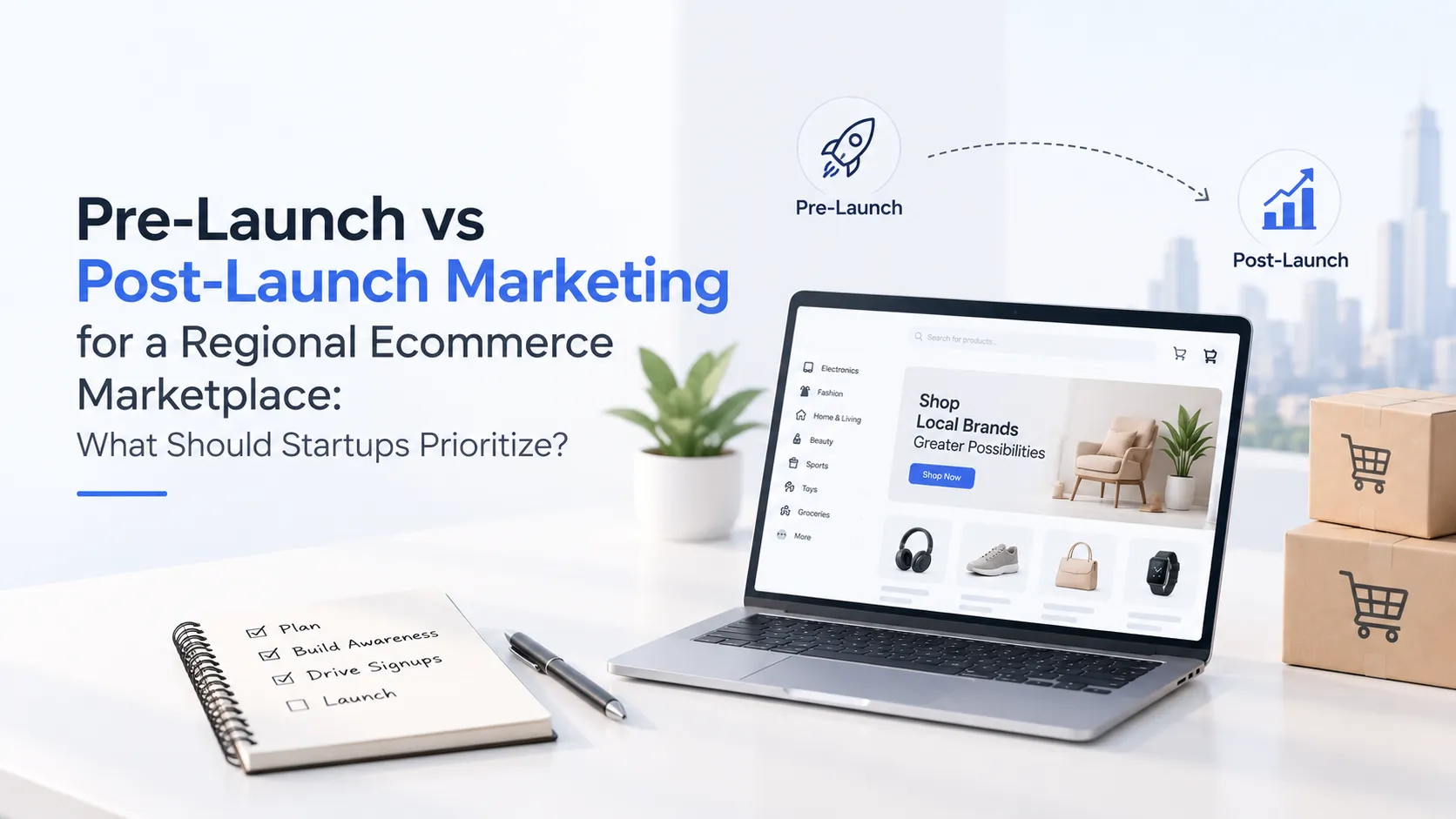
Key Takeaways
- Pre-launch marketing prepares marketplace supply, customer demand, regional trust, and launch visibility.
- Post-launch marketing converts early attention into orders, reviews, referrals, repeat purchases, and seller activity.
- Effective marketing for regional ecommerce must address buyers and sellers at different stages of the journey.
- Startups should validate product categories, delivery zones, payment preferences, and local buying behavior before scaling campaigns.
- The strongest strategy uses pre-launch activity to build readiness and post-launch activity to create repeatable growth.
Marketing Priority Signals
- Before launch, prioritize regional positioning, seller outreach, category research, landing pages, and buyer waitlists.
- Build trust by explaining seller verification, payment security, delivery coverage, returns, and customer support.
- After launch, focus on first-order conversion, abandoned carts, retargeting, reviews, referrals, and loyalty campaigns.
- Monitor conversion rates, repeat purchases, order frequency, delivery performance, seller fulfillment, and customer complaints.
- Move larger budgets into proven categories, locations, audiences, and campaigns only after reliable transaction data becomes available.
Real Insights
- Launching with buyer traffic but insufficient seller supply can cause users to leave before placing an order.
- Onboarding sellers without creating customer demand can reduce seller confidence and marketplace participation.
- Heavy paid acquisition should wait until checkout, inventory, delivery, and customer support workflows are dependable.
- Post-launch order data provides stronger marketing direction than pre-launch assumptions or vanity engagement metrics.
- Miracuves develops regional ecommerce marketplaces with seller onboarding, product management, payments, delivery workflows, promotions, analytics, and admin controls.
Launching a regional ecommerce marketplace is not just a technology decision. It is a timing decision, a supply decision, a demand decision, and a trust-building decision.
Many founders spend months thinking about app screens, product categories, payment gateways, delivery flows, and vendor panels. Those things matter. But the marketplace does not become valuable only because it exists. It becomes valuable when the right sellers join, the right buyers trust it, and the first orders create repeatable growth signals.
That is where pre-launch and post-launch marketing become important.
Pre-launch marketing helps a regional ecommerce startup create awareness, onboard sellers, test demand, collect early users, and build launch momentum before the platform goes live. Post-launch marketing helps convert that early attention into orders, repeat purchases, customer trust, vendor activity, and revenue growth.
The real question is not whether pre-launch or post-launch marketing is more important. The smarter question is: what should a regional ecommerce marketplace prioritize at each stage so the launch does not feel empty on day one and growth does not stop after the first campaign?
For founders building a multi-vendor ecommerce business, this guide explains how to balance both stages, what to prioritize before and after launch, and how a launch-ready marketplace foundation from Miracuves can help reduce the gap between planning and execution.
Why Marketing Timing Matters for Regional Ecommerce Marketplaces
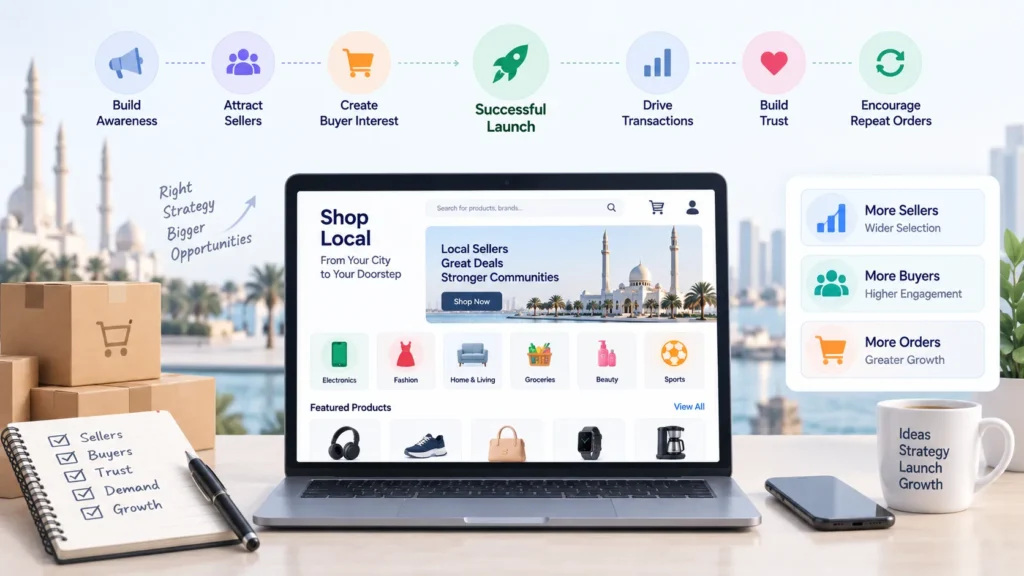
Image Source: AI-generated visual by Miracuves
A regional ecommerce marketplace has a different launch challenge from a normal online store.
A single-brand ecommerce store mainly needs product-market fit, traffic, conversion, and fulfilment. A regional marketplace has to solve both sides at once. It needs sellers, inventory, pricing, product quality, customer trust, payment confidence, delivery coverage, customer support, and marketplace governance.
If the platform launches with buyers but not enough sellers, customers leave. If it launches with sellers but no demand, vendors lose interest. If it launches with offers but weak delivery, the first reviews suffer. If it launches with paid traffic but poor onboarding, customer acquisition cost rises before the business learns what works.
That is why marketing cannot start only after launch. It should begin before the platform goes live, but the goal of pre-launch marketing should not be vanity hype. It should prepare the marketplace for real transactions.
For regional ecommerce founders, marketing timing should answer four business questions:
- Do sellers understand why they should join this marketplace?
- Do buyers understand why this platform is useful in their region?
- Is there enough trust for first-time transactions?
- Can the platform turn early demand into repeat orders after launch?
When those answers are clear, marketing becomes a growth system instead of a launch announcement.
Read More: Why Startups Choose a Ready-Made Regional Ecommerce Marketplace Over Custom Development
What Is Pre-Launch Marketing for a Regional Ecommerce Marketplace?
Pre-launch marketing is everything a startup does before the marketplace goes live to prepare supply, demand, trust, and launch visibility.
For a regional ecommerce marketplace, this includes seller outreach, category research, local audience building, brand positioning, landing pages, waitlists, social media previews, city-level campaigns, influencer partnerships, email collection, and launch offer planning.
But the strongest pre-launch campaigns are not just promotional. They are investigative.
They help founders learn which categories people care about, which vendors are willing to join, which delivery zones are realistic, which pricing models make sense, and which customer segments are most likely to place the first orders.
A good pre-launch campaign should help you validate:
- Which product categories should launch first
- Which cities, towns, or delivery zones have stronger early demand
- What vendor objections must be solved
- What customers expect from delivery, returns, and payment options
- What offers or loyalty hooks can trigger first purchases
- What brand promise feels locally relevant
This is especially important for regional marketplaces because trust is often built through familiarity. Local sellers, local language, regional festivals, cash preferences, neighbourhood-level delivery expectations, and city-specific buying habits can all affect adoption.
What Is Post-Launch Marketing for a Regional Ecommerce Marketplace?
Post-launch marketing begins once the marketplace is live and real users can browse, order, pay, review, return, refer, and repeat.
At this stage, the goal shifts from preparation to performance. Founders need to understand what users actually do, not just what they said they would do before launch.
Post-launch marketing includes paid campaigns, email flows, push notifications, app engagement, referral programs, retargeting, loyalty campaigns, seller promotions, customer support communication, review collection, local partnerships, and performance analysis.
The strongest post-launch marketing systems focus on behaviour:
- Who placed the first order?
- Which categories converted fastest?
- Which products got abandoned in carts?
- Which delivery zones performed reliably?
- Which vendors fulfilled orders on time?
- Which offers drove repeat orders?
- Which customers came back without discounts?
- Which complaints appeared repeatedly?
This stage is where a regional ecommerce marketplace becomes sharper. The founder can stop guessing and start improving acquisition, retention, pricing, vendor performance, catalogue quality, delivery reliability, and customer trust.
Read More: Regional Ecommerce Marketplace vs Global Marketplace: Which Business Model Fits Startups Better?
Pre-Launch vs Post-Launch Marketing: The Core Difference
Pre-launch marketing builds readiness. Post-launch marketing builds repeatability.
Before launch, the startup is trying to create enough confidence and momentum to avoid launching into silence. After launch, the startup is trying to convert that momentum into orders, insights, retention, and scalable growth.
| Marketing Stage | Primary Goal | Founder Priority | Success Signal |
|---|---|---|---|
| Pre-launch marketing | Build awareness, collect early demand, and prepare vendor supply | Validate categories, onboard sellers, create launch interest, and define regional positioning | Waitlist signups, vendor commitments, launch registrations, and early campaign engagement |
| Post-launch marketing | Convert users, increase orders, retain customers, and improve marketplace operations | Drive first purchases, repeat orders, reviews, referrals, and seller performance | Conversion rate, repeat purchase rate, order frequency, customer feedback, and vendor fulfilment quality |
| Pre-launch content | Explain the marketplace promise before transactions begin | Educate buyers and sellers on why the platform matters locally | Audience trust, email subscribers, vendor inquiries, and social proof signals |
| Post-launch content | Support transactions, trust, and retention | Promote categories, offers, delivery zones, seller stories, and customer reviews | Traffic to product pages, order conversions, app engagement, and repeat visits |
What Startups Should Prioritize Before Launch
Pre-launch marketing should be practical, not noisy. A marketplace founder does not need to be everywhere before launch. The priority is to build enough supply, demand, and trust to make the first month meaningful.
1. Define the Regional Marketplace Positioning
Before running campaigns, founders need a clear answer to one question: why should customers in this region use this marketplace instead of buying the way they already buy?
The answer could be faster access to local sellers, better category discovery, regional product availability, trusted delivery, better pricing, curated vendors, local language support, or a stronger shopping experience for specific communities.
Weak positioning sounds like “buy anything online.” Strong positioning sounds like “discover trusted local sellers in your city with reliable delivery and simple payment options.”
A regional ecommerce platform needs a local reason to exist. Without that, pre-launch marketing becomes generic and expensive.
2. Build a Vendor Acquisition Pipeline Early
For a marketplace, sellers are not an afterthought. They are part of the product.
Before launch, founders should identify priority vendor categories, create seller onboarding messages, prepare vendor benefits, and build a simple pipeline for outreach. This can include local retailers, distributors, independent sellers, regional brands, wholesalers, boutique stores, grocery merchants, fashion sellers, electronics dealers, or niche category experts.
The goal is not to onboard every seller possible. The goal is to onboard enough quality sellers in categories that can drive repeat transactions.
Vendor pre-launch marketing should explain:
- Why joining early gives sellers an advantage
- What commission or listing model is being used
- How orders, payouts, and fulfilment will work
- What support sellers receive during onboarding
- How the marketplace plans to attract buyers
- What makes the platform regionally relevant
A strong seller base gives customer marketing more credibility. Buyers are more likely to trust a marketplace when product availability feels real from day one.
3. Create a Landing Page That Captures Both Buyers and Sellers
A pre-launch landing page should not be a vague “coming soon” page. It should capture intent from both sides of the marketplace.
For customers, it should explain what they can expect, which categories are launching, which locations are covered, and why joining early matters. For sellers, it should explain how to register interest, what benefits they get, and how the platform will support their online growth.
Useful landing page sections include:
- Regional marketplace promise
- Buyer waitlist form
- Seller interest form
- Launch categories
- Expected delivery zones
- Early access offer
- Trust and support message
- Contact or consultation option for vendors
If the startup is still finalizing the product foundation, this is also a natural place to guide readers toward a regional marketplace app foundation that already supports multi-vendor commerce workflows.
4. Test Category Demand Before Spending Heavily
Not every category deserves equal attention on launch day. Some categories create frequent orders. Some create higher order value. Some create vendor interest but low buyer urgency. Some perform well only during seasonal demand.
Pre-launch marketing should help founders identify which categories deserve the strongest opening push.
A regional ecommerce marketplace can test demand through:
- Polls and surveys
- City-specific social campaigns
- Early access forms
- Search trend review
- Seller interviews
- Local community groups
- Product teaser campaigns
- Waitlist category preferences
The insight matters more than the size of the campaign. A small campaign that reveals strong demand for groceries, fashion, electronics, home essentials, or local specialty products can shape the entire launch plan.
5. Build Local Trust Before Asking for Transactions
Trust is one of the biggest barriers for a new regional ecommerce marketplace. Customers may hesitate if they do not know who runs the platform, whether sellers are verified, how delivery works, what happens if an order fails, or whether payments are safe.
Pre-launch content should answer those concerns early.
Founders can build trust by communicating:
- Seller verification process
- Clear refund and return expectations
- Delivery coverage and support availability
- Secure payment options
- Cash or local payment preferences where relevant
- Customer support channels
- Brand story and regional mission
This is not just branding. It is risk reduction. When people trust the marketplace before launch, the first purchase requires less persuasion.
6. Prepare Launch Offers Without Training Users to Expect Discounts Forever
Launch offers can create first orders, but discount-heavy marketing can create long-term margin pressure.
A better approach is to use offers strategically. Instead of only giving broad discounts, founders can test category-specific promotions, free delivery thresholds, seller-funded offers, referral rewards, bundle pricing, loyalty points, or early access benefits.
The goal is to encourage trial without making the entire value proposition dependent on low prices.
For example, a regional marketplace could use:
- First-order benefits for waitlist users
- Free delivery in selected launch zones
- Vendor-sponsored product deals
- Referral rewards for early customers
- Festival or city-specific campaigns
- Loyalty credits for repeat purchases
The best launch offer is the one that creates repeat behaviour, not just one-time traffic.
What Startups Should Prioritize After Launch
Once the marketplace is live, marketing becomes more accountable. Founders should move from assumptions to performance data.
The post-launch stage is where the marketplace must prove that customers are not only curious, but willing to order, return, recommend, and trust the platform again.
1. Convert Early Interest Into First Orders
If the pre-launch campaign built a waitlist, the first post-launch priority is activation.
Founders should not simply announce that the platform is live. They should guide early users toward a specific action. That could be browsing a popular category, using a launch code, ordering from a featured seller, trying same-city delivery, or inviting a friend.
Post-launch activation campaigns can include:
- Email launch sequences
- Push notification campaigns
- WhatsApp or SMS alerts where appropriate
- First-order offers
- Category-specific landing pages
- Featured seller promotions
- Retargeting campaigns for waitlist visitors
- Social proof from early customers
The first order is a trust milestone. Once customers complete it successfully, the marketplace has a stronger chance of earning repeat behaviour.
2. Track What Users Actually Do Inside the Marketplace
After launch, founders should not judge marketing only by traffic or installs. A marketplace can receive visitors and still fail if users do not find products, trust sellers, complete checkout, or receive orders reliably.
Important post-launch metrics include:
- Product page views
- Search queries with no results
- Cart abandonment
- Checkout completion
- Payment method usage
- Delivery zone failures
- Repeat purchase rate
- Refund or cancellation reasons
- Vendor fulfilment speed
- Customer support tickets
These signals show whether marketing is bringing the right users and whether the platform experience is ready to retain them.
For founders planning long-term marketplace growth, product analytics and admin visibility matter as much as ad campaigns. This is where a multi-vendor commerce platform with admin control can support faster operational decisions.
3. Turn Vendors Into Growth Partners
After launch, sellers should not only list products and wait for sales. They can become part of the marketplace growth engine.
Vendors can help promote their storefronts, share product links, offer exclusive deals, participate in category campaigns, and bring their existing customers to the platform.
Post-launch vendor marketing can include:
- Seller spotlight campaigns
- Co-branded offers
- Featured category promotions
- Vendor education emails
- Dashboard insights for sellers
- Seasonal seller campaigns
- Local business storytelling
- Performance-based seller rewards
The stronger the vendor relationship, the more marketplace growth becomes shared rather than fully dependent on the platform operator’s ad budget.
4. Build Retention Campaigns Early
Many ecommerce founders over-focus on launch traffic and under-focus on repeat purchase behaviour. But regional marketplaces grow when customers come back for convenience, trust, product availability, and habit.
Retention campaigns should begin as soon as the first orders are completed.
Useful retention flows include:
- Order confirmation and delivery updates
- Review requests after delivery
- Reorder reminders
- Category recommendation emails
- Loyalty credits
- Cart recovery messages
- Festival and seasonal campaigns
- Personalized product alerts
- Referral prompts after successful delivery
The goal is to make the second purchase easier than the first. Once customers repeat, marketing efficiency improves because the marketplace is no longer buying every order from scratch.
5. Use Reviews and Social Proof to Reduce Buyer Hesitation
A new marketplace must prove reliability. Reviews, ratings, seller trust badges, delivery updates, customer testimonials, and transparent policies all help reduce hesitation.
After launch, founders should actively collect and use trust signals.
This can include:
- Product reviews
- Seller ratings
- Delivery experience feedback
- Customer support response examples
- Verified seller labels
- User-generated content
- Local customer stories
- Before-and-after seller growth narratives without inventing fake claims
The strongest social proof is specific and real. Avoid fake testimonials, exaggerated results, or unsupported claims. Trust is hard to build and easy to lose.
6. Improve Campaigns Based on Real Order Economics
Post-launch marketing should connect to marketplace economics, not just audience growth.
A campaign that drives many low-margin orders may look successful at first but create fulfilment pressure. A campaign that attracts high-value repeat buyers may be more useful even with fewer clicks.
Founders should compare campaigns based on:
- Customer acquisition cost
- Average order value
- Gross margin
- Delivery cost
- Repeat purchase behaviour
- Refund and cancellation rate
- Seller fulfilment performance
- Support workload
- Lifetime value potential
This helps the startup avoid scaling the wrong campaign too early.
Founder Decision Signals: When to Prioritize Pre-Launch or Post-Launch Marketing
Prioritize Pre-Launch
If you do not yet have enough sellers, launch categories, delivery zones, or customer demand signals, focus on pre-launch marketing before spending heavily on paid acquisition.
Prioritize Post-Launch
If the platform is live and users are browsing but not ordering, focus on activation, trust, checkout improvement, retargeting, and retention campaigns.
Balance Both
If your launch date is close, build buyer waitlists and seller readiness together so the marketplace does not open with demand on one side and weakness on the other.
Pause Campaign Scaling
If cancellations, delivery issues, poor catalogue depth, or support complaints are rising, fix operations before increasing acquisition spend.
A Practical Marketing Roadmap for Regional Ecommerce Startups
A strong regional marketplace launch does not need to be complicated. It needs sequencing.
60 to 90 Days Before Launch: Validate the Market
At this stage, founders should focus on research, audience clarity, seller conversations, category testing, and landing page setup.
Key priorities:
- Define the regional audience
- Identify priority product categories
- Speak with potential sellers
- Build a buyer waitlist
- Create a seller interest form
- Test local messaging
- Start organic social content
- Prepare launch offer ideas
- Map delivery and support expectations
This stage is about learning before spending.
30 to 60 Days Before Launch: Build Supply and Trust
Now the marketplace should become more visible. Founders should onboard early sellers, create category previews, publish educational content, and begin city-level or region-level awareness campaigns.
Key priorities:
- Finalize launch sellers
- Prepare product listings
- Start seller onboarding content
- Publish trust-focused posts
- Collect buyer preferences
- Build email and notification flows
- Announce launch categories
- Begin local influencer or community outreach
- Prepare referral mechanics
This stage is about making the launch feel real.
Launch Week: Convert Attention Into Orders
Launch week should be focused, not scattered. The campaign should direct users toward specific categories, offers, sellers, and actions.
Key priorities:
- Activate waitlist users
- Promote first-order campaigns
- Feature trusted sellers
- Push top categories
- Monitor checkout and payment issues
- Respond quickly to support questions
- Track delivery performance
- Encourage first reviews
- Capture launch feedback
This stage is about transaction confidence.
First 30 to 90 Days After Launch: Improve Repeatability
After launch, founders should analyze what worked, fix weak points, and build retention loops.
Key priorities:
- Track order performance
- Improve catalogue gaps
- Retarget abandoned carts
- Build repeat purchase campaigns
- Launch referral programs
- Promote high-performing sellers
- Remove weak campaign channels
- Improve delivery communication
- Collect and publish real reviews
- Refine pricing and offer strategy
This stage is about building a repeatable growth engine.
Mistakes Founders Should Avoid
Launching With Demand but Weak Vendor Supply
If customers arrive and cannot find enough relevant products, the marketplace loses trust quickly. Pre-launch seller onboarding should happen before major buyer campaigns.
Using Discounts as the Whole Marketing Strategy
Discounts can create first orders, but they should not replace trust, product quality, seller depth, delivery reliability, or retention strategy.
Scaling Paid Ads Before Fixing Checkout and Fulfilment
If users abandon carts, payments fail, or delivery is unreliable, more traffic only increases wasted spend and customer dissatisfaction.
Ignoring Seller Marketing After Launch
Vendors can become growth partners. If sellers are not educated, promoted, and supported, the marketplace operator carries too much of the marketing burden alone.
How Technology Supports Marketplace Marketing
Marketing cannot perform well if the product foundation cannot support the campaign.
For example, a launch campaign may promise fast delivery, but the admin panel must support delivery zones, order tracking, dispatch workflows, and fulfilment visibility. A seller acquisition campaign may promise easy onboarding, but the seller panel must support catalogue uploads, product management, order status, and payout visibility. A customer retention campaign may promise personalized offers, but the backend must support user segmentation, order history, and notification flows.
This is why founders should treat the ecommerce marketplace platform as part of the marketing engine.
Useful platform capabilities include:
- Customer app or storefront
- Seller panel
- Delivery partner workflow
- Operator dashboard
- Product catalogue management
- Multi-vendor cart and checkout
- Payment and cash handling options
- Coupon and offer management
- Order tracking
- Reviews and ratings
- Push notification support
- Commission and payout management
- Reporting and analytics
- Role-based admin access
A strong marketing plan needs these operational layers behind it. Without them, campaign promises become hard to deliver.
Miracuves helps founders move faster with a launch-ready ecommerce marketplace solution designed for multi-vendor selling, admin control, branding, and faster deployment. For startups that do not want to spend months building every core module from zero, this can help them move from strategy to launch with more clarity.
Pre-Launch vs Post-Launch Budget: Where Should Startups Spend First?
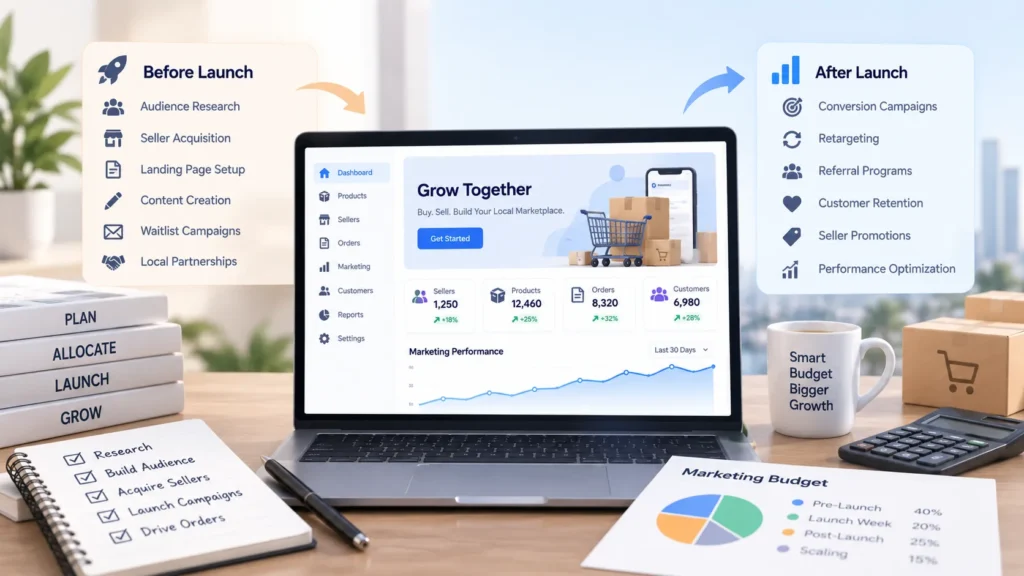
Image Source: AI-generated visual by Miracuves
Budget allocation depends on how ready the marketplace is.
If the platform is not live yet, most of the budget should go toward audience research, seller acquisition, landing page setup, content creation, waitlist campaigns, launch assets, and local partnerships.
If the platform is already live, more budget can shift toward conversion campaigns, retargeting, referral programs, customer retention, seller promotions, and performance optimization.
A simple early-stage allocation can look like this:
| Stage | Suggested Budget Focus | Why It Matters |
|---|---|---|
| Pre-launch | Seller acquisition, landing page, organic content, waitlist, local awareness | Builds supply, demand, and launch readiness |
| Launch week | First-order campaigns, category promotions, influencer/community push, email activation | Turns early attention into transactions |
| Post-launch | Retargeting, retention, referral, reviews, seller campaigns, analytics | Improves repeat orders and growth efficiency |
| Scaling stage | Paid acquisition, category expansion, loyalty, regional partnerships | Expands what is already working |
Founders should avoid spending aggressively before the marketplace has enough catalogue depth, vendor readiness, and fulfilment clarity. The goal is not to look busy. The goal is to make each campaign more likely to convert.
What Should Startups Prioritize First?
If the marketplace has not launched, prioritize supply readiness and demand validation.
That means seller outreach, product category selection, regional audience testing, landing page signups, early access campaigns, and trust-building content.
If the marketplace has launched, prioritize activation and retention.
That means first orders, cart recovery, customer reviews, repeat purchase campaigns, referral flows, vendor promotions, and operational improvements based on real data.
The smartest founders do not treat launch day as the finish line. They treat it as the point where marketing changes from assumption-based to behaviour-based.
Miracuves Perspective: Launch Faster, Then Market Smarter
For regional ecommerce founders, the biggest risk is not only building late. It is building slowly, launching quietly, and discovering too late that the market needed different categories, offers, sellers, or delivery coverage.
A ready-made platform approach can help reduce that risk by giving founders a working product foundation faster. Miracuves supports founders with white-label, source-code-owned marketplace solutions that can be configured with branding, admin dashboards, vendor workflows, customer ordering, and delivery operations.
Where relevant, Miracuves’ 6-day solution delivery helps startups focus earlier on market validation, seller acquisition, launch campaigns, and customer retention instead of waiting months for the basic marketplace foundation to be built.
The stronger approach is not to copy a large marketplace blindly. It is to understand the marketplace model, adapt it for a specific region, launch with the right operational controls, and use marketing data to improve after real users start buying.
Related reading: regional e-commerce marketplace growth strategy.
Final Thoughts
Pre-launch marketing prepares the marketplace. Post-launch marketing proves it.
For a regional ecommerce marketplace, both stages matter because founders must build trust on two sides at once. Sellers need confidence that buyers will come. Buyers need confidence that products, delivery, payments, support, and returns will work. Marketing has to connect both sides before launch and then improve the system after real transactions begin.
Before launch, prioritize positioning, seller acquisition, demand validation, landing page signups, and regional trust. After launch, prioritize first orders, retention, reviews, referrals, vendor performance, and campaign optimization.
The winning strategy is not pre-launch versus post-launch. It is pre-launch for readiness and post-launch for repeatability.
Founders who combine both can launch with stronger momentum, learn faster from real users, and build a regional ecommerce marketplace that grows beyond the first announcement.
FAQs
What is pre-launch marketing for a regional ecommerce marketplace?
Pre-launch marketing is the work done before the marketplace goes live to build awareness, collect buyer interest, onboard sellers, validate categories, and prepare launch demand. For a regional ecommerce marketplace, it should focus on local trust, vendor readiness, early access signups, and launch category planning.
What is post-launch marketing for an ecommerce marketplace?
Post-launch marketing starts after the platform is live. It focuses on converting users into buyers, increasing repeat purchases, collecting reviews, running referral campaigns, promoting sellers, improving retention, and using real order data to optimize growth.
Should ecommerce marketplace startups spend more before or after launch?
Startups should spend carefully before launch on validation, seller acquisition, content, landing pages, and local awareness. Bigger spending usually makes more sense after launch, once the platform has enough sellers, products, delivery readiness, and checkout stability.
How early should a regional marketplace start marketing before launch?
A startup should ideally begin pre-launch marketing once the positioning, target region, seller categories, and product foundation are clear. Many founders start outreach and waitlist campaigns 60 to 90 days before launch, but the exact timing depends on seller onboarding, platform readiness, and launch scope.
What should a regional ecommerce marketplace promote first?
A regional ecommerce marketplace should promote the categories that have strong local demand, reliable sellers, reasonable fulfilment, and repeat purchase potential. It is better to launch with fewer strong categories than many weak or poorly supplied categories.
How can sellers help marketplace growth after launch?
Sellers can promote their storefronts, share product links, participate in offers, provide product content, bring existing customers, and support category campaigns. Strong seller participation reduces pressure on the marketplace operator and creates more authentic local reach.
Why do many marketplace launches fail after initial buzz?
Many launches fail because they focus on attention but not readiness. Common issues include weak product availability, poor seller onboarding, unclear delivery promises, checkout problems, lack of trust, discount dependency, and no retention strategy after the first order.
How can Miracuves help regional ecommerce marketplace startups?
Miracuves helps founders launch ready-made, white-label ecommerce marketplace platforms with source-code ownership, branded design, admin control, vendor workflows, customer ordering, and delivery operations. For relevant ready-made solutions, Miracuves can support faster deployment in 6 days, helping founders focus sooner on marketing, validation, and growth.
Miracuves is an independent software development company. We are not affiliated with, connected to, sponsored by, or endorsed by any company or product named in this article.
Terms such as “X Clone” are used descriptively. It is how the software industry refers to building a platform with functionality comparable to a known service, and how clients search for it.
The entire design and codebase of our products is built by our own team. Our products contain no code, design, graphics, or content originating from any third-party website or applications.
All third-party names and marks referenced in this article are the property of their respective owners, referenced solely to identify the services discussed.