






















Key Takeaways
- A regional ecommerce marketplace must connect buyers, sellers, product catalogs, payments, delivery, payouts, disputes, and administration.
- A ready-made platform can accelerate launch and market validation through established marketplace workflows.
- Custom development provides greater flexibility for proprietary operations and complex integrations but requires more time, budget, and testing.
- A modular approach allows founders to launch essential features first and expand the platform using real market feedback.
- The right development approach should balance launch speed, customization, cost, technical control, and operational readiness.
Development Decision Signals
- Choose a ready-made foundation when rapid deployment and early business-model validation are the main priorities.
- Consider custom development for unique seller workflows, pricing systems, fulfillment logic, or enterprise integrations.
- Use a modular strategy when the business needs phased investment and flexibility during market validation.
- Confirm support for local languages, currencies, payment methods, taxes, delivery zones, returns, and refunds.
- Evaluate source-code ownership, white-label control, integration flexibility, admin capabilities, maintenance, and scalability.
Real Insights
- A longer feature list does not guarantee that a marketplace is ready for real-world operations.
- An inexpensive ready-made platform can become restrictive when source-code access and customization options are limited.
- Custom development becomes risky when requirements, operational dependencies, and transaction edge cases remain unclear.
- A modular strategy succeeds only when every phase follows a coherent architecture and long-term product roadmap.
- Miracuves develops ready-made, modular, and custom regional ecommerce marketplaces with seller workflows, payments, delivery management, source-code ownership, and admin controls.
A regional ecommerce marketplace is more complex than a single-brand online store. It connects buyers, sellers, delivery workflows, payment systems, product catalogs, commissions, offers, refunds, and admin controls inside one operating system.
The challenge becomes bigger when the marketplace serves multiple cities, regions, product categories, or local seller groups. Each region may have different delivery expectations, payment habits, language preferences, tax logic, return behavior, and customer support needs.
That is why founders should not begin by asking only, “How much will the app cost?” A better question is:
Which of the available Regional Ecommerce Marketplace Development Options gives us the right balance of speed, control, customization, and operational readiness?
For some businesses, a ready-made marketplace platform is the fastest and most practical path. For others, a custom build or phased modular approach may be more suitable. The right answer depends on launch urgency, product complexity, budget, team size, seller onboarding strategy, and long-term business model.
What Makes a Regional Ecommerce Marketplace Different From a Normal Ecommerce App?
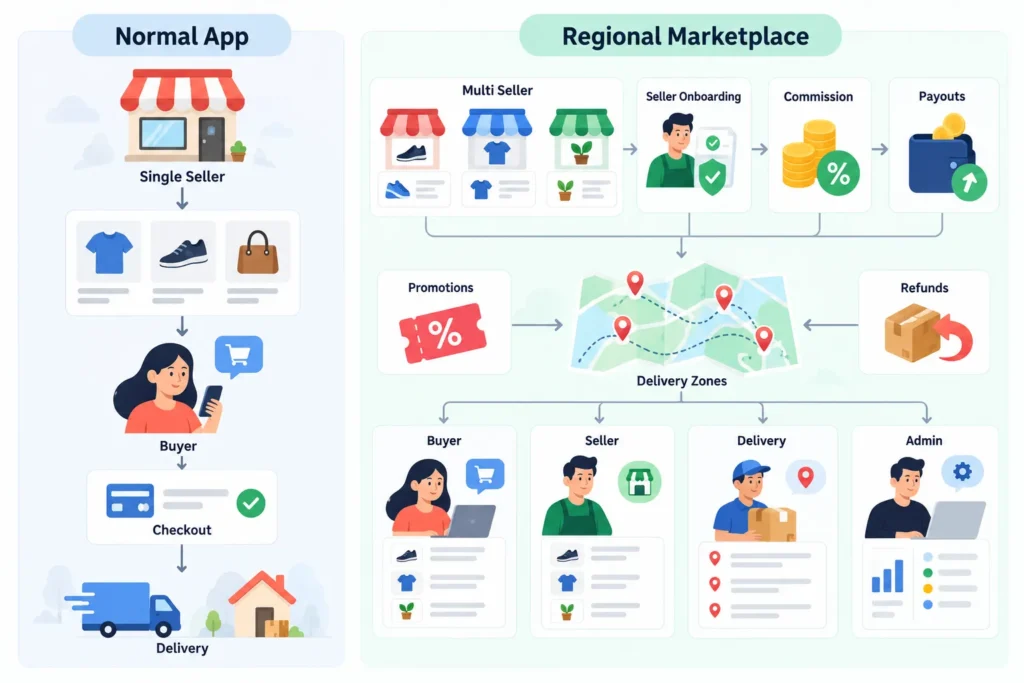
Image Source: AI-generated visual by Miracuves
A normal ecommerce app usually supports one business selling its own products. A regional marketplace has to manage multiple sellers, multiple catalogs, marketplace commissions, order allocation, delivery coverage, payouts, disputes, and buyer trust at scale.
This difference changes the entire product foundation.
A regional marketplace may need:
- Multi-vendor product listing workflows
- Seller onboarding and verification
- Category and brand management
- Product approval and moderation
- Commission rules
- Seller payout tracking
- Delivery zone configuration
- Cash, card, wallet, or local payment support
- Refund and return workflows
- Offer and promotion management
- Buyer, seller, delivery, and admin dashboards
- Order history and activity logs
- Role-based admin access
The founder’s real risk is not launching an app with fewer screens. The bigger risk is launching without the control layer needed to manage sellers, money movement, delivery issues, product quality, and customer complaints.
That is where platform choice matters.
Read More: Regional Ecommerce Marketplace vs Global Marketplace: Which Business Model Fits Startups Better?
The Three Main Development Options for Regional Ecommerce Marketplaces
Founders usually have three practical choices when planning a regional ecommerce marketplace:
- Start with a ready-made marketplace platform
- Build the marketplace fully custom
- Launch through a modular or phased approach
Each option can work, but each serves a different founder situation.
Regional Ecommerce Marketplace Development Options
| Development Option | Best For | Business Advantage | Main Risk |
|---|---|---|---|
| Ready-Made Marketplace Platform | Founders who want faster launch, proven workflows, and lower initial development risk | Shorter deployment cycle, existing marketplace modules, admin control, faster validation | May require customization if the business model is highly unique |
| Custom Marketplace Build | Businesses with complex workflows, enterprise systems, or unique operating logic | Maximum flexibility and deeper product differentiation | Longer timeline, higher cost, more testing, and greater execution risk |
| Modular Marketplace Approach | Founders who want to launch in phases and expand features over time | Better cost control, phased validation, flexible roadmap | Requires strong planning to avoid disconnected modules later |
Option 1: Ready-Made Ecommerce Marketplace Platform
A ready-made ecommerce marketplace platform gives founders a launch-ready product foundation with core workflows already built. Instead of starting from a blank development file, the business starts with existing buyer, seller, admin, catalog, order, payment, and delivery modules.
This approach is useful when the founder’s priority is speed and market validation.
A ready-made marketplace platform can help when:
- You want to enter the market faster
- You need a working seller and buyer flow from the start
- You want admin control without waiting for a long custom build
- You are testing demand in a specific region or category
- You need a cost-efficient first launch
- You want to customize branding, categories, payments, and delivery rules
The biggest advantage is execution speed. A ready-made foundation allows founders to focus on market entry, seller acquisition, product positioning, and operations instead of spending months building basic marketplace infrastructure.
For businesses evaluating a regional ecommerce launch, Miracuves offers a ready-made regional marketplace foundation that can be customized with branding, seller workflows, catalog management, delivery controls, and admin visibility. Where the selected solution scope fits, Miracuves’ 6-day delivery model can help founders move from planning to deployment faster.
When a Ready-Made Platform Makes Sense
A ready-made approach is usually the right fit when your business model follows a proven marketplace pattern.
For example, if your platform needs buyers, sellers, product listings, orders, commissions, delivery tracking, offers, ratings, and admin management, a ready-made base can reduce unnecessary development effort.
You do not need to reinvent the marketplace engine just to validate regional demand. You need a reliable product foundation that can be branded, configured, and improved based on real buyer and seller behavior.
What Founders Should Check Before Choosing Ready-Made Software
Not every ready-made ecommerce platform is equal. Some products only offer basic storefront functionality, while others include marketplace operations, seller logic, and admin control.
Before choosing a ready-made solution, evaluate:
- Does it support multiple sellers?
- Can sellers manage products, prices, and orders?
- Can the admin approve, reject, or moderate listings?
- Does it support regional payment methods?
- Can delivery zones be configured?
- Is there commission management?
- Are refunds, returns, and cancellations included?
- Is the source code available?
- Can the design be white-labeled?
- Can the platform be customized after launch?
The strongest ready-made platforms are not rigid scripts. They are product foundations that allow founders to launch faster while still keeping ownership and customization flexibility.
Option 2: Custom Ecommerce Marketplace Development
Custom ecommerce marketplace development means building the platform from the ground up based on your specific business requirements. This can be a strong choice when the marketplace has unusual workflows, large-scale enterprise dependencies, complex integrations, or proprietary operating logic.
A custom build may be useful when:
- You need deeply unique seller workflows
- You have complex ERP, warehouse, or finance integrations
- Your marketplace model does not follow standard buyer-seller flows
- You need advanced personalization or pricing rules
- Your business has an internal technical team
- You have enough time and budget for discovery, design, development, QA, and iterations
The benefit of custom development is flexibility. You can define every workflow, permission, role, integration, database structure, and user experience around your business.
But the tradeoff is time and execution risk.
A custom marketplace requires product strategy, UI/UX design, architecture planning, backend development, frontend development, mobile app development, integrations, testing, deployment, and post-launch stabilization. If the requirements are not clear from the start, the project can expand quickly.
When Custom Development Is the Better Choice
Custom development makes sense when differentiation depends on the product logic itself.
For example, if your marketplace uses a unique fulfillment system, proprietary seller scoring, complex B2B ordering, advanced inventory routing, or custom pricing intelligence, a ready-made platform may need too much modification.
In that case, custom development can protect long-term flexibility.
However, founders should be realistic. Custom development is not automatically better. It is better only when the business truly needs workflows that existing marketplace foundations cannot support efficiently.
Option 3: Modular Ecommerce Marketplace Development
A modular approach sits between ready-made and fully custom development. Instead of launching every possible feature at once, the founder launches the most important modules first and adds advanced workflows in phases.
This approach is useful when the business has a clear vision but wants to control cost, reduce launch risk, and learn from real users before expanding.
A modular rollout may start with:
- Buyer storefront
- Seller onboarding
- Product catalog
- Cart and checkout
- Order management
- Payment integration
- Admin dashboard
- Basic delivery settings
Later phases may add:
- Loyalty programs
- Advanced seller subscriptions
- AI-powered product recommendations
- Multi-region tax configuration
- Warehouse integrations
- In-app wallet
- Marketing automation
- Advanced analytics
- Seller performance scoring
- Subscription commerce
- B2B ordering workflows
The modular approach works best when the platform roadmap is planned from the beginning. If modules are added randomly, the system can become difficult to maintain. But when modular development is planned correctly, it gives founders a practical balance between speed and customization.
Ready-Made vs Custom vs Modular: Which One Should Founders Choose?
The right development approach depends on your current business stage.
If you are validating a new marketplace idea, ready-made development usually gives you the fastest path to market. If you are building a highly differentiated commerce engine, custom development may be worth the investment. If you want to balance speed with gradual expansion, modular development can be the smartest middle path.
Founder Decision Signals
Speed
Choose a ready-made platform if your biggest priority is launching quickly, testing demand, and onboarding sellers without waiting for a long development cycle.
Cost
Choose a modular or ready-made approach if you want better cost control and do not need every advanced feature on day one.
Scalability
Choose custom or modular development if your roadmap includes complex integrations, large seller networks, or multi-region operational rules.
Market Fit
Choose a phased approach if you still need to validate categories, seller behavior, delivery promises, and buyer retention patterns.
Core Features Every Regional Ecommerce Marketplace Needs
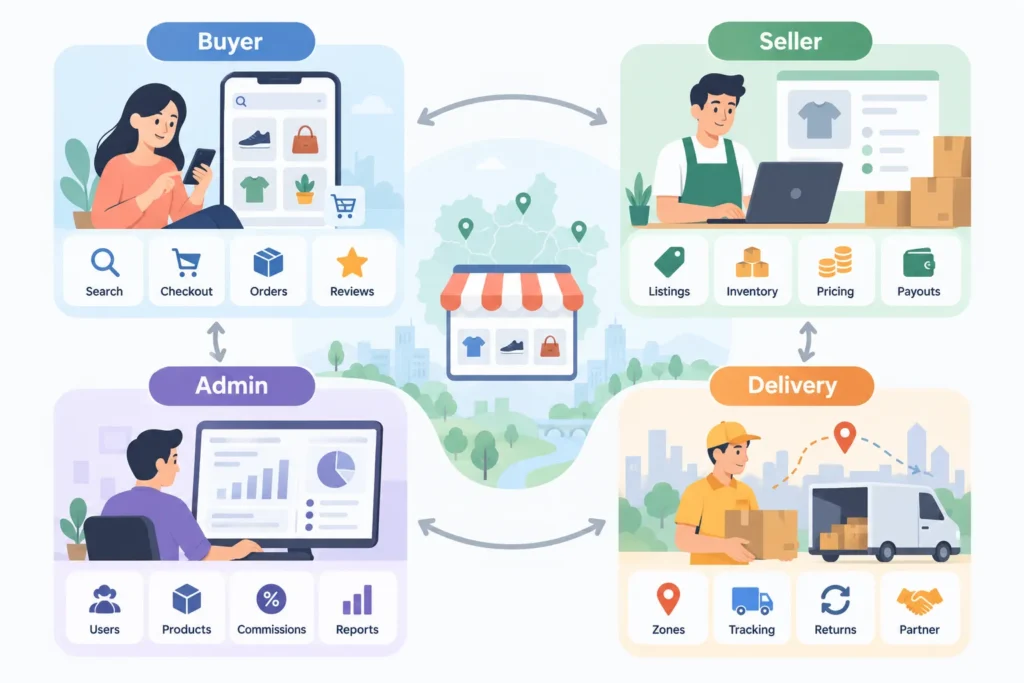
Image Source: AI-generated visual by Miracuves
A regional marketplace must be designed around operations, not just shopping screens. Buyers care about search, pricing, checkout, delivery, and trust. Sellers care about listings, order visibility, payments, and support. The operator needs control over everything.
Buyer App and Web Storefront
The buyer side should make shopping fast, clear, and trustworthy.
Important buyer features include:
- Product search and filters
- Category browsing
- Product details
- Cart and checkout
- Saved addresses
- Multiple payment options
- Order tracking
- Ratings and reviews
- Offers and coupons
- Return and refund requests
- Push notifications
- Customer support access
For regional ecommerce, the buyer experience must also reflect local habits. That may include local language support, regional payment preferences, delivery time expectations, and category-specific browsing behavior.
Seller Panel and Seller App
The seller layer decides whether the marketplace can grow supply efficiently. If seller onboarding is difficult, product quality and catalog depth will suffer.
Important seller features include:
- Seller registration
- Business profile management
- Product upload
- Inventory updates
- Price management
- Order acceptance and processing
- Sales reporting
- Payout visibility
- Promotion participation
- Return and refund handling
- Support ticket management
A strong seller dashboard reduces operational friction. It allows sellers to manage their business without depending on the platform team for every small update.
Admin Dashboard
The admin dashboard is the control center of the marketplace. This is where the platform operator manages users, sellers, products, orders, payments, commissions, disputes, marketing, and reporting.
Important admin features include:
- User management
- Seller approval and moderation
- Product approval
- Category management
- Commission settings
- Payment and payout monitoring
- Order management
- Delivery zone settings
- Coupon and promotion control
- Refund and dispute management
- Reports and analytics
- Role-based staff access
- Activity logs
For a regional marketplace, admin control is not optional. It is what helps the founder adjust business rules, manage seller quality, fix operational issues, and scale without depending on developers for every change.
Delivery and Fulfillment Workflows
Delivery is one of the most important parts of regional ecommerce. A marketplace can have great products and still fail if delivery promises are unreliable.
Useful delivery workflows include:
- Delivery zone configuration
- Shipping fee rules
- Delivery partner assignment
- Order status tracking
- Estimated delivery updates
- Cash collection tracking where relevant
- Failed delivery handling
- Return pickup management
- Delivery partner dashboard
Founders should decide early whether delivery will be seller-managed, platform-managed, third-party integrated, or hybrid. This decision affects cost, user experience, and backend architecture.
Marketplace Monetization Models to Consider
A regional ecommerce marketplace should not rely on only one revenue stream. The platform can combine multiple monetization models depending on category, seller type, buyer demand, and operational maturity.
Common revenue models include:
| Revenue Model | How It Works | Best For |
|---|---|---|
| Commission | The platform earns a percentage from each order | Most multi-vendor marketplaces |
| Seller Subscription | Sellers pay a recurring fee for access or premium tools | B2B sellers, professional merchants, niche marketplaces |
| Featured Listings | Sellers pay to promote products or appear higher in category sections | Competitive product categories |
| Delivery Fees | Buyers or sellers pay for delivery services | Marketplace-controlled fulfillment |
| Advertising | Sellers or brands pay for banner placements, sponsored products, or campaigns | High-traffic marketplaces |
| Membership Plans | Buyers pay for benefits such as faster delivery, discounts, or exclusive offers | Loyalty-driven regional platforms |
| Service Fees | A small platform fee is added during checkout | Convenience-based marketplaces |
The right monetization mix depends on the marketplace’s category strategy. A grocery marketplace may focus on delivery fees and repeat orders, while an electronics marketplace may focus more on commission, protection plans, and seller promotions.
Security, Trust, and Compliance-Ready Workflows
Regional ecommerce platforms handle buyer data, seller records, payments, order history, refunds, and sometimes identity or business documents. That makes security and trust part of the platform foundation.
Important trust and security layers include:
- Encrypted data transfer
- Secure payment gateway integration
- Role-based access control
- Seller verification
- Activity logs
- Refund and dispute workflows
- Order history records
- Admin approval controls
- Fraud monitoring signals
- Review moderation
- Permission-based dashboards
Founders should avoid treating security as an afterthought. Even if the first launch is small, the platform should be structured to support secure payments, transparent records, and controlled admin access.
Final compliance requirements depend on the operating region, payment partners, business model, and legal review. The platform foundation can support compliance-ready workflows, but legal and regulatory validation should always be handled based on the target market.
Cost Factors in Regional Ecommerce Marketplace Development
The cost of developing a regional ecommerce marketplace depends on the selected build approach, feature depth, integrations, design complexity, and operational requirements.
The biggest cost drivers include:
- Buyer app and web storefront
- Seller panel and seller app
- Admin dashboard
- Product catalog structure
- Search and filter logic
- Payment gateway integrations
- Delivery and logistics workflows
- Commission and payout management
- Multi-language or multi-currency support
- Return and refund workflows
- Analytics and reporting
- Custom UI/UX design
- Third-party integrations
- Hosting and deployment setup
- Security and testing scope
A ready-made platform can reduce development effort because the core marketplace foundation is already built. Custom development gives more flexibility but usually requires more planning, engineering, testing, and iteration. Modular development can help control cost by prioritizing the first set of launch-critical features.
Miracuves can help founders compare these paths and identify whether a ready-made, modular, or custom approach is more practical for their business model.
Mistakes Founders Should Avoid
Building Too Many Features Before Validating Demand
A marketplace does not need every advanced feature on day one. Founders should first validate category demand, seller interest, checkout behavior, delivery reliability, and repeat purchase potential.
Ignoring Seller Operations
Many ecommerce projects focus heavily on the buyer app but underbuild the seller panel. If sellers cannot upload products, manage orders, track payouts, or resolve issues easily, marketplace supply will suffer.
Treating the Admin Dashboard as a Basic Backend
The admin dashboard is where the business controls commissions, sellers, orders, disputes, promotions, and reports. Weak admin control creates operational dependency and slows decision-making.
Choosing Custom Development Without Clear Requirements
Custom development can be powerful, but vague requirements can increase cost and timeline. Founders should document workflows, integrations, roles, and launch priorities before committing to a custom build.
How Miracuves Helps Founders Choose the Right Marketplace Build Path
Miracuves helps founders, startups, agencies, and businesses launch ecommerce marketplace platforms with a practical approach to speed, ownership, customization, and admin control.
The right path may be:
- A ready-made white-label marketplace platform for faster launch
- A custom marketplace build for complex workflows
- A modular roadmap that starts lean and expands over time
For ready-made solutions, Miracuves can support faster deployment with a 6-day delivery approach where the selected scope matches the available product foundation. This is especially useful for founders who want to validate regional demand without building every marketplace workflow from zero.
A founder planning a regional marketplace can start with a multi-vendor ecommerce platform foundation and customize it around categories, seller workflows, branding, delivery rules, payment preferences, and admin controls.
The goal is not to copy another marketplace. The goal is to use a proven product structure, adapt it for a specific region, and launch with enough control to operate the business confidently.
Related reading: regional e-commerce marketplace launch mistakes.
Final Thoughts: Choose the Build Path That Matches Your Market Risk
Regional ecommerce marketplace development is not only a technical decision. It is a business decision about speed, control, seller operations, cost, and long-term scalability.
A ready-made platform is useful when you want to launch quickly and validate a proven marketplace model. A custom build is better when your workflows are highly unique and require deep engineering from the start. A modular approach works well when you want to launch with core features first and expand based on real market feedback.
The strongest founders do not choose the most complex development path by default. They choose the path that gives them the right product foundation at the right stage of the business.
Miracuves helps founders make that decision with ready-made, modular, and custom marketplace development support designed for faster execution and practical business control.
FAQs
What is regional ecommerce marketplace development?
Regional ecommerce marketplace development is the process of building a multi-vendor commerce platform for a specific country, region, city network, or local market. It usually includes buyer apps, seller panels, product catalogs, order management, payments, delivery workflows, commissions, and admin control.
Is a ready-made ecommerce marketplace platform better than custom development?
A ready-made platform is better when speed, cost control, and faster validation matter most. Custom development is better when the business requires deeply unique workflows, complex integrations, or proprietary marketplace logic.
What is a modular ecommerce marketplace approach?
A modular approach means launching the marketplace in phases. Founders start with essential features such as buyer shopping, seller onboarding, product catalog, checkout, order management, and admin control, then add advanced modules later.
What features are important in a regional marketplace platform?
Important features include buyer storefront, seller dashboard, admin panel, product catalog, payment integration, delivery zone management, commissions, seller payouts, refunds, returns, reports, notifications, and security controls.
How long does it take to launch a regional ecommerce marketplace?
The timeline depends on the development approach. Ready-made solutions can launch faster when the required scope matches an existing platform foundation. Custom development usually takes longer because the product is built from the ground up.
Why is source-code ownership important for marketplace founders?
Source-code ownership gives founders more control over customization, future development, hosting decisions, integrations, and long-term product independence. It also reduces dependency on restricted or locked software models.
Can a regional ecommerce marketplace support multiple sellers and delivery workflows?
Yes. A well-planned marketplace platform can support multiple sellers, product categories, seller dashboards, order flows, delivery zones, commission settings, payment options, and admin-level operational control.
How can Miracuves help with ecommerce marketplace development?
Miracuves helps founders choose between ready-made, modular, and custom marketplace development. For suitable ready-made scopes, Miracuves supports 6-day delivery with white-label branding, source-code ownership, seller workflows, and admin control.
Miracuves is an independent software development company. We are not affiliated with, connected to, sponsored by, or endorsed by any company or product named in this article.
Terms such as “X Clone” are used descriptively. It is how the software industry refers to building a platform with functionality comparable to a known service, and how clients search for it.
The entire design and codebase of our products is built by our own team. Our products contain no code, design, graphics, or content originating from any third-party website or applications.
All third-party names and marks referenced in this article are the property of their respective owners, referenced solely to identify the services discussed.